FUNCTIONS AND THEORIES
Cell membrane
 Dynamic, fluid structure and forms the external
boundary of the cells
 Selectively permeable
 Regulates the molecular traffic across the
boundaries
 Plants have cell wall whereas animals don’t
 given different specific names based on their lipid
and protein composition such as “sarcolemma” in
myocytes and “oolemma” in oocytes
 The plasma membrane is just 5-10nm wide thus
cannot be detected under the light microscope. It
can only be observed under the Transmission
electron microscope as a trilaminar structure which is
a layer of hydrophobic tails of phospholipids
sandwiched between two layers of hydrophilic
Functions
Functional diversity is due to the variability in lipid and
protein composition of the membranes
1.Diffusion
2. Osmosis
3. Mediated Transport
4. Endocytosis
5. Exocytosis
6. Cell adhesion
7. Cell signaling
Theories
 Overton (1895)
He investigated the osmotic properties of cells
and noticed that the permeation of molecules
through membranes is related to their partition
coefficient between water and oil. He called the
layers surrounding cells “lipoids” made from lipids
and cholesterol.
 Langmuir (1917) and Gorter and Grendel (1925)
Langmuir proposed that in the molecular film the
polar head groups were directed toward the water
whereas the hydrophobic hydrocarbons are
pointed toward the air phase.
Gorter and Grendel (1925) experimentally
investigated the surface area of lipids. For this
purpose they extracted the lipids from red blood cells
of man, dog, rabbit, sheep, guinea pig, and goat in
acetone. The lipids were spread on a water surface
and the area was measured using a Langmuir film
balance. From the same blood preparations they
measured the surface area of the red blood cells from
the microscopic images. They found that the surface
area of the monofilms was within error exactly two
times that of the cells. They concluded that cell
membranes are made of two opposing thin molecular
layers, and they proposed that this double layer is
constructed such that two lipid layers form a bilayer
with the polar head groups pointing toward the
aqueous environment
 Jim Danielli and Hugh Davson thus proposed a model of
the cell membrane consisting of a lipid bilayer, with which
a protein layer is tightly associated
In a theoretical paper they made the following
consideration.
• Proteins are adsorbed to the lipophilic layers surrounding
cells. The proteins possess hydrophobic interiors and a
water-containing outer layer.
• The lipid layer possesses amphiphilic or charged head
groups. This implies that the lipid membrane also
contains some water.
• The water-containing regions of protein layers adsorped
on lipid layers are permeable for charged solutes, e.g.,
ions.
• Divalent cations as calcium form complexes with lipids or
proteins that reduce their interaction with water.
Therefore membranes containing calcium are less
permeable for ions.
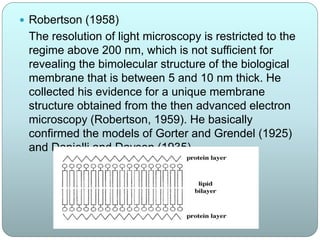
 Robertson (1958)
The resolution of light microscopy is restricted to the
regime above 200 nm, which is not sufficient for
revealing the bimolecular structure of the biological
membrane that is between 5 and 10 nm thick. He
collected his evidence for a unique membrane
structure obtained from the then advanced electron
microscopy (Robertson, 1959). He basically
confirmed the models of Gorter and Grendel (1925)
and Danielli and Davson (1935).
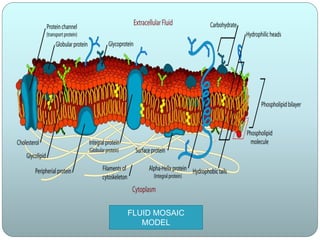
Fluid Mosaic Model of Singer and Nicolson
(1972)
This model can be summarized as follows:
Membranes are constructed from lipids and proteins.
The proteins form mainly two classes. Peripheral
proteins are those proteins that are only loosely
attached to the membrane surface and can easily be
separated from the membrane by mild treatment
(e.g., cytochrome c in mitochondria or spectrin in
erythrocytes). Integral proteins, in contrast, cannot
easily be separated from the lipids. They form the
major fraction of membrane proteins. The structure
forming unit (matrix) is the lipid double layer (bilayer).
Proteins may be either adsorbed to the membrane
surface or span through the membrane
It was postulated that the lipid membranes
of biological cells are in the fluid lipid state
(with exceptions, e.g., the myelin) in which
proteins can freely diffuse.
 The Fluid Quality of Membranes
 Membranes are held together by hydrophobic interactions.
 Most membrane lipids and some proteins can drift laterally within the membrane.
 Molecules rarely flip transversely across the membrane, because hydrophilic parts
would have to cross the membrane's hydrophobic core.
 Phospholipids move quickly along the membrane's plane, averaging 2 um per
second.
 Membrane proteins drift more slowly than lipids. The fact that proteins drift
laterally was established experimentally by fusing a human and mouse cell:
 Membrane proteins of a human and mouse cell were labeled with different green
and red fluorescent dyes.
 Cells were fused to form a hybrid cell with a continuous membrane.
 Hybrid cell membrane had initially distinct regions of green and red dye.
 In less than an hour, the two colors were intermixed.
 Some membrane proteins are tethered to the cytoskeleton and cannot move far.
 Membranes solidify if the temperature decreases to a critical point. Critical
temperature is lower in membranes with a greater concentration of unsaturated
phospholipids.
 Because they hinder close packing of phospholipids, the steroid cholesterol and
unsaturated hydrocarbon tails (with kinks at the carbon-to-carbon double bonds)
enhance membrane fluidity.
 Membranes must be fluid to work properly. Solidification may result in
permeability changes and enzyme deactivation.
 Organisms adapt to cold temperatures by altering membrane lipid composition
(e.g. winter wheat increases concentration of membrane unsaturated
phospholipids and some hibernating animals enrich membranes with
 Membranes as Mosaics of Structure and FunctionA
membrane is a mosaic of different proteins
embedded and dispersed in the phospholipid
bilayer. These proteins vary in both structure and
function, and they occur in two spatial
arrangements:
 Integral proteins which are inserted into the
membrane so their hydrophobic regions are
surrounded by hydrocarbon portions of phospholipids.
They may be:
 unilateral, reaching only part way across the membrane.
 transmembrane, with hydrophobic midsections between
hydrophilic ends exposed on both sides of the membrane.
 Peripheral proteins which are not embedded but
attached to the membrane's surface.
 May be attached to integral proteins.
 Membranes are bifacial.The membrane's synthesis
and modification by the ER and Golgi determines
this asymmetric distribution of lipids, proteins and
carbohydrates:
 Two lipid layers may differ in lipid composition.
 Membrane proteins have distinct directional
orientation.
 When present, carbohydrates are restricted to the
membrane's orientation.
 Side of the membrane facing the lumen of the ER,
Golgi and vesicles is topologically the same as the
plasma membrane's outside face.
 Side of the membrane facing the cytoplasm has always faced
the cytoplasm, form the time of its formation by the
endomembrane system to its addition to the plasma membrane
by the fusion of a vesicle.
 Membrane Carbohydrates and Cell-Cell
RecognitionCell-cell recognition = The ability of a cell to
determine if other cells it encounters are alike or different
from itself.
 Cell-cell recognition is crucial in the functioning of an
organism. It is the basis for:
 Sorting of an animal embryo's cells into tissues and organs.
 Rejection of foreign cells by the immune system.
 The way cells recognize other cells is probably by keying
on cell markers found on the external surface of the cell
membrane. Because of their diversity and location, likely
candidates for such cell markers are membrane
carbohydrates:
 Usually branched oligosaccharides.
 Some covalently bonded to lipids (glycolipids).
 Most covalently bonded to proteins (glycoproteins).
 Vary from species to species, between individuals of the
same species and among cells in the same individual.
FLUID MOSAIC
MODEL

Cell membrane

  • 1.
  • 2.
     Dynamic, fluidstructure and forms the external boundary of the cells  Selectively permeable  Regulates the molecular traffic across the boundaries  Plants have cell wall whereas animals don’t  given different specific names based on their lipid and protein composition such as “sarcolemma” in myocytes and “oolemma” in oocytes  The plasma membrane is just 5-10nm wide thus cannot be detected under the light microscope. It can only be observed under the Transmission electron microscope as a trilaminar structure which is a layer of hydrophobic tails of phospholipids sandwiched between two layers of hydrophilic
  • 3.
    Functions Functional diversity isdue to the variability in lipid and protein composition of the membranes 1.Diffusion 2. Osmosis 3. Mediated Transport 4. Endocytosis 5. Exocytosis 6. Cell adhesion 7. Cell signaling
  • 4.
    Theories  Overton (1895) Heinvestigated the osmotic properties of cells and noticed that the permeation of molecules through membranes is related to their partition coefficient between water and oil. He called the layers surrounding cells “lipoids” made from lipids and cholesterol.  Langmuir (1917) and Gorter and Grendel (1925) Langmuir proposed that in the molecular film the polar head groups were directed toward the water whereas the hydrophobic hydrocarbons are pointed toward the air phase.
  • 5.
    Gorter and Grendel(1925) experimentally investigated the surface area of lipids. For this purpose they extracted the lipids from red blood cells of man, dog, rabbit, sheep, guinea pig, and goat in acetone. The lipids were spread on a water surface and the area was measured using a Langmuir film balance. From the same blood preparations they measured the surface area of the red blood cells from the microscopic images. They found that the surface area of the monofilms was within error exactly two times that of the cells. They concluded that cell membranes are made of two opposing thin molecular layers, and they proposed that this double layer is constructed such that two lipid layers form a bilayer with the polar head groups pointing toward the aqueous environment
  • 6.
     Jim Danielliand Hugh Davson thus proposed a model of the cell membrane consisting of a lipid bilayer, with which a protein layer is tightly associated In a theoretical paper they made the following consideration. • Proteins are adsorbed to the lipophilic layers surrounding cells. The proteins possess hydrophobic interiors and a water-containing outer layer. • The lipid layer possesses amphiphilic or charged head groups. This implies that the lipid membrane also contains some water. • The water-containing regions of protein layers adsorped on lipid layers are permeable for charged solutes, e.g., ions. • Divalent cations as calcium form complexes with lipids or proteins that reduce their interaction with water. Therefore membranes containing calcium are less permeable for ions.
  • 7.
     Robertson (1958) Theresolution of light microscopy is restricted to the regime above 200 nm, which is not sufficient for revealing the bimolecular structure of the biological membrane that is between 5 and 10 nm thick. He collected his evidence for a unique membrane structure obtained from the then advanced electron microscopy (Robertson, 1959). He basically confirmed the models of Gorter and Grendel (1925) and Danielli and Davson (1935).
  • 8.
    Fluid Mosaic Modelof Singer and Nicolson (1972) This model can be summarized as follows: Membranes are constructed from lipids and proteins. The proteins form mainly two classes. Peripheral proteins are those proteins that are only loosely attached to the membrane surface and can easily be separated from the membrane by mild treatment (e.g., cytochrome c in mitochondria or spectrin in erythrocytes). Integral proteins, in contrast, cannot easily be separated from the lipids. They form the major fraction of membrane proteins. The structure forming unit (matrix) is the lipid double layer (bilayer). Proteins may be either adsorbed to the membrane surface or span through the membrane It was postulated that the lipid membranes of biological cells are in the fluid lipid state (with exceptions, e.g., the myelin) in which proteins can freely diffuse.
  • 9.
     The FluidQuality of Membranes  Membranes are held together by hydrophobic interactions.  Most membrane lipids and some proteins can drift laterally within the membrane.  Molecules rarely flip transversely across the membrane, because hydrophilic parts would have to cross the membrane's hydrophobic core.  Phospholipids move quickly along the membrane's plane, averaging 2 um per second.  Membrane proteins drift more slowly than lipids. The fact that proteins drift laterally was established experimentally by fusing a human and mouse cell:  Membrane proteins of a human and mouse cell were labeled with different green and red fluorescent dyes.  Cells were fused to form a hybrid cell with a continuous membrane.  Hybrid cell membrane had initially distinct regions of green and red dye.  In less than an hour, the two colors were intermixed.  Some membrane proteins are tethered to the cytoskeleton and cannot move far.  Membranes solidify if the temperature decreases to a critical point. Critical temperature is lower in membranes with a greater concentration of unsaturated phospholipids.  Because they hinder close packing of phospholipids, the steroid cholesterol and unsaturated hydrocarbon tails (with kinks at the carbon-to-carbon double bonds) enhance membrane fluidity.  Membranes must be fluid to work properly. Solidification may result in permeability changes and enzyme deactivation.  Organisms adapt to cold temperatures by altering membrane lipid composition (e.g. winter wheat increases concentration of membrane unsaturated phospholipids and some hibernating animals enrich membranes with
  • 10.
     Membranes asMosaics of Structure and FunctionA membrane is a mosaic of different proteins embedded and dispersed in the phospholipid bilayer. These proteins vary in both structure and function, and they occur in two spatial arrangements:  Integral proteins which are inserted into the membrane so their hydrophobic regions are surrounded by hydrocarbon portions of phospholipids. They may be:  unilateral, reaching only part way across the membrane.  transmembrane, with hydrophobic midsections between hydrophilic ends exposed on both sides of the membrane.  Peripheral proteins which are not embedded but attached to the membrane's surface.  May be attached to integral proteins.
  • 11.
     Membranes arebifacial.The membrane's synthesis and modification by the ER and Golgi determines this asymmetric distribution of lipids, proteins and carbohydrates:  Two lipid layers may differ in lipid composition.  Membrane proteins have distinct directional orientation.  When present, carbohydrates are restricted to the membrane's orientation.  Side of the membrane facing the lumen of the ER, Golgi and vesicles is topologically the same as the plasma membrane's outside face.  Side of the membrane facing the cytoplasm has always faced the cytoplasm, form the time of its formation by the endomembrane system to its addition to the plasma membrane by the fusion of a vesicle.
  • 12.
     Membrane Carbohydratesand Cell-Cell RecognitionCell-cell recognition = The ability of a cell to determine if other cells it encounters are alike or different from itself.  Cell-cell recognition is crucial in the functioning of an organism. It is the basis for:  Sorting of an animal embryo's cells into tissues and organs.  Rejection of foreign cells by the immune system.  The way cells recognize other cells is probably by keying on cell markers found on the external surface of the cell membrane. Because of their diversity and location, likely candidates for such cell markers are membrane carbohydrates:  Usually branched oligosaccharides.  Some covalently bonded to lipids (glycolipids).  Most covalently bonded to proteins (glycoproteins).  Vary from species to species, between individuals of the same species and among cells in the same individual.
  • 13.