Lipids, Membranes &
the First Cells
Chapter 6
Evolution of the Membrane
 The evolution of the plasma membrane was a
momentous event because it separated life
from non-life
 Before the cell RNA molecules clung to clay
particles, building copies as nucleotides
washed over them randomly
Lipid Membrane
 The formation of the membrane performed
three important tasks
 Separated the chemical composition of the inside
from the chemical composition of the outside
 Chemical reactions became more efficient as
reactants could collide more frequently
 Membrane could form a collective barrier
Lipid Formation
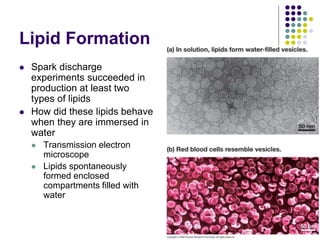
 Spark discharge
experiments succeeded in
production at least two
types of lipids
 How did these lipids behave
when they are immersed in
water
 Transmission electron
microscope
 Lipids spontaneously
formed enclosed
compartments filled with
water
What Characterizes
a Lipid
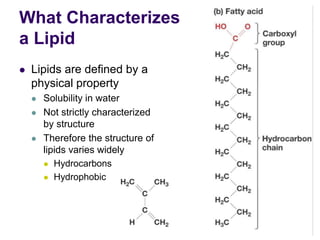
 Lipids are defined by a
physical property
 Solubility in water
 Not strictly characterized
by structure
 Therefore the structure of
lipids varies widely
 Hydrocarbons
 Hydrophobic
Lipids Found In Cells
 There are three types of lipids found in cells
 Lipids for energy storage
 Triacylglycerols
 Lipids for cell membranes
 Phospholipids
 Lipids for steroids
 Cholesterol, estrogen, & testosterone
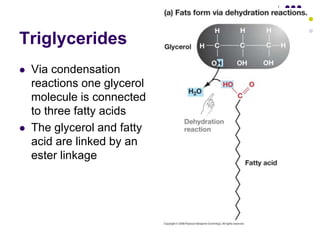
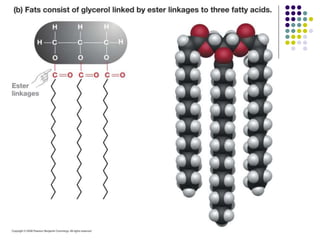
Triglycerides
 Via condensation
reactions one glycerol
molecule is connected
to three fatty acids
 The glycerol and fatty
acid are linked by an
ester linkage
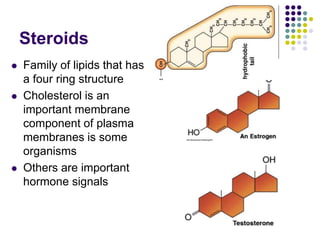
Steroids
 Family of lipids that has
a four ring structure
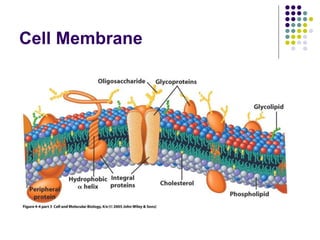
 Cholesterol is an
important membrane
component of plasma
membranes is some
organisms
 Others are important
hormone signals
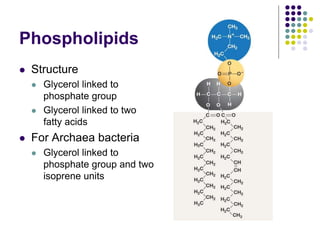
Phospholipids
 Structure
 Glycerol linked to
phosphate group
 Glycerol linked to two
fatty acids
 For Archaea bacteria
 Glycerol linked to
phosphate group and two
isoprene units
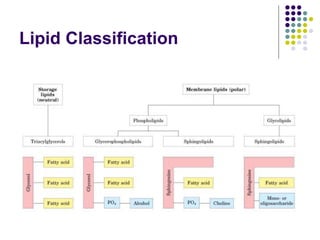
Lipid Classification
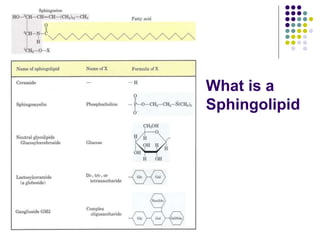
What is a
Sphingolipid
Lipids & Disease
 Membrane lipids undergo constant metabolic
turnover
 Breakdown is performed by hydrolytic enzymes in
lysosomes
 Impaired degradation by a defect enzyme leads to
the accumulation of partial breakdown products
 Brain, liver & spleen
 Genetic basis for Niemann-Pick disease and Tay-
Sachs disease
 Metal retardation, paralysis, blindness, early death
Lipids in Membranes
 In order to spontaneously form a lipid bilayer
lipid must have
 Charges and polar bonds in the head region to
interact with water
 Long fatty acid tails to interact with each other
 Amphipathic
Lipid Bilayer
Formation & Energy
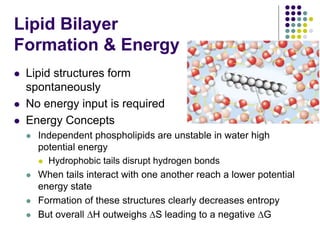
 Lipid structures form
spontaneously
 No energy input is required
 Energy Concepts
 Independent phospholipids are unstable in water high
potential energy
 Hydrophobic tails disrupt hydrogen bonds
 When tails interact with one another reach a lower potential
energy state
 Formation of these structures clearly decreases entropy
 But overall ∆H outweighs ∆S leading to a negative ∆G
What Will
Form
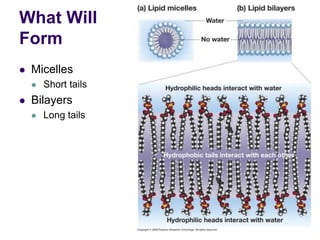
 Micelles
 Short tails
 Bilayers
 Long tails
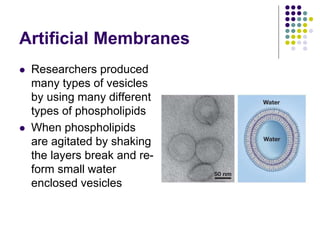
Artificial Membranes
 Researchers produced
many types of vesicles
by using many different
types of phospholipids
 When phospholipids
are agitated by shaking
the layers break and re-
form small water
enclosed vesicles
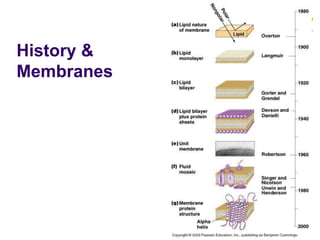
Evolution of Membrane Models
 Today cell membranes are characterized by
what is known as a fluid mosaic model
 Over 100 years of research was performed
before this model
 Historical Perspectives
History &
Membranes
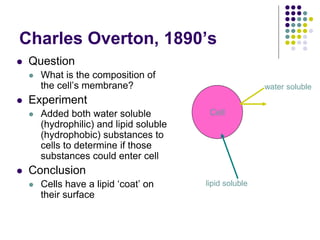
Cell
water soluble
lipid soluble
Charles Overton, 1890’s
 Question
 What is the composition of
the cell’s membrane?
 Experiment
 Added both water soluble
(hydrophilic) and lipid soluble
(hydrophobic) substances to
cells to determine if those
substances could enter cell
 Conclusion
 Cells have a lipid ‘coat’ on
their surface
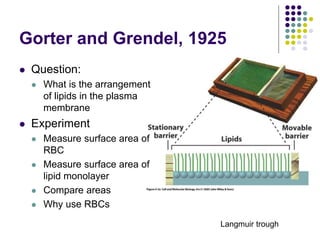
Gorter and Grendel, 1925
Langmuir trough
 Question:
 What is the arrangement
of lipids in the plasma
membrane
 Experiment
 Measure surface area of
RBC
 Measure surface area of
lipid monolayer
 Compare areas
 Why use RBCs
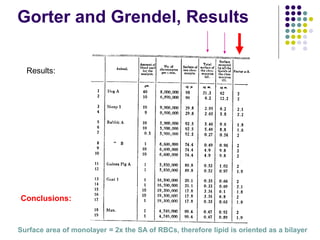
Gorter and Grendel, Results
Results:
Surface area of monolayer = 2x the SA of RBCs, therefore lipid is oriented as a bilayer
Conclusions:
Gorter and Grendel,
Conclusion
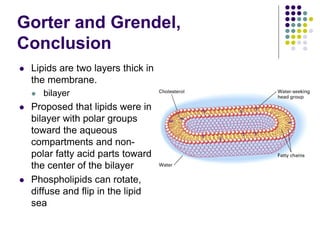
 Lipids are two layers thick in
the membrane.
 bilayer
 Proposed that lipids were in
bilayer with polar groups
toward the aqueous
compartments and non-
polar fatty acid parts toward
the center of the bilayer
 Phospholipids can rotate,
diffuse and flip in the lipid
sea
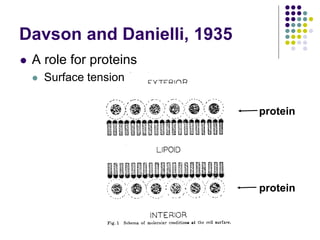
protein
protein
Davson and Danielli, 1935
 A role for proteins
 Surface tension
Davson and Danielli
 1st model
 Evidence
 surface tension of oil droplets is high
 surface tension of cell membranes is low
 using starfish eggs
 Surface tension of oil droplets coated with protein
is low
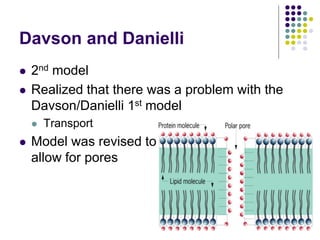
Davson and Danielli
 2nd model
 Realized that there was a problem with the
Davson/Danielli 1st model
 Transport
 Model was revised to
allow for pores
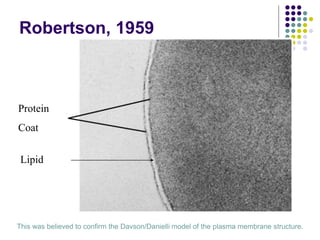
Protein
Coat
Lipid
This was believed to confirm the Davson/Danielli model of the plasma membrane structure.
Robertson, 1959
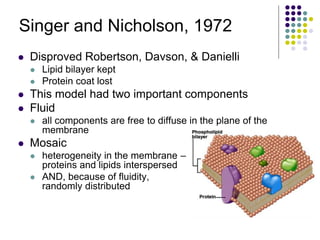
Singer and Nicholson, 1972
 Disproved Robertson, Davson, & Danielli
 Lipid bilayer kept
 Protein coat lost
 This model had two important components
 Fluid
 all components are free to diffuse in the plane of the
membrane
 Mosaic
 heterogeneity in the membrane –
proteins and lipids interspersed
 AND, because of fluidity,
randomly distributed
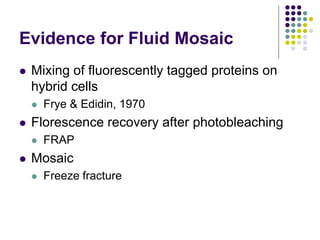
Evidence for Fluid Mosaic
 Mixing of fluorescently tagged proteins on
hybrid cells
 Frye & Edidin, 1970
 Florescence recovery after photobleaching
 FRAP
 Mosaic
 Freeze fracture
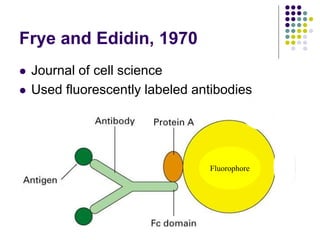
Frye and Edidin, 1970
 Journal of cell science
 Used fluorescently labeled antibodies
Fluorophore
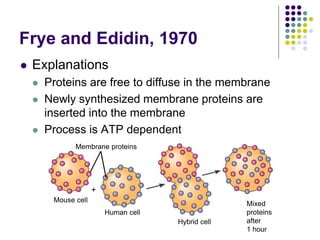
Membrane proteins
Mouse cell
Human cell
Hybrid cell
Mixed
proteins
after
1 hour
+
Frye and Edidin, 1970
 Explanations
 Proteins are free to diffuse in the membrane
 Newly synthesized membrane proteins are
inserted into the membrane
 Process is ATP dependent
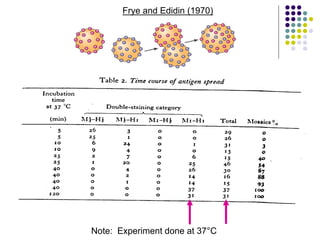
Note: Experiment done at 37°C
Frye and Edidin (1970)
Frye and Edidin, 1970
 Is protein synthesis of new membrane
proteins responsible for intermixing
 Add protein synthesis inhibitor cyclohexamide
 Mixing still occurred
 Is intermixing an ATP dependent process
 Block ATP production with DNP, cyanide
 Mixing still occurred
 Conclusion
 Mixing is due to fluidity
(fusing)
virus
Mouse
cell
(a)
Incubation temperature (ºC)
Mosaics (%)
0
+
+
+
+
+
+
+
+
50
100
5 15 25 35
+
+
+
+
(c)
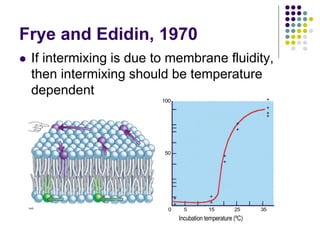
Frye and Edidin, 1970
 If intermixing is due to membrane fluidity,
then intermixing should be temperature
dependent
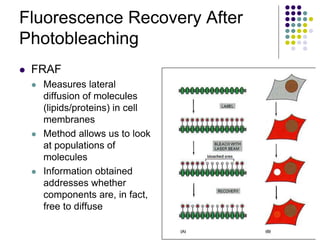
Fluorescence Recovery After
Photobleaching
 FRAF
 Measures lateral
diffusion of molecules
(lipids/proteins) in cell
membranes
 Method allows us to look
at populations of
molecules
 Information obtained
addresses whether
components are, in fact,
free to diffuse
3
2
1
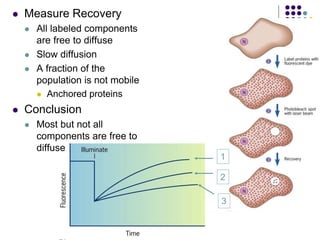
 Measure Recovery
 All labeled components
are free to diffuse
 Slow diffusion
 A fraction of the
population is not mobile
 Anchored proteins
 Conclusion
 Most but not all
components are free to
diffuse
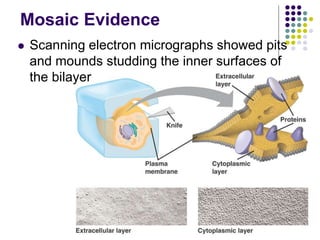
Mosaic Evidence
 Scanning electron micrographs showed pits
and mounds studding the inner surfaces of
the bilayer
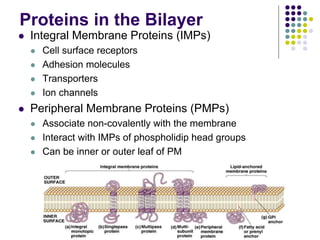
Proteins in the Bilayer
 Integral Membrane Proteins (IMPs)
 Cell surface receptors
 Adhesion molecules
 Transporters
 Ion channels
 Peripheral Membrane Proteins (PMPs)
 Associate non-covalently with the membrane
 Interact with IMPs of phospholidip head groups
 Can be inner or outer leaf of PM
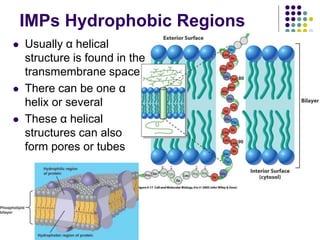
IMPs Hydrophobic Regions
 Usually α helical
structure is found in the
transmembrane space
 There can be one α
helix or several
 These α helical
structures can also
form pores or tubes
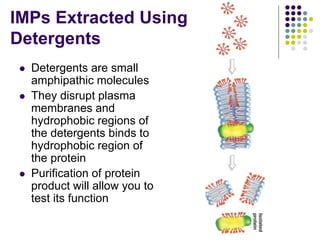
IMPs Extracted Using
Detergents
 Detergents are small
amphipathic molecules
 They disrupt plasma
membranes and
hydrophobic regions of
the detergents binds to
hydrophobic region of
the protein
 Purification of protein
product will allow you to
test its function
Glycosylation of Proteins
 Never occurs on cytoplasmic proteins
 Uses specific enzymes of ER and golgi
 Two types
 N-linked = carbohydrates are attached to
asparigine (terminal amino group) synthesis of
CHO side chain begins in ER and is completed in
Golgi
 O-linked = carbohydrates are attached to serine
or threonine (hydroxyl groups) synthesis of CHO
side chain begins and ends in Golgi
 For review of the function see chapter 5 notes
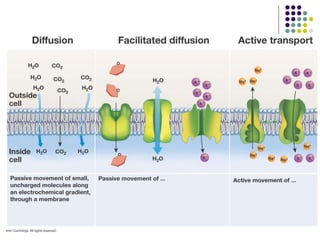
Transport Proteins
 Facilitated Diffusion
 Requires no ATP moves with a concentration gradient
 Channels
 Ion channels
 Ions move according to an electrochemical gradient
 Usually specific to one type of ion
 Aquaporins
 Transporters
 Glucose transporter
 Changes shape
 Active Transport
 Requires ATP moves against concentration gradient
 Ion pumps
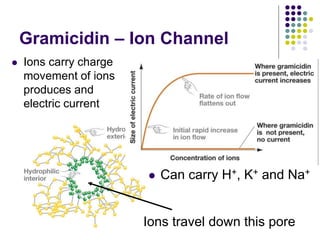
Gramicidin – Ion Channel
 Ions carry charge
movement of ions
produces and
electric current
 Can carry H+, K+ and Na+
Ions travel down this pore
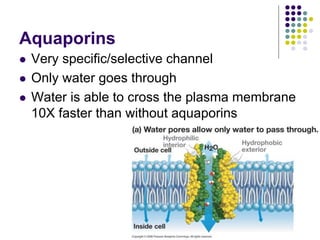
Aquaporins
 Very specific/selective channel
 Only water goes through
 Water is able to cross the plasma membrane
10X faster than without aquaporins
Gated Channels
 Aquaporins and ion channels are gated
 Open or close in response to signal
 Voltage gated channels
 Open in response to depolarization of membrane
 Ligand gated channels
 Open in response to a chemical signal
 Remember no energy is needed for transport
 Powered by diffusion along an
electrochemical gradient
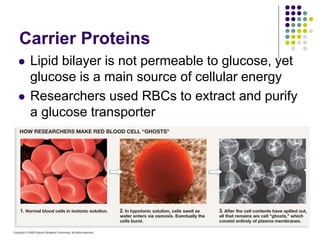
Carrier Proteins
 Lipid bilayer is not permeable to glucose, yet
glucose is a main source of cellular energy
 Researchers used RBCs to extract and purify
a glucose transporter
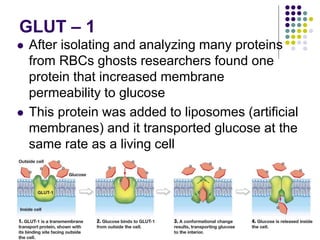
GLUT – 1
 After isolating and analyzing many proteins
from RBCs ghosts researchers found one
protein that increased membrane
permeability to glucose
 This protein was added to liposomes (artificial
membranes) and it transported glucose at the
same rate as a living cell
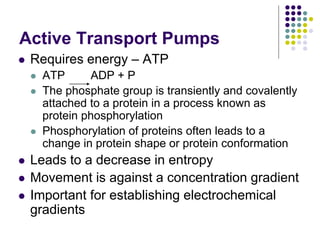
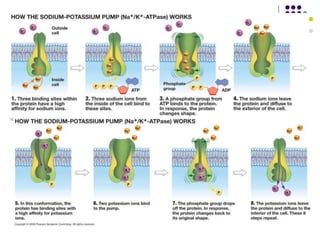
Active Transport Pumps
 Requires energy – ATP
 ATP ADP + P
 The phosphate group is transiently and covalently
attached to a protein in a process known as
protein phosphorylation
 Phosphorylation of proteins often leads to a
change in protein shape or protein conformation
 Leads to a decrease in entropy
 Movement is against a concentration gradient
 Important for establishing electrochemical
gradients
Cell Membrane
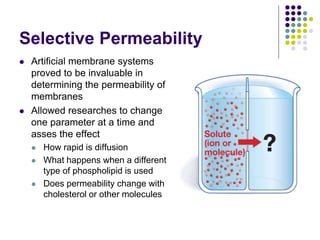
Selective Permeability
 Artificial membrane systems
proved to be invaluable in
determining the permeability of
membranes
 Allowed researches to change
one parameter at a time and
asses the effect
 How rapid is diffusion
 What happens when a different
type of phospholipid is used
 Does permeability change with
cholesterol or other molecules
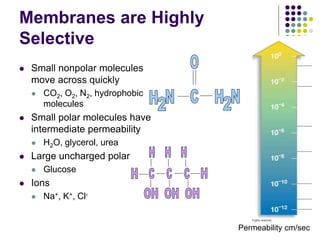
Membranes are Highly
Selective
 Small nonpolar molecules
move across quickly
 CO2, O2, N2, hydrophobic
molecules
 Small polar molecules have
intermediate permeability
 H2O, glycerol, urea
 Large uncharged polar
 Glucose
 Ions
 Na+, K+, Cl-
Permeability cm/sec
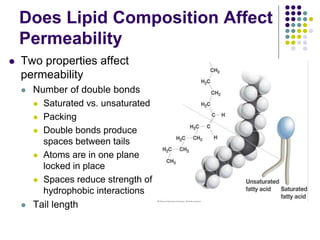
Does Lipid Composition Affect
Permeability
 Two properties affect
permeability
 Number of double bonds
 Saturated vs. unsaturated
 Packing
 Double bonds produce
spaces between tails
 Atoms are in one plane
locked in place
 Spaces reduce strength of
hydrophobic interactions
 Tail length
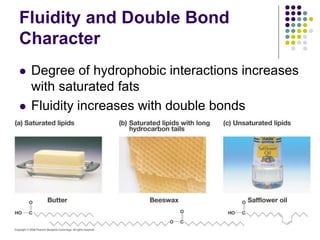
Fluidity and Double Bond
Character
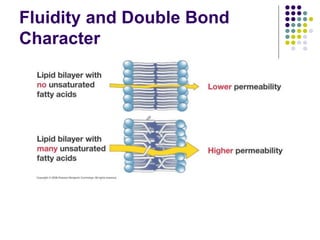
 Degree of hydrophobic interactions increases
with saturated fats
 Fluidity increases with double bonds
Fluidity and Double Bond
Character
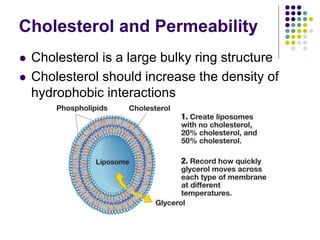
Cholesterol and Permeability
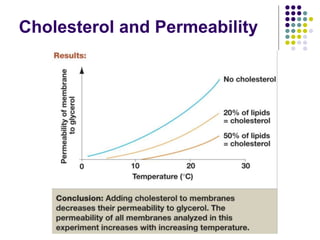
 Cholesterol is a large bulky ring structure
 Cholesterol should increase the density of
hydrophobic interactions
Cholesterol and Permeability
Diffusion
 Diffusion is a process which occurs
spontaneously due to an increase in entropy
 Diffusion occurs from an area of high
concentration to an area of low concentration
 Diffusion across a plasma membrane
Osmosis
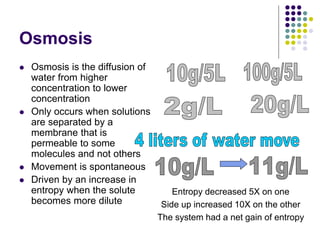
 Osmosis is the diffusion of
water from higher
concentration to lower
concentration
 Only occurs when solutions
are separated by a
membrane that is
permeable to some
molecules and not others
 Movement is spontaneous
 Driven by an increase in
entropy when the solute
becomes more dilute
Entropy decreased 5X on one
Side up increased 10X on the other
The system had a net gain of entropy
Osmosis
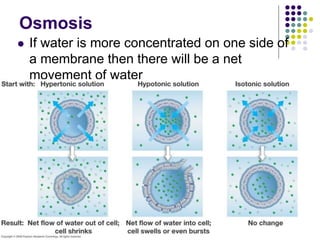
 If water is more concentrated on one side of
a membrane then there will be a net
movement of water
Osmosis & Diffusion
 Osmosis and diffusion reduce differences in
chemical composition between the inside and
outside of membrane bound vesicles
 Therefore, it is unlikely that interiors differed
radically from the external environment
 Lipid bilayers become capable of creating a
specialized internal environment due to
specialized protein transporters

2-12-2012-2.ppt

  • 1.
    Lipids, Membranes & theFirst Cells Chapter 6
  • 2.
    Evolution of theMembrane  The evolution of the plasma membrane was a momentous event because it separated life from non-life  Before the cell RNA molecules clung to clay particles, building copies as nucleotides washed over them randomly
  • 3.
    Lipid Membrane  Theformation of the membrane performed three important tasks  Separated the chemical composition of the inside from the chemical composition of the outside  Chemical reactions became more efficient as reactants could collide more frequently  Membrane could form a collective barrier
  • 4.
    Lipid Formation  Sparkdischarge experiments succeeded in production at least two types of lipids  How did these lipids behave when they are immersed in water  Transmission electron microscope  Lipids spontaneously formed enclosed compartments filled with water
  • 5.
    What Characterizes a Lipid Lipids are defined by a physical property  Solubility in water  Not strictly characterized by structure  Therefore the structure of lipids varies widely  Hydrocarbons  Hydrophobic
  • 6.
    Lipids Found InCells  There are three types of lipids found in cells  Lipids for energy storage  Triacylglycerols  Lipids for cell membranes  Phospholipids  Lipids for steroids  Cholesterol, estrogen, & testosterone
  • 7.
    Triglycerides  Via condensation reactionsone glycerol molecule is connected to three fatty acids  The glycerol and fatty acid are linked by an ester linkage
  • 9.
    Steroids  Family oflipids that has a four ring structure  Cholesterol is an important membrane component of plasma membranes is some organisms  Others are important hormone signals
  • 10.
    Phospholipids  Structure  Glycerollinked to phosphate group  Glycerol linked to two fatty acids  For Archaea bacteria  Glycerol linked to phosphate group and two isoprene units
  • 11.
  • 12.
  • 13.
    Lipids & Disease Membrane lipids undergo constant metabolic turnover  Breakdown is performed by hydrolytic enzymes in lysosomes  Impaired degradation by a defect enzyme leads to the accumulation of partial breakdown products  Brain, liver & spleen  Genetic basis for Niemann-Pick disease and Tay- Sachs disease  Metal retardation, paralysis, blindness, early death
  • 14.
    Lipids in Membranes In order to spontaneously form a lipid bilayer lipid must have  Charges and polar bonds in the head region to interact with water  Long fatty acid tails to interact with each other  Amphipathic
  • 15.
    Lipid Bilayer Formation &Energy  Lipid structures form spontaneously  No energy input is required  Energy Concepts  Independent phospholipids are unstable in water high potential energy  Hydrophobic tails disrupt hydrogen bonds  When tails interact with one another reach a lower potential energy state  Formation of these structures clearly decreases entropy  But overall ∆H outweighs ∆S leading to a negative ∆G
  • 16.
    What Will Form  Micelles Short tails  Bilayers  Long tails
  • 17.
    Artificial Membranes  Researchersproduced many types of vesicles by using many different types of phospholipids  When phospholipids are agitated by shaking the layers break and re- form small water enclosed vesicles
  • 18.
    Evolution of MembraneModels  Today cell membranes are characterized by what is known as a fluid mosaic model  Over 100 years of research was performed before this model  Historical Perspectives
  • 19.
  • 20.
    Cell water soluble lipid soluble CharlesOverton, 1890’s  Question  What is the composition of the cell’s membrane?  Experiment  Added both water soluble (hydrophilic) and lipid soluble (hydrophobic) substances to cells to determine if those substances could enter cell  Conclusion  Cells have a lipid ‘coat’ on their surface
  • 21.
    Gorter and Grendel,1925 Langmuir trough  Question:  What is the arrangement of lipids in the plasma membrane  Experiment  Measure surface area of RBC  Measure surface area of lipid monolayer  Compare areas  Why use RBCs
  • 22.
    Gorter and Grendel,Results Results: Surface area of monolayer = 2x the SA of RBCs, therefore lipid is oriented as a bilayer Conclusions:
  • 23.
    Gorter and Grendel, Conclusion Lipids are two layers thick in the membrane.  bilayer  Proposed that lipids were in bilayer with polar groups toward the aqueous compartments and non- polar fatty acid parts toward the center of the bilayer  Phospholipids can rotate, diffuse and flip in the lipid sea
  • 24.
    protein protein Davson and Danielli,1935  A role for proteins  Surface tension
  • 25.
    Davson and Danielli 1st model  Evidence  surface tension of oil droplets is high  surface tension of cell membranes is low  using starfish eggs  Surface tension of oil droplets coated with protein is low
  • 26.
    Davson and Danielli 2nd model  Realized that there was a problem with the Davson/Danielli 1st model  Transport  Model was revised to allow for pores
  • 27.
    Protein Coat Lipid This was believedto confirm the Davson/Danielli model of the plasma membrane structure. Robertson, 1959
  • 28.
    Singer and Nicholson,1972  Disproved Robertson, Davson, & Danielli  Lipid bilayer kept  Protein coat lost  This model had two important components  Fluid  all components are free to diffuse in the plane of the membrane  Mosaic  heterogeneity in the membrane – proteins and lipids interspersed  AND, because of fluidity, randomly distributed
  • 29.
    Evidence for FluidMosaic  Mixing of fluorescently tagged proteins on hybrid cells  Frye & Edidin, 1970  Florescence recovery after photobleaching  FRAP  Mosaic  Freeze fracture
  • 30.
    Frye and Edidin,1970  Journal of cell science  Used fluorescently labeled antibodies Fluorophore
  • 31.
    Membrane proteins Mouse cell Humancell Hybrid cell Mixed proteins after 1 hour + Frye and Edidin, 1970  Explanations  Proteins are free to diffuse in the membrane  Newly synthesized membrane proteins are inserted into the membrane  Process is ATP dependent
  • 32.
    Note: Experiment doneat 37°C Frye and Edidin (1970)
  • 33.
    Frye and Edidin,1970  Is protein synthesis of new membrane proteins responsible for intermixing  Add protein synthesis inhibitor cyclohexamide  Mixing still occurred  Is intermixing an ATP dependent process  Block ATP production with DNP, cyanide  Mixing still occurred  Conclusion  Mixing is due to fluidity
  • 34.
    (fusing) virus Mouse cell (a) Incubation temperature (ºC) Mosaics(%) 0 + + + + + + + + 50 100 5 15 25 35 + + + + (c) Frye and Edidin, 1970  If intermixing is due to membrane fluidity, then intermixing should be temperature dependent
  • 35.
    Fluorescence Recovery After Photobleaching FRAF  Measures lateral diffusion of molecules (lipids/proteins) in cell membranes  Method allows us to look at populations of molecules  Information obtained addresses whether components are, in fact, free to diffuse
  • 36.
    3 2 1  Measure Recovery All labeled components are free to diffuse  Slow diffusion  A fraction of the population is not mobile  Anchored proteins  Conclusion  Most but not all components are free to diffuse
  • 37.
    Mosaic Evidence  Scanningelectron micrographs showed pits and mounds studding the inner surfaces of the bilayer
  • 38.
    Proteins in theBilayer  Integral Membrane Proteins (IMPs)  Cell surface receptors  Adhesion molecules  Transporters  Ion channels  Peripheral Membrane Proteins (PMPs)  Associate non-covalently with the membrane  Interact with IMPs of phospholidip head groups  Can be inner or outer leaf of PM
  • 39.
    IMPs Hydrophobic Regions Usually α helical structure is found in the transmembrane space  There can be one α helix or several  These α helical structures can also form pores or tubes
  • 40.
    IMPs Extracted Using Detergents Detergents are small amphipathic molecules  They disrupt plasma membranes and hydrophobic regions of the detergents binds to hydrophobic region of the protein  Purification of protein product will allow you to test its function
  • 41.
    Glycosylation of Proteins Never occurs on cytoplasmic proteins  Uses specific enzymes of ER and golgi  Two types  N-linked = carbohydrates are attached to asparigine (terminal amino group) synthesis of CHO side chain begins in ER and is completed in Golgi  O-linked = carbohydrates are attached to serine or threonine (hydroxyl groups) synthesis of CHO side chain begins and ends in Golgi  For review of the function see chapter 5 notes
  • 42.
    Transport Proteins  FacilitatedDiffusion  Requires no ATP moves with a concentration gradient  Channels  Ion channels  Ions move according to an electrochemical gradient  Usually specific to one type of ion  Aquaporins  Transporters  Glucose transporter  Changes shape  Active Transport  Requires ATP moves against concentration gradient  Ion pumps
  • 43.
    Gramicidin – IonChannel  Ions carry charge movement of ions produces and electric current  Can carry H+, K+ and Na+ Ions travel down this pore
  • 44.
    Aquaporins  Very specific/selectivechannel  Only water goes through  Water is able to cross the plasma membrane 10X faster than without aquaporins
  • 45.
    Gated Channels  Aquaporinsand ion channels are gated  Open or close in response to signal  Voltage gated channels  Open in response to depolarization of membrane  Ligand gated channels  Open in response to a chemical signal  Remember no energy is needed for transport  Powered by diffusion along an electrochemical gradient
  • 46.
    Carrier Proteins  Lipidbilayer is not permeable to glucose, yet glucose is a main source of cellular energy  Researchers used RBCs to extract and purify a glucose transporter
  • 47.
    GLUT – 1 After isolating and analyzing many proteins from RBCs ghosts researchers found one protein that increased membrane permeability to glucose  This protein was added to liposomes (artificial membranes) and it transported glucose at the same rate as a living cell
  • 48.
    Active Transport Pumps Requires energy – ATP  ATP ADP + P  The phosphate group is transiently and covalently attached to a protein in a process known as protein phosphorylation  Phosphorylation of proteins often leads to a change in protein shape or protein conformation  Leads to a decrease in entropy  Movement is against a concentration gradient  Important for establishing electrochemical gradients
  • 51.
  • 52.
    Selective Permeability  Artificialmembrane systems proved to be invaluable in determining the permeability of membranes  Allowed researches to change one parameter at a time and asses the effect  How rapid is diffusion  What happens when a different type of phospholipid is used  Does permeability change with cholesterol or other molecules
  • 53.
    Membranes are Highly Selective Small nonpolar molecules move across quickly  CO2, O2, N2, hydrophobic molecules  Small polar molecules have intermediate permeability  H2O, glycerol, urea  Large uncharged polar  Glucose  Ions  Na+, K+, Cl- Permeability cm/sec
  • 54.
    Does Lipid CompositionAffect Permeability  Two properties affect permeability  Number of double bonds  Saturated vs. unsaturated  Packing  Double bonds produce spaces between tails  Atoms are in one plane locked in place  Spaces reduce strength of hydrophobic interactions  Tail length
  • 55.
    Fluidity and DoubleBond Character  Degree of hydrophobic interactions increases with saturated fats  Fluidity increases with double bonds
  • 56.
    Fluidity and DoubleBond Character
  • 57.
    Cholesterol and Permeability Cholesterol is a large bulky ring structure  Cholesterol should increase the density of hydrophobic interactions
  • 58.
  • 59.
    Diffusion  Diffusion isa process which occurs spontaneously due to an increase in entropy  Diffusion occurs from an area of high concentration to an area of low concentration  Diffusion across a plasma membrane
  • 60.
    Osmosis  Osmosis isthe diffusion of water from higher concentration to lower concentration  Only occurs when solutions are separated by a membrane that is permeable to some molecules and not others  Movement is spontaneous  Driven by an increase in entropy when the solute becomes more dilute Entropy decreased 5X on one Side up increased 10X on the other The system had a net gain of entropy
  • 61.
    Osmosis  If wateris more concentrated on one side of a membrane then there will be a net movement of water
  • 62.
    Osmosis & Diffusion Osmosis and diffusion reduce differences in chemical composition between the inside and outside of membrane bound vesicles  Therefore, it is unlikely that interiors differed radically from the external environment  Lipid bilayers become capable of creating a specialized internal environment due to specialized protein transporters