

CELL
MEMBRANES
CHAPTER 2A
LEARNING OBJECTIVES
 Know the structure and properties of cell membranes
 Understand how models such as the fluid mosaic model of
membrane structure are interpretations of data used to
develop scientific explanations of the structure and
properties of cell membranes.
MEMBRANES
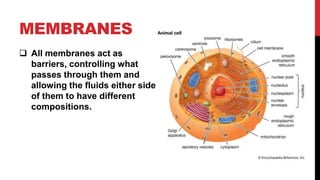
 All membranes act as
barriers, controlling what
passes through them and
allowing the fluids either side
of them to have different
compositions.
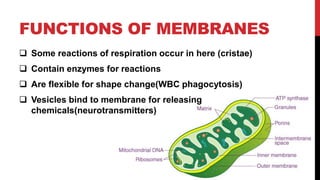
FUNCTIONS OF MEMBRANES
 Some reactions of respiration occur in here (cristae)
 Contain enzymes for reactions
 Are flexible for shape change(WBC phagocytosis)
 Vesicles bind to membrane for releasing
chemicals(neurotransmitters)
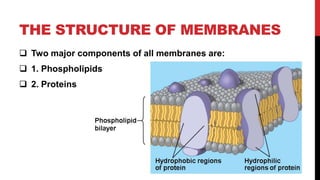
THE STRUCTURE OF MEMBRANES
 Two major components of all membranes are:
 1. Phospholipids
 2. Proteins
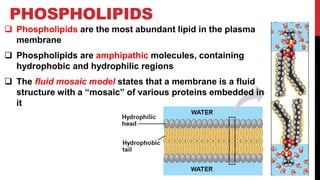
PHOSPHOLIPIDS
 Phospholipids are the most abundant lipid in the plasma
membrane
 Phospholipids are amphipathic molecules, containing
hydrophobic and hydrophilic regions
 The fluid mosaic model states that a membrane is a fluid
structure with a “mosaic” of various proteins embedded in
it
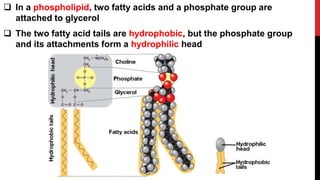
 In a phospholipid, two fatty acids and a phosphate group are
attached to glycerol
 The two fatty acid tails are hydrophobic, but the phosphate group
and its attachments form a hydrophilic head
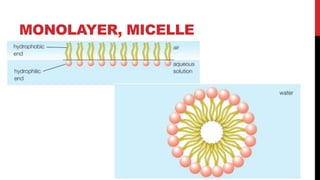
MONOLAYER, MICELLE
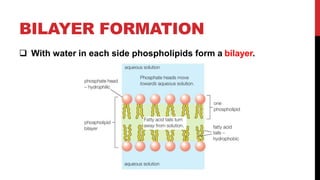
BILAYER FORMATION
 With water in each side phospholipids form a bilayer.
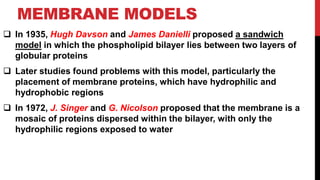
MEMBRANE MODELS
 In 1935, Hugh Davson and James Danielli proposed a sandwich
model in which the phospholipid bilayer lies between two layers of
globular proteins
 Later studies found problems with this model, particularly the
placement of membrane proteins, which have hydrophilic and
hydrophobic regions
 In 1972, J. Singer and G. Nicolson proposed that the membrane is a
mosaic of proteins dispersed within the bilayer, with only the
hydrophilic regions exposed to water
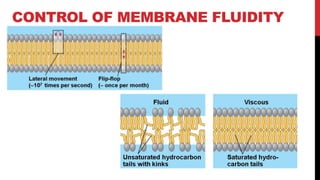
CONTROL OF MEMBRANE FLUIDITY
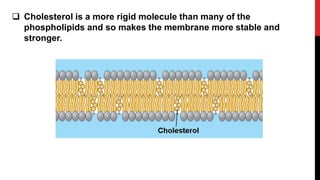
 Cholesterol is a more rigid molecule than many of the
phospholipids and so makes the membrane more stable and
stronger.
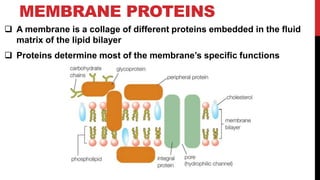
MEMBRANE PROTEINS
 A membrane is a collage of different proteins embedded in the fluid
matrix of the lipid bilayer
 Proteins determine most of the membrane’s specific functions
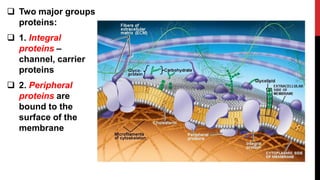
 Two major groups
proteins:
 1. Integral
proteins –
channel, carrier
proteins
 2. Peripheral
proteins are
bound to the
surface of the
membrane
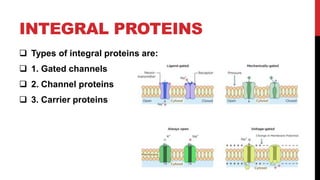
INTEGRAL PROTEINS
 Types of integral proteins are:
 1. Gated channels
 2. Channel proteins
 3. Carrier proteins
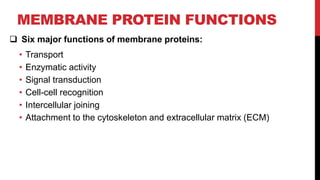
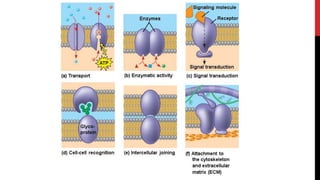
MEMBRANE PROTEIN FUNCTIONS
 Six major functions of membrane proteins:
• Transport
• Enzymatic activity
• Signal transduction
• Cell-cell recognition
• Intercellular joining
• Attachment to the cytoskeleton and extracellular matrix (ECM)
BUILDING A MODEL OF THE
MEMBRANE
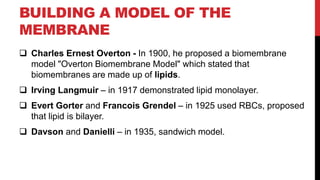
 Charles Ernest Overton - In 1900, he proposed a biomembrane
model "Overton Biomembrane Model" which stated that
biomembranes are made up of lipids.
 Irving Langmuir – in 1917 demonstrated lipid monolayer.
 Evert Gorter and Francois Grendel – in 1925 used RBCs, proposed
that lipid is bilayer.
 Davson and Danielli – in 1935, sandwich model.

AS Biology - CELL MEMBRANES

  • 1.
  • 4.
    LEARNING OBJECTIVES  Knowthe structure and properties of cell membranes  Understand how models such as the fluid mosaic model of membrane structure are interpretations of data used to develop scientific explanations of the structure and properties of cell membranes.
  • 5.
    MEMBRANES  All membranesact as barriers, controlling what passes through them and allowing the fluids either side of them to have different compositions.
  • 6.
    FUNCTIONS OF MEMBRANES Some reactions of respiration occur in here (cristae)  Contain enzymes for reactions  Are flexible for shape change(WBC phagocytosis)  Vesicles bind to membrane for releasing chemicals(neurotransmitters)
  • 7.
    THE STRUCTURE OFMEMBRANES  Two major components of all membranes are:  1. Phospholipids  2. Proteins
  • 8.
    PHOSPHOLIPIDS  Phospholipids arethe most abundant lipid in the plasma membrane  Phospholipids are amphipathic molecules, containing hydrophobic and hydrophilic regions  The fluid mosaic model states that a membrane is a fluid structure with a “mosaic” of various proteins embedded in it
  • 9.
     In aphospholipid, two fatty acids and a phosphate group are attached to glycerol  The two fatty acid tails are hydrophobic, but the phosphate group and its attachments form a hydrophilic head
  • 10.
  • 11.
    BILAYER FORMATION  Withwater in each side phospholipids form a bilayer.
  • 12.
    MEMBRANE MODELS  In1935, Hugh Davson and James Danielli proposed a sandwich model in which the phospholipid bilayer lies between two layers of globular proteins  Later studies found problems with this model, particularly the placement of membrane proteins, which have hydrophilic and hydrophobic regions  In 1972, J. Singer and G. Nicolson proposed that the membrane is a mosaic of proteins dispersed within the bilayer, with only the hydrophilic regions exposed to water
  • 13.
  • 14.
     Cholesterol isa more rigid molecule than many of the phospholipids and so makes the membrane more stable and stronger.
  • 15.
    MEMBRANE PROTEINS  Amembrane is a collage of different proteins embedded in the fluid matrix of the lipid bilayer  Proteins determine most of the membrane’s specific functions
  • 16.
     Two majorgroups proteins:  1. Integral proteins – channel, carrier proteins  2. Peripheral proteins are bound to the surface of the membrane
  • 17.
    INTEGRAL PROTEINS  Typesof integral proteins are:  1. Gated channels  2. Channel proteins  3. Carrier proteins
  • 18.
    MEMBRANE PROTEIN FUNCTIONS Six major functions of membrane proteins: • Transport • Enzymatic activity • Signal transduction • Cell-cell recognition • Intercellular joining • Attachment to the cytoskeleton and extracellular matrix (ECM)
  • 20.
    BUILDING A MODELOF THE MEMBRANE  Charles Ernest Overton - In 1900, he proposed a biomembrane model "Overton Biomembrane Model" which stated that biomembranes are made up of lipids.  Irving Langmuir – in 1917 demonstrated lipid monolayer.  Evert Gorter and Francois Grendel – in 1925 used RBCs, proposed that lipid is bilayer.  Davson and Danielli – in 1935, sandwich model.