CLINICAL PRESENTATION
of UROLOGICAL PATIENTS
TOPIC DISCUSSION BY
DR. ANICK SAHA SHUVO
MBBS (RPMC)
MS RESIDENT (P-A), PEDIATRIC SURGERY, DMCH
UROLOGY – YELLOW UNIT
INTRODUCTION
In the workup of any patient, the history is of paramount importance; this is
particularly true in urology. It is necessary to discuss here only those
urologic symptoms that are apt to be brought to the physician’s attention by
the patient. It is important to know not only whether the disease is acute or
chronic but also Whether it is recurrent, since recurring symptoms may
represent acute exacerbations of chronic disease.
Can be headed into two sections:
1. Systemic Manifestation
2. Local & Referred Pain
SYSTEMIC MANIFESTATION
• Fever: Acute Pyelonephritis (Chills), Prostatitis, RCC
(Afebrile: Simple Cystitis, Chronic Pyelonephritis)
• Wt. Loss: Advance Ca, Chronic GN Infection, Chronic UTI
LOCAL & REFERRED PAIN
• Renal pain: usually caused by distension of the renal capsule and is felt
as a constant, gnawing pain in the loin/renal angle. Typical renal pain is
felt as a dull and constant ache in the costovertebral angle just lateral to
the sacrospinalis muscle and just below the 12th rib. This pain often
spreads along the subcostal area toward the umbilicus or lower
abdominal quadrant.
Eg. Acute pyelonephritis, ureteral obs.
• Many urologic renal diseases are painless because their progression is
so slow that sudden capsular distention does not occur. Such diseases
include cancer, chronic pyelonephritis, staghorn calculus, tuberculosis,
polycystic kidney, and hydronephrosis due to chronic ureteral obstruction.
LOCAL & REFERRED PAIN
• Ureteric colic (often incorrectly referred to as renal colic) is different from
renal pain and is typified by the lateralised, colicky pain experienced by
someone who has a ureteric calculus. Ureteric colic can radiate to the
groin or lower still to the testicle/labium but does not radiate to the back of
the leg. Ureteric colic can be caused by something other than a stone in
the ureter, such as a blood clot or, rarely, a sloughed renal papilla. If the
history is carefully taken, it will be apparent that some patients
simultaneously experience both ureteric colic and renal pain.
LOCAL & REFERRED PAIN
• Suprapubic Pain: Disease processes in the bladder, e.G. Infection or
inflammation, can produce suprapubic pain. Suprapubic bladder pain,
which is experienced when the bladder is full and is relieved by
micturition, is typical of interstitial cystitis, an idiopathic benign
inflammatory disorder of the bladder typically seen in middle-aged
females.
LOCAL & REFERRED PAIN
• Testicular Pain: Common symptom in men, especially in early middle-
age (<40Y)
Causes:
1. Testicular Torsion
2. Acute Epididymo-orchitis
3. Trauma
4. Hydrocele, Epididymal Cyst ( Dragging Pain)
5. Post Vasectomy (10% acute, 1% Chronic)
LOCAL & REFERRED PAIN
• Perineal pain is often a feature of a complex of symptoms typically seen
in middle-aged men who, by a process of exclusion, are diagnosed as
suffering from acute or chronic prostatitis. With prostatitis, perineal pain
may be accompanied by suprapubic pain, low back pain which radiates to
the legs, penile pain as well as frequency of micturition and dysuria.
LUTS
• The international continence society (ICS) provides the internationally accepted definitions for
symptoms relating to lower urinary tract function:
A. Storage LUTS:
● Frequency is the complaint by the patient who considers that he/she voids too often during the
day. The patient may report needing to void more frequently than is their habit.
● Nocturia is the complaint that the individual needs to wake at night at least once to void.
● Strangury is a sensation of constantly needing to void. Typically, the patient describes having to
stand/sit for long periods with the sensation that micturition is imminent. Strangury is most commonly
due to a lower urinary tract infection (UTI).
● Urgency is a sudden compelling desire to pass urine which is difficult to defer.
● Urge incontinence (UI) is involuntary urinary leakage, often large volume, immediately preceded
by the sensation of urgency. Urgency and episodes of urge incontinence are often associated with
an overactive bladder or a bladder neuropathy.
LUTS
B. Voiding LUTS:
● Stress incontinence is involuntary urinary leakage which occurs when the intra-abdominal
pressure rises specially complicated NVD pt.
● Nocturnal enuresis is involuntary loss of urine during sleep. A common cause in an elderly male
is chronic
retention of urine with overflow incontinence
● Hesitancy is the term used when an individual describes difficulty in initiating micturition, resulting
in a delay in the onset of voiding. Signifies BOO.
● Reduced urinary stream
● Intermittency urine flow which stops and starts one or more than one time
● Straining
● Incomplete emptying
● Post micturition dribble (PMD)
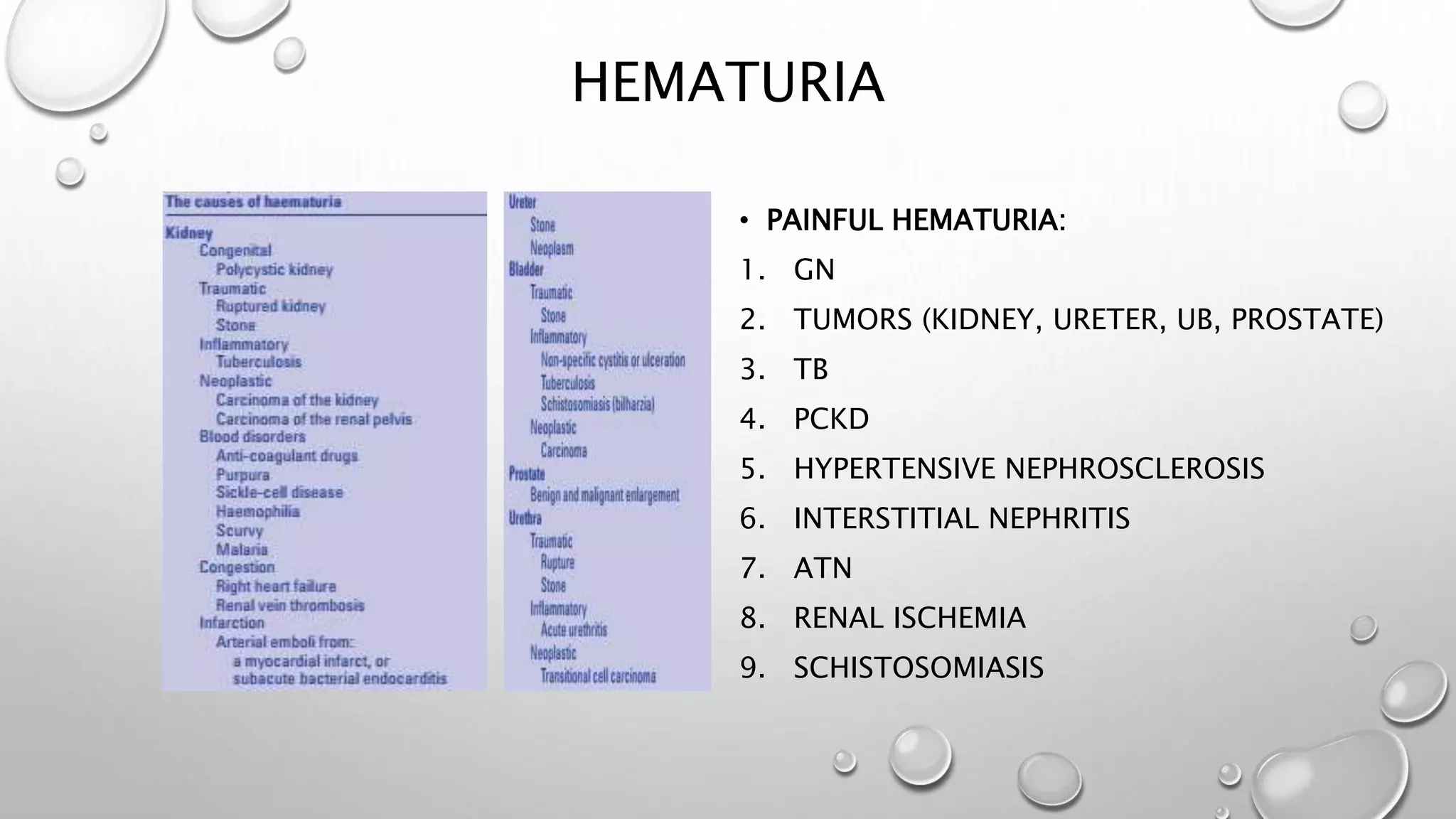
HEMATURIA
• PAINFUL HEMATURIA:
1. GN
2. TUMORS (KIDNEY, URETER, UB, PROSTATE)
3. TB
4. PCKD
5. HYPERTENSIVE NEPHROSCLEROSIS
6. INTERSTITIAL NEPHRITIS
7. ATN
8. RENAL ISCHEMIA
9. SCHISTOSOMIASIS
TIMING OF HEMATURIA
• The timing of the blood in relation to the urinary stream; initial (urethral
pathology), throughout the stream (bladder or upper tracts), or terminal
(bladder neck or prostatic pathology), as well as degree of haematuria
and its frequency.
PNEUMATURIA
Cause:
1. Colovesical Fistula
2. Crohn’s Disease
3. Ca Colon or UB
4. UTI by gas producing organism (Emphysematous Cystitis)
HAEMATOSPERMIA
• Blood, which can be bright red or a brown colour, seen in the seminal fluid. It is
most commonly due to benign inflammatory change in the prostate but
occasionally can be the presenting symptom of a prostate cancer. In most
cases, haematospermia is self-limiting.
THE URETHRAL SYNDROME
• Typically seen in young females, symptoms suggestive of a UTI are reported but
with negative bacteriology. It is sometimes remedied by a simple cystoscopy
and urethral dilatation.
EXT. GENITALIA RELATED SYMPTOMS
A) Testis:
1. Testicular Agenesis
2. Torsion/Inflammation of Appendix
of Testes
3. Small Testes (Klinfelter’s Syn.)
4. Hydrocele
5. Lump
B) Epididymis:
1. Pain due to Epididymitis
2. Nodular Induration (TB)
3. Swelling (Hard/Cystic)
EXT. GENITALIA RELATED SYMPTOMS
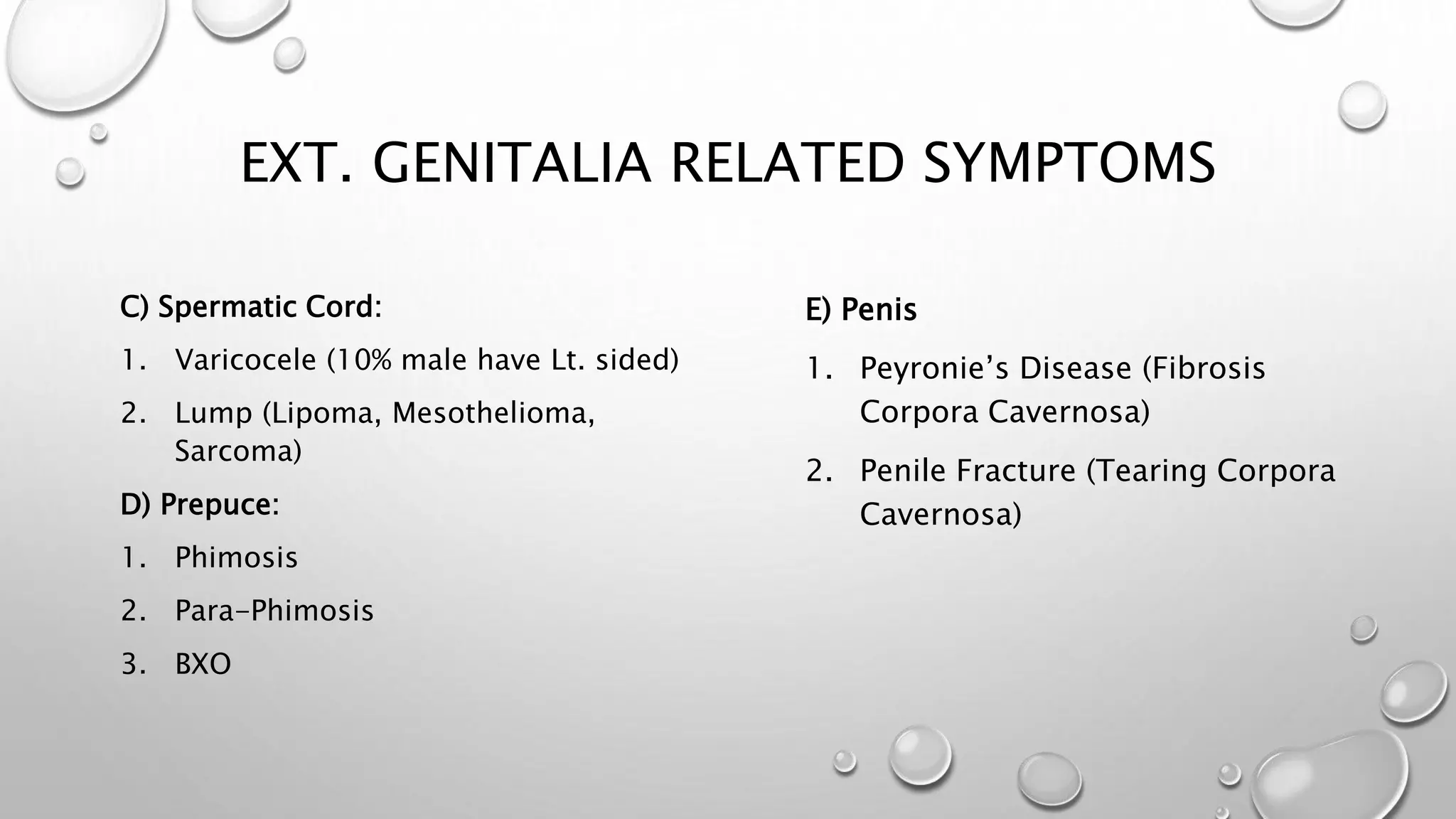
C) Spermatic Cord:
1. Varicocele (10% male have Lt. sided)
2. Lump (Lipoma, Mesothelioma,
Sarcoma)
D) Prepuce:
1. Phimosis
2. Para-Phimosis
3. BXO
E) Penis
1. Peyronie’s Disease (Fibrosis
Corpora Cavernosa)
2. Penile Fracture (Tearing Corpora
Cavernosa)
EXT. GENITALIA RELATED SYMPTOMS
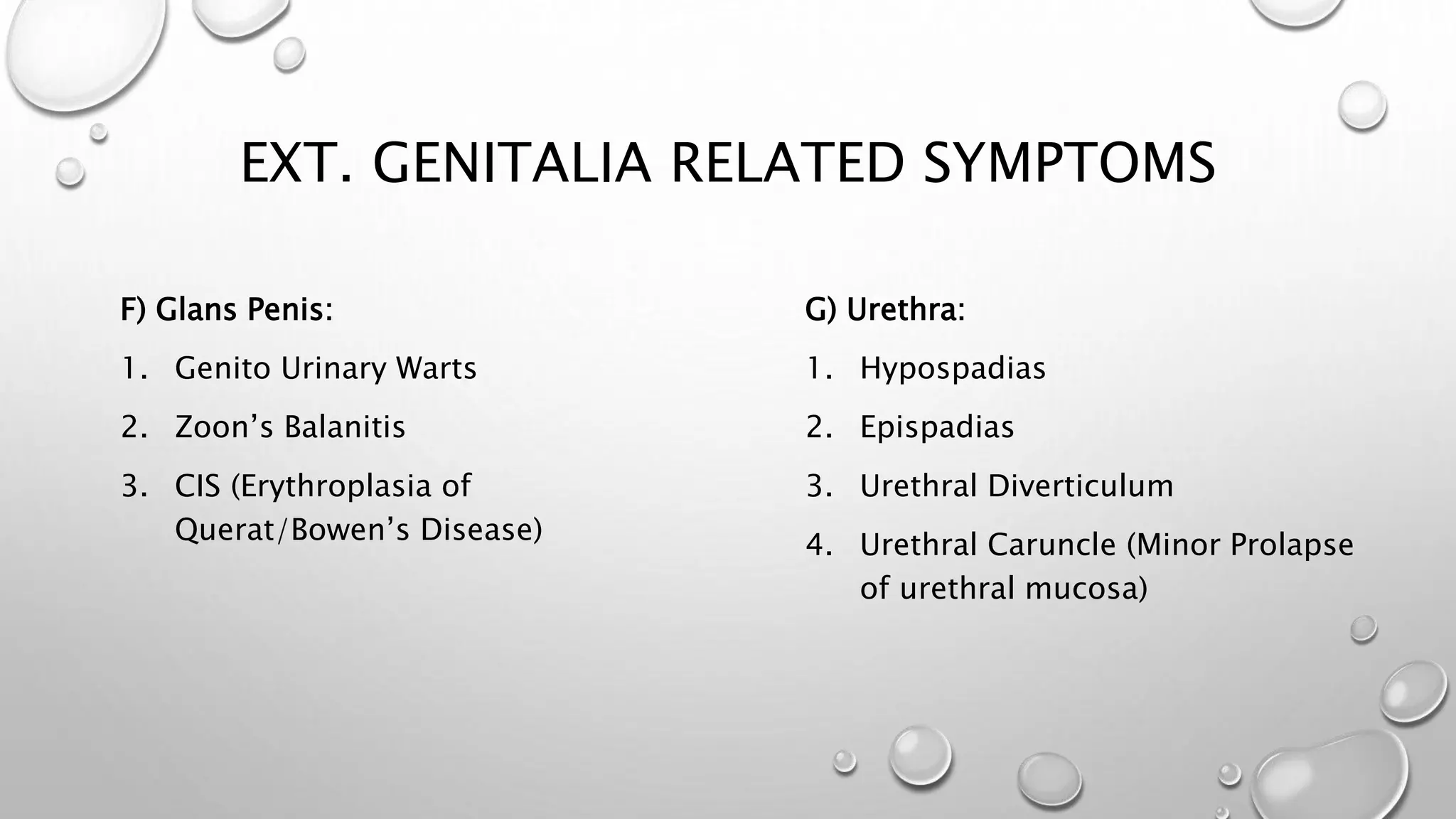
F) Glans Penis:
1. Genito Urinary Warts
2. Zoon’s Balanitis
3. CIS (Erythroplasia of
Querat/Bowen’s Disease)
G) Urethra:
1. Hypospadias
2. Epispadias
3. Urethral Diverticulum
4. Urethral Caruncle (Minor Prolapse
of urethral mucosa)
OTHER OBJECTIVE MANIFESTATIONS
1. Urethral Discharge
2. Skin change of External Genitalia
3. Visible/Palpable Mass
4. Oedema
5. Bloody Ejaculation
6. Gynecomastia

Clinical Presentation of Urological Patients

  • 1.
    CLINICAL PRESENTATION of UROLOGICALPATIENTS TOPIC DISCUSSION BY DR. ANICK SAHA SHUVO MBBS (RPMC) MS RESIDENT (P-A), PEDIATRIC SURGERY, DMCH UROLOGY – YELLOW UNIT
  • 2.
    INTRODUCTION In the workupof any patient, the history is of paramount importance; this is particularly true in urology. It is necessary to discuss here only those urologic symptoms that are apt to be brought to the physician’s attention by the patient. It is important to know not only whether the disease is acute or chronic but also Whether it is recurrent, since recurring symptoms may represent acute exacerbations of chronic disease. Can be headed into two sections: 1. Systemic Manifestation 2. Local & Referred Pain
  • 3.
    SYSTEMIC MANIFESTATION • Fever:Acute Pyelonephritis (Chills), Prostatitis, RCC (Afebrile: Simple Cystitis, Chronic Pyelonephritis) • Wt. Loss: Advance Ca, Chronic GN Infection, Chronic UTI
  • 4.
    LOCAL & REFERREDPAIN • Renal pain: usually caused by distension of the renal capsule and is felt as a constant, gnawing pain in the loin/renal angle. Typical renal pain is felt as a dull and constant ache in the costovertebral angle just lateral to the sacrospinalis muscle and just below the 12th rib. This pain often spreads along the subcostal area toward the umbilicus or lower abdominal quadrant. Eg. Acute pyelonephritis, ureteral obs. • Many urologic renal diseases are painless because their progression is so slow that sudden capsular distention does not occur. Such diseases include cancer, chronic pyelonephritis, staghorn calculus, tuberculosis, polycystic kidney, and hydronephrosis due to chronic ureteral obstruction.
  • 5.
    LOCAL & REFERREDPAIN • Ureteric colic (often incorrectly referred to as renal colic) is different from renal pain and is typified by the lateralised, colicky pain experienced by someone who has a ureteric calculus. Ureteric colic can radiate to the groin or lower still to the testicle/labium but does not radiate to the back of the leg. Ureteric colic can be caused by something other than a stone in the ureter, such as a blood clot or, rarely, a sloughed renal papilla. If the history is carefully taken, it will be apparent that some patients simultaneously experience both ureteric colic and renal pain.
  • 6.
    LOCAL & REFERREDPAIN • Suprapubic Pain: Disease processes in the bladder, e.G. Infection or inflammation, can produce suprapubic pain. Suprapubic bladder pain, which is experienced when the bladder is full and is relieved by micturition, is typical of interstitial cystitis, an idiopathic benign inflammatory disorder of the bladder typically seen in middle-aged females.
  • 7.
    LOCAL & REFERREDPAIN • Testicular Pain: Common symptom in men, especially in early middle- age (<40Y) Causes: 1. Testicular Torsion 2. Acute Epididymo-orchitis 3. Trauma 4. Hydrocele, Epididymal Cyst ( Dragging Pain) 5. Post Vasectomy (10% acute, 1% Chronic)
  • 8.
    LOCAL & REFERREDPAIN • Perineal pain is often a feature of a complex of symptoms typically seen in middle-aged men who, by a process of exclusion, are diagnosed as suffering from acute or chronic prostatitis. With prostatitis, perineal pain may be accompanied by suprapubic pain, low back pain which radiates to the legs, penile pain as well as frequency of micturition and dysuria.
  • 9.
    LUTS • The internationalcontinence society (ICS) provides the internationally accepted definitions for symptoms relating to lower urinary tract function: A. Storage LUTS: ● Frequency is the complaint by the patient who considers that he/she voids too often during the day. The patient may report needing to void more frequently than is their habit. ● Nocturia is the complaint that the individual needs to wake at night at least once to void. ● Strangury is a sensation of constantly needing to void. Typically, the patient describes having to stand/sit for long periods with the sensation that micturition is imminent. Strangury is most commonly due to a lower urinary tract infection (UTI). ● Urgency is a sudden compelling desire to pass urine which is difficult to defer. ● Urge incontinence (UI) is involuntary urinary leakage, often large volume, immediately preceded by the sensation of urgency. Urgency and episodes of urge incontinence are often associated with an overactive bladder or a bladder neuropathy.
  • 10.
    LUTS B. Voiding LUTS: ●Stress incontinence is involuntary urinary leakage which occurs when the intra-abdominal pressure rises specially complicated NVD pt. ● Nocturnal enuresis is involuntary loss of urine during sleep. A common cause in an elderly male is chronic retention of urine with overflow incontinence ● Hesitancy is the term used when an individual describes difficulty in initiating micturition, resulting in a delay in the onset of voiding. Signifies BOO. ● Reduced urinary stream ● Intermittency urine flow which stops and starts one or more than one time ● Straining ● Incomplete emptying ● Post micturition dribble (PMD)
  • 11.
    HEMATURIA • PAINFUL HEMATURIA: 1.GN 2. TUMORS (KIDNEY, URETER, UB, PROSTATE) 3. TB 4. PCKD 5. HYPERTENSIVE NEPHROSCLEROSIS 6. INTERSTITIAL NEPHRITIS 7. ATN 8. RENAL ISCHEMIA 9. SCHISTOSOMIASIS
  • 12.
    TIMING OF HEMATURIA •The timing of the blood in relation to the urinary stream; initial (urethral pathology), throughout the stream (bladder or upper tracts), or terminal (bladder neck or prostatic pathology), as well as degree of haematuria and its frequency.
  • 13.
    PNEUMATURIA Cause: 1. Colovesical Fistula 2.Crohn’s Disease 3. Ca Colon or UB 4. UTI by gas producing organism (Emphysematous Cystitis)
  • 14.
    HAEMATOSPERMIA • Blood, whichcan be bright red or a brown colour, seen in the seminal fluid. It is most commonly due to benign inflammatory change in the prostate but occasionally can be the presenting symptom of a prostate cancer. In most cases, haematospermia is self-limiting. THE URETHRAL SYNDROME • Typically seen in young females, symptoms suggestive of a UTI are reported but with negative bacteriology. It is sometimes remedied by a simple cystoscopy and urethral dilatation.
  • 15.
    EXT. GENITALIA RELATEDSYMPTOMS A) Testis: 1. Testicular Agenesis 2. Torsion/Inflammation of Appendix of Testes 3. Small Testes (Klinfelter’s Syn.) 4. Hydrocele 5. Lump B) Epididymis: 1. Pain due to Epididymitis 2. Nodular Induration (TB) 3. Swelling (Hard/Cystic)
  • 16.
    EXT. GENITALIA RELATEDSYMPTOMS C) Spermatic Cord: 1. Varicocele (10% male have Lt. sided) 2. Lump (Lipoma, Mesothelioma, Sarcoma) D) Prepuce: 1. Phimosis 2. Para-Phimosis 3. BXO E) Penis 1. Peyronie’s Disease (Fibrosis Corpora Cavernosa) 2. Penile Fracture (Tearing Corpora Cavernosa)
  • 17.
    EXT. GENITALIA RELATEDSYMPTOMS F) Glans Penis: 1. Genito Urinary Warts 2. Zoon’s Balanitis 3. CIS (Erythroplasia of Querat/Bowen’s Disease) G) Urethra: 1. Hypospadias 2. Epispadias 3. Urethral Diverticulum 4. Urethral Caruncle (Minor Prolapse of urethral mucosa)
  • 18.
    OTHER OBJECTIVE MANIFESTATIONS 1.Urethral Discharge 2. Skin change of External Genitalia 3. Visible/Palpable Mass 4. Oedema 5. Bloody Ejaculation 6. Gynecomastia