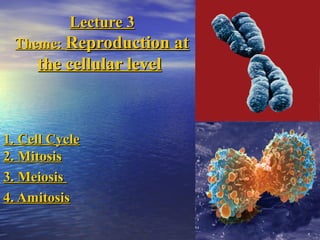
Lecture 3Lecture 3
Theme:Theme: Reproduction atReproduction at
the cellular levelthe cellular level
1. Cell Cycle1. Cell Cycle
2. Mitosis2. Mitosis
3. Meiosis3. Meiosis
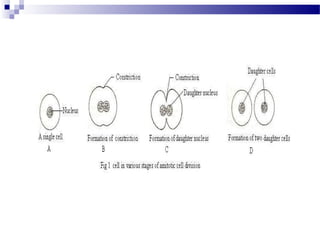
4. Amitosis4. Amitosis
1. Cell Cycle1. Cell Cycle
• The cell cycle is a sequence of cellThe cell cycle is a sequence of cell
growth and division.growth and division.
• The cell cycle is the period fromThe cell cycle is the period from
the beginning of one division to thethe beginning of one division to the
beginning of the next.beginning of the next.
• The time it takes to complete oneThe time it takes to complete one
cell cycle is thecell cycle is the generation time.generation time.
• Cells divide when they reach a certain sizeCells divide when they reach a certain size
NONO (nerve, skeletal muscle and red(nerve, skeletal muscle and red
blood cells)blood cells)
• Cell division involves mitosis andCell division involves mitosis and
cytokinesis.cytokinesis.
• Mitosis involves division of theMitosis involves division of the
chromosomes.chromosomes.
• Cytokinesis involves division of theCytokinesis involves division of the
cytoplasm.cytoplasm.
• Mitosis without cytokinesis results inMitosis without cytokinesis results in
multinucleate cells.multinucleate cells.
SponsoredSponsored
Medical Lecture Notes –Medical Lecture Notes – All SubjectsAll Subjects
USMLE Exam (America) –USMLE Exam (America) – PracticePractice
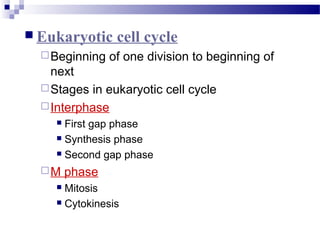
 Eukaryotic cell cycle
Beginning of one division to beginning of
next
Stages in eukaryotic cell cycle
Interphase
 First gap phase
 Synthesis phase
 Second gap phase
M phase
 Mitosis
 Cytokinesis
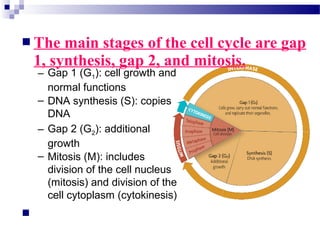
 The main stages of the cell cycle are gap
1, synthesis, gap 2, and mitosis.
– Gap 1 (G1): cell growth and
normal functions
 Mitosis occurs only if the cell is large enough
and the DNA undamaged.
– DNA synthesis (S): copies
DNA
– Gap 2 (G2): additional
growth
– Mitosis (M): includes
division of the cell nucleus
(mitosis) and division of the
cell cytoplasm (cytokinesis)
• Chromosomes become duplicatedChromosomes become duplicated
duringduring interphaseinterphase
• Cells are very active duringCells are very active during
interphaseinterphase, synthesizing biological, synthesizing biological
molecules and growing the Gmolecules and growing the G11 (gap)(gap)
phasephase
• The S (synthesis) phase is markedThe S (synthesis) phase is marked
byby DNA replicationDNA replication
• The GThe G22 (gap) phase occurs between(gap) phase occurs between
the S phase and mitosisthe S phase and mitosis
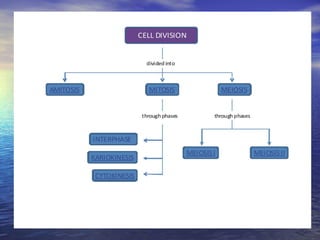
Cell division
• Chromosomal packaging of DNA allows
efficient distribution of genetic material
during cell division
• Life cycle requires two distinct types of cell
division processes: mitosis and meiosis
• Cell division: one cell becomes two cells during
an organism’s life cycle
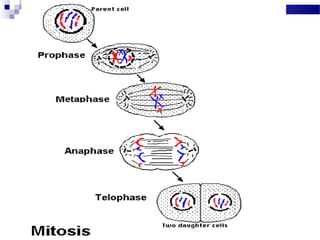
2. Mitosis
 Mitosis is nuclear division plus
cytokinesis, and produces two
identical daughter cells during
the following steps:
Prophase
Metaphase
Anaphase
Telophase.
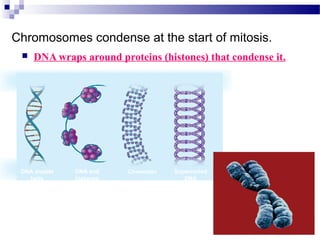
Chromosomes condense at the start of mitosis.
 DNA wraps around proteins (histones) that condense it.
DNA double
helix
DNA and
histones
Chromatin Supercoiled
DNA
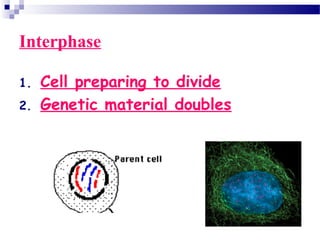
Interphase
1. Cell preparing to divide
2. Genetic material doubles
Prophase
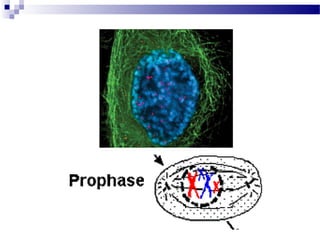
 Chromosome pair up!
1. Chromosomes thicken and shorten
-1 become visible
-2 chromatids joined by a centromere
2. Centrioles move to the opposite sides of the
nucleus
3. Nucleolus disappears
4. Nuclear membrane disintegrate
Metaphase
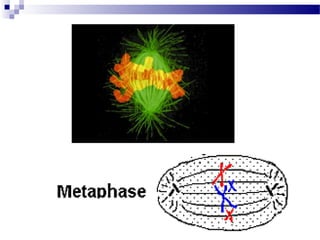
 Chromosomes meet in the middle!
1. Chromosomes arrange at equator of
cell
2. Become attached to spindle fibres by
centromeres
3. Homologous chromosomes do not
associate
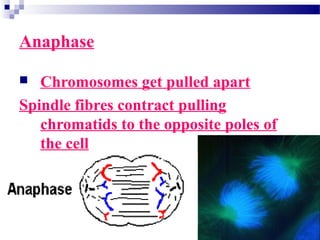
Anaphase
 Chromosomes get pulled apart
Spindle fibres contract pulling
chromatids to the opposite poles of
the cell
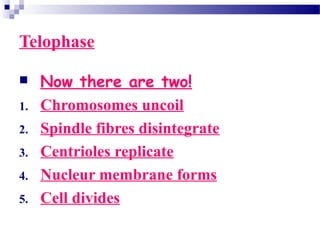
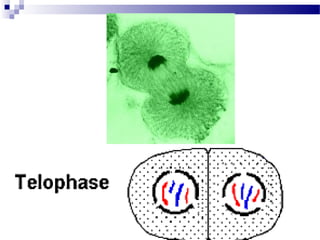
Telophase
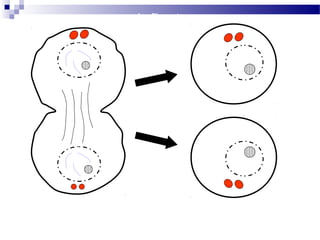
 Now there are two!
1. Chromosomes uncoil
2. Spindle fibres disintegrate
3. Centrioles replicate
4. Nucleur membrane forms
5. Cell divides
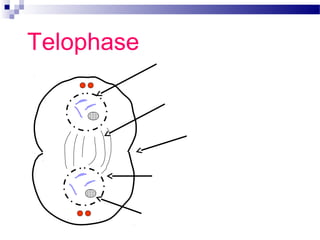
Chromosomes decondense
nuclear envelope reforms
nucleolus reappears
pinching of cell
membrane at equator
spindle fibers disintegrate
Telophase
cytokinesis
Daughter Cells
microfilaments
attach to plasma
membrane to form a
ring around equator
of cell
ring contracts,
like a drawstring,
dividing the
cytoplasm
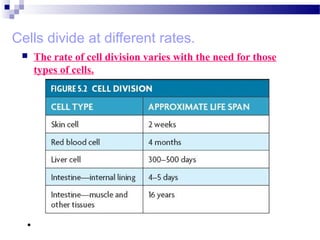
Cells divide at different rates.
 The rate of cell division varies with the need for those
types of cells.
• Some cells are unlikely to divide (G0).
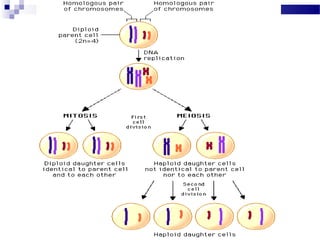
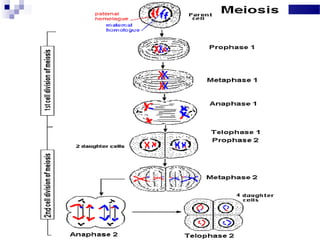
3. Meiosis
4 daughter cells produced
Each daughter cell has half the
chromosomes of the parent
2 sets of cell division involved
Reduces chromosome # from
46 --> 23
Reduces the DNA content from
2n --> 1n
One diploid (2n) --> Four haploid (1n) cells
Meiosis
Mitosis
One diploid (2n) cell --> two diploid daughter cells
Maintains chromosome #
46 --> 46
Maintains DNA content
2n --> 2n
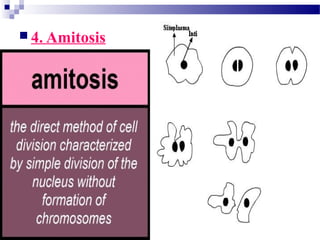
 4. Amitosis

 http://www.youtube.com/watch?
v=Wy3N5NCZBHQ

Reproduction at the Cellular level

  • 1.
    Lecture 3Lecture 3 Theme:Theme:Reproduction atReproduction at the cellular levelthe cellular level 1. Cell Cycle1. Cell Cycle 2. Mitosis2. Mitosis 3. Meiosis3. Meiosis 4. Amitosis4. Amitosis
  • 2.
    1. Cell Cycle1.Cell Cycle • The cell cycle is a sequence of cellThe cell cycle is a sequence of cell growth and division.growth and division. • The cell cycle is the period fromThe cell cycle is the period from the beginning of one division to thethe beginning of one division to the beginning of the next.beginning of the next. • The time it takes to complete oneThe time it takes to complete one cell cycle is thecell cycle is the generation time.generation time.
  • 4.
    • Cells dividewhen they reach a certain sizeCells divide when they reach a certain size NONO (nerve, skeletal muscle and red(nerve, skeletal muscle and red blood cells)blood cells) • Cell division involves mitosis andCell division involves mitosis and cytokinesis.cytokinesis. • Mitosis involves division of theMitosis involves division of the chromosomes.chromosomes. • Cytokinesis involves division of theCytokinesis involves division of the cytoplasm.cytoplasm. • Mitosis without cytokinesis results inMitosis without cytokinesis results in multinucleate cells.multinucleate cells.
  • 5.
    SponsoredSponsored Medical Lecture Notes–Medical Lecture Notes – All SubjectsAll Subjects USMLE Exam (America) –USMLE Exam (America) – PracticePractice
  • 6.
     Eukaryotic cellcycle Beginning of one division to beginning of next Stages in eukaryotic cell cycle Interphase  First gap phase  Synthesis phase  Second gap phase M phase  Mitosis  Cytokinesis
  • 7.
     The mainstages of the cell cycle are gap 1, synthesis, gap 2, and mitosis. – Gap 1 (G1): cell growth and normal functions  Mitosis occurs only if the cell is large enough and the DNA undamaged. – DNA synthesis (S): copies DNA – Gap 2 (G2): additional growth – Mitosis (M): includes division of the cell nucleus (mitosis) and division of the cell cytoplasm (cytokinesis)
  • 8.
    • Chromosomes becomeduplicatedChromosomes become duplicated duringduring interphaseinterphase • Cells are very active duringCells are very active during interphaseinterphase, synthesizing biological, synthesizing biological molecules and growing the Gmolecules and growing the G11 (gap)(gap) phasephase • The S (synthesis) phase is markedThe S (synthesis) phase is marked byby DNA replicationDNA replication • The GThe G22 (gap) phase occurs between(gap) phase occurs between the S phase and mitosisthe S phase and mitosis
  • 9.
    Cell division • Chromosomalpackaging of DNA allows efficient distribution of genetic material during cell division • Life cycle requires two distinct types of cell division processes: mitosis and meiosis • Cell division: one cell becomes two cells during an organism’s life cycle
  • 10.
    2. Mitosis  Mitosisis nuclear division plus cytokinesis, and produces two identical daughter cells during the following steps: Prophase Metaphase Anaphase Telophase.
  • 11.
    Chromosomes condense atthe start of mitosis.  DNA wraps around proteins (histones) that condense it. DNA double helix DNA and histones Chromatin Supercoiled DNA
  • 12.
    Interphase 1. Cell preparingto divide 2. Genetic material doubles
  • 13.
    Prophase  Chromosome pairup! 1. Chromosomes thicken and shorten -1 become visible -2 chromatids joined by a centromere 2. Centrioles move to the opposite sides of the nucleus 3. Nucleolus disappears 4. Nuclear membrane disintegrate
  • 15.
    Metaphase  Chromosomes meetin the middle! 1. Chromosomes arrange at equator of cell 2. Become attached to spindle fibres by centromeres 3. Homologous chromosomes do not associate
  • 17.
    Anaphase  Chromosomes getpulled apart Spindle fibres contract pulling chromatids to the opposite poles of the cell
  • 18.
    Telophase  Now thereare two! 1. Chromosomes uncoil 2. Spindle fibres disintegrate 3. Centrioles replicate 4. Nucleur membrane forms 5. Cell divides
  • 19.
    Chromosomes decondense nuclear envelopereforms nucleolus reappears pinching of cell membrane at equator spindle fibers disintegrate Telophase
  • 21.
    cytokinesis Daughter Cells microfilaments attach toplasma membrane to form a ring around equator of cell ring contracts, like a drawstring, dividing the cytoplasm
  • 23.
    Cells divide atdifferent rates.  The rate of cell division varies with the need for those types of cells. • Some cells are unlikely to divide (G0).
  • 24.
    3. Meiosis 4 daughtercells produced Each daughter cell has half the chromosomes of the parent 2 sets of cell division involved
  • 25.
    Reduces chromosome #from 46 --> 23 Reduces the DNA content from 2n --> 1n One diploid (2n) --> Four haploid (1n) cells Meiosis Mitosis One diploid (2n) cell --> two diploid daughter cells Maintains chromosome # 46 --> 46 Maintains DNA content 2n --> 2n
  • 28.
  • 30.