A Presentation on Cell Cycle
Regulation
PRESENTED BY:-
ABHISHEK NAYAN
M.SC LIFE SCIENCE
CENTRAL UNIVERSITY OF SOUTH BIHAR
Cell Cycle
• Ordered series of events that lead to cell division and the production of two
daughter cells, each containing chromosomes identical to those of the parent
cell.
Q:-When does cell starts to divide?
When cell have reached the appropriate size and have synthesized
the required proteins,they enter the cell cycle by crossing a point called
START in yeast and RESTRICTION POINT in mammals.
Phases in Cell cycle
 G1 PHASE- Cell organelles increase in cell.
synthesis of different types of proteins for DNA
synthesis
 S PHASE- DNA synthesis phase.
synthesis of histone proteins.
 G2 PHASE- 2nd gap phase/pre mitotic phase
preparation for M phase i.e
synthesis of proteins, cell growth continues
 M PHASE- Starts with nuclear division
separation of daughter chromosome(KARYOKINESIS)
Ends with division of cytoplasm(CYTOKINESIS)
What is cell cycle regulation?
• Any process that controls the series of events by which a cell goes through the cell
division.
Importance-
• In unicellular organisms, cell division must be balanced with cell growth so that cell
size is properly maintained.
If several division occur before parent cells have reached the proper size, the
daughter cells eventually become too small to be viable
If cell grow too large before cell division the cells function improperly and the
number of cells increase slowly.
• Loss of normal controls on cell replication results in development of cancer
REGULATION BY CHECKPOINTS
• Cell cycle is regulated by SURVEILLANCE MECHANISMS that monitor
the order, integrity and fidelity of cell cycle.
these include –
growth to appropriate cell size
replication and integrity of chromosomes
their accurate segregation at mitosis
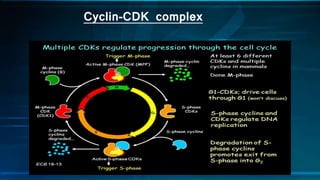
• The central mechanisms that drive cell cycle progression are CYCLIN
DEPENDENT KINASES(CDKs).
these are serine/threonine protein kinases that
phosphorylates substrates to promote DNA and
mitotic progressions.
CHECKPOINTS IN CELL CYCLE
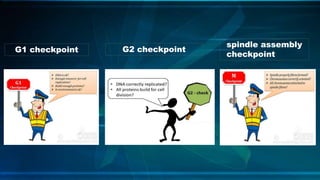
G1 checkpoint G2 checkpoint
spindle assembly
checkpoint
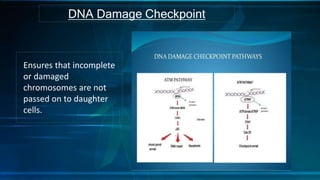
DNA Damage Checkpoint
Ensures that incomplete
or damaged
chromosomes are not
passed on to daughter
cells.
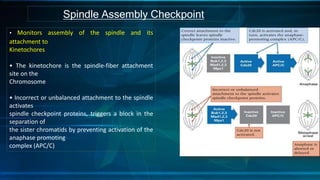
Spindle Assembly Checkpoint
• Monitors assembly of the spindle and its
attachment to
Kinetochores
• The kinetochore is the spindle-fiber attachment
site on the
Chromosome
• Incorrect or unbalanced attachment to the spindle
activates
spindle checkpoint proteins, triggers a block in the
separation of
the sister chromatids by preventing activation of the
anaphase promoting
complex (APC/C)
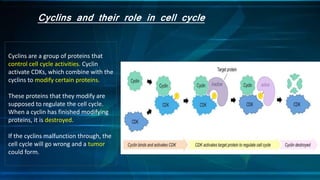
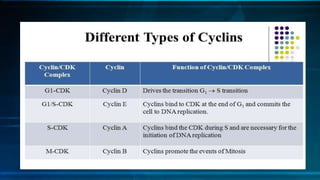
Cyclins and their role in cell cycle
Cyclins are a group of proteins that
control cell cycle activities. Cyclin
activate CDKs, which combine with the
cyclins to modify certain proteins.
These proteins that they modify are
supposed to regulate the cell cycle.
When a cyclin has finished modifying
proteins, it is destroyed.
If the cyclins malfunction through, the
cell cycle will go wrong and a tumor
could form.
Cyclin-CDK complex
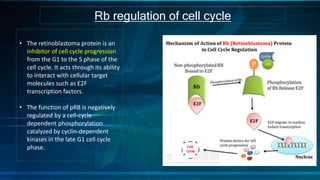
Rb regulation of cell cycle
• The retinoblastoma protein is an
inhibitor of cell cycle progression
from the G1 to the S phase of the
cell cycle. It acts through its ability
to interact with cellular target
molecules such as E2F
transcription factors.
• The function of pRB is negatively
regulated by a cell-cycle
dependent phosphorylation
catalyzed by cyclin-dependent
kinases in the late G1 cell cycle
phase.
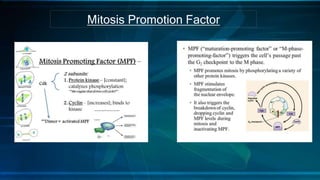
Mitosis Promotion Factor
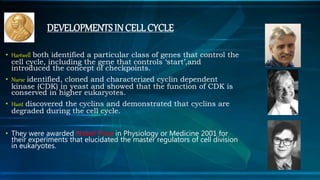
DEVELOPMENTS IN CELL CYCLE
• Hartwell both identified a particular class of genes that control the
cell cycle, including the gene that controls ‘start’,and
introduced the concept of checkpoints.
• Nurse identified, cloned and characterized cyclin dependent
kinase (CDK) in yeast and showed that the function of CDK is
conserved in higher eukaryotes.
• Hunt discovered the cyclins and demonstrated that cyclins are
degraded during the cell cycle.
• They were awarded Nobel Prize in Physiology or Medicine 2001 for
their experiments that elucidated the master regulators of cell division
in eukaryotes.
References-
• Karp, J.G. Cell and Molecular Biology. John Wiley & Sons,
USA.
• Lodish, H., Berk, A., Zipursky, S.L., Matsudaria, P., Baltimore,
D. and Darnell, J.(Eds). Molecular Cell Biology
• Wikipedia
• NCBI- cell cycle regulation by checkpoints
Acknowledgements
• In preparation of my assignment, I had to take the help and guidance
of some respected persons, who deserve my deepest gratitude. As the
completion of this assignment gave me much pleasure, I would like to
show my gratitude to Dr. Gautam Kumar for giving me a good
guidelines for assignment. I would also like to expand my gratitude to
all those who have directly and indirectly guided me in writing this
assignment.
• In addition, a thank you to Mr.
Sameer Kumar- Helped with PowerPoint.
Abinash Swain- Helped in understanding the topic.
Abhisek Singh- Moral support.
Cell cycle regulation ppt

Cell cycle regulation ppt

  • 1.
    A Presentation onCell Cycle Regulation PRESENTED BY:- ABHISHEK NAYAN M.SC LIFE SCIENCE CENTRAL UNIVERSITY OF SOUTH BIHAR
  • 2.
    Cell Cycle • Orderedseries of events that lead to cell division and the production of two daughter cells, each containing chromosomes identical to those of the parent cell. Q:-When does cell starts to divide? When cell have reached the appropriate size and have synthesized the required proteins,they enter the cell cycle by crossing a point called START in yeast and RESTRICTION POINT in mammals.
  • 3.
    Phases in Cellcycle  G1 PHASE- Cell organelles increase in cell. synthesis of different types of proteins for DNA synthesis  S PHASE- DNA synthesis phase. synthesis of histone proteins.  G2 PHASE- 2nd gap phase/pre mitotic phase preparation for M phase i.e synthesis of proteins, cell growth continues  M PHASE- Starts with nuclear division separation of daughter chromosome(KARYOKINESIS) Ends with division of cytoplasm(CYTOKINESIS)
  • 4.
    What is cellcycle regulation? • Any process that controls the series of events by which a cell goes through the cell division. Importance- • In unicellular organisms, cell division must be balanced with cell growth so that cell size is properly maintained. If several division occur before parent cells have reached the proper size, the daughter cells eventually become too small to be viable If cell grow too large before cell division the cells function improperly and the number of cells increase slowly. • Loss of normal controls on cell replication results in development of cancer
  • 5.
    REGULATION BY CHECKPOINTS •Cell cycle is regulated by SURVEILLANCE MECHANISMS that monitor the order, integrity and fidelity of cell cycle. these include – growth to appropriate cell size replication and integrity of chromosomes their accurate segregation at mitosis • The central mechanisms that drive cell cycle progression are CYCLIN DEPENDENT KINASES(CDKs). these are serine/threonine protein kinases that phosphorylates substrates to promote DNA and mitotic progressions.
  • 6.
  • 7.
    G1 checkpoint G2checkpoint spindle assembly checkpoint
  • 8.
    DNA Damage Checkpoint Ensuresthat incomplete or damaged chromosomes are not passed on to daughter cells.
  • 9.
    Spindle Assembly Checkpoint •Monitors assembly of the spindle and its attachment to Kinetochores • The kinetochore is the spindle-fiber attachment site on the Chromosome • Incorrect or unbalanced attachment to the spindle activates spindle checkpoint proteins, triggers a block in the separation of the sister chromatids by preventing activation of the anaphase promoting complex (APC/C)
  • 10.
    Cyclins and theirrole in cell cycle Cyclins are a group of proteins that control cell cycle activities. Cyclin activate CDKs, which combine with the cyclins to modify certain proteins. These proteins that they modify are supposed to regulate the cell cycle. When a cyclin has finished modifying proteins, it is destroyed. If the cyclins malfunction through, the cell cycle will go wrong and a tumor could form.
  • 12.
  • 13.
    Rb regulation ofcell cycle • The retinoblastoma protein is an inhibitor of cell cycle progression from the G1 to the S phase of the cell cycle. It acts through its ability to interact with cellular target molecules such as E2F transcription factors. • The function of pRB is negatively regulated by a cell-cycle dependent phosphorylation catalyzed by cyclin-dependent kinases in the late G1 cell cycle phase.
  • 14.
  • 15.
    DEVELOPMENTS IN CELLCYCLE • Hartwell both identified a particular class of genes that control the cell cycle, including the gene that controls ‘start’,and introduced the concept of checkpoints. • Nurse identified, cloned and characterized cyclin dependent kinase (CDK) in yeast and showed that the function of CDK is conserved in higher eukaryotes. • Hunt discovered the cyclins and demonstrated that cyclins are degraded during the cell cycle. • They were awarded Nobel Prize in Physiology or Medicine 2001 for their experiments that elucidated the master regulators of cell division in eukaryotes.
  • 16.
    References- • Karp, J.G.Cell and Molecular Biology. John Wiley & Sons, USA. • Lodish, H., Berk, A., Zipursky, S.L., Matsudaria, P., Baltimore, D. and Darnell, J.(Eds). Molecular Cell Biology • Wikipedia • NCBI- cell cycle regulation by checkpoints
  • 17.
    Acknowledgements • In preparationof my assignment, I had to take the help and guidance of some respected persons, who deserve my deepest gratitude. As the completion of this assignment gave me much pleasure, I would like to show my gratitude to Dr. Gautam Kumar for giving me a good guidelines for assignment. I would also like to expand my gratitude to all those who have directly and indirectly guided me in writing this assignment. • In addition, a thank you to Mr. Sameer Kumar- Helped with PowerPoint. Abinash Swain- Helped in understanding the topic. Abhisek Singh- Moral support.