Structure of Skeletal Muscle Chapter 8: Muscular System Unit 2: Support and Movement
Introduction Muscles are organs composed of specialized cells that use the chemical energy stored in nutrients to contract. Muscle action provide muscle tone, propel body fluids and food, generate the heartbeat, and distribute heat.
Muscle Tissue Types The muscle tissue in the body can be divided into 3 distinct categories: 1. Skeletal Muscle 2. Smooth Muscle 3. Cardiac Muscle
Structure of a Skeletal Muscle The skeletal muscle structure is composed of four different types of tissues: 1. Skeletal Muscle Tissue 2. Nervous Tissue 3. Blood Tissue [connective] 4. Connective Tissue
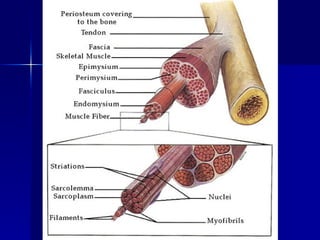
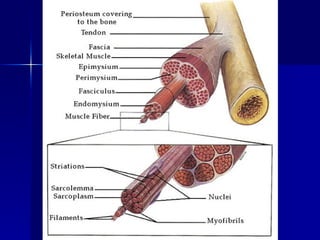
Connective Tissue Coverings Layers of fibrous connective tissue called  Fascia  separate an individual skeletal muscle from adjacent muscles and hold it in position. Usually projects beyond its end to form a cordlike tendon Fibers in tendon often intertwine with those in bone’s  periosteum .
Layers of Connective Tissue The layer of connective tissue that closely surrounds the whole of a skeletal muscle is called  Epimysium . The connective tissue layer that extends inward from the epimysium and separates the muscle tissue into small compartments is called  Perimysium . Bundles of skeletal muscle fibers are called  Fascicles . Each muscle fiber within a fascicle lies within a layer of connective tissue in the form of a thin covering called  Endomysium .
 
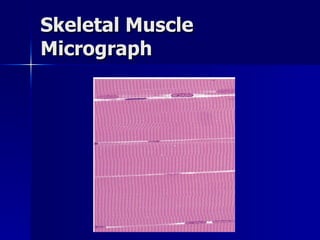
Skeletal Muscle Micrograph
Skeletal Muscle Fibers A skeletal muscle fiber is a  single cell  that contracts in response to stimulation and then relaxes when the stimulation ends. Each fasiculus (fiber) is a thin, elongated cylinder with rounded ends. Each fasiculus contains many small, oval nuclei and many mitochondria.
Myofibrils Every muscle fiber (muscle cell) is surrounded by a cell membrane called a  sarcolemma The cytoplasm in a muscle fiber is called the  sarcoplasm Sarcoplasm  contains multiple threadlike  Myofibrils  that lie parallel to one another. Contains two kinds of protein filaments: Thick ones composed of the protein  Myosin . Thin ones composed of the protein  Actin .
 
 
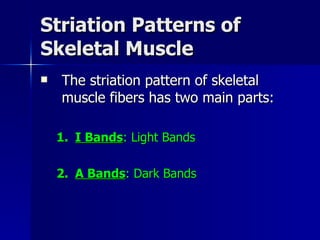
Striation Patterns of Skeletal Muscle The striation pattern of skeletal muscle fibers has two main parts: 1.  I Bands : Light Bands 2.  A Bands : Dark Bands
 
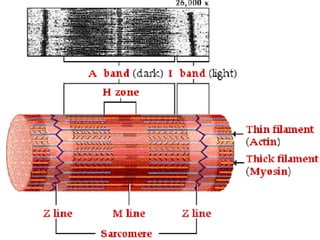
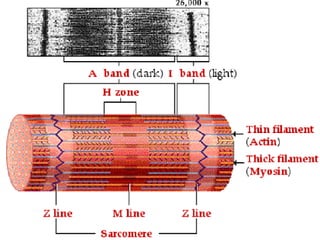
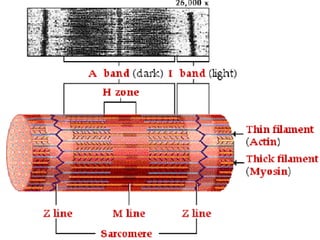
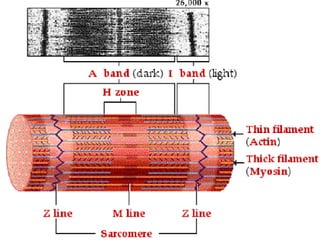
Bands I Bands  are composed of thin  Actin  filaments directly attached to structures called  Z lines . A Bands  are composed of thick mysosin filaments overlapping thin actin filaments.
 
A Bands Continued The A Band consists not only of a region where the thick and thin filaments overlap, but also a central region (H Zone) consisting only of thick filaments. A thickening know as an  M Line  is found in the middle of the A Band. The segment of a myofibril that extends from one Z line to the next Z line is called a  Sarcomere .
 
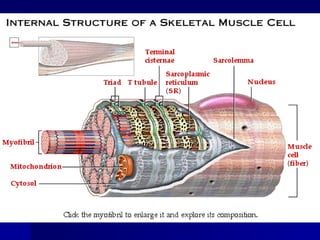
More Structures of the Sarcoplasm A network of membranous channels that  surrounds  each myofibril and runs along its length is known as the  Sarcoplasmic Reticulum . The SR acts as a reservoir of Ca2+ ions Calcium ions are used to stimulate muscle contraction *more to come on this later Another set of membranous channels, called  Transverse Tubules , extend inward from the fibers’ membrane and passes all the way through the fiber. Each tubule opens to the outside of the muscle fiber and contains extracellular fluid. Both membranous channels activate the muscle contraction mechanism where the fiber is stimulated.
More Structures of the Sarcoplasmic Reticulum Another set of membranous channels, called  Transverse Tubules , extend inward from the sarcolemma and passes all the way through the fiber. Each T-tubule passes by many myofibrils Each tubule opens to the outside of the muscle fiber and contains extracellular fluid. T-tubules & SR work together to activate the muscle contraction mechanism when the fiber is stimulated.
 
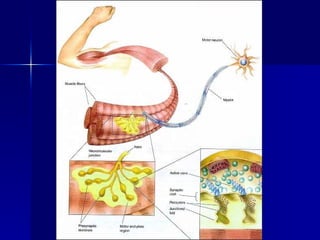
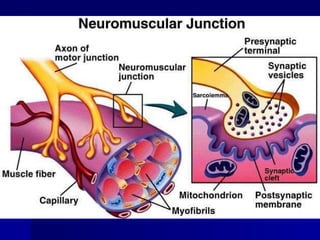
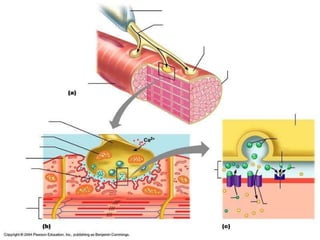
Neuromuscular Junction Each skeletal muscle fiber connects to an axon from a nerve cell, called a  Motor Neuron . This axon extends outward from the brain or spinal cord, and the muscle fiber contracts only when the motor neuron stimulates it. The connection between the motor neuron and muscle fiber is called a  Neuromuscular Junction .
 
Neuromuscular Junction Continued A neuromuscular junction includes the end of a motor neuron and the motor end plate of a muscle fiber. A  Motor End Plate  is a specialized region of the muscle fiber membrane where muscle fiber, nuclei, and mitochondria are abundant. The sarcolemma is extensively folded in this region to create more surface area.
 
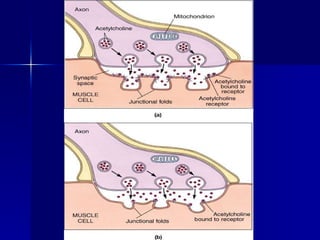
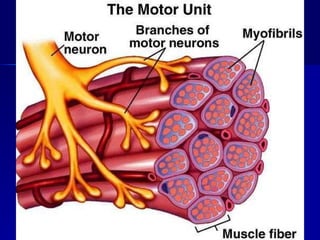
More on Motor Neurons The end of the motor neuron branches and projects into recesses of the muscle fiber membrane. Cytoplasm at the distal ends of the motor neuron axons are rich in mitochondria and contains vesicles that store chemicals called  Neurotransmitters .
Neurotransmitters Nerve impulse traveling from the brain or spinal cord reach the end of the motor neuron axon. Some of the vesicles release a neurotransmitter into the  Synaptic Cleft . The  Synaptic Cleft  is the gap between the neuron and the motor end plate of the muscle fiber.
 
 
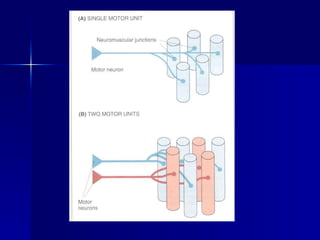
Motor Units A muscle fiber usually has a single motor end plate. One motor neuron may connect to many muscle fibers. When a motor neuron transmits an impulse, all of the muscle fibers it links to are stimulated to contract simultaneously. A motor neuron and the muscle fibers that it controls constitute a  Motor Unit .


Structure of skeletal_muscle

  • 1.
    Structure of SkeletalMuscle Chapter 8: Muscular System Unit 2: Support and Movement
  • 2.
    Introduction Muscles areorgans composed of specialized cells that use the chemical energy stored in nutrients to contract. Muscle action provide muscle tone, propel body fluids and food, generate the heartbeat, and distribute heat.
  • 3.
    Muscle Tissue TypesThe muscle tissue in the body can be divided into 3 distinct categories: 1. Skeletal Muscle 2. Smooth Muscle 3. Cardiac Muscle
  • 4.
    Structure of aSkeletal Muscle The skeletal muscle structure is composed of four different types of tissues: 1. Skeletal Muscle Tissue 2. Nervous Tissue 3. Blood Tissue [connective] 4. Connective Tissue
  • 5.
    Connective Tissue CoveringsLayers of fibrous connective tissue called Fascia separate an individual skeletal muscle from adjacent muscles and hold it in position. Usually projects beyond its end to form a cordlike tendon Fibers in tendon often intertwine with those in bone’s periosteum .
  • 6.
    Layers of ConnectiveTissue The layer of connective tissue that closely surrounds the whole of a skeletal muscle is called Epimysium . The connective tissue layer that extends inward from the epimysium and separates the muscle tissue into small compartments is called Perimysium . Bundles of skeletal muscle fibers are called Fascicles . Each muscle fiber within a fascicle lies within a layer of connective tissue in the form of a thin covering called Endomysium .
  • 7.
  • 8.
  • 9.
    Skeletal Muscle FibersA skeletal muscle fiber is a single cell that contracts in response to stimulation and then relaxes when the stimulation ends. Each fasiculus (fiber) is a thin, elongated cylinder with rounded ends. Each fasiculus contains many small, oval nuclei and many mitochondria.
  • 10.
    Myofibrils Every musclefiber (muscle cell) is surrounded by a cell membrane called a sarcolemma The cytoplasm in a muscle fiber is called the sarcoplasm Sarcoplasm contains multiple threadlike Myofibrils that lie parallel to one another. Contains two kinds of protein filaments: Thick ones composed of the protein Myosin . Thin ones composed of the protein Actin .
  • 11.
  • 12.
  • 13.
    Striation Patterns ofSkeletal Muscle The striation pattern of skeletal muscle fibers has two main parts: 1. I Bands : Light Bands 2. A Bands : Dark Bands
  • 14.
  • 15.
    Bands I Bands are composed of thin Actin filaments directly attached to structures called Z lines . A Bands are composed of thick mysosin filaments overlapping thin actin filaments.
  • 16.
  • 17.
    A Bands ContinuedThe A Band consists not only of a region where the thick and thin filaments overlap, but also a central region (H Zone) consisting only of thick filaments. A thickening know as an M Line is found in the middle of the A Band. The segment of a myofibril that extends from one Z line to the next Z line is called a Sarcomere .
  • 18.
  • 19.
    More Structures ofthe Sarcoplasm A network of membranous channels that surrounds each myofibril and runs along its length is known as the Sarcoplasmic Reticulum . The SR acts as a reservoir of Ca2+ ions Calcium ions are used to stimulate muscle contraction *more to come on this later Another set of membranous channels, called Transverse Tubules , extend inward from the fibers’ membrane and passes all the way through the fiber. Each tubule opens to the outside of the muscle fiber and contains extracellular fluid. Both membranous channels activate the muscle contraction mechanism where the fiber is stimulated.
  • 20.
    More Structures ofthe Sarcoplasmic Reticulum Another set of membranous channels, called Transverse Tubules , extend inward from the sarcolemma and passes all the way through the fiber. Each T-tubule passes by many myofibrils Each tubule opens to the outside of the muscle fiber and contains extracellular fluid. T-tubules & SR work together to activate the muscle contraction mechanism when the fiber is stimulated.
  • 21.
  • 22.
    Neuromuscular Junction Eachskeletal muscle fiber connects to an axon from a nerve cell, called a Motor Neuron . This axon extends outward from the brain or spinal cord, and the muscle fiber contracts only when the motor neuron stimulates it. The connection between the motor neuron and muscle fiber is called a Neuromuscular Junction .
  • 23.
  • 24.
    Neuromuscular Junction ContinuedA neuromuscular junction includes the end of a motor neuron and the motor end plate of a muscle fiber. A Motor End Plate is a specialized region of the muscle fiber membrane where muscle fiber, nuclei, and mitochondria are abundant. The sarcolemma is extensively folded in this region to create more surface area.
  • 25.
  • 26.
    More on MotorNeurons The end of the motor neuron branches and projects into recesses of the muscle fiber membrane. Cytoplasm at the distal ends of the motor neuron axons are rich in mitochondria and contains vesicles that store chemicals called Neurotransmitters .
  • 27.
    Neurotransmitters Nerve impulsetraveling from the brain or spinal cord reach the end of the motor neuron axon. Some of the vesicles release a neurotransmitter into the Synaptic Cleft . The Synaptic Cleft is the gap between the neuron and the motor end plate of the muscle fiber.
  • 28.
  • 29.
  • 30.
    Motor Units Amuscle fiber usually has a single motor end plate. One motor neuron may connect to many muscle fibers. When a motor neuron transmits an impulse, all of the muscle fibers it links to are stimulated to contract simultaneously. A motor neuron and the muscle fibers that it controls constitute a Motor Unit .
  • 31.
  • 32.