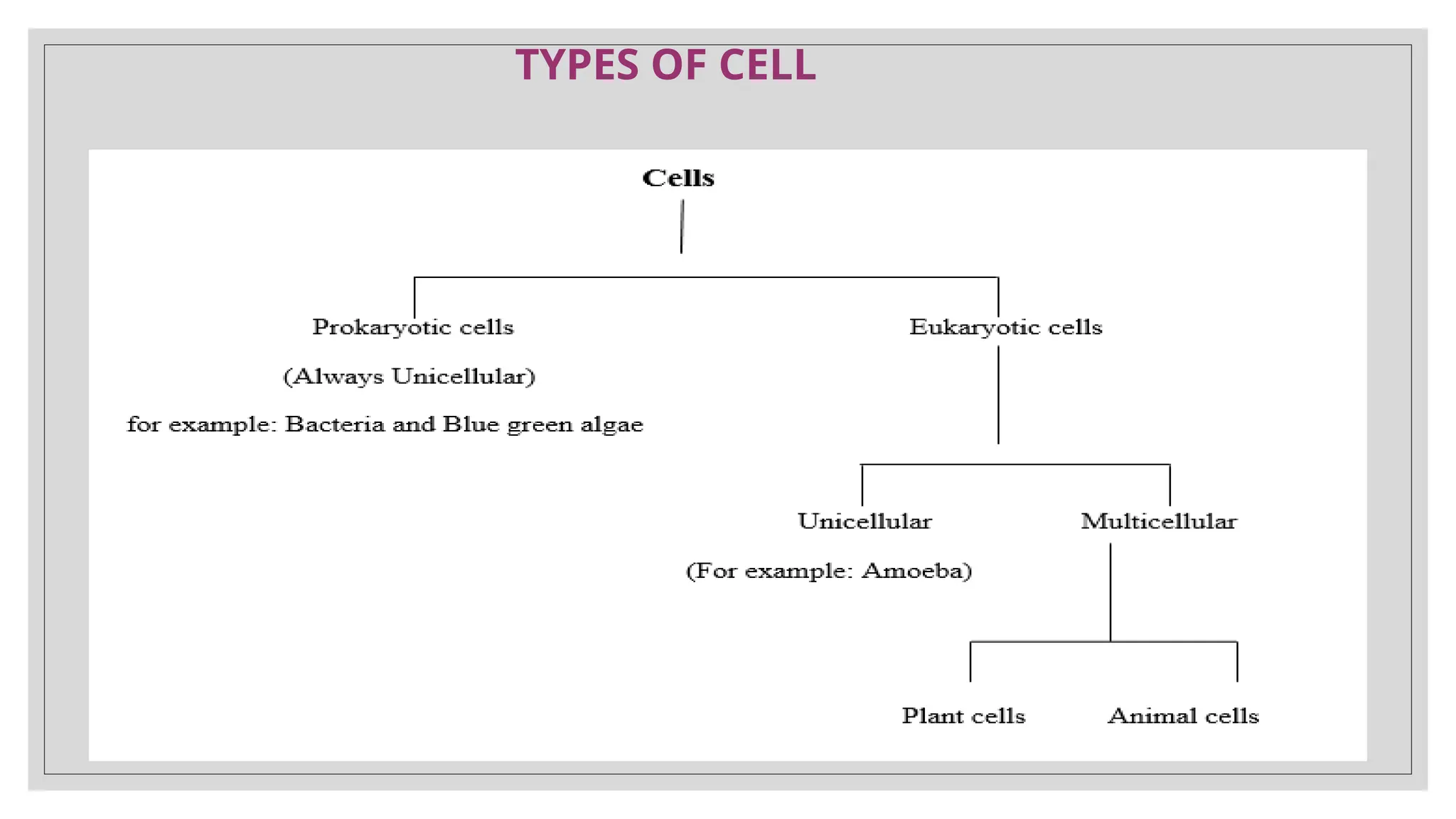
BY : VISHALKOTHARI AND DIPANSHU SEN
MGGS BARAN
BY : VISHAL KOTHARI AND DIPANSHU SEN
MGGS BARAN
2.
Introductio
n
• The cellis a fundamental, structural and functional unit of living
organisms and basic unit of life.
• All living organisms are made up of cells. Cells make tissues, tissues
together make organ, organs make organ system and organ systems
make body of organisms. So cell is called structural unit of life.
• All the basic functions of the body like respiration, excretion etc. are
carried out by cell through its cell organelles, so cell is called
functional unit of life.
• Cell biology is the study of cells in all aspects of structure and
functions.
• The body of all organisms is made up of tiny microscopic units called
cell.
4.
Discovery of cell
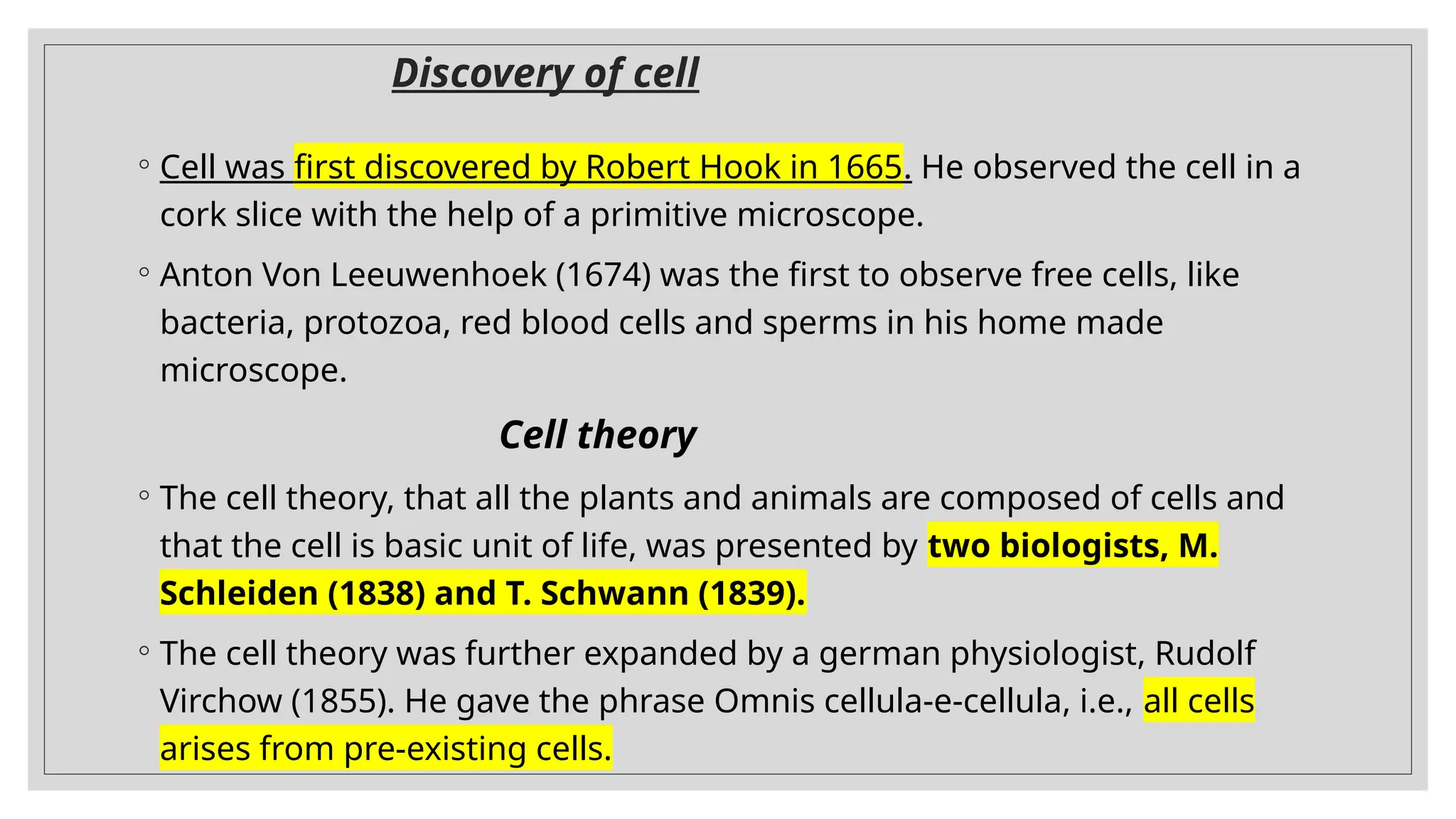
◦Cell was first discovered by Robert Hook in 1665. He observed the cell in a
cork slice with the help of a primitive microscope.
◦ Anton Von Leeuwenhoek (1674) was the first to observe free cells, like
bacteria, protozoa, red blood cells and sperms in his home made
microscope.
Cell theory
◦ The cell theory, that all the plants and animals are composed of cells and
that the cell is basic unit of life, was presented by two biologists, M.
Schleiden (1838) and T. Schwann (1839).
◦ The cell theory was further expanded by a german physiologist, Rudolf
Virchow (1855). He gave the phrase Omnis cellula-e-cellula, i.e., all cells
arises from pre-existing cells.
5.
Modified cell theoryis termed as cell principle or modern
cell theory which postulates that
All living organisms are composed of cells or cell products.
All living cells arise from pre-existing cells.
All cells are basically alike in chemical composition and
metabolic processes.
The functions of an organism as a whole is the result of the
activities and interaction of the constituent cells.
6.
Shape, size andnumber of cells
Cell shape:
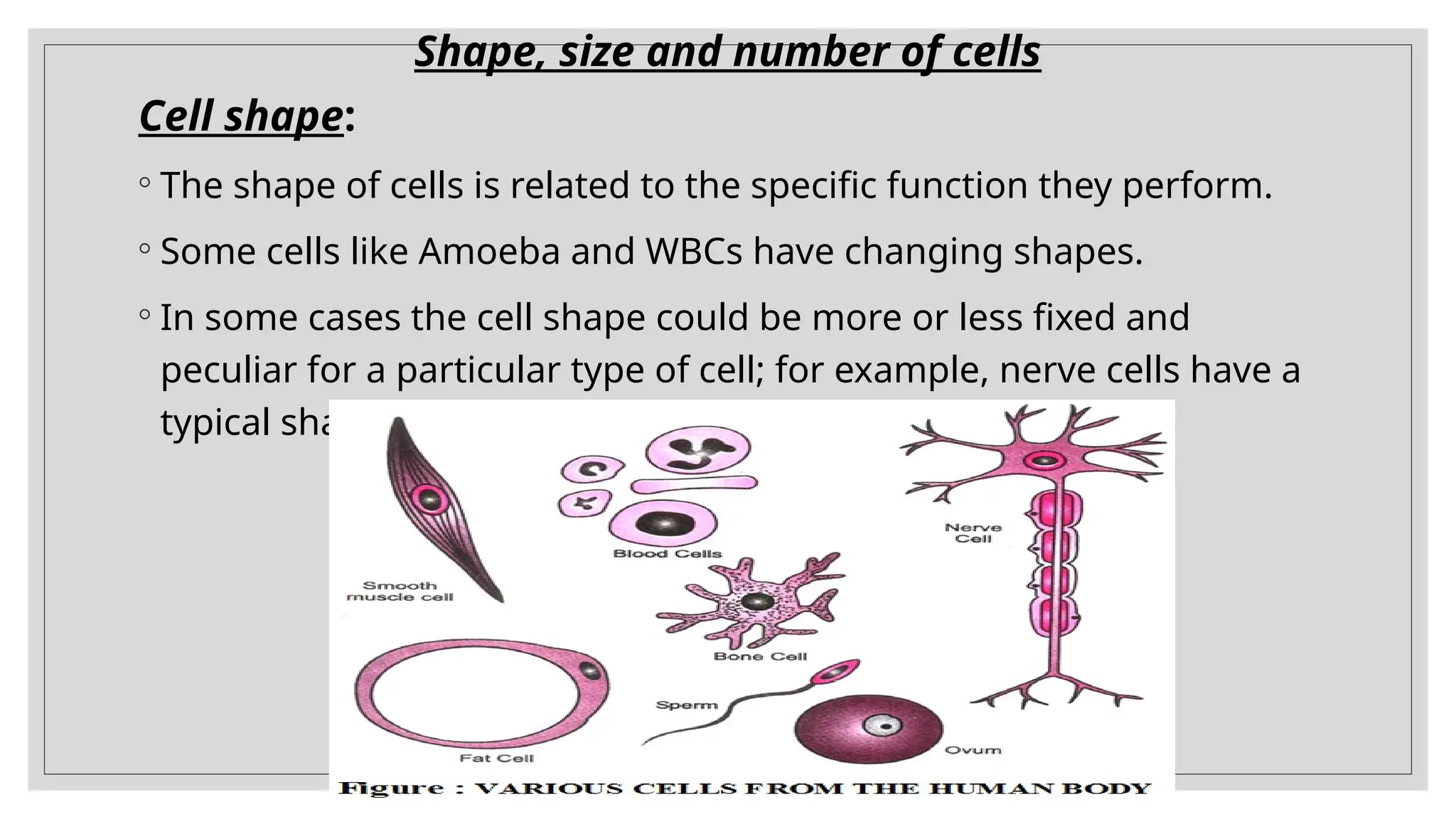
◦ The shape of cells is related to the specific function they perform.
◦ Some cells like Amoeba and WBCs have changing shapes.
◦ In some cases the cell shape could be more or less fixed and
peculiar for a particular type of cell; for example, nerve cells have a
typical shape.
7.
Cell size
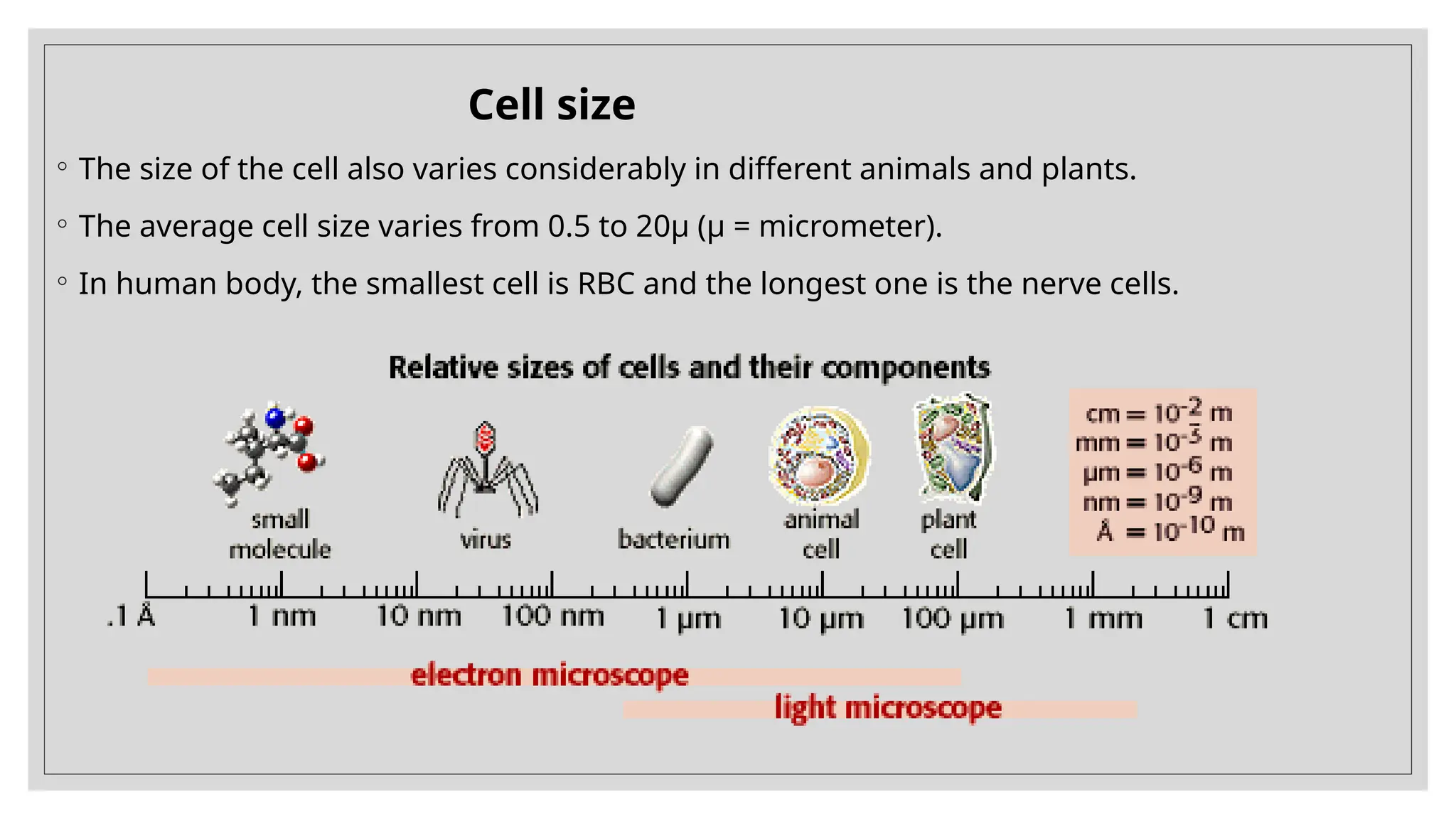
◦ Thesize of the cell also varies considerably in different animals and plants.
◦ The average cell size varies from 0.5 to 20µ (µ = micrometer).
◦ In human body, the smallest cell is RBC and the longest one is the nerve cells.
8.
Cell number:
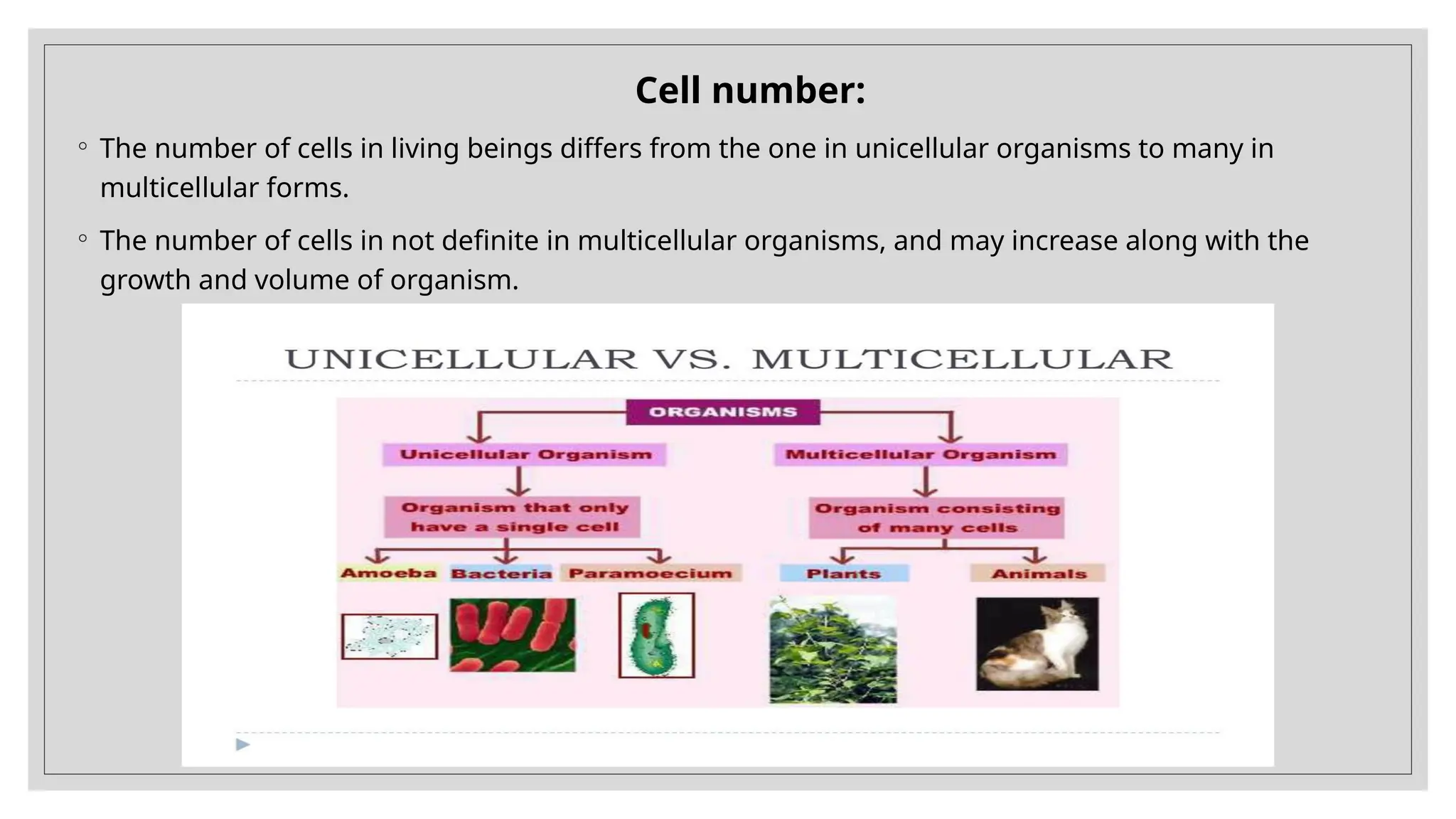
◦ Thenumber of cells in living beings differs from the one in unicellular organisms to many in
multicellular forms.
◦ The number of cells in not definite in multicellular organisms, and may increase along with the
growth and volume of organism.
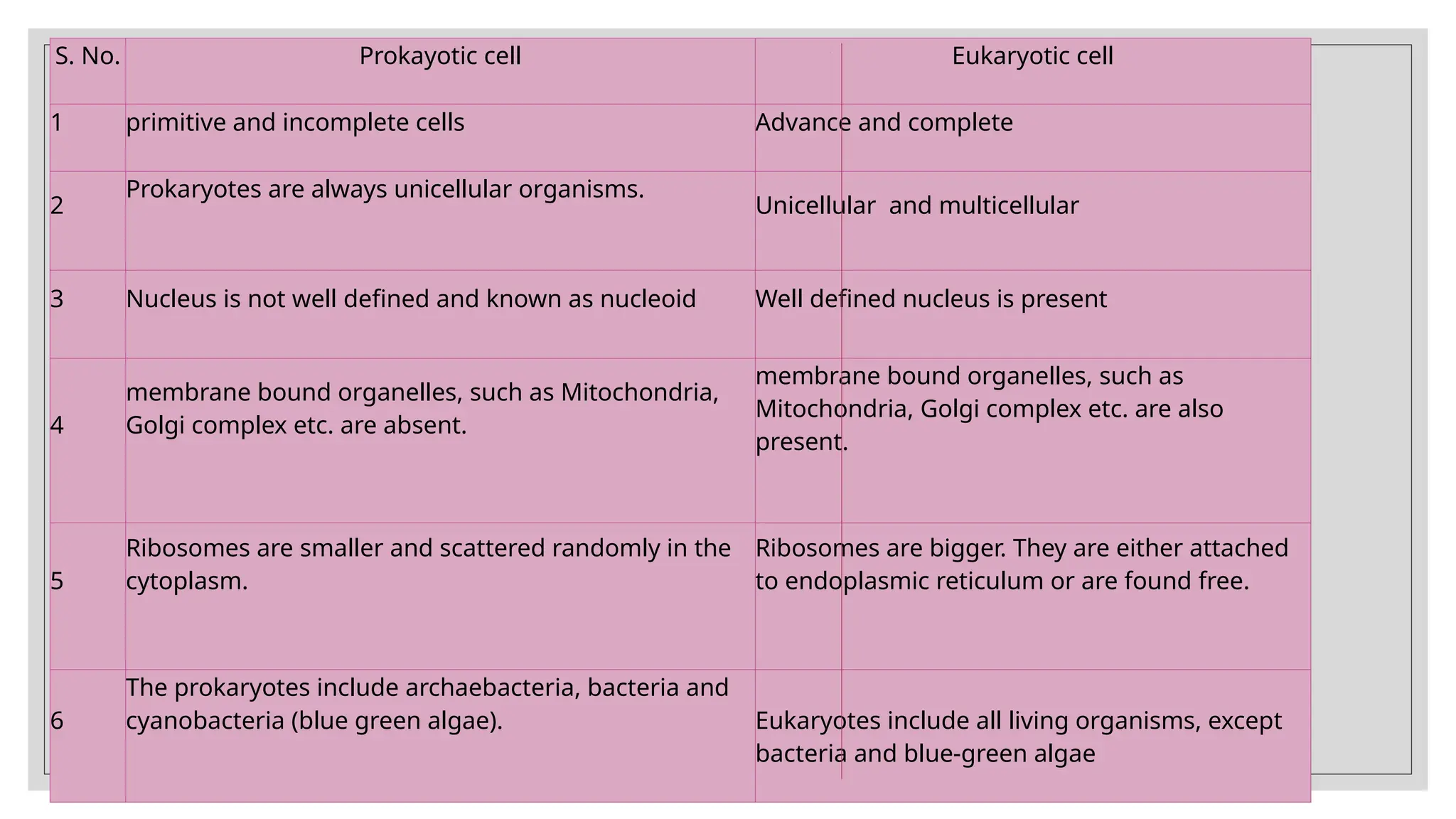
S. No. Prokayoticcell Eukaryotic cell
1 primitive and incomplete cells Advance and complete
2
Prokaryotes are always unicellular organisms.
Unicellular and multicellular
3 Nucleus is not well defined and known as nucleoid Well defined nucleus is present
4
membrane bound organelles, such as Mitochondria,
Golgi complex etc. are absent.
membrane bound organelles, such as
Mitochondria, Golgi complex etc. are also
present.
5
Ribosomes are smaller and scattered randomly in the
cytoplasm.
Ribosomes are bigger. They are either attached
to endoplasmic reticulum or are found free.
6
The prokaryotes include archaebacteria, bacteria and
cyanobacteria (blue green algae). Eukaryotes include all living organisms, except
bacteria and blue-green algae
11.
Plasma membrane (cellmembrane)
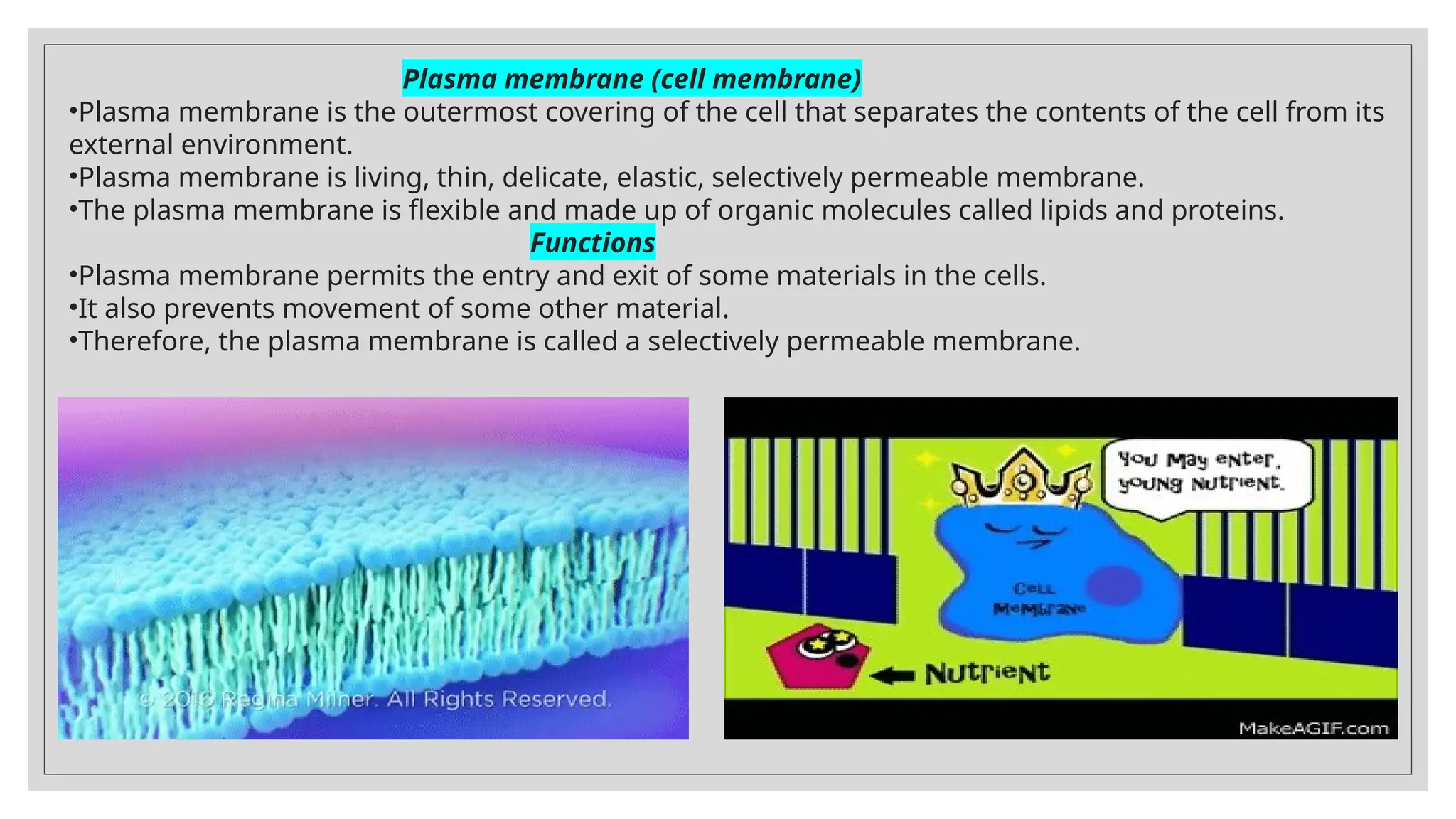
•Plasma membrane is the outermost covering of the cell that separates the contents of the cell from its
external environment.
•Plasma membrane is living, thin, delicate, elastic, selectively permeable membrane.
•The plasma membrane is flexible and made up of organic molecules called lipids and proteins.
Functions
•Plasma membrane permits the entry and exit of some materials in the cells.
•It also prevents movement of some other material.
•Therefore, the plasma membrane is called a selectively permeable membrane.
12.
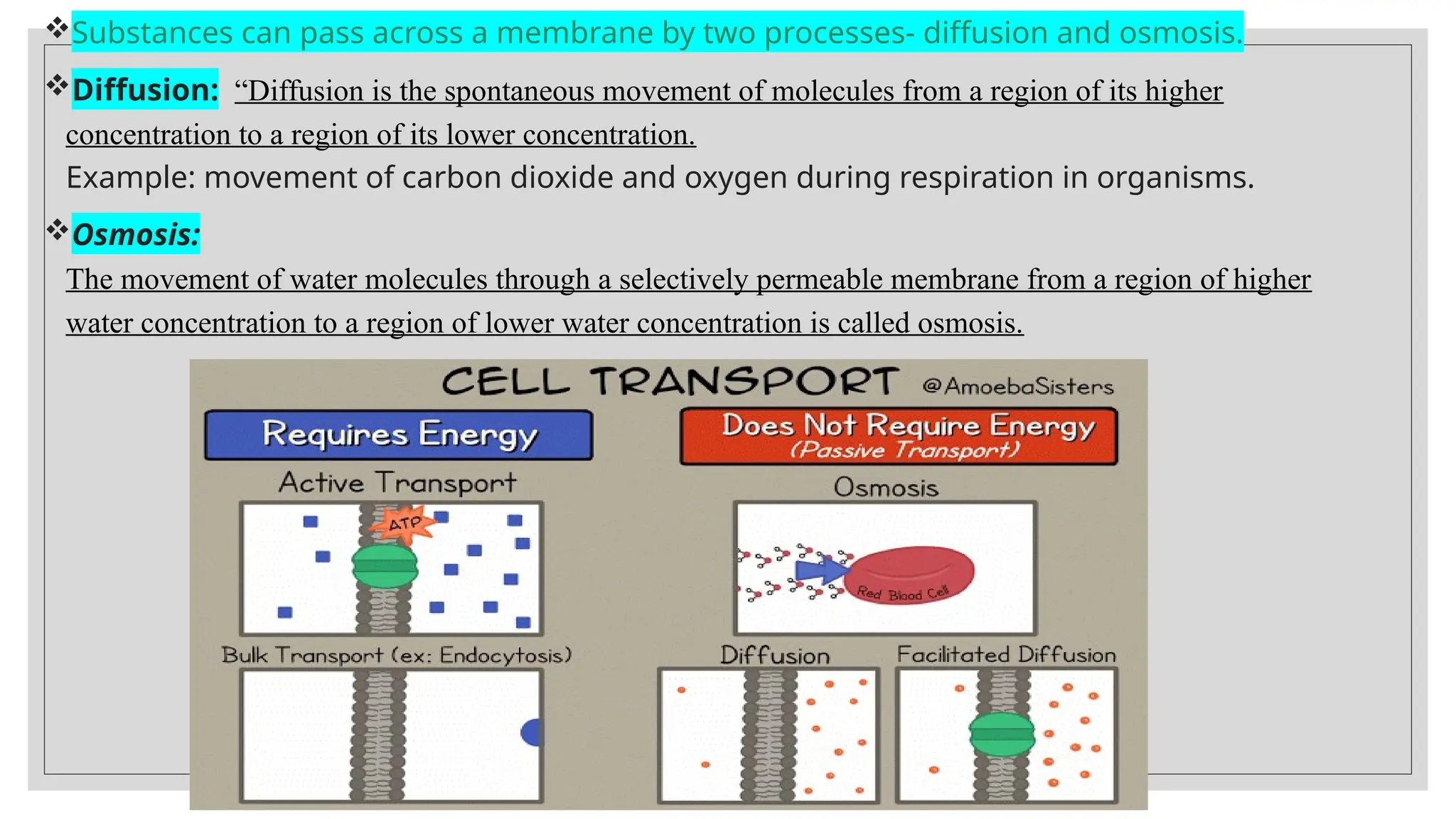
Substances can passacross a membrane by two processes- diffusion and osmosis.
Diffusion: “Diffusion is the spontaneous movement of molecules from a region of its higher
concentration to a region of its lower concentration.
Example: movement of carbon dioxide and oxygen during respiration in organisms.
Osmosis:
The movement of water molecules through a selectively permeable membrane from a region of higher
water concentration to a region of lower water concentration is called osmosis.
13.
Cell wall
In plantcells, there occurs a rigid cell wall which lies outside the plasma membrane.
Cell wall is thick, non-living and permeable covering made up of cellulose. Cellulose is
a kind of carbohydrate (polysaccharide) and it provides structural strength to the
plant.
FUNCTIONS
Cell wall protects cell membrane and the internal structures of the cell.
It provides rigidity and determines the shape of the plant cell.
It prevents drying of the cell and helps it to bear unfavourable conditions.
It provides mechanical strength to the plant cells.
14.
Cell walls permitthe cells of plants, fungi and bacteria to withstand very
dilute (hypotonic) external media without bursting.
In such media the cells tend to take up water by osmosis.
The cell swells, building up pressure against the cell wall.
The wall exerts an equal pressure against the swollen cell.
Because of their walls, such cells can withstand much greater changes in the
surrounding medium than animal cells.
When a living plant cell loses water through osmosis there is shrinkage or
contraction of the contents of the cell away from the cell wall. This
phenomenon is known as plasmolysis.
15.
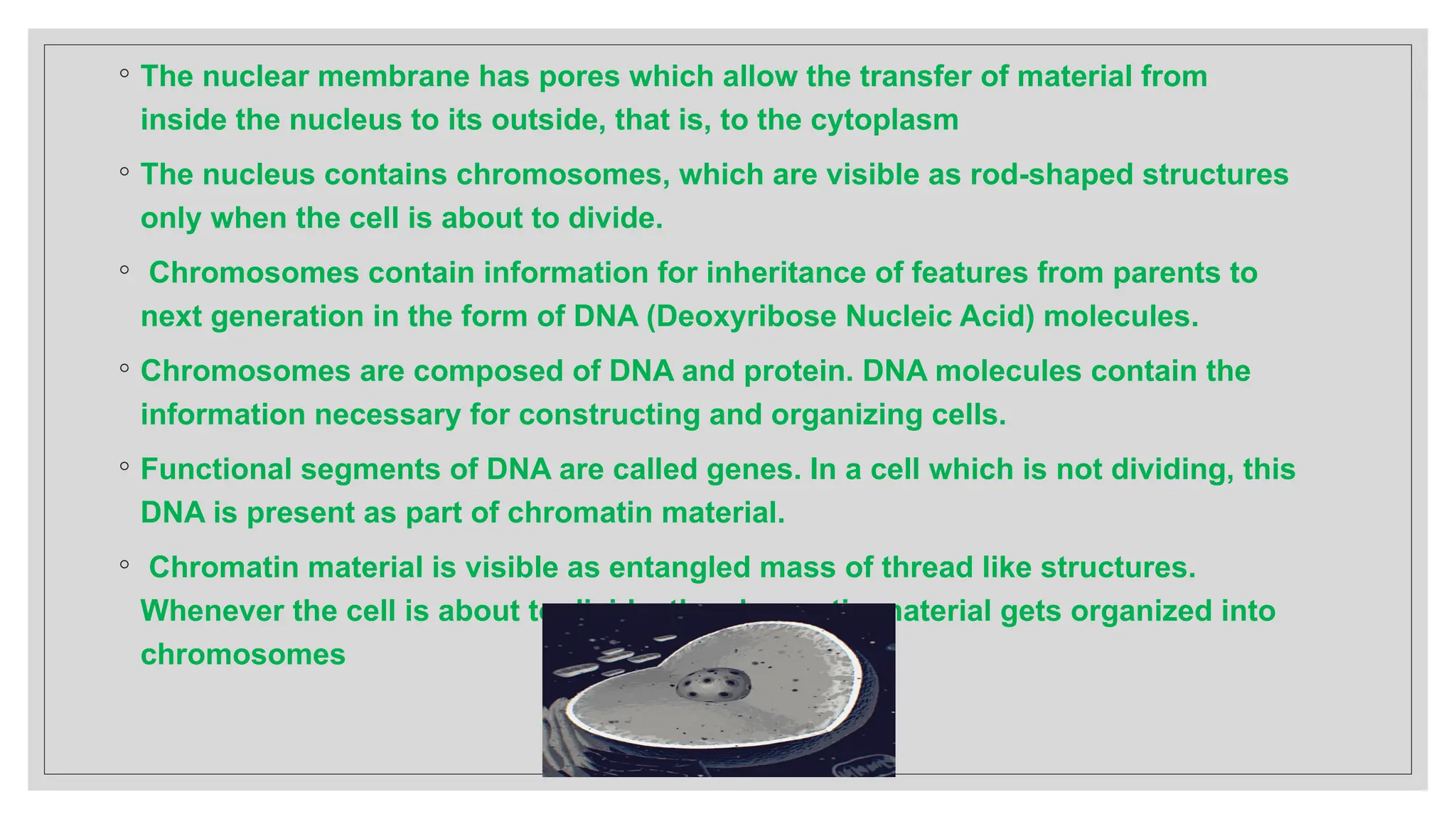
◦ The nuclearmembrane has pores which allow the transfer of material from
inside the nucleus to its outside, that is, to the cytoplasm
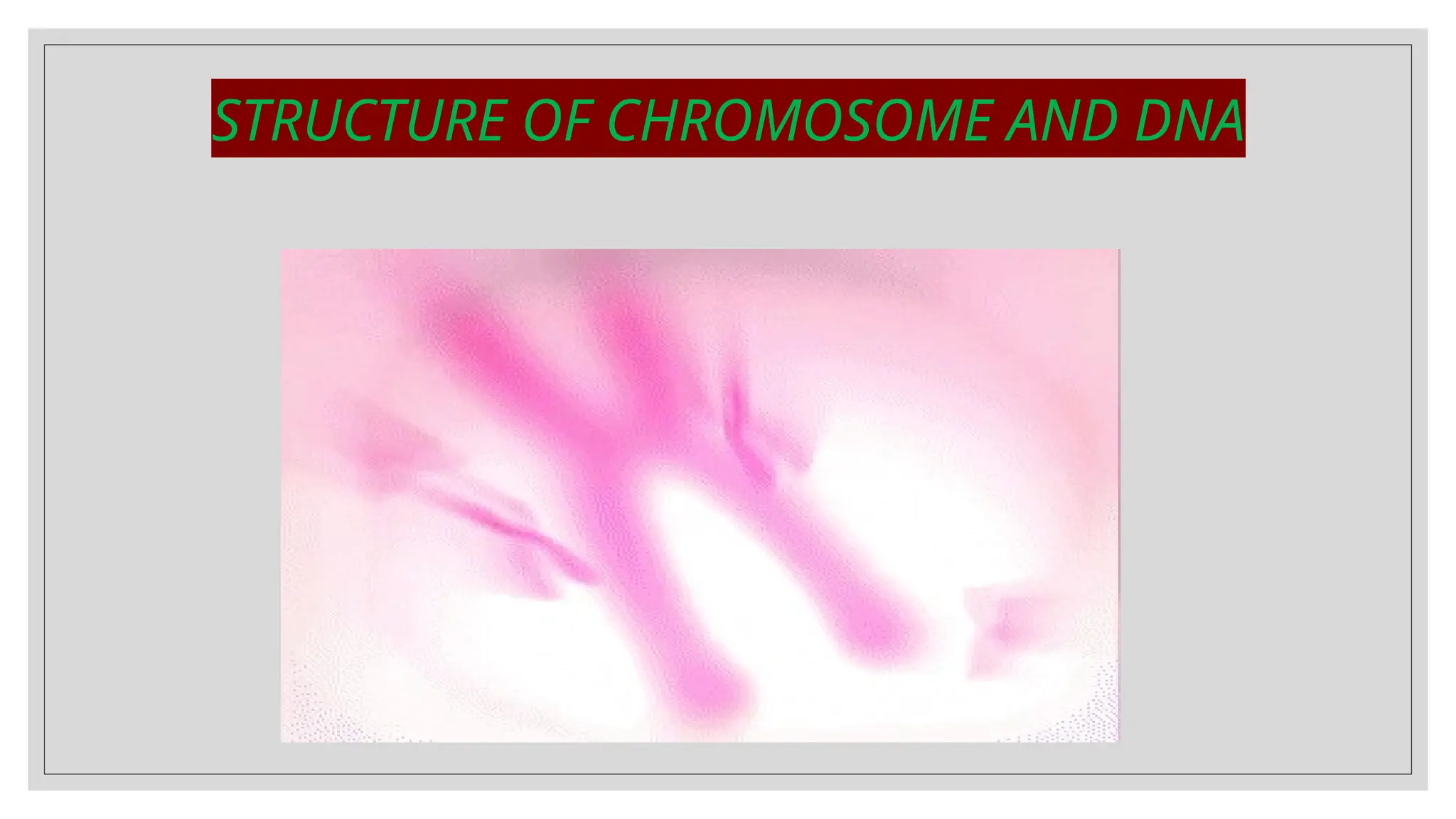
◦ The nucleus contains chromosomes, which are visible as rod-shaped structures
only when the cell is about to divide.
◦ Chromosomes contain information for inheritance of features from parents to
next generation in the form of DNA (Deoxyribose Nucleic Acid) molecules.
◦ Chromosomes are composed of DNA and protein. DNA molecules contain the
information necessary for constructing and organizing cells.
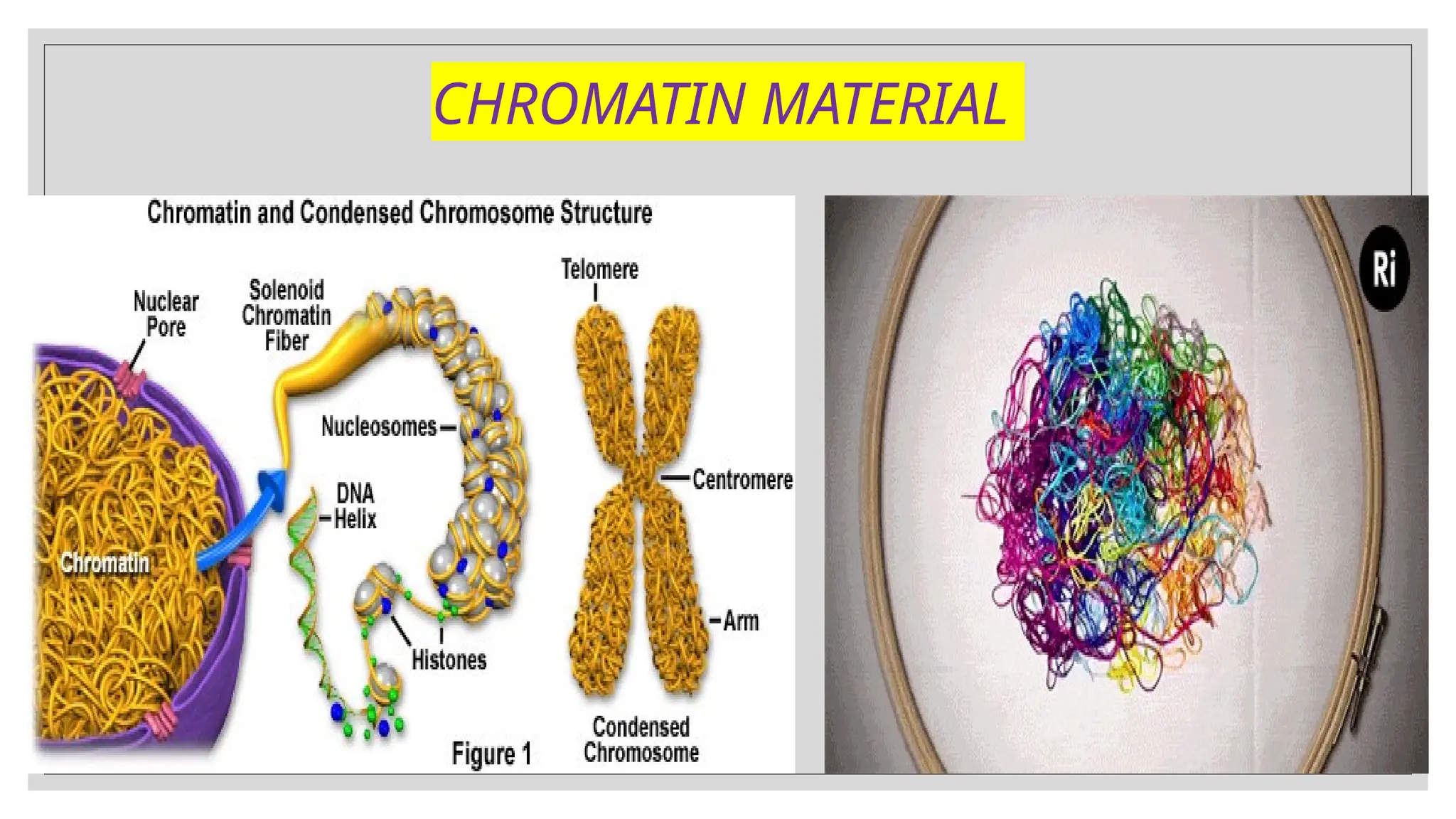
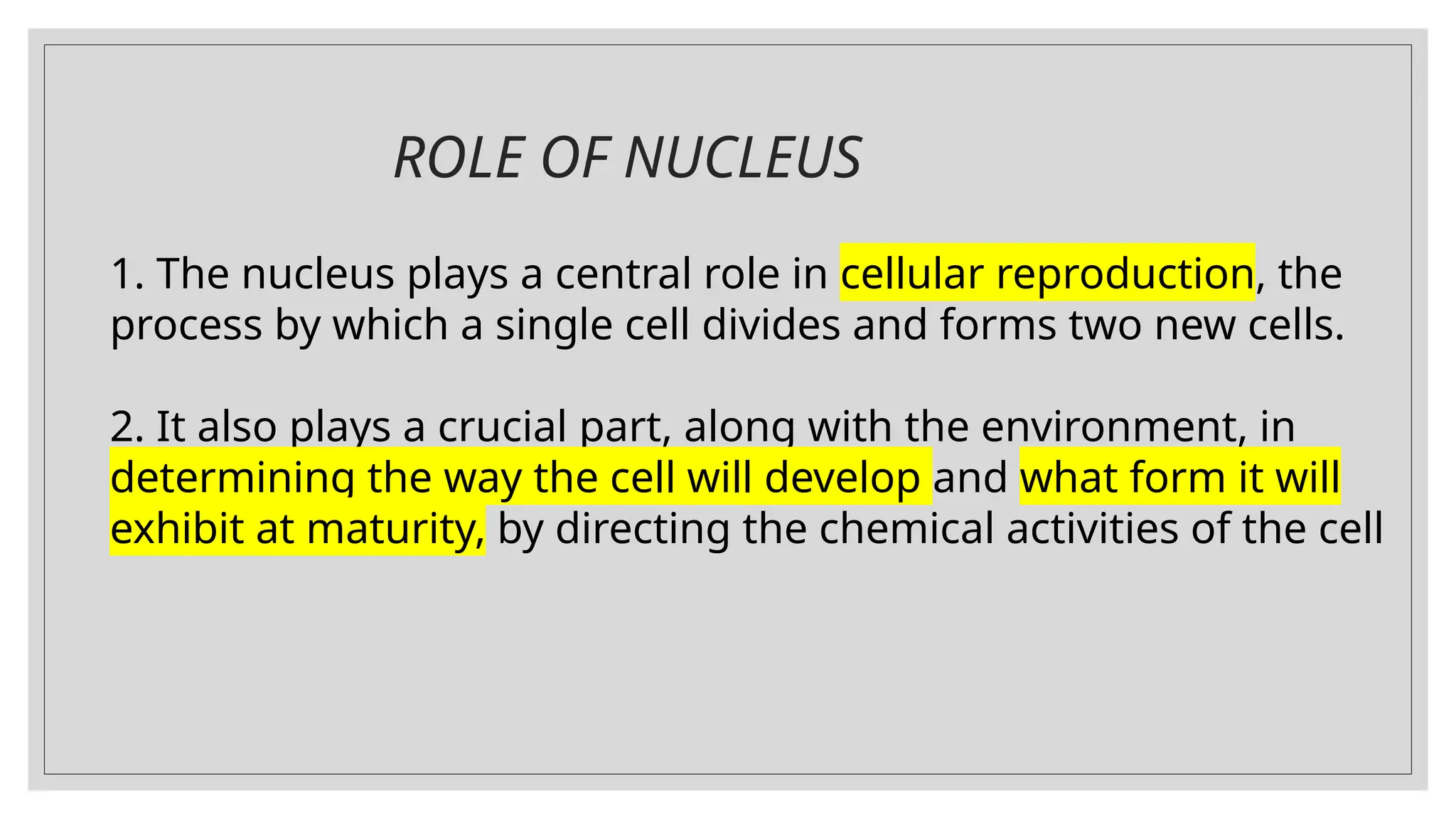
◦ Functional segments of DNA are called genes. In a cell which is not dividing, this
DNA is present as part of chromatin material.
◦ Chromatin material is visible as entangled mass of thread like structures.
Whenever the cell is about to divide, the chromatin material gets organized into
chromosomes
ROLE OF NUCLEUS
1.The nucleus plays a central role in cellular reproduction, the
process by which a single cell divides and forms two new cells.
2. It also plays a crucial part, along with the environment, in
determining the way the cell will develop and what form it will
exhibit at maturity, by directing the chemical activities of the cell
19.
ROLE OF CYTOPLASM
◦The cytoplasm is the fluid content inside the plasma membrane.
◦ It also contains many specialized cell organelles. Each of these organelles
performs a specific function for the cell. Cell organelles are enclosed by
membranes.
◦ In prokaryotes, beside the absence of a defined nuclear region, the
membrane-bound cell organelles are also absent.
◦ On the other hand, the eukaryotic cells have nuclear membrane as well
as membrane-enclosed organelles.
20.
CELL ORGANELLES
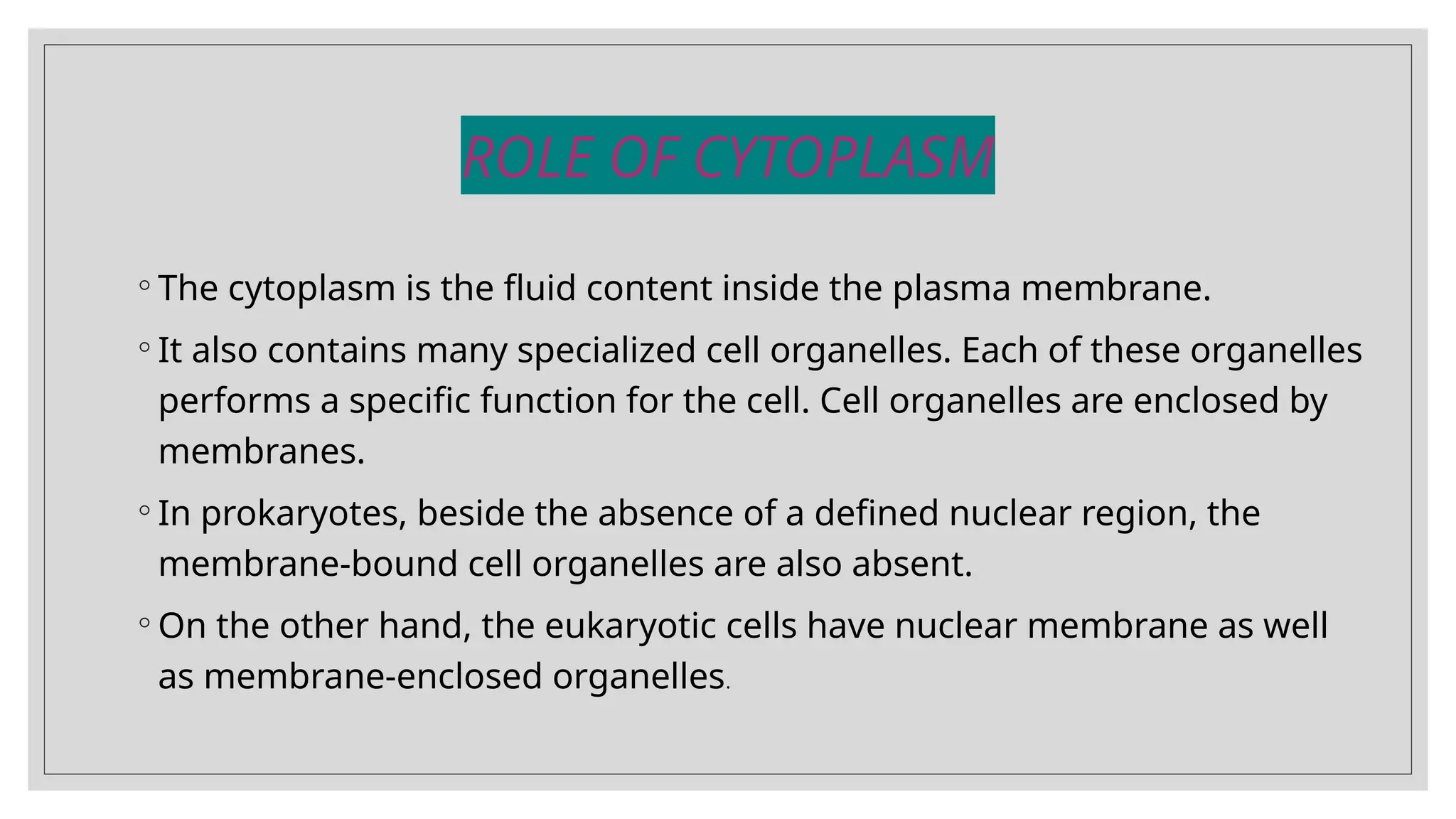
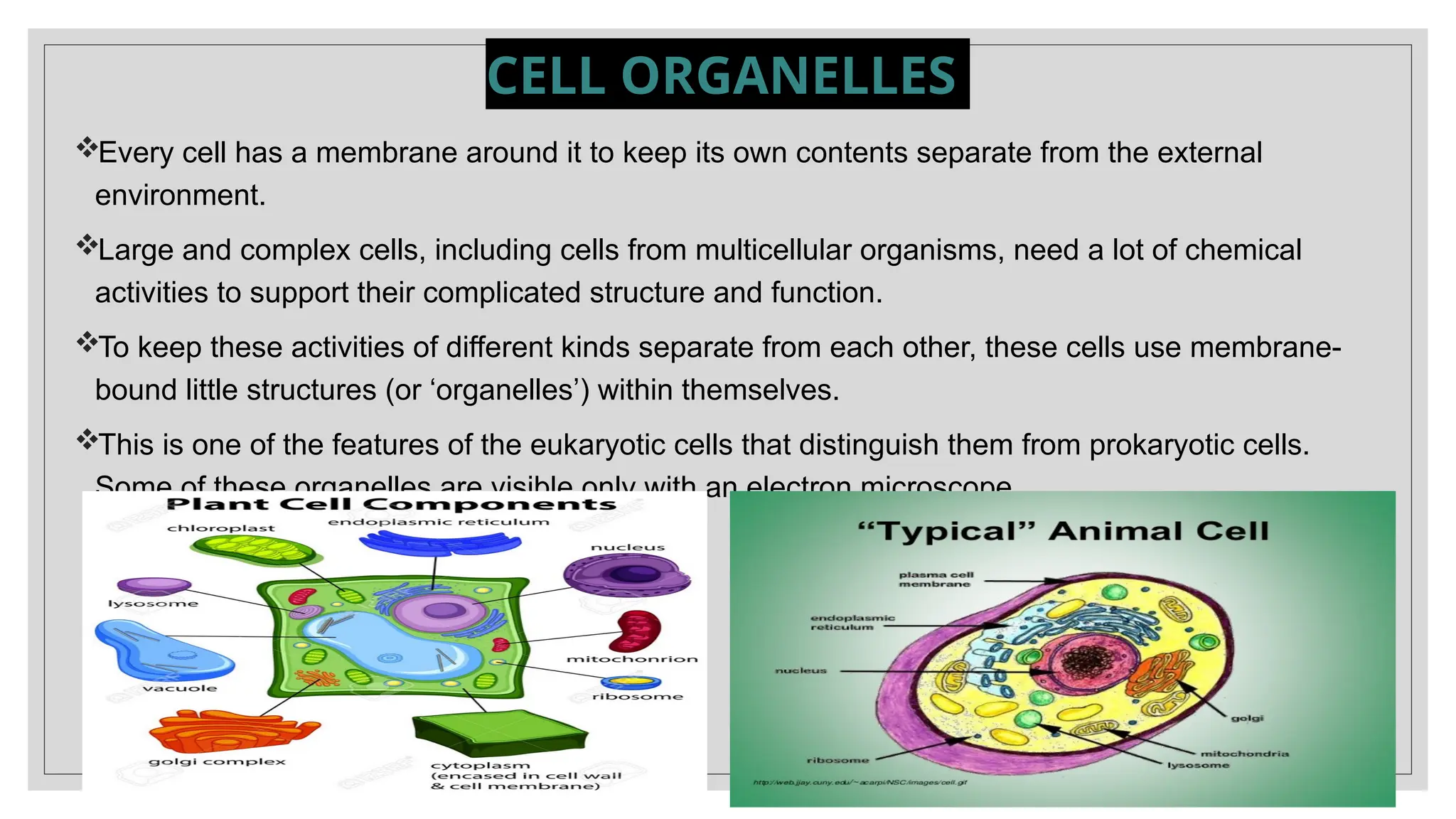
Every cellhas a membrane around it to keep its own contents separate from the external
environment.
Large and complex cells, including cells from multicellular organisms, need a lot of chemical
activities to support their complicated structure and function.
To keep these activities of different kinds separate from each other, these cells use membrane-
bound little structures (or ‘organelles’) within themselves.
This is one of the features of the eukaryotic cells that distinguish them from prokaryotic cells.
Some of these organelles are visible only with an electron microscope
21.
ENDOPLASMIC RETICULUM
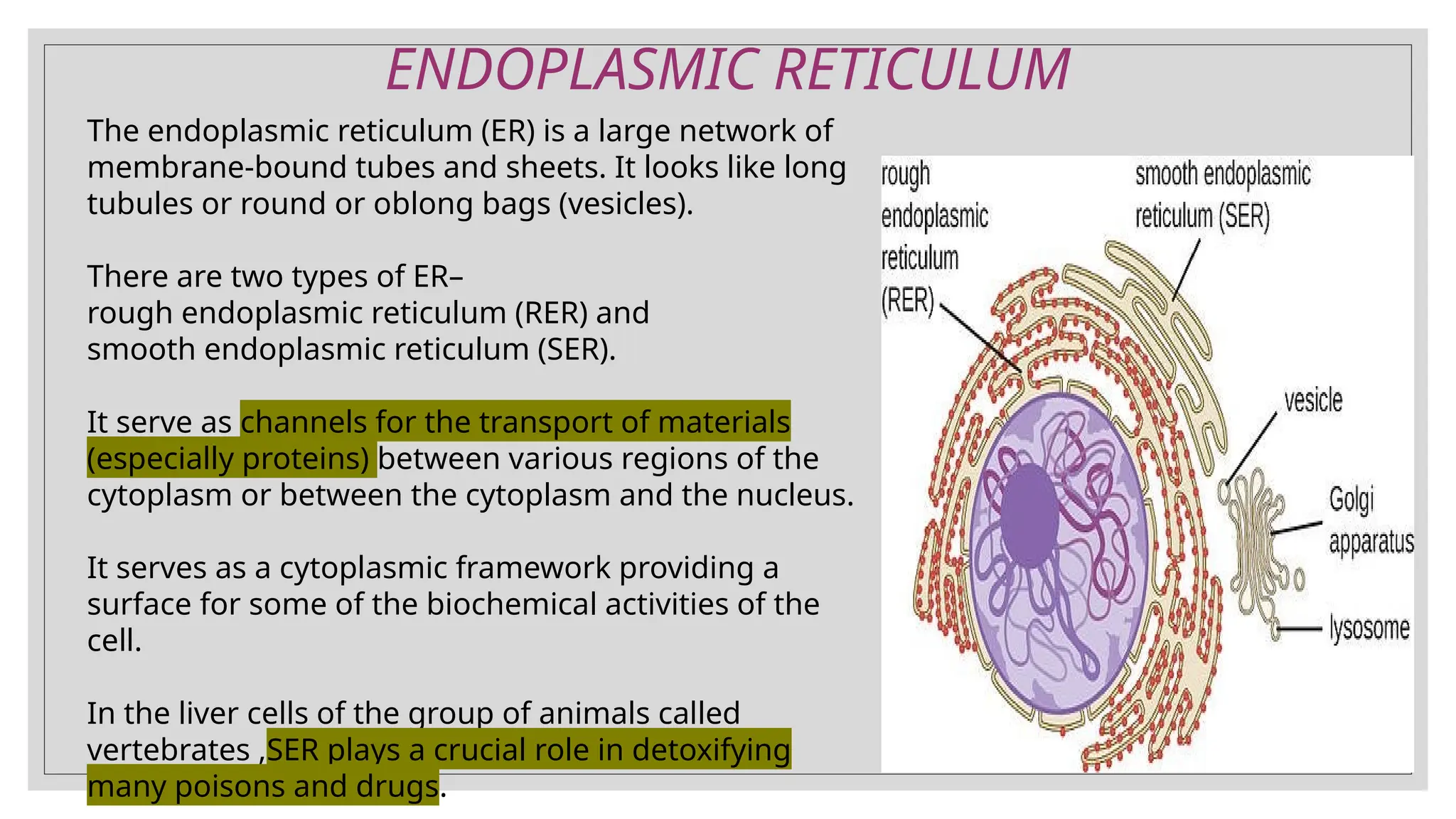
The endoplasmicreticulum (ER) is a large network of
membrane-bound tubes and sheets. It looks like long
tubules or round or oblong bags (vesicles).
There are two types of ER–
rough endoplasmic reticulum (RER) and
smooth endoplasmic reticulum (SER).
It serve as channels for the transport of materials
(especially proteins) between various regions of the
cytoplasm or between the cytoplasm and the nucleus.
It serves as a cytoplasmic framework providing a
surface for some of the biochemical activities of the
cell.
In the liver cells of the group of animals called
vertebrates ,SER plays a crucial role in detoxifying
many poisons and drugs.
22.
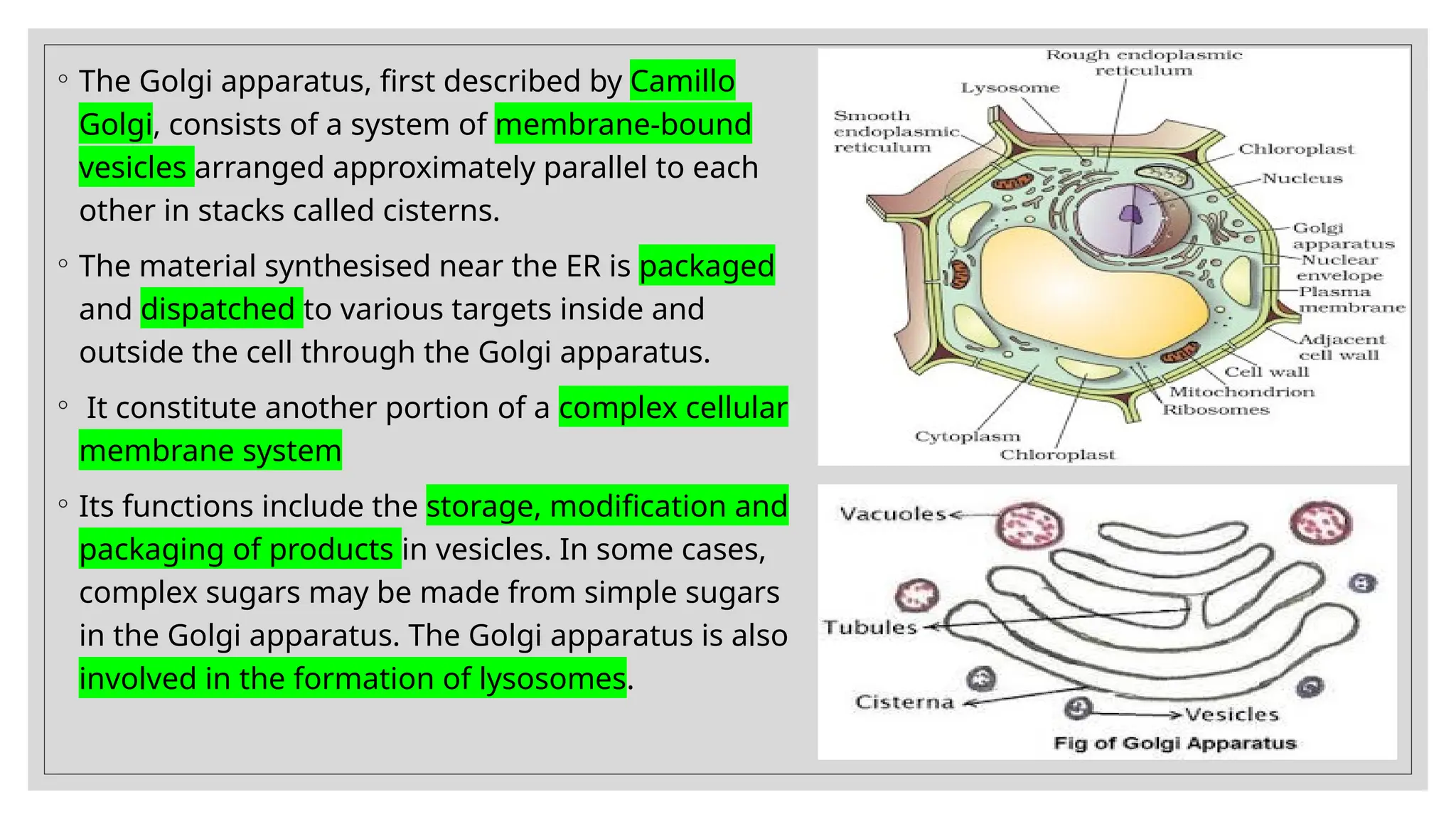
◦ The Golgiapparatus, first described by Camillo
Golgi, consists of a system of membrane-bound
vesicles arranged approximately parallel to each
other in stacks called cisterns.
◦ The material synthesised near the ER is packaged
and dispatched to various targets inside and
outside the cell through the Golgi apparatus.
◦ It constitute another portion of a complex cellular
membrane system
◦ Its functions include the storage, modification and
packaging of products in vesicles. In some cases,
complex sugars may be made from simple sugars
in the Golgi apparatus. The Golgi apparatus is also
involved in the formation of lysosomes.
23.
◦ Mitochondria areknown as the powerhouses of the cell
◦ The energy required for various chemical activities needed for life is
released by mitochondria in the form of ATP (Adenosine triphopshate)
molecules.
◦ ATP is known as the energy currency of the cell.
◦ The body uses energy stored in ATP for making new chemical compounds
and for mechanical work.
◦ Mitochondria are strange organelles in the sense that they have
their own DNA and ribosomes. Therefore, mitochondria are able
to make some of their own proteins