Cell
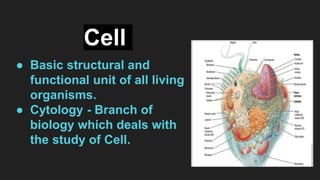
● Basic structural and
functional unit of all living
organisms.
● Cytology - Branch of
biology which deals with
the study of Cell.
Important points
● Anton van Leeuwenhoek first saw and described
a living cell.
● Robert Brown discovered nucleus .
● Robert Hooke- Introduced the term 'Cell’.
● Schleiden and Schwann - Cell Theory
● Rudolf Vichrow - Modified Cell Theory
● Largest known Cell - Unfertilised Ostrich Egg
● Smallest Cell - PPLO ( mycoplasma)
● Largest Human Cell- female ovum
● Longest Cell - Neuron
Types of Cell
● Prokaryotic Cell- (pro=primitive , karyos=
nucleus) Cell which do not have a nuclear
membrane and other membrane bound
organelles. Ex- Bacterial Cell
● Eukaryotic cell- (Eu = true; karyos = nucleus)cell
having well organised nuclear envelope and
several membrane bound organelle. Present in
unicellular and multicellular organisms.
Cell
Nucleus
Nuclear Membrane
Nucleoplasm
Nucleolus
Chromatin
Cytoplasm :
1.Cytosol
● 2.Organelle -
Mitochondria,Vacuoles
, Endoplasmic
Reticulum, Golgi
complex, lysosomes,
plastids, ribosome
Outer Membrane
Cell-wall (in Plants) and
plasma membrane
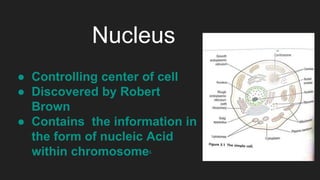
Nucleus
● Controlling center of cell
● Discovered by Robert
Brown
● Contains the information in
the form of nucleic Acid
within chromosome.
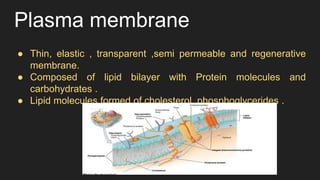
Plasma membrane
● Thin, elastic , transparent ,semi permeable and regenerative
membrane.
● Composed of lipid bilayer with Protein molecules and
carbohydrates .
● Lipid molecules formed of cholesterol ,phosphoglycerides .
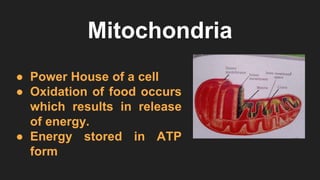
Mitochondria
● Power House of a cell
● Oxidation of food occurs
which results in release
of energy.
● Energy stored in ATP
form
Ribosome
● Protein Synthesis
● Tiny granules composed of RNA
● Present in outer surface of Nuclear
envelope,rough Endoplasmic Reticulum.
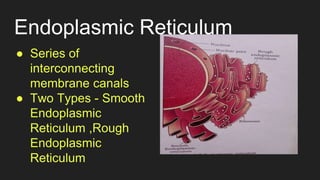
Endoplasmic Reticulum
● Series of
interconnecting
membrane canals
● Two Types - Smooth
Endoplasmic
Reticulum ,Rough
Endoplasmic
Reticulum
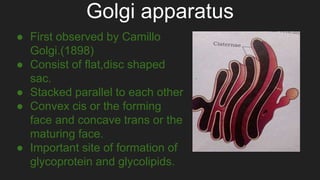
Golgi apparatus
● First observed by Camillo
Golgi.(1898)
● Consist of flat,disc shaped
sac.
● Stacked parallel to each other
● Convex cis or the forming
face and concave trans or the
maturing face.
● Important site of formation of
glycoprotein and glycolipids.
Lysosomes
● Suicidal Bags of the cell .
● Polymorphic
● Having hydrolytic enzyme.These enzyme
fiction at acidic pH .
● Help in carcinogenesis.
● Membrane bound space in cytoplasm
● Bound by tonoplast
● In Plants tonoplast facilitates transport of ions and
other materials.
● In ameoba 'contractile vacuole’ important for
excretion .
● In protist ,food Vacuoles are formed by engulfing
the food particles.
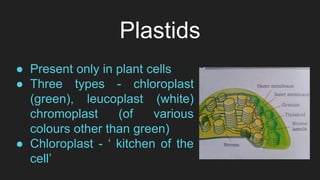
Plastids
● Present only in plant cells
● Three types - chloroplast
(green), leucoplast (white)
chromoplast (of various
colours other than green)
● Chloroplast - ‘ kitchen of the
cell’
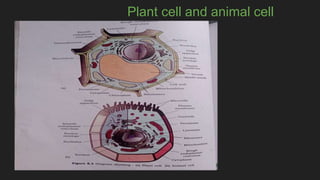
Plant cell and animal cell
Cell

Cell

  • 1.
    Cell ● Basic structuraland functional unit of all living organisms. ● Cytology - Branch of biology which deals with the study of Cell.
  • 2.
    Important points ● Antonvan Leeuwenhoek first saw and described a living cell. ● Robert Brown discovered nucleus . ● Robert Hooke- Introduced the term 'Cell’. ● Schleiden and Schwann - Cell Theory ● Rudolf Vichrow - Modified Cell Theory ● Largest known Cell - Unfertilised Ostrich Egg ● Smallest Cell - PPLO ( mycoplasma) ● Largest Human Cell- female ovum ● Longest Cell - Neuron
  • 3.
    Types of Cell ●Prokaryotic Cell- (pro=primitive , karyos= nucleus) Cell which do not have a nuclear membrane and other membrane bound organelles. Ex- Bacterial Cell ● Eukaryotic cell- (Eu = true; karyos = nucleus)cell having well organised nuclear envelope and several membrane bound organelle. Present in unicellular and multicellular organisms.
  • 4.
    Cell Nucleus Nuclear Membrane Nucleoplasm Nucleolus Chromatin Cytoplasm : 1.Cytosol ●2.Organelle - Mitochondria,Vacuoles , Endoplasmic Reticulum, Golgi complex, lysosomes, plastids, ribosome Outer Membrane Cell-wall (in Plants) and plasma membrane
  • 5.
    Nucleus ● Controlling centerof cell ● Discovered by Robert Brown ● Contains the information in the form of nucleic Acid within chromosome.
  • 6.
    Plasma membrane ● Thin,elastic , transparent ,semi permeable and regenerative membrane. ● Composed of lipid bilayer with Protein molecules and carbohydrates . ● Lipid molecules formed of cholesterol ,phosphoglycerides .
  • 7.
    Mitochondria ● Power Houseof a cell ● Oxidation of food occurs which results in release of energy. ● Energy stored in ATP form
  • 8.
    Ribosome ● Protein Synthesis ●Tiny granules composed of RNA ● Present in outer surface of Nuclear envelope,rough Endoplasmic Reticulum.
  • 9.
    Endoplasmic Reticulum ● Seriesof interconnecting membrane canals ● Two Types - Smooth Endoplasmic Reticulum ,Rough Endoplasmic Reticulum
  • 10.
    Golgi apparatus ● Firstobserved by Camillo Golgi.(1898) ● Consist of flat,disc shaped sac. ● Stacked parallel to each other ● Convex cis or the forming face and concave trans or the maturing face. ● Important site of formation of glycoprotein and glycolipids.
  • 11.
    Lysosomes ● Suicidal Bagsof the cell . ● Polymorphic ● Having hydrolytic enzyme.These enzyme fiction at acidic pH . ● Help in carcinogenesis.
  • 12.
    ● Membrane boundspace in cytoplasm ● Bound by tonoplast ● In Plants tonoplast facilitates transport of ions and other materials. ● In ameoba 'contractile vacuole’ important for excretion . ● In protist ,food Vacuoles are formed by engulfing the food particles.
  • 13.
    Plastids ● Present onlyin plant cells ● Three types - chloroplast (green), leucoplast (white) chromoplast (of various colours other than green) ● Chloroplast - ‘ kitchen of the cell’
  • 14.
    Plant cell andanimal cell