EMBANKMENT DAMS
MODULE II
DESIGN OF HYDRAULIC
STRUCTURE
INTRODUCTION
• An embankment dam, as defined earlier, is one
that is built of natural materials. In its simplest
and oldest form, the embankment dam was
constructed with low-permeability soils to a
nominally homogeneous profile.
• The section featured neither internal drainage nor
a cutoff to restrict seepage flow through the
foundation. Dams of this type proved vulnerable
associated with uncontrolled seepage, but there
was little progress in design prior to the
nineteenth century.
1/8/2014

2
INTRODUCTION
It was then increasingly recognized that, in
principle, larger embankment dams required
two component elements.
1. An impervious water-retaining element or
core of very low permeability of soil, for
example, soft clay or a heavily remoulded
‘puddle’ clay, and
2. Supporting shoulders of coarser
earthfill(or of rockfill), to provide structural
stability
1/8/2014

3
DESIGN AND ANALYSIS

• Although the loads acting on the concrete
gravity dam (discussed SOON) is the same
acting on the embankment dam, the
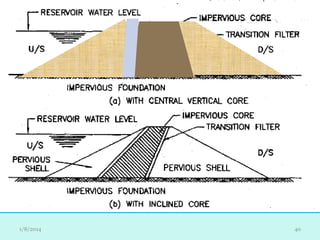
method of design and analysis of the two
differ considerably.
• This is mostly because the gravity dam
acts as one monolithic structure, and
it has to resist the destabilizing forces with
its own self weight mainly.
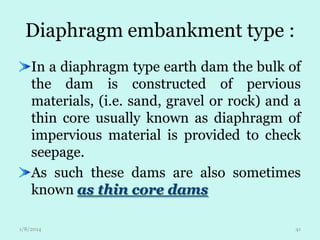
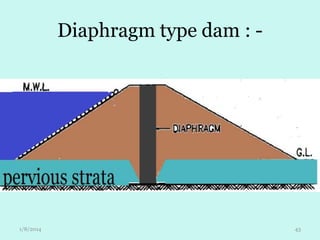
• Failure to do so may lead to its
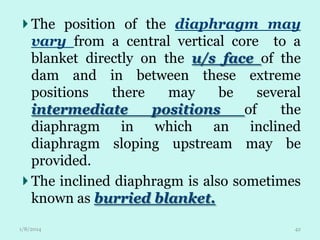
topping, sliding or crushing of some of the
highly stressed regions.
1/8/2014

4
An embankment dam, on the other
hand, cannot be considered monolithic.
It is actually a conglomerate of
particles and on the action of the various
modes, which are much different from
those of a gravity dam.
Hence, the design of an embankment dam
is done in a different way than that of a
gravity dam. In fact, the design procedures
are targeted towards resisting the failure
of an embankment dam under different
modes, which are explained in the next
section.
1/8/2014

5
Embankment dam
types
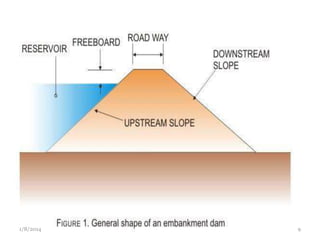
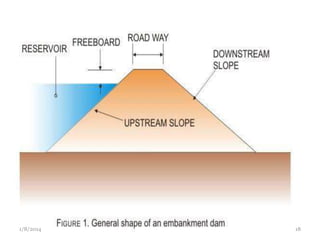
• An embankment dam, whether made of
earth completely or of rock in-filled with
earth core, has a trapezoidal shape with
the shoulder slopes decided from the
point of stability against the various
possible modes of failure,

1/8/2014

6
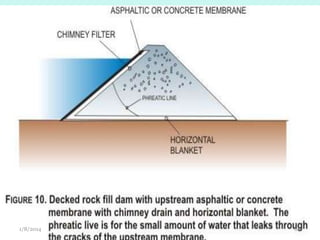
• The top crest is kept wide so as to accommodate
roadway In order to check the seepage through
the body of the dam, a number of variations are
provided. For earthen embankment dams, these
range from the following types:
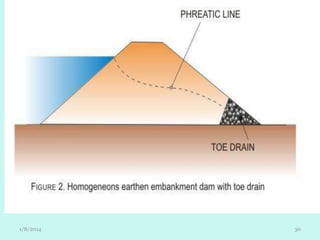
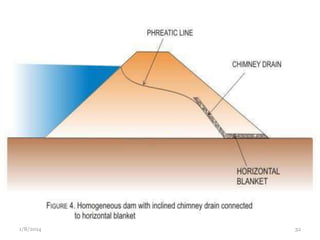
1. Homogeneous dam with toe drain
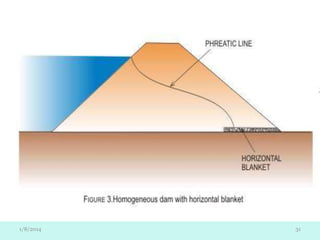
2. Homogeneous dam with horizontal blanket
3. Homogeneous dam with chimney drain and
horizontal blanket
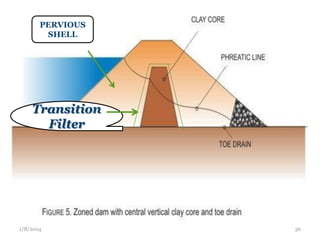
4. Zoned dam with central vertical core & toe drain
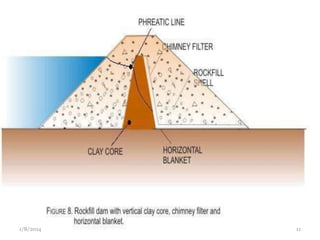
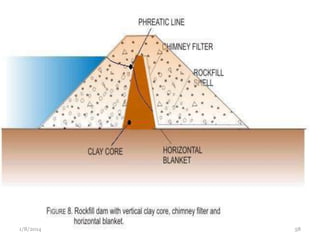
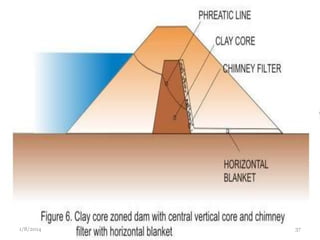
5. Zoned dam with central vertical core, chimney
filter and horizontal blanket
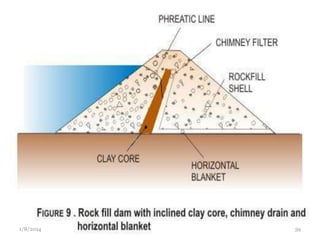
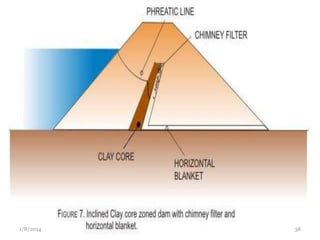
6. Zoned dam with inclined core, chimney filter and
horizontal blanket
1/8/2014

7
Embankment dam
types
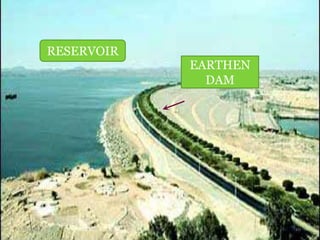
EARTHEN DAM

ROCKFILL DAM

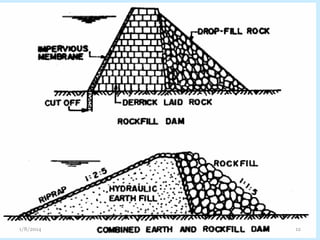
Earth dams have been
built since the early
days of civilization.
They are constructed
mainly from earth (or
soil). Fig..

Rockfill dams are
constructed mainly
from rockfill or pieces
of rocks. Fig. 2.1(1
They require somewhat

stronger foundations
as compared to earth
1/8/2014

dams,

8
1/8/2014

9
RESERVOIR

1/8/2014

EARTHEN
DAM

10
1/8/2014

11
1/8/2014

12
For example, The
Nurek dam across
river Vakhsh in
U.S.S.R, which is
the second highest
dam in the world
is an earth dam
and it is 300 m
high

1/8/2014

but the foundation need

not be as strong as
those for gravity
dams.
13
Composite earth and rockfill
dams :
These dmas are constructed from
both earth and rockfill. Fig.
The Rogun dam across river
Vakhsh in U.S.S.R. is the
highest dam in the work

1/8/2014

14
which is a composite earth and
rockfill type embankment dam
antf it is 335 m high.
In India, Tehri dam across
river
Bhagirathi
is
the
highest dam which is also a
compositie earth and rockfill dam
type embankment dam and it is
261 m high.
1/8/2014

15
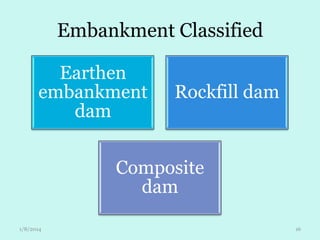
Embankment Classified
Earthen
embankment
dam

Rockfill dam

Composite
dam
1/8/2014

16
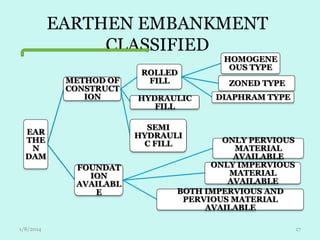
EARTHEN EMBANKMENT
CLASSIFIED
METHOD OF
CONSTRUCT
ION

HYDRAULIC
FILL

ZONED TYPE
DIAPHRAM TYPE

SEMI
HYDRAULI
C FILL

EAR
THE
N
DAM
FOUNDAT
ION
AVAILABL
E

1/8/2014

ROLLED
FILL

HOMOGENE
OUS TYPE

ONLY PERVIOUS
MATERIAL
AVAILABLE
ONLY IMPERVIOUS
MATERIAL
AVAILABLE
BOTH IMPERVIOUS AND
PERVIOUS MATERIAL
AVAILABLE
17
1/8/2014

18
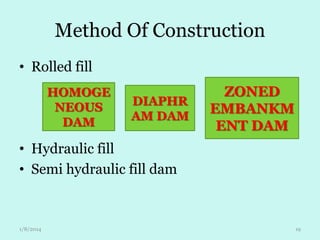
Method Of Construction
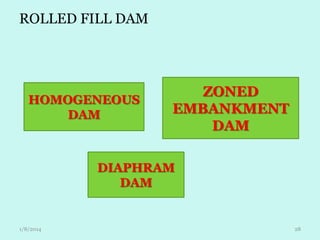
• Rolled fill
HOMOGE
NEOUS
DAM

DIAPHR
AM DAM

ZONED
EMBANKM
ENT DAM

• Hydraulic fill
• Semi hydraulic fill dam

1/8/2014

19
Rolled fill
• A rolled filled dam is the one which is
constructed in successive, mechanically
compacted
layers.
The
material
(sand, clay, gravel, etc.) is transported from
the borrow Pits to the dam site by trucks or
scrapers.
• It is then spread within the dam section by
Bulldozers to form layers of 15 to 45 cm
thickness. Each layer is then thoroughly
compacted bonded with the preceding layer
by means of power operated rollers of proper
design weight.
1/8/2014

20
Usually sheep foot rollers and heavy
pneumatic-tyred rollers are used. For
proper compaction the moisture
content of the material should be near
that for OMC (Optimum Moisture
Content), for which required quantity
of water is sprinkled on each layer of
soil during compaction.

1/8/2014

21
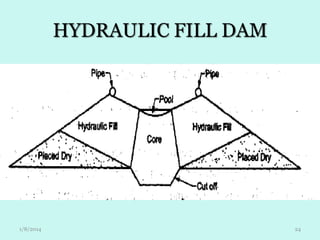
Hydraulic fill
• In the case of hydraulic fill dam the
transportation of the material from
borrow pits the dam site as well as its
placement in final position in the dam is
done by water.
• In this case at the borrow pits the material
is mixed with water to form slush which is
transported through flumes or pipes and
deposited near the faces of the dam.
1/8/2014

22
• The coarser material of the slush stay near
the faces of the dam while the finer'ones
moves towards centre and get deposited
there.
• This would provide a dam section with
shoulders of coarse-free draining material
and an imperious central core of fine
grained material
• as clay and silt. In this method no
compaction is required.
1/8/2014

23
HYDRAULIC FILL DAM

1/8/2014

24
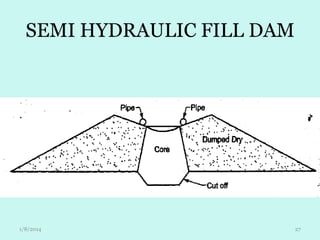
Semi-hydraulic fill dams :
In semi-hydraulic fill dams, the coarse
material is dumped from trucks as in
case of rolled fill dam without use of water.
Some of dumped material is then moved to
its final position in the dam by action of
water.
For this jet of water are directed on
dumped fill which causes finer material
from fill near faces of dam to be washed
away.
1/8/2014

25
The finer material moves towards the
central position of the dam and is
deposited there thus forming an
impervious central core while the
coarser material stays near the face of
dam.
However absence of proper jetting
action the dumped fill faces of dam may be
more dense and impervious than the
material immediately below it which may
result in failure.
In this case no compaction is done.
1/8/2014

26
SEMI HYDRAULIC FILL DAM

1/8/2014

27
ROLLED FILL DAM

HOMOGENEOUS
DAM

ZONED
EMBANKMENT
DAM

DIAPHRAM
DAM

1/8/2014

28
HOMOGENEOUS DAM

1/8/2014

29
1/8/2014

30
1/8/2014

31
1/8/2014

32
HOMOGENEOUS TYPE DAM
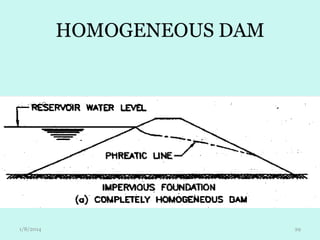
A purely homogeneous type earth dam is
composed of a single kind of
material, dams are usually built of
impervious or semi-impervious soils, but
several successful have been built of
relatively pervious sands and sand
gravel mixture.
These dams are used only for low to
moderate heights
1/8/2014

33
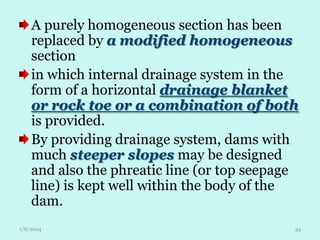
A purely homogeneous section has been
replaced by a modified homogeneous
section
in which internal drainage system in the
form of a horizontal drainage blanket
or rock toe or a combination of both
is provided.
By providing drainage system, dams with
much steeper slopes may be designed
and also the phreatic line (or top seepage
line) is kept well within the body of the
dam.
1/8/2014

34
Zoned type dam :
• A zoned embankment dam is composed of
more than one kind of material. This is most
common type of a rolled fill dam in which a
central impervious core is flanked by zones of
materials considerably more pervious.
• The pervious zones enclose, support and
protect the impervious core. The upstream
pervious zone provides free drainage during
sudden drawdown and the downstream
pervious zone acts as a drain to control the
phreatic line
• The impervious core checks the seepage.
1/8/2014

35
PERVIOUS
SHELL

Transition
Filter

1/8/2014

36
1/8/2014

37
1/8/2014

38
The pervious zones may consists of
sand, gravel, cobbles or rock or
mixtures of these materials while the
core consists of impervious soil such as
clay, silt, etc.
In general, dam is considered as
zoned embankment type dam if the
horizontal width of impervious core
at any elevation equals or exceeds the
height of the dam above in the dam and
is not less than 3 m.
1/8/2014

39
1/8/2014

40
Diaphragm embankment type :
In a diaphragm type earth dam the bulk of
the dam is constructed of pervious
materials, (i.e. sand, gravel or rock) and a
thin core usually known as diaphragm of
impervious material is provided to check
seepage.
As such these dams are also sometimes
known as thin core dams
1/8/2014

41
The position of the diaphragm may
vary from a central vertical core to a
blanket directly on the u/s face of the
dam and in between these extreme
positions
there
may
be
several
intermediate
positions
of
the
diaphragm in which an inclined
diaphragm sloping upstream may be
provided.
The inclined diaphragm is also sometimes
known as burried blanket.
1/8/2014

42
Diaphragm type dam : -

1/8/2014

43
• Scan p.n.modi page no 448

1/8/2014

44
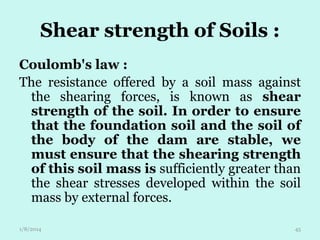
Shear strength of Soils :
Coulomb's law :
The resistance offered by a soil mass against
the shearing forces, is known as shear
strength of the soil. In order to ensure
that the foundation soil and the soil of
the body of the dam are stable, we
must ensure that the shearing strength
of this soil mass is sufficiently greater than
the shear stresses developed within the soil
mass by external forces.
1/8/2014

45
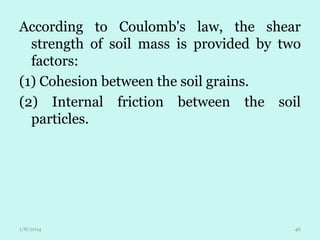
According to Coulomb's law, the shear
strength of soil mass is provided by two
factors:
(1) Cohesion between the soil grains.
(2) Internal friction between the soil
particles.

1/8/2014

46
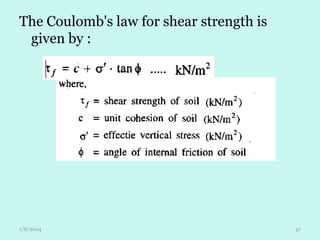
The Coulomb's law for shear strength is
given by :

1/8/2014

47
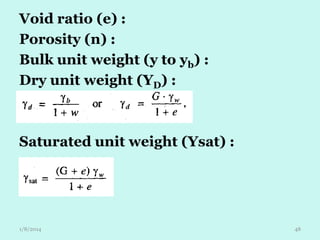
Void ratio (e) :
Porosity (n) :
Bulk unit weight (y to yb) :
Dry unit weight (YD) :

Saturated unit weight (Ysat) :

1/8/2014

48
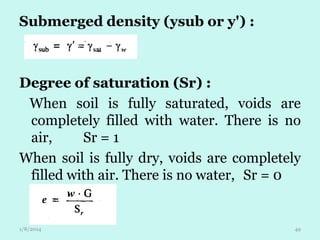
Submerged density (ysub or y') :

Degree of saturation (Sr) :
When soil is fully saturated, voids are
completely filled with water. There is no
air,
Sr = 1
When soil is fully dry, voids are completely
filled with air. There is no water, Sr = 0

1/8/2014

49
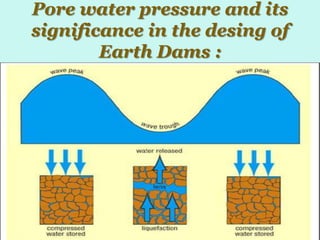
Pore water pressure and its
significance in the desing of
Earth Dams :

1/8/2014

50
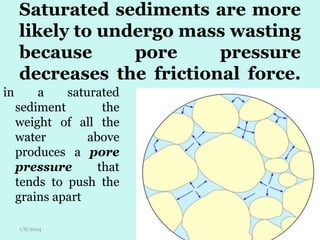
Saturated sediments are more
likely to undergo mass wasting
because
pore
pressure
decreases the frictional force.
in

a
saturated
sediment
the
weight of all the
water
above
produces a pore
pressure
that
tends to push the
grains apart
1/8/2014

51
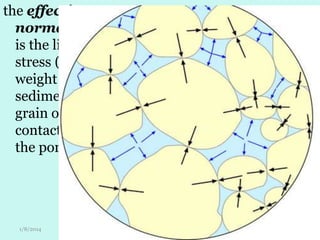
the effective
normal stress
is the lithostatic
stress (from the
weight of the
sediments in
grain on grain
contact) minus
the pore pressure

1/8/2014

52
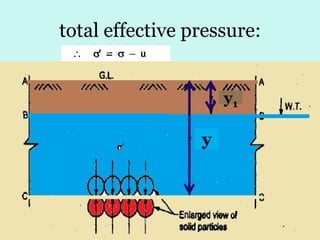
total effective pressure:
y1

y

1/8/2014

53
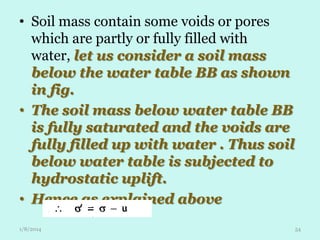
• Soil mass contain some voids or pores
which are partly or fully filled with
water, let us consider a soil mass
below the water table BB as shown
in fig.
• The soil mass below water table BB
is fully saturated and the voids are
fully filled up with water . Thus soil
below water table is subjected to
hydrostatic uplift.
• Hence as explained above
1/8/2014

54
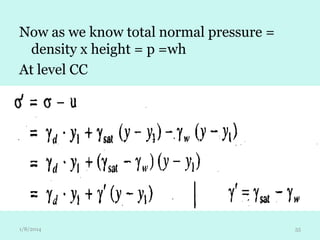
Now as we know total normal pressure =
density x height = p =wh
At level CC

1/8/2014

55
• It, therefore, become evident that the
effective normal stress is much less than
the total normal stress, as a part of the
total stress gets consumed by water as
pore pressure.
• The pore water pressure acts equally in
all directions. It does not press the soil
grains in its frictional resistance, that is
why, it is called a neutral stress.
• When the pore water pressure is
considered, the Coulomb's law will become
1/8/2014

56
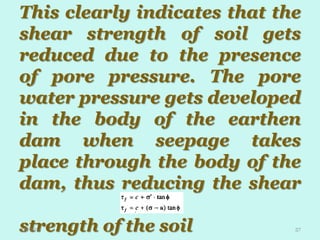
This clearly indicates that the
shear strength of soil gets
reduced due to the presence
of pore pressure. The pore
water pressure gets developed
in the body of the earthen
dam when seepage takes
place through the body of the
dam, thus reducing the shear
st
strength of the soil
1/8/2014

57
1/8/2014

58
1/8/2014

59
1/8/2014

60

Embankment lecture 1

  • 1.
    EMBANKMENT DAMS MODULE II DESIGNOF HYDRAULIC STRUCTURE
  • 2.
    INTRODUCTION • An embankmentdam, as defined earlier, is one that is built of natural materials. In its simplest and oldest form, the embankment dam was constructed with low-permeability soils to a nominally homogeneous profile. • The section featured neither internal drainage nor a cutoff to restrict seepage flow through the foundation. Dams of this type proved vulnerable associated with uncontrolled seepage, but there was little progress in design prior to the nineteenth century. 1/8/2014 2
  • 3.
    INTRODUCTION It was thenincreasingly recognized that, in principle, larger embankment dams required two component elements. 1. An impervious water-retaining element or core of very low permeability of soil, for example, soft clay or a heavily remoulded ‘puddle’ clay, and 2. Supporting shoulders of coarser earthfill(or of rockfill), to provide structural stability 1/8/2014 3
  • 4.
    DESIGN AND ANALYSIS •Although the loads acting on the concrete gravity dam (discussed SOON) is the same acting on the embankment dam, the method of design and analysis of the two differ considerably. • This is mostly because the gravity dam acts as one monolithic structure, and it has to resist the destabilizing forces with its own self weight mainly. • Failure to do so may lead to its topping, sliding or crushing of some of the highly stressed regions. 1/8/2014 4
  • 5.
    An embankment dam,on the other hand, cannot be considered monolithic. It is actually a conglomerate of particles and on the action of the various modes, which are much different from those of a gravity dam. Hence, the design of an embankment dam is done in a different way than that of a gravity dam. In fact, the design procedures are targeted towards resisting the failure of an embankment dam under different modes, which are explained in the next section. 1/8/2014 5
  • 6.
    Embankment dam types • Anembankment dam, whether made of earth completely or of rock in-filled with earth core, has a trapezoidal shape with the shoulder slopes decided from the point of stability against the various possible modes of failure, 1/8/2014 6
  • 7.
    • The topcrest is kept wide so as to accommodate roadway In order to check the seepage through the body of the dam, a number of variations are provided. For earthen embankment dams, these range from the following types: 1. Homogeneous dam with toe drain 2. Homogeneous dam with horizontal blanket 3. Homogeneous dam with chimney drain and horizontal blanket 4. Zoned dam with central vertical core & toe drain 5. Zoned dam with central vertical core, chimney filter and horizontal blanket 6. Zoned dam with inclined core, chimney filter and horizontal blanket 1/8/2014 7
  • 8.
    Embankment dam types EARTHEN DAM ROCKFILLDAM Earth dams have been built since the early days of civilization. They are constructed mainly from earth (or soil). Fig.. Rockfill dams are constructed mainly from rockfill or pieces of rocks. Fig. 2.1(1 They require somewhat stronger foundations as compared to earth 1/8/2014 dams, 8
  • 9.
  • 10.
  • 11.
  • 12.
  • 13.
    For example, The Nurekdam across river Vakhsh in U.S.S.R, which is the second highest dam in the world is an earth dam and it is 300 m high 1/8/2014 but the foundation need not be as strong as those for gravity dams. 13
  • 14.
    Composite earth androckfill dams : These dmas are constructed from both earth and rockfill. Fig. The Rogun dam across river Vakhsh in U.S.S.R. is the highest dam in the work 1/8/2014 14
  • 15.
    which is acomposite earth and rockfill type embankment dam antf it is 335 m high. In India, Tehri dam across river Bhagirathi is the highest dam which is also a compositie earth and rockfill dam type embankment dam and it is 261 m high. 1/8/2014 15
  • 16.
  • 17.
    EARTHEN EMBANKMENT CLASSIFIED METHOD OF CONSTRUCT ION HYDRAULIC FILL ZONEDTYPE DIAPHRAM TYPE SEMI HYDRAULI C FILL EAR THE N DAM FOUNDAT ION AVAILABL E 1/8/2014 ROLLED FILL HOMOGENE OUS TYPE ONLY PERVIOUS MATERIAL AVAILABLE ONLY IMPERVIOUS MATERIAL AVAILABLE BOTH IMPERVIOUS AND PERVIOUS MATERIAL AVAILABLE 17
  • 18.
  • 19.
    Method Of Construction •Rolled fill HOMOGE NEOUS DAM DIAPHR AM DAM ZONED EMBANKM ENT DAM • Hydraulic fill • Semi hydraulic fill dam 1/8/2014 19
  • 20.
    Rolled fill • Arolled filled dam is the one which is constructed in successive, mechanically compacted layers. The material (sand, clay, gravel, etc.) is transported from the borrow Pits to the dam site by trucks or scrapers. • It is then spread within the dam section by Bulldozers to form layers of 15 to 45 cm thickness. Each layer is then thoroughly compacted bonded with the preceding layer by means of power operated rollers of proper design weight. 1/8/2014 20
  • 21.
    Usually sheep footrollers and heavy pneumatic-tyred rollers are used. For proper compaction the moisture content of the material should be near that for OMC (Optimum Moisture Content), for which required quantity of water is sprinkled on each layer of soil during compaction. 1/8/2014 21
  • 22.
    Hydraulic fill • Inthe case of hydraulic fill dam the transportation of the material from borrow pits the dam site as well as its placement in final position in the dam is done by water. • In this case at the borrow pits the material is mixed with water to form slush which is transported through flumes or pipes and deposited near the faces of the dam. 1/8/2014 22
  • 23.
    • The coarsermaterial of the slush stay near the faces of the dam while the finer'ones moves towards centre and get deposited there. • This would provide a dam section with shoulders of coarse-free draining material and an imperious central core of fine grained material • as clay and silt. In this method no compaction is required. 1/8/2014 23
  • 24.
  • 25.
    Semi-hydraulic fill dams: In semi-hydraulic fill dams, the coarse material is dumped from trucks as in case of rolled fill dam without use of water. Some of dumped material is then moved to its final position in the dam by action of water. For this jet of water are directed on dumped fill which causes finer material from fill near faces of dam to be washed away. 1/8/2014 25
  • 26.
    The finer materialmoves towards the central position of the dam and is deposited there thus forming an impervious central core while the coarser material stays near the face of dam. However absence of proper jetting action the dumped fill faces of dam may be more dense and impervious than the material immediately below it which may result in failure. In this case no compaction is done. 1/8/2014 26
  • 27.
    SEMI HYDRAULIC FILLDAM 1/8/2014 27
  • 28.
  • 29.
  • 30.
  • 31.
  • 32.
  • 33.
    HOMOGENEOUS TYPE DAM Apurely homogeneous type earth dam is composed of a single kind of material, dams are usually built of impervious or semi-impervious soils, but several successful have been built of relatively pervious sands and sand gravel mixture. These dams are used only for low to moderate heights 1/8/2014 33
  • 34.
    A purely homogeneoussection has been replaced by a modified homogeneous section in which internal drainage system in the form of a horizontal drainage blanket or rock toe or a combination of both is provided. By providing drainage system, dams with much steeper slopes may be designed and also the phreatic line (or top seepage line) is kept well within the body of the dam. 1/8/2014 34
  • 35.
    Zoned type dam: • A zoned embankment dam is composed of more than one kind of material. This is most common type of a rolled fill dam in which a central impervious core is flanked by zones of materials considerably more pervious. • The pervious zones enclose, support and protect the impervious core. The upstream pervious zone provides free drainage during sudden drawdown and the downstream pervious zone acts as a drain to control the phreatic line • The impervious core checks the seepage. 1/8/2014 35
  • 36.
  • 37.
  • 38.
  • 39.
    The pervious zonesmay consists of sand, gravel, cobbles or rock or mixtures of these materials while the core consists of impervious soil such as clay, silt, etc. In general, dam is considered as zoned embankment type dam if the horizontal width of impervious core at any elevation equals or exceeds the height of the dam above in the dam and is not less than 3 m. 1/8/2014 39
  • 40.
  • 41.
    Diaphragm embankment type: In a diaphragm type earth dam the bulk of the dam is constructed of pervious materials, (i.e. sand, gravel or rock) and a thin core usually known as diaphragm of impervious material is provided to check seepage. As such these dams are also sometimes known as thin core dams 1/8/2014 41
  • 42.
    The position ofthe diaphragm may vary from a central vertical core to a blanket directly on the u/s face of the dam and in between these extreme positions there may be several intermediate positions of the diaphragm in which an inclined diaphragm sloping upstream may be provided. The inclined diaphragm is also sometimes known as burried blanket. 1/8/2014 42
  • 43.
    Diaphragm type dam: - 1/8/2014 43
  • 44.
    • Scan p.n.modipage no 448 1/8/2014 44
  • 45.
    Shear strength ofSoils : Coulomb's law : The resistance offered by a soil mass against the shearing forces, is known as shear strength of the soil. In order to ensure that the foundation soil and the soil of the body of the dam are stable, we must ensure that the shearing strength of this soil mass is sufficiently greater than the shear stresses developed within the soil mass by external forces. 1/8/2014 45
  • 46.
    According to Coulomb'slaw, the shear strength of soil mass is provided by two factors: (1) Cohesion between the soil grains. (2) Internal friction between the soil particles. 1/8/2014 46
  • 47.
    The Coulomb's lawfor shear strength is given by : 1/8/2014 47
  • 48.
    Void ratio (e): Porosity (n) : Bulk unit weight (y to yb) : Dry unit weight (YD) : Saturated unit weight (Ysat) : 1/8/2014 48
  • 49.
    Submerged density (ysubor y') : Degree of saturation (Sr) : When soil is fully saturated, voids are completely filled with water. There is no air, Sr = 1 When soil is fully dry, voids are completely filled with air. There is no water, Sr = 0 1/8/2014 49
  • 50.
    Pore water pressureand its significance in the desing of Earth Dams : 1/8/2014 50
  • 51.
    Saturated sediments aremore likely to undergo mass wasting because pore pressure decreases the frictional force. in a saturated sediment the weight of all the water above produces a pore pressure that tends to push the grains apart 1/8/2014 51
  • 52.
    the effective normal stress isthe lithostatic stress (from the weight of the sediments in grain on grain contact) minus the pore pressure 1/8/2014 52
  • 53.
  • 54.
    • Soil masscontain some voids or pores which are partly or fully filled with water, let us consider a soil mass below the water table BB as shown in fig. • The soil mass below water table BB is fully saturated and the voids are fully filled up with water . Thus soil below water table is subjected to hydrostatic uplift. • Hence as explained above 1/8/2014 54
  • 55.
    Now as weknow total normal pressure = density x height = p =wh At level CC 1/8/2014 55
  • 56.
    • It, therefore,become evident that the effective normal stress is much less than the total normal stress, as a part of the total stress gets consumed by water as pore pressure. • The pore water pressure acts equally in all directions. It does not press the soil grains in its frictional resistance, that is why, it is called a neutral stress. • When the pore water pressure is considered, the Coulomb's law will become 1/8/2014 56
  • 57.
    This clearly indicatesthat the shear strength of soil gets reduced due to the presence of pore pressure. The pore water pressure gets developed in the body of the earthen dam when seepage takes place through the body of the dam, thus reducing the shear st strength of the soil 1/8/2014 57
  • 58.
  • 59.
  • 60.