1
CBT FOR OCD
Dr V.Sabitha
Associate Professor
Institute of Mental Health
Chennai
2
WHY CBT FOR OCD?
 All thought processes arise from activity in
appropriate neural circuits.
 OCD phenomena arise from aberrant thought
processes, likely due to disturbances in the cortico-
thalamo-striatal circuitry.
 Neural circuits can be strengthened or weakened.
 Drugs modulate neural circuit activity through
receptor effects and later neuroplasticity changes.
 CBT triggers learning which is hardwired into the
brain, and may be more enduring in its effects.
3
BIOLOGICAL EFFECTS OF
CBT IN OCD
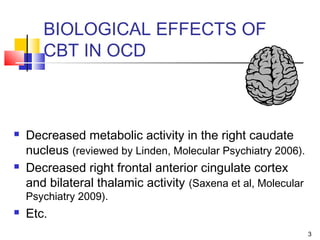
 Decreased metabolic activity in the right caudate
nucleus (reviewed by Linden, Molecular Psychiatry 2006).
 Decreased right frontal anterior cingulate cortex
and bilateral thalamic activity (Saxena et al, Molecular
Psychiatry 2009).
 Etc.
4
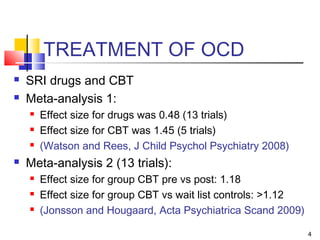
TREATMENT OF OCD
 SRI drugs and CBT
 Meta-analysis 1:
 Effect size for drugs was 0.48 (13 trials)
 Effect size for CBT was 1.45 (5 trials)
 (Watson and Rees, J Child Psychol Psychiatry 2008)
 Meta-analysis 2 (13 trials):
 Effect size for group CBT pre vs post: 1.18
 Effect size for group CBT vs wait list controls: >1.12
 (Jonsson and Hougaard, Acta Psychiatrica Scand 2009)
5
ADVANTAGES OF CBT
 Effective as monotherapy.
 Large effect size [caveat: biases
could arise from sample selection
and consenting processes].
 Improves long-term outcomes
with drugs.
 Treating with drugs+CBT may
offer the best outcomes.
6
TREATMENT OF OCD
 The proper treatment of
OCD with CBT requires a
complete understanding of
the spectrum of symptoms
that the patient displays.
7
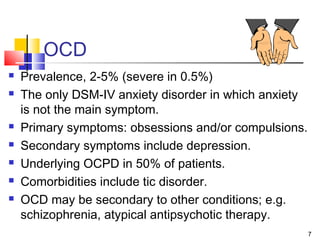
OCD
 Prevalence, 2-5% (severe in 0.5%)
 The only DSM-IV anxiety disorder in which anxiety
is not the main symptom.
 Primary symptoms: obsessions and/or compulsions.
 Secondary symptoms include depression.
 Underlying OCPD in 50% of patients.
 Comorbidities include tic disorder.
 OCD may be secondary to other conditions; e.g.
schizophrenia, atypical antipsychotic therapy.
8
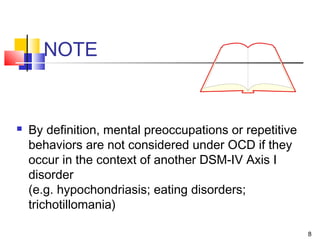
NOTE
 By definition, mental preoccupations or repetitive
behaviors are not considered under OCD if they
occur in the context of another DSM-IV Axis I
disorder
(e.g. hypochondriasis; eating disorders;
trichotillomania)
9
OBSESSIONS AND
COMPULSIONS
 Obsessions are repeated thoughts.
 E.g. “My son is going to die.”
 E.g. “I will get AIDS.”
 Compulsions are repeated actions.
 E.g. Handwashing.
 Every time a patient sees a picture of a deity, he
feels compelled to say a short, mental prayer to
the deity. Is this an obsession or a compulsion.
 [In CBT, the approach to treatment differs between
obsessions and compulsions.]
10
COMPULSIONS
 Thoughts which are deliberately repeated to
relieve anxiety are compulsions, not obsessions.
 E.g. Compulsively repeating a prayer a certain number
of times to ward off evil after a trigger event.
 E.g. Repeating a prayer over and over again just in
case it was not properly said previously (scrupulosity).
 Important to differentiate obsession from
compulsion because the treatment approach is
different.
PSYCHOPATHOLOGY OF
OCD
 Fear acquired through classical conditioning and
maintained by operant conditioning
 Eg. Checker associates electrical
appliance(conditioned stimulus) with
death(unconditional stimulus;danger of fire) and
thus feels anxiety (unconditional response and
conditioned response) in the presence of a stove
 Checking behaviour:Negative Reinforcer as it
removes anxiety
11
OCD COGNITIONS
 Inflated sense of Personal Responsibility
 Undue Importance to Thoughts
 A need to control thoughts
 Overestimation of threat
 Intolerance of Uncertainity
 Perfectionism
12
13
TYPES OF OBSESSIONS
[obsessions provoke anxiety]
 Obsessive thoughts
 Obsessive ruminations
 Obsessive doubts
 Obsessive vacillations
 Obsessive phobias
 Obsessive impulses
 Obsessive images
14
TYPES OF COMPULSIONS
[compulsions relieve anxiety]
 Almost always secondary to obsessions
 May be behavioral or mental
 Yielding:
 Counting
 Checking
 Ordering
 Cleaning/washing
 Resisting:
 Repeating thoughts or actions to prevent or undo a
feared event
 (Overlap may be present)
15
ASSESSMENT
(2-4 h)
 It is important to comprehensively document all
aspects of the phenomenology present.
 List all obsessions.
 List all compulsions.
 Understand the contexts which generate each.
 Arrange in a hierarchy of severity.
 Assess insight into the irrationality of each.
 Assess motivation to change each.
16
ASSESSMENT
(contd.)
 Make a chart with each symptom rated:
 Frequency (occasions per day)
 Time spent (minutes or hours)
 Distress (0-10)
 Impairment (0-10, with examples of impairment)
 Overall severity
 This chart can be used to monitor progress.
 Use the Y-BOCS or LOI or other scales.
17
YALE-BROWN OBSESSIVE-
COMPULSIVE SCALE
 10 items (5 for obsessions, 5 for compulsions)
 Semi-structured interview based on an explanation
to the patient about what obsessions and
compulsions are.
 Rated 0-4; range of possible scores, 0-40
 For obsessions: Time occupied by obsessive
thoughts, obsession-free interval, interference,
distress, resistance, control.
 Ditto for compulsions.
18
LEYTON OBSESSIONAL
INVENTORY
 69 items
 Identification of OCD s/s
 Assessment of resistance
 Assessment of interference
 Plus: Common OCD s/s listed individually
 Minus: Rare s/s are omitted.
19
CORNERSTONES OF CBT
 Common to both obsessions and compulsions:
 Psychoeducation
 Challenging assumptions
 [Family support, if indicated]
 Obsessions:
 Thought-stopping
 Distraction
 Compulsions:
 Exposure
 Response prevention
20
CBT FOR OBSESSIONS
 Psychoeducation
 Challenging assumptions
 Family support
 Thought stopping
 Distraction
21
PSYCHOEDUCATION FOR
OBSESSIONS
 Explain about OCD
 Destigmatize the illness
 Explain the principles of drug
therapy
 Explain the principles of CBT
 Discuss plan of management
 Review patient understanding
 Time: 1-2 hours
22
CHALLENGING
ASSUMPTIONS
 Obsessions are, by definition, irrational thoughts.
 Patients don’t always recognize their irrationality.
 Taking each obsession by turn, challenge the
flawed logic that underlies it.
 Goal: To reduce anxiety through the realization
that the thought is irrational and can be ignored.
 E.g. Obsessive fears: “What if that man [on the bus] is
carrying a bomb?”
 E.g. “What if I get AIDS?” [by using public cutlery]
23
CHALLENGING
ASSUMPTIONS
 Generalization: The patient must
learn how to reduce anxiety by
arguing against his own beliefs
when the obsessions arise
outside the clinic.
 Challenging assumptions should
result in full insight. So, take as
much time as the patient requires
to fully grasp, appreciate, accept,
and articulate the arguments.
24
THOUGHT-STOPPING
 Terminates the obsession
 Slapping the table or pinching one’s thigh
 Shouting stop
 Snapping a rubber band on the wrist
 Doing these physically or imaginally
25
OTHER DISTRACTOR
TECHNIQUES
 Taking up a chore that demands attention
 Phoning a friend
 Speaking to a family member
 Examining details in the environment
 Etc. [plan these out]
26
STRATEGY FOR TACKLING
OBSESSIONS
 Take one obsession at a time.
 Go from education to challenging assumptions to
thought stopping and distraction.
 Preferably move to the next obsession only after
the previous obsession has been satisfactorily
overcome.
27
CBT FOR COMPULSIONS
 Psychoeducation
 Challenging assumptions
 Recruit family support
 Exposure
 Response prevention
28
CHALLENGING ASSUMPTIONS:
CHECKING COMPLSIONS
 Did I lock the door?
 Strategy
 Be aware that this is a problem.
 When locking, say “I have done it” [lays memory trace].
 When the doubt arises, recall the memory.
 Learn to trust the memory [if you cannot trust yourself,
whom will you trust?]
 Recall past experience [has there been any occasion that
you checked and repeatedly checked and found that the
door was unlocked?]
29
CHALLENGING ASSUMPTIONS:
WASHING COMPLSIONS
 What is dirt?
 Why is dirt dirty?
 When is dirt dirty?
 Can dirt be good (prevents allergy, builds immunity)
 Why is water clean?
 Note that, after the first wash, washing/soaping
removes layers of skin, not dirt.
30
MORE ABOUT DIRT
 Why are bodily secretions
dirty the moment they leave
the body?
 Smelling a fart and airborne
particles
 Do not tell the patient this!
31
CHALLENGING
ASSUMPTIONS
 [Same as with obsessions]
 E.g. for checking whether a door was locked
 E.g. for removing dirt from the hand
 E.g. for repeated rituals lest a deity be offended
 E.g. for repeated rituals after stepping on paper
 E.g. for rituals that seek to ward off harm.
32
CHALLENGING
ASSUMPTIONS
 Challenging assumptions should result in full
insight. So, take as much time as the patient
requires to fully grasp, appreciate, accept, and
articulate the arguments.
 This is necessary to ensure motivation in exposure
and response prevention exercises.
33
EXPOSURE AND RESPONSE
PREVENTION
 Systematic desensitization
 Flooding
 Imaginal (as part of the desensitization hierarchy, or if in
vivo exposure is not feasible)
 Voluntary response prevention (should not be forced
by family, hospital staff e.g. as in turning off the water supply
in a patient with washing compulsions)
 Goal: Anxiety reduction through habituation
 Time: At least 30-120 min per exposure session;
anxiety reduction must be substantial.
34
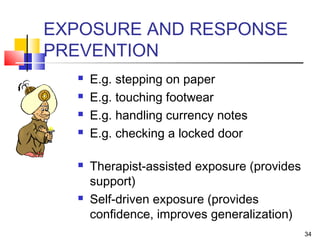
EXPOSURE AND RESPONSE
PREVENTION
 E.g. stepping on paper
 E.g. touching footwear
 E.g. handling currency notes
 E.g. checking a locked door
 Therapist-assisted exposure (provides
support)
 Self-driven exposure (provides
confidence, improves generalization)
35
DEALING WITH
BATHING RITUALS
 Identify and tackle underlying obsessions.
 Break up the rituals into their component parts
[wetting, soaping, rinsing, wiping].
 Define what is the purpose of each, and what is the
normal limit of behavior for each.
 Practice behavior within these set limits while
simultaneously challenging the assumptions which
were responsible for the obsessions.
36
DEALING WITH RELIGIOUS
OBSESSIONS AND RITUALS
 Understand the cultural context.
 Tread carefully, respect beliefs, challenge
assumptions only with informed consent.
 Discuss source of beliefs and practices; consider
the ‘tying the dog story’.
 Probe inconsistencies between obsessions and
beliefs about the nature of God.
 Remind patient that idols and pictures are
representations, not personifications, of God.
37
DEALING WITH
OBSESSIVE SLOWNESS
 Suggestions:
 Challenge assumptions.
 Set timetable with
attention to problem
specifics.
 Enlist family supervision.
38
COMMENTS
 Patients sometimes develop
substitute rituals after their
primary symptoms are addressed.
 E.g. rubbing hands to replace
washing.
 Not all patients are suited for
CBT; not all patients will respond;
however, some improvement is
better than no improvement.
39
SESSIONS
 3-5 sessions a week for 3-5 weeks.
 Each session up to 2 hours.
 15 min for review of previous session, homework.
 45-90 min for exposure and response prevention.
 15 min for setting homework.
 Ideally, when a symptom is addressed, there should be
100% compliance with therapy directions [e.g. response
prevention]; otherwise, the therapy work is undermined.
 Booster sessions (maintenance therapy).
40
IMPORTANT THERAPIST AND
CLIENT CHARACTERISTS
 Client:
 Motivation and compliance
 Therapist:
 Effort to identify the symptoms in their entirety
 Ability to successfully challenge assumptions.
41
ENFIN…
 That’s it, folks;
thanks for listening!

Cbt -Ocd

  • 1.
    1 CBT FOR OCD DrV.Sabitha Associate Professor Institute of Mental Health Chennai
  • 2.
    2 WHY CBT FOROCD?  All thought processes arise from activity in appropriate neural circuits.  OCD phenomena arise from aberrant thought processes, likely due to disturbances in the cortico- thalamo-striatal circuitry.  Neural circuits can be strengthened or weakened.  Drugs modulate neural circuit activity through receptor effects and later neuroplasticity changes.  CBT triggers learning which is hardwired into the brain, and may be more enduring in its effects.
  • 3.
    3 BIOLOGICAL EFFECTS OF CBTIN OCD  Decreased metabolic activity in the right caudate nucleus (reviewed by Linden, Molecular Psychiatry 2006).  Decreased right frontal anterior cingulate cortex and bilateral thalamic activity (Saxena et al, Molecular Psychiatry 2009).  Etc.
  • 4.
    4 TREATMENT OF OCD SRI drugs and CBT  Meta-analysis 1:  Effect size for drugs was 0.48 (13 trials)  Effect size for CBT was 1.45 (5 trials)  (Watson and Rees, J Child Psychol Psychiatry 2008)  Meta-analysis 2 (13 trials):  Effect size for group CBT pre vs post: 1.18  Effect size for group CBT vs wait list controls: >1.12  (Jonsson and Hougaard, Acta Psychiatrica Scand 2009)
  • 5.
    5 ADVANTAGES OF CBT Effective as monotherapy.  Large effect size [caveat: biases could arise from sample selection and consenting processes].  Improves long-term outcomes with drugs.  Treating with drugs+CBT may offer the best outcomes.
  • 6.
    6 TREATMENT OF OCD The proper treatment of OCD with CBT requires a complete understanding of the spectrum of symptoms that the patient displays.
  • 7.
    7 OCD  Prevalence, 2-5%(severe in 0.5%)  The only DSM-IV anxiety disorder in which anxiety is not the main symptom.  Primary symptoms: obsessions and/or compulsions.  Secondary symptoms include depression.  Underlying OCPD in 50% of patients.  Comorbidities include tic disorder.  OCD may be secondary to other conditions; e.g. schizophrenia, atypical antipsychotic therapy.
  • 8.
    8 NOTE  By definition,mental preoccupations or repetitive behaviors are not considered under OCD if they occur in the context of another DSM-IV Axis I disorder (e.g. hypochondriasis; eating disorders; trichotillomania)
  • 9.
    9 OBSESSIONS AND COMPULSIONS  Obsessionsare repeated thoughts.  E.g. “My son is going to die.”  E.g. “I will get AIDS.”  Compulsions are repeated actions.  E.g. Handwashing.  Every time a patient sees a picture of a deity, he feels compelled to say a short, mental prayer to the deity. Is this an obsession or a compulsion.  [In CBT, the approach to treatment differs between obsessions and compulsions.]
  • 10.
    10 COMPULSIONS  Thoughts whichare deliberately repeated to relieve anxiety are compulsions, not obsessions.  E.g. Compulsively repeating a prayer a certain number of times to ward off evil after a trigger event.  E.g. Repeating a prayer over and over again just in case it was not properly said previously (scrupulosity).  Important to differentiate obsession from compulsion because the treatment approach is different.
  • 11.
    PSYCHOPATHOLOGY OF OCD  Fearacquired through classical conditioning and maintained by operant conditioning  Eg. Checker associates electrical appliance(conditioned stimulus) with death(unconditional stimulus;danger of fire) and thus feels anxiety (unconditional response and conditioned response) in the presence of a stove  Checking behaviour:Negative Reinforcer as it removes anxiety 11
  • 12.
    OCD COGNITIONS  Inflatedsense of Personal Responsibility  Undue Importance to Thoughts  A need to control thoughts  Overestimation of threat  Intolerance of Uncertainity  Perfectionism 12
  • 13.
    13 TYPES OF OBSESSIONS [obsessionsprovoke anxiety]  Obsessive thoughts  Obsessive ruminations  Obsessive doubts  Obsessive vacillations  Obsessive phobias  Obsessive impulses  Obsessive images
  • 14.
    14 TYPES OF COMPULSIONS [compulsionsrelieve anxiety]  Almost always secondary to obsessions  May be behavioral or mental  Yielding:  Counting  Checking  Ordering  Cleaning/washing  Resisting:  Repeating thoughts or actions to prevent or undo a feared event  (Overlap may be present)
  • 15.
    15 ASSESSMENT (2-4 h)  Itis important to comprehensively document all aspects of the phenomenology present.  List all obsessions.  List all compulsions.  Understand the contexts which generate each.  Arrange in a hierarchy of severity.  Assess insight into the irrationality of each.  Assess motivation to change each.
  • 16.
    16 ASSESSMENT (contd.)  Make achart with each symptom rated:  Frequency (occasions per day)  Time spent (minutes or hours)  Distress (0-10)  Impairment (0-10, with examples of impairment)  Overall severity  This chart can be used to monitor progress.  Use the Y-BOCS or LOI or other scales.
  • 17.
    17 YALE-BROWN OBSESSIVE- COMPULSIVE SCALE 10 items (5 for obsessions, 5 for compulsions)  Semi-structured interview based on an explanation to the patient about what obsessions and compulsions are.  Rated 0-4; range of possible scores, 0-40  For obsessions: Time occupied by obsessive thoughts, obsession-free interval, interference, distress, resistance, control.  Ditto for compulsions.
  • 18.
    18 LEYTON OBSESSIONAL INVENTORY  69items  Identification of OCD s/s  Assessment of resistance  Assessment of interference  Plus: Common OCD s/s listed individually  Minus: Rare s/s are omitted.
  • 19.
    19 CORNERSTONES OF CBT Common to both obsessions and compulsions:  Psychoeducation  Challenging assumptions  [Family support, if indicated]  Obsessions:  Thought-stopping  Distraction  Compulsions:  Exposure  Response prevention
  • 20.
    20 CBT FOR OBSESSIONS Psychoeducation  Challenging assumptions  Family support  Thought stopping  Distraction
  • 21.
    21 PSYCHOEDUCATION FOR OBSESSIONS  Explainabout OCD  Destigmatize the illness  Explain the principles of drug therapy  Explain the principles of CBT  Discuss plan of management  Review patient understanding  Time: 1-2 hours
  • 22.
    22 CHALLENGING ASSUMPTIONS  Obsessions are,by definition, irrational thoughts.  Patients don’t always recognize their irrationality.  Taking each obsession by turn, challenge the flawed logic that underlies it.  Goal: To reduce anxiety through the realization that the thought is irrational and can be ignored.  E.g. Obsessive fears: “What if that man [on the bus] is carrying a bomb?”  E.g. “What if I get AIDS?” [by using public cutlery]
  • 23.
    23 CHALLENGING ASSUMPTIONS  Generalization: Thepatient must learn how to reduce anxiety by arguing against his own beliefs when the obsessions arise outside the clinic.  Challenging assumptions should result in full insight. So, take as much time as the patient requires to fully grasp, appreciate, accept, and articulate the arguments.
  • 24.
    24 THOUGHT-STOPPING  Terminates theobsession  Slapping the table or pinching one’s thigh  Shouting stop  Snapping a rubber band on the wrist  Doing these physically or imaginally
  • 25.
    25 OTHER DISTRACTOR TECHNIQUES  Takingup a chore that demands attention  Phoning a friend  Speaking to a family member  Examining details in the environment  Etc. [plan these out]
  • 26.
    26 STRATEGY FOR TACKLING OBSESSIONS Take one obsession at a time.  Go from education to challenging assumptions to thought stopping and distraction.  Preferably move to the next obsession only after the previous obsession has been satisfactorily overcome.
  • 27.
    27 CBT FOR COMPULSIONS Psychoeducation  Challenging assumptions  Recruit family support  Exposure  Response prevention
  • 28.
    28 CHALLENGING ASSUMPTIONS: CHECKING COMPLSIONS Did I lock the door?  Strategy  Be aware that this is a problem.  When locking, say “I have done it” [lays memory trace].  When the doubt arises, recall the memory.  Learn to trust the memory [if you cannot trust yourself, whom will you trust?]  Recall past experience [has there been any occasion that you checked and repeatedly checked and found that the door was unlocked?]
  • 29.
    29 CHALLENGING ASSUMPTIONS: WASHING COMPLSIONS What is dirt?  Why is dirt dirty?  When is dirt dirty?  Can dirt be good (prevents allergy, builds immunity)  Why is water clean?  Note that, after the first wash, washing/soaping removes layers of skin, not dirt.
  • 30.
    30 MORE ABOUT DIRT Why are bodily secretions dirty the moment they leave the body?  Smelling a fart and airborne particles  Do not tell the patient this!
  • 31.
    31 CHALLENGING ASSUMPTIONS  [Same aswith obsessions]  E.g. for checking whether a door was locked  E.g. for removing dirt from the hand  E.g. for repeated rituals lest a deity be offended  E.g. for repeated rituals after stepping on paper  E.g. for rituals that seek to ward off harm.
  • 32.
    32 CHALLENGING ASSUMPTIONS  Challenging assumptionsshould result in full insight. So, take as much time as the patient requires to fully grasp, appreciate, accept, and articulate the arguments.  This is necessary to ensure motivation in exposure and response prevention exercises.
  • 33.
    33 EXPOSURE AND RESPONSE PREVENTION Systematic desensitization  Flooding  Imaginal (as part of the desensitization hierarchy, or if in vivo exposure is not feasible)  Voluntary response prevention (should not be forced by family, hospital staff e.g. as in turning off the water supply in a patient with washing compulsions)  Goal: Anxiety reduction through habituation  Time: At least 30-120 min per exposure session; anxiety reduction must be substantial.
  • 34.
    34 EXPOSURE AND RESPONSE PREVENTION E.g. stepping on paper  E.g. touching footwear  E.g. handling currency notes  E.g. checking a locked door  Therapist-assisted exposure (provides support)  Self-driven exposure (provides confidence, improves generalization)
  • 35.
    35 DEALING WITH BATHING RITUALS Identify and tackle underlying obsessions.  Break up the rituals into their component parts [wetting, soaping, rinsing, wiping].  Define what is the purpose of each, and what is the normal limit of behavior for each.  Practice behavior within these set limits while simultaneously challenging the assumptions which were responsible for the obsessions.
  • 36.
    36 DEALING WITH RELIGIOUS OBSESSIONSAND RITUALS  Understand the cultural context.  Tread carefully, respect beliefs, challenge assumptions only with informed consent.  Discuss source of beliefs and practices; consider the ‘tying the dog story’.  Probe inconsistencies between obsessions and beliefs about the nature of God.  Remind patient that idols and pictures are representations, not personifications, of God.
  • 37.
    37 DEALING WITH OBSESSIVE SLOWNESS Suggestions:  Challenge assumptions.  Set timetable with attention to problem specifics.  Enlist family supervision.
  • 38.
    38 COMMENTS  Patients sometimesdevelop substitute rituals after their primary symptoms are addressed.  E.g. rubbing hands to replace washing.  Not all patients are suited for CBT; not all patients will respond; however, some improvement is better than no improvement.
  • 39.
    39 SESSIONS  3-5 sessionsa week for 3-5 weeks.  Each session up to 2 hours.  15 min for review of previous session, homework.  45-90 min for exposure and response prevention.  15 min for setting homework.  Ideally, when a symptom is addressed, there should be 100% compliance with therapy directions [e.g. response prevention]; otherwise, the therapy work is undermined.  Booster sessions (maintenance therapy).
  • 40.
    40 IMPORTANT THERAPIST AND CLIENTCHARACTERISTS  Client:  Motivation and compliance  Therapist:  Effort to identify the symptoms in their entirety  Ability to successfully challenge assumptions.
  • 41.
    41 ENFIN…  That’s it,folks; thanks for listening!