OBSSESSIVE
COMPULSIVE
DISORDER
DR. SUJIT KUMAR KAR
ASSOCIATE PROFESSOR OF PSYCtfIATRY
KING GEORGE’ S MEDICAL UNIVERSITY
LUCKNOW, U.P
OC
D
Wha
t
Wh
y
Wh
o
Ho
w
Whe
n
Who
m
Focus of
presentatio
n
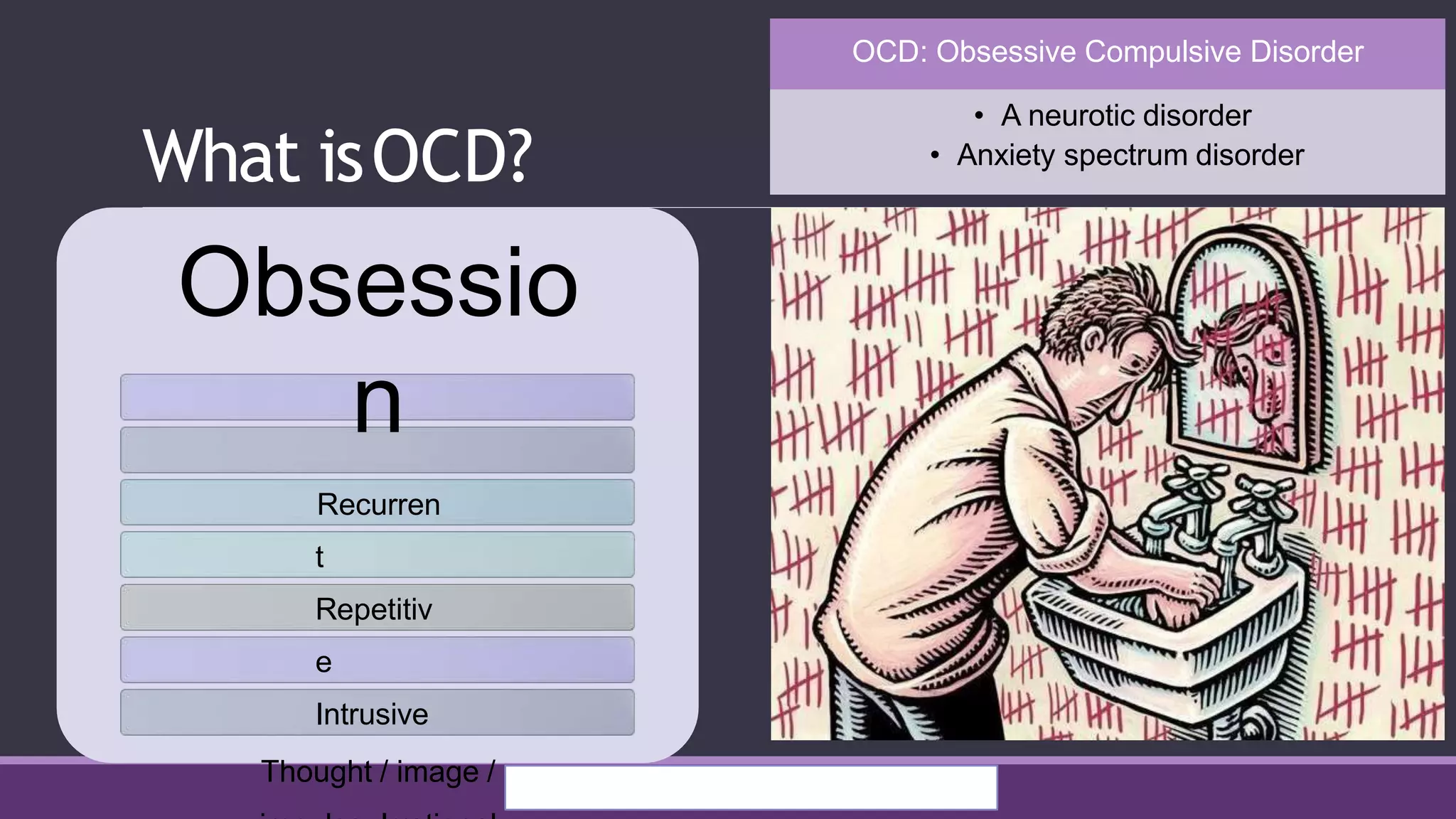
What isOCD?
OCD: Obsessive Compulsive Disorder
• A neurotic disorder
• Anxiety spectrum disorder
Obsessio
n
Recurren
t
Repetitiv
e
Intrusive
Thought / image /
What isOCD?
Compulsion
Recurrent
Repetitive
Excessive
Unreasonabl
e Acts /
rituals
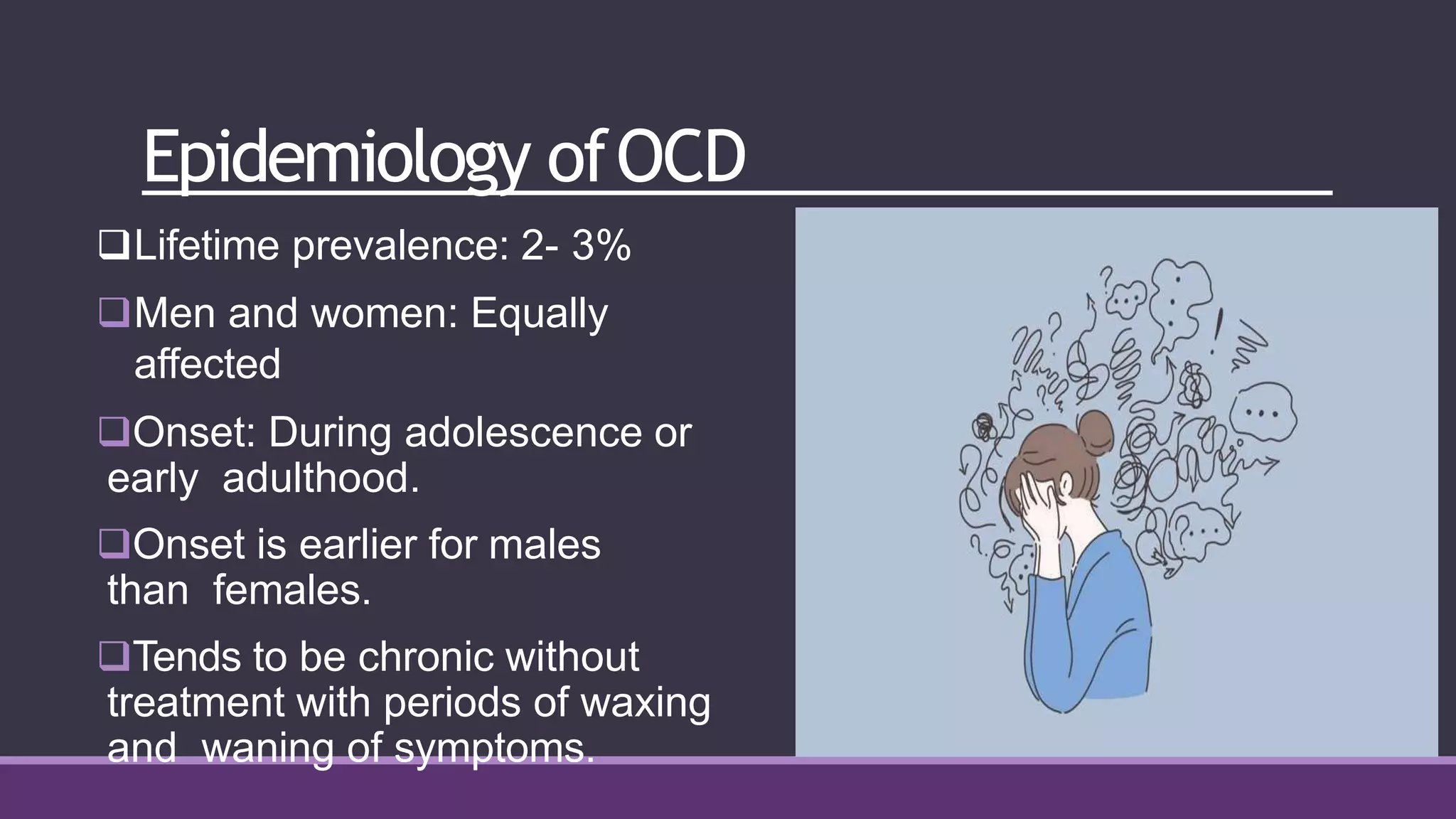
Epidemiology ofOCD
Lifetime prevalence: 2- 3%
Men and women: Equally
affected
Onset: During adolescence or
early adulthood.
Onset is earlier for males
than females.
Tends to be chronic without
treatment with periods of waxing
and waning of symptoms.
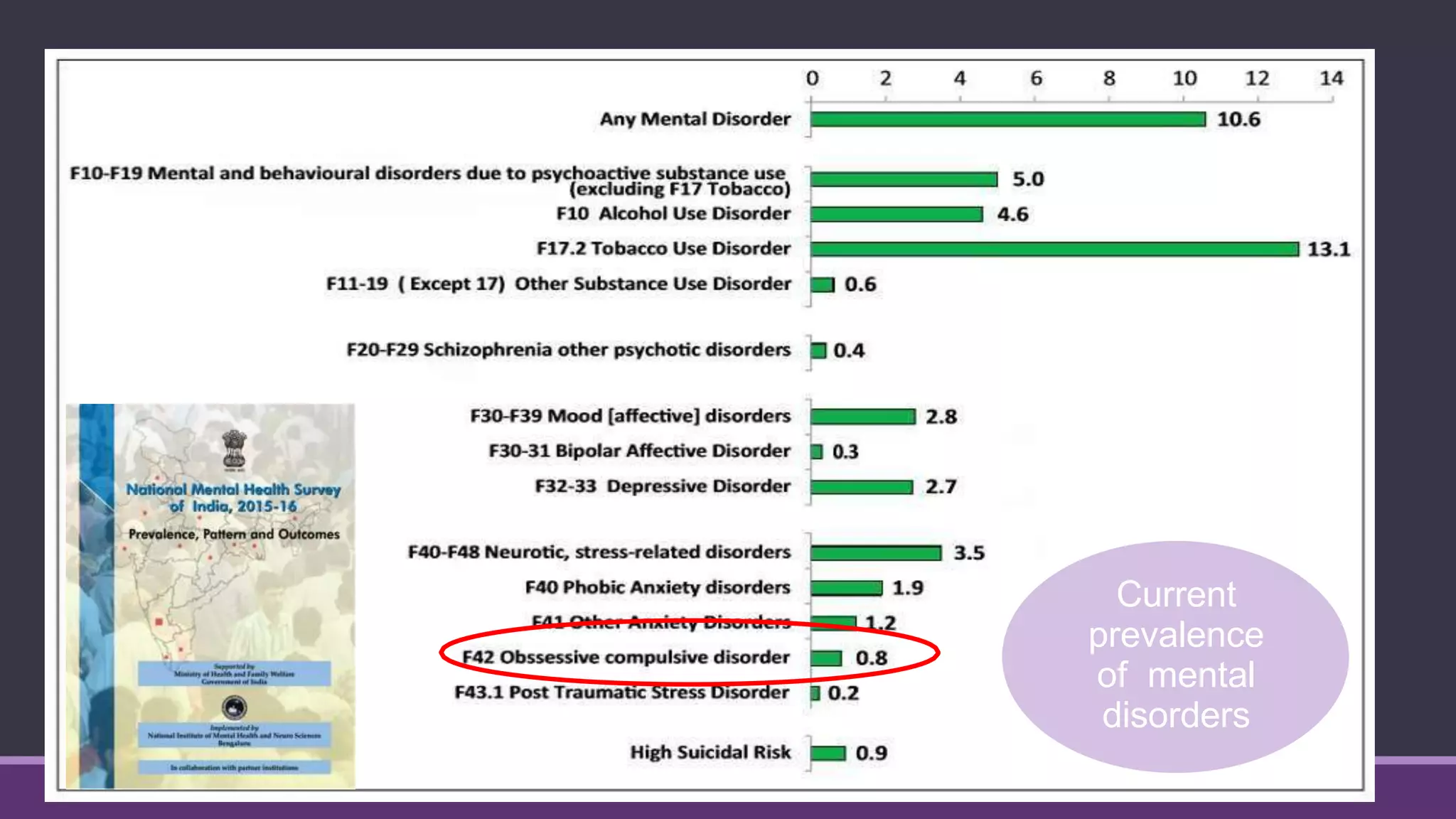
Current
prevalence
of mental
disorders
Obsessions
may
be
• Thought of contamination (Dirt
and contamination)
• Pathological doubt
• Need for symmetry
Obsessions
• Hoarding
• Sexual content (blasphemous
religious thoughts.)
• Aggressive content
• Superstitious fears
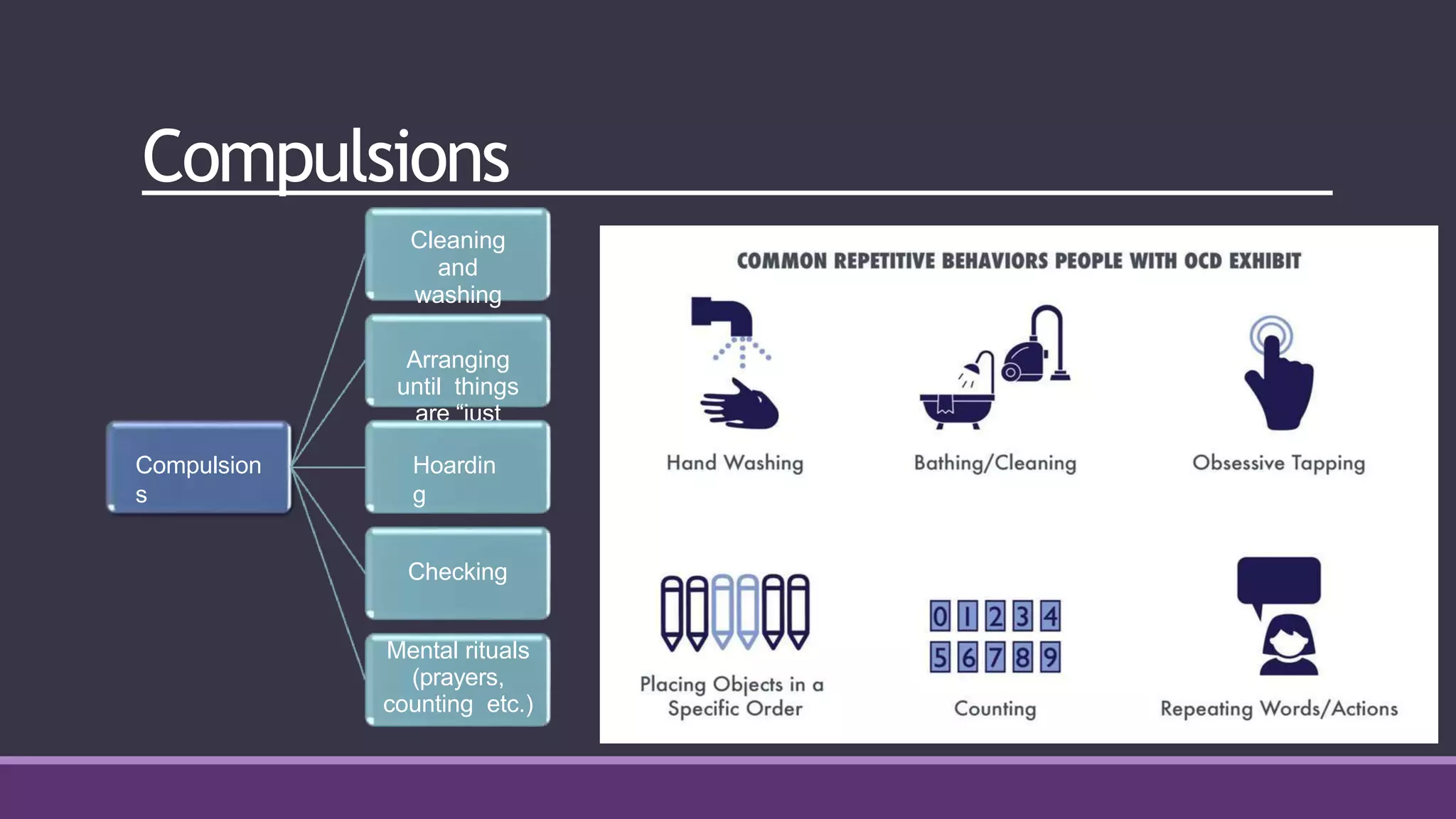
Compulsions
Compulsion
s
Cleaning
and
washing
Arranging
until things
are “just
right”
Hoardin
g
Checking
Mental rituals
(prayers,
counting etc.)
Linking Obsessions andCompulsions
Generalrequirements
•The person must have recognized at some point that the
obsessions or compulsions are excessive or unreasonable.
• These recurrent obsessions or compulsions must be severe enough
to be
time consuming (taking up more than 2 hour per day).
•The obsessions/compulsions must cause a marked distress or
significantly interfere with the individuals normal routine,
occupational functioning, or usual social activities or relationships with
others
Neuroanatomical models ofOCD
• Common areas
include
– Orbito-frontal cortex
– Head of the caudate
– Anterior cingulate
– Thalamus
Prefrontal
cortex:
Generation of
thought
Thalamus:
Filtration
of thought
Basal
ganglia:
Execution of
action
Amygdal
a:
Anxiety
AssessmentTechniques
Clinical interview.
The Yale-Brown Obsessive-
Compulsive Symptom Checklist
(YBOC)
Dimensional Yale-Brown
Obsessive- Compulsive scale
(D-YBOCS)
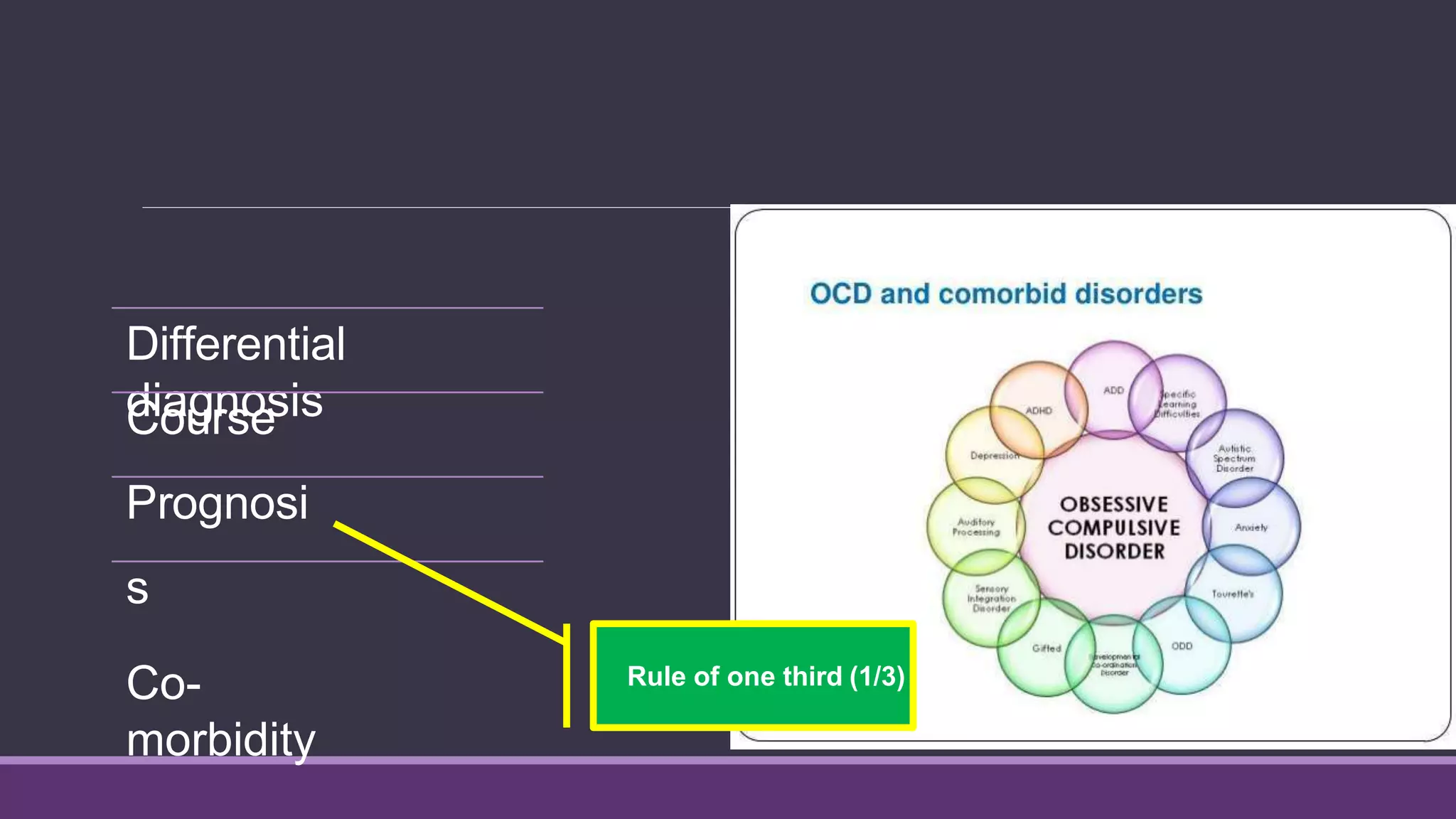
Differential
diagnosis
Course
Prognosi
s
Co-
morbidity
Rule of one third (1/3)
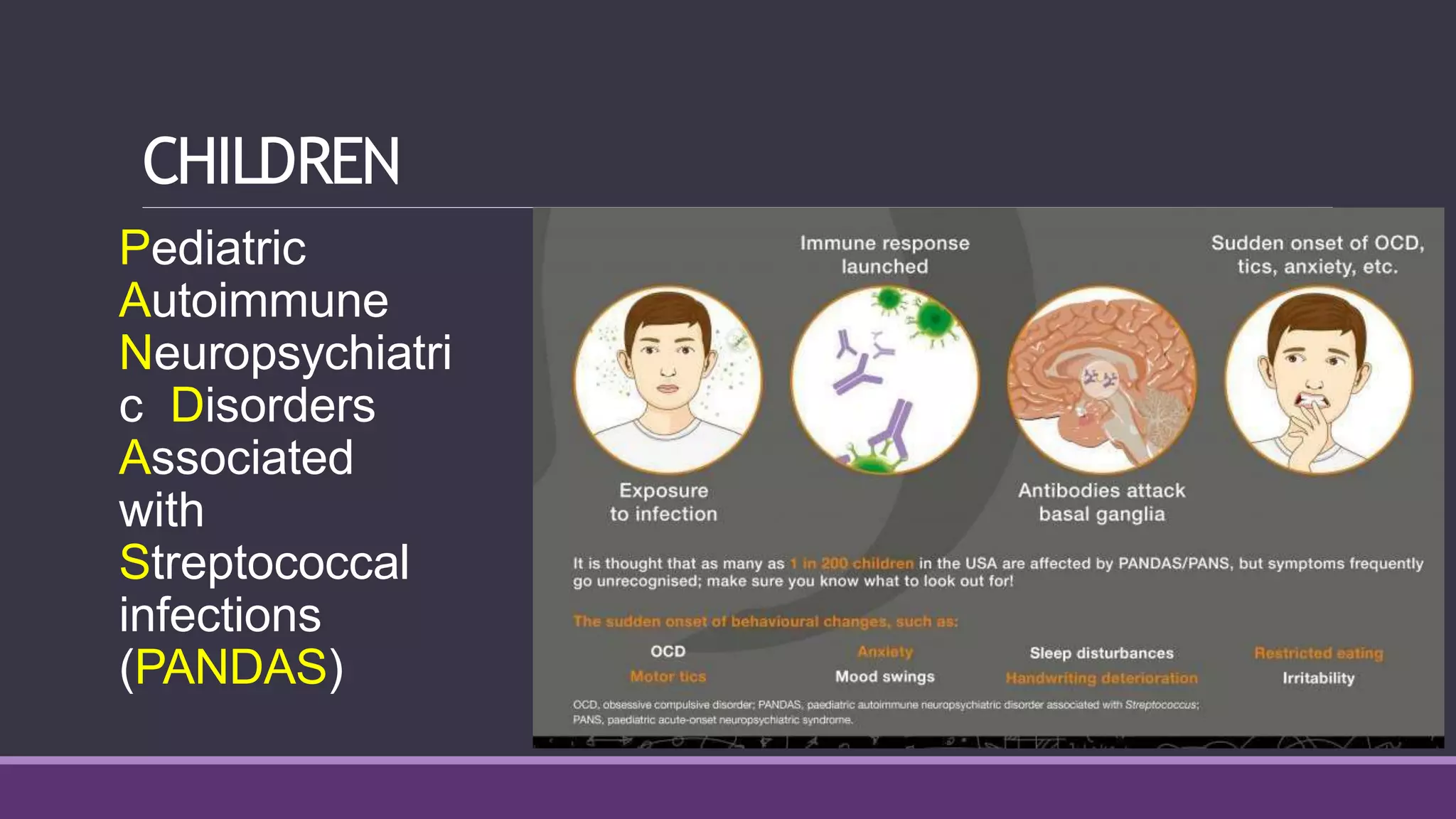
CHILDREN
Pediatric
Autoimmune
Neuropsychiatri
c Disorders
Associated
with
Streptococcal
infections
(PANDAS)
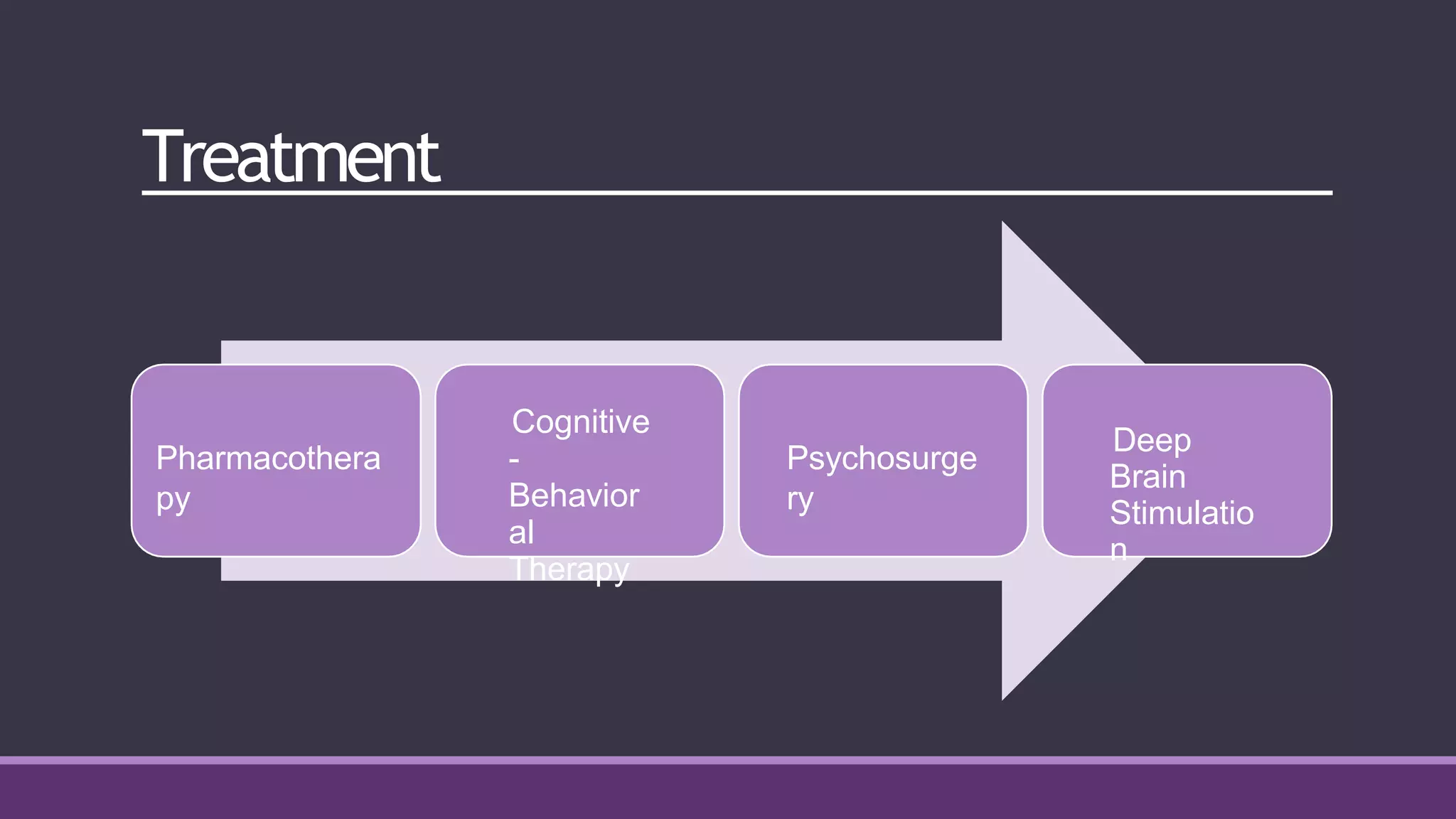
Treatment
Pharmacothera
py
Cognitive
-
Behavior
al
Therapy
Psychosurge
ry
Deep
Brain
Stimulatio
n
Pharmacotherapy
• SSRI’s (selective-Serotonin Reuptake Inhibitors)
– First line drug.
– Higher doses than for MDD (ex. 80 mg fluoxetine)
– 10-12 weeks before switching
• Clomipramine
– first FDA approved, most serotonin specific of TCA’s.
– Augmentation with Li / atypical antipsychotics, e.g.
risperidone
Other Medications
• Monoamine Oxidase Inhibitors
–The monoamine oxidase
inhibitors (MAOIs) are effective
antidepressants
–The two MAOIs available are
phenelzine and tranylcipramine
– The MAOIs are used to treat OCD
only when SSRI medications fail.
Augmenting
agents:
Risperidone
Aripiprazole
Ondansetron
Buspirone
Memantine
Lithium
Ketamine
Psychotherapy
• Cognitive-Behavioral Therapy
– RCT supported
– Longer lasting than pills
– Cognitive
• Challenge faulty reasoning
• Ex: “magical thinking”
– Behavioral
• Exposure and Response
Prevention
Obsessio
n
Cognitive
intervention
s
• Mindfulness
techniques, Cognitive
restructuring
Compulsio
n
Behavioural
interventions
• Exposure and
Response
Prevention
Let’s
experiment
the power of
thinking
Exposure and ResponsePrevention (ERP)
•The most widely practiced behavior therapy for OCD is called exposure and
response prevention.
• There are two components:
– Exposure Treatment
– Response Prevention Treatment
• Treatment starts with exposure to situations that cause the least anxiety
• As the patient overcomes these, they move on to situations that cause more
anxiety
ERP
• Exposure Treatment
– Controlled exposure (direct or imagined) to objects or situations that trigger
obsessions
while raising anxiety levels
– Over time the exposure leads to less anxiety and over a long period of time it leads
to very little anxiety at all.
ERP
• Response Prevention Treatment
– The ritual behaviours that people with OCD engage in to reduce anxiety.
– Patients learn to resist the compulsion to perform rituals and are eventually able to
stop engaging in these behaviours
Neuromodulation
Transcranial
magnetic
stimulation (TMS)
Transcranial direct
current stimulation
(tDCS)
Deep brain stimulation
TreatmentRefractory
• Psychosurgery
– For patient’s who have failed medication and therapy
– Response rate approx. 50%
– Four surgical prodecures
• Cingulotomy, subcaudate tractotomy, limbic leukotomy,
capsulotomy
• Interrupt signals from OFC to basal ganglia
– Gamma Knife
• Anterior limb of internal capsule
OCD Experiences
OCD NOT OCD
A man who washes his hands 100 times a day until
they
are red and raw
A woman who unfailingly washer her hands before
every
meal
A women who locks and relocks her door before
going to work every day – for half an hour
woman who double-checks that her apartment door
and windows are locked each night before she goes
to bed.
A college student who must tap on the door
frame of every classroom 14 times before
entering
A musician who practices a difficult passage
over and over again until its perfect
A man who stores 19 years of newspapers “just in
case”
– with no system for filling or retrieving
A woman who dedicates all her spare time and
money to building her record collection
You are
victim
of your
own
belief
OCD.pptx

OCD.pptx