Risk Management Strategy & Tactics
Risk Management  “ Any organization that provides programs to the  public has a  moral, legal and spiritual obligation  to institute appropriate risk management practices  for volunteer programs. This is not only the right thing to do; it is  legally required under the principle of duty of care .”  Marlene Deboisbriand  Risk Management
Lead Organizer volunteeralberta.ab.ca Lead Organizer
A lberta Voluntary Sector  Insurance Council (AVSIC) History History Risk management being more than insurance was identified as an educational priority of Alberta Voluntary Sector Insurance Council in 2005 because of the impacts of the “hard market” on nonprofit/voluntary sector organizations. Two seminars developed: Directors’ and Officers’ Liability and General Insurance funded by Insurance Bureau of Canada , Wild Rose Foundation, and Volunteer Alberta 2008 – WRF, The Co-operators, and Volunteer Alberta funded Risk Management Seminars
Presenter Don T. Radford   MBA FCIP CCIB CRM Insurance Professional - 30 years Specialty:  Commercial Insurance Management Consultant, Author, Trainer Presenter
Insurance is risk management Insurance takes care of everything If I don’t know about it, it can’t hurt me so I am not responsible  Risk Management MYTHS
Buildings won’t burn Computers won’t crash Executive Director will never leave, get sick Staff would never…….!! We can’t control our volunteer’s actions, so we can’t be held liable for what they do Risk Management MYTHS
What is Risk? Any impact caused by internal/external situations or events that prevents: Achievement of objectives Delivery of services  Carrying out projects or events  Risk is:   “ measured  by its  likelihood  and  consequences ”   What is Risk?
The  Process  that an organization uses to:  Identify Assess Control   Minimize the risks of  Bodily Injury  or  Financial Loss   arising from its activities and operations.  Risk Management:
Discipline for managing the possibility that some future event will cause harm It provides strategies and techniques to recognize and confront threats or danger Risk Management
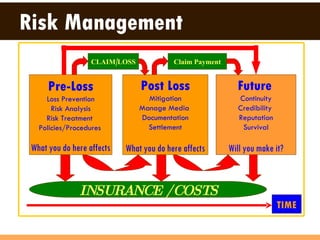
Pre-Loss Loss Prevention Risk Analysis Risk Treatment  Policies/Procedures   What you do here affects Post Loss Mitigation Manage Media  Documentation Settlement What you do here affects Future   Continuity Credibility  Reputation Survival Will you make it? INSURANCE / COSTS Claim Payment TIME Risk Management CLAIM/LOSS
What is Liability? Our laws make every person/organization liable  for  acts or omissions  that cause damage to other’s property or injury to persons .  We have a legal obligation to:  Be aware of the losses we cause   Compensate those who suffer  as a result or  consequence of our activities  What is Liability?
What is Liability? Those who undertake an enterprise  are required to take  all reasonable means to  reduce the risk of loss by others Demonstrate an  ability and attempt  to manage risks  Its called:  Due diligence The Greatest Risk of All:  DO NOTHING
What is Liability? Due Diligence Effort made by an ordinarily prudent or reasonable party to avoid harm to another party Failure to make this effort is considered negligence Standard of care imposed by our courts
What is Liability? Due Diligence (Directors) Duty to act cautiously Must be seen to attempt to anticipate consequences of decisions or actions Obligation to foresee potential risks and take reasonable action to manage them
What is Liability? Negligence Legal concept of fault or who is to blame Means that someone:  Failed to do something they should have Did something they should not have  There is a Standard of Care our laws require
What is Liability? Standard of Care as defined by courts:  Whether the danger was foreseeable Was the conduct within acceptable standards? Was an inspection process in effect and used? Did danger exist an unreasonable time?  The ease of preventing the danger
Why Risk Management? Every activity  has inherent  risks,  potential  liability  and   opportunities Risk management is a  proactive, continuous process   that identifies, measures and manages those risks Enables decision making  as to whether a risk is  acceptable or requires further action  Its Purpose :  To avoid, reduce or prevent risk from  imposing negative consequences
Projects and programs achieve  better results   Process leads to  effective decision making Provides valuable decision making information Assists in clearly  defined insurance needs
Enhances regulatory compliance requirements Assists in audit preparation  Reducing risk  creates greater confidence  in your activities - encourages people to participate
Why Manage Risk? Gives managers the confidence to make decisions  about  how to manage risk to an acceptable level Creates effective  planning and preparation  with appropriate and  adequate resource allocation   Enables contingency plans to deal with the consequences
Managing the  uncertainty of risk  causes decision makers to:  Think more carefully about all issues Identify the most important risks, then set priorities to manage them Prepare for contingencies with plans and training  Overall :  It saves time, effort and financial resources
Risk Management Decisions Lead, support and enable:  Achievement of organizational objectives  Due diligence issues  Management of the uncertainty and consequences of future events
Risk Management Decisions Lead, support and enable:  A continuous, proactive and systematic process to understand, manage and communicate risk  Cost-effective procedures to prepare for and finance the consequences of a loss
What It Considers   Risks at all levels of operations  (strategic, operational and project/events) Business objectives, decision making and management framework The entire organization :  from the board to senior management, employees, volunteers and  members
What It Considers   Risk Assessment  (What do you need to know?) To assess potential risks, consider: Likelihood :  the probability and frequency Consequences :  what are they - loss, injury,  disadvantage or gain?  What will they cost?
What It Considers   The adequacy of existing risk management strategies –  are they working?   Decide  which risks are to be treated and how - accepted, managed or transferred? Determine  how you pay for them?
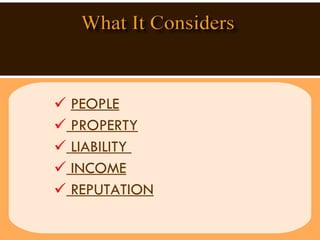
PEOPLE PROPERTY LIABILITY  INCOME REPUTATION
PEOPLE The talent, commitment and community Staff, volunteers, clients, board members, donors Injuries never fully repaired, often expensive Nonprofits help people, not hurt them
PROPERTY  Owned, leased, rented, borrowed, loaned  if damaged who is responsible?   Kept in one place – office equipment, buildings  In various places or travels from place to place To transport people or property – vehicles
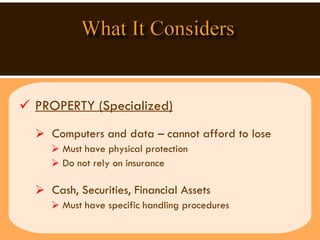
PROPERTY (Specialized)   Computers and data – cannot afford to lose Must have physical protection  Do not rely on insurance Cash, Securities, Financial Assets Must have specific handling procedures
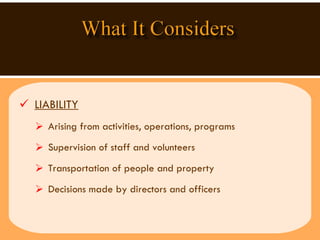
LIABILITY Arising from activities, operations, programs  Supervision of staff and volunteers  Transportation of people and property Decisions made by directors and officers
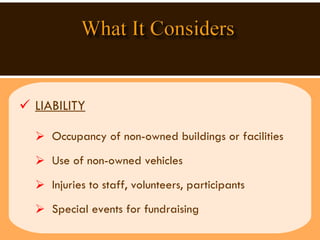
LIABILITY Occupancy of non-owned buildings or facilities Use of non-owned vehicles  Injuries to staff, volunteers, participants  Special events for fundraising
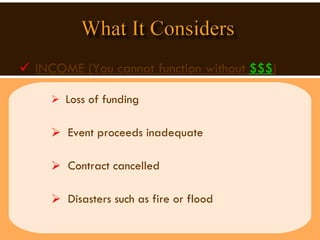
INCOME (You cannot function without  $$$ ) Loss of funding Event proceeds inadequate Contract cancelled Disasters such as fire or flood
REPUTATION:   (You cannot afford to lose) NO INSURANCE AVAILABLE  Key to fundraising, volunteer recruitment,  staff retention  Difficult to quantify, critical to maintain Occurs in wake of a crisis
Main Principles   Commitment of senior management  to a formal, documented, integrated risk management process Clear,  defined responsibility & accountability  for functions, activities and associated risks Use of common risk language
Main Principles   A process for identification and treatment of risk integrated with existing management Commitment reinforced by training Outcomes monitored  by senior management
Strategic Objectives Risk Identification and Mitigation Ready to  take advantage of opportunities Reducing uncertainty, increases confidence
Strategic Objectives Be a good citizen  Fulfilling legal and ethical issues -  reduces chances of being sued Fosters favorable public image -  improves public support, attracts members and funds
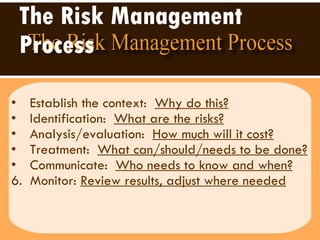
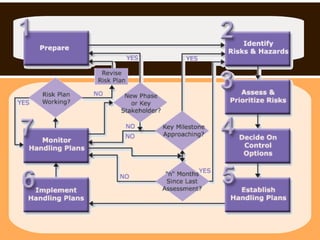
The Risk Management Process   Establish the context:  Why do this?   Identification:  What are the risks? Analysis/evaluation:  How much will it cost?   Treatment:  What can/should/needs to be done?   Communicate:  Who needs to know and when?   6.  Monitor:  Review results, adjust where needed
How It Starts With a  Risk Management Statement “ To ensure ongoing, unimpeded capacity of _______ to fulfill its mission, perform its key functions and meet its objectives by:
How It Starts Protecting ( Your Nonprofit ) from adverse incidents by reducing its exposures to loss, preparing to mitigate and  control loss should it occur,  and thereby reduce the  cost of risk Adopting Risk Management practices throughout  Ensure all members are aware of the need to manage  risk and  promote participation in that process
Fundamental Questions What assets and resources do you rely to achieve your objectives? What risks can affect those assets and resources? What affects or consequences can those risks create?
Fundamental Questions How will consequences affect what we do?  How much will those consequences cost – time, energy, money?  How will this affect our ability to continue? How do we manage to prevent or avoid the affects?
Basic Risk Management 1.  Identify possible risks  – external/internal -  consider what problems/possibilities do they contain?  2.  Assess the probability  of each risk, consider the  potential  frequency and severity  of it happening  3.  Create a plan that  treats the critical risks  - how they can be avoided, accepted, or transferred
Basic Risk Management 4.  Implement  the plan,  train personnel  to  understand how and why they are involved  5.  Monitor and evaluate  the success of the risk  management plan, adjust when and where  needed 6.  Communicate  the results to stakeholders
 
Communication/Consultation Components for effective/sustainable decisions:  Ensure participants understand  why and where they are needed, what is expected of them , that they are engaged and contribute  Gather experiences, information, ideas, input and perspectives, share the results
Communication/Consultation Collect and share factual information from all relevant sources  Most effective  where people are valued and their viewpoints respected
Risk Communication   Critical process: Builds trust  and encourages buy-in through  shared decision-making Reduces misperceptions, misunderstandings Improves the technical understanding or  “ science” of  what needs to be done
Without Communication   Loss of management credibility Protracted, unnecessary, costly debate and  conflict with stakeholders  Diversion of management attention and resources  away from more valuable issues Lack of support by employees and volunteers
Risk Identification/Mitigation Enables decisions about potential risks that  risk is either acceptable or requires treatment  Minimizes the possibility  that risk will go   undetected – no surprises Concept:  manage risk within acceptable levels
Successful Risk Management Aligned with an organization's overall objectives, strategic direction, operating practices and internal culture Is a factor in setting priorities and revenue allocation Integrated within existing governance and decision-making structures
Critical Success Factors Strong involvement by upper management Organized process for risk analysis and response Assignment of specific risk responsibilities
Practical Strategies Assume the risk   Decide that the risk is minor and do nothing Reduce the risk   Change people’s behaviour or the environment so that risk is reduced Pre-loss activity  example:  preparation of contingency plans before a loss occurs
Practical Strategies Eliminate/Avoid the risk   Fix the problem Remove it or choose not to begin  Transfer the risk   Accept the risk - transfer the cost and responsibility to someone else
Practical Strategies Control  -  Post-loss:  Keep resulting damages to a minimum   Control the contingent consequences  Called mitigating loss –  required by insurance   Examples:  Effective administration of third party claims
Practical Strategies Contractual Risk Transfer Transfers the risk of a specific activity or project to another party through a contract  Waivers, disclaimers, indemnity agreements, hold harmless agreements, work contracts Insurance is a form of contractual risk transfer
Transfer to Insurance   Some exposures may be  uninsurable   Loss of reputation  All Insurance policies have  exclusions Losses may exceed policy limits
Policy Exclusions Exist to:   Eliminate uninsurable loss exposures :   Those not accidental, or predictable  Within the control of the insured Catastrophic  Manage moral and morale hazards Intentional acts Loss caused by undue care and attention
Policy Exclusions Avoid coverage duplication :  Other insurance is available Eliminate coverage for extreme risks   Those requiring special treatment – flood, earthquake  Keep premiums at a reasonable level   No policy can or will insure everything
Effective Risk Management Plans Reflect the range of stakeholder perspectives  Express the  belief in and support  of a risk management philosophy and practice State that  all personnel are vital  in protecting the mission, reputation and assets
Implementation Assign responsibility and accountability   Allocate required resources Document  (record of decisions and plans) Establish criteria to measure performance
Implementation Strategies Define framework – Risk Management Plan  Define it as policy Select Risk Champion Task people to engage Set guidelines and train
Proportionate : to the risk assessed Accountable : those affected should be advised how and why decisions are made Balanced: between “analysis-paralysis” by over-managing and indecision by not making decisions and taking action
Consistent :  interpret policies consistently Transparent :  open and user-friendly process Targeted :  treatments focused on problem
Implementation - Best Practices Commitment and support from leaders Risk management plan provides roadmap Policy statement  defines the commitment Risk  mitigation control system  in place
Implementation - Best Practices “Learn by Doing” Training   Personnel need to know:  Why  risk management is important What to do and when What is expected  of them
Implementation - Best Practices Monitor and assess  results frequently, adjust where advisable or necessary Communication: make it  consistent and  frequent  to all stakeholders
Monitoring Are the selected risk control and risk financing options  achieving their expected results?   If not,  make adjustments where/when needed Example:  Update values in the property insurance policy, they may have changed substantially
Benefits include: Identification of new or changing risks and methods to treat them  Accumulation of evidence to support assumptions and  results of analysis Development of a more accurate portrait of risks Reduction of costs associated with improper or  redundant risk control measures
Operational Recommendations Conduct audit  of ongoing operational risks Review, design  and  implement policies/procedures Empower  and  train personnel  to address risks Ensure Board of Directors receive regular updates
Operational Recommendations Review insurance regularly Investigate and keep records on all claims –  incident reports   Review all legal agreements to identify their risks Use waivers, risk assumptions, disclaimers,  indemnifications to transfer risk
Operational Recommendations Establish and enforce required risk management  procedures –  before, during and after  all activities, events or programs  Ensure contractors have adequate insurance –  require Certificates of Insurance as proof
Accident-prevention programs are  good due diligence: They ensure  personnel and financial resources are put to their best possible use Instead of being diverted to pay for accident-related losses
Early, aggressive detection  and management of risk is typically  easier, less costly, and less disruptive  to implement Strong  quality-control  improves goods, services,  activities, reputation and credibility  Reducing the potential for lawsuits  conserves resources  – financial and personnel
Quick response  to situations/circumstances, if left unattended they can cause devastating affects  Advance agreements with lenders offers access to  cash when its most needed – in a crisis Effective contingency planning:  service continues following adverse events
Organizations with active risk management plans report:  Improved relations  with clients, volunteers, staff and their communities Better planning and preparation Stability among employees and volunteers Greater credibility  in their community
Risk management is never the responsibility of one person -  involve others  in your efforts It is the application of healthy doses of  common sense  and sound planning The  simpler the strategy , greater likelihood it will be applied and sustained
Risk management is a process  not a task Constantly review  what you are doing Celebrate when things work Analyze  the reasons behind  a setback   Adjust where and when needed
Don’t Get Overwhelmed Break the process into  manageable steps   Set priorities  and realistic goals  Create a timeline for developing your  risk management practices
Don’t Get Overwhelmed Don’t attempt to do it all at once Connect with other organizations  that  have already gone through this process to get support and recommendations
Funding Organizations
Contact Information   Don Radford   Ph: 403-221-7165  Fax: 403-221-7077 M/A:  140, 6700 Macleod Trail SE Calgary, Alberta  T2H 0L3 Email:  [email_address]
www.volunteeralberta.ab.ca 1 (877) 915 - 6336 T hank You! For more information, resources or training, contact Volunteer Alberta!
Questions?

CAVR 2009 Risk Management PPT

  • 1.
  • 2.
    Risk Management “ Any organization that provides programs to the public has a moral, legal and spiritual obligation to institute appropriate risk management practices for volunteer programs. This is not only the right thing to do; it is legally required under the principle of duty of care .” Marlene Deboisbriand Risk Management
  • 3.
  • 4.
    A lberta VoluntarySector Insurance Council (AVSIC) History History Risk management being more than insurance was identified as an educational priority of Alberta Voluntary Sector Insurance Council in 2005 because of the impacts of the “hard market” on nonprofit/voluntary sector organizations. Two seminars developed: Directors’ and Officers’ Liability and General Insurance funded by Insurance Bureau of Canada , Wild Rose Foundation, and Volunteer Alberta 2008 – WRF, The Co-operators, and Volunteer Alberta funded Risk Management Seminars
  • 5.
    Presenter Don T.Radford MBA FCIP CCIB CRM Insurance Professional - 30 years Specialty: Commercial Insurance Management Consultant, Author, Trainer Presenter
  • 6.
    Insurance is riskmanagement Insurance takes care of everything If I don’t know about it, it can’t hurt me so I am not responsible Risk Management MYTHS
  • 7.
    Buildings won’t burnComputers won’t crash Executive Director will never leave, get sick Staff would never…….!! We can’t control our volunteer’s actions, so we can’t be held liable for what they do Risk Management MYTHS
  • 8.
    What is Risk?Any impact caused by internal/external situations or events that prevents: Achievement of objectives Delivery of services Carrying out projects or events Risk is: “ measured by its likelihood and consequences ” What is Risk?
  • 9.
    The Process that an organization uses to: Identify Assess Control Minimize the risks of Bodily Injury or Financial Loss arising from its activities and operations. Risk Management:
  • 10.
    Discipline for managingthe possibility that some future event will cause harm It provides strategies and techniques to recognize and confront threats or danger Risk Management
  • 11.
    Pre-Loss Loss PreventionRisk Analysis Risk Treatment Policies/Procedures What you do here affects Post Loss Mitigation Manage Media Documentation Settlement What you do here affects Future Continuity Credibility Reputation Survival Will you make it? INSURANCE / COSTS Claim Payment TIME Risk Management CLAIM/LOSS
  • 12.
    What is Liability?Our laws make every person/organization liable for acts or omissions that cause damage to other’s property or injury to persons . We have a legal obligation to: Be aware of the losses we cause Compensate those who suffer as a result or consequence of our activities What is Liability?
  • 13.
    What is Liability?Those who undertake an enterprise are required to take all reasonable means to reduce the risk of loss by others Demonstrate an ability and attempt to manage risks Its called: Due diligence The Greatest Risk of All: DO NOTHING
  • 14.
    What is Liability?Due Diligence Effort made by an ordinarily prudent or reasonable party to avoid harm to another party Failure to make this effort is considered negligence Standard of care imposed by our courts
  • 15.
    What is Liability?Due Diligence (Directors) Duty to act cautiously Must be seen to attempt to anticipate consequences of decisions or actions Obligation to foresee potential risks and take reasonable action to manage them
  • 16.
    What is Liability?Negligence Legal concept of fault or who is to blame Means that someone: Failed to do something they should have Did something they should not have There is a Standard of Care our laws require
  • 17.
    What is Liability?Standard of Care as defined by courts: Whether the danger was foreseeable Was the conduct within acceptable standards? Was an inspection process in effect and used? Did danger exist an unreasonable time? The ease of preventing the danger
  • 18.
    Why Risk Management?Every activity has inherent risks, potential liability and opportunities Risk management is a proactive, continuous process that identifies, measures and manages those risks Enables decision making as to whether a risk is acceptable or requires further action Its Purpose : To avoid, reduce or prevent risk from imposing negative consequences
  • 19.
    Projects and programsachieve better results Process leads to effective decision making Provides valuable decision making information Assists in clearly defined insurance needs
  • 20.
    Enhances regulatory compliancerequirements Assists in audit preparation Reducing risk creates greater confidence in your activities - encourages people to participate
  • 21.
    Why Manage Risk?Gives managers the confidence to make decisions about how to manage risk to an acceptable level Creates effective planning and preparation with appropriate and adequate resource allocation Enables contingency plans to deal with the consequences
  • 22.
    Managing the uncertainty of risk causes decision makers to: Think more carefully about all issues Identify the most important risks, then set priorities to manage them Prepare for contingencies with plans and training Overall : It saves time, effort and financial resources
  • 23.
    Risk Management DecisionsLead, support and enable: Achievement of organizational objectives Due diligence issues Management of the uncertainty and consequences of future events
  • 24.
    Risk Management DecisionsLead, support and enable: A continuous, proactive and systematic process to understand, manage and communicate risk Cost-effective procedures to prepare for and finance the consequences of a loss
  • 25.
    What It Considers Risks at all levels of operations (strategic, operational and project/events) Business objectives, decision making and management framework The entire organization : from the board to senior management, employees, volunteers and members
  • 26.
    What It Considers Risk Assessment (What do you need to know?) To assess potential risks, consider: Likelihood : the probability and frequency Consequences : what are they - loss, injury, disadvantage or gain? What will they cost?
  • 27.
    What It Considers The adequacy of existing risk management strategies – are they working? Decide which risks are to be treated and how - accepted, managed or transferred? Determine how you pay for them?
  • 28.
    PEOPLE PROPERTY LIABILITY INCOME REPUTATION
  • 29.
    PEOPLE The talent,commitment and community Staff, volunteers, clients, board members, donors Injuries never fully repaired, often expensive Nonprofits help people, not hurt them
  • 30.
    PROPERTY Owned,leased, rented, borrowed, loaned if damaged who is responsible? Kept in one place – office equipment, buildings In various places or travels from place to place To transport people or property – vehicles
  • 31.
    PROPERTY (Specialized) Computers and data – cannot afford to lose Must have physical protection Do not rely on insurance Cash, Securities, Financial Assets Must have specific handling procedures
  • 32.
    LIABILITY Arising fromactivities, operations, programs Supervision of staff and volunteers Transportation of people and property Decisions made by directors and officers
  • 33.
    LIABILITY Occupancy ofnon-owned buildings or facilities Use of non-owned vehicles Injuries to staff, volunteers, participants Special events for fundraising
  • 34.
    INCOME (You cannotfunction without $$$ ) Loss of funding Event proceeds inadequate Contract cancelled Disasters such as fire or flood
  • 35.
    REPUTATION: (You cannot afford to lose) NO INSURANCE AVAILABLE Key to fundraising, volunteer recruitment, staff retention Difficult to quantify, critical to maintain Occurs in wake of a crisis
  • 36.
    Main Principles Commitment of senior management to a formal, documented, integrated risk management process Clear, defined responsibility & accountability for functions, activities and associated risks Use of common risk language
  • 37.
    Main Principles A process for identification and treatment of risk integrated with existing management Commitment reinforced by training Outcomes monitored by senior management
  • 38.
    Strategic Objectives RiskIdentification and Mitigation Ready to take advantage of opportunities Reducing uncertainty, increases confidence
  • 39.
    Strategic Objectives Bea good citizen Fulfilling legal and ethical issues - reduces chances of being sued Fosters favorable public image - improves public support, attracts members and funds
  • 40.
    The Risk ManagementProcess Establish the context: Why do this? Identification: What are the risks? Analysis/evaluation: How much will it cost? Treatment: What can/should/needs to be done? Communicate: Who needs to know and when? 6. Monitor: Review results, adjust where needed
  • 41.
    How It StartsWith a Risk Management Statement “ To ensure ongoing, unimpeded capacity of _______ to fulfill its mission, perform its key functions and meet its objectives by:
  • 42.
    How It StartsProtecting ( Your Nonprofit ) from adverse incidents by reducing its exposures to loss, preparing to mitigate and control loss should it occur, and thereby reduce the cost of risk Adopting Risk Management practices throughout Ensure all members are aware of the need to manage risk and promote participation in that process
  • 43.
    Fundamental Questions Whatassets and resources do you rely to achieve your objectives? What risks can affect those assets and resources? What affects or consequences can those risks create?
  • 44.
    Fundamental Questions Howwill consequences affect what we do? How much will those consequences cost – time, energy, money? How will this affect our ability to continue? How do we manage to prevent or avoid the affects?
  • 45.
    Basic Risk Management1. Identify possible risks – external/internal - consider what problems/possibilities do they contain? 2. Assess the probability of each risk, consider the potential frequency and severity of it happening 3. Create a plan that treats the critical risks - how they can be avoided, accepted, or transferred
  • 46.
    Basic Risk Management4. Implement the plan, train personnel to understand how and why they are involved 5. Monitor and evaluate the success of the risk management plan, adjust when and where needed 6. Communicate the results to stakeholders
  • 47.
  • 48.
    Communication/Consultation Components foreffective/sustainable decisions: Ensure participants understand why and where they are needed, what is expected of them , that they are engaged and contribute Gather experiences, information, ideas, input and perspectives, share the results
  • 49.
    Communication/Consultation Collect andshare factual information from all relevant sources Most effective where people are valued and their viewpoints respected
  • 50.
    Risk Communication Critical process: Builds trust and encourages buy-in through shared decision-making Reduces misperceptions, misunderstandings Improves the technical understanding or “ science” of what needs to be done
  • 51.
    Without Communication Loss of management credibility Protracted, unnecessary, costly debate and conflict with stakeholders Diversion of management attention and resources away from more valuable issues Lack of support by employees and volunteers
  • 52.
    Risk Identification/Mitigation Enablesdecisions about potential risks that risk is either acceptable or requires treatment Minimizes the possibility that risk will go undetected – no surprises Concept: manage risk within acceptable levels
  • 53.
    Successful Risk ManagementAligned with an organization's overall objectives, strategic direction, operating practices and internal culture Is a factor in setting priorities and revenue allocation Integrated within existing governance and decision-making structures
  • 54.
    Critical Success FactorsStrong involvement by upper management Organized process for risk analysis and response Assignment of specific risk responsibilities
  • 55.
    Practical Strategies Assumethe risk Decide that the risk is minor and do nothing Reduce the risk Change people’s behaviour or the environment so that risk is reduced Pre-loss activity example: preparation of contingency plans before a loss occurs
  • 56.
    Practical Strategies Eliminate/Avoidthe risk Fix the problem Remove it or choose not to begin Transfer the risk Accept the risk - transfer the cost and responsibility to someone else
  • 57.
    Practical Strategies Control - Post-loss: Keep resulting damages to a minimum Control the contingent consequences Called mitigating loss – required by insurance Examples: Effective administration of third party claims
  • 58.
    Practical Strategies ContractualRisk Transfer Transfers the risk of a specific activity or project to another party through a contract Waivers, disclaimers, indemnity agreements, hold harmless agreements, work contracts Insurance is a form of contractual risk transfer
  • 59.
    Transfer to Insurance Some exposures may be uninsurable Loss of reputation All Insurance policies have exclusions Losses may exceed policy limits
  • 60.
    Policy Exclusions Existto: Eliminate uninsurable loss exposures : Those not accidental, or predictable Within the control of the insured Catastrophic Manage moral and morale hazards Intentional acts Loss caused by undue care and attention
  • 61.
    Policy Exclusions Avoidcoverage duplication : Other insurance is available Eliminate coverage for extreme risks Those requiring special treatment – flood, earthquake Keep premiums at a reasonable level No policy can or will insure everything
  • 62.
    Effective Risk ManagementPlans Reflect the range of stakeholder perspectives Express the belief in and support of a risk management philosophy and practice State that all personnel are vital in protecting the mission, reputation and assets
  • 63.
    Implementation Assign responsibilityand accountability Allocate required resources Document (record of decisions and plans) Establish criteria to measure performance
  • 64.
    Implementation Strategies Defineframework – Risk Management Plan Define it as policy Select Risk Champion Task people to engage Set guidelines and train
  • 65.
    Proportionate : tothe risk assessed Accountable : those affected should be advised how and why decisions are made Balanced: between “analysis-paralysis” by over-managing and indecision by not making decisions and taking action
  • 66.
    Consistent : interpret policies consistently Transparent : open and user-friendly process Targeted : treatments focused on problem
  • 67.
    Implementation - BestPractices Commitment and support from leaders Risk management plan provides roadmap Policy statement defines the commitment Risk mitigation control system in place
  • 68.
    Implementation - BestPractices “Learn by Doing” Training Personnel need to know: Why risk management is important What to do and when What is expected of them
  • 69.
    Implementation - BestPractices Monitor and assess results frequently, adjust where advisable or necessary Communication: make it consistent and frequent to all stakeholders
  • 70.
    Monitoring Are theselected risk control and risk financing options achieving their expected results? If not, make adjustments where/when needed Example: Update values in the property insurance policy, they may have changed substantially
  • 71.
    Benefits include: Identificationof new or changing risks and methods to treat them Accumulation of evidence to support assumptions and results of analysis Development of a more accurate portrait of risks Reduction of costs associated with improper or redundant risk control measures
  • 72.
    Operational Recommendations Conductaudit of ongoing operational risks Review, design and implement policies/procedures Empower and train personnel to address risks Ensure Board of Directors receive regular updates
  • 73.
    Operational Recommendations Reviewinsurance regularly Investigate and keep records on all claims – incident reports Review all legal agreements to identify their risks Use waivers, risk assumptions, disclaimers, indemnifications to transfer risk
  • 74.
    Operational Recommendations Establishand enforce required risk management procedures – before, during and after all activities, events or programs Ensure contractors have adequate insurance – require Certificates of Insurance as proof
  • 75.
    Accident-prevention programs are good due diligence: They ensure personnel and financial resources are put to their best possible use Instead of being diverted to pay for accident-related losses
  • 76.
    Early, aggressive detection and management of risk is typically easier, less costly, and less disruptive to implement Strong quality-control improves goods, services, activities, reputation and credibility Reducing the potential for lawsuits conserves resources – financial and personnel
  • 77.
    Quick response to situations/circumstances, if left unattended they can cause devastating affects Advance agreements with lenders offers access to cash when its most needed – in a crisis Effective contingency planning: service continues following adverse events
  • 78.
    Organizations with activerisk management plans report: Improved relations with clients, volunteers, staff and their communities Better planning and preparation Stability among employees and volunteers Greater credibility in their community
  • 79.
    Risk management isnever the responsibility of one person - involve others in your efforts It is the application of healthy doses of common sense and sound planning The simpler the strategy , greater likelihood it will be applied and sustained
  • 80.
    Risk management isa process not a task Constantly review what you are doing Celebrate when things work Analyze the reasons behind a setback Adjust where and when needed
  • 81.
    Don’t Get OverwhelmedBreak the process into manageable steps Set priorities and realistic goals Create a timeline for developing your risk management practices
  • 82.
    Don’t Get OverwhelmedDon’t attempt to do it all at once Connect with other organizations that have already gone through this process to get support and recommendations
  • 83.
  • 84.
    Contact Information Don Radford Ph: 403-221-7165 Fax: 403-221-7077 M/A: 140, 6700 Macleod Trail SE Calgary, Alberta T2H 0L3 Email: [email_address]
  • 85.
    www.volunteeralberta.ab.ca 1 (877)915 - 6336 T hank You! For more information, resources or training, contact Volunteer Alberta!
  • 86.

Editor's Notes

  • #4 Nonprofit, provincial organization committed to: Increasing Alberta’s capacity to support volunteerism Mission: To create possibilities in Alberta’s voluntary sector by strategically connecting leaders, members, organizations and networks
  • #5 The council brings together the insurance industry, voluntary sector, and address the insurance related issues facing this sector Members Include: Volunteer and Voluntary Sector organizations in Alberta Insurance organizations, businesses and professionals Government of Alberta
  • #6 CIP 20 years of experience Owned agency 12 years AUMA account manager
  • #14 The Greatest Risk of All: DO NOTHING
  • #61 Every policy has exclusions that limit the insurance coverage provided.
  • #62 Every policy has exclusions that limit the insurance coverage provided.