
“Information Risk Management”
Presentation on
By- Nikhil Soni
2020MTIS-06
SECURE SOFTWARE SYSTEMS
What is Risk & Risk Management?
• A Risk is a potential or future event that, should it
occur, will have a (negative) impact on the
Business Objectives of an Organization
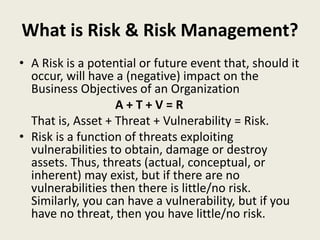
A + T + V = R
That is, Asset + Threat + Vulnerability = Risk.
• Risk is a function of threats exploiting
vulnerabilities to obtain, damage or destroy
assets. Thus, threats (actual, conceptual, or
inherent) may exist, but if there are no
vulnerabilities then there is little/no risk.
Similarly, you can have a vulnerability, but if you
have no threat, then you have little/no risk.
What is Risk & Risk Management?
• “Risk Management is the process of
measuring, or assessing risk and then
developing strategies to manage the risk.”-
Wikipedia
Risk Life Cycle
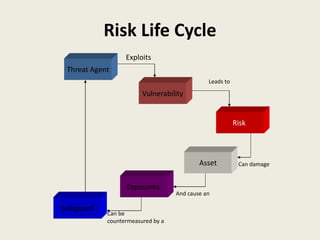
Threat Agent
Vulnerability
Risk
Asset
Exposures
Safeguard
Leads to
Can damage
And cause an
Exploits
Can be
countermeasured by a
General Terms:
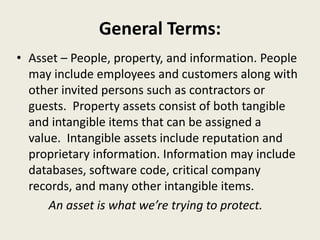
• Asset – People, property, and information. People
may include employees and customers along with
other invited persons such as contractors or
guests. Property assets consist of both tangible
and intangible items that can be assigned a
value. Intangible assets include reputation and
proprietary information. Information may include
databases, software code, critical company
records, and many other intangible items.
An asset is what we’re trying to protect.
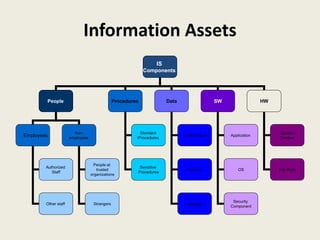
Information Assets
IS
Components
People Procedures Data
Transmission
HW
SW
Employees
Non-
employees
People at
trusted
organizations
Authorized
Staff
Other staff Strangers
Standard
Procedures
Sensitive
Procedures
Process
Storage
Application
OS
Security
Component
System
Devises
Net Work
General Terms:
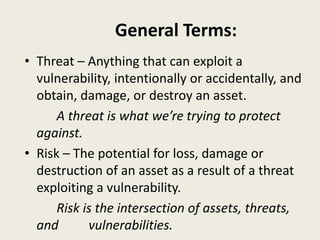
• Threat – Anything that can exploit a
vulnerability, intentionally or accidentally, and
obtain, damage, or destroy an asset.
A threat is what we’re trying to protect
against.
• Risk – The potential for loss, damage or
destruction of an asset as a result of a threat
exploiting a vulnerability.
Risk is the intersection of assets, threats,
and vulnerabilities.
General Terms:
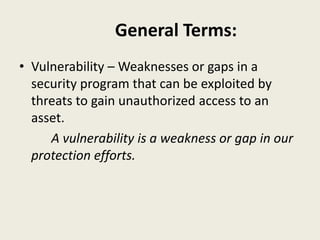
• Vulnerability – Weaknesses or gaps in a
security program that can be exploited by
threats to gain unauthorized access to an
asset.
A vulnerability is a weakness or gap in our
protection efforts.
Risk Management Process
• It involves two sub processes:
1. Risk Assessment
2. Risk Control
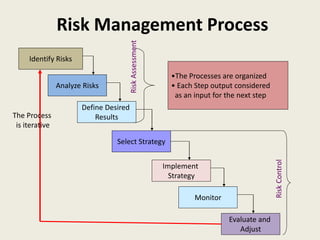
Identify Risks
Analyze Risks
Define Desired
Results
Select Strategy
Implement
Strategy
Monitor
Evaluate and
Adjust
The Process
is iterative
•The Processes are organized
• Each Step output considered
as an input for the next step
Risk
Control
Risk
Assessment
Risk Management Process
Risk Identification
• First step in the process of managing risk is to
identify potential risks. Risks are about events
that, when triggered, will cause problems.
• This is a crucial phase. If a risk is not identified
it cannot be evaluated and managed
• Any failure at this stage to identify risk may
cause a major loss for the organization.
• Risk identification provides the foundation of
risk management.
• Risk identification requires knowledge of the
organization, the market in which it operates,
the legal, social, economic, political, and
climatic environment in which it has its
impact.
Risk Identification
Risk Analysis
• Assessing risk is the process of determining
the likelihood of the threat being exercised
against the vulnerability and the resulting
impact from a successful compromise.
• The risk analyzing step assist in determining
which risks have a greater consequence or
impact than others.
Methods of Risk Analysis
Risk analysis is generally lumped into two main
categories: Qualitative and Quantitative.
• Qualitative Risk Analysis:
The root word of qualitative is “quality” and that is
what these techniques focus on. Qualifying risks under
this method involves making a simple list of the risks
themselves, along with ranking them and mapping
them out. The following are some common tricks used
for assessing risks from a qualitative aspect:
– Probability And Impact Assessment And Matrix: Analyzing
and rating risks using probability and impact on things like
cost, schedule and performance.
Methods of Risk Analysis
– Risk Categorization: Grouping risks by common
root causes to develop effective responses.
– Risk Urgency: The risk ranking from your
probability matrix combined with urgency can
help place risks priorities.
– Expert Judgment: Professional opinions from
people in the industry or with similar project
Methods of Risk Analysis
Quantitative Risk Analysis
These methods are more about definitive
measuring and probabilistic techniques. The
greatest risk of all is the risk of losing money
and you cannot use qualitative systems to
count your cost. The following are a few
simple ways in which organizations are
counting their risks:
– Probability distributions: Used in modeling and
simulation to represent the uncertainty of values
in things like task costs and labor.
Methods of Risk Analysis
– Cost and Schedule Risk Analysis: Cost estimates
and scheduling are used as input values that are
chosen randomly for each iteration.
– Sensitivity Analysis: This is a simple technique to
determine how much impact a risk poses to a
project.
– Expected Monetary Value analysis
(EMV): Calculating the average outcome of
scenarios that may or may not happen
Strategies: Selection &
Implementation
• Risk treatment is about considering options
for treating risks that were not considered
acceptable or tolerable.
• Risk treatment involves identifying options for
treating or controlling risk, in order to either
reduce or eliminate negative consequences, or
to reduce the likelihood of an adverse
occurrence.
Strategies: Selection &
Implementation
• Risk control should also aim to enhance positive
outcomes.
• Organizations can respond to risk in a variety of
ways. These include:
– (i) risk acceptance
– (ii) risk avoidance
– (iii) risk mitigation
– (iv) risk sharing
– (v) risk transfer
– (vi) a combination of the above.
Strategies: Selection &
Implementation
• Risk Acceptance: Risk acceptance is the
appropriate risk response when the identified
risk is within the organizational risk tolerance.
Organizations can accept risk deemed to be
low, moderate, or high depending on
particular situations or conditions.
Strategies: Selection &
Implementation
• Risk Avoidance: Risk avoidance may be the appropriate
risk response when the identified risk exceeds the
organizational risk tolerance. Organizations may
conduct certain types of activities or employ certain
types of information technologies that result in risk
that is unacceptable. In such situations, risk avoidance
involves taking specific actions to eliminate the
activities or technologies that are the basis for the risk
or to revise or reposition these activities or
technologies in the organizational mission/business
processes to avoid the potential for unacceptable risk
Strategies: Selection &
Implementation
• Risk Mitigation : Risk mitigation, or risk
reduction, is the appropriate risk response for
that portion of risk that cannot be accepted,
avoided, shared, or transferred.
• Risk mitigation involves taking action to
reduce an organization’s exposure
to potential risks and reduce the likelihood
that those risks will happen again.
Strategies: Selection &
Implementation
• Risk Sharing or Transfer : Risk sharing or risk
transfer is the appropriate risk response when
organizations desire and have the means to shift
risk liability and responsibility to other
organizations.
• Risk transfer shifts the entire risk responsibility or
liability from one organization to another
organization (e.g., using insurance to transfer risk
from particular organizations to insurance
companies).
Strategies: Selection &
Implementation
• It is important to note that risk transfer
reduces neither the likelihood of harmful
events occurring nor the consequences in
terms of harm to organizational operations
and assets, individuals, other organizations, or
the Nation.
Monitor and Review
• Monitor and review is an essential and
integral step in the risk management process.
• An owner of the organization must monitor
risks and review the effectiveness of the
treatment plan, strategies and management
system that have been set up to effectively
manage risk.
Monitor and Review
• Risks need to be monitored periodically to
ensure changing circumstances do not alter
the risk priorities. Very few risks will remain
static, therefore the risk management process
needs to be regularly repeated, so that new
risks are captured in the process and
effectively managed.
Thank You

Information Security Risk Management

  • 1.
    “Information Risk Management” Presentationon By- Nikhil Soni 2020MTIS-06 SECURE SOFTWARE SYSTEMS
  • 2.
    What is Risk& Risk Management? • A Risk is a potential or future event that, should it occur, will have a (negative) impact on the Business Objectives of an Organization A + T + V = R That is, Asset + Threat + Vulnerability = Risk. • Risk is a function of threats exploiting vulnerabilities to obtain, damage or destroy assets. Thus, threats (actual, conceptual, or inherent) may exist, but if there are no vulnerabilities then there is little/no risk. Similarly, you can have a vulnerability, but if you have no threat, then you have little/no risk.
  • 3.
    What is Risk& Risk Management? • “Risk Management is the process of measuring, or assessing risk and then developing strategies to manage the risk.”- Wikipedia
  • 4.
    Risk Life Cycle ThreatAgent Vulnerability Risk Asset Exposures Safeguard Leads to Can damage And cause an Exploits Can be countermeasured by a
  • 5.
    General Terms: • Asset– People, property, and information. People may include employees and customers along with other invited persons such as contractors or guests. Property assets consist of both tangible and intangible items that can be assigned a value. Intangible assets include reputation and proprietary information. Information may include databases, software code, critical company records, and many other intangible items. An asset is what we’re trying to protect.
  • 6.
    Information Assets IS Components People ProceduresData Transmission HW SW Employees Non- employees People at trusted organizations Authorized Staff Other staff Strangers Standard Procedures Sensitive Procedures Process Storage Application OS Security Component System Devises Net Work
  • 7.
    General Terms: • Threat– Anything that can exploit a vulnerability, intentionally or accidentally, and obtain, damage, or destroy an asset. A threat is what we’re trying to protect against. • Risk – The potential for loss, damage or destruction of an asset as a result of a threat exploiting a vulnerability. Risk is the intersection of assets, threats, and vulnerabilities.
  • 8.
    General Terms: • Vulnerability– Weaknesses or gaps in a security program that can be exploited by threats to gain unauthorized access to an asset. A vulnerability is a weakness or gap in our protection efforts.
  • 9.
    Risk Management Process •It involves two sub processes: 1. Risk Assessment 2. Risk Control
  • 10.
    Identify Risks Analyze Risks DefineDesired Results Select Strategy Implement Strategy Monitor Evaluate and Adjust The Process is iterative •The Processes are organized • Each Step output considered as an input for the next step Risk Control Risk Assessment Risk Management Process
  • 11.
    Risk Identification • Firststep in the process of managing risk is to identify potential risks. Risks are about events that, when triggered, will cause problems. • This is a crucial phase. If a risk is not identified it cannot be evaluated and managed • Any failure at this stage to identify risk may cause a major loss for the organization. • Risk identification provides the foundation of risk management.
  • 12.
    • Risk identificationrequires knowledge of the organization, the market in which it operates, the legal, social, economic, political, and climatic environment in which it has its impact. Risk Identification
  • 13.
    Risk Analysis • Assessingrisk is the process of determining the likelihood of the threat being exercised against the vulnerability and the resulting impact from a successful compromise. • The risk analyzing step assist in determining which risks have a greater consequence or impact than others.
  • 14.
    Methods of RiskAnalysis Risk analysis is generally lumped into two main categories: Qualitative and Quantitative. • Qualitative Risk Analysis: The root word of qualitative is “quality” and that is what these techniques focus on. Qualifying risks under this method involves making a simple list of the risks themselves, along with ranking them and mapping them out. The following are some common tricks used for assessing risks from a qualitative aspect: – Probability And Impact Assessment And Matrix: Analyzing and rating risks using probability and impact on things like cost, schedule and performance.
  • 15.
    Methods of RiskAnalysis – Risk Categorization: Grouping risks by common root causes to develop effective responses. – Risk Urgency: The risk ranking from your probability matrix combined with urgency can help place risks priorities. – Expert Judgment: Professional opinions from people in the industry or with similar project
  • 16.
    Methods of RiskAnalysis Quantitative Risk Analysis These methods are more about definitive measuring and probabilistic techniques. The greatest risk of all is the risk of losing money and you cannot use qualitative systems to count your cost. The following are a few simple ways in which organizations are counting their risks: – Probability distributions: Used in modeling and simulation to represent the uncertainty of values in things like task costs and labor.
  • 17.
    Methods of RiskAnalysis – Cost and Schedule Risk Analysis: Cost estimates and scheduling are used as input values that are chosen randomly for each iteration. – Sensitivity Analysis: This is a simple technique to determine how much impact a risk poses to a project. – Expected Monetary Value analysis (EMV): Calculating the average outcome of scenarios that may or may not happen
  • 18.
    Strategies: Selection & Implementation •Risk treatment is about considering options for treating risks that were not considered acceptable or tolerable. • Risk treatment involves identifying options for treating or controlling risk, in order to either reduce or eliminate negative consequences, or to reduce the likelihood of an adverse occurrence.
  • 19.
    Strategies: Selection & Implementation •Risk control should also aim to enhance positive outcomes. • Organizations can respond to risk in a variety of ways. These include: – (i) risk acceptance – (ii) risk avoidance – (iii) risk mitigation – (iv) risk sharing – (v) risk transfer – (vi) a combination of the above.
  • 20.
    Strategies: Selection & Implementation •Risk Acceptance: Risk acceptance is the appropriate risk response when the identified risk is within the organizational risk tolerance. Organizations can accept risk deemed to be low, moderate, or high depending on particular situations or conditions.
  • 21.
    Strategies: Selection & Implementation •Risk Avoidance: Risk avoidance may be the appropriate risk response when the identified risk exceeds the organizational risk tolerance. Organizations may conduct certain types of activities or employ certain types of information technologies that result in risk that is unacceptable. In such situations, risk avoidance involves taking specific actions to eliminate the activities or technologies that are the basis for the risk or to revise or reposition these activities or technologies in the organizational mission/business processes to avoid the potential for unacceptable risk
  • 22.
    Strategies: Selection & Implementation •Risk Mitigation : Risk mitigation, or risk reduction, is the appropriate risk response for that portion of risk that cannot be accepted, avoided, shared, or transferred. • Risk mitigation involves taking action to reduce an organization’s exposure to potential risks and reduce the likelihood that those risks will happen again.
  • 23.
    Strategies: Selection & Implementation •Risk Sharing or Transfer : Risk sharing or risk transfer is the appropriate risk response when organizations desire and have the means to shift risk liability and responsibility to other organizations. • Risk transfer shifts the entire risk responsibility or liability from one organization to another organization (e.g., using insurance to transfer risk from particular organizations to insurance companies).
  • 24.
    Strategies: Selection & Implementation •It is important to note that risk transfer reduces neither the likelihood of harmful events occurring nor the consequences in terms of harm to organizational operations and assets, individuals, other organizations, or the Nation.
  • 25.
    Monitor and Review •Monitor and review is an essential and integral step in the risk management process. • An owner of the organization must monitor risks and review the effectiveness of the treatment plan, strategies and management system that have been set up to effectively manage risk.
  • 26.
    Monitor and Review •Risks need to be monitored periodically to ensure changing circumstances do not alter the risk priorities. Very few risks will remain static, therefore the risk management process needs to be regularly repeated, so that new risks are captured in the process and effectively managed.
  • 27.