Group 4:
Parikshit Sangvikar -29
Labdhi Vora - 16
Bhavik Shah - 08
1
Disclaimer: The credit of the content also goes to different authors and sources from which
data has been procured
Agenda
 What is (supply chain) risk?
 What are typical supply chain risks?
 How to manage supply chain risks?
2
What is Supply Chain Risk
Management
Risk = probability of occurrence x consequences
Supply chain risk management (SCRM) is
"the implementation of strategies to manage
both everyday and exceptional risks along the
supply chain based on continuous risk
assessment with the objective of reducing
vulnerability and ensuring continuity".
Source: Cranfield University, School of Management
3
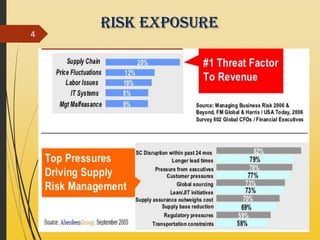
Risk Exposure
4
Why are today’s supply chains
so DYNAMIC AND COMPLEX?
 Faster (Growth, Innovation)
 Stronger (Competition)
 Cheaper (Lean, economies of scale, efficient)
 Quicker (JIT, agile)
 Shorter (Lead times)
 Wider (Globalization)
 Lesser inventory (VMI)
 Changing (Demands, Technology)
 Heavier (Requirements, Workload)
5
Why is supply chain risk
important?
 Even a relatively small supply chain disruption
caused by a localized event may have
consequences across the global economic
system
 No control over causes to events in supply
chain
 Only control over consequences of events in
supply chain
6
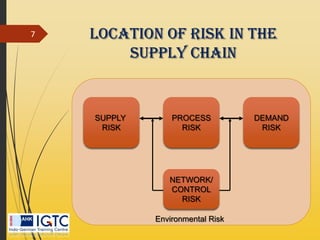
Location of risk in the
supply chain
7
SUPPLY
RISK
PROCESS
RISK
DEMAND
RISK
NETWORK/
CONTROL
RISK
Environmental Risk
Supply Risk
Dependency only on key suppliers
Quality and management issues arising
from outsourcing
Variability in lead-times
Poor quality of RM supplied
Delays in transportation
8
Process Risk
 Manufacturing yield variability
 Lengthy set-up times and inflexible processes
 Equipment reliability
 Capacity shortage/bottlenecks
 Outsourcing key business processes
 Power failure
 Breakdown of machines
 Absenteeism during festive season,
 Problems in IT systems
 Warehouse problems
9
Demand Risk
 Loss of major customers
 Volatility of demand
 Concentration of customer base
 Short life cycles
 Innovative competitors
 Inaccurate forecasts
10
Network/Control Risk
 Inefficient communication
 Poor visibility along the pipeline
 Inappropriate rules that distort demand
 Lack of collaborative planning and forecasts
 Bullwhip effects due to multiple reasons
 Security Risks - theft, data
loss, counterfeiting, terrorism, piracy
11
Environmental Risk
 Macro Risks
Economic shifts, recession, exchange
rates, custom, natural disasters, labor unrest
 Policy Risks
Actions and sanctions of governments, shifts in
legislation
 Competition Risks
Uncertainty about competitors’ moves and actions
 Resource Risks
Lack of human resources, capital or technology
 No disaster management focus
12
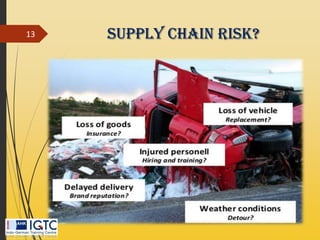
Supply Chain Risk?13
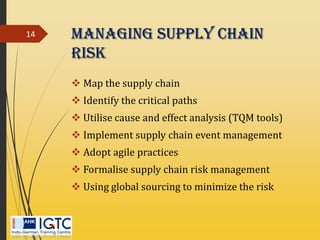
Managing Supply Chain
Risk
 Map the supply chain
 Identify the critical paths
 Utilise cause and effect analysis (TQM tools)
 Implement supply chain event management
 Adopt agile practices
 Formalise supply chain risk management
 Using global sourcing to minimize the risk
14
15
Risk mapping - example (Reference: Anil S Sathe
presentation, Oct 21st, 2013)
Inherent Risk Analysis & Evaluation (Step II)
Existing Controls/Treatment Plans
(Step III)
Risk Description
(Event/Scenario)
Risk Type
Internal /
External
Risk
Information
Variables
Impact Risk
Category
(People, Assets/
Revenue
/Production Loss,
Environment,
Reputation &
Compliance)
Likelihood
Existing Control
Description
Product Failure -
technical Operation
al
Internal
Defect
percentage
identified
Critical
Not Likely (Less than
10%)
Quality Control and
Assurance Process
Risk of significant
breakdowns of
Plant and
Machinery
Operation
al
Internal
Reported
Breakdowns
Critical
Not Likely (Less than
10%)
Preventive Maintenance
process
Inadequate future
capacity creation Strategic Internal
Demand vs
Supply Gap
High Not Likely (<10%)
Appropriate
planning/forecast
Delayed
availability or un-
availability of
Supplies
Operation
al
Internal
and
External
Reported
unavailabilities
Critical Not Likely (less than 10%)
Project Planning and
Management
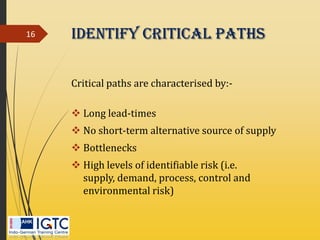
Identify Critical Paths
Critical paths are characterised by:-
 Long lead-times
 No short-term alternative source of supply
 Bottlenecks
 High levels of identifiable risk (i.e.
supply, demand, process, control and
environmental risk)
16
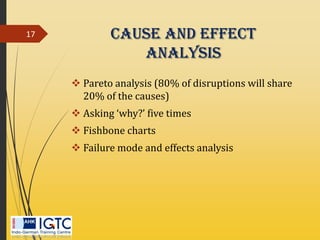
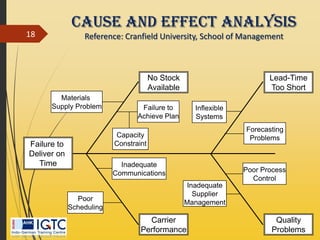
Cause And Effect
Analysis
 Pareto analysis (80% of disruptions will share
20% of the causes)
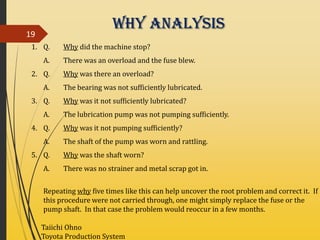
 Asking ‘why?’ five times
 Fishbone charts
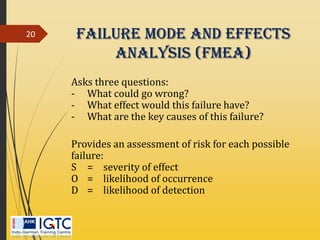
 Failure mode and effects analysis
17
Cause And Effect Analysis
Reference: Cranfield University, School of Management18
Failure to
Deliver on
Time
No Stock
Available
Lead-Time
Too Short
Carrier
Performance
Quality
Problems
Capacity
Constraint
Inflexible
Systems
Inadequate
Communications
Poor
Scheduling
Inadequate
Supplier
Management
Materials
Supply Problem Failure to
Achieve Plan
Forecasting
Problems
Poor Process
Control
Why Analysis
1. Q. Why did the machine stop?
A. There was an overload and the fuse blew.
2. Q. Why was there an overload?
A. The bearing was not sufficiently lubricated.
3. Q. Why was it not sufficiently lubricated?
A. The lubrication pump was not pumping sufficiently.
4. Q. Why was it not pumping sufficiently?
A. The shaft of the pump was worn and rattling.
5. Q. Why was the shaft worn?
A. There was no strainer and metal scrap got in.
Repeating why five times like this can help uncover the root problem and correct it. If
this procedure were not carried through, one might simply replace the fuse or the
pump shaft. In that case the problem would reoccur in a few months.
Taiichi Ohno
Toyota Production System
19
Failure mode and effects
analysis (FMEA)
Asks three questions:
- What could go wrong?
- What effect would this failure have?
- What are the key causes of this failure?
Provides an assessment of risk for each possible
failure:
S = severity of effect
O = likelihood of occurrence
D = likelihood of detection
20
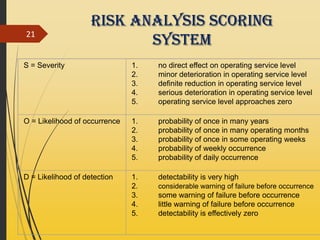
Risk Analysis Scoring
System21
S = Severity 1. no direct effect on operating service level
2. minor deterioration in operating service level
3. definite reduction in operating service level
4. serious deterioration in operating service level
5. operating service level approaches zero
O = Likelihood of occurrence 1. probability of once in many years
2. probability of once in many operating months
3. probability of once in some operating weeks
4. probability of weekly occurrence
5. probability of daily occurrence
D = Likelihood of detection 1. detectability is very high
2. considerable warning of failure before occurrence
3. some warning of failure before occurrence
4. little warning of failure before occurrence
5. detectability is effectively zero
Agility holds the key
Agile supply chains are designed to respond rapidly to
unpredictable change. They are based upon a number of
principles:-
 Very close connection to final marketplace
 Visibility of real demand
 High levels of synchronicity upstream and downstream
 Organisational focus on processes rather than functions
 Advanced level of collaborative planning with supply chain
partners
 Continuous search for time compression opportunities
22
Globalization
Globalization allows us:
 To site facilities in safer locations
 Tap into educated overseas workforces and set up
production centers closer to sources of raw
material
 By opening the door to using vendors and
suppliers from around the world
 The number of vendors and suppliers that
companies can tap to fill gaps in their supply chain.
23
Robust Or Resilient
 A robust process can be defined as “a process able to
deal with reasonable variability”
 A resilient supply chain can be defined as “a supply
chain with the ability to recover quickly from
unexpected events impacting supply chain
performance”
24
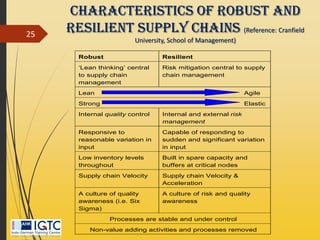
Characteristics of Robust and
Resilient supply chains (Reference: Cranfield
University, School of Management)
25
Robust Resilient
‘Lean thinking’ central
to supply chain
management
Risk mitigation central to supply
chain management
Lean Agile
Strong Elastic
Internal quality control Internal and external risk
management
Responsive to
reasonable variation in
input
Capable of responding to
sudden and significant variation
in input
Low inventory levels
throughout
Built in spare capacity and
buffers at critical nodes
Supply chain Velocity Supply chain Velocity &
Acceleration
A culture of quality
awareness (i.e. Six
Sigma)
A culture of risk and quality
awareness
Processes are stable and under control
Non-value adding activities and processes removed
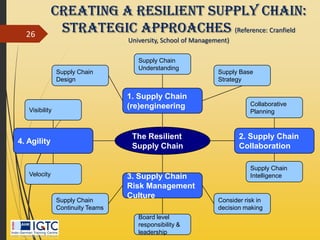
Creating a Resilient Supply Chain:
Strategic Approaches (Reference: Cranfield
University, School of Management)
26
The Resilient
Supply Chain
1. Supply Chain
(re)engineering
Supply Chain
Design
Supply Chain
Understanding
Supply Base
Strategy
2. Supply Chain
Collaboration
Collaborative
Planning
Supply Chain
Intelligence3. Supply Chain
Risk Management
Culture
4. Agility
Visibility
Velocity
Supply Chain
Continuity Teams
Board level
responsibility &
leadership
Consider risk in
decision making
“A fire at a key Philips semiconductor factory in 2000
caused a worldwide shortage of the radio frequency chips
used by both Nokia and Ericsson. Nokia immediately lined
up another source and redesigned other chips so they could
be produced elsewhere. However, Ericsson responded
more slowly and lost an estimated $400 million in mobile
phone handsets.”
MIT Sloan Management Review
Summer 2006
27
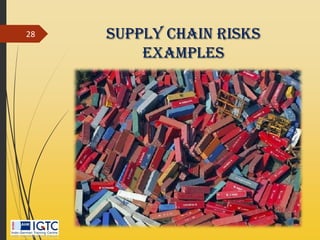
Supply Chain risks
examples
28
“The entire Japanese vehicle industry ground to a halt
following an earthquake that stopped production of
piston rings for engines provided by Riken, the industry
leader in the domestic market.
Toyota, in particular, was forced to stop operations at all
12 of its domestic plants.”
Financial Times, 24 July 2007
29
“Yesterday it emerged that ice-cream supplies may run short
because Unilever’s only UK factory, based in flood-stricken
Gloucester, has been closed for the past ten days.
The company usually manufacturers five million ice-creams
and lollipops a day at the plant. It has stocks in freezers but it
could be days before normal production resumes. Industry
insiders predict that there will now be an ice-cream war as
rival brands attempt to exploit Unilever’s predicament and
gain market share.”
The Times, 31 July 2007
30

Risk management in supply chain

  • 1.
    Group 4: Parikshit Sangvikar-29 Labdhi Vora - 16 Bhavik Shah - 08 1 Disclaimer: The credit of the content also goes to different authors and sources from which data has been procured
  • 2.
    Agenda  What is(supply chain) risk?  What are typical supply chain risks?  How to manage supply chain risks? 2
  • 3.
    What is SupplyChain Risk Management Risk = probability of occurrence x consequences Supply chain risk management (SCRM) is "the implementation of strategies to manage both everyday and exceptional risks along the supply chain based on continuous risk assessment with the objective of reducing vulnerability and ensuring continuity". Source: Cranfield University, School of Management 3
  • 4.
  • 5.
    Why are today’ssupply chains so DYNAMIC AND COMPLEX?  Faster (Growth, Innovation)  Stronger (Competition)  Cheaper (Lean, economies of scale, efficient)  Quicker (JIT, agile)  Shorter (Lead times)  Wider (Globalization)  Lesser inventory (VMI)  Changing (Demands, Technology)  Heavier (Requirements, Workload) 5
  • 6.
    Why is supplychain risk important?  Even a relatively small supply chain disruption caused by a localized event may have consequences across the global economic system  No control over causes to events in supply chain  Only control over consequences of events in supply chain 6
  • 7.
    Location of riskin the supply chain 7 SUPPLY RISK PROCESS RISK DEMAND RISK NETWORK/ CONTROL RISK Environmental Risk
  • 8.
    Supply Risk Dependency onlyon key suppliers Quality and management issues arising from outsourcing Variability in lead-times Poor quality of RM supplied Delays in transportation 8
  • 9.
    Process Risk  Manufacturingyield variability  Lengthy set-up times and inflexible processes  Equipment reliability  Capacity shortage/bottlenecks  Outsourcing key business processes  Power failure  Breakdown of machines  Absenteeism during festive season,  Problems in IT systems  Warehouse problems 9
  • 10.
    Demand Risk  Lossof major customers  Volatility of demand  Concentration of customer base  Short life cycles  Innovative competitors  Inaccurate forecasts 10
  • 11.
    Network/Control Risk  Inefficientcommunication  Poor visibility along the pipeline  Inappropriate rules that distort demand  Lack of collaborative planning and forecasts  Bullwhip effects due to multiple reasons  Security Risks - theft, data loss, counterfeiting, terrorism, piracy 11
  • 12.
    Environmental Risk  MacroRisks Economic shifts, recession, exchange rates, custom, natural disasters, labor unrest  Policy Risks Actions and sanctions of governments, shifts in legislation  Competition Risks Uncertainty about competitors’ moves and actions  Resource Risks Lack of human resources, capital or technology  No disaster management focus 12
  • 13.
  • 14.
    Managing Supply Chain Risk Map the supply chain  Identify the critical paths  Utilise cause and effect analysis (TQM tools)  Implement supply chain event management  Adopt agile practices  Formalise supply chain risk management  Using global sourcing to minimize the risk 14
  • 15.
    15 Risk mapping -example (Reference: Anil S Sathe presentation, Oct 21st, 2013) Inherent Risk Analysis & Evaluation (Step II) Existing Controls/Treatment Plans (Step III) Risk Description (Event/Scenario) Risk Type Internal / External Risk Information Variables Impact Risk Category (People, Assets/ Revenue /Production Loss, Environment, Reputation & Compliance) Likelihood Existing Control Description Product Failure - technical Operation al Internal Defect percentage identified Critical Not Likely (Less than 10%) Quality Control and Assurance Process Risk of significant breakdowns of Plant and Machinery Operation al Internal Reported Breakdowns Critical Not Likely (Less than 10%) Preventive Maintenance process Inadequate future capacity creation Strategic Internal Demand vs Supply Gap High Not Likely (<10%) Appropriate planning/forecast Delayed availability or un- availability of Supplies Operation al Internal and External Reported unavailabilities Critical Not Likely (less than 10%) Project Planning and Management
  • 16.
    Identify Critical Paths Criticalpaths are characterised by:-  Long lead-times  No short-term alternative source of supply  Bottlenecks  High levels of identifiable risk (i.e. supply, demand, process, control and environmental risk) 16
  • 17.
    Cause And Effect Analysis Pareto analysis (80% of disruptions will share 20% of the causes)  Asking ‘why?’ five times  Fishbone charts  Failure mode and effects analysis 17
  • 18.
    Cause And EffectAnalysis Reference: Cranfield University, School of Management18 Failure to Deliver on Time No Stock Available Lead-Time Too Short Carrier Performance Quality Problems Capacity Constraint Inflexible Systems Inadequate Communications Poor Scheduling Inadequate Supplier Management Materials Supply Problem Failure to Achieve Plan Forecasting Problems Poor Process Control
  • 19.
    Why Analysis 1. Q.Why did the machine stop? A. There was an overload and the fuse blew. 2. Q. Why was there an overload? A. The bearing was not sufficiently lubricated. 3. Q. Why was it not sufficiently lubricated? A. The lubrication pump was not pumping sufficiently. 4. Q. Why was it not pumping sufficiently? A. The shaft of the pump was worn and rattling. 5. Q. Why was the shaft worn? A. There was no strainer and metal scrap got in. Repeating why five times like this can help uncover the root problem and correct it. If this procedure were not carried through, one might simply replace the fuse or the pump shaft. In that case the problem would reoccur in a few months. Taiichi Ohno Toyota Production System 19
  • 20.
    Failure mode andeffects analysis (FMEA) Asks three questions: - What could go wrong? - What effect would this failure have? - What are the key causes of this failure? Provides an assessment of risk for each possible failure: S = severity of effect O = likelihood of occurrence D = likelihood of detection 20
  • 21.
    Risk Analysis Scoring System21 S= Severity 1. no direct effect on operating service level 2. minor deterioration in operating service level 3. definite reduction in operating service level 4. serious deterioration in operating service level 5. operating service level approaches zero O = Likelihood of occurrence 1. probability of once in many years 2. probability of once in many operating months 3. probability of once in some operating weeks 4. probability of weekly occurrence 5. probability of daily occurrence D = Likelihood of detection 1. detectability is very high 2. considerable warning of failure before occurrence 3. some warning of failure before occurrence 4. little warning of failure before occurrence 5. detectability is effectively zero
  • 22.
    Agility holds thekey Agile supply chains are designed to respond rapidly to unpredictable change. They are based upon a number of principles:-  Very close connection to final marketplace  Visibility of real demand  High levels of synchronicity upstream and downstream  Organisational focus on processes rather than functions  Advanced level of collaborative planning with supply chain partners  Continuous search for time compression opportunities 22
  • 23.
    Globalization Globalization allows us: To site facilities in safer locations  Tap into educated overseas workforces and set up production centers closer to sources of raw material  By opening the door to using vendors and suppliers from around the world  The number of vendors and suppliers that companies can tap to fill gaps in their supply chain. 23
  • 24.
    Robust Or Resilient A robust process can be defined as “a process able to deal with reasonable variability”  A resilient supply chain can be defined as “a supply chain with the ability to recover quickly from unexpected events impacting supply chain performance” 24
  • 25.
    Characteristics of Robustand Resilient supply chains (Reference: Cranfield University, School of Management) 25 Robust Resilient ‘Lean thinking’ central to supply chain management Risk mitigation central to supply chain management Lean Agile Strong Elastic Internal quality control Internal and external risk management Responsive to reasonable variation in input Capable of responding to sudden and significant variation in input Low inventory levels throughout Built in spare capacity and buffers at critical nodes Supply chain Velocity Supply chain Velocity & Acceleration A culture of quality awareness (i.e. Six Sigma) A culture of risk and quality awareness Processes are stable and under control Non-value adding activities and processes removed
  • 26.
    Creating a ResilientSupply Chain: Strategic Approaches (Reference: Cranfield University, School of Management) 26 The Resilient Supply Chain 1. Supply Chain (re)engineering Supply Chain Design Supply Chain Understanding Supply Base Strategy 2. Supply Chain Collaboration Collaborative Planning Supply Chain Intelligence3. Supply Chain Risk Management Culture 4. Agility Visibility Velocity Supply Chain Continuity Teams Board level responsibility & leadership Consider risk in decision making
  • 27.
    “A fire ata key Philips semiconductor factory in 2000 caused a worldwide shortage of the radio frequency chips used by both Nokia and Ericsson. Nokia immediately lined up another source and redesigned other chips so they could be produced elsewhere. However, Ericsson responded more slowly and lost an estimated $400 million in mobile phone handsets.” MIT Sloan Management Review Summer 2006 27
  • 28.
  • 29.
    “The entire Japanesevehicle industry ground to a halt following an earthquake that stopped production of piston rings for engines provided by Riken, the industry leader in the domestic market. Toyota, in particular, was forced to stop operations at all 12 of its domestic plants.” Financial Times, 24 July 2007 29
  • 30.
    “Yesterday it emergedthat ice-cream supplies may run short because Unilever’s only UK factory, based in flood-stricken Gloucester, has been closed for the past ten days. The company usually manufacturers five million ice-creams and lollipops a day at the plant. It has stocks in freezers but it could be days before normal production resumes. Industry insiders predict that there will now be an ice-cream war as rival brands attempt to exploit Unilever’s predicament and gain market share.” The Times, 31 July 2007 30

Editor's Notes

  • #29 Cargo containers carrying millions of goods after a tsunami took place in Japan, 2011. The automotive and electronics sectors were greatly affected.