LINEAR ORDER
Preliminaries
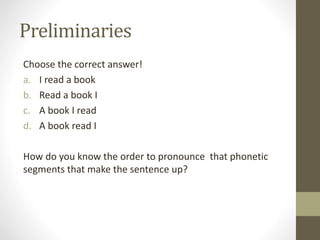
Choose the correct answer!
a. I read a book
b. Read a book I
c. A book I read
d. A book read I
How do you know the order to pronounce that phonetic
segments that make the sentence up?
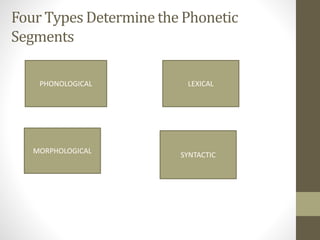
Four Types Determine the Phonetic
Segments
PHONOLOGICAL
MORPHOLOGICAL
LEXICAL
SYNTACTIC
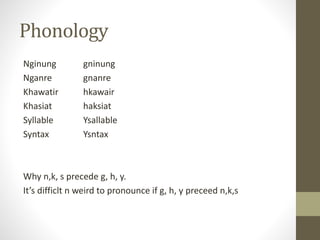
Phonology
Nginung gninung
Nganre gnanre
Khawatir hkawair
Khasiat haksiat
Syllable Ysallable
Syntax Ysntax
Why n,k, s precede g, h, y.
It’s difficlt n weird to pronounce if g, h, y preceed n,k,s
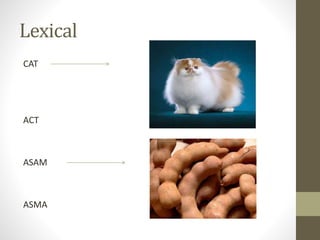
Lexical
CAT
ACT
ASAM
ASMA
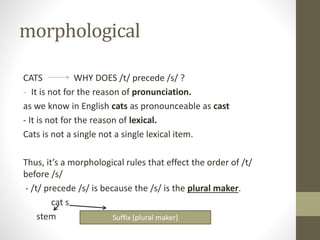
morphological
CATS WHY DOES /t/ precede /s/ ?
- It is not for the reason of pronunciation.
as we know in English cats as pronounceable as cast
- It is not for the reason of lexical.
Cats is not a single not a single lexical item.
Thus, it’s a morphological rules that effect the order of /t/
before /s/
- /t/ precede /s/ is because the /s/ is the plural maker.
cat s
stem (bound morpheme)plural maker
Suffix (plural maker)
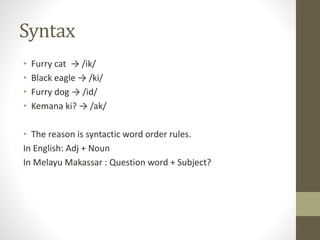
Syntax
• Furry cat → /ik/
• Black eagle → /ki/
• Furry dog → /id/
• Kemana ki? → /ak/
• The reason is syntactic word order rules.
In English: Adj + Noun
In Melayu Makassar : Question word + Subject?
Temporal Relation
• Relation
• Terms
• Context
• Modalities
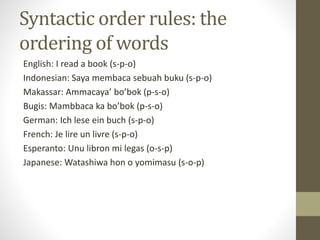
Syntactic order rules: the
ordering of words
English: I read a book (s-p-o)
Indonesian: Saya membaca sebuah buku (s-p-o)
Makassar: Ammacaya’ bo’bok (p-s-o)
Bugis: Mambbaca ka bo’bok (p-s-o)
German: Ich lese ein buch (s-p-o)
French: Je lire un livre (s-p-o)
Esperanto: Unu libron mi legas (o-s-p)
Japanese: Watashiwa hon o yomimasu (s-o-p)
Relation
• A. simultaneous [---A---]
[---B---]
• B. immediately precedes [---A---] [---B---]
• C. included [---A---]
[------B---]
• D. overlap [--A--]
[---B---]
• E. interlocked [--A1--] [--A2]
[--B1--] [--B2]
RELATION
• The two temporal that are available for words are :
1. Immediate Precedence[---a---] [--b--]
2. Interlocking [--a1--] [--a2--]
[--b1--] [--b2--]
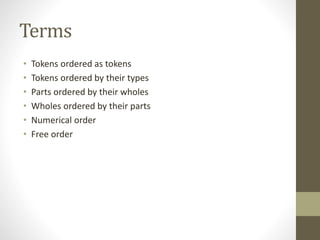
Terms
• Tokens ordered as tokens
• Tokens ordered by their types
• Parts ordered by their wholes
• Wholes ordered by their parts
• Numerical order
• Free order
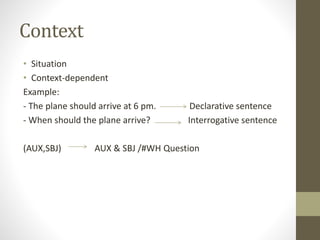
Context
• Situation
• Context-dependent
Example:
- The plane should arrive at 6 pm. Declarative sentence
- When should the plane arrive? Interrogative sentence
(AUX,SBJ) AUX & SBJ /#WH Question
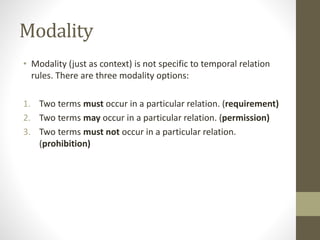
Modality
• Modality (just as context) is not specific to temporal relation
rules. There are three modality options:
1. Two terms must occur in a particular relation. (requirement)
2. Two terms may occur in a particular relation. (permission)
3. Two terms must not occur in a particular relation.
(prohibition)
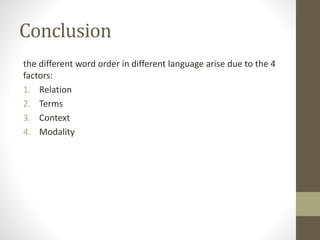
Conclusion
the different word order in different language arise due to the 4
factors:
1. Relation
2. Terms
3. Context
4. Modality

LINEAR ORDER in English Syntax

  • 1.
  • 2.
    Preliminaries Choose the correctanswer! a. I read a book b. Read a book I c. A book I read d. A book read I How do you know the order to pronounce that phonetic segments that make the sentence up?
  • 3.
    Four Types Determinethe Phonetic Segments PHONOLOGICAL MORPHOLOGICAL LEXICAL SYNTACTIC
  • 4.
    Phonology Nginung gninung Nganre gnanre Khawatirhkawair Khasiat haksiat Syllable Ysallable Syntax Ysntax Why n,k, s precede g, h, y. It’s difficlt n weird to pronounce if g, h, y preceed n,k,s
  • 5.
  • 6.
    morphological CATS WHY DOES/t/ precede /s/ ? - It is not for the reason of pronunciation. as we know in English cats as pronounceable as cast - It is not for the reason of lexical. Cats is not a single not a single lexical item. Thus, it’s a morphological rules that effect the order of /t/ before /s/ - /t/ precede /s/ is because the /s/ is the plural maker. cat s stem (bound morpheme)plural maker Suffix (plural maker)
  • 7.
    Syntax • Furry cat→ /ik/ • Black eagle → /ki/ • Furry dog → /id/ • Kemana ki? → /ak/ • The reason is syntactic word order rules. In English: Adj + Noun In Melayu Makassar : Question word + Subject?
  • 8.
    Temporal Relation • Relation •Terms • Context • Modalities
  • 9.
    Syntactic order rules:the ordering of words English: I read a book (s-p-o) Indonesian: Saya membaca sebuah buku (s-p-o) Makassar: Ammacaya’ bo’bok (p-s-o) Bugis: Mambbaca ka bo’bok (p-s-o) German: Ich lese ein buch (s-p-o) French: Je lire un livre (s-p-o) Esperanto: Unu libron mi legas (o-s-p) Japanese: Watashiwa hon o yomimasu (s-o-p)
  • 10.
    Relation • A. simultaneous[---A---] [---B---] • B. immediately precedes [---A---] [---B---] • C. included [---A---] [------B---] • D. overlap [--A--] [---B---] • E. interlocked [--A1--] [--A2] [--B1--] [--B2]
  • 11.
    RELATION • The twotemporal that are available for words are : 1. Immediate Precedence[---a---] [--b--] 2. Interlocking [--a1--] [--a2--] [--b1--] [--b2--]
  • 12.
    Terms • Tokens orderedas tokens • Tokens ordered by their types • Parts ordered by their wholes • Wholes ordered by their parts • Numerical order • Free order
  • 13.
    Context • Situation • Context-dependent Example: -The plane should arrive at 6 pm. Declarative sentence - When should the plane arrive? Interrogative sentence (AUX,SBJ) AUX & SBJ /#WH Question
  • 14.
    Modality • Modality (justas context) is not specific to temporal relation rules. There are three modality options: 1. Two terms must occur in a particular relation. (requirement) 2. Two terms may occur in a particular relation. (permission) 3. Two terms must not occur in a particular relation. (prohibition)
  • 15.
    Conclusion the different wordorder in different language arise due to the 4 factors: 1. Relation 2. Terms 3. Context 4. Modality