Roads
English for Civil
Engineering
Juvrianto CJ, S.Pd., M.Pd.
History and Evolution
Thousands of years before urban planning, motor vehicles, or even the
wheel, the first roads appeared on the landscape. Just as molecules
coalesced into cells and cells into more complex organisms, our first roads
were spontaneously formed by humans walking the same paths over and
over to get water and find food. As small groups of people combined into
villages, towns and cities, networks of walking paths became more formal
roads. Following the introduction of the wheel about 7,000 years ago, the
larger, heavier loads that could be transported showed the limitations of dirt
paths that turned into muddy bogs when it rained. The earliest stone paved
roads have been traced to about 4,000 B.C. in the Indian subcontinent and
Mesopotamia.
History and Evolution
With much of the 20th century punctuated by hot and cold wars, the need to
move the military just as the Romans did led to the development of the
modern superhighway, including the German Autobahn and American
interstate system. Military requirements for long, unobstructed stretches
that could be used as emergency runways for aircraft paid a dividend for
civilian drivers who could now cross countries at high speeds in relative
safety.
Building or expanding modern roads is a complex undertaking that can cost
anywhere from $2 to12 million per mile depending on the number of lanes
and the location. A great deal of consideration must be put into where roads
should go in order to minimize disruptions and the make them as direct as
possible, while simultaneously keeping slopes reasonable in hilly areas for
performance and safety reasons.
Components Of Modern Road Structure
Following are the different components of road structure:
 Subgrade
 Sub-base
 Base course
 Surface course or wearing course
Subgrade
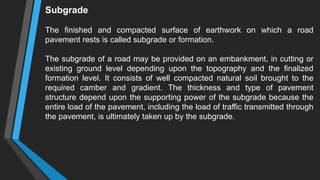
The finished and compacted surface of earthwork on which a road
pavement rests is called subgrade or formation.
The subgrade of a road may be provided on an embankment, in cutting or
existing ground level depending upon the topography and the finalized
formation level. It consists of well compacted natural soil brought to the
required camber and gradient. The thickness and type of pavement
structure depend upon the supporting power of the subgrade because the
entire load of the pavement, including the load of traffic transmitted through
the pavement, is ultimately taken up by the subgrade.
Sub-base
A layer of granular material provided in between the subgrade and the base
course in a road pavement is known as sub-base.
It is provided as an additional layer when subgrade is of poor quality. It
consists of a layer comparatively cheaper material like burnt clinker, natural
gravel or slag.
Base Course
A layer of boulders or bricks provided over the subbase or immediately over
the subgrade in the absence of sub-base in a road pavement is called base
course or soling or foundation course.
This course is considered as the most important and major component of
road structure because this course is to bear the impact of traffic
transferred through the wearing course. It consists of a stable material like
boulders, gravel, one or two layers of well-burnt bricks etc. In case of rocky
subgrade, this course is not provided.
Surface Course Or Wearing Course
The topmost layer of the road pavement directly exposed to traffic is called
is called wearing course or surfacing.
It may consist of one or more number of layers in case of flexible
pavements. A good wearing course should be impervious and weather
resisting. it should be able to resist abrasive action of the traffic.
Components Of Modern Road Structure
Classification of Roads
Road transportation is an essential network for any country. Classification
of roads based on many factors such as materials, locations, traffic etc. are
discussed.
Classification or Types of Roads
The roads are classified based on many factors as follows.
 Materials
 Location & function
 Traffic volume
 Width
 Economy
 Traffic type
 Rigidity
 Topography
Types of Roads Based on Materials
 Earthen roads
 Gravel roads
 Murrum roads
 Kankar roads
 WBM roads
 Bituminous roads
 Concrete roads
Earthen Roads
Earthen roads are laid with soil. They are cheaper of all types of roads.
This type of road is provided for less traffic areas and or for countryside
areas. Good drainage system should be required which reflects good
performance for longer period.
Gravel Roads
Gravel roads are also low quality roads but they are good when compared
to earthen roads. Compacted mixture of gravel and earth is used as
pavement material in this case.
Murrum Roads
Murrum is a matter obtained from the disintegration of igneous rocks by
weathering agencies. This is used to make roads called as murrum roads.
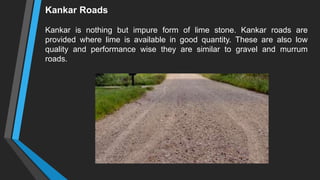
Kankar Roads
Kankar is nothing but impure form of lime stone. Kankar roads are
provided where lime is available in good quantity. These are also low
quality and performance wise they are similar to gravel and murrum
roads.
WBM Roads
Water Bound Macadam (WBM) roads contain crushed stone aggregate in
its base course. The aggregates are spread on the surface and these are
rolled after sprinkling water. WBM roads provides better performance
compared to earthen, gravel, murrum and kankar roads. WBM roads are
laid as layers about 10cm thickness of each layer. They are very rough
and may disintegrate immediately under traffic.
Bituminous Roads
Bituminous roads are very popular roads around the world. They are most
used roads in the world. They are low in cost and good for driving
conditions. They are flexible and thickness of bituminous roads depends
upon the subgrade soil conditions.
Concrete Roads
Cement concrete is used to construct the pavements in case of concrete
roads. These are very popular and costlier than all other types of roads.
They are not flexible so, they require less maintenance.
Types of Roads Based on Location and Function
 National highways
 State highways
 District roads
 Rural roads or village roads
National Highways
National highways are main roads of a particular country. They connects
all major cities to the capital of the country. They run throughout the length
and breadth of the country. Minimum two lane road is provided for
national highways.
State Highways
State highways are second main roads which connect major parts of state
with in it. State highway ultimately connects to the national highways.
District Roads
District roads are provided with in the cities and connects markets and
production places to state and national highways. Two types of district
roads are there namely, Major district roads & Minor district roads.
Major district roads connect headquarters of neighboring district with main
parts of district while minor district roads are laid with in the district.
Rural Roads or Village Roads
Village roads connects the nearby villages with each other. They lead to
nearby town or district roads. Usually low quality roads are provided as
village roads because of low traffic.
Types of Roads Based on Traffic Volume
 Light Traffic Roads
The roads which are carrying 400 vehicles daily on an average is called
light traffic roads.
 Medium Traffic Roads
If a road carrying 400 to 1000 vehicles per day then it is said to be
medium traffic road.
 High Traffic Roads
If a road is carrying is more than 1000 vehicles per day then it is
considered as high traffic road.
Types of Roads Based on Economy
 Low cost roads
 Medium cost roads
 High cost roads
The economy depend upon the location and function of roads and also on
the traffic analysis.
Types of Roads Based on Traffic Type
 Pedestrian Ways
Pedestrian ways are exclusively built for pedestrians and no vehicles are
permitted in this way.
 Cycle Tracks
Cycle tracks or bicycle tracks are provided on both sides of pavement for
cyclists hence they can travel safely.
 Motorways
Motorways are also known as expressways. Only few vehicles are
accessible to use this type of roads. The vehicles which can move with
high speed acceleration are permitted into this way. Motorways makes
travel quick and provides comfort for high speed vehicles.
Types of Roads Based on Rigidity
 Flexible Roads
Flexible roads consists flexible layer as pavement surface which require
good maintenance otherwise it can be disintegrated easily with heavy
traffic. All types of roads except concrete roads are come under this
category.
 Rigid Roads
Rigid pavements are non-flexible and cement concrete roads are come
under this category.
Types of Roads Based on Topography
 Plain Area Road
The roads constructed on leveled surface is known as plain area roads.
 Hilly Area Roads
Roads constructed in hilly regions are called as hill area roads or ghat
roads. Generally these are provided around the hill in spiral shape.
References:
1. https://www.roadandtrack.com/car-culture/a4447/the-road-ahead-road-
evolution/
2. https://theconstructor.org/transportation/classification-of-roads/17470/
3. https://dailycivil.com/components-road-pavement-structure/
4. https://www.aboutcivil.org/components-of-road-structure.html

Roads

  • 1.
  • 2.
    History and Evolution Thousandsof years before urban planning, motor vehicles, or even the wheel, the first roads appeared on the landscape. Just as molecules coalesced into cells and cells into more complex organisms, our first roads were spontaneously formed by humans walking the same paths over and over to get water and find food. As small groups of people combined into villages, towns and cities, networks of walking paths became more formal roads. Following the introduction of the wheel about 7,000 years ago, the larger, heavier loads that could be transported showed the limitations of dirt paths that turned into muddy bogs when it rained. The earliest stone paved roads have been traced to about 4,000 B.C. in the Indian subcontinent and Mesopotamia.
  • 4.
    History and Evolution Withmuch of the 20th century punctuated by hot and cold wars, the need to move the military just as the Romans did led to the development of the modern superhighway, including the German Autobahn and American interstate system. Military requirements for long, unobstructed stretches that could be used as emergency runways for aircraft paid a dividend for civilian drivers who could now cross countries at high speeds in relative safety. Building or expanding modern roads is a complex undertaking that can cost anywhere from $2 to12 million per mile depending on the number of lanes and the location. A great deal of consideration must be put into where roads should go in order to minimize disruptions and the make them as direct as possible, while simultaneously keeping slopes reasonable in hilly areas for performance and safety reasons.
  • 6.
    Components Of ModernRoad Structure Following are the different components of road structure:  Subgrade  Sub-base  Base course  Surface course or wearing course
  • 7.
    Subgrade The finished andcompacted surface of earthwork on which a road pavement rests is called subgrade or formation. The subgrade of a road may be provided on an embankment, in cutting or existing ground level depending upon the topography and the finalized formation level. It consists of well compacted natural soil brought to the required camber and gradient. The thickness and type of pavement structure depend upon the supporting power of the subgrade because the entire load of the pavement, including the load of traffic transmitted through the pavement, is ultimately taken up by the subgrade.
  • 8.
    Sub-base A layer ofgranular material provided in between the subgrade and the base course in a road pavement is known as sub-base. It is provided as an additional layer when subgrade is of poor quality. It consists of a layer comparatively cheaper material like burnt clinker, natural gravel or slag.
  • 9.
    Base Course A layerof boulders or bricks provided over the subbase or immediately over the subgrade in the absence of sub-base in a road pavement is called base course or soling or foundation course. This course is considered as the most important and major component of road structure because this course is to bear the impact of traffic transferred through the wearing course. It consists of a stable material like boulders, gravel, one or two layers of well-burnt bricks etc. In case of rocky subgrade, this course is not provided.
  • 10.
    Surface Course OrWearing Course The topmost layer of the road pavement directly exposed to traffic is called is called wearing course or surfacing. It may consist of one or more number of layers in case of flexible pavements. A good wearing course should be impervious and weather resisting. it should be able to resist abrasive action of the traffic.
  • 11.
    Components Of ModernRoad Structure
  • 12.
    Classification of Roads Roadtransportation is an essential network for any country. Classification of roads based on many factors such as materials, locations, traffic etc. are discussed. Classification or Types of Roads The roads are classified based on many factors as follows.  Materials  Location & function  Traffic volume  Width  Economy  Traffic type  Rigidity  Topography
  • 13.
    Types of RoadsBased on Materials  Earthen roads  Gravel roads  Murrum roads  Kankar roads  WBM roads  Bituminous roads  Concrete roads
  • 14.
    Earthen Roads Earthen roadsare laid with soil. They are cheaper of all types of roads. This type of road is provided for less traffic areas and or for countryside areas. Good drainage system should be required which reflects good performance for longer period.
  • 15.
    Gravel Roads Gravel roadsare also low quality roads but they are good when compared to earthen roads. Compacted mixture of gravel and earth is used as pavement material in this case.
  • 16.
    Murrum Roads Murrum isa matter obtained from the disintegration of igneous rocks by weathering agencies. This is used to make roads called as murrum roads.
  • 17.
    Kankar Roads Kankar isnothing but impure form of lime stone. Kankar roads are provided where lime is available in good quantity. These are also low quality and performance wise they are similar to gravel and murrum roads.
  • 18.
    WBM Roads Water BoundMacadam (WBM) roads contain crushed stone aggregate in its base course. The aggregates are spread on the surface and these are rolled after sprinkling water. WBM roads provides better performance compared to earthen, gravel, murrum and kankar roads. WBM roads are laid as layers about 10cm thickness of each layer. They are very rough and may disintegrate immediately under traffic.
  • 19.
    Bituminous Roads Bituminous roadsare very popular roads around the world. They are most used roads in the world. They are low in cost and good for driving conditions. They are flexible and thickness of bituminous roads depends upon the subgrade soil conditions.
  • 20.
    Concrete Roads Cement concreteis used to construct the pavements in case of concrete roads. These are very popular and costlier than all other types of roads. They are not flexible so, they require less maintenance.
  • 21.
    Types of RoadsBased on Location and Function  National highways  State highways  District roads  Rural roads or village roads
  • 22.
    National Highways National highwaysare main roads of a particular country. They connects all major cities to the capital of the country. They run throughout the length and breadth of the country. Minimum two lane road is provided for national highways.
  • 23.
    State Highways State highwaysare second main roads which connect major parts of state with in it. State highway ultimately connects to the national highways.
  • 24.
    District Roads District roadsare provided with in the cities and connects markets and production places to state and national highways. Two types of district roads are there namely, Major district roads & Minor district roads. Major district roads connect headquarters of neighboring district with main parts of district while minor district roads are laid with in the district.
  • 25.
    Rural Roads orVillage Roads Village roads connects the nearby villages with each other. They lead to nearby town or district roads. Usually low quality roads are provided as village roads because of low traffic.
  • 26.
    Types of RoadsBased on Traffic Volume  Light Traffic Roads The roads which are carrying 400 vehicles daily on an average is called light traffic roads.  Medium Traffic Roads If a road carrying 400 to 1000 vehicles per day then it is said to be medium traffic road.  High Traffic Roads If a road is carrying is more than 1000 vehicles per day then it is considered as high traffic road.
  • 27.
    Types of RoadsBased on Economy  Low cost roads  Medium cost roads  High cost roads The economy depend upon the location and function of roads and also on the traffic analysis.
  • 28.
    Types of RoadsBased on Traffic Type  Pedestrian Ways Pedestrian ways are exclusively built for pedestrians and no vehicles are permitted in this way.  Cycle Tracks Cycle tracks or bicycle tracks are provided on both sides of pavement for cyclists hence they can travel safely.  Motorways Motorways are also known as expressways. Only few vehicles are accessible to use this type of roads. The vehicles which can move with high speed acceleration are permitted into this way. Motorways makes travel quick and provides comfort for high speed vehicles.
  • 29.
    Types of RoadsBased on Rigidity  Flexible Roads Flexible roads consists flexible layer as pavement surface which require good maintenance otherwise it can be disintegrated easily with heavy traffic. All types of roads except concrete roads are come under this category.  Rigid Roads Rigid pavements are non-flexible and cement concrete roads are come under this category.
  • 30.
    Types of RoadsBased on Topography  Plain Area Road The roads constructed on leveled surface is known as plain area roads.  Hilly Area Roads Roads constructed in hilly regions are called as hill area roads or ghat roads. Generally these are provided around the hill in spiral shape.
  • 31.
    References: 1. https://www.roadandtrack.com/car-culture/a4447/the-road-ahead-road- evolution/ 2. https://theconstructor.org/transportation/classification-of-roads/17470/ 3.https://dailycivil.com/components-road-pavement-structure/ 4. https://www.aboutcivil.org/components-of-road-structure.html