Anupam Chauhan
CSJMA14001390190
CONTENTS
1.Classification of nuclear reactor
2.Components of nuclear reactor
3.Nuclear fission reaction
4.Different types of nuclear reactors
5.Reactor units in India
6.Proposed reactor units in India
7.Conclusion
1
CLASSIFICATION OF NUCLEAR
REACTOR
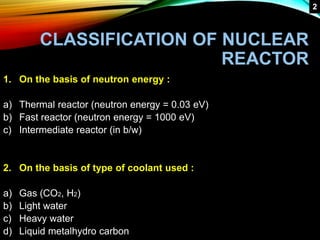
1. On the basis of neutron energy :
a) Thermal reactor (neutron energy = 0.03 eV)
b) Fast reactor (neutron energy = 1000 eV)
c) Intermediate reactor (in b/w)
2. On the basis of type of coolant used :
a) Gas (CO2, H2)
b) Light water
c) Heavy water
d) Liquid metalhydro carbon
2
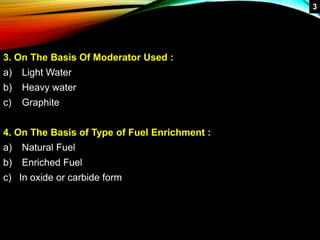
3. On The Basis Of Moderator Used :
a) Light Water
b) Heavy water
c) Graphite
4. On The Basis of Type of Fuel Enrichment :
a) Natural Fuel
b) Enriched Fuel
c) In oxide or carbide form
3
MAIN COMPONENTS OF
NUCLEAR REACTOR
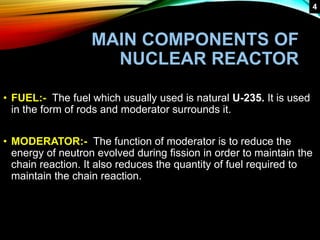
• FUEL:- The fuel which usually used is natural U-235. It is used
in the form of rods and moderator surrounds it.
• MODERATOR:- The function of moderator is to reduce the
energy of neutron evolved during fission in order to maintain the
chain reaction. It also reduces the quantity of fuel required to
maintain the chain reaction.
4
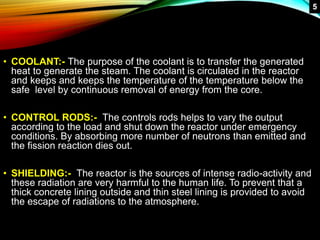
• COOLANT:- The purpose of the coolant is to transfer the generated
heat to generate the steam. The coolant is circulated in the reactor
and keeps and keeps the temperature of the temperature below the
safe level by continuous removal of energy from the core.
• CONTROL RODS:- The controls rods helps to vary the output
according to the load and shut down the reactor under emergency
conditions. By absorbing more number of neutrons than emitted and
the fission reaction dies out.
• SHIELDING:- The reactor is the sources of intense radio-activity and
these radiation are very harmful to the human life. To prevent that a
thick concrete lining outside and thin steel lining is provided to avoid
the escape of radiations to the atmosphere.
5
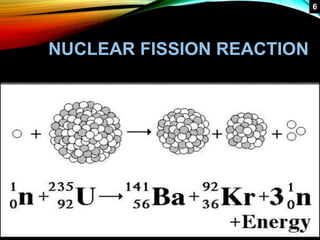
NUCLEAR FISSION REACTION
6
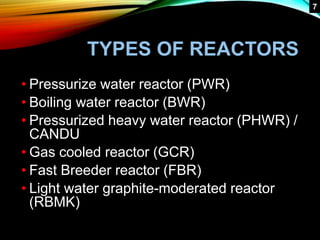
TYPES OF REACTORS
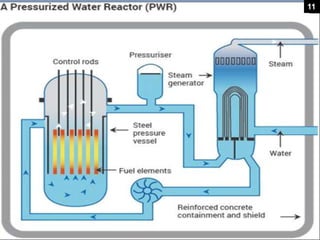
• Pressurize water reactor (PWR)
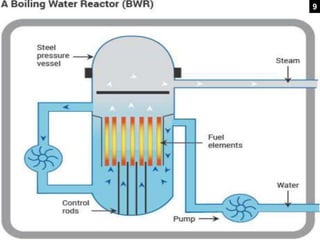
• Boiling water reactor (BWR)
• Pressurized heavy water reactor (PHWR) /
CANDU
• Gas cooled reactor (GCR)
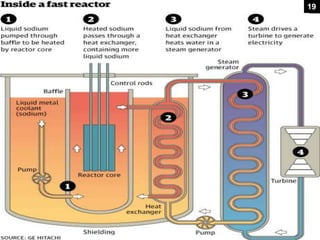
• Fast Breeder reactor (FBR)
• Light water graphite-moderated reactor
(RBMK)
7
BOILING WATER
REACTOR (BWR)
8
9
PRESSURIZED
WATER REACTOR
(PWR)
10
11
PRESSURIZED
HEAVY WATER
REACTOR (PWR)
112
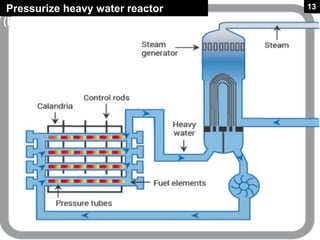
113Pressurize heavy water reactor
(PHWR)
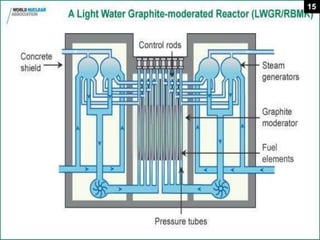
LIGHT WATER
GRAPHITE-
MODERATED
REACTOR (LWGR)
114
`
15
GAS COOLED
REACTOR (GCR)
116
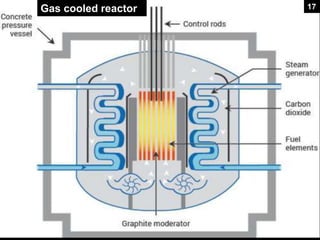
• ADVANTAGES 17Gas cooled reactor
FAST BREEDER
REACTOR (FBR)
118
119
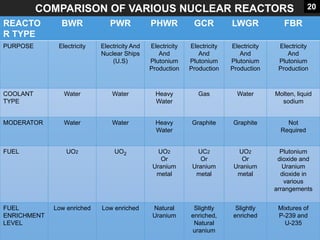
REACTO
R TYPE
BWR PWR PHWR GCR LWGR FBR
PURPOSE Electricity Electricity And
Nuclear Ships
(U.S)
Electricity
And
Plutonium
Production
Electricity
And
Plutonium
Production
Electricity
And
Plutonium
Production
Electricity
And
Plutonium
Production
COOLANT
TYPE
Water Water Heavy
Water
Gas Water Molten, liquid
sodium
MODERATOR Water Water Heavy
Water
Graphite Graphite Not
Required
FUEL UO2 UO2 UO2
Or
Uranium
metal
UC2
Or
Uranium
metal
UO2
Or
Uranium
metal
Plutonium
dioxide and
Uranium
dioxide in
various
arrangements
FUEL
ENRICHMENT
LEVEL
Low enriched Low enriched Natural
Uranium
Slightly
enriched,
Natural
uranium
Slightly
enriched
Mixtures of
P-239 and
U-235
1COMPARISON OF VARIOUS NUCLEAR REACTORS 20
21
122
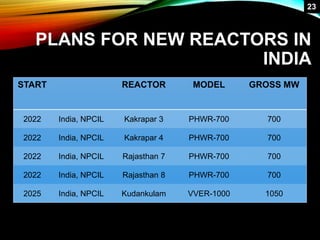
PLANS FOR NEW REACTORS IN
INDIA
START REACTOR MODEL GROSS MW
2022 India, NPCIL Kakrapar 3 PHWR-700 700
2022 India, NPCIL Kakrapar 4 PHWR-700 700
2022 India, NPCIL Rajasthan 7 PHWR-700 700
2022 India, NPCIL Rajasthan 8 PHWR-700 700
2025 India, NPCIL Kudankulam VVER-1000 1050
123
CONCLUSION
• Utilizing Nuclear Energy is needed if humanity is to continue
its advancement. It has great potential to be quite useful
and beneficial part of humanity's growth.
• It is extremely important that Nuclear power plants are held
to stringent safety standards.
• Nuclear weapons such as America’s “Trident D5” and
Russia's “RS-28 sermet ” need to well maintained and kept
secured.
• As a world, it is imperative that we work to expand the use
of nuclear energy, all the while remaining cautious of its
destructive problems.
24
REFERENCES
Links :
1. www.npcil.nic.in
2. www.nptel.ac.in
3. www.world-nuclear.org
Books :
• Christopher E. Brennen, An Introduction to
Nuclear Power generation ; Dankat
Publishing Company (2005)
25
THANK YOU !

Nuclear reactor anupam

  • 1.
  • 2.
    CONTENTS 1.Classification of nuclearreactor 2.Components of nuclear reactor 3.Nuclear fission reaction 4.Different types of nuclear reactors 5.Reactor units in India 6.Proposed reactor units in India 7.Conclusion 1
  • 3.
    CLASSIFICATION OF NUCLEAR REACTOR 1.On the basis of neutron energy : a) Thermal reactor (neutron energy = 0.03 eV) b) Fast reactor (neutron energy = 1000 eV) c) Intermediate reactor (in b/w) 2. On the basis of type of coolant used : a) Gas (CO2, H2) b) Light water c) Heavy water d) Liquid metalhydro carbon 2
  • 4.
    3. On TheBasis Of Moderator Used : a) Light Water b) Heavy water c) Graphite 4. On The Basis of Type of Fuel Enrichment : a) Natural Fuel b) Enriched Fuel c) In oxide or carbide form 3
  • 5.
    MAIN COMPONENTS OF NUCLEARREACTOR • FUEL:- The fuel which usually used is natural U-235. It is used in the form of rods and moderator surrounds it. • MODERATOR:- The function of moderator is to reduce the energy of neutron evolved during fission in order to maintain the chain reaction. It also reduces the quantity of fuel required to maintain the chain reaction. 4
  • 6.
    • COOLANT:- Thepurpose of the coolant is to transfer the generated heat to generate the steam. The coolant is circulated in the reactor and keeps and keeps the temperature of the temperature below the safe level by continuous removal of energy from the core. • CONTROL RODS:- The controls rods helps to vary the output according to the load and shut down the reactor under emergency conditions. By absorbing more number of neutrons than emitted and the fission reaction dies out. • SHIELDING:- The reactor is the sources of intense radio-activity and these radiation are very harmful to the human life. To prevent that a thick concrete lining outside and thin steel lining is provided to avoid the escape of radiations to the atmosphere. 5
  • 7.
  • 8.
    TYPES OF REACTORS •Pressurize water reactor (PWR) • Boiling water reactor (BWR) • Pressurized heavy water reactor (PHWR) / CANDU • Gas cooled reactor (GCR) • Fast Breeder reactor (FBR) • Light water graphite-moderated reactor (RBMK) 7
  • 9.
  • 10.
  • 11.
  • 12.
  • 13.
  • 14.
  • 15.
  • 16.
  • 17.
  • 18.
    • ADVANTAGES 17Gascooled reactor
  • 19.
  • 20.
  • 21.
    REACTO R TYPE BWR PWRPHWR GCR LWGR FBR PURPOSE Electricity Electricity And Nuclear Ships (U.S) Electricity And Plutonium Production Electricity And Plutonium Production Electricity And Plutonium Production Electricity And Plutonium Production COOLANT TYPE Water Water Heavy Water Gas Water Molten, liquid sodium MODERATOR Water Water Heavy Water Graphite Graphite Not Required FUEL UO2 UO2 UO2 Or Uranium metal UC2 Or Uranium metal UO2 Or Uranium metal Plutonium dioxide and Uranium dioxide in various arrangements FUEL ENRICHMENT LEVEL Low enriched Low enriched Natural Uranium Slightly enriched, Natural uranium Slightly enriched Mixtures of P-239 and U-235 1COMPARISON OF VARIOUS NUCLEAR REACTORS 20
  • 22.
  • 23.
  • 24.
    PLANS FOR NEWREACTORS IN INDIA START REACTOR MODEL GROSS MW 2022 India, NPCIL Kakrapar 3 PHWR-700 700 2022 India, NPCIL Kakrapar 4 PHWR-700 700 2022 India, NPCIL Rajasthan 7 PHWR-700 700 2022 India, NPCIL Rajasthan 8 PHWR-700 700 2025 India, NPCIL Kudankulam VVER-1000 1050 123
  • 25.
    CONCLUSION • Utilizing NuclearEnergy is needed if humanity is to continue its advancement. It has great potential to be quite useful and beneficial part of humanity's growth. • It is extremely important that Nuclear power plants are held to stringent safety standards. • Nuclear weapons such as America’s “Trident D5” and Russia's “RS-28 sermet ” need to well maintained and kept secured. • As a world, it is imperative that we work to expand the use of nuclear energy, all the while remaining cautious of its destructive problems. 24
  • 26.
    REFERENCES Links : 1. www.npcil.nic.in 2.www.nptel.ac.in 3. www.world-nuclear.org Books : • Christopher E. Brennen, An Introduction to Nuclear Power generation ; Dankat Publishing Company (2005) 25
  • 27.