PRESENTATION ON INPLANT
TRAINING AT MRPL
 Mangalore Refinery and petrochemicals Limited is a subsidiary of ONGC.
 It is located north of mangalore city, in Dakshina Karnataka region, set amidst a
stunning hilly terrain.
 Before acquisition by ONGC in the year 2003,MRPL was a joint venture Oil
refinery promoted by Hindustan Petroleum Corporation Limited and AV Birla
group
VISION
To be a world-class Refining and Petrochemicals Company, with a strong emphasis on
Productivity, Customer Satisfaction, Safety, Health and Environment Management,
Corporate Social Responsibility and Care for Employees.
MISSION
Sustain Leadership in energy conservation, efficiency, productivity and
innovation.
Capitalise on emerging opportunities in the domestic and international market.
Strive to meet customers’ requirements to their satisfaction.
Maintain global standards in health, safety and environmental norms with a
strong commitment towards community welfare.
Continuing focus on employee welfare and employee relations.
Imbibe highest standards of business ethics and values.
Naphtha
Stabiliser
CDU
VDU
Naphtha
Splitter
Kero/ATF
Splitter
CRUDE
O/H Stream
HN
RFN
Kero/ATF
LGO
HGO
VDO
LVGO
HVGO
SR
Kero /ATF
MEROX
LN
O/H
FG
LPG MEROX
GOHDS
Vac Slop
Hot well
OG/OIL
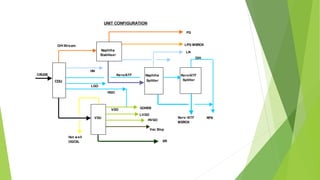
UNIT CONFIGURATION
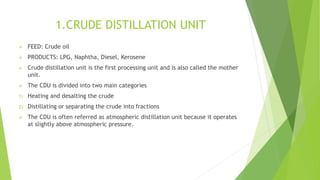
1.CRUDE DISTILLATION UNIT
 FEED: Crude oil
 PRODUCTS: LPG, Naphtha, Diesel, Kerosene
 Crude distillation unit is the first processing unit and is also called the mother
unit.
 The CDU is divided into two main categories
1) Heating and desalting the crude
2) Distillating or separating the crude into fractions
 The CDU is often referred as atmospheric distillation unit because it operates
at slightly above atmospheric pressure.
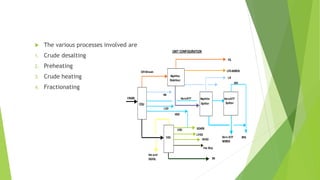
 The various processes involved are
1. Crude desalting
2. Preheating
3. Crude heating
4. Fractionating
Naphtha
Stabiliser
CDU
VDU
Naphtha
Splitter
Kero/ATF
Splitter
CRUDE
O/HStream
HN
RFN
Kero/ATF
LGO
HGO
VDO
LVGO
HVGO
SR
Kero /ATF
MEROX
LN
O/H
FG
LPG MEROX
GOHDS
Vac Slop
Hot well
OG/OIL
UNIT CONFIGURATION
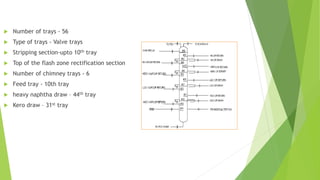
 Number of trays - 56
 Type of trays - Valve trays
 Stripping section-upto 10th tray
 Top of the flash zone rectification section
 Number of chimney trays - 6
 Feed tray - 10th tray
 heavy naphtha draw – 44th tray
 Kero draw – 31st tray
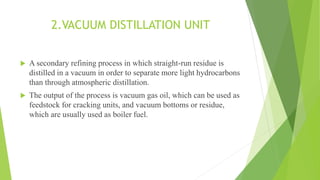
2.VACUUM DISTILLATION UNIT
 A secondary refining process in which straight-run residue is
distilled in a vacuum in order to separate more light hydrocarbons
than through atmospheric distillation.
 The output of the process is vacuum gas oil, which can be used as
feedstock for cracking units, and vacuum bottoms or residue,
which are usually used as boiler fuel.
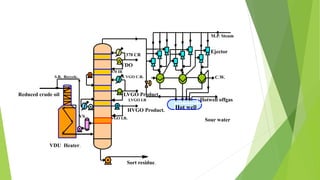
 Vacuum distillation column is divided into three sections
1) The top section
2) The middle section
3) The bottom section
 Here, chimney trays are used to draw products since downcomers cannot be
used for packed column.
 The streams coming of the column is of 3 types
1) circulating reflux
2) Internal reflux
3) Product stream
Demister pads are provided to trap entrained droplets.
M.P. Steam
Ejector
370 CR
VDO
370 IR
S.R. Recycle. C.W.L VGO C.R.
LVGO Product.Reduced crude oil
LVGO I.R
HVGO Product.
HVGO I.R. Sour water
VS
VDU Heater.
Sort residue.
f
Hot well
Hotwell offgas
 It increases the relative volatility therefore making components more
separable thereby lessening the number of stages required.
 There is also reduced temperature requirement at lower pressures hence
preventing product degradation by polymer formation.
 It also reduces the mean residence time by using packings rather than trays
and packings reduce pressure drop.
 Products
• Vacuum diesel oil (VDO) is lighter product in vacuum column
• VDO process to GOHDS to remove sulfur
• May have multiple gas oils
• Separate products to increase the heat recovery in the column
• Products recombined downstream
• Feed for hydrocracker
• Vacuum residue
• Further processing – thermal cracking (VBU) and BBU
• Blended with cutter stock to make fuel oil
• Choice depends on products & crude
3.HYDROCRACKER UNIT
 FEED: VGO
 PRODUCTS: LPG, NAPTHA ,DIESEL,ATF,LSHS
 Hydrocracking is a process for catalytically hydrocracking heavy petroleum
fractions in to lighter fractions and more valuable products.
 The feed is converted into lower molecular weight products ,usually maximising
naptha or middle distillate.
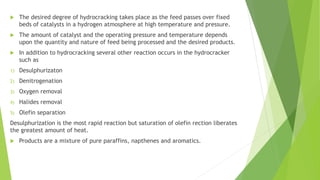
 The desired degree of hydrocracking takes place as the feed passes over fixed
beds of catalysts in a hydrogen atmosphere at high temperature and pressure.
 The amount of catalyst and the operating pressure and temperature depends
upon the quantity and nature of feed being processed and the desired products.
 In addition to hydrocracking several other reaction occurs in the hydrocracker
such as
1) Desulphurizaton
2) Denitrogenation
3) Oxygen removal
4) Halides removal
5) Olefin separation
Desulphurization is the most rapid reaction but saturation of olefin rection liberates
the greatest amount of heat.
 Products are a mixture of pure paraffins, napthenes and aromatics.
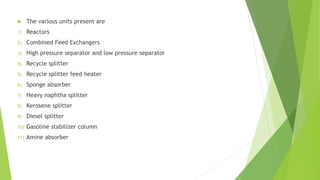
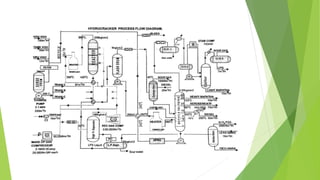
 The various units present are
1) Reactors
2) Combined Feed Exchangers
3) High pressure separator and low pressure separator
4) Recycle splitter
5) Recycle splitter feed heater
6) Sponge absorber
7) Heavy naphtha splitter
8) Kerosene splitter
9) Diesel splitter
10) Gasoline stabilizer column
11) Amine absorber
4.HYDROGEN UNIT
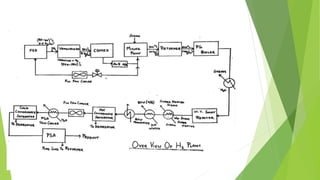
This unit deals with the production of hydrogen gas which is utilized by several
other units such as Hydrocracking unit and Gas oil hydrodesulphurization unit.
The process used here is steam reforming of naphtha and the product obtained is
99.99% pure hydrogen.
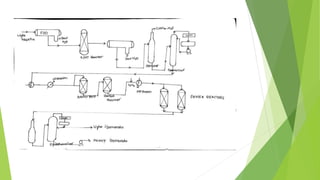
The naphtha from HCU is fed into feed surge drum and then fed to a heater having
3 fuel gas fired burners to heat the fed.This is then sent to a COMOX reactor
followed by a ZnO reactor where the following reactions occur
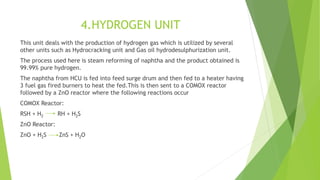
COMOX Reactor:
RSH + H2 RH + H2S
ZnO Reactor:
ZnO + H2S ZnS + H2O
 The effluent of ZnO reactor is sent to a reformer consisting of 192
tubes containing potash bearing nickel catalyst along with nickel
catalyst and 75 burners.
 The high temperature outlet is used for stem generation and cooled
in a process gas boiler and a steam of temperature of about 633K is
obtained which is mixed with the product stream of ZnO reactor in
High temperature shift gas reactor.
 The process gas obtained is then passed through pressure swing
absorbtion unit which is a series of 10 absorbers consisting of 5 beds
each.
 This is followed by a series of 3 exchangers, hot and cold seperator
 The absorber consist of Extrudes, molecular sieves, activated carbon,
silica gel and activated alumina which remove gases such as CO, C,
CO2,and moisture and the product gas coming out of the vessel is
about 99.99% pure hydrogen
5.GAS OIL HYDRO DESULPHURIZATION UNIT
 The feed consists of light gas oil and heavy gas oil and is obtained from
Crude Distillation Unit or from storage.
 The feed after passing though feed filter and feed surge drum is passed
into a series of two reactors through a multistage pump and combined
feed exchanger .
 The first reactor consists of both COMOX and NIMOX catalyst whereas the
second reactor has only NIMOX reactor.
 A balanced draft heater is provided between combined heat exchanger
and reactor1 to increase the temperature of the feed at the inlet of the
reactor.
 The effluent is then sent into a hot separator.The gas separated in the hot
separator is sent to a fin fan cooler and water cooler followed by cold
separator where the gas is sent to amine absorber.
 The liquid from hot separator and cold separator is sent to a stripper
consisting of 24 trays. The product obtained is purified further to obtain
diesel.
 The function of NIMOX catalyst is denitrification whereas COMOX is mainly
associated with desulfurization.
 The reactor bed is also provided with rashchig rings and ceramic
balls.
 The removal of moisture from diesel is done using coalasers and
salt filters consisting of rock salts.
 The product obtained consists of about 30-40% moisture.
6.MEROX UNIT
 Introduction
 Types of merox
 Chemical reactions
 Process description
 Process flow diagram
Introduction
 The merox process is an efficient and economical catalytic process developed
for the chemical treatment of petroleum distillates for the removal of sulphur
present as mercaptans,by converting the mercaptan as disulphide oil in the
presence of air.
 Mercaptan is a sulfur compound designated as RSH where R is an alkyl radical
attached to Sulfur which is attached to Hydrogen. These compounds can be
toxic and are highly corrosive leading to the need of their removal.
 The name “Merox” originates from the functi of the process itself,namely the
conversion of mercaptans by oxidation.
 MRPL processes 261MT/day in LPG Merox and 2181MT/day in Kero Merox.
Types
 There are two types of merox treatments possible.
 They are Extractive Merox and Sweetening Merox.
 Extractive Merox: This process reduces the sulphur content of LPG products
to meet specification by extracting out the mercaptans from the LPG/
Gasoline streams
 Sweetening Merox: This process converts the mercaptans present in the
hydrocarbon stream into harmless disulphide oil in the presence of air.Thus
keeping the total sulphur in the hydrocarbon stream as disulphides.Hence this
process is know as sweetening process.
Chemical reactions
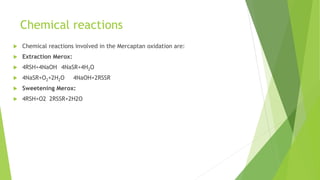
 Chemical reactions involved in the Mercaptan oxidation are:
 Extraction Merox:
 4RSH+4NaOH 4NaSR+4H2O
 4NaSR+O2+2H2O 4NaOH+2RSSR
 Sweetening Merox:
 4RSH+O2 2RSSR+2H2O
Process description
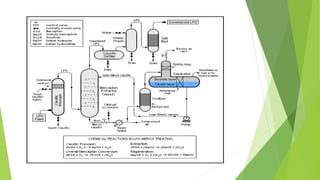
 Extraction Merox:
 Extraction Merox is also known as LPG Merox.
 LPG from CDU& VDU is sent to amine treatment.
 The LPG from amine treatment is sent to prewash column.
 where prewash is done with 10 Be NaOH solution which brings down the H2S concentration to
below 10ppm.
 Next the feed is sent to Extractor having sieve trays.
 Here Mercaptans react with 20 Be NaOH solution to form NaSR.
 Next it goes to caustic KOD and to the sand filter for NaOH recycle.
 NaSR is oxidized in the presence of Merox F.B catalyst where it forms disulphide oil.
 Disulphide oil is separated from the LPG in disulphide oil separator.
 Thus the LPG of required specification is obtained.
Sweetening Merox:
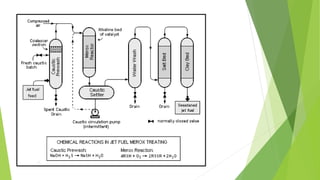
 Sweeteninig is also known as Kero Merox.
 Kerosene is sent to electrostatic coaleser where kerosene reacts with 30Be
NaOH solution which removes traces of H2S and mercaptans dissolve in NaOH.
 In mixer air gets mixed with kerosene.
 This mixture is fed to the fixed bed reactor where merox F.B catalyst is
impregnated on activated charcoal,here Mercaptans are converted into
disulphides.
 The mixture is sent to causticsettler,waterwash,saltfilter and then to clay
filter to recycle the caustic.
 The kero Merox product is then sent to storage tanks.
7.ISOMERISATION UNIT
 Isomerisation is a chemical process where one molecule is
transformed in to another with the same molecular formula but with
the different arrangement of atoms
 Reaction takes place is
n-paraffinsisoparaffins
Objective:
The main objective of isomerisation unit is to produce high octane,low aromatic
gasoline
Feed:
Light naptha receiving from
 CDU,hydrocracker,RSU,storage
Overall process is divided in to 3 sections
 Light naptha hydro treater unit(LNHT)
 Bensat section
 Penex section
Light naptha hydrotreater section(LNHT):
Feed→ CFE→ heater→ reactor→ pinfanncooler→ stripper
 Reactor:
Reactants: feed+hydrogen
Catalyst: comox
Used to remove impuritites from the feed
(sulphur→H2S,nitrogen→ammonium chloride)
 Stripper: 30 trays
Condensed liquid feed is inserted in the 29th tray &MP steam is inserted from the
bottom of stripper
From the top of stripper we can obtain c1 to c4 & also H2S
From bottom of stipper we can obtain C5 to C7
Depentanizer :
Bottom stripper→depentanizer.
The bottom product of depentanizer is sent to bensat section
Bensat section:
Here benzene is converted to cyclohexanes in a bensat reactor
Catalyst:H8
methanater:CO→CO2→CH4
Penex section:
 The feed from bensat section is sent to feed and gas driers→to moisture
content
 Penex reactor:
 Feed from the driers goes to penex reactor
catalyst –platinum and base is aluminium oxide
promoter: perchloroethylene
The following reaction takes in the reactor
i. C7→C3&C4
ii. C5→isopentanes
iii. hexanes→2,2 DMB 2,3 DMB & 2MP ,3MP
Stripper section:
From reactor→stabilizer
Bottom:2,2 DMP 2,3 DMP
2MP 3MP
Top product: c1 to c4 stream
Di-isohexanizer:(80 trays)
Stripper bottom→di-isohezanizer
Top product:2,2 DMP 2,3 DMP(light isomer)
RON:91
Bottom liquid:heavy isomerate
RON:73
Side drop: 2MP 3MP
Side drop is mixed with feed and sent as feed
Product specifications:
 Benzene % is zero
 Sulphur % is zero
 RON is 91
 Density is in the range of 0.65
 Licensor:UOP
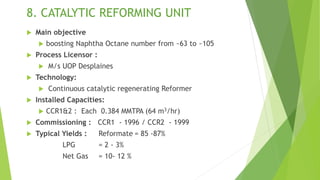
8. CATALYTIC REFORMING UNIT
 Main objective
 boosting Naphtha Octane number from ~63 to ~105
 Process Licensor :
 M/s UOP Desplaines
 Technology:
 Continuous catalytic regenerating Reformer
 Installed Capacities:
 CCR1&2 : Each 0.384 MMTPA (64 m3/hr)
 Commissioning : CCR1 - 1996 / CCR2 - 1999
 Typical Yields : Reformate = 85 -87%
LPG = 2 - 3%
Net Gas = 10- 12 %
Main sections:
 Naphtha Hydrotreater
 Platformer
 Continuous Catalytic Regenerator
 Debutanizer
 Net gas purification (PSA unit)
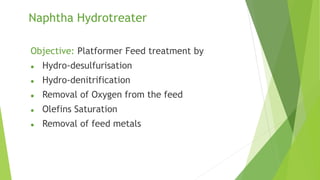
Naphtha Hydrotreater
Objective: Platformer Feed treatment by
 Hydro-desulfurisation
 Hydro-denitrification
 Removal of Oxygen from the feed
 Olefins Saturation
 Removal of feed metals
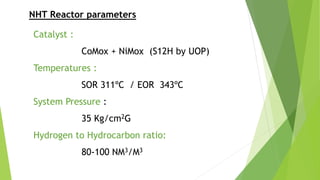
NHT Reactor parameters
Catalyst :
CoMox + NiMox (S12H by UOP)
Temperatures :
SOR 311ºC / EOR 343ºC
System Pressure :
35 Kg/cm2G
Hydrogen to Hydrocarbon ratio:
80-100 NM3/M3
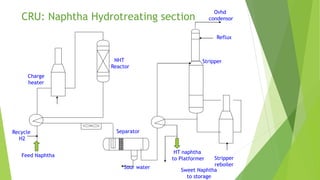
Feed Naphtha
Recycle
H2
HT naphtha
to Platformer
Sweet Naphtha
to storage
Sour water
NHT
Reactor
Stripper
Separator
Stripper
reboiler
Charge
heater
Reflux
Ovhd
condensorCRU: Naphtha Hydrotreating section
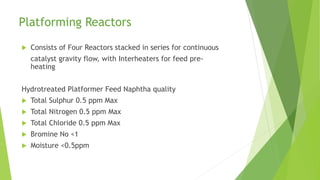
Platforming Reactors
 Consists of Four Reactors stacked in series for continuous
catalyst gravity flow, with Interheaters for feed pre-
heating
Hydrotreated Platformer Feed Naphtha quality
 Total Sulphur 0.5 ppm Max
 Total Nitrogen 0.5 ppm Max
 Total Chloride 0.5 ppm Max
 Bromine No <1
 Moisture <0.5ppm
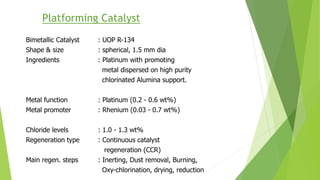
Platforming Catalyst
Bimetallic Catalyst : UOP R-134
Shape & size : spherical, 1.5 mm dia
Ingredients : Platinum with promoting
metal dispersed on high purity
chlorinated Alumina support.
Metal function : Platinum (0.2 - 0.6 wt%)
Metal promoter : Rhenium (0.03 - 0.7 wt%)
Chloride levels : 1.0 - 1.3 wt%
Regeneration type : Continuous catalyst
regeneration (CCR)
Main regen. steps : Inerting, Dust removal, Burning,
Oxy-chlorination, drying, reduction
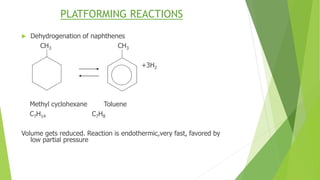
PLATFORMING REACTIONS
 Dehydrogenation of naphthenes
CH3 CH3
+3H2
Methyl cyclohexane Toluene
C7H14 C7H8
Volume gets reduced. Reaction is endothermic,very fast, favored by
low partial pressure
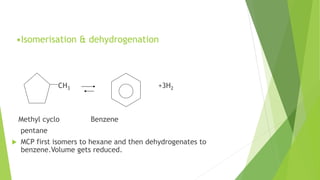
•Isomerisation & dehydrogenation
CH3 +3H2
Methyl cyclo Benzene
pentane
 MCP first isomers to hexane and then dehydrogenates to
benzene.Volume gets reduced.
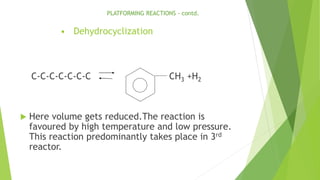
• Dehydrocyclization
C-C-C-C-C-C-C CH3 +H2
 Here volume gets reduced.The reaction is
favoured by high temperature and low pressure.
This reaction predominantly takes place in 3rd
reactor.
PLATFORMING REACTIONS - contd.
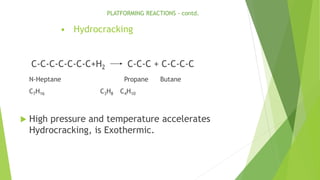
• Hydrocracking
C-C-C-C-C-C-C+H2 C-C-C + C-C-C-C
N-Heptane Propane Butane
C7H16 C3H8 C4H10
 High pressure and temperature accelerates
Hydrocracking, is Exothermic.
PLATFORMING REACTIONS - contd.
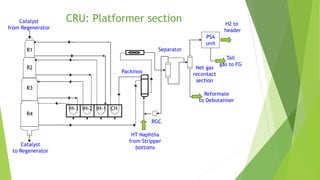
CRU: Platformer sectionCatalyst
from Regenerator
Catalyst
to Regenerator
R1
R2
R3
R4
Packinox
RGC
HT Naphtha
from Stripper
bottoms
CHIH-1IH-2IH-3
Reformate
to Debutaniser
H2 to
header
PSA
unit
Tail
gas to FG
Separator
Net gas
recontact
section
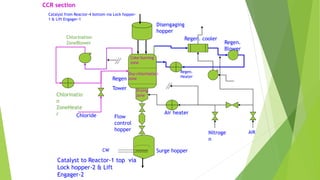
CCR section
Surge hopper
Flow
control
hopper
Disengaging
hopper
Nitroge
n
AIR
Chloride
Regen.
Blower
Chlorination
ZoneBlower
Regen.
Heater
Air heater
Regen
Tower
Catalyst from Reactor-4 bottom via Lock hopper-
1 & Lift Engager-1
Chlorinatio
n
ZoneHeate
r
Catalyst to Reactor-1 top via
Lock hopper-2 & Lift
Engager-2
Regen. cooler
Coke burning
zone
Oxy-chlorination
zone
Drying
zone
CW
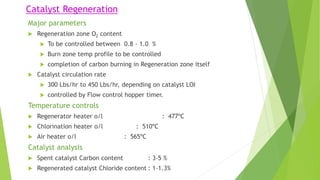
Catalyst Regeneration
Major parameters
 Regeneration zone O2 content
 To be controlled between 0.8 - 1.0 %
 Burn zone temp profile to be controlled
 completion of carbon burning in Regeneration zone itself
 Catalyst circulation rate
 300 Lbs/hr to 450 Lbs/hr, depending on catalyst LOI
 controlled by Flow control hopper timer.
Temperature controls
 Regenerator heater o/l : 477ºC
 Chlorination heater o/l : 510ºC
 Air heater o/l : 565ºC
Catalyst analysis
 Spent catalyst Carbon content : 3-5 %
 Regenerated catalyst Chloride content : 1-1.3%
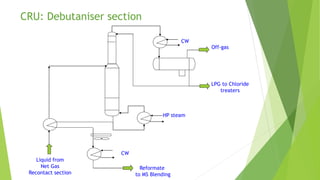
CRU: Debutaniser section
Liquid from
Net Gas
Recontact section
Reformate
to MS Blending
LPG to Chloride
treaters
HP steam
CW
CW
Off-gas
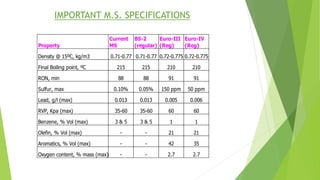
IMPORTANT M.S. SPECIFICATIONS
Property
Current
MS
BS-2
(regular)
Euro-III
(Reg)
Euro-IV
(Reg)
Density @ 15ºC, kg/m3 0.71-0.77 0.71-0.77 0.72-0.775 0.72-0.775
Final Boiling point, ºC 215 215 210 210
RON, min 88 88 91 91
Sulfur, max 0.10% 0.05% 150 ppm 50 ppm
Lead, g/l (max) 0.013 0.013 0.005 0.006
RVP, Kpa (max) 35-60 35-60 60 60
Benzene, % Vol (max) 3 & 5 3 & 5 1 1
Olefin, % Vol (max) - - 21 21
Aromatics, % Vol (max) - - 42 35
Oxygen content, % mass (max) - - 2.7 2.7
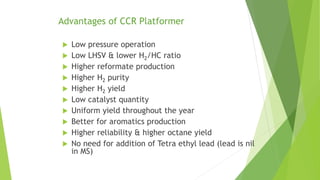
Advantages of CCR Platformer
 Low pressure operation
 Low LHSV & lower H2/HC ratio
 Higher reformate production
 Higher H2 purity
 Higher H2 yield
 Low catalyst quantity
 Uniform yield throughout the year
 Better for aromatics production
 Higher reliability & higher octane yield
 No need for addition of Tetra ethyl lead (lead is nil
in MS)
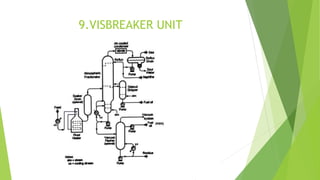
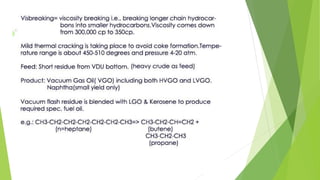
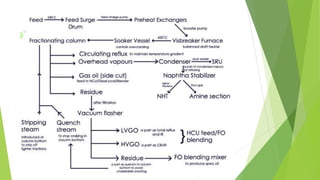
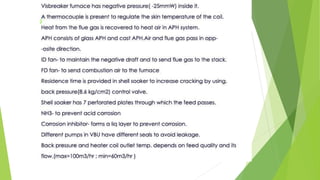
9.VISBREAKER UNIT
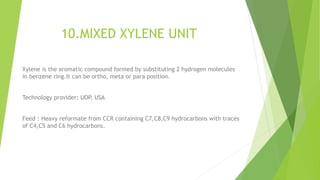
10.MIXED XYLENE UNIT
Xylene is the aromatic compound formed by substituting 2 hydrogen molecules
in benzene ring.It can be ortho, meta or para position.
Technology provider: UOP, USA
Feed : Heavy reformate from CCR containing C7,C8,C9 hydrocarbons with traces
of C4,C5 and C6 hydrocarbons.
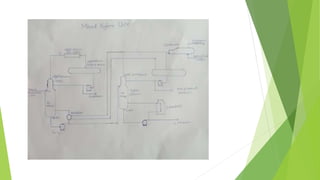
The feed is sent to a reformate splitter in which C4,C5 and C6 hydrocarbons are
removed at the top of the column.
The C7,C8,C9 hydrocarbons are present in the bottom product. The bottom product
is sent to a column in which the C7 hydrocarbons are removed at the top and is sent
to be blended to obtain the require RON.
The C8 and C9 hydrocarbons are obtained at the bottom and sent to Xylene column
( 11 trays )
From the top of xylene column the desired C8 hydrocarbon ( xylene) is removed and
is sent to the storage tanks. The C9 hydrocarbon obtained from the bottom of the
xylene column is sent to the blender for blending with gasoline.
11.BITUMEN BLOWING UNIT
 Bitumen is the heaviest fraction of crude oil.It is black in colour and is a highly viscous
liquid or a soft solid at room temperature.They are non-volatile and highly resistant to
oxidation and weathering.
 The process involve passing air bitumen feedstock at elevated temperature in order to
change the physical properties of the products.The main purpose is to harden the
bitumen and increase the softening point.The VR is subjected to oxidation by blowing
compressed air through it at a temperature of 220-280 C in a blowing tower.
 The general reaction pathway is the transformation of cyclic structures into resins(polar
aromatics) which are in turn condensed to form asphaltenes.In bitumen blowing, the
primary oxidative process is carbon-carbon bond formation via oxidative
condensation.As the reaction proceeds , cyclic and resins that make up the oily phase
are converted to asphaltenes resulting in hardening of bitumen and increase in softening
point.
Bitumen/Asphalt is categorized into four types: Straight run, blown, cutback and
emulsion.
1.Straight run bitumen is a black/dark brown high viscous solid material. Flashing at very
high temperatures of the vacuum residue is required in order to produce this bitumen.
There are two major characteristics of bitumen:
Softening point: It is the temperature at which an object with a standardized weight and
shape will start to sink into the asphalt. Common practice is to use steel balls, which is
what MRPL follows. Commercial softening points range from 80-340°F.
Penetration: Hardness of asphalt once load is applied. The range is from 0 (very hard) –
250 (very soft)
1.Blown bitumen is produced by blowing hot air into softer grades of the asphalt causing
a chemical reaction yielding more rubbery and harder asphalt.
 Cutbacks are yielded from the addition of a thinner to the bitumen in order
to reduce the temperature requirements giving softer asphalt. However
after asphalt has been applied the thinner/diluent evaporates yielding a
hard, durable asphalt.
 Emulsion is a mixture of 50-70% bitumen and 30-50% water. The mixture
remains mixed with the aid of an emulsifying agent, like soap.
 MRPL only produces straight run and blown bitumen. The blown bitumen is
produced in this Bitumen Blowing Unit (BBU).
THANKYOU 

PRESENTATION ON INPLANT TRAINING AT MRPL

  • 1.
  • 2.
     Mangalore Refineryand petrochemicals Limited is a subsidiary of ONGC.  It is located north of mangalore city, in Dakshina Karnataka region, set amidst a stunning hilly terrain.  Before acquisition by ONGC in the year 2003,MRPL was a joint venture Oil refinery promoted by Hindustan Petroleum Corporation Limited and AV Birla group VISION To be a world-class Refining and Petrochemicals Company, with a strong emphasis on Productivity, Customer Satisfaction, Safety, Health and Environment Management, Corporate Social Responsibility and Care for Employees.
  • 3.
    MISSION Sustain Leadership inenergy conservation, efficiency, productivity and innovation. Capitalise on emerging opportunities in the domestic and international market. Strive to meet customers’ requirements to their satisfaction. Maintain global standards in health, safety and environmental norms with a strong commitment towards community welfare. Continuing focus on employee welfare and employee relations. Imbibe highest standards of business ethics and values.
  • 4.
  • 5.
    1.CRUDE DISTILLATION UNIT FEED: Crude oil  PRODUCTS: LPG, Naphtha, Diesel, Kerosene  Crude distillation unit is the first processing unit and is also called the mother unit.  The CDU is divided into two main categories 1) Heating and desalting the crude 2) Distillating or separating the crude into fractions  The CDU is often referred as atmospheric distillation unit because it operates at slightly above atmospheric pressure.
  • 6.
     The variousprocesses involved are 1. Crude desalting 2. Preheating 3. Crude heating 4. Fractionating Naphtha Stabiliser CDU VDU Naphtha Splitter Kero/ATF Splitter CRUDE O/HStream HN RFN Kero/ATF LGO HGO VDO LVGO HVGO SR Kero /ATF MEROX LN O/H FG LPG MEROX GOHDS Vac Slop Hot well OG/OIL UNIT CONFIGURATION
  • 7.
     Number oftrays - 56  Type of trays - Valve trays  Stripping section-upto 10th tray  Top of the flash zone rectification section  Number of chimney trays - 6  Feed tray - 10th tray  heavy naphtha draw – 44th tray  Kero draw – 31st tray
  • 8.
    2.VACUUM DISTILLATION UNIT A secondary refining process in which straight-run residue is distilled in a vacuum in order to separate more light hydrocarbons than through atmospheric distillation.  The output of the process is vacuum gas oil, which can be used as feedstock for cracking units, and vacuum bottoms or residue, which are usually used as boiler fuel.
  • 9.
     Vacuum distillationcolumn is divided into three sections 1) The top section 2) The middle section 3) The bottom section  Here, chimney trays are used to draw products since downcomers cannot be used for packed column.  The streams coming of the column is of 3 types 1) circulating reflux 2) Internal reflux 3) Product stream Demister pads are provided to trap entrained droplets.
  • 10.
    M.P. Steam Ejector 370 CR VDO 370IR S.R. Recycle. C.W.L VGO C.R. LVGO Product.Reduced crude oil LVGO I.R HVGO Product. HVGO I.R. Sour water VS VDU Heater. Sort residue. f Hot well Hotwell offgas
  • 11.
     It increasesthe relative volatility therefore making components more separable thereby lessening the number of stages required.  There is also reduced temperature requirement at lower pressures hence preventing product degradation by polymer formation.  It also reduces the mean residence time by using packings rather than trays and packings reduce pressure drop.  Products • Vacuum diesel oil (VDO) is lighter product in vacuum column • VDO process to GOHDS to remove sulfur • May have multiple gas oils • Separate products to increase the heat recovery in the column • Products recombined downstream • Feed for hydrocracker • Vacuum residue • Further processing – thermal cracking (VBU) and BBU • Blended with cutter stock to make fuel oil • Choice depends on products & crude
  • 12.
    3.HYDROCRACKER UNIT  FEED:VGO  PRODUCTS: LPG, NAPTHA ,DIESEL,ATF,LSHS  Hydrocracking is a process for catalytically hydrocracking heavy petroleum fractions in to lighter fractions and more valuable products.  The feed is converted into lower molecular weight products ,usually maximising naptha or middle distillate.
  • 13.
     The desireddegree of hydrocracking takes place as the feed passes over fixed beds of catalysts in a hydrogen atmosphere at high temperature and pressure.  The amount of catalyst and the operating pressure and temperature depends upon the quantity and nature of feed being processed and the desired products.  In addition to hydrocracking several other reaction occurs in the hydrocracker such as 1) Desulphurizaton 2) Denitrogenation 3) Oxygen removal 4) Halides removal 5) Olefin separation Desulphurization is the most rapid reaction but saturation of olefin rection liberates the greatest amount of heat.  Products are a mixture of pure paraffins, napthenes and aromatics.
  • 14.
     The variousunits present are 1) Reactors 2) Combined Feed Exchangers 3) High pressure separator and low pressure separator 4) Recycle splitter 5) Recycle splitter feed heater 6) Sponge absorber 7) Heavy naphtha splitter 8) Kerosene splitter 9) Diesel splitter 10) Gasoline stabilizer column 11) Amine absorber
  • 16.
    4.HYDROGEN UNIT This unitdeals with the production of hydrogen gas which is utilized by several other units such as Hydrocracking unit and Gas oil hydrodesulphurization unit. The process used here is steam reforming of naphtha and the product obtained is 99.99% pure hydrogen. The naphtha from HCU is fed into feed surge drum and then fed to a heater having 3 fuel gas fired burners to heat the fed.This is then sent to a COMOX reactor followed by a ZnO reactor where the following reactions occur COMOX Reactor: RSH + H2 RH + H2S ZnO Reactor: ZnO + H2S ZnS + H2O
  • 17.
     The effluentof ZnO reactor is sent to a reformer consisting of 192 tubes containing potash bearing nickel catalyst along with nickel catalyst and 75 burners.  The high temperature outlet is used for stem generation and cooled in a process gas boiler and a steam of temperature of about 633K is obtained which is mixed with the product stream of ZnO reactor in High temperature shift gas reactor.  The process gas obtained is then passed through pressure swing absorbtion unit which is a series of 10 absorbers consisting of 5 beds each.  This is followed by a series of 3 exchangers, hot and cold seperator  The absorber consist of Extrudes, molecular sieves, activated carbon, silica gel and activated alumina which remove gases such as CO, C, CO2,and moisture and the product gas coming out of the vessel is about 99.99% pure hydrogen
  • 19.
    5.GAS OIL HYDRODESULPHURIZATION UNIT  The feed consists of light gas oil and heavy gas oil and is obtained from Crude Distillation Unit or from storage.  The feed after passing though feed filter and feed surge drum is passed into a series of two reactors through a multistage pump and combined feed exchanger .  The first reactor consists of both COMOX and NIMOX catalyst whereas the second reactor has only NIMOX reactor.  A balanced draft heater is provided between combined heat exchanger and reactor1 to increase the temperature of the feed at the inlet of the reactor.
  • 20.
     The effluentis then sent into a hot separator.The gas separated in the hot separator is sent to a fin fan cooler and water cooler followed by cold separator where the gas is sent to amine absorber.  The liquid from hot separator and cold separator is sent to a stripper consisting of 24 trays. The product obtained is purified further to obtain diesel.  The function of NIMOX catalyst is denitrification whereas COMOX is mainly associated with desulfurization.
  • 21.
     The reactorbed is also provided with rashchig rings and ceramic balls.  The removal of moisture from diesel is done using coalasers and salt filters consisting of rock salts.  The product obtained consists of about 30-40% moisture.
  • 22.
    6.MEROX UNIT  Introduction Types of merox  Chemical reactions  Process description  Process flow diagram
  • 23.
    Introduction  The meroxprocess is an efficient and economical catalytic process developed for the chemical treatment of petroleum distillates for the removal of sulphur present as mercaptans,by converting the mercaptan as disulphide oil in the presence of air.  Mercaptan is a sulfur compound designated as RSH where R is an alkyl radical attached to Sulfur which is attached to Hydrogen. These compounds can be toxic and are highly corrosive leading to the need of their removal.  The name “Merox” originates from the functi of the process itself,namely the conversion of mercaptans by oxidation.  MRPL processes 261MT/day in LPG Merox and 2181MT/day in Kero Merox.
  • 24.
    Types  There aretwo types of merox treatments possible.  They are Extractive Merox and Sweetening Merox.  Extractive Merox: This process reduces the sulphur content of LPG products to meet specification by extracting out the mercaptans from the LPG/ Gasoline streams  Sweetening Merox: This process converts the mercaptans present in the hydrocarbon stream into harmless disulphide oil in the presence of air.Thus keeping the total sulphur in the hydrocarbon stream as disulphides.Hence this process is know as sweetening process.
  • 25.
    Chemical reactions  Chemicalreactions involved in the Mercaptan oxidation are:  Extraction Merox:  4RSH+4NaOH 4NaSR+4H2O  4NaSR+O2+2H2O 4NaOH+2RSSR  Sweetening Merox:  4RSH+O2 2RSSR+2H2O
  • 26.
    Process description  ExtractionMerox:  Extraction Merox is also known as LPG Merox.  LPG from CDU& VDU is sent to amine treatment.  The LPG from amine treatment is sent to prewash column.  where prewash is done with 10 Be NaOH solution which brings down the H2S concentration to below 10ppm.  Next the feed is sent to Extractor having sieve trays.  Here Mercaptans react with 20 Be NaOH solution to form NaSR.  Next it goes to caustic KOD and to the sand filter for NaOH recycle.  NaSR is oxidized in the presence of Merox F.B catalyst where it forms disulphide oil.  Disulphide oil is separated from the LPG in disulphide oil separator.  Thus the LPG of required specification is obtained.
  • 28.
    Sweetening Merox:  Sweeteninigis also known as Kero Merox.  Kerosene is sent to electrostatic coaleser where kerosene reacts with 30Be NaOH solution which removes traces of H2S and mercaptans dissolve in NaOH.  In mixer air gets mixed with kerosene.  This mixture is fed to the fixed bed reactor where merox F.B catalyst is impregnated on activated charcoal,here Mercaptans are converted into disulphides.  The mixture is sent to causticsettler,waterwash,saltfilter and then to clay filter to recycle the caustic.  The kero Merox product is then sent to storage tanks.
  • 30.
    7.ISOMERISATION UNIT  Isomerisationis a chemical process where one molecule is transformed in to another with the same molecular formula but with the different arrangement of atoms  Reaction takes place is n-paraffinsisoparaffins
  • 31.
    Objective: The main objectiveof isomerisation unit is to produce high octane,low aromatic gasoline Feed: Light naptha receiving from  CDU,hydrocracker,RSU,storage Overall process is divided in to 3 sections  Light naptha hydro treater unit(LNHT)  Bensat section  Penex section
  • 32.
    Light naptha hydrotreatersection(LNHT): Feed→ CFE→ heater→ reactor→ pinfanncooler→ stripper  Reactor: Reactants: feed+hydrogen Catalyst: comox Used to remove impuritites from the feed (sulphur→H2S,nitrogen→ammonium chloride)  Stripper: 30 trays Condensed liquid feed is inserted in the 29th tray &MP steam is inserted from the bottom of stripper From the top of stripper we can obtain c1 to c4 & also H2S From bottom of stipper we can obtain C5 to C7
  • 33.
    Depentanizer : Bottom stripper→depentanizer. Thebottom product of depentanizer is sent to bensat section Bensat section: Here benzene is converted to cyclohexanes in a bensat reactor Catalyst:H8 methanater:CO→CO2→CH4
  • 34.
    Penex section:  Thefeed from bensat section is sent to feed and gas driers→to moisture content  Penex reactor:  Feed from the driers goes to penex reactor catalyst –platinum and base is aluminium oxide promoter: perchloroethylene The following reaction takes in the reactor i. C7→C3&C4 ii. C5→isopentanes iii. hexanes→2,2 DMB 2,3 DMB & 2MP ,3MP
  • 35.
    Stripper section: From reactor→stabilizer Bottom:2,2DMP 2,3 DMP 2MP 3MP Top product: c1 to c4 stream Di-isohexanizer:(80 trays) Stripper bottom→di-isohezanizer Top product:2,2 DMP 2,3 DMP(light isomer) RON:91 Bottom liquid:heavy isomerate RON:73 Side drop: 2MP 3MP Side drop is mixed with feed and sent as feed
  • 37.
    Product specifications:  Benzene% is zero  Sulphur % is zero  RON is 91  Density is in the range of 0.65  Licensor:UOP
  • 38.
    8. CATALYTIC REFORMINGUNIT  Main objective  boosting Naphtha Octane number from ~63 to ~105  Process Licensor :  M/s UOP Desplaines  Technology:  Continuous catalytic regenerating Reformer  Installed Capacities:  CCR1&2 : Each 0.384 MMTPA (64 m3/hr)  Commissioning : CCR1 - 1996 / CCR2 - 1999  Typical Yields : Reformate = 85 -87% LPG = 2 - 3% Net Gas = 10- 12 %
  • 39.
    Main sections:  NaphthaHydrotreater  Platformer  Continuous Catalytic Regenerator  Debutanizer  Net gas purification (PSA unit)
  • 40.
    Naphtha Hydrotreater Objective: PlatformerFeed treatment by  Hydro-desulfurisation  Hydro-denitrification  Removal of Oxygen from the feed  Olefins Saturation  Removal of feed metals
  • 41.
    NHT Reactor parameters Catalyst: CoMox + NiMox (S12H by UOP) Temperatures : SOR 311ºC / EOR 343ºC System Pressure : 35 Kg/cm2G Hydrogen to Hydrocarbon ratio: 80-100 NM3/M3
  • 42.
    Feed Naphtha Recycle H2 HT naphtha toPlatformer Sweet Naphtha to storage Sour water NHT Reactor Stripper Separator Stripper reboiler Charge heater Reflux Ovhd condensorCRU: Naphtha Hydrotreating section
  • 43.
    Platforming Reactors  Consistsof Four Reactors stacked in series for continuous catalyst gravity flow, with Interheaters for feed pre- heating Hydrotreated Platformer Feed Naphtha quality  Total Sulphur 0.5 ppm Max  Total Nitrogen 0.5 ppm Max  Total Chloride 0.5 ppm Max  Bromine No <1  Moisture <0.5ppm
  • 44.
    Platforming Catalyst Bimetallic Catalyst: UOP R-134 Shape & size : spherical, 1.5 mm dia Ingredients : Platinum with promoting metal dispersed on high purity chlorinated Alumina support. Metal function : Platinum (0.2 - 0.6 wt%) Metal promoter : Rhenium (0.03 - 0.7 wt%) Chloride levels : 1.0 - 1.3 wt% Regeneration type : Continuous catalyst regeneration (CCR) Main regen. steps : Inerting, Dust removal, Burning, Oxy-chlorination, drying, reduction
  • 45.
    PLATFORMING REACTIONS  Dehydrogenationof naphthenes CH3 CH3 +3H2 Methyl cyclohexane Toluene C7H14 C7H8 Volume gets reduced. Reaction is endothermic,very fast, favored by low partial pressure
  • 46.
    •Isomerisation & dehydrogenation CH3+3H2 Methyl cyclo Benzene pentane  MCP first isomers to hexane and then dehydrogenates to benzene.Volume gets reduced.
  • 47.
    • Dehydrocyclization C-C-C-C-C-C-C CH3+H2  Here volume gets reduced.The reaction is favoured by high temperature and low pressure. This reaction predominantly takes place in 3rd reactor. PLATFORMING REACTIONS - contd.
  • 48.
    • Hydrocracking C-C-C-C-C-C-C+H2 C-C-C+ C-C-C-C N-Heptane Propane Butane C7H16 C3H8 C4H10  High pressure and temperature accelerates Hydrocracking, is Exothermic. PLATFORMING REACTIONS - contd.
  • 49.
    CRU: Platformer sectionCatalyst fromRegenerator Catalyst to Regenerator R1 R2 R3 R4 Packinox RGC HT Naphtha from Stripper bottoms CHIH-1IH-2IH-3 Reformate to Debutaniser H2 to header PSA unit Tail gas to FG Separator Net gas recontact section
  • 50.
    CCR section Surge hopper Flow control hopper Disengaging hopper Nitroge n AIR Chloride Regen. Blower Chlorination ZoneBlower Regen. Heater Airheater Regen Tower Catalyst from Reactor-4 bottom via Lock hopper- 1 & Lift Engager-1 Chlorinatio n ZoneHeate r Catalyst to Reactor-1 top via Lock hopper-2 & Lift Engager-2 Regen. cooler Coke burning zone Oxy-chlorination zone Drying zone CW
  • 51.
    Catalyst Regeneration Major parameters Regeneration zone O2 content  To be controlled between 0.8 - 1.0 %  Burn zone temp profile to be controlled  completion of carbon burning in Regeneration zone itself  Catalyst circulation rate  300 Lbs/hr to 450 Lbs/hr, depending on catalyst LOI  controlled by Flow control hopper timer. Temperature controls  Regenerator heater o/l : 477ºC  Chlorination heater o/l : 510ºC  Air heater o/l : 565ºC Catalyst analysis  Spent catalyst Carbon content : 3-5 %  Regenerated catalyst Chloride content : 1-1.3%
  • 52.
    CRU: Debutaniser section Liquidfrom Net Gas Recontact section Reformate to MS Blending LPG to Chloride treaters HP steam CW CW Off-gas
  • 53.
    IMPORTANT M.S. SPECIFICATIONS Property Current MS BS-2 (regular) Euro-III (Reg) Euro-IV (Reg) Density@ 15ºC, kg/m3 0.71-0.77 0.71-0.77 0.72-0.775 0.72-0.775 Final Boiling point, ºC 215 215 210 210 RON, min 88 88 91 91 Sulfur, max 0.10% 0.05% 150 ppm 50 ppm Lead, g/l (max) 0.013 0.013 0.005 0.006 RVP, Kpa (max) 35-60 35-60 60 60 Benzene, % Vol (max) 3 & 5 3 & 5 1 1 Olefin, % Vol (max) - - 21 21 Aromatics, % Vol (max) - - 42 35 Oxygen content, % mass (max) - - 2.7 2.7
  • 54.
    Advantages of CCRPlatformer  Low pressure operation  Low LHSV & lower H2/HC ratio  Higher reformate production  Higher H2 purity  Higher H2 yield  Low catalyst quantity  Uniform yield throughout the year  Better for aromatics production  Higher reliability & higher octane yield  No need for addition of Tetra ethyl lead (lead is nil in MS)
  • 55.
  • 59.
    10.MIXED XYLENE UNIT Xyleneis the aromatic compound formed by substituting 2 hydrogen molecules in benzene ring.It can be ortho, meta or para position. Technology provider: UOP, USA Feed : Heavy reformate from CCR containing C7,C8,C9 hydrocarbons with traces of C4,C5 and C6 hydrocarbons.
  • 60.
    The feed issent to a reformate splitter in which C4,C5 and C6 hydrocarbons are removed at the top of the column. The C7,C8,C9 hydrocarbons are present in the bottom product. The bottom product is sent to a column in which the C7 hydrocarbons are removed at the top and is sent to be blended to obtain the require RON. The C8 and C9 hydrocarbons are obtained at the bottom and sent to Xylene column ( 11 trays ) From the top of xylene column the desired C8 hydrocarbon ( xylene) is removed and is sent to the storage tanks. The C9 hydrocarbon obtained from the bottom of the xylene column is sent to the blender for blending with gasoline.
  • 62.
    11.BITUMEN BLOWING UNIT Bitumen is the heaviest fraction of crude oil.It is black in colour and is a highly viscous liquid or a soft solid at room temperature.They are non-volatile and highly resistant to oxidation and weathering.  The process involve passing air bitumen feedstock at elevated temperature in order to change the physical properties of the products.The main purpose is to harden the bitumen and increase the softening point.The VR is subjected to oxidation by blowing compressed air through it at a temperature of 220-280 C in a blowing tower.  The general reaction pathway is the transformation of cyclic structures into resins(polar aromatics) which are in turn condensed to form asphaltenes.In bitumen blowing, the primary oxidative process is carbon-carbon bond formation via oxidative condensation.As the reaction proceeds , cyclic and resins that make up the oily phase are converted to asphaltenes resulting in hardening of bitumen and increase in softening point.
  • 63.
    Bitumen/Asphalt is categorizedinto four types: Straight run, blown, cutback and emulsion. 1.Straight run bitumen is a black/dark brown high viscous solid material. Flashing at very high temperatures of the vacuum residue is required in order to produce this bitumen. There are two major characteristics of bitumen: Softening point: It is the temperature at which an object with a standardized weight and shape will start to sink into the asphalt. Common practice is to use steel balls, which is what MRPL follows. Commercial softening points range from 80-340°F. Penetration: Hardness of asphalt once load is applied. The range is from 0 (very hard) – 250 (very soft) 1.Blown bitumen is produced by blowing hot air into softer grades of the asphalt causing a chemical reaction yielding more rubbery and harder asphalt.
  • 64.
     Cutbacks areyielded from the addition of a thinner to the bitumen in order to reduce the temperature requirements giving softer asphalt. However after asphalt has been applied the thinner/diluent evaporates yielding a hard, durable asphalt.  Emulsion is a mixture of 50-70% bitumen and 30-50% water. The mixture remains mixed with the aid of an emulsifying agent, like soap.  MRPL only produces straight run and blown bitumen. The blown bitumen is produced in this Bitumen Blowing Unit (BBU).
  • 65.