SUBMITTED BY :
AVINASH
JAISWAL
[CSJMA14001390195]
B.TECH,
IVth year
[CHEMICAL ENGINEERING]
FLY ASH BRICKS
CONTENTS
INTRODUCTION
CLASSIFICATION OF FLY ASH
WHY FLY ASH BRICKS?
VARIOUS TYPES OF FLY ASH BRICKS
ADVANTAGES OF FLY ASH BRICKS
APPLICATIONS
REFERENCES
1
INTRODUCTION
WHAT IS FLY ASH?
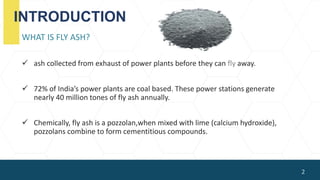
 ash collected from exhaust of power plants before they can fly away.
 72% of India’s power plants are coal based. These power stations generate
nearly 40 million tones of fly ash annually.
 Chemically, fly ash is a pozzolan,when mixed with lime (calcium hydroxide),
pozzolans combine to form cementitious compounds.
2
CLASSIFICATION OF FLY ASH
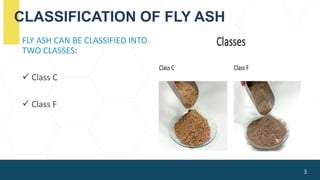
FLY ASH CAN BE CLASSIFIED INTO
TWO CLASSES:
 Class C
 Class F
3
CLASS C
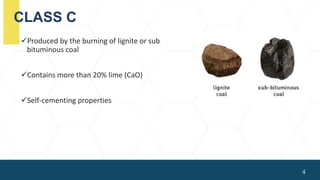
Produced by the burning of lignite or sub
bituminous coal
Contains more than 20% lime (CaO)
Self-cementing properties
4
CLASS F
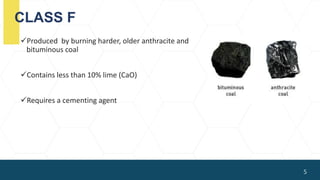
Produced by burning harder, older anthracite and
bituminous coal
Contains less than 10% lime (CaO)
Requires a cementing agent
5
WHY FLY ASH BRICKS?
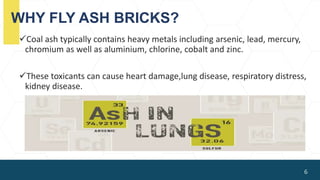
Coal ash typically contains heavy metals including arsenic, lead, mercury,
chromium as well as aluminium, chlorine, cobalt and zinc.
These toxicants can cause heart damage,lung disease, respiratory distress,
kidney disease.
6
VARIOUS TYPES OF FLY ASH BRICKS
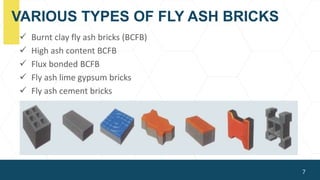
 Burnt clay fly ash bricks (BCFB)
 High ash content BCFB
 Flux bonded BCFB
 Fly ash lime gypsum bricks
 Fly ash cement bricks
7
Burnt clay fly ash bricks (BCFB):
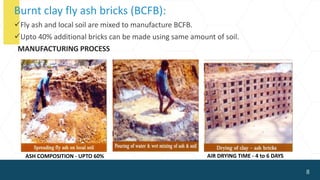
Fly ash and local soil are mixed to manufacture BCFB.
Upto 40% additional bricks can be made using same amount of soil.
MANUFACTURING PROCESS
8
AIR DRYING TIME - 4 to 6 DAYSASH COMPOSITION - UPTO 60%
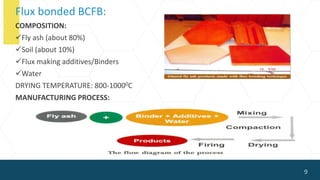
Flux bonded BCFB:
COMPOSITION:
Fly ash (about 80%)
Soil (about 10%)
Flux making additives/Binders
Water
DRYING TEMPERATURE: 800-10000C
MANUFACTURING PROCESS:
9
Fly ash lime gypsum bricks (FAL-G):
COMPOSITION:
 Fly ash (50-65%)
 Hydrated lime (8-12%)
 Stone dust (20-30%)
 Gypsum (5%)
MANUFACTURING PROCESS:
10
[1 - 2 DAYS] [15 - 21 DAYS]
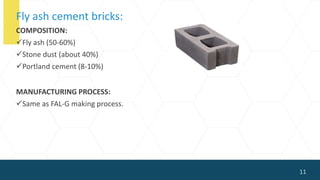
Fly ash cement bricks:
COMPOSITION:
Fly ash (50-60%)
Stone dust (about 40%)
Portland cement (8-10%)
MANUFACTURING PROCESS:
Same as FAL-G making process.
11
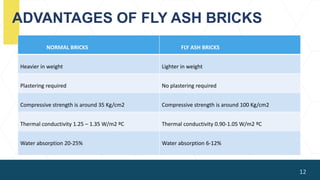
ADVANTAGES OF FLY ASH BRICKS
NORMAL BRICKS FLY ASH BRICKS
Heavier in weight Lighter in weight
Plastering required No plastering required
Compressive strength is around 35 Kg/cm2 Compressive strength is around 100 Kg/cm2
Thermal conductivity 1.25 – 1.35 W/m2 ºC Thermal conductivity 0.90-1.05 W/m2 ºC
Water absorption 20-25% Water absorption 6-12%
12
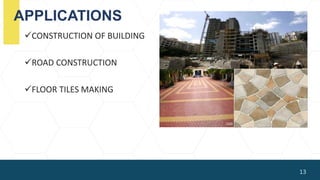
APPLICATIONS
CONSTRUCTION OF BUILDING
ROAD CONSTRUCTION
FLOOR TILES MAKING
13
CONCLUSION
 Electricity is an essential requirement of each society and in INDIA major
part of power is produced using coal which produces fly ash.
Each one who consumes power has a moral responsibility to contribute
for its utilization.
Fly ash bricks are environment friendly and can be easily manufactured
in factory.
There is a need to shift users habit and use fly ash bricks in place of clay
bricks.
14
REFERENCES
http://www.ntpc.co.in
http://flyashbricksinfo.com
http://buildwithash.com
http://www.ecobrick.in
15
Fly ash bricks 195

Fly ash bricks 195

  • 1.
    SUBMITTED BY : AVINASH JAISWAL [CSJMA14001390195] B.TECH, IVthyear [CHEMICAL ENGINEERING] FLY ASH BRICKS
  • 2.
    CONTENTS INTRODUCTION CLASSIFICATION OF FLYASH WHY FLY ASH BRICKS? VARIOUS TYPES OF FLY ASH BRICKS ADVANTAGES OF FLY ASH BRICKS APPLICATIONS REFERENCES 1
  • 3.
    INTRODUCTION WHAT IS FLYASH?  ash collected from exhaust of power plants before they can fly away.  72% of India’s power plants are coal based. These power stations generate nearly 40 million tones of fly ash annually.  Chemically, fly ash is a pozzolan,when mixed with lime (calcium hydroxide), pozzolans combine to form cementitious compounds. 2
  • 4.
    CLASSIFICATION OF FLYASH FLY ASH CAN BE CLASSIFIED INTO TWO CLASSES:  Class C  Class F 3
  • 5.
    CLASS C Produced bythe burning of lignite or sub bituminous coal Contains more than 20% lime (CaO) Self-cementing properties 4
  • 6.
    CLASS F Produced byburning harder, older anthracite and bituminous coal Contains less than 10% lime (CaO) Requires a cementing agent 5
  • 7.
    WHY FLY ASHBRICKS? Coal ash typically contains heavy metals including arsenic, lead, mercury, chromium as well as aluminium, chlorine, cobalt and zinc. These toxicants can cause heart damage,lung disease, respiratory distress, kidney disease. 6
  • 8.
    VARIOUS TYPES OFFLY ASH BRICKS  Burnt clay fly ash bricks (BCFB)  High ash content BCFB  Flux bonded BCFB  Fly ash lime gypsum bricks  Fly ash cement bricks 7
  • 9.
    Burnt clay flyash bricks (BCFB): Fly ash and local soil are mixed to manufacture BCFB. Upto 40% additional bricks can be made using same amount of soil. MANUFACTURING PROCESS 8 AIR DRYING TIME - 4 to 6 DAYSASH COMPOSITION - UPTO 60%
  • 10.
    Flux bonded BCFB: COMPOSITION: Flyash (about 80%) Soil (about 10%) Flux making additives/Binders Water DRYING TEMPERATURE: 800-10000C MANUFACTURING PROCESS: 9
  • 11.
    Fly ash limegypsum bricks (FAL-G): COMPOSITION:  Fly ash (50-65%)  Hydrated lime (8-12%)  Stone dust (20-30%)  Gypsum (5%) MANUFACTURING PROCESS: 10 [1 - 2 DAYS] [15 - 21 DAYS]
  • 12.
    Fly ash cementbricks: COMPOSITION: Fly ash (50-60%) Stone dust (about 40%) Portland cement (8-10%) MANUFACTURING PROCESS: Same as FAL-G making process. 11
  • 13.
    ADVANTAGES OF FLYASH BRICKS NORMAL BRICKS FLY ASH BRICKS Heavier in weight Lighter in weight Plastering required No plastering required Compressive strength is around 35 Kg/cm2 Compressive strength is around 100 Kg/cm2 Thermal conductivity 1.25 – 1.35 W/m2 ºC Thermal conductivity 0.90-1.05 W/m2 ºC Water absorption 20-25% Water absorption 6-12% 12
  • 14.
    APPLICATIONS CONSTRUCTION OF BUILDING ROADCONSTRUCTION FLOOR TILES MAKING 13
  • 15.
    CONCLUSION  Electricity isan essential requirement of each society and in INDIA major part of power is produced using coal which produces fly ash. Each one who consumes power has a moral responsibility to contribute for its utilization. Fly ash bricks are environment friendly and can be easily manufactured in factory. There is a need to shift users habit and use fly ash bricks in place of clay bricks. 14
  • 16.