Case Studies
Research Design: cyclical Writing the Case Selecting a project Making a record Asking questions Collecting  data Analysing  the data
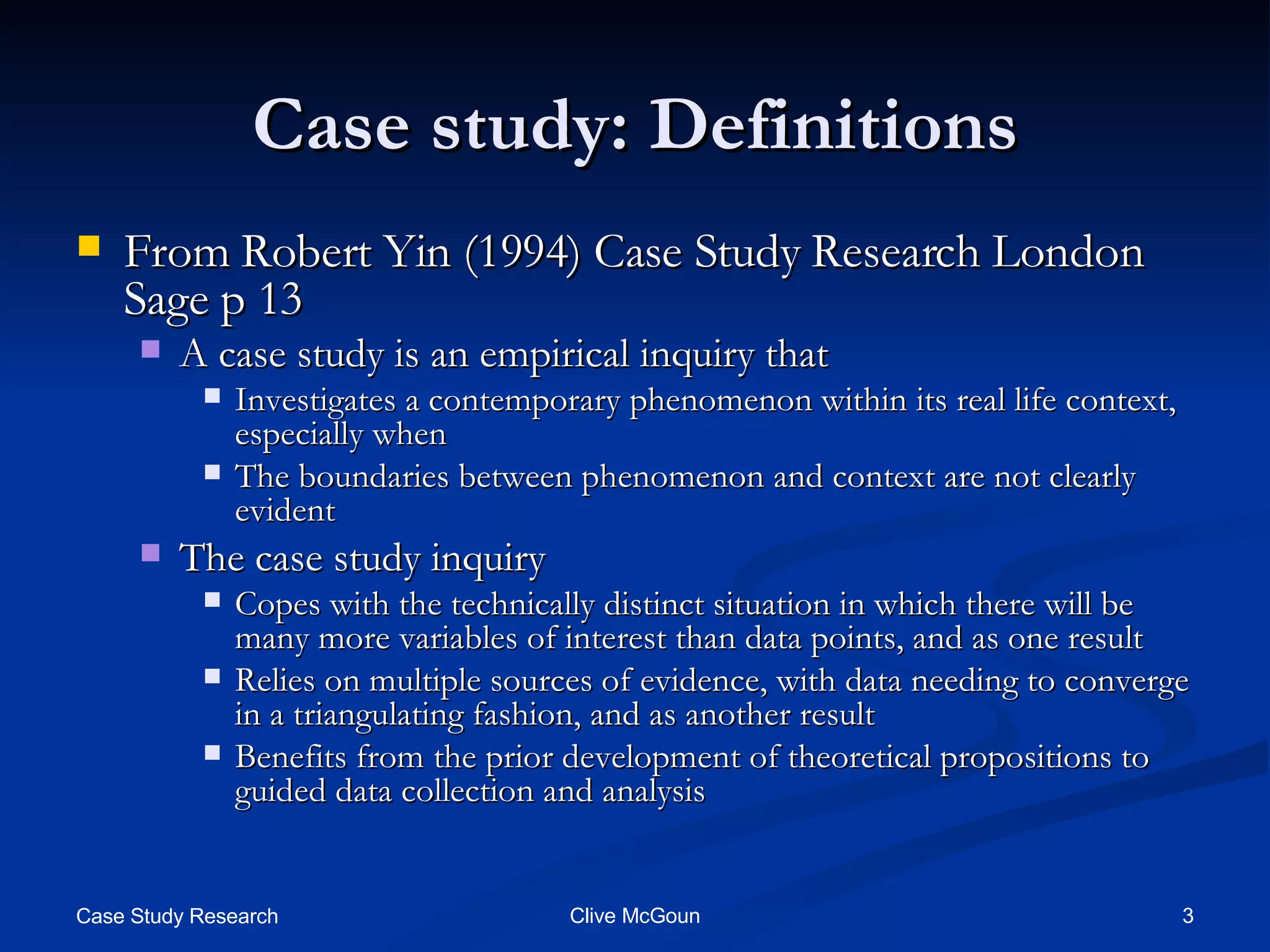
Case study: Definitions From Robert Yin (1994) Case Study Research London Sage p 13 A case study is an empirical inquiry that Investigates a contemporary phenomenon within its real life context, especially when The boundaries between phenomenon and context are not clearly evident The case study inquiry Copes with the technically distinct situation in which there will be  many more variables of interest than data points, and as one result Relies on multiple sources of evidence, with data needing to converge in a triangulating fashion, and as another result Benefits from the prior development of theoretical propositions to guided data collection and analysis
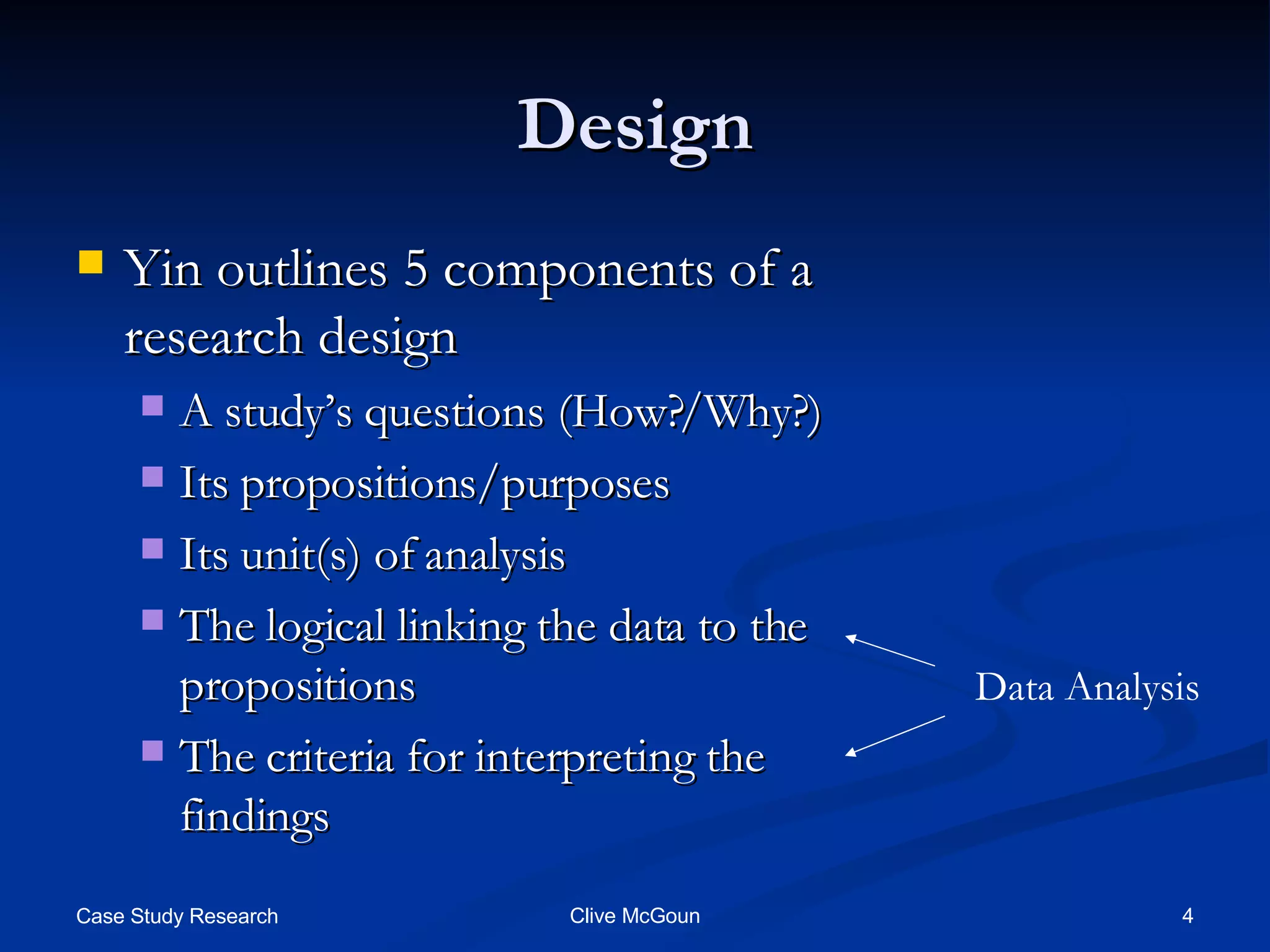
Design Yin outlines 5 components of a research design A study’s questions (How?/Why?) Its propositions/purposes Its unit(s) of analysis The logical linking the data to the propositions The criteria for interpreting the findings Data Analysis
Data Collection Skills The ability to ask good questions – and to interpret the answers The ability to listen effectively – not to be trapped by personal preconceptions The ability to be adaptive and flexible A firm grasp of the issues being studied Be unbiased by preconceived notions
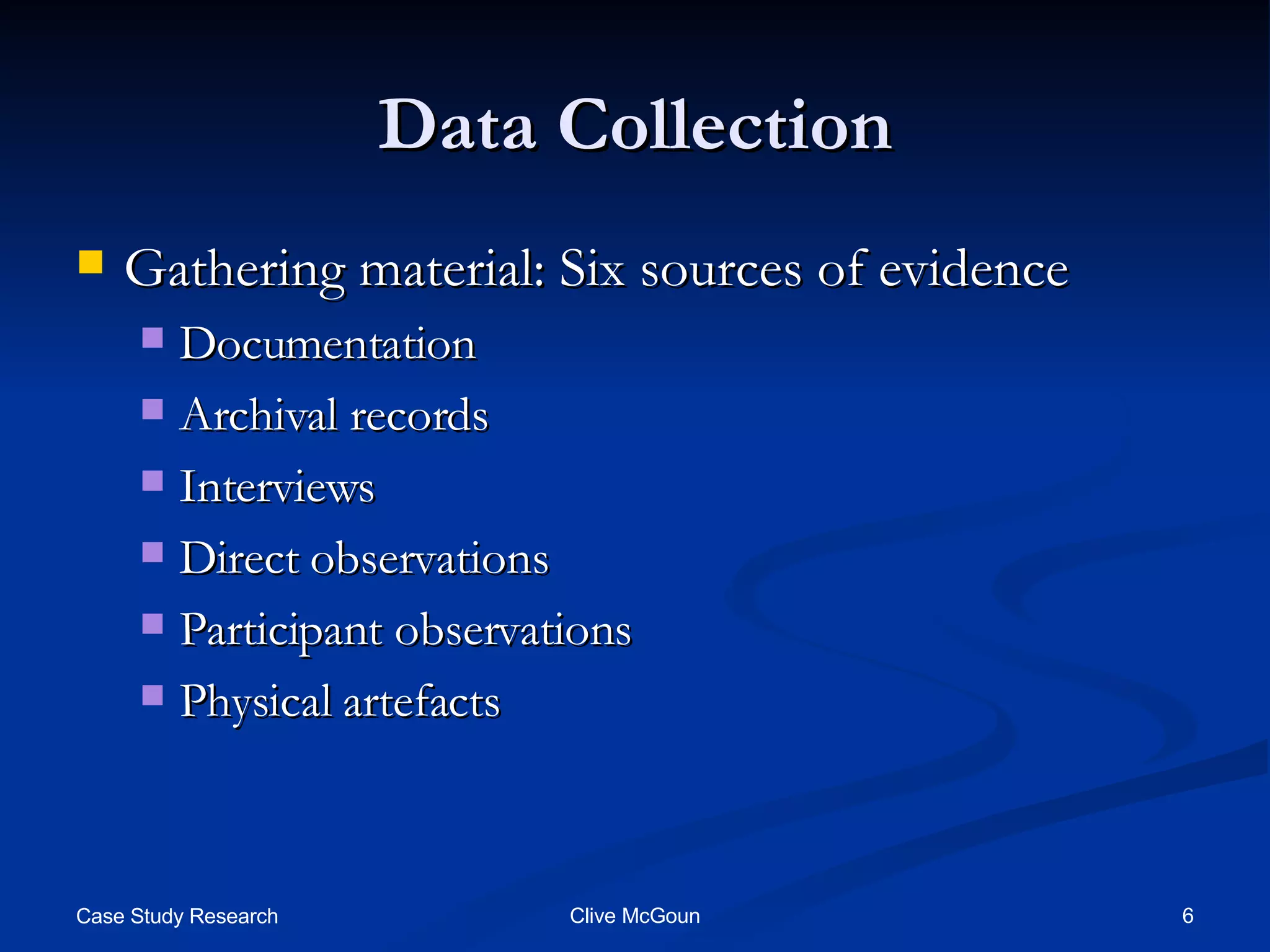
Data Collection Gathering material: Six sources of evidence Documentation Archival records Interviews Direct observations Participant observations Physical artefacts
Writing Up the case Organise – sections, topics, sub-topics – this will constitute the report’s structure Review Van Maanen concept of ‘tales’ for reporting fieldwork results Six example structures: Linear-analytic Comparative Chronological Theory-building ‘ suspense’ structures Unsequenced structures
Research Design: cyclical Writing the Case Selecting a project Making a record Asking questions Collecting  data Analysing  the data

Case Study Research

  • 1.
  • 2.
    Research Design: cyclicalWriting the Case Selecting a project Making a record Asking questions Collecting data Analysing the data
  • 3.
    Case study: DefinitionsFrom Robert Yin (1994) Case Study Research London Sage p 13 A case study is an empirical inquiry that Investigates a contemporary phenomenon within its real life context, especially when The boundaries between phenomenon and context are not clearly evident The case study inquiry Copes with the technically distinct situation in which there will be many more variables of interest than data points, and as one result Relies on multiple sources of evidence, with data needing to converge in a triangulating fashion, and as another result Benefits from the prior development of theoretical propositions to guided data collection and analysis
  • 4.
    Design Yin outlines5 components of a research design A study’s questions (How?/Why?) Its propositions/purposes Its unit(s) of analysis The logical linking the data to the propositions The criteria for interpreting the findings Data Analysis
  • 5.
    Data Collection SkillsThe ability to ask good questions – and to interpret the answers The ability to listen effectively – not to be trapped by personal preconceptions The ability to be adaptive and flexible A firm grasp of the issues being studied Be unbiased by preconceived notions
  • 6.
    Data Collection Gatheringmaterial: Six sources of evidence Documentation Archival records Interviews Direct observations Participant observations Physical artefacts
  • 7.
    Writing Up thecase Organise – sections, topics, sub-topics – this will constitute the report’s structure Review Van Maanen concept of ‘tales’ for reporting fieldwork results Six example structures: Linear-analytic Comparative Chronological Theory-building ‘ suspense’ structures Unsequenced structures
  • 8.
    Research Design: cyclicalWriting the Case Selecting a project Making a record Asking questions Collecting data Analysing the data