1
CASE STUDY AS
A RESEARCH METHOD
Introduction
4
According to Yin (2014, p.10), the case study
method is particularly appropriate when the
research question starts with: “How?” or “Why?”.
A research question starting with “What?” is also
accurate, especially for a relativist/subjective
approach.
The case study method is particularly interesting
when the studied phenomenon is:
not clearly or not sufficiently theorized,
complex (several actors, assignments,
procedures, goals, etc.).
Case study typologies
5
The main types of case study can be
identified on the following basis:
1.
2.
Research design (Yin/COSMOS Corp.,
1984),
Research purpose.
Case study typologies
6
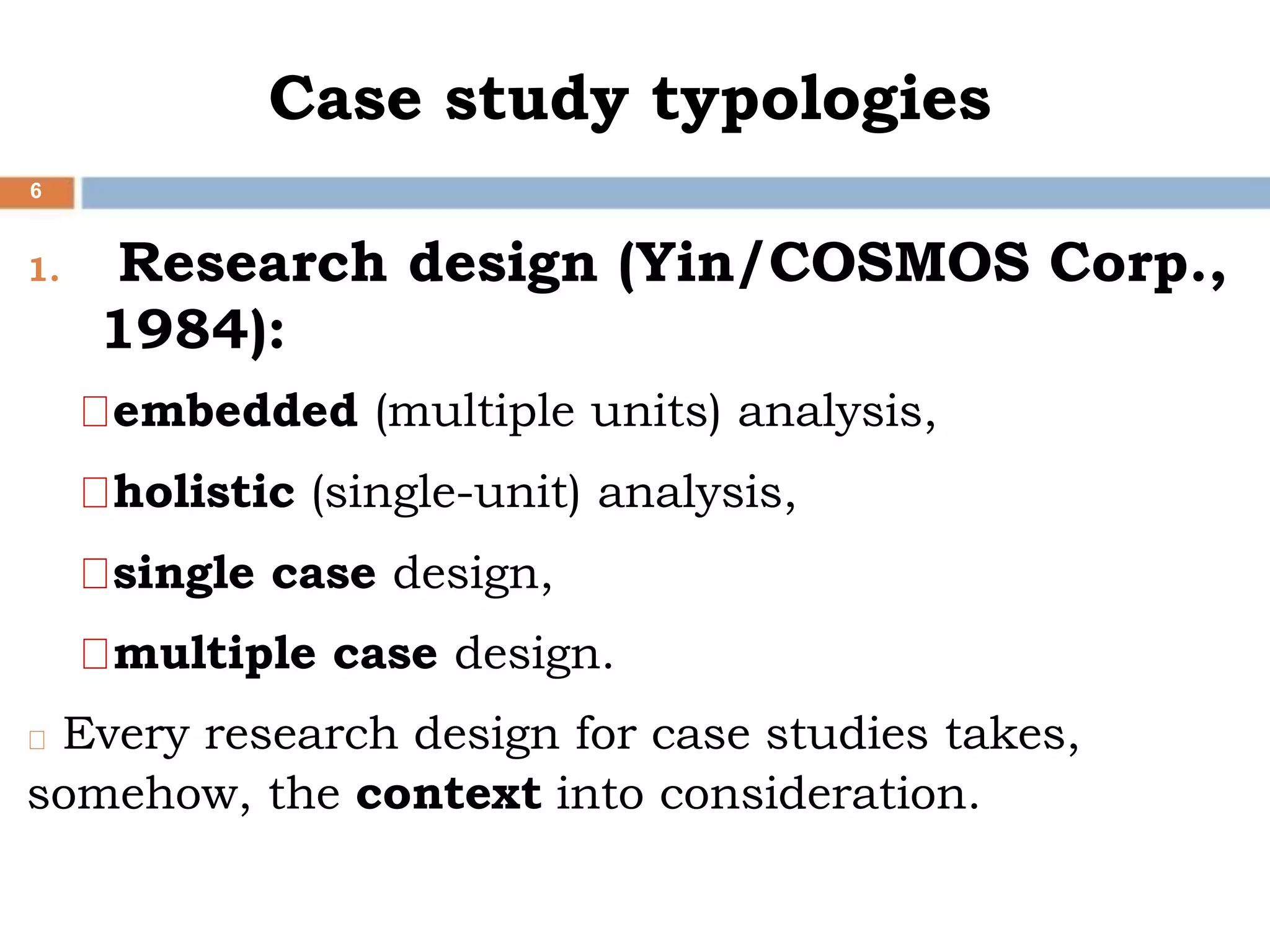
1. Research design (Yin/COSMOS Corp.,
1984):
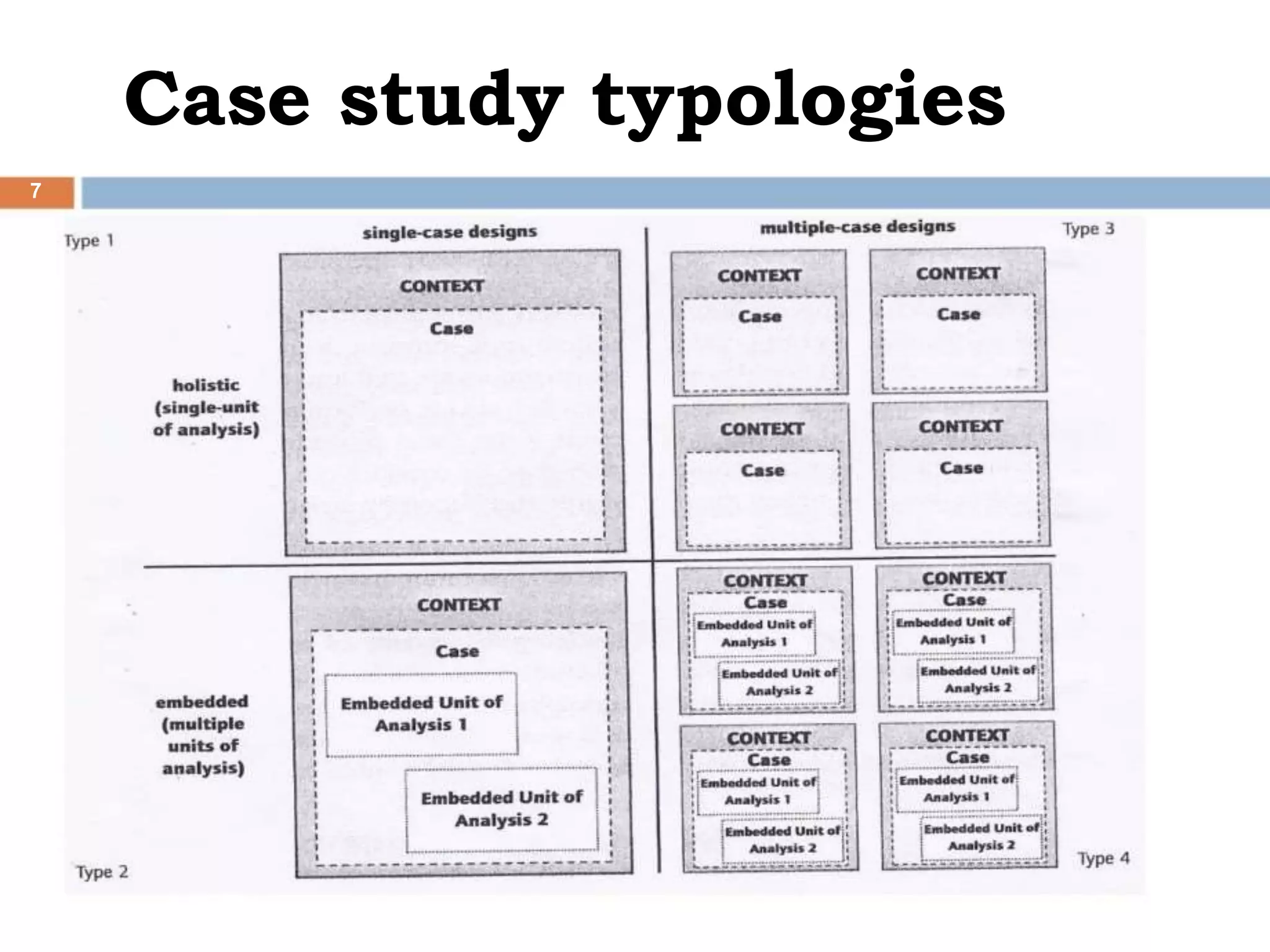
embedded (multiple units) analysis,
holistic (single-unit) analysis,
single case design,
multiple case design.
Every research design for case studies takes,
somehow, the context into consideration.
Case study typologies
7
Case study typologies
8
Holistic case study
This analysis is based on
the systemic approach
of a phenomenon/entity.
It is useful when:
no sub-unit can be
identified,
when the theory
underlying the case is itself
of a holistic nature.
Embedded case study
This analysis focuses on
different sub-units of a
specific phenomenon/
entity.
It is useful to:
put into perspective the holistic
illusion,
confront rival interpretations,
strengthen internal validity.
Case study typologies
9
Single case design
According to Yin (2014),
this design is
appropriate when the
case:
is critical to test a
specific theory with a
clear set of propositions;
represents an extreme
or unusual case;
is representative of a
situation;
reveals a situation;
is longitudinal.
Multiple case design
This design is
particularly relevant for:
testing the conclusions
(replication),
avoiding extraneous
variation,
providing a larger picture
of a complex phenomenon
(Stake, 2006),
comparing different studies
(between industries, countries,
etc.).
Case study typologies
10
2. Research purpose:
Exploratory case study
Explanatory (or causal) case study
Descriptive case study
Confirmatory case study
Case study typologies
11
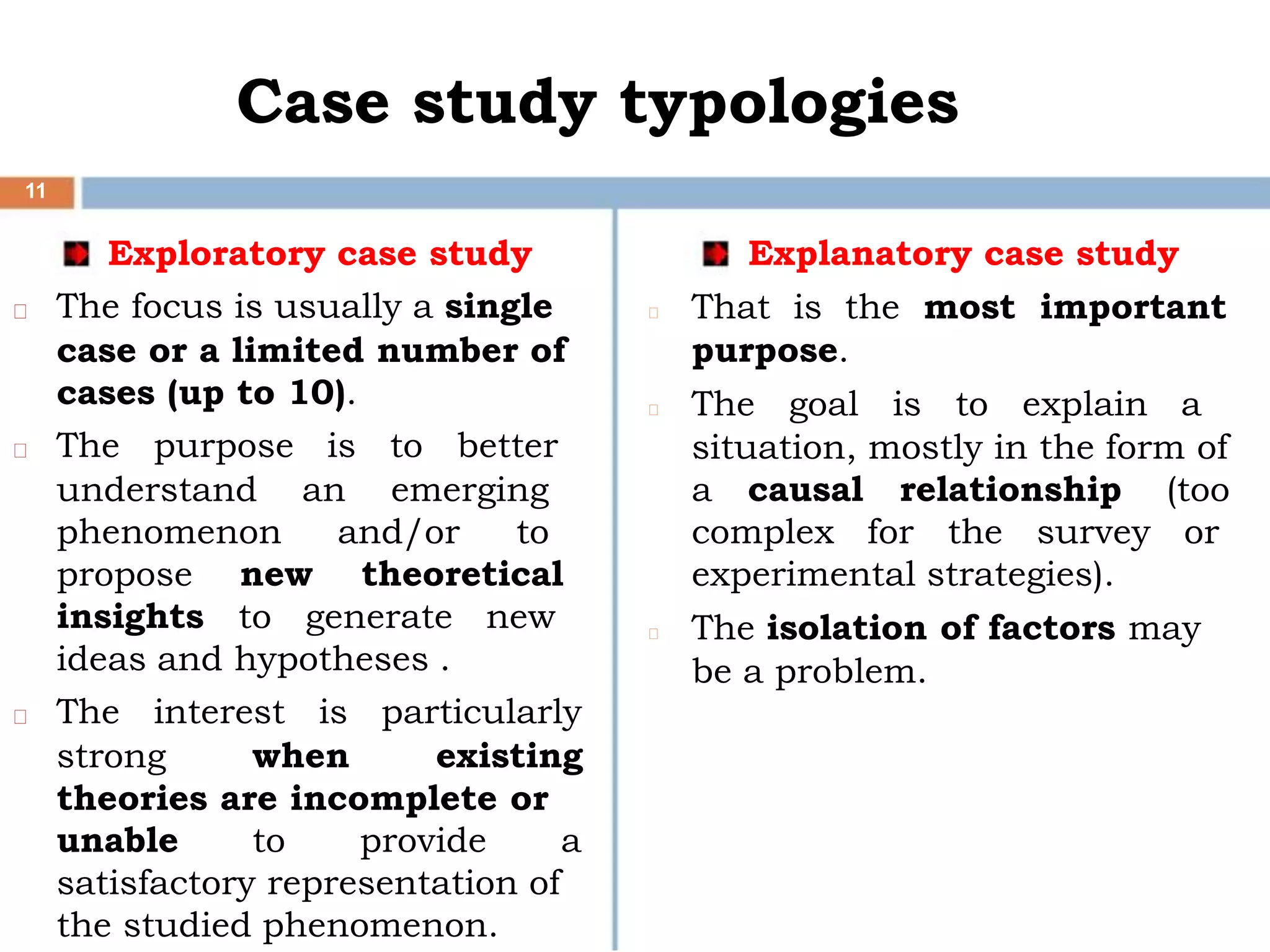
Exploratory case study
The focus is usually a single
case or a limited number of
cases (up to 10).
The purpose is to better
understand an emerging
phenomenon and/or to
propose new theoretical
insights to generate new
ideas and hypotheses .
The interest is particularly
strong when existing
theories are incomplete or
unable to provide a
satisfactory representation of
the studied phenomenon.
Explanatory case study
That is the most important
purpose.
The goal is to explain a
situation, mostly in the form of
a causal relationship (too
complex for the survey or
experimental strategies).
The isolation of factors may
be a problem.
Case study typologies
12
Descriptive case study
The goal is to portray
precisely a phenomenon.
The approach is used when the
generality of the phenomenon
is of secondary importance.
Confirmatory case study
The purpose is to evaluate the
robustness or the weakness of
a clearly defined theory (or
theoretical conjecture).
A conflicting case might be
used to falsify a theory by
giving examples of events
contradicting some theoretical
statements.
The falsified theory, in a
specific context, must then be
modified.
•The logical sequence that connects the empirical
data to a study’s initial research questions and
conclusions
•Design as a way of addressing four basic sets of
research issues
•What questions to study
• What data are relevant
• What data to collect
•How to analyse the results
11
11
Case Study Research Design depends on the
following:
Paradigmatic framework
15
There is an emerging consensus to formally
present a paradigmatic framework.
The concept of paradigm refers to a specific
scientific research framework.
Epistemological project.
Ontological perspective.
Methodological protocol.
Epistemological projects
16
Piaget (1970) distinguishes three types of epistemological
projects.
The idiographic project (observation of unique facts or
events before theorization):
historiography (to study a phenomenon’s history),
ethnography (to study a phenomenon’s context).
The praxeological project (analysis of decisions and actions):
To identify and delineate norms, rules and obligations impacting
decision-making and implementation).
The nomothetic project (theorization before explanation):
To identify and analyze the laws that can be more or less generalized
to other situations (causal determinism).
Post Positivist ontology(Link of post positivism
with Case Study Methodology)
18
Post-neopositivism (some members of the Vienna Circle in
the1930’s)
The verification principle is abandoned.
It’s replaced by the refutation/falsification principle
(Popper,1934) or confirmation/testability principle
(Carnap, 1936).
The positivist ontology is often used for case studies
(Inductive theory-building and Natural experiment methods
[Welch et al., 2011]).
The drawbacks are the following: difficult generalization from
case studies, weak emphasis on contextualization, the
principle of scientific objectivity is questionable, etc.
Methodological protocol
27
SHARED METHODS - DIFFERENT METHODOLOGIES
METHODOLOGIES
METHODS QUANTITATIVE QUALITATIVE
RESEARCH RESEARCH
Observation As an Introduction Essential
Interviews Fully structured Unstructured or semi-
structured
Recording Rarely used Analysis of way of
To verify saying
Textual Frequency of Understanding of used
analysis occurrence of categories
recording units
Source: Hlady-Rispal (2002).
case study research
28
-
xamples:
or instance, education audiences may want to know about
he following:
How and why a high school principal had done an especially
ood job
The dynamics of a successful (or unsuccessful) collective
argaining negotiation with severe consequences (
.g., a teachers’ strike)
Everyday life in a special residential school
ou could use a questionnaire or other instrument to study
hese situations, but doing some original fieldwork, as
part of a case study, might go further in helping you best
understand them.
Strengths of case study designs
28
-
adaptability to different types of research question and to
ifferent research settings
The use of multiple sources of evidence allows triangulation
f findings
Case studies also offer the benefit of studying phenomena in
etail and in context, particularly in situations where there
re many more variables of interest than there are observations
Another potential advantage of case studies is that the format
may make the research accessible to wider readership than
ome other designs
case studies can help academics and practitioners keep up
with a fast-changing field, ‘papers that build theory from cases
re among the most highly cited pieces in’
Weaknesses of case study designs
28
-
One technical issue is a variant of what is known as selection
ias whereby the choice of cases biases the findings of the
esearch
if the research findings need to be generalised statistically
then a case study approach is not suitable
A further concern about case study design is that since
neither experimental nor statistical controls can be used in
ase study research
it is important when evaluating case study research not
o interpret them exclusively through the ‘prism of statistical
methods’
Another limitation, or more accurately a practical challenge,
f case study research is that it can be very demanding to
arry out
Conclusion
38
Case study as a research method:
is very popular (especially in qualitative research),
is respected in the academic world,
has a large paradigmatic flexibility,
presents a high theory-testing and theory-building
potential,
Can be based on four main research methods.

Case study research method

  • 1.
    1 CASE STUDY AS ARESEARCH METHOD
  • 2.
    Introduction 4 According to Yin(2014, p.10), the case study method is particularly appropriate when the research question starts with: “How?” or “Why?”. A research question starting with “What?” is also accurate, especially for a relativist/subjective approach. The case study method is particularly interesting when the studied phenomenon is: not clearly or not sufficiently theorized, complex (several actors, assignments, procedures, goals, etc.).
  • 3.
    Case study typologies 5 Themain types of case study can be identified on the following basis: 1. 2. Research design (Yin/COSMOS Corp., 1984), Research purpose.
  • 4.
    Case study typologies 6 1.Research design (Yin/COSMOS Corp., 1984): embedded (multiple units) analysis, holistic (single-unit) analysis, single case design, multiple case design. Every research design for case studies takes, somehow, the context into consideration.
  • 5.
  • 6.
    Case study typologies 8 Holisticcase study This analysis is based on the systemic approach of a phenomenon/entity. It is useful when: no sub-unit can be identified, when the theory underlying the case is itself of a holistic nature. Embedded case study This analysis focuses on different sub-units of a specific phenomenon/ entity. It is useful to: put into perspective the holistic illusion, confront rival interpretations, strengthen internal validity.
  • 7.
    Case study typologies 9 Singlecase design According to Yin (2014), this design is appropriate when the case: is critical to test a specific theory with a clear set of propositions; represents an extreme or unusual case; is representative of a situation; reveals a situation; is longitudinal. Multiple case design This design is particularly relevant for: testing the conclusions (replication), avoiding extraneous variation, providing a larger picture of a complex phenomenon (Stake, 2006), comparing different studies (between industries, countries, etc.).
  • 8.
    Case study typologies 10 2.Research purpose: Exploratory case study Explanatory (or causal) case study Descriptive case study Confirmatory case study
  • 9.
    Case study typologies 11 Exploratorycase study The focus is usually a single case or a limited number of cases (up to 10). The purpose is to better understand an emerging phenomenon and/or to propose new theoretical insights to generate new ideas and hypotheses . The interest is particularly strong when existing theories are incomplete or unable to provide a satisfactory representation of the studied phenomenon. Explanatory case study That is the most important purpose. The goal is to explain a situation, mostly in the form of a causal relationship (too complex for the survey or experimental strategies). The isolation of factors may be a problem.
  • 10.
    Case study typologies 12 Descriptivecase study The goal is to portray precisely a phenomenon. The approach is used when the generality of the phenomenon is of secondary importance. Confirmatory case study The purpose is to evaluate the robustness or the weakness of a clearly defined theory (or theoretical conjecture). A conflicting case might be used to falsify a theory by giving examples of events contradicting some theoretical statements. The falsified theory, in a specific context, must then be modified.
  • 11.
    •The logical sequencethat connects the empirical data to a study’s initial research questions and conclusions •Design as a way of addressing four basic sets of research issues •What questions to study • What data are relevant • What data to collect •How to analyse the results 11 11 Case Study Research Design depends on the following:
  • 12.
    Paradigmatic framework 15 There isan emerging consensus to formally present a paradigmatic framework. The concept of paradigm refers to a specific scientific research framework. Epistemological project. Ontological perspective. Methodological protocol.
  • 13.
    Epistemological projects 16 Piaget (1970)distinguishes three types of epistemological projects. The idiographic project (observation of unique facts or events before theorization): historiography (to study a phenomenon’s history), ethnography (to study a phenomenon’s context). The praxeological project (analysis of decisions and actions): To identify and delineate norms, rules and obligations impacting decision-making and implementation). The nomothetic project (theorization before explanation): To identify and analyze the laws that can be more or less generalized to other situations (causal determinism).
  • 14.
    Post Positivist ontology(Linkof post positivism with Case Study Methodology) 18 Post-neopositivism (some members of the Vienna Circle in the1930’s) The verification principle is abandoned. It’s replaced by the refutation/falsification principle (Popper,1934) or confirmation/testability principle (Carnap, 1936). The positivist ontology is often used for case studies (Inductive theory-building and Natural experiment methods [Welch et al., 2011]). The drawbacks are the following: difficult generalization from case studies, weak emphasis on contextualization, the principle of scientific objectivity is questionable, etc.
  • 15.
    Methodological protocol 27 SHARED METHODS- DIFFERENT METHODOLOGIES METHODOLOGIES METHODS QUANTITATIVE QUALITATIVE RESEARCH RESEARCH Observation As an Introduction Essential Interviews Fully structured Unstructured or semi- structured Recording Rarely used Analysis of way of To verify saying Textual Frequency of Understanding of used analysis occurrence of categories recording units Source: Hlady-Rispal (2002).
  • 16.
    case study research 28 - xamples: orinstance, education audiences may want to know about he following: How and why a high school principal had done an especially ood job The dynamics of a successful (or unsuccessful) collective argaining negotiation with severe consequences ( .g., a teachers’ strike) Everyday life in a special residential school ou could use a questionnaire or other instrument to study hese situations, but doing some original fieldwork, as part of a case study, might go further in helping you best understand them.
  • 17.
    Strengths of casestudy designs 28 - adaptability to different types of research question and to ifferent research settings The use of multiple sources of evidence allows triangulation f findings Case studies also offer the benefit of studying phenomena in etail and in context, particularly in situations where there re many more variables of interest than there are observations Another potential advantage of case studies is that the format may make the research accessible to wider readership than ome other designs case studies can help academics and practitioners keep up with a fast-changing field, ‘papers that build theory from cases re among the most highly cited pieces in’
  • 18.
    Weaknesses of casestudy designs 28 - One technical issue is a variant of what is known as selection ias whereby the choice of cases biases the findings of the esearch if the research findings need to be generalised statistically then a case study approach is not suitable A further concern about case study design is that since neither experimental nor statistical controls can be used in ase study research it is important when evaluating case study research not o interpret them exclusively through the ‘prism of statistical methods’ Another limitation, or more accurately a practical challenge, f case study research is that it can be very demanding to arry out
  • 19.
    Conclusion 38 Case study asa research method: is very popular (especially in qualitative research), is respected in the academic world, has a large paradigmatic flexibility, presents a high theory-testing and theory-building potential, Can be based on four main research methods.