
 A very detailed investigation and in depth empirical examination of a single phenomenon or a
case in its real life context, through using multiple sources of evidence. In another word, it is a
system of actions and tend to be selective, that focuses on one or two fundamental issues to
understand what is being examined.
 Case study research is a general and inclusive approach to qualitative research. What case study researchers
have in common is that they choose to call their objects of study “cases” and they organize their research efforts
around the study of those cases. The focus is usually on describing the characteristics of one or more cases,
describing how the case or cases operate, and answering specific research questions about the case(s).
 A case study is about the particular rather than the general. You can not generalize from a case
study.
case study researchers carefully examine the contexts of the case to describe and explain better the functioning
of the case. They view each case as having an internal and an external context. For example, school as a
context.
o Internally, a researcher might examine the organizational climate at a school, the leadership style used by
the principal, and the condition of the physical and instructional facilities.
o Externally, the school is situated in a geographical area with specific social, economic, and demographic
characteristics.
 The main purpose is to explore possible causes, factors and process that play an
important role in the outcome.
 When the study is very complex and needs to be provided with detail to be
comprehended.
 it can be used when the researcher believes that real-life contextual conditions play
a significant role of intervention for researching the phenomenon.
 Counselling, history, criminology, clinical medicine,
administration, politics, military studies, education,
bio-chemistry, anatomy, artificial intelligence, social
sciences, gerontology, education, botany, law
psychology, law, second language acquisition, first
language acquisition, linguistics…etc.
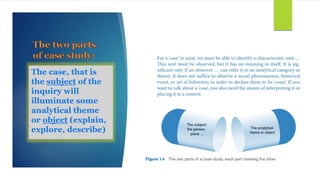
The case, that is
the subject of the
inquiry will
illuminate some
analytical theme
or object (explain,
explore, describe)
A case study can be experimental, or quasi experimental. Explanatory or
exploratory. It can be conducted quantitatively according to the data
collection techqniques and the purpose of the study but mostly find as a
sub-category of a qualitative research.
1. The main feature of case study is multi-dimensional perspective; different perspective,
in collecting data from different sources.
2. Triangulation, which is confirming validity of the data that can be suggested as follows:
a) Data source triangulation. The researcher collects different types of information to ensure validity
b) Different researchers study the same phenomenon, so if the same result achieved, it is valid
c) Theory triangulation, investigators with different perspective and advocating different theories have the same
interpretation of the results
d) Methodological triangulation, different approaches are used to find the same result.
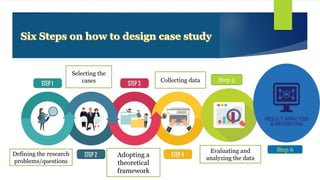
Step 6
Step 5
Defining the research
problems/questions
Selecting the
cases
Adopting a
theoretical
framework
Collecting data
Evaluating and
analyzing the data
1. Defining the research problems/questions
 It begins with establishing a firm research focus
 The central theme of the study controls most of research activities.
 It is a point of reference for the researcher.
 Good research problem can be located in the literature related to the topic, it helps to focus on
specific aspects of the problem.
 Good research question is specific where the research variables are operationally defined.
 specify and narrow down research problem through relating a case to psychological, social,
historical or educational issues.
 Both exploration and explanation can be sought, both how and why questions can be asked.
2. Selecting the Case.
 It is the essential part of the case study research design. All researchers should learn how to select cases
with care. It is the unit of the study, so it makes it different from other methods.
 Case selection refers to a method by which cases are chosen for an intensive investigation.
 The unit should be precisely identified so that it can be easily differentiated from other units with clear
identifiable boundaries.
 The more specific object the more and easily identified as a case study.
 The case can be single or multiple.
 If multiple cases are selected, they are treated as one single case in data collection, the findings of each
case are put together.
 How general the case should be? Unique or typical? Depends on the nature of research.
3. Adopting a theoretical framework
 Adopting a theoretical framework in the form of proposition.
 It functions as a hypothesis for case study.
 The proposition states what behavior or relationship the researcher expects to observe and the
reason why he thinks so.
 The proposition also helps the researcher narrow the focus of study and to look for relevant data.
4. Collecting the Data
 One advantage of case study is collecting a large amount of data from a multiple sources.
 Researchers should have plan to avoid confusion due to large amount of data.
 It requires a careful observation and identifying the key factors in the case.
 This may involve conducting pilot study and doing field work.
 The researcher should develop an efficient and accessible data base for further interpretation and
analysis.
 The data base, can contain field notes, results of questionnaire and interviews, and documents
 A data base can help the research uncover the factors and issues related to the case.
5. Evaluating and analyzing the data
 First of all, the researcher should categorize, summarize, tabulate and display the data.
 Check for its reliability.
 To this end, different tables, graphs, and frequency counts can be used that facilitate data analysis and
interpretation.
 The data can be interpreted by using different strategies, such as triangulation and cross-referenced to check
validity.
Cross-case analysis technique: helps to look at the data from different perspectives. The cases are
divided into different sub-types and there come different researchers to work on, each researcher
looks for a pattern and come-up with commonalities of patterns. This can provide more insights for
final interpretation and increase validity of the findings.
 The researcher should be open for new ideas and insights that may occur during data analysis.
 The researcher can purposefully look for contradictory data to confirm or disconfirm the conclusion.
6. Reporting the results
 The final report of the case study should provide the reader sufficient information about the research
objective and the information collected so that they can develop a deep understanding of the case.
 The report can follow a chronology of the case (a list of everything that happened in date order from the
earliest to the most recent), or develop a narrative story of the case(focused on close readings of stories
told by participants).
 Validity does not apply to case study design as the way used and defined in experimental
research, because it is not a sampling research and does not claim generalization. Validity
for this study depends on analytic generalization ( to which degree the findings support a
theory).
 Reliability of case study can be established by the evidence that the same findings could be
reached and provided by another researcher while conducting a study.
The major 3 types of case study research are:
1. intrinsic case study: the researcher is interested in a specific case. For example, a researcher might
want to understand a student who is having difficulty in class. The researcher study every single detail
because the goal is to understand the case as a holistic entity, as well as to understand its inner
working.
2. instrumental case study: The researcher studies a case for a broader purpose, to understand
something other than the particular case. The researcher studies the case to learn about something
more general, for example teenage drug use in general rather than teenage drug use at a particular high
school. The goal tends to be less particularistic and more universalistic.
 3. collective case study: also called the multiple-case design. The researcher studies multiple cases for
comparison, the researcher believes that, a greater insight into a research topic is gained by concurrently
studying multiple cases in one overall research study. However, less depth study is required because the
greater resources are available. It has several advantages. First, a comparative type of study can be
conducted in which several cases are compared for similarities and differences. For example, a public
school might be studied and compared with a private school. Second, one can more effectively test a
theory by observing the results of multiple cases. Third, is more likely to generalize the results from a
single case.
* When there is more than one case, cross-case analysis is used to identify similarities and differences across
the cases.
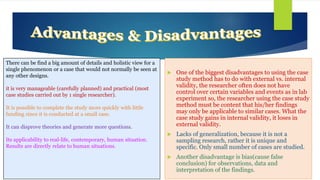
 One of the biggest disadvantages to using the case
study method has to do with external vs. internal
validity, the researcher often does not have
control over certain variables and events as in lab
experiment so, the researcher using the case study
method must be content that his/her findings
may only be applicable to similar cases. What the
case study gains in internal validity, it loses in
external validity.
 Lacks of generalization, because it is not a
sampling research, rather it is unique and
specific. Only small number of cases are studied.
 Another disadvantage is bias(cause false
conclusion) for observations, data and
interpretation of the findings.
There can be find a big amount of details and holistic view for a
single phenomenon or a case that would not normally be seen at
any other designs.
it is very manageable (carefully planned) and practical (most
case studies carried out by 1 single researcher).
It is possible to complete the study more quickly with little
funding since it is conducted at a small case.
It can disprove theories and generate more questions.
Its applicability to real-life, contemporary, human situation.
Results are directly relate to human situations.
Case studies have been used in a wide variety of second language research studies. Generally aim to provide a holistic
description of language learning or use within a specific population and setting. Case studies tend to provide
detailed descriptions of specific learners, or sometimes classes within learning setting by exploring the
behaviors and attitudes of individuals, groups (e.g., a whole class), organizations (e.g., a language program), or
events (e.g., a tutorial or seminar), are also usually associated with a longitudinal approach, where observations
of the phenomena under investigation are made at periodic intervals for an extended period of time.
One well-known longitudinal case study investigating the development of L2 communicative competence is
Schmidt’s (1983) study of Wes, an ESL learner. Wes was a 33-year-old native speaker of Japanese who had
little formal instruction in English. Schmidt studied Wes’ language development over a three year period
when he was residing in Japan but visited Hawaii, the research site, regularly on business. The study
focused on a small number of grammatical features, including plural “s,” third-person singular “s,” and
regular past tense. Schmidt transcribed conversations between Wes and friends and also transcribed
monologues that he asked Wes to produce and record while at home in Japan. Although Wes attained
relatively high levels of pragmatic ability and acculturation (for example, in the use of formulae such as “So,
what’s new?” and “Whaddya know?”), he had very limited improvement in terms of linguistic accuracy for
the grammatical forms over the three years of the study, thus providing evidence for the separability of
linguistic and pragmatic competence.
Work Cited
 Johnson, R. Burke and Larry Christensen. “Educational research: Quantitative,
qualitative, and mixed approaches” SAGE Publications, 2014.
 Mackey, Alison and Susan M. Gass. “Second Language Research”. 2nd ed., New York:
Routledge, 2016
 Moini, M. Raouf “Research Methods and Designs in Humanities” Iran: jungle
publication, 2008.
 Thomas, Gary. “How to do your case study” London: SAGE Publications, 2016.
 https://www.ukessays.com/essays/psychology/the-advantages-and-disadvantages-
of-case-study-research-psychology-essay.php

Case study

  • 3.
     A verydetailed investigation and in depth empirical examination of a single phenomenon or a case in its real life context, through using multiple sources of evidence. In another word, it is a system of actions and tend to be selective, that focuses on one or two fundamental issues to understand what is being examined.  Case study research is a general and inclusive approach to qualitative research. What case study researchers have in common is that they choose to call their objects of study “cases” and they organize their research efforts around the study of those cases. The focus is usually on describing the characteristics of one or more cases, describing how the case or cases operate, and answering specific research questions about the case(s).  A case study is about the particular rather than the general. You can not generalize from a case study.
  • 4.
    case study researcherscarefully examine the contexts of the case to describe and explain better the functioning of the case. They view each case as having an internal and an external context. For example, school as a context. o Internally, a researcher might examine the organizational climate at a school, the leadership style used by the principal, and the condition of the physical and instructional facilities. o Externally, the school is situated in a geographical area with specific social, economic, and demographic characteristics.
  • 5.
     The mainpurpose is to explore possible causes, factors and process that play an important role in the outcome.  When the study is very complex and needs to be provided with detail to be comprehended.  it can be used when the researcher believes that real-life contextual conditions play a significant role of intervention for researching the phenomenon.
  • 6.
     Counselling, history,criminology, clinical medicine, administration, politics, military studies, education, bio-chemistry, anatomy, artificial intelligence, social sciences, gerontology, education, botany, law psychology, law, second language acquisition, first language acquisition, linguistics…etc.
  • 7.
    The case, thatis the subject of the inquiry will illuminate some analytical theme or object (explain, explore, describe)
  • 8.
    A case studycan be experimental, or quasi experimental. Explanatory or exploratory. It can be conducted quantitatively according to the data collection techqniques and the purpose of the study but mostly find as a sub-category of a qualitative research.
  • 9.
    1. The mainfeature of case study is multi-dimensional perspective; different perspective, in collecting data from different sources. 2. Triangulation, which is confirming validity of the data that can be suggested as follows: a) Data source triangulation. The researcher collects different types of information to ensure validity b) Different researchers study the same phenomenon, so if the same result achieved, it is valid c) Theory triangulation, investigators with different perspective and advocating different theories have the same interpretation of the results d) Methodological triangulation, different approaches are used to find the same result.
  • 10.
    Step 6 Step 5 Definingthe research problems/questions Selecting the cases Adopting a theoretical framework Collecting data Evaluating and analyzing the data
  • 11.
    1. Defining theresearch problems/questions  It begins with establishing a firm research focus  The central theme of the study controls most of research activities.  It is a point of reference for the researcher.  Good research problem can be located in the literature related to the topic, it helps to focus on specific aspects of the problem.  Good research question is specific where the research variables are operationally defined.  specify and narrow down research problem through relating a case to psychological, social, historical or educational issues.  Both exploration and explanation can be sought, both how and why questions can be asked.
  • 12.
    2. Selecting theCase.  It is the essential part of the case study research design. All researchers should learn how to select cases with care. It is the unit of the study, so it makes it different from other methods.  Case selection refers to a method by which cases are chosen for an intensive investigation.  The unit should be precisely identified so that it can be easily differentiated from other units with clear identifiable boundaries.  The more specific object the more and easily identified as a case study.  The case can be single or multiple.  If multiple cases are selected, they are treated as one single case in data collection, the findings of each case are put together.  How general the case should be? Unique or typical? Depends on the nature of research.
  • 13.
    3. Adopting atheoretical framework  Adopting a theoretical framework in the form of proposition.  It functions as a hypothesis for case study.  The proposition states what behavior or relationship the researcher expects to observe and the reason why he thinks so.  The proposition also helps the researcher narrow the focus of study and to look for relevant data.
  • 14.
    4. Collecting theData  One advantage of case study is collecting a large amount of data from a multiple sources.  Researchers should have plan to avoid confusion due to large amount of data.  It requires a careful observation and identifying the key factors in the case.  This may involve conducting pilot study and doing field work.  The researcher should develop an efficient and accessible data base for further interpretation and analysis.  The data base, can contain field notes, results of questionnaire and interviews, and documents  A data base can help the research uncover the factors and issues related to the case.
  • 15.
    5. Evaluating andanalyzing the data  First of all, the researcher should categorize, summarize, tabulate and display the data.  Check for its reliability.  To this end, different tables, graphs, and frequency counts can be used that facilitate data analysis and interpretation.  The data can be interpreted by using different strategies, such as triangulation and cross-referenced to check validity. Cross-case analysis technique: helps to look at the data from different perspectives. The cases are divided into different sub-types and there come different researchers to work on, each researcher looks for a pattern and come-up with commonalities of patterns. This can provide more insights for final interpretation and increase validity of the findings.  The researcher should be open for new ideas and insights that may occur during data analysis.  The researcher can purposefully look for contradictory data to confirm or disconfirm the conclusion.
  • 16.
    6. Reporting theresults  The final report of the case study should provide the reader sufficient information about the research objective and the information collected so that they can develop a deep understanding of the case.  The report can follow a chronology of the case (a list of everything that happened in date order from the earliest to the most recent), or develop a narrative story of the case(focused on close readings of stories told by participants).
  • 17.
     Validity doesnot apply to case study design as the way used and defined in experimental research, because it is not a sampling research and does not claim generalization. Validity for this study depends on analytic generalization ( to which degree the findings support a theory).  Reliability of case study can be established by the evidence that the same findings could be reached and provided by another researcher while conducting a study.
  • 18.
    The major 3types of case study research are: 1. intrinsic case study: the researcher is interested in a specific case. For example, a researcher might want to understand a student who is having difficulty in class. The researcher study every single detail because the goal is to understand the case as a holistic entity, as well as to understand its inner working. 2. instrumental case study: The researcher studies a case for a broader purpose, to understand something other than the particular case. The researcher studies the case to learn about something more general, for example teenage drug use in general rather than teenage drug use at a particular high school. The goal tends to be less particularistic and more universalistic.
  • 19.
     3. collectivecase study: also called the multiple-case design. The researcher studies multiple cases for comparison, the researcher believes that, a greater insight into a research topic is gained by concurrently studying multiple cases in one overall research study. However, less depth study is required because the greater resources are available. It has several advantages. First, a comparative type of study can be conducted in which several cases are compared for similarities and differences. For example, a public school might be studied and compared with a private school. Second, one can more effectively test a theory by observing the results of multiple cases. Third, is more likely to generalize the results from a single case. * When there is more than one case, cross-case analysis is used to identify similarities and differences across the cases.
  • 20.
     One ofthe biggest disadvantages to using the case study method has to do with external vs. internal validity, the researcher often does not have control over certain variables and events as in lab experiment so, the researcher using the case study method must be content that his/her findings may only be applicable to similar cases. What the case study gains in internal validity, it loses in external validity.  Lacks of generalization, because it is not a sampling research, rather it is unique and specific. Only small number of cases are studied.  Another disadvantage is bias(cause false conclusion) for observations, data and interpretation of the findings. There can be find a big amount of details and holistic view for a single phenomenon or a case that would not normally be seen at any other designs. it is very manageable (carefully planned) and practical (most case studies carried out by 1 single researcher). It is possible to complete the study more quickly with little funding since it is conducted at a small case. It can disprove theories and generate more questions. Its applicability to real-life, contemporary, human situation. Results are directly relate to human situations.
  • 21.
    Case studies havebeen used in a wide variety of second language research studies. Generally aim to provide a holistic description of language learning or use within a specific population and setting. Case studies tend to provide detailed descriptions of specific learners, or sometimes classes within learning setting by exploring the behaviors and attitudes of individuals, groups (e.g., a whole class), organizations (e.g., a language program), or events (e.g., a tutorial or seminar), are also usually associated with a longitudinal approach, where observations of the phenomena under investigation are made at periodic intervals for an extended period of time.
  • 22.
    One well-known longitudinalcase study investigating the development of L2 communicative competence is Schmidt’s (1983) study of Wes, an ESL learner. Wes was a 33-year-old native speaker of Japanese who had little formal instruction in English. Schmidt studied Wes’ language development over a three year period when he was residing in Japan but visited Hawaii, the research site, regularly on business. The study focused on a small number of grammatical features, including plural “s,” third-person singular “s,” and regular past tense. Schmidt transcribed conversations between Wes and friends and also transcribed monologues that he asked Wes to produce and record while at home in Japan. Although Wes attained relatively high levels of pragmatic ability and acculturation (for example, in the use of formulae such as “So, what’s new?” and “Whaddya know?”), he had very limited improvement in terms of linguistic accuracy for the grammatical forms over the three years of the study, thus providing evidence for the separability of linguistic and pragmatic competence.
  • 23.
    Work Cited  Johnson,R. Burke and Larry Christensen. “Educational research: Quantitative, qualitative, and mixed approaches” SAGE Publications, 2014.  Mackey, Alison and Susan M. Gass. “Second Language Research”. 2nd ed., New York: Routledge, 2016  Moini, M. Raouf “Research Methods and Designs in Humanities” Iran: jungle publication, 2008.  Thomas, Gary. “How to do your case study” London: SAGE Publications, 2016.  https://www.ukessays.com/essays/psychology/the-advantages-and-disadvantages- of-case-study-research-psychology-essay.php