Samir Iqbal Ghanchi -
VGTU
Case Studies
• A process or record of research in which detailed
consideration is given to the development of a particular
person, group, or situation over a period of time.
• Case studies are in-depth studies of a phenomenon, like a
person, group, or situation. The phenomenon is studied in
detail, cases are analyzed and solutions or interpretations
are presented. It can provide a deeper understanding of a
complex topic or assist a person in gaining experience about
a certain historical situation. Although case studies are used
across a wide variety of disciplines, they are more frequently
found in the social sciences.
How: The process of developing a case study
• Define the objective of the case study
• Identify the important players within the organization,
the stakeholders or those who have a vested interest in the
outcomes
• Identify other target groups of the organization,
whether clients or suppliers
• State the official mission of the organization studied
• State the historical mission of the organization
• State the understood mission of the stakeholders in the
organization
:
[Con…]
• Scale the importance of stakeholders,
whether in decision-making or effect of consequences
• Outline the formal decision-making process
• Note informal decision-making processes
• Identify the process of production or service delivery
• Identify support mechanisms
• Identify competitors
Data Collection
• Documents.
• Archival records.
• Interviews.
• Direct observation.
• Participant observation.
• Artifacts.
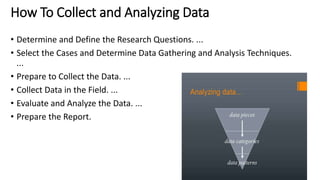
How To Collect and Analyzing Data
• Determine and Define the Research Questions. ...
• Select the Cases and Determine Data Gathering and Analysis Techniques.
...
• Prepare to Collect the Data. ...
• Collect Data in the Field. ...
• Evaluate and Analyze the Data. ...
• Prepare the Report.
Types of Case Studies
• Enterprise level case study
• Organization level case study
• Function level case study i.e. marketing, finance, production,
IT etc.
• Success Story
• Cases of Failures
• Cases regarding mergers and acquisitions
• Subject related case studies –Marketing, Finance, HR, etc.
Types Of Case Studies
• Illustrative case studies:-
These are primarily descriptive studies. They typically utilize one or two
instances of an event to show the existing situation. Illustrative case
studies serve primarily to make the unfamiliar familiar and to give
readers a common language about the topic in question.
• Exploratory (or pilot) case studies:-
These are condensed case studies performed before implementing a
large scale investigation. Their basic function is to help identify
questions and select types of measurement prior to the main
investigation. The primary pitfall of this type of study is that initial
findings may seem convincing enough to be released prematurely as
conclusions.
[Con…]
• Cumulative case studies:-
These serve to aggregate information from several sites collected at
different times. The idea behind these studies is the collection of past
studies will allow for greater generalization without additional cost or
time being expended on new, possibly repetitive studies.
• Critical instance case studies:-
These examine one or more sites for either the purpose of examining
a situation of unique interest with little to no interest in
generalization, or to call into question or challenge a highly
generalized or universal assertion. This method is useful for answering
cause and effect questions.
Observation
• The definition of an observation is the act of noticing
something or a judgment or inference from something seen
or experienced.
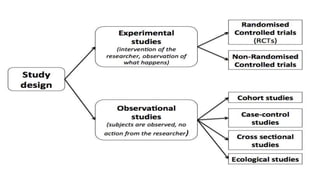
• In an observational study investigators observe subjects and
measure variables of interest without assigning treatments
to the subjects. The treatment that each subject receives is
determined beyond the control of the investigator.
Examples :-
•A principal watching a teacher give a lesson to her class in order
to judge her effectiveness as an educator
•A scientist looking at a chemical reaction in an experiment
•A doctor watching a patient after administering an injection
•A parent watching her children interact with other children on the
playground
•An astronomer looking at the night sky and recording data
regarding movement and brightness of the objects he sees
•A zoologist watching lions in a den after prey is introduced to
determine the swiftness of the animals' response
•Air flight controllers watching their monitors for airplane
movements and locations
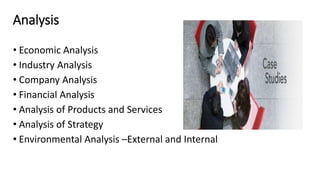
Analysis
• Economic Analysis
• Industry Analysis
• Company Analysis
• Financial Analysis
• Analysis of Products and Services
• Analysis of Strategy
• Environmental Analysis –External and Internal
CASE STUDIES ANALYSIS
• The role of participants.
• The network analysis of formal and informal exchanges
among groups.
• Historical.
• Thematical.
• Resources.
• Ritual and symbolism.
• Critical incidents that challenge or reinforce fundamental
beliefs, practices, and values.
Process of Case Analysis
• Reading the case
• Jotting down / underlining / highlighting the key facts,
figures, events, strategies, success or failures.
• Analyzing the economy and the various dimensions of
business environment
• Analyzing the Industry in which the company is operating
• Analyzing the various products and services.
Advantages of Case Study Method
• Advantages are millions..
To name a few..
-Develops strong reading skills
-Develops analytical skills
-Develops logical thinking
-Develops strategic planning skills
-Facilitates learning regarding analysis of impact of decisions
taken
-Facilitates enhanced domain learning experience
Advantages [Con…]
-Develops coherence in the thought processes
-Develops good communication skills
-Develops confidence and art of public speaking
-Develops all the skills and confidence that is required at the
time of summer and final placements
-Develops thinking, planning and implementation skills
Disadvantages
• It might be difficult to find an appropriate case study to suit
to all subjects.
• Case studies contain the study of observations and
perception of one person. There are chances that the person
presenting the case study may completely present it in one
manner missing other aspects completely.
• Managing time is a criterion in a training program. Case
studies generally consume more time when compared to
other instruments. For shorter duration programs case
studies may not be the best medium.
[Con…]
• Since there is no one right answer, the problem arises in
validation of the solutions because there are more than one
way to look at things.
• Its best suited to advanced training programs when
compared to basic level training programs and a certain level
of maturity of participants is required as they have to
participate in the case discussion.
CASE STUDY DESIGN
• What questions to study
• What data are relevant
• What data to collect
• How to analyze that data
• In other words, a research design is basically a blueprint for getting
from the beginning to the end of a study. The beginning is an initial
set of questions to be answered, and the end is some set of
conclusions about those questions.
DESIGN
• Multiple screenshots:-
While all design portfolios will include screenshots or images to
display the work.
• Client background information:-
The purpose of the case study is to put the design project, many
cases studies will include some basic information about the client,
what they do, and what they wanted from the designer.
• Project overviews:-
The project overview or description will allow visitors to the portfolio
to get some additional information about the project and may help
them to understand what was accomplished
[Con…]
• Listing of specific services provided:-
Many case studies will include the details of services that were
performed as part of the project by the designer or agency. This is
especially useful when multiple parties have worked together to
complete the end result.
• Dedicated page:-
Generally, but not always, when case studies are used there will
be a separate page on the portfolio site for each case study.
When case studies are not used, the “portfolio” or “work” page
of the site typically includes images for a number of projects with
links to larger versions of the image.
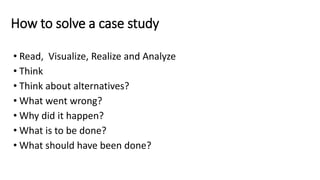
How to solve a case study
• Read, Visualize, Realize and Analyze
• Think
• Think about alternatives?
• What went wrong?
• Why did it happen?
• What is to be done?
• What should have been done?
[Con…]
• Focus on the various data, graph and events.
• Find out the major reasons of success /failure.
• Focus on different types of Analysis
• SWOT Analysis, PEST Analysis, Financial Analysis, Ratio
Analysis and any other.
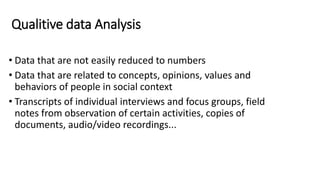
Qualitive data Analysis
• Data that are not easily reduced to numbers
• Data that are related to concepts, opinions, values and
behaviors of people in social context
• Transcripts of individual interviews and focus groups, field
notes from observation of certain activities, copies of
documents, audio/video recordings...
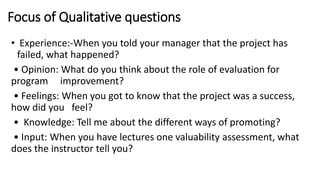
Focus of Qualitative questions
• Experience:-When you told your manager that the project has
failed, what happened?
• Opinion: What do you think about the role of evaluation for
program improvement?
• Feelings: When you got to know that the project was a success,
how did you feel?
• Knowledge: Tell me about the different ways of promoting?
• Input: When you have lectures one valuability assessment, what
does the instructor tell you?
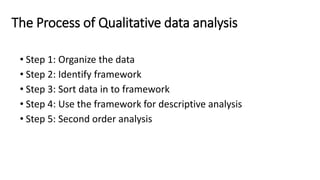
The Process of Qualitative data analysis
• Step 1: Organize the data
• Step 2: Identify framework
• Step 3: Sort data in to framework
• Step 4: Use the framework for descriptive analysis
• Step 5: Second order analysis
Quantitative analysis
• Quantitative analysis involves the techniques by
• which researchers convert data to numerical
• forms and subject them to statistical analyses.
• Involves techniques
• Involve task of converting data into knowledge
• Analysis comes at the end after all the data are collected
• Data have their own meaning.
Presentation of the case
• Make a good power point presentation
• Support it with graphs and charts
• Support it with statistical data and analysis
• Present the recommended ideas, and solutions and the
preferably the concept note and detailed action plan.
• Recommend the various functional strategies
• Recommend the precautions to be taken in the process of
implementation of your suggested solution
References
• What is Case Study:-
http://www.studygs.net/casestudy.htm
• Data collection:-
https://www.ischool.utexas.edu/~ssoy/usesusers/l391d1b.htm
http://examples.yourdictionary.com/examples-of-observation.html
Book:- Experimentation in software Engineering
http://link.springer.com/book/10.1007%2F978-3-642-29044-2
Case studies analysis:-
http://writing.colostate.edu/guides/page.cfm?pageid=1297&guideid=
60
Case studies

Case studies

  • 1.
  • 2.
    Case Studies • Aprocess or record of research in which detailed consideration is given to the development of a particular person, group, or situation over a period of time. • Case studies are in-depth studies of a phenomenon, like a person, group, or situation. The phenomenon is studied in detail, cases are analyzed and solutions or interpretations are presented. It can provide a deeper understanding of a complex topic or assist a person in gaining experience about a certain historical situation. Although case studies are used across a wide variety of disciplines, they are more frequently found in the social sciences.
  • 3.
    How: The processof developing a case study • Define the objective of the case study • Identify the important players within the organization, the stakeholders or those who have a vested interest in the outcomes • Identify other target groups of the organization, whether clients or suppliers • State the official mission of the organization studied • State the historical mission of the organization • State the understood mission of the stakeholders in the organization :
  • 4.
    [Con…] • Scale theimportance of stakeholders, whether in decision-making or effect of consequences • Outline the formal decision-making process • Note informal decision-making processes • Identify the process of production or service delivery • Identify support mechanisms • Identify competitors
  • 5.
    Data Collection • Documents. •Archival records. • Interviews. • Direct observation. • Participant observation. • Artifacts.
  • 6.
    How To Collectand Analyzing Data • Determine and Define the Research Questions. ... • Select the Cases and Determine Data Gathering and Analysis Techniques. ... • Prepare to Collect the Data. ... • Collect Data in the Field. ... • Evaluate and Analyze the Data. ... • Prepare the Report.
  • 7.
    Types of CaseStudies • Enterprise level case study • Organization level case study • Function level case study i.e. marketing, finance, production, IT etc. • Success Story • Cases of Failures • Cases regarding mergers and acquisitions • Subject related case studies –Marketing, Finance, HR, etc.
  • 8.
    Types Of CaseStudies • Illustrative case studies:- These are primarily descriptive studies. They typically utilize one or two instances of an event to show the existing situation. Illustrative case studies serve primarily to make the unfamiliar familiar and to give readers a common language about the topic in question. • Exploratory (or pilot) case studies:- These are condensed case studies performed before implementing a large scale investigation. Their basic function is to help identify questions and select types of measurement prior to the main investigation. The primary pitfall of this type of study is that initial findings may seem convincing enough to be released prematurely as conclusions.
  • 9.
    [Con…] • Cumulative casestudies:- These serve to aggregate information from several sites collected at different times. The idea behind these studies is the collection of past studies will allow for greater generalization without additional cost or time being expended on new, possibly repetitive studies. • Critical instance case studies:- These examine one or more sites for either the purpose of examining a situation of unique interest with little to no interest in generalization, or to call into question or challenge a highly generalized or universal assertion. This method is useful for answering cause and effect questions.
  • 10.
    Observation • The definitionof an observation is the act of noticing something or a judgment or inference from something seen or experienced. • In an observational study investigators observe subjects and measure variables of interest without assigning treatments to the subjects. The treatment that each subject receives is determined beyond the control of the investigator.
  • 12.
    Examples :- •A principalwatching a teacher give a lesson to her class in order to judge her effectiveness as an educator •A scientist looking at a chemical reaction in an experiment •A doctor watching a patient after administering an injection •A parent watching her children interact with other children on the playground •An astronomer looking at the night sky and recording data regarding movement and brightness of the objects he sees •A zoologist watching lions in a den after prey is introduced to determine the swiftness of the animals' response •Air flight controllers watching their monitors for airplane movements and locations
  • 13.
    Analysis • Economic Analysis •Industry Analysis • Company Analysis • Financial Analysis • Analysis of Products and Services • Analysis of Strategy • Environmental Analysis –External and Internal
  • 14.
    CASE STUDIES ANALYSIS •The role of participants. • The network analysis of formal and informal exchanges among groups. • Historical. • Thematical. • Resources. • Ritual and symbolism. • Critical incidents that challenge or reinforce fundamental beliefs, practices, and values.
  • 15.
    Process of CaseAnalysis • Reading the case • Jotting down / underlining / highlighting the key facts, figures, events, strategies, success or failures. • Analyzing the economy and the various dimensions of business environment • Analyzing the Industry in which the company is operating • Analyzing the various products and services.
  • 16.
    Advantages of CaseStudy Method • Advantages are millions.. To name a few.. -Develops strong reading skills -Develops analytical skills -Develops logical thinking -Develops strategic planning skills -Facilitates learning regarding analysis of impact of decisions taken -Facilitates enhanced domain learning experience
  • 17.
    Advantages [Con…] -Develops coherencein the thought processes -Develops good communication skills -Develops confidence and art of public speaking -Develops all the skills and confidence that is required at the time of summer and final placements -Develops thinking, planning and implementation skills
  • 18.
    Disadvantages • It mightbe difficult to find an appropriate case study to suit to all subjects. • Case studies contain the study of observations and perception of one person. There are chances that the person presenting the case study may completely present it in one manner missing other aspects completely. • Managing time is a criterion in a training program. Case studies generally consume more time when compared to other instruments. For shorter duration programs case studies may not be the best medium.
  • 19.
    [Con…] • Since thereis no one right answer, the problem arises in validation of the solutions because there are more than one way to look at things. • Its best suited to advanced training programs when compared to basic level training programs and a certain level of maturity of participants is required as they have to participate in the case discussion.
  • 21.
    CASE STUDY DESIGN •What questions to study • What data are relevant • What data to collect • How to analyze that data • In other words, a research design is basically a blueprint for getting from the beginning to the end of a study. The beginning is an initial set of questions to be answered, and the end is some set of conclusions about those questions.
  • 22.
    DESIGN • Multiple screenshots:- Whileall design portfolios will include screenshots or images to display the work. • Client background information:- The purpose of the case study is to put the design project, many cases studies will include some basic information about the client, what they do, and what they wanted from the designer. • Project overviews:- The project overview or description will allow visitors to the portfolio to get some additional information about the project and may help them to understand what was accomplished
  • 23.
    [Con…] • Listing ofspecific services provided:- Many case studies will include the details of services that were performed as part of the project by the designer or agency. This is especially useful when multiple parties have worked together to complete the end result. • Dedicated page:- Generally, but not always, when case studies are used there will be a separate page on the portfolio site for each case study. When case studies are not used, the “portfolio” or “work” page of the site typically includes images for a number of projects with links to larger versions of the image.
  • 24.
    How to solvea case study • Read, Visualize, Realize and Analyze • Think • Think about alternatives? • What went wrong? • Why did it happen? • What is to be done? • What should have been done?
  • 25.
    [Con…] • Focus onthe various data, graph and events. • Find out the major reasons of success /failure. • Focus on different types of Analysis • SWOT Analysis, PEST Analysis, Financial Analysis, Ratio Analysis and any other.
  • 26.
    Qualitive data Analysis •Data that are not easily reduced to numbers • Data that are related to concepts, opinions, values and behaviors of people in social context • Transcripts of individual interviews and focus groups, field notes from observation of certain activities, copies of documents, audio/video recordings...
  • 27.
    Focus of Qualitativequestions • Experience:-When you told your manager that the project has failed, what happened? • Opinion: What do you think about the role of evaluation for program improvement? • Feelings: When you got to know that the project was a success, how did you feel? • Knowledge: Tell me about the different ways of promoting? • Input: When you have lectures one valuability assessment, what does the instructor tell you?
  • 28.
    The Process ofQualitative data analysis • Step 1: Organize the data • Step 2: Identify framework • Step 3: Sort data in to framework • Step 4: Use the framework for descriptive analysis • Step 5: Second order analysis
  • 29.
    Quantitative analysis • Quantitativeanalysis involves the techniques by • which researchers convert data to numerical • forms and subject them to statistical analyses. • Involves techniques • Involve task of converting data into knowledge • Analysis comes at the end after all the data are collected • Data have their own meaning.
  • 30.
    Presentation of thecase • Make a good power point presentation • Support it with graphs and charts • Support it with statistical data and analysis • Present the recommended ideas, and solutions and the preferably the concept note and detailed action plan. • Recommend the various functional strategies • Recommend the precautions to be taken in the process of implementation of your suggested solution
  • 31.
    References • What isCase Study:- http://www.studygs.net/casestudy.htm • Data collection:- https://www.ischool.utexas.edu/~ssoy/usesusers/l391d1b.htm http://examples.yourdictionary.com/examples-of-observation.html Book:- Experimentation in software Engineering http://link.springer.com/book/10.1007%2F978-3-642-29044-2 Case studies analysis:- http://writing.colostate.edu/guides/page.cfm?pageid=1297&guideid= 60