Verbal Communication
LECTURE
There were these three men
The first man walked into a bar
The second man walked into a bar
The third man didn’t
He ducked!
Focus Questions
• What are the differences between grammatical
language and talk in everyday use?
• What frames your understanding of talk and gives it
meaning?
• What values are hidden in the speech you use?
• How does everyday talk use relationships to frame
meanings?
• How do different types of talk work, and how do they
connect to relationships?
• What is talk style and how does it frame meaning?
Understanding Meanings
• Relationships frame the meaning of talk
– Langue – formal, grammatically structured
language use
– Parole – informal, everyday use of talk (includes
familiarity, context, and cultural assumptions)
Understanding Meanings
• What do we call what’s happening in this
next clip?
Polysemy
• Multiple meanings for the same symbol
• A feature of all communication
• Meanings are constantly changing, creating
ambiguity and uncertainty
• Frames give “clues” to meaning
Language Creates Frames
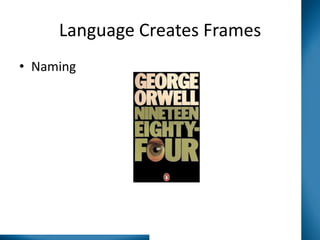
• Naming
– Arbitrary
– Natural
– Makes crucial distinctions
– Sapir-Whorf Hypothesis
• We can only know what we can name.
Language Creates Frames
• Naming
Language Creates Frames
• Naming

•

DEUTSCHER, G. (2010). Through the language glass: why the world looks
different in other languages. New York, Metropolitan Books/Henry Holt and
Co.
Types of Verbal Meanings
• Denotative – use of talk to identify or define
objects
• Connotative – use of talk to establish and
understand the implications and deeper
meanings of words
Intentionality Frame
• Intentionality – the belief that messages
indicate a sender’s purposeful intentions
• Relationships help us understand intentions
based on our personal knowledge of others
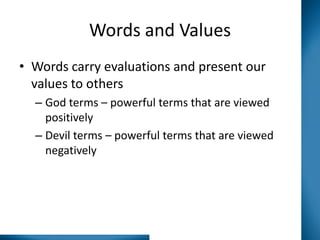
Words and Values
• Words carry evaluations and present our
values to others
– God terms – powerful terms that are viewed
positively
– Devil terms – powerful terms that are viewed
negatively
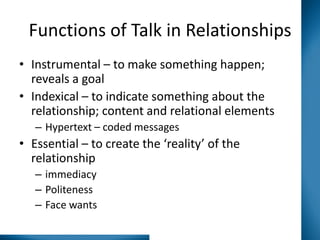
Functions of Talk in Relationships
• Instrumental – to make something happen;
reveals a goal
• Indexical – to indicate something about the
relationship; content and relational elements
– Hypertext – coded messages

• Essential – to create the ‘reality’ of the
relationship
– immediacy
– Politeness
– Face wants
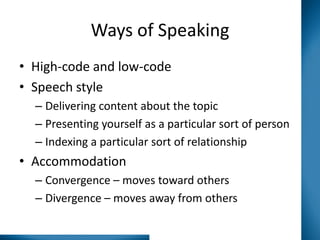
Ways of Speaking
• High-code and low-code
• Speech style
– Delivering content about the topic
– Presenting yourself as a particular sort of person
– Indexing a particular sort of relationship

• Accommodation
– Convergence – moves toward others
– Divergence – moves away from others
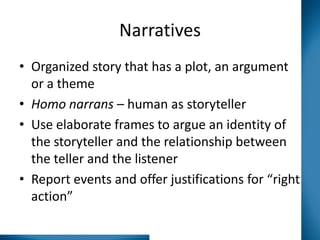
Narratives
• Organized story that has a plot, an argument
or a theme
• Homo narrans – human as storyteller
• Use elaborate frames to argue an identity of
the storyteller and the relationship between
the teller and the listener
• Report events and offer justifications for “right
action”
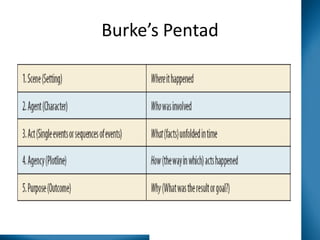
Burke’s Pentad

Verbal communication

  • 1.
  • 2.
    There were thesethree men The first man walked into a bar The second man walked into a bar The third man didn’t He ducked!
  • 3.
    Focus Questions • Whatare the differences between grammatical language and talk in everyday use? • What frames your understanding of talk and gives it meaning? • What values are hidden in the speech you use? • How does everyday talk use relationships to frame meanings? • How do different types of talk work, and how do they connect to relationships? • What is talk style and how does it frame meaning?
  • 4.
    Understanding Meanings • Relationshipsframe the meaning of talk – Langue – formal, grammatically structured language use – Parole – informal, everyday use of talk (includes familiarity, context, and cultural assumptions)
  • 5.
    Understanding Meanings • Whatdo we call what’s happening in this next clip?
  • 6.
    Polysemy • Multiple meaningsfor the same symbol • A feature of all communication • Meanings are constantly changing, creating ambiguity and uncertainty • Frames give “clues” to meaning
  • 7.
    Language Creates Frames •Naming – Arbitrary – Natural – Makes crucial distinctions – Sapir-Whorf Hypothesis • We can only know what we can name.
  • 8.
  • 9.
    Language Creates Frames •Naming • DEUTSCHER, G. (2010). Through the language glass: why the world looks different in other languages. New York, Metropolitan Books/Henry Holt and Co.
  • 10.
    Types of VerbalMeanings • Denotative – use of talk to identify or define objects • Connotative – use of talk to establish and understand the implications and deeper meanings of words
  • 11.
    Intentionality Frame • Intentionality– the belief that messages indicate a sender’s purposeful intentions • Relationships help us understand intentions based on our personal knowledge of others
  • 12.
    Words and Values •Words carry evaluations and present our values to others – God terms – powerful terms that are viewed positively – Devil terms – powerful terms that are viewed negatively
  • 13.
    Functions of Talkin Relationships • Instrumental – to make something happen; reveals a goal • Indexical – to indicate something about the relationship; content and relational elements – Hypertext – coded messages • Essential – to create the ‘reality’ of the relationship – immediacy – Politeness – Face wants
  • 14.
    Ways of Speaking •High-code and low-code • Speech style – Delivering content about the topic – Presenting yourself as a particular sort of person – Indexing a particular sort of relationship • Accommodation – Convergence – moves toward others – Divergence – moves away from others
  • 15.
    Narratives • Organized storythat has a plot, an argument or a theme • Homo narrans – human as storyteller • Use elaborate frames to argue an identity of the storyteller and the relationship between the teller and the listener • Report events and offer justifications for “right action”
  • 16.

Editor's Notes

  • #16 Occurs within, and serves to create a set of assumptions about the culture and what works within it justice, responsibility and free will the speaker’s personality and characteraudience characteristics