Case study on Steel
Structure
Submitted By –
SHRIKANT
B.ARCH
Content
• WHAT IS STEEL STRUCTURE?
• ELEMENTS OS STEEL STRUCTURE.
• REASONS WHY STEEL STRUCTURE IS BEST TO CHOICE?
• TYPES OF STRUCTURES
• CASE STUDY
• HEARTH TOWER, MANHATTAN,NYC.
• ST. MARY AXE (THE GHERKIN).
• LIC JEEWAN BHARTI (SPACE FRAME).
WHAT IS STEEL STRUCTURE?
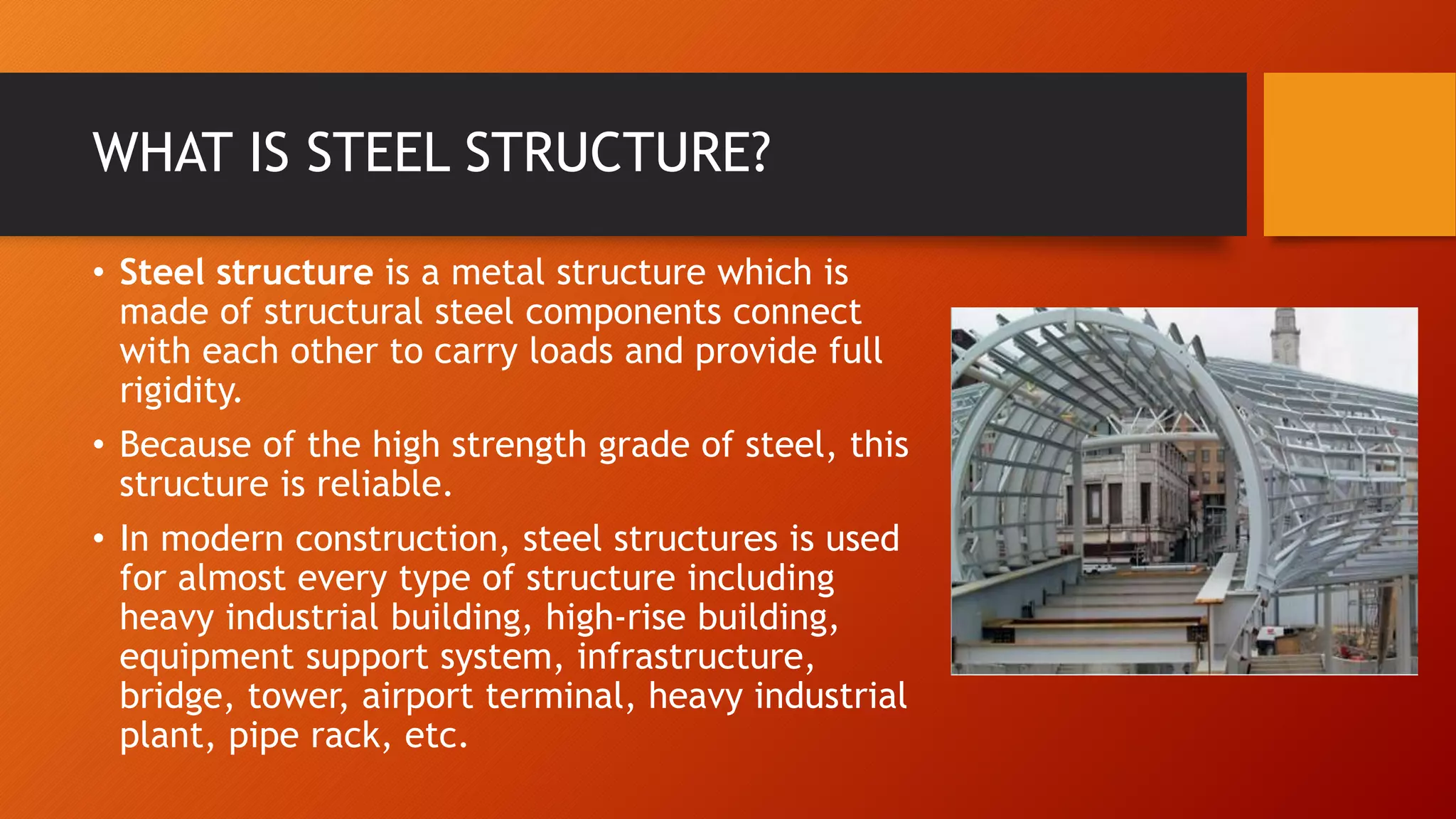
• Steel structure is a metal structure which is
made of structural steel components connect
with each other to carry loads and provide full
rigidity.
• Because of the high strength grade of steel, this
structure is reliable.
• In modern construction, steel structures is used
for almost every type of structure including
heavy industrial building, high-rise building,
equipment support system, infrastructure,
bridge, tower, airport terminal, heavy industrial
plant, pipe rack, etc.
ELEMENTS OS STEEL STRUCTURE.
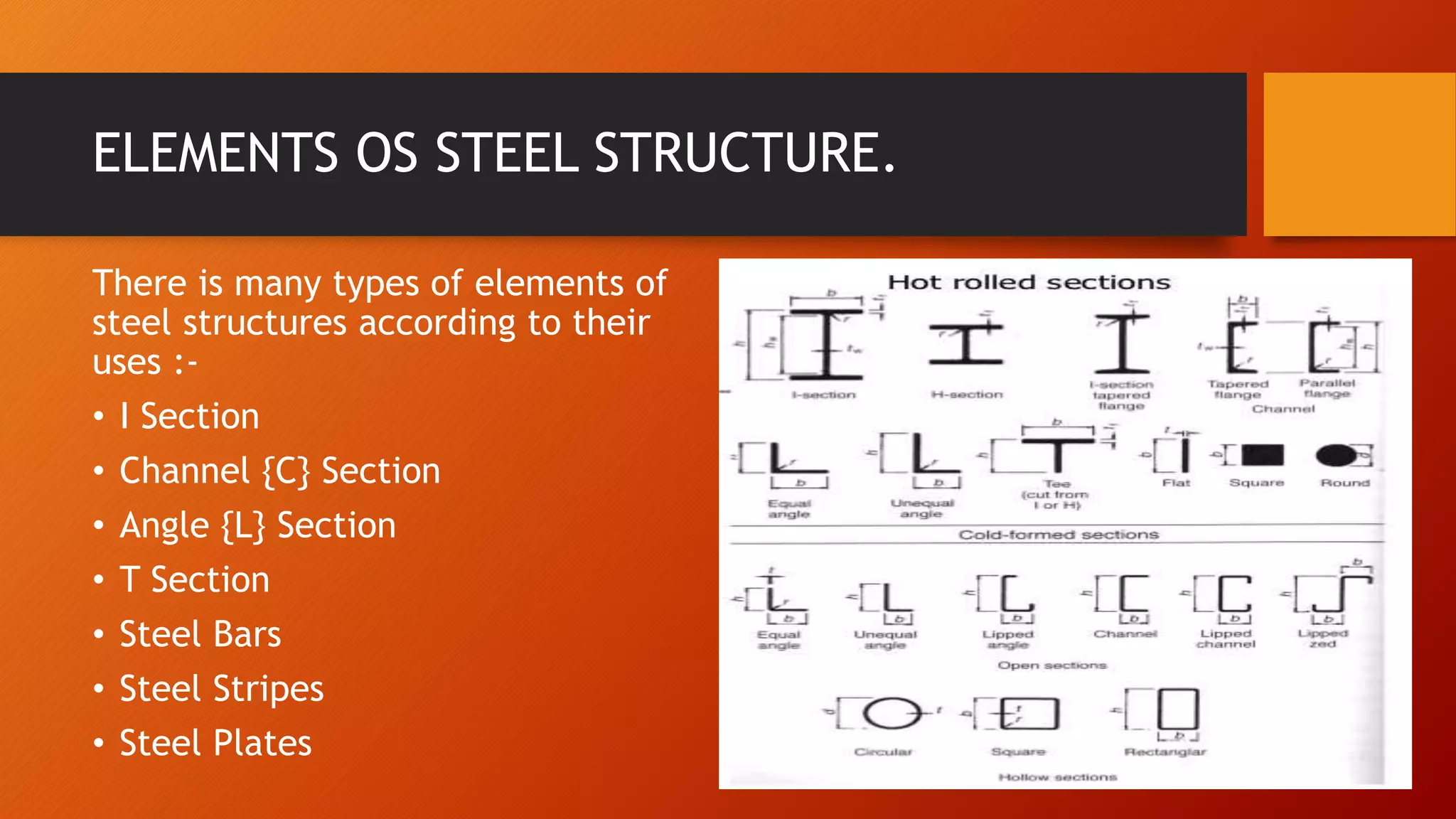
There is many types of elements of
steel structures according to their
uses :-
• I Section
• Channel {C} Section
• Angle {L} Section
• T Section
• Steel Bars
• Steel Stripes
• Steel Plates
REASONS WHY STEEL STRUCTURE IS BEST TO
CHOICE?
1. Cost savings
Steel structure is the cost leader for most projects in materials and design. It is inexpensive to
manufacture and erection, requires less maintenance than other traditional building methods.
2. Creativity
Steel has a natural beauty that most architects can’t wait to take advantage of. Steel allows for
long column-free spans and you can have a lot of natural light if you want it in any shape of
structures.
3. Control and Management
Steel structures is fabricated at factory and rapidly erected at construction site by skilled
personnel that makes safe construction process. Industry surveys consistently demonstrate that
steel structures is the optimal solution in management.
4. Durability
It can withstand extreme forces or harsh weather conditions, such as strong winds, earthquakes,
hurricanes and heavy snow. They are also unreceptive to rust and, unlike wood frames, they are
not affected by termites, bugs, mildew, mold and fungi.
TYPES OF STRUCTURES
1.Braced Frame
2.Rigid FrameStructure (MDF TOWER , PETRONAS TOWER)
3.Infilled FrameStructure (EMPIRE STATE BUILDING)
4.Flat Plate and Flat SlabStructure (BANCO DE BILBAU)
5.Shear wall structure (TRUMP INTERNATIONAL HOTEL AND TOWER)
6.Wall-frame structure (MAJESTIC BUILDING)
7.The trussed tube (HANCOCK TOWER BUILDING)
8.Core and Outtriggersystem (PETRONAS TWIN TOWER)
9.Hybrid structure (OVERSEAS UNION BANK CENTER)
CASE STUDY
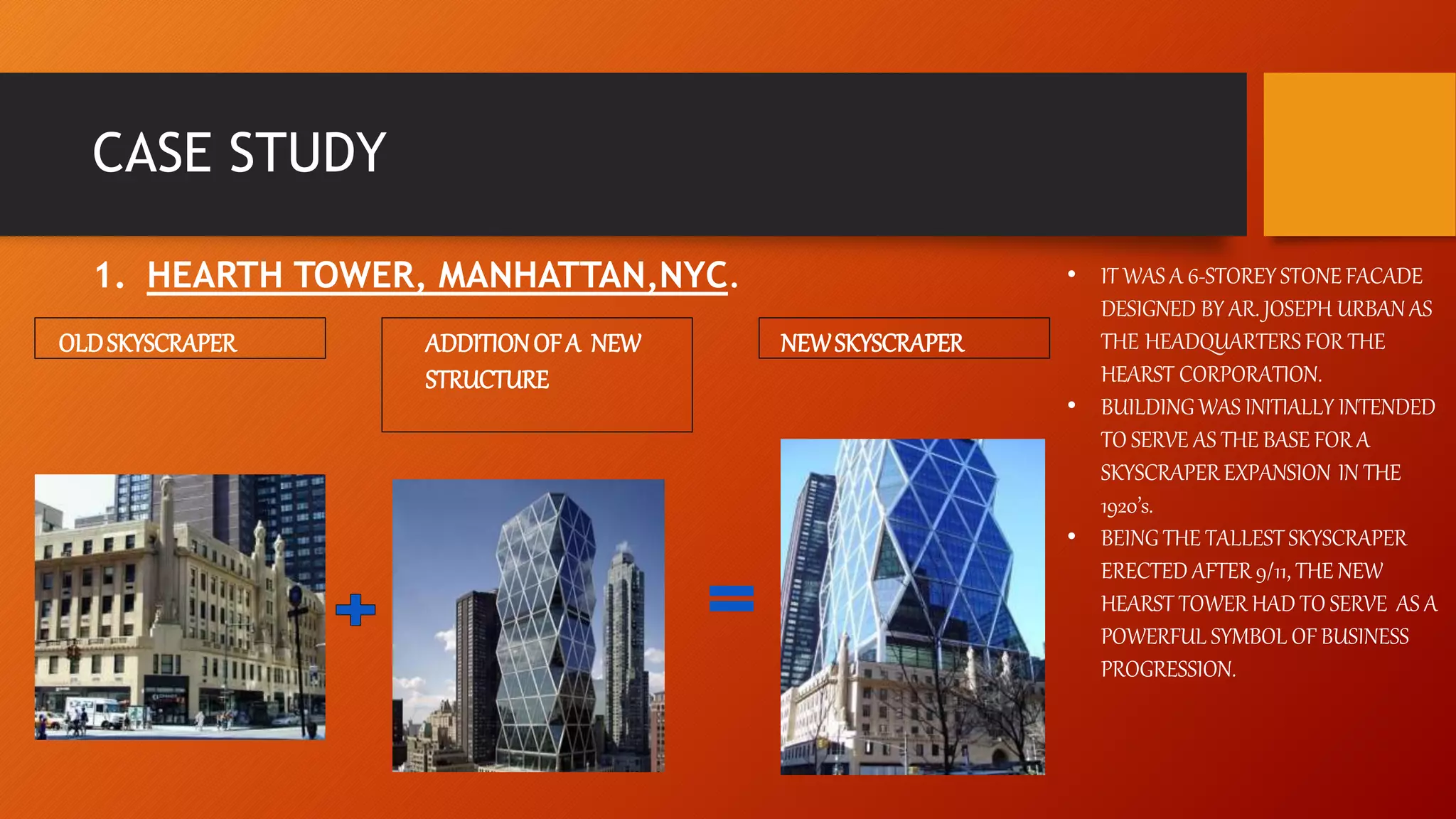
1. HEARTH TOWER, MANHATTAN,NYC.
OLDSKYSCRAPER ADDITIONOFA NEW
STRUCTURE
NEWSKYSCRAPER
• IT WAS A 6-STOREYSTONE FACADE
DESIGNED BY AR. JOSEPH URBAN AS
THE HEADQUARTERS FOR THE
HEARST CORPORATION.
• BUILDINGWAS INITIALLY INTENDED
TO SERVE AS THE BASE FOR A
SKYSCRAPER EXPANSION IN THE
1920’s.
• BEING THE TALLESTSKYSCRAPER
ERECTED AFTER 9/11, THE NEW
HEARST TOWER HAD TO SERVE AS A
POWERFUL SYMBOL OF BUSINESS
PROGRESSION.
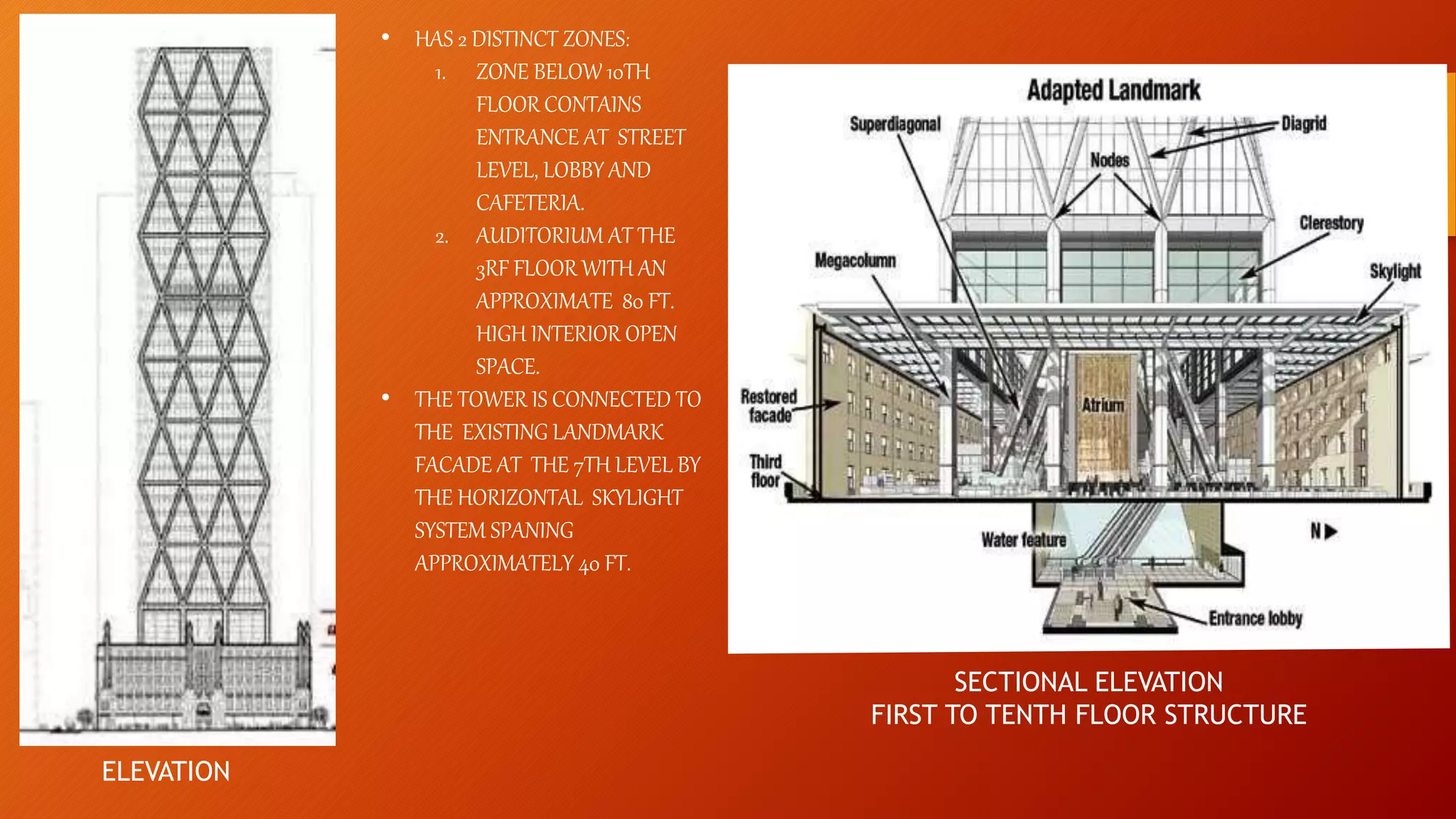
ELEVATION
• HAS 2 DISTINCT ZONES:
1. ZONE BELOW 10TH
FLOOR CONTAINS
ENTRANCE AT STREET
LEVEL, LOBBY AND
CAFETERIA.
2. AUDITORIUM AT THE
3RF FLOOR WITH AN
APPROXIMATE 80 FT.
HIGH INTERIOR OPEN
SPACE.
• THE TOWER IS CONNECTED TO
THE EXISTING LANDMARK
FACADE AT THE 7TH LEVEL BY
THE HORIZONTAL SKYLIGHT
SYSTEM SPANING
APPROXIMATELY 40 FT.
SECTIONAL ELEVATION
FIRST TO TENTH FLOOR STRUCTURE
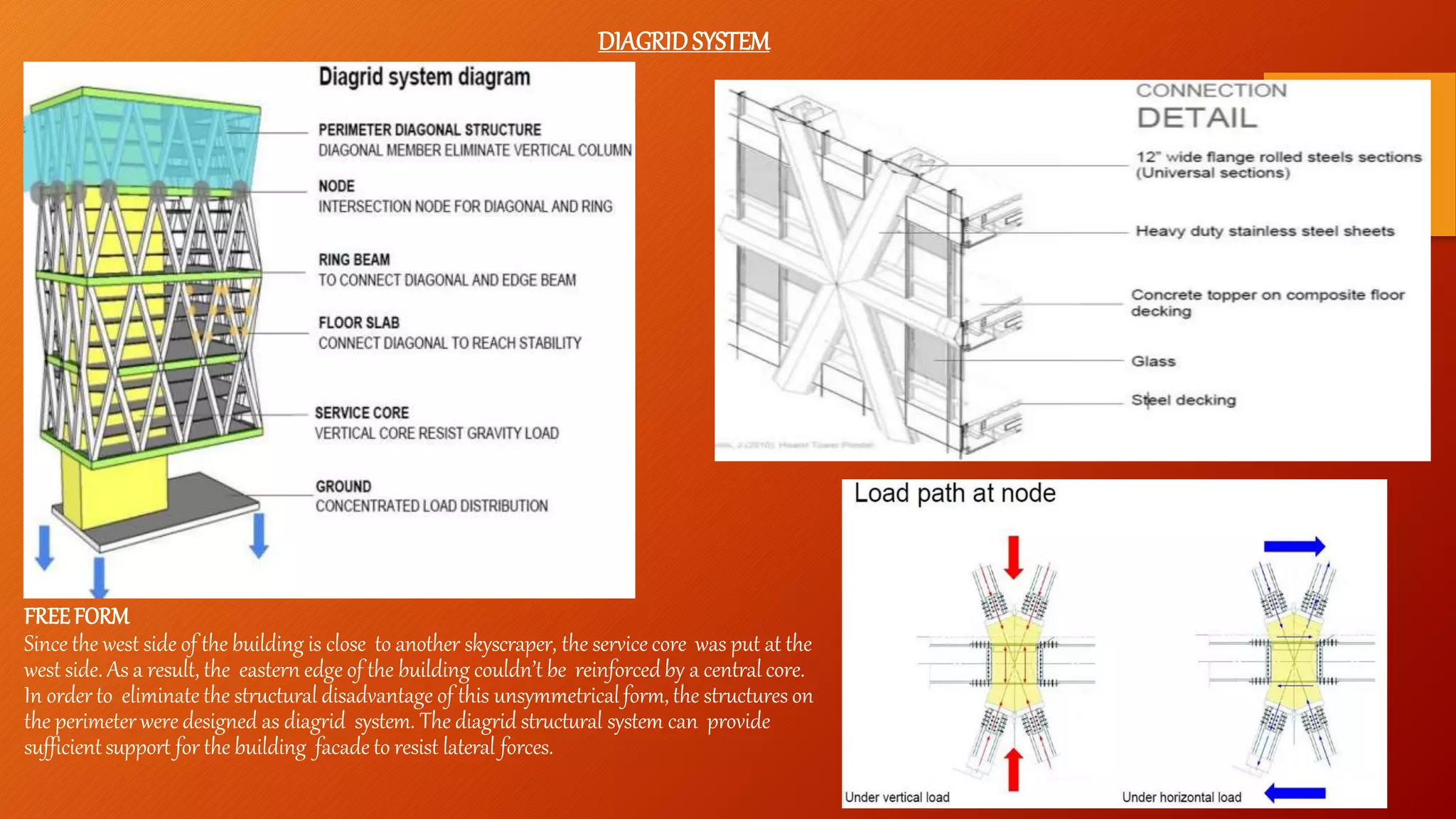
DIAGRIDSYSTEM
FREEFORM
Since the west side of the building is close to another skyscraper, the service core was put at the
west side. As a result, the eastern edge of the building couldn’t be reinforcedby a central core.
In orderto eliminate the structural disadvantage of this unsymmetricalform,the structures on
the perimeterwere designed as diagrid system. The diagrid structural system can provide
sufficientsupport for the building facade to resist lateral forces.
2. ST MARY AXE (THE GHERKIN)
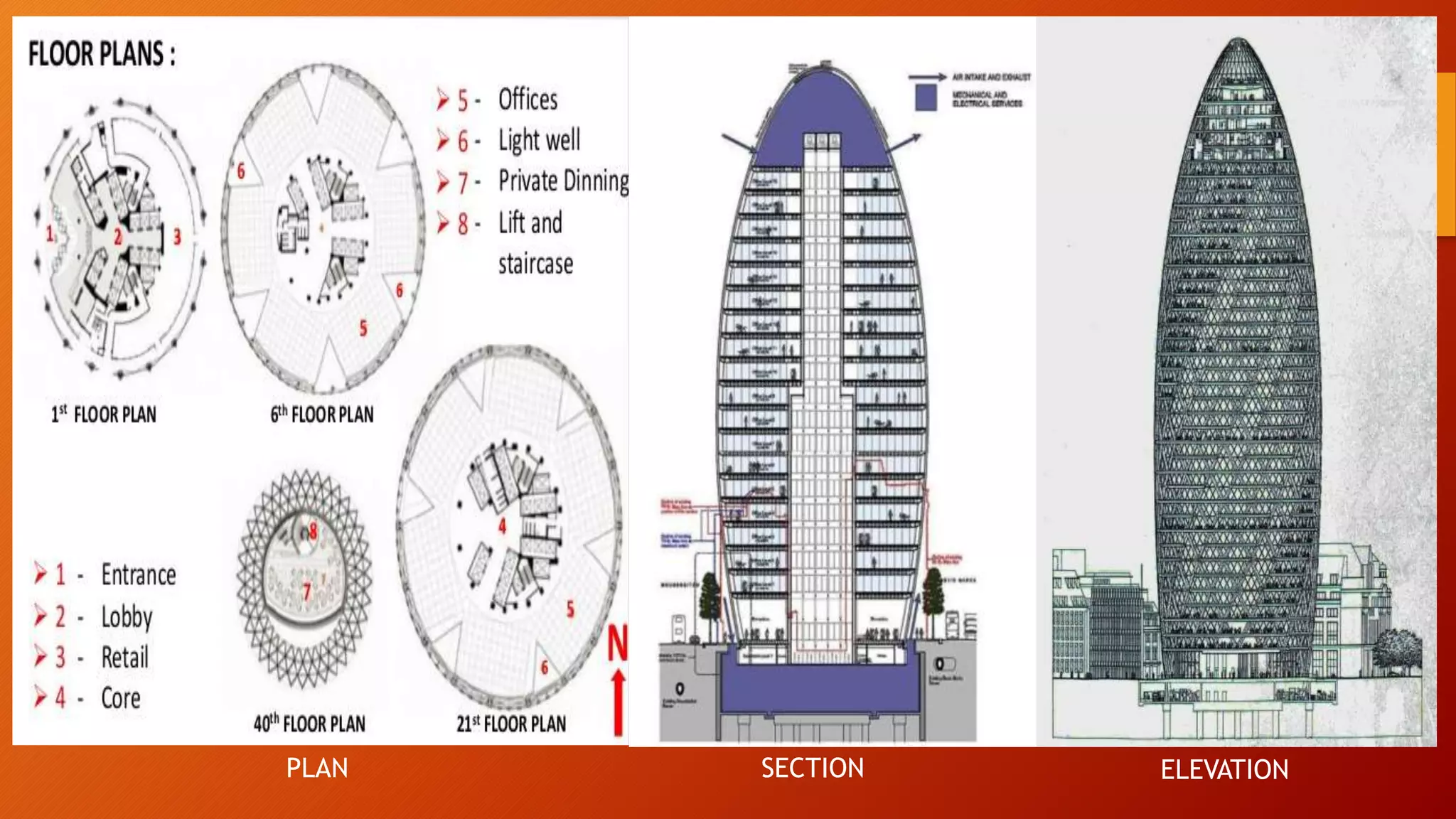
 30 St Mary Axe, better known as the Gherkin because is floor plan resembleda sliced pickle.
 Flexible and environmentally sound office space in London.
 London’s first ecological green tall building. It is the second highest building in the City of London.
 The site of the 30 St Mary Axe building lies at the heart of the City.
 Floors: 41.Floors Height: 180 meters
 Estimated actual area : 516,100 sq. ft.
 The Gherkin is elongated, curved, shaft with a rounded.
 It is covered uniformlyaround the outside with glass panels and is rounded off at the corners.It has a lens-like dome at
the top that serves as a type of observation deck.
 Sitecontext –
1. Highest design quality that would makea realcontribution
to the urban environment of the City,
2. limitation of time
3. Trafficlimited accessibility
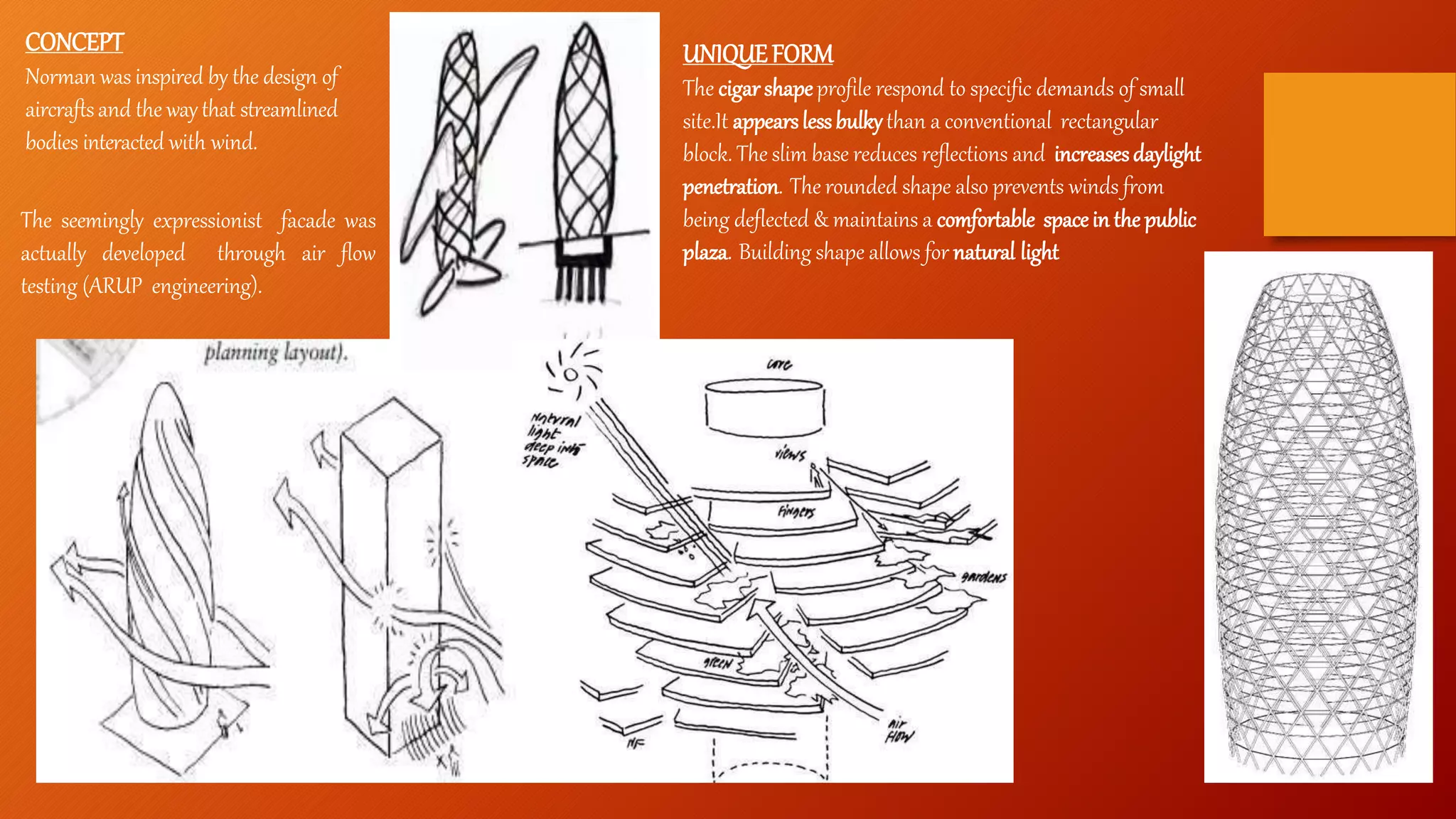
CONCEPT
Norman was inspired by the design of
aircraftsand the waythat streamlined
bodies interacted with wind.
The seemingly expressionist facade was
actually developed through air flow
testing (ARUP engineering).
UNIQUEFORM
The cigar shapeprofile respond to specific demands of small
site.It appearslessbulkythan a conventional rectangular
block. The slim base reduces reflections and increasesdaylight
penetration. The rounded shape also prevents winds from
being deflected & maintains a comfortable spacein the public
plaza. Building shape allows for natural light
SUSTAINABILITYANDVENTILATION
Differing air pressures and double skin façade allow for natural ventilation. Six
spiraling light wells allow daylight to flood down onto the floors. Windows open
when external temperature is between 20°C and 26°C and wind speed is less
than 10 mph. Window and blinds are computer controlled. Solar blindsto
reclaimor reject heat.
CIRCULATION
Each of the two main stairwells contains 1,037 stairs.
The 23 lifts vary in velocity from 1 meter per second to 6
metersper second.
PLAN SECTION ELEVATION
3. L.I.C. JEEWAN BHARTI
• Architect - Charles
Marks Correa
• Structural Consultant -
Mahendra Raj
• It acts as a pivot
between the colonnades
of Connaught Place and
the new generation of
high-rise towers that
now surround it.
• Commercial building
with two 13 floors tower
springing out of three
level base.
SPACE FRAME
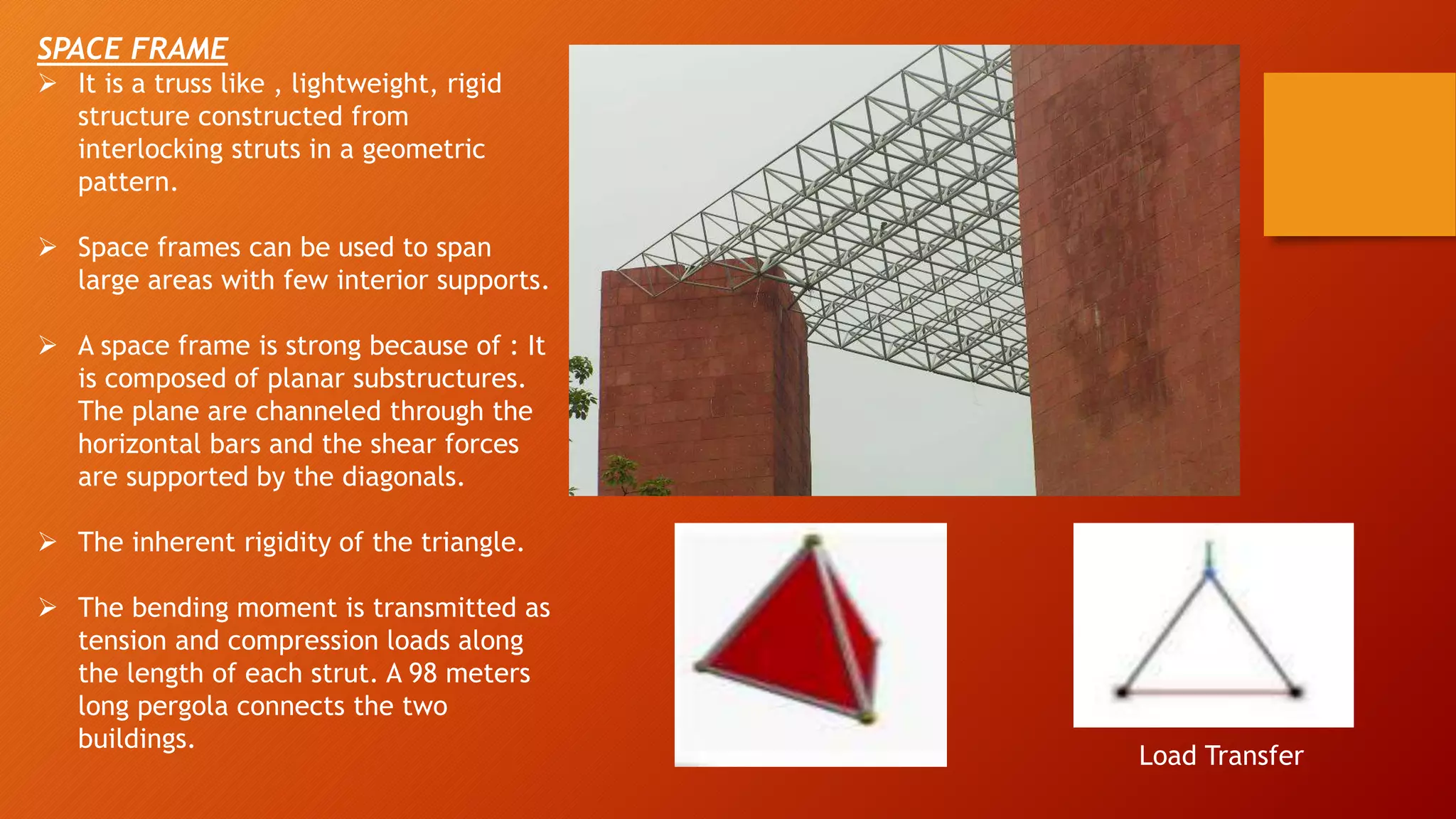
 It is a truss like , lightweight, rigid
structure constructed from
interlocking struts in a geometric
pattern.
 Space frames can be used to span
large areas with few interior supports.
 A space frame is strong because of : It
is composed of planar substructures.
The plane are channeled through the
horizontal bars and the shear forces
are supported by the diagonals.
 The inherent rigidity of the triangle.
 The bending moment is transmitted as
tension and compression loads along
the length of each strut. A 98 meters
long pergola connects the two
buildings.
Load Transfer
Dimensions
Length of the member in space frame =1500mm
Since, h= ½. a . 0.414
= 0.707a
= 0.707 X 1500mm ( a=1500mm )
= 1060mm
Member Length = 1500mm
Height of the Space Frame =1060mm
THANK YOU

Case study on steel structure Shrikant

  • 1.
    Case study onSteel Structure Submitted By – SHRIKANT B.ARCH
  • 2.
    Content • WHAT ISSTEEL STRUCTURE? • ELEMENTS OS STEEL STRUCTURE. • REASONS WHY STEEL STRUCTURE IS BEST TO CHOICE? • TYPES OF STRUCTURES • CASE STUDY • HEARTH TOWER, MANHATTAN,NYC. • ST. MARY AXE (THE GHERKIN). • LIC JEEWAN BHARTI (SPACE FRAME).
  • 3.
    WHAT IS STEELSTRUCTURE? • Steel structure is a metal structure which is made of structural steel components connect with each other to carry loads and provide full rigidity. • Because of the high strength grade of steel, this structure is reliable. • In modern construction, steel structures is used for almost every type of structure including heavy industrial building, high-rise building, equipment support system, infrastructure, bridge, tower, airport terminal, heavy industrial plant, pipe rack, etc.
  • 4.
    ELEMENTS OS STEELSTRUCTURE. There is many types of elements of steel structures according to their uses :- • I Section • Channel {C} Section • Angle {L} Section • T Section • Steel Bars • Steel Stripes • Steel Plates
  • 5.
    REASONS WHY STEELSTRUCTURE IS BEST TO CHOICE? 1. Cost savings Steel structure is the cost leader for most projects in materials and design. It is inexpensive to manufacture and erection, requires less maintenance than other traditional building methods. 2. Creativity Steel has a natural beauty that most architects can’t wait to take advantage of. Steel allows for long column-free spans and you can have a lot of natural light if you want it in any shape of structures. 3. Control and Management Steel structures is fabricated at factory and rapidly erected at construction site by skilled personnel that makes safe construction process. Industry surveys consistently demonstrate that steel structures is the optimal solution in management. 4. Durability It can withstand extreme forces or harsh weather conditions, such as strong winds, earthquakes, hurricanes and heavy snow. They are also unreceptive to rust and, unlike wood frames, they are not affected by termites, bugs, mildew, mold and fungi.
  • 6.
    TYPES OF STRUCTURES 1.BracedFrame 2.Rigid FrameStructure (MDF TOWER , PETRONAS TOWER) 3.Infilled FrameStructure (EMPIRE STATE BUILDING) 4.Flat Plate and Flat SlabStructure (BANCO DE BILBAU) 5.Shear wall structure (TRUMP INTERNATIONAL HOTEL AND TOWER) 6.Wall-frame structure (MAJESTIC BUILDING) 7.The trussed tube (HANCOCK TOWER BUILDING) 8.Core and Outtriggersystem (PETRONAS TWIN TOWER) 9.Hybrid structure (OVERSEAS UNION BANK CENTER)
  • 7.
    CASE STUDY 1. HEARTHTOWER, MANHATTAN,NYC. OLDSKYSCRAPER ADDITIONOFA NEW STRUCTURE NEWSKYSCRAPER • IT WAS A 6-STOREYSTONE FACADE DESIGNED BY AR. JOSEPH URBAN AS THE HEADQUARTERS FOR THE HEARST CORPORATION. • BUILDINGWAS INITIALLY INTENDED TO SERVE AS THE BASE FOR A SKYSCRAPER EXPANSION IN THE 1920’s. • BEING THE TALLESTSKYSCRAPER ERECTED AFTER 9/11, THE NEW HEARST TOWER HAD TO SERVE AS A POWERFUL SYMBOL OF BUSINESS PROGRESSION.
  • 8.
    ELEVATION • HAS 2DISTINCT ZONES: 1. ZONE BELOW 10TH FLOOR CONTAINS ENTRANCE AT STREET LEVEL, LOBBY AND CAFETERIA. 2. AUDITORIUM AT THE 3RF FLOOR WITH AN APPROXIMATE 80 FT. HIGH INTERIOR OPEN SPACE. • THE TOWER IS CONNECTED TO THE EXISTING LANDMARK FACADE AT THE 7TH LEVEL BY THE HORIZONTAL SKYLIGHT SYSTEM SPANING APPROXIMATELY 40 FT. SECTIONAL ELEVATION FIRST TO TENTH FLOOR STRUCTURE
  • 9.
    DIAGRIDSYSTEM FREEFORM Since the westside of the building is close to another skyscraper, the service core was put at the west side. As a result, the eastern edge of the building couldn’t be reinforcedby a central core. In orderto eliminate the structural disadvantage of this unsymmetricalform,the structures on the perimeterwere designed as diagrid system. The diagrid structural system can provide sufficientsupport for the building facade to resist lateral forces.
  • 10.
    2. ST MARYAXE (THE GHERKIN)  30 St Mary Axe, better known as the Gherkin because is floor plan resembleda sliced pickle.  Flexible and environmentally sound office space in London.  London’s first ecological green tall building. It is the second highest building in the City of London.  The site of the 30 St Mary Axe building lies at the heart of the City.  Floors: 41.Floors Height: 180 meters  Estimated actual area : 516,100 sq. ft.  The Gherkin is elongated, curved, shaft with a rounded.  It is covered uniformlyaround the outside with glass panels and is rounded off at the corners.It has a lens-like dome at the top that serves as a type of observation deck.  Sitecontext – 1. Highest design quality that would makea realcontribution to the urban environment of the City, 2. limitation of time 3. Trafficlimited accessibility
  • 11.
    CONCEPT Norman was inspiredby the design of aircraftsand the waythat streamlined bodies interacted with wind. The seemingly expressionist facade was actually developed through air flow testing (ARUP engineering). UNIQUEFORM The cigar shapeprofile respond to specific demands of small site.It appearslessbulkythan a conventional rectangular block. The slim base reduces reflections and increasesdaylight penetration. The rounded shape also prevents winds from being deflected & maintains a comfortable spacein the public plaza. Building shape allows for natural light
  • 12.
    SUSTAINABILITYANDVENTILATION Differing air pressuresand double skin façade allow for natural ventilation. Six spiraling light wells allow daylight to flood down onto the floors. Windows open when external temperature is between 20°C and 26°C and wind speed is less than 10 mph. Window and blinds are computer controlled. Solar blindsto reclaimor reject heat. CIRCULATION Each of the two main stairwells contains 1,037 stairs. The 23 lifts vary in velocity from 1 meter per second to 6 metersper second.
  • 13.
  • 14.
    3. L.I.C. JEEWANBHARTI • Architect - Charles Marks Correa • Structural Consultant - Mahendra Raj • It acts as a pivot between the colonnades of Connaught Place and the new generation of high-rise towers that now surround it. • Commercial building with two 13 floors tower springing out of three level base.
  • 15.
    SPACE FRAME  Itis a truss like , lightweight, rigid structure constructed from interlocking struts in a geometric pattern.  Space frames can be used to span large areas with few interior supports.  A space frame is strong because of : It is composed of planar substructures. The plane are channeled through the horizontal bars and the shear forces are supported by the diagonals.  The inherent rigidity of the triangle.  The bending moment is transmitted as tension and compression loads along the length of each strut. A 98 meters long pergola connects the two buildings. Load Transfer
  • 16.
    Dimensions Length of themember in space frame =1500mm Since, h= ½. a . 0.414 = 0.707a = 0.707 X 1500mm ( a=1500mm ) = 1060mm Member Length = 1500mm Height of the Space Frame =1060mm
  • 17.