BROWNFIELD PROJECT
Building Material And Science – IV
SUBMITTED BY-
 SHRIKANT
 B.ARCH (2 YEAR-A)
CONTENT
▪ What Is a Brownfield Project?
▪ What we look for in a Brownfield Project?
Environmental process
▪ Opportunities for Architect
▪ Economic Benefits
▪ Case Studies
Waste of Wonder
High Line
PROPER EXPLAINATION.
WHAT IS A BROWNFIELD PROJECT?
▪ The term Brownfield refers to land that
was previously used for a commercial or
industrial purpose and currently potentially
contains hazardous waste or pollution.
Common contaminants include asbestos,
lead paint, hydrocarbon spillages, solvents,
pesticides. If the land is properly cleaned up
and the contamination is remediated, the
site can safely be used for other purposes.
▪ “Brownfield project” is primarily an urban
planning term, and it can also refer generally
to commercial/industrial land that will soon
be upgraded. Brownfield properties can be
large (for example, manufacturing sites and
industrial plants) or small (abandoned dry
cleaners, gas stations), and they are not
necessarily contaminated. To be labeled a
Brownfield, the site must only
be suspected of contamination.
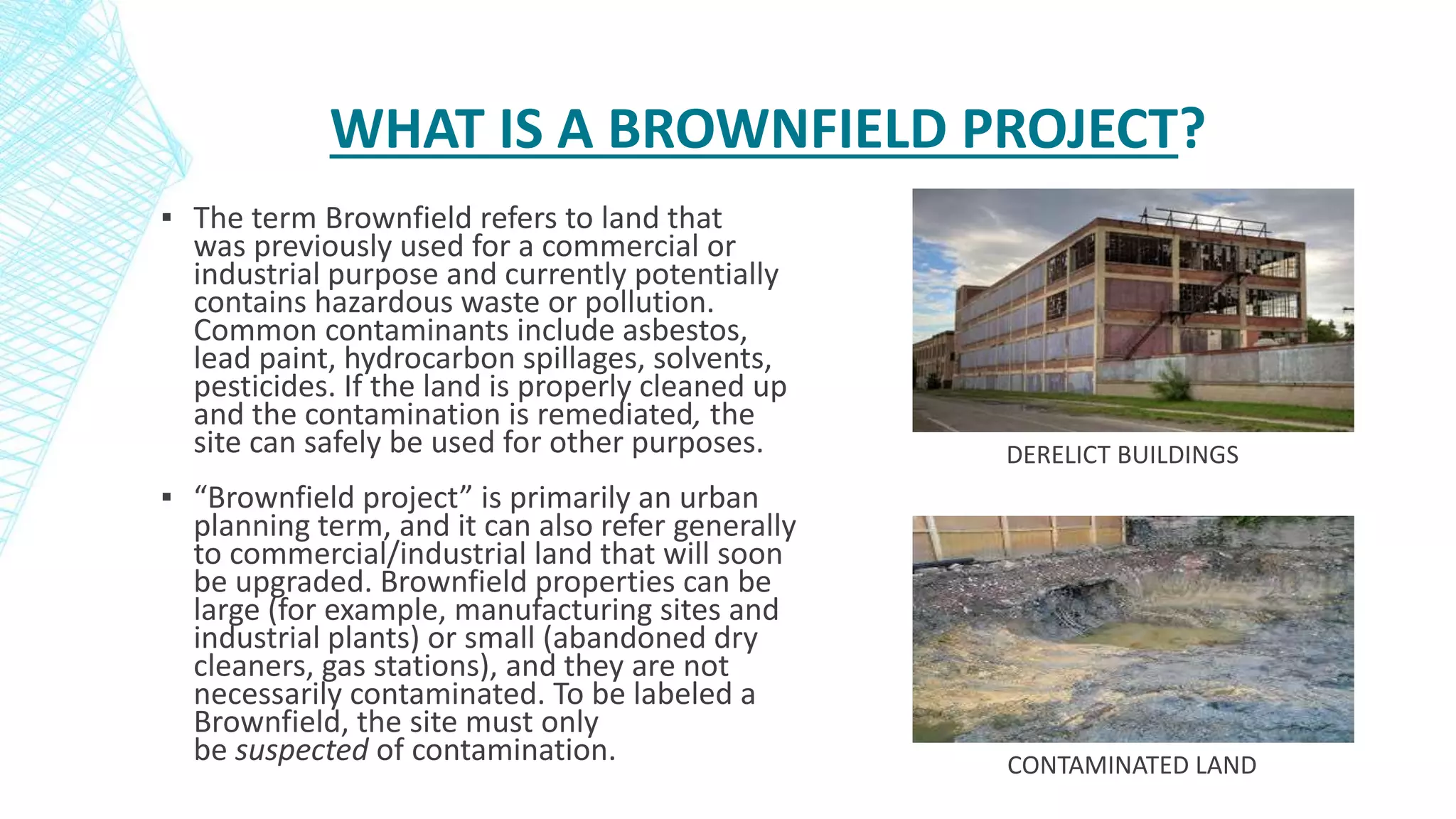
DERELICT BUILDINGS
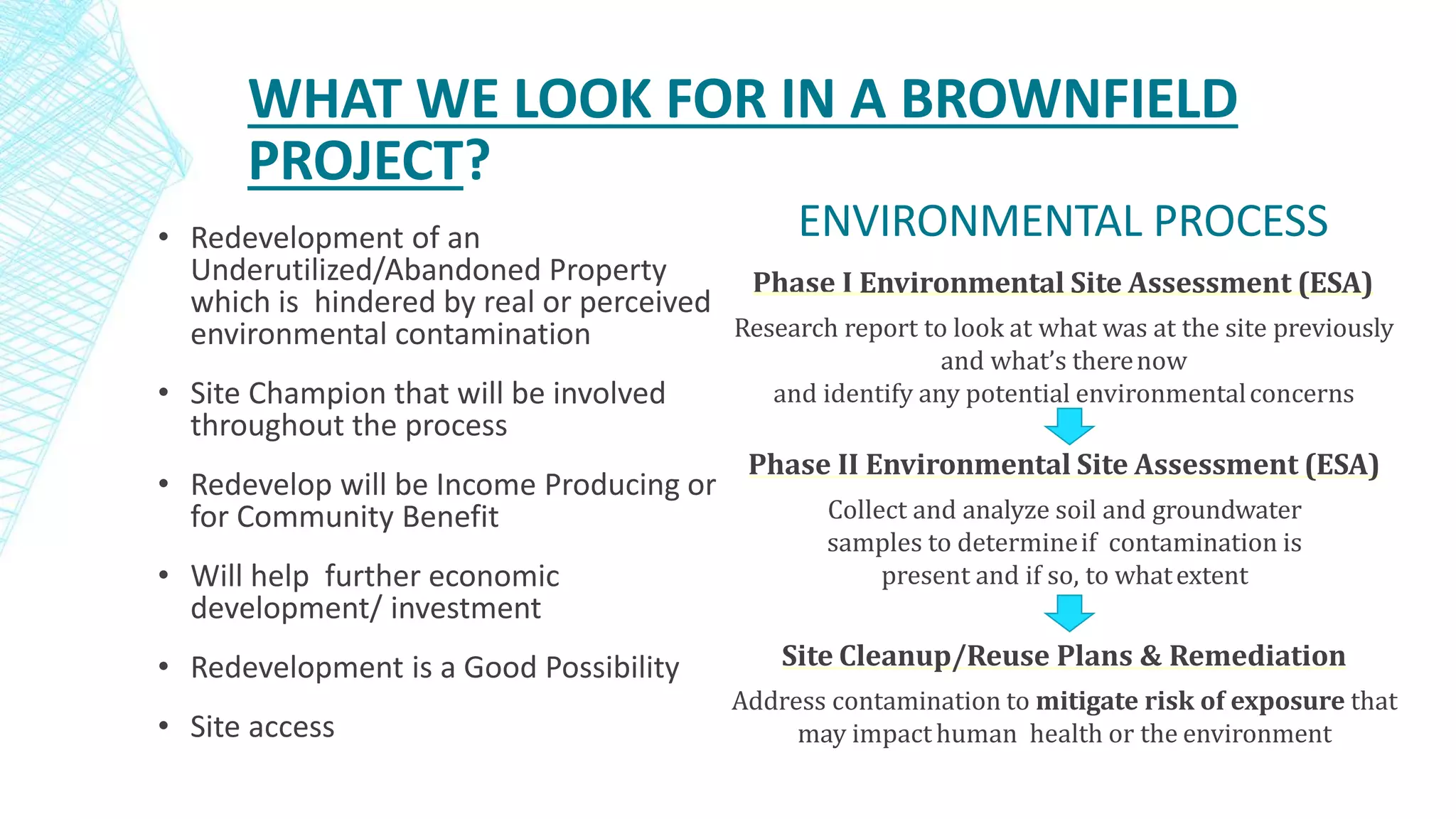
CONTAMINATED LAND
WHAT WE LOOK FOR IN A BROWNFIELD
PROJECT?
• Redevelopment of an
Underutilized/Abandoned Property
which is hindered by real or perceived
environmental contamination
• Site Champion that will be involved
throughout the process
• Redevelop will be Income Producing or
for Community Benefit
• Will help further economic
development/ investment
• Redevelopment is a Good Possibility
• Site access
Phase I Environmental Site Assessment (ESA)
Research report to look at what was at the site previously
and what’s therenow
and identify any potential environmentalconcerns
Phase II Environmental Site Assessment (ESA)
Collect and analyze soil and groundwater
samples to determineif contamination is
present and if so, to whatextent
Site Cleanup/Reuse Plans & Remediation
Address contamination to mitigate risk of exposure that
may impacthuman health or the environment
ENVIRONMENTAL PROCESS
OPPORTUNITIES FOR ARCHITECTS
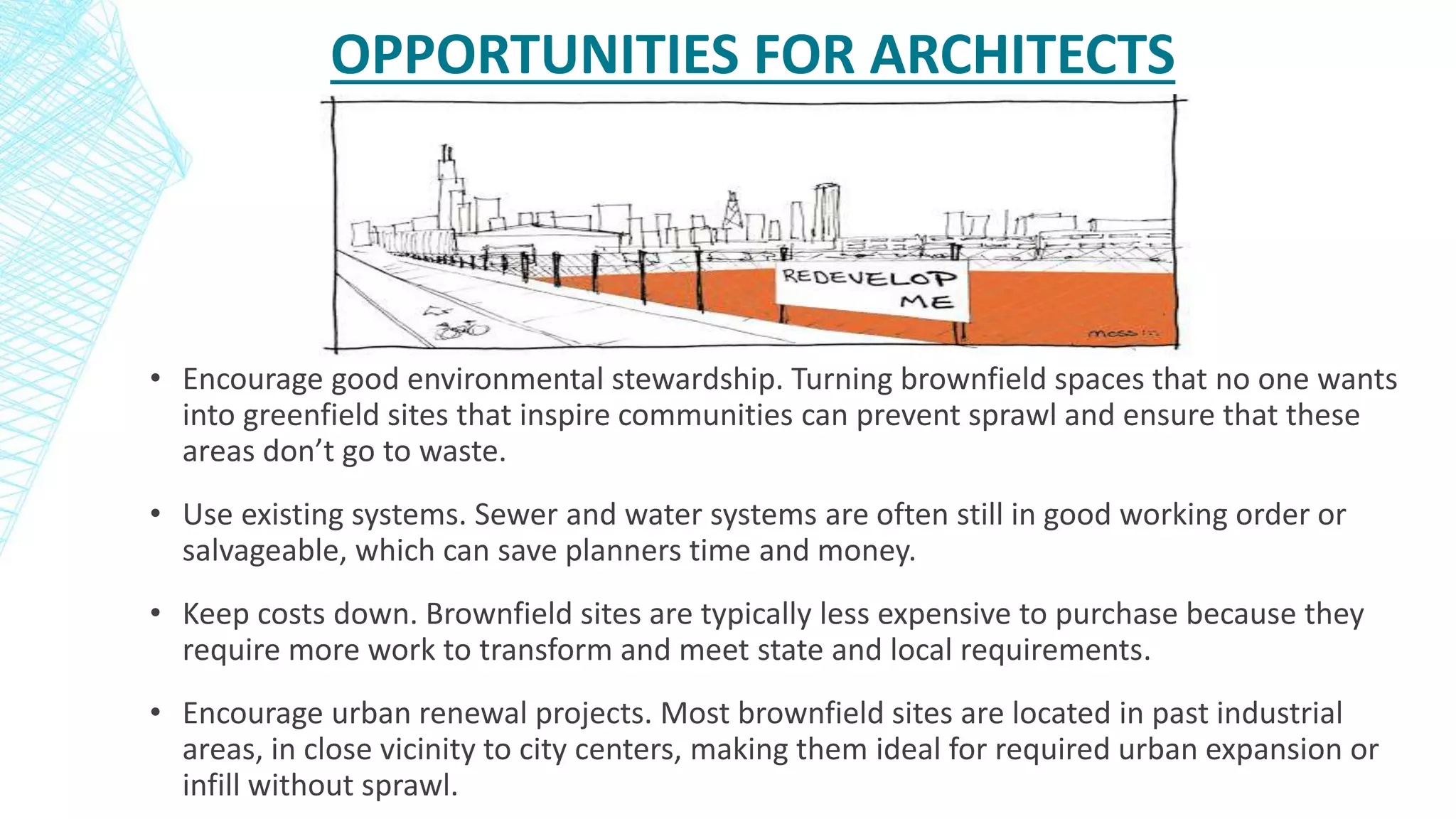
• Encourage good environmental stewardship. Turning brownfield spaces that no one wants
into greenfield sites that inspire communities can prevent sprawl and ensure that these
areas don’t go to waste.
• Use existing systems. Sewer and water systems are often still in good working order or
salvageable, which can save planners time and money.
• Keep costs down. Brownfield sites are typically less expensive to purchase because they
require more work to transform and meet state and local requirements.
• Encourage urban renewal projects. Most brownfield sites are located in past industrial
areas, in close vicinity to city centers, making them ideal for required urban expansion or
infill without sprawl.
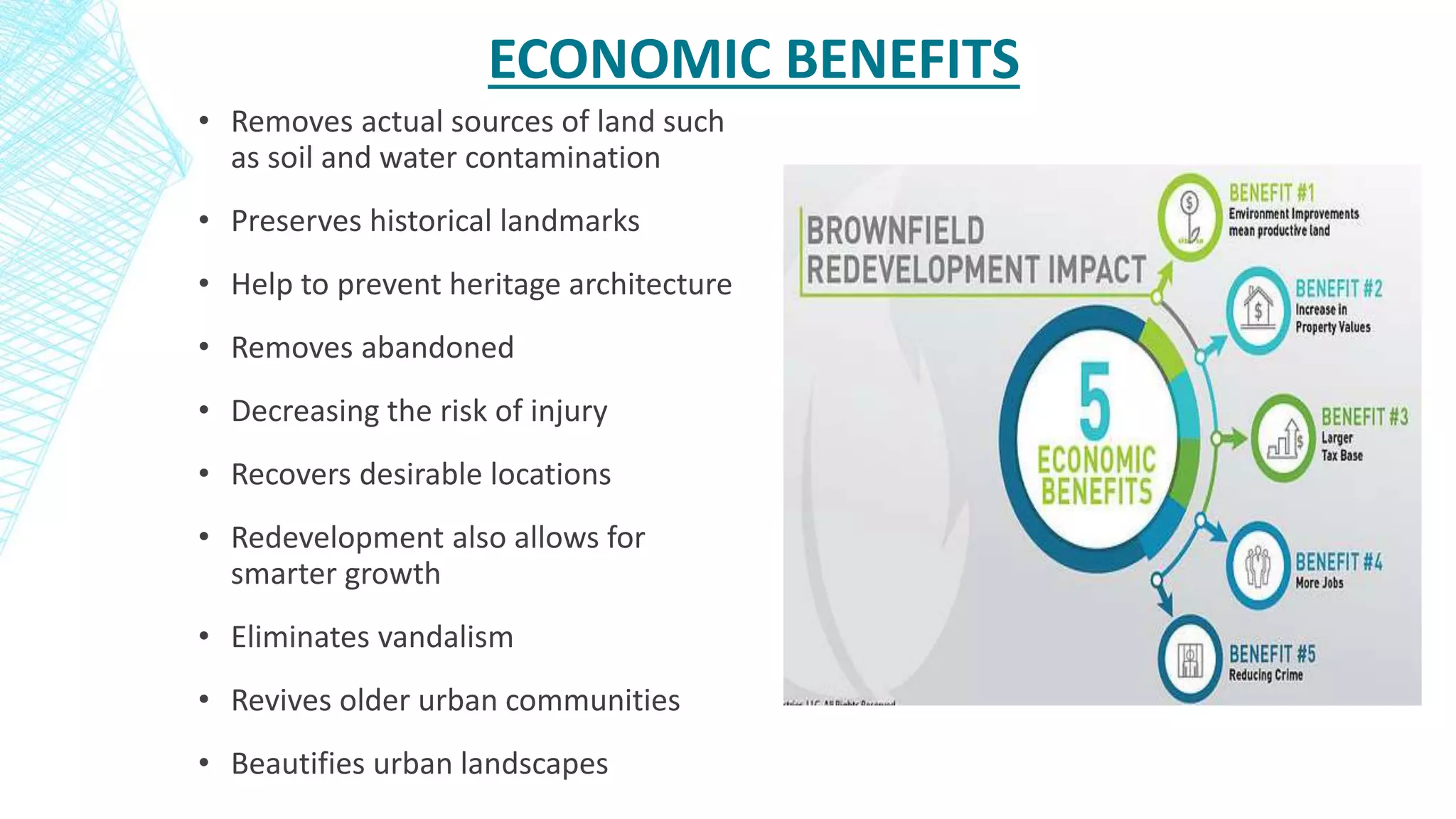
ECONOMIC BENEFITS
• Removes actual sources of land such
as soil and water contamination
• Preserves historical landmarks
• Help to prevent heritage architecture
• Removes abandoned
• Decreasing the risk of injury
• Recovers desirable locations
• Redevelopment also allows for
smarter growth
• Eliminates vandalism
• Revives older urban communities
• Beautifies urban landscapes
CASE STUDY
 WASTE OF WONDER
• The park is home to replicas of some of the most visited monuments in the world. But what makes
these structures unique is that these have been constructed from waste materials like scrap metal,
discarded auto parts, procured from the landfills of the city.
• The clones at the park established by the South Delhi Municipal Corporation (SDMC) has the Great
Pyramid of Giza, the oldest of the Seven Wonders of the Ancient World, Leaning Tower of Pisa is one
of the Seven Wonders of the Medieval World and others such as the Colosseum, Christ The
Redeemer, India’s gem – Taj Mahal, are listed under New7Wonders of the World.
• Apart from recycling waste materials to create the installations, the park has also taken other
measures to cut down its carbon footprint, like using solar power to meet its electricity needs. In an
effort to make the park self-sustainable, solar panels have been installed on the rooftops of the
washroom and there three solar trees in the park, which capture energy from sunlight and wind for
producing energy.
• The SDMC plans to start a light and sound show to showcase the journey leading to the one of its
kind waste to wonder park. SDMC has decided to charge an entry fee of Rs. 50 from adults,
and Rs. 25 from children belonging to the age group of 3-12 years. Children up to three years of age,
senior citizens – 65 years and above, and school students from the municipal corporations, carrying
their identity cards will not be charged an entry fee
LANDFILL SCRAP AND WASTE MATERIAL WELDING SCRAP
WORKOUT ON EXISTING PIPELINESPLANNING
FINAL BUILT FORM
COMPLETE EXPLANATION OF WASTE OF
WONDER
 HIGH LINE
• The High Line is an elevated freight rail line
transformed into a public park on Manhattan’s West
Side.
• It is owned by the City of New York, and maintained
and operated by Friends of the High Line.
• Founded in 1999 by community residents, Friends
of the High Line fought for the High Line’s
preservation and transformation at a time when the
historic structure was under the threat of demolition.
• It is now the non-profit conservancy working with
the New York City Department of Parks &
Recreation to make sure the High Line is
maintained as an extraordinary public space for all
visitors to enjoy.
• In addition to overseeing maintenance, operations,
and public programming for the park, Friends of the
High Line raises the funding to maintain and
operate the High Line and its programs from both
private and public sources.
COMPLETE EXPLANATION OF HIGH LINE
BIBLIOGRAPHY
 Arch daily.com
 Youtube.com
 Wikipedia.org
 Thehighline.org
 Google Image
THANK YOU!

Brownfield project by Shrikant

  • 1.
    BROWNFIELD PROJECT Building MaterialAnd Science – IV SUBMITTED BY-  SHRIKANT  B.ARCH (2 YEAR-A)
  • 2.
    CONTENT ▪ What Isa Brownfield Project? ▪ What we look for in a Brownfield Project? Environmental process ▪ Opportunities for Architect ▪ Economic Benefits ▪ Case Studies Waste of Wonder High Line
  • 3.
  • 4.
    WHAT IS ABROWNFIELD PROJECT? ▪ The term Brownfield refers to land that was previously used for a commercial or industrial purpose and currently potentially contains hazardous waste or pollution. Common contaminants include asbestos, lead paint, hydrocarbon spillages, solvents, pesticides. If the land is properly cleaned up and the contamination is remediated, the site can safely be used for other purposes. ▪ “Brownfield project” is primarily an urban planning term, and it can also refer generally to commercial/industrial land that will soon be upgraded. Brownfield properties can be large (for example, manufacturing sites and industrial plants) or small (abandoned dry cleaners, gas stations), and they are not necessarily contaminated. To be labeled a Brownfield, the site must only be suspected of contamination. DERELICT BUILDINGS CONTAMINATED LAND
  • 5.
    WHAT WE LOOKFOR IN A BROWNFIELD PROJECT? • Redevelopment of an Underutilized/Abandoned Property which is hindered by real or perceived environmental contamination • Site Champion that will be involved throughout the process • Redevelop will be Income Producing or for Community Benefit • Will help further economic development/ investment • Redevelopment is a Good Possibility • Site access Phase I Environmental Site Assessment (ESA) Research report to look at what was at the site previously and what’s therenow and identify any potential environmentalconcerns Phase II Environmental Site Assessment (ESA) Collect and analyze soil and groundwater samples to determineif contamination is present and if so, to whatextent Site Cleanup/Reuse Plans & Remediation Address contamination to mitigate risk of exposure that may impacthuman health or the environment ENVIRONMENTAL PROCESS
  • 6.
    OPPORTUNITIES FOR ARCHITECTS •Encourage good environmental stewardship. Turning brownfield spaces that no one wants into greenfield sites that inspire communities can prevent sprawl and ensure that these areas don’t go to waste. • Use existing systems. Sewer and water systems are often still in good working order or salvageable, which can save planners time and money. • Keep costs down. Brownfield sites are typically less expensive to purchase because they require more work to transform and meet state and local requirements. • Encourage urban renewal projects. Most brownfield sites are located in past industrial areas, in close vicinity to city centers, making them ideal for required urban expansion or infill without sprawl.
  • 7.
    ECONOMIC BENEFITS • Removesactual sources of land such as soil and water contamination • Preserves historical landmarks • Help to prevent heritage architecture • Removes abandoned • Decreasing the risk of injury • Recovers desirable locations • Redevelopment also allows for smarter growth • Eliminates vandalism • Revives older urban communities • Beautifies urban landscapes
  • 8.
    CASE STUDY  WASTEOF WONDER • The park is home to replicas of some of the most visited monuments in the world. But what makes these structures unique is that these have been constructed from waste materials like scrap metal, discarded auto parts, procured from the landfills of the city. • The clones at the park established by the South Delhi Municipal Corporation (SDMC) has the Great Pyramid of Giza, the oldest of the Seven Wonders of the Ancient World, Leaning Tower of Pisa is one of the Seven Wonders of the Medieval World and others such as the Colosseum, Christ The Redeemer, India’s gem – Taj Mahal, are listed under New7Wonders of the World. • Apart from recycling waste materials to create the installations, the park has also taken other measures to cut down its carbon footprint, like using solar power to meet its electricity needs. In an effort to make the park self-sustainable, solar panels have been installed on the rooftops of the washroom and there three solar trees in the park, which capture energy from sunlight and wind for producing energy. • The SDMC plans to start a light and sound show to showcase the journey leading to the one of its kind waste to wonder park. SDMC has decided to charge an entry fee of Rs. 50 from adults, and Rs. 25 from children belonging to the age group of 3-12 years. Children up to three years of age, senior citizens – 65 years and above, and school students from the municipal corporations, carrying their identity cards will not be charged an entry fee
  • 9.
    LANDFILL SCRAP ANDWASTE MATERIAL WELDING SCRAP WORKOUT ON EXISTING PIPELINESPLANNING FINAL BUILT FORM
  • 10.
    COMPLETE EXPLANATION OFWASTE OF WONDER
  • 11.
     HIGH LINE •The High Line is an elevated freight rail line transformed into a public park on Manhattan’s West Side. • It is owned by the City of New York, and maintained and operated by Friends of the High Line. • Founded in 1999 by community residents, Friends of the High Line fought for the High Line’s preservation and transformation at a time when the historic structure was under the threat of demolition. • It is now the non-profit conservancy working with the New York City Department of Parks & Recreation to make sure the High Line is maintained as an extraordinary public space for all visitors to enjoy. • In addition to overseeing maintenance, operations, and public programming for the park, Friends of the High Line raises the funding to maintain and operate the High Line and its programs from both private and public sources.
  • 12.
  • 13.
    BIBLIOGRAPHY  Arch daily.com Youtube.com  Wikipedia.org  Thehighline.org  Google Image THANK YOU!