CARTILAGE
INJURIES
PRESENTER- Dr.
RAGHAVENDRA
.
INTRODUCTION
 Most common in knee joints.
 Occur in both young and elderly populations.
 ETIOLOGY- 1. traumatic.
2. degenerative.
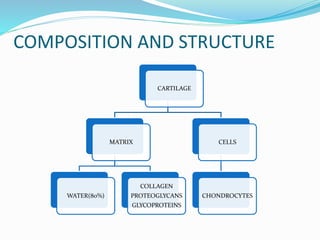
COMPOSITION AND STRUCTURE
CARTILAGE
MATRIX
WATER(80%)
COLLAGEN
PROTEOGLYCANS
GLYCOPROTEINS
CELLS
CHONDROCYTES
 CHONDROCYTES- play role in synthesis,
maintenance, degradation.
 Mechanical properties of cartilage is due to biphasic
nature of cartilage.
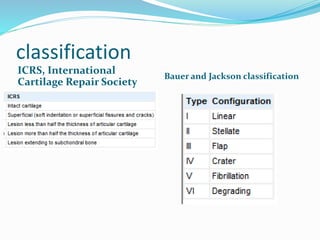
Classifications
 Based on severity-
classification
ICRS, International
Cartilage Repair Society
Bauer and Jackson classification
RESPONSE TO INJURY
INJURY TO CARTILAGE
CHONDROCYTES DEGENERATION
WITH MATRIX DESTRUCTION
NO HAEMATOMA
NO FIBRIN
NO INFLAMMATION
NO UNDIFFENTIATED CELL SUPPLY
Remaining viable
chondrocytes
profilerate
Incomplete and
short lived
response
Symptoms and signs
Symptoms-
 pain ( most common and increases with weight
bearing).
 Swelling
 Mechanical symptoms.
SIGNS-
1. Tenderness.
2. Effusion.
3. Fat globules on aspiration may suggest chondral
injury or osteochondral fracture.
Investigations
 X rays –
 MRI- cartilage sensitive MRI or fast spin echo
sequence MRI.
 Most accurate- diagnostic arthroscopy.
TREATMENT
 Consider lesion location, size, and depth, associated
instability, malalignment , age, and activity level of
patient.
 Broadly divided in 1. partial thickness injury.
2. full thickness injury.
CONSERVATIVE-
 Decreasing the load on the joint( lose weight).
 Alter activities.
 Strengthen the muscles across the joint .
 Orthoses or braces also are beneficial.
 Analgesics and antiinflammatory medications.
OPERATIVE TREATMENT
Operative treatment generally is indicated if nonoperative
methods fail to relieve pain and mechanical symptoms.
The choice of procedure is based primarily on the
size of the lesion and the activity demands of the
patient.
Partial thickness injury
 Remain stable for long duration.
 It is important to distinguish symptomatic lesions
from those that are incidental findings.
 Correlate symptoms and findings.
 Treat only those areas that have large articular flaps
and impending loose bodies.
Arthroscopic debridement
 For patients with minimal symptoms and small
lesions (<2 cm) in areas of limited weight bearing,
arthroscopic débridement to remove loose flaps
or edges that impinge in the joint can provide
short-term relief .
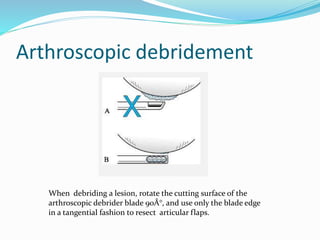
Arthroscopic debridement
When debriding a lesion, rotate the cutting surface of the
arthroscopic debrider blade 90°, and use only the blade edge
in a tangential fashion to resect articular flaps.
 The goal of arthroscopic débridement and lavage
is to reduce the inflammation and mechanical
irritation within the joint.
FULL THICKNESS INJURIES
 These techniques began with open debridement,
spongialization, and osteotomy; evolved into
arthroscopic debridement, abrasion arthroplasty, and
microfracture; and now include autogenous
osteoarticular mosaicplasty, autogenous chondrocyte
implantation, and allograft replacement
FOUR BASIC TECHNIQUES
 (A) STIMULATION OF INTRINSIC HEALING
POTENTIAL
 (B) ALTERATION OF LOADS
 (C) TRANSFER OF AUTOGENOUS TISSUE AND
CELLS
 (D) TRANSFER OF ALLOGRAFT TISSUE
Stimulation of Intrinsic Healing
Potential
Debridement with drilling, abrasion arthroplasty, and microfracture all share the
basic principles of removing loose debris and degenerative cartilage, and
penetrating the subchondral bone to produce bleeding.
With subchondral bone penetration, a pluripotential stem cell
line is released and, in the proper environment, can differentiate
into a chondrogenic cell line .
 It is important to understand that subchondral
penetration does not produce normal articular
cartilage, instead it produces fibrocartilage with a
high concentration of type I collagen.
 Gill et al. listed five factors that affect the quality
of the cartilaginous repair tissue after
microfracture of a chondral defect-
 (1) during débridement, the calcified cartilage
layer must be removed, but the abrasion of the
subchondral bone must be avoided.
 (2) a 1- to 2-mm bridge of bone must be left
between penetrations to allow connective tissue to
fill the defect and adhere to the base of the defect.
 (3) joint function must be maintained after
surgery by the use of early continuous passive
motion.
 (4) protected weight bearing must be strictly
enforced, depending on the location of the lesion
 (5) any significant abnormality in the mechanical
axis must be corrected in conjunction with the
microfracture procedure
Alteration of Loads
 Its underlying principle is to shift a force concentration
overload away from a damaged joint surface.
 Insall et al. reported good and excellent results from
proximal tibial osteotomy in 85% of patients at 5 years
but noted only 37% excellent results after 9 years.
Autogenous Tissue Grafting
 Transfer normal articular cartilage into a damaged
area.
1: Preparation of recipient site
2: Harvest of the grafts
3,4: Preparation for the plug grafts
5: Insertion of the plugs
6: Completed mosaicplasty.
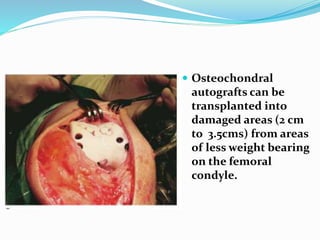
 Osteochondral
autografts can be
transplanted into
damaged areas (2 cm
to 3.5cms) from areas
of less weight bearing
on the femoral
condyle.
ADVANTAGES-
 NO RISK OF DISEASE TRANSMISSION
 NO PROBLEM WITH TISSUE REJECTION
 A HIGH RATE OF UNION
 CHONDROCYTE VIABILITY IS MAINTAINED WITH
FRESH AUTOGENOUS GRAFTS
 Disadvantages-
 supply of expendable autogenous osteoarticular grafts
is limited.
 donor site morbidity is a major concern.
Periosteal and Perichondrial
Grafting
 The principle behind these procedures is to provide a
new source of chondrogenic cells to repair the defect.
Autologous Chondrocyte
Implantation
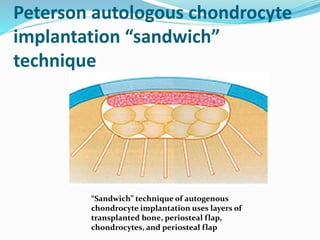
Peterson autologous chondrocyte
implantation “sandwich”
technique
“Sandwich” technique of autogenous
chondrocyte implantation uses layers of
transplanted bone, periosteal flap,
chondrocytes, and periosteal flap
 A disadvantage of autologous chondrocyte
implantation is the prolonged postoperative
rehabilitation that requires strict compliance of
the patient with weight bearing and activity
restrictions.
FUTURE APPROACHES
 Repair process at the cellular and molecular levels
by the transfer of new genetic information to cells
that contribute to the healing process by gene
therapy.
Cartilage injuries

Cartilage injuries

  • 1.
  • 2.
    INTRODUCTION  Most commonin knee joints.  Occur in both young and elderly populations.  ETIOLOGY- 1. traumatic. 2. degenerative.
  • 3.
  • 4.
     CHONDROCYTES- playrole in synthesis, maintenance, degradation.  Mechanical properties of cartilage is due to biphasic nature of cartilage.
  • 5.
  • 6.
    classification ICRS, International Cartilage RepairSociety Bauer and Jackson classification
  • 7.
    RESPONSE TO INJURY INJURYTO CARTILAGE CHONDROCYTES DEGENERATION WITH MATRIX DESTRUCTION NO HAEMATOMA NO FIBRIN NO INFLAMMATION NO UNDIFFENTIATED CELL SUPPLY
  • 8.
  • 9.
    Symptoms and signs Symptoms- pain ( most common and increases with weight bearing).  Swelling  Mechanical symptoms.
  • 10.
    SIGNS- 1. Tenderness. 2. Effusion. 3.Fat globules on aspiration may suggest chondral injury or osteochondral fracture.
  • 11.
    Investigations  X rays–  MRI- cartilage sensitive MRI or fast spin echo sequence MRI.  Most accurate- diagnostic arthroscopy.
  • 12.
    TREATMENT  Consider lesionlocation, size, and depth, associated instability, malalignment , age, and activity level of patient.  Broadly divided in 1. partial thickness injury. 2. full thickness injury.
  • 13.
    CONSERVATIVE-  Decreasing theload on the joint( lose weight).  Alter activities.  Strengthen the muscles across the joint .  Orthoses or braces also are beneficial.  Analgesics and antiinflammatory medications.
  • 14.
    OPERATIVE TREATMENT Operative treatmentgenerally is indicated if nonoperative methods fail to relieve pain and mechanical symptoms. The choice of procedure is based primarily on the size of the lesion and the activity demands of the patient.
  • 15.
    Partial thickness injury Remain stable for long duration.  It is important to distinguish symptomatic lesions from those that are incidental findings.  Correlate symptoms and findings.  Treat only those areas that have large articular flaps and impending loose bodies.
  • 16.
    Arthroscopic debridement  Forpatients with minimal symptoms and small lesions (<2 cm) in areas of limited weight bearing, arthroscopic débridement to remove loose flaps or edges that impinge in the joint can provide short-term relief .
  • 17.
    Arthroscopic debridement When debridinga lesion, rotate the cutting surface of the arthroscopic debrider blade 90°, and use only the blade edge in a tangential fashion to resect articular flaps.
  • 18.
     The goalof arthroscopic débridement and lavage is to reduce the inflammation and mechanical irritation within the joint.
  • 19.
    FULL THICKNESS INJURIES These techniques began with open debridement, spongialization, and osteotomy; evolved into arthroscopic debridement, abrasion arthroplasty, and microfracture; and now include autogenous osteoarticular mosaicplasty, autogenous chondrocyte implantation, and allograft replacement
  • 20.
    FOUR BASIC TECHNIQUES (A) STIMULATION OF INTRINSIC HEALING POTENTIAL  (B) ALTERATION OF LOADS  (C) TRANSFER OF AUTOGENOUS TISSUE AND CELLS  (D) TRANSFER OF ALLOGRAFT TISSUE
  • 22.
    Stimulation of IntrinsicHealing Potential Debridement with drilling, abrasion arthroplasty, and microfracture all share the basic principles of removing loose debris and degenerative cartilage, and penetrating the subchondral bone to produce bleeding.
  • 23.
    With subchondral bonepenetration, a pluripotential stem cell line is released and, in the proper environment, can differentiate into a chondrogenic cell line .
  • 24.
     It isimportant to understand that subchondral penetration does not produce normal articular cartilage, instead it produces fibrocartilage with a high concentration of type I collagen.
  • 25.
     Gill etal. listed five factors that affect the quality of the cartilaginous repair tissue after microfracture of a chondral defect-  (1) during débridement, the calcified cartilage layer must be removed, but the abrasion of the subchondral bone must be avoided.  (2) a 1- to 2-mm bridge of bone must be left between penetrations to allow connective tissue to fill the defect and adhere to the base of the defect.  (3) joint function must be maintained after surgery by the use of early continuous passive motion.
  • 26.
     (4) protectedweight bearing must be strictly enforced, depending on the location of the lesion  (5) any significant abnormality in the mechanical axis must be corrected in conjunction with the microfracture procedure
  • 27.
    Alteration of Loads Its underlying principle is to shift a force concentration overload away from a damaged joint surface.  Insall et al. reported good and excellent results from proximal tibial osteotomy in 85% of patients at 5 years but noted only 37% excellent results after 9 years.
  • 28.
    Autogenous Tissue Grafting Transfer normal articular cartilage into a damaged area. 1: Preparation of recipient site 2: Harvest of the grafts 3,4: Preparation for the plug grafts 5: Insertion of the plugs 6: Completed mosaicplasty.
  • 29.
     Osteochondral autografts canbe transplanted into damaged areas (2 cm to 3.5cms) from areas of less weight bearing on the femoral condyle.
  • 30.
    ADVANTAGES-  NO RISKOF DISEASE TRANSMISSION  NO PROBLEM WITH TISSUE REJECTION  A HIGH RATE OF UNION  CHONDROCYTE VIABILITY IS MAINTAINED WITH FRESH AUTOGENOUS GRAFTS
  • 31.
     Disadvantages-  supplyof expendable autogenous osteoarticular grafts is limited.  donor site morbidity is a major concern.
  • 32.
    Periosteal and Perichondrial Grafting The principle behind these procedures is to provide a new source of chondrogenic cells to repair the defect.
  • 33.
  • 35.
    Peterson autologous chondrocyte implantation“sandwich” technique “Sandwich” technique of autogenous chondrocyte implantation uses layers of transplanted bone, periosteal flap, chondrocytes, and periosteal flap
  • 36.
     A disadvantageof autologous chondrocyte implantation is the prolonged postoperative rehabilitation that requires strict compliance of the patient with weight bearing and activity restrictions.
  • 37.
    FUTURE APPROACHES  Repairprocess at the cellular and molecular levels by the transfer of new genetic information to cells that contribute to the healing process by gene therapy.