BIOCHEMICAL MARKERS OF
BONE FORMATION AND
RESORPTION AND THEIR
UTILITY IN ORTHOPAEDICS
INTRODUCTION
• Chemicals in serum and urine can serve as
markers for monitoring bone loss, bone
reformation, and the effectiveness of therapy
in patients with osteoporosis. Although not yet
well recognized or readily available, tests for
these markers may prove preferable to
densitometry in some settings or for some
patients. In the future, biochemical markers
may provide important information on fracture
risks as well.
HISTORY
• More than 50 years ago, Fuller Albright,the
father of metabolic bone diseases, noted that
postmenopausal women were losing excessive
amounts of calcium in their urine.
• He is credited with introducing the use of
biochemical markers into the clinical arena.
CO
The BONE matrix
– 40% organic
• Type 1 collagen (tensile strength)
• Proteoglycans (compressive strength)
• Osteocalcin/Osteonectin
• Growth factors/Cytokines/Osteoid
– 60% inorganic
• Calcium hydroxyapatite
• The cells
– osteo-clast/blast/cyte/progenitor
PHYSIOLOGY
• Bone is a reservoir of calcium, calcium En
Masse being required to make &maintain the
skeleton. To be an effective reservoir for the
maintenance of normal blood calcium, calcium
must be able to be incorporated into &
liberated from the bone on short notice.
BONE REMODELLING
• Characteristic of the adult skeleton, occurs most often
in skeletal sites rich in trabecular bone, e.g. proximal
femur, calcaneus, and distal radius.
• Remodeling is essential to maintain skeletal
homeostasis, to provide elasticity to bone, and to
produce a steady source of extracellular calcium.
• Takes place in a cyclic fashion at specific sites or
skeletal lacunae in a cycle lasting about 120 days .
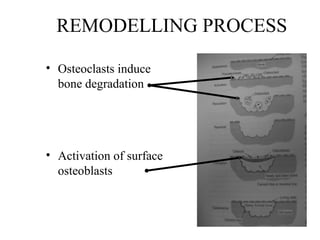
REMODELLING PROCESS
• Osteoclasts induce
bone degradation
• Activation of surface
osteoblasts
BONE TURNOVER
• It is a coupled process of bone formation and bone
resorption
• Takes place throughout the life at different rates
• Before 30yrs bone formation exceeds resorption
• At 30 yrs the skeletal mass is at its peak and both
processes are matched
• Later resorption goes on increasing for the rest of the
life
MEDIATORS
• Bone formation is mediated by osteoblasts.
• Bone resorption is mediated by osteoclasts
MARKERS
OSTEOBLASTIC MARKERS
MarkerMarker Type ofType of
assayassay
Ease of use*Ease of use* BoneBone
specificityspecificity
VariabilityVariability
Total alkalineTotal alkaline
phosphatasephosphatase
ColorimetricColorimetric ++++++++ -- ++++
SkeletalSkeletal
alkalinealkaline
phosphatasephosphatase
ELISAELISA ++++ ++++++ ++
Procollagen-IProcollagen-I
extensionextension
peptidepeptide
RIARIA ++++ ++++++ ++++
OsteocalcinOsteocalcin RIA, ELISARIA, ELISA ++++++ ++++++ ++
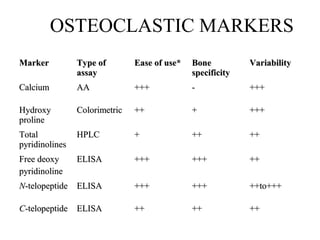
OSTEOCLASTIC MARKERS
MarkerMarker Type ofType of
assayassay
Ease of use*Ease of use* BoneBone
specificityspecificity
VariabilityVariability
CalciumCalcium AAAA ++++++ -- ++++++
HydroxyHydroxy
prolineproline
ColorimetricColorimetric ++++ ++ ++++++
TotalTotal
pyridinolinespyridinolines
HPLCHPLC ++ ++++ ++++
Free deoxyFree deoxy
pyridinolinepyridinoline
ELISAELISA ++++++ ++++++ ++++
NN-telopeptide-telopeptide ELISAELISA ++++++ ++++++ ++to+++++to+++
CC-telopeptide-telopeptide ELISAELISA ++++ ++++ ++++
CALCIUM HOMEOSTASIS
DIETARY CALCIUM
INTESTINAL ABSORPTION
ORGAN PHYSIOLOGY
ENDOCRINE PHYSIOLOGY
DIETARY HABITS,
SUPPLEMENTS
BLOOD CALCIUM
BONE
KIDNEYS
URINE
THE ONLY “IN”
THE PRINCIPLE “OUT”
ORGAN PHYS.
ENDOCRINE PHYS.
ORGAN,
ENDOCRINE
CALCIUM, PTH, AND VITAMIN D
FEEDBACK LOOPS
NORMAL BLOOD Ca
RISING BLOOD Ca
FALLING BLOOD Ca
SUPPRESS PTH
STIMULATE PTH
BONE RESORPTION
URINARY LOSS
1,25(OH)2 D PRODUCTION
BONE RESORPTION
URINARY LOSS
1,25(OH)2 D PRODUCTION
ALKALINE PHOSPHATASE
• In intestinal mucosa, bone & kidney
• Concentrated in epiphyseal area
• Normal level : 4-13 units/dl (KA).
• Composed of a group of isoenzymes- heat
labile and heat stable
HYDROXYPROLINE
• Hypro is an exclusive constituent of collagen
• Excreted in urine in peptide bound form
• Rate of excretion differs with age
FACTORS AFFECTING BONE
TURNOVER
• Local factors
• I-GF 1 (somatomedin C)
– increased osteoblast proliferation
• TGF
– increased osteoblast activity
• IL-1
– increased osteoclast activity (myeloma)
• PG’s
– increased bone turnover (#’s/inflammn)
• BMP
– bone formation
FACTORS AFFECTING BONE
TURNOVER
• Other hormones
• Oestrogen
– gut – increased ca absorption
– bone - decreased re-sorption
• Glucocorticoids
– gut - decrease ca absorption
– bone - increased re-sorption/decreased formation
• Thyroxine
– stimulates bone formation/resorption
– net resorption
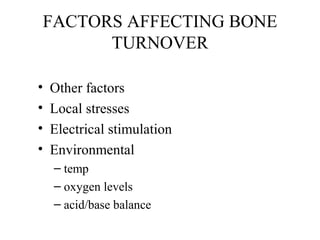
FACTORS AFFECTING BONE
TURNOVER
• Other factors
• Local stresses
• Electrical stimulation
• Environmental
– temp
– oxygen levels
– acid/base balance
THANK YOU

Biochemical markers

  • 1.
    BIOCHEMICAL MARKERS OF BONEFORMATION AND RESORPTION AND THEIR UTILITY IN ORTHOPAEDICS
  • 2.
    INTRODUCTION • Chemicals inserum and urine can serve as markers for monitoring bone loss, bone reformation, and the effectiveness of therapy in patients with osteoporosis. Although not yet well recognized or readily available, tests for these markers may prove preferable to densitometry in some settings or for some patients. In the future, biochemical markers may provide important information on fracture risks as well.
  • 3.
    HISTORY • More than50 years ago, Fuller Albright,the father of metabolic bone diseases, noted that postmenopausal women were losing excessive amounts of calcium in their urine. • He is credited with introducing the use of biochemical markers into the clinical arena.
  • 4.
    CO The BONE matrix –40% organic • Type 1 collagen (tensile strength) • Proteoglycans (compressive strength) • Osteocalcin/Osteonectin • Growth factors/Cytokines/Osteoid – 60% inorganic • Calcium hydroxyapatite • The cells – osteo-clast/blast/cyte/progenitor
  • 5.
    PHYSIOLOGY • Bone isa reservoir of calcium, calcium En Masse being required to make &maintain the skeleton. To be an effective reservoir for the maintenance of normal blood calcium, calcium must be able to be incorporated into & liberated from the bone on short notice.
  • 6.
    BONE REMODELLING • Characteristicof the adult skeleton, occurs most often in skeletal sites rich in trabecular bone, e.g. proximal femur, calcaneus, and distal radius. • Remodeling is essential to maintain skeletal homeostasis, to provide elasticity to bone, and to produce a steady source of extracellular calcium. • Takes place in a cyclic fashion at specific sites or skeletal lacunae in a cycle lasting about 120 days .
  • 7.
    REMODELLING PROCESS • Osteoclastsinduce bone degradation • Activation of surface osteoblasts
  • 8.
    BONE TURNOVER • Itis a coupled process of bone formation and bone resorption • Takes place throughout the life at different rates • Before 30yrs bone formation exceeds resorption • At 30 yrs the skeletal mass is at its peak and both processes are matched • Later resorption goes on increasing for the rest of the life
  • 9.
    MEDIATORS • Bone formationis mediated by osteoblasts. • Bone resorption is mediated by osteoclasts
  • 10.
  • 11.
    OSTEOBLASTIC MARKERS MarkerMarker TypeofType of assayassay Ease of use*Ease of use* BoneBone specificityspecificity VariabilityVariability Total alkalineTotal alkaline phosphatasephosphatase ColorimetricColorimetric ++++++++ -- ++++ SkeletalSkeletal alkalinealkaline phosphatasephosphatase ELISAELISA ++++ ++++++ ++ Procollagen-IProcollagen-I extensionextension peptidepeptide RIARIA ++++ ++++++ ++++ OsteocalcinOsteocalcin RIA, ELISARIA, ELISA ++++++ ++++++ ++
  • 12.
    OSTEOCLASTIC MARKERS MarkerMarker TypeofType of assayassay Ease of use*Ease of use* BoneBone specificityspecificity VariabilityVariability CalciumCalcium AAAA ++++++ -- ++++++ HydroxyHydroxy prolineproline ColorimetricColorimetric ++++ ++ ++++++ TotalTotal pyridinolinespyridinolines HPLCHPLC ++ ++++ ++++ Free deoxyFree deoxy pyridinolinepyridinoline ELISAELISA ++++++ ++++++ ++++ NN-telopeptide-telopeptide ELISAELISA ++++++ ++++++ ++to+++++to+++ CC-telopeptide-telopeptide ELISAELISA ++++ ++++ ++++
  • 13.
    CALCIUM HOMEOSTASIS DIETARY CALCIUM INTESTINALABSORPTION ORGAN PHYSIOLOGY ENDOCRINE PHYSIOLOGY DIETARY HABITS, SUPPLEMENTS BLOOD CALCIUM BONE KIDNEYS URINE THE ONLY “IN” THE PRINCIPLE “OUT” ORGAN PHYS. ENDOCRINE PHYS. ORGAN, ENDOCRINE
  • 14.
    CALCIUM, PTH, ANDVITAMIN D FEEDBACK LOOPS NORMAL BLOOD Ca RISING BLOOD Ca FALLING BLOOD Ca SUPPRESS PTH STIMULATE PTH BONE RESORPTION URINARY LOSS 1,25(OH)2 D PRODUCTION BONE RESORPTION URINARY LOSS 1,25(OH)2 D PRODUCTION
  • 15.
    ALKALINE PHOSPHATASE • Inintestinal mucosa, bone & kidney • Concentrated in epiphyseal area • Normal level : 4-13 units/dl (KA). • Composed of a group of isoenzymes- heat labile and heat stable
  • 16.
    HYDROXYPROLINE • Hypro isan exclusive constituent of collagen • Excreted in urine in peptide bound form • Rate of excretion differs with age
  • 17.
    FACTORS AFFECTING BONE TURNOVER •Local factors • I-GF 1 (somatomedin C) – increased osteoblast proliferation • TGF – increased osteoblast activity • IL-1 – increased osteoclast activity (myeloma) • PG’s – increased bone turnover (#’s/inflammn) • BMP – bone formation
  • 18.
    FACTORS AFFECTING BONE TURNOVER •Other hormones • Oestrogen – gut – increased ca absorption – bone - decreased re-sorption • Glucocorticoids – gut - decrease ca absorption – bone - increased re-sorption/decreased formation • Thyroxine – stimulates bone formation/resorption – net resorption
  • 19.
    FACTORS AFFECTING BONE TURNOVER •Other factors • Local stresses • Electrical stimulation • Environmental – temp – oxygen levels – acid/base balance
  • 20.