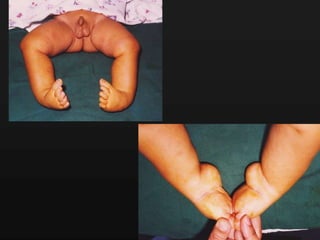
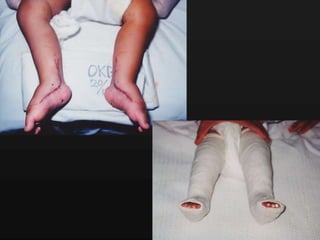
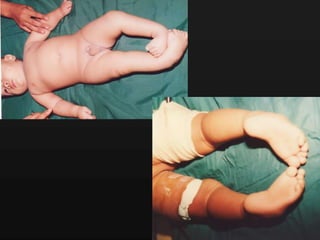
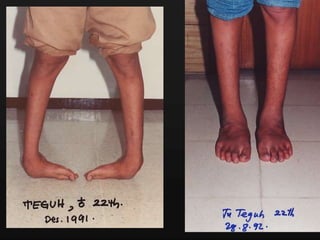
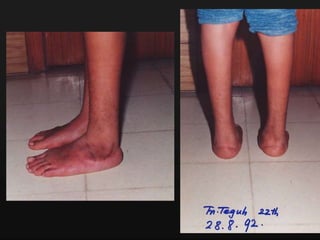
Clubfoot
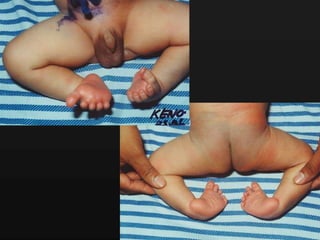
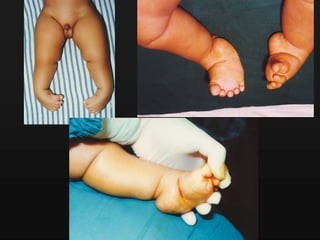
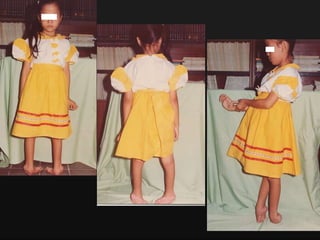
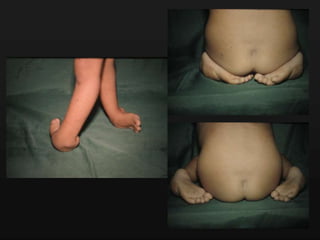
Congenital Talipes Equino Varus
(CTEV)
Definition
Twisting of the scaphoid, os calcis and
cuboid around the astragalus
Congenital Talipes Equino Varus or club foot
has 4 basic deformation:
1. fore foot : adduction
2. hind foot : inversion or varus
3. hind foot : equinus
4. mid foot : cavus
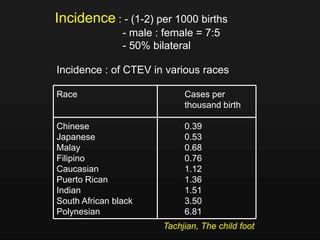
Incidence : - (1-2) per 1000 births
- male : female = 7:5
- 50% bilateral
Incidence : of CTEV in various races
Race Cases per
thousand birth
Chinese 0.39
Japanese 0.53
Malay 0.68
Filipino 0.76
Caucasian 1.12
Puerto Rican 1.36
Indian 1.51
South African black 3.50
Polynesian 6.81
Tachjian, The child foot
ETIOLOGY
 Chromosomal theory
 Embryonic theory
 Otogenic theory
 Fetal theory
 Neurological theory
 Muscular theory
ETIOLOGY
Chromosomal theory
defect : in unfertilized germ cell (defect exists
before fertilization)
ETIOLOGY
Embryonic theory
defect : within fertilized germ cell
Occurs : between conception-12 weeks (Irani,
Sherman and Settle)
ETIOLOGY
Otogenic theory (arrest theory)
arrest of development
related to a change in genetic factor known as “cronon”
Cronon : guide the precise time of the progressive
modification every structure during development
ETIOLOGY
Neurologic theory
Muscular theory
ETIOLOGY
Fetal theory (packing syndrome)
Intrauterine packing (mechanical factors)
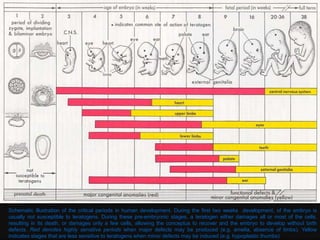
Schematic illustration of the critical periods in human development. During the first two weeks development, of the embryo is
usually not susceptible to teratogens. During these pre-embryonic stages, a teratogen either damages all or most of the cells,
resulting in its death, or damages only a few cells, allowing the conceptus to recover and the embryo to develop without birth
defects. Red denotes highly sensitive periods when major defects may be produced (e.g. amelia, absence of limbs). Yellow
indicates stages that are less sensitive to teratogens when minor defects may be induced (e.g. hypoplastic thumbs)
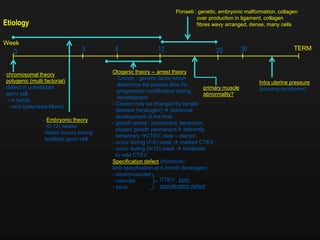
Etiology
- chromosomal theory
polygenic (multi factorial)
- defect in unfertilized
germ cell :
- in family
- race (palynesia-Maori)
Week
TERM3012850
- Embryonic theory
(0-12) weeks
defect occurs during
fertilized germ cell
Otogenic theory -- arrest theory
- Cronon : genetic factor which
determine the precise time for
progression modification during
development
- Cronon may be changed by certain
element (teratogen)  abnormal
development of the limb
- growth arrest : permanent, temporair,
slowed growth permanent deformity
temporary CTEV, slow – steroid
- occur during (7-8) week  marked CTEV
- occur during (9-12) week  moderate
to mild CTEV
Specification defect (Hoofnick)
limb specification at 5 month (teratogen)
- neuromuscular
- vascular
- bone
CTEV : post
specification defect
primary muscle
abnormality?
Intra uterine pressure
(packing syndrome)
20
Ponseti : genetic, embryonic malformation, collagen
over production in ligament, collagen
fibres wavy arranged, dense, many cells
PATHOANATOMY
 Major deformity
• Inward rotation of the whole foot on the talus
 Rotation primarily takes place in :
• talocalcaneal joint
• talonavicular joint
• calcaneocuboid joint
PATHOANATOMY
Talocrural (ankle ) joint :
• Talus in equinus
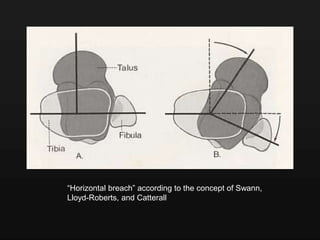
• Talus in mortise = external rotation (horizontal breach)
• Posterior = capsule & ligament contracted
“Horizontal breach” according to the concept of Swann,
Lloyd-Roberts, and Catterall
PATHOANATOMY
TALUS
 Constriction encasement
 Head & neck : medial & plantar deviation
PATHOANATOMY
TALOCALCANEAL JOINT:
Calcaneus :
rotation in 3 dimensions :
• Sagittal
• Coronal
• Horizontal
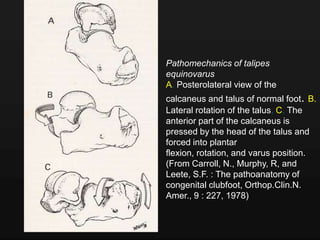
Pathomechanics of talipes
equinovarus
A. Posterolateral view of the
calcaneus and talus of normal foot. B.
Lateral rotation of the talus, C. The
anterior part of the calcaneus is
pressed by the head of the talus and
forced into plantar
flexion, rotation, and varus position.
(From Carroll, N., Murphy, R, and
Leete, S.F. : The pathoanatomy of
congenital clubfoot, Orthop.Clin.N.
Amer., 9 : 227, 1978)
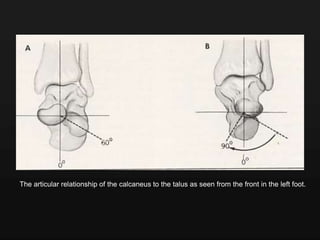
The articular relationship of the calcaneus to the talus as seen from the front in the left foot.
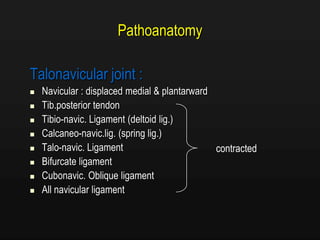
Pathoanatomy
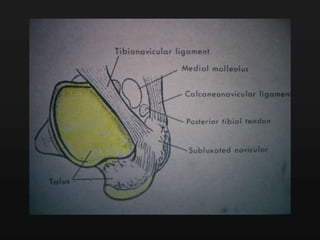
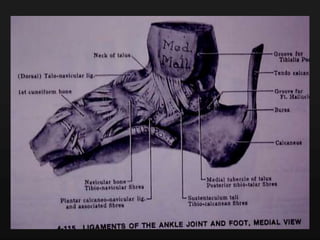
Talonavicular joint :
 Navicular : displaced medial & plantarward
 Tib.posterior tendon
 Tibio-navic. Ligament (deltoid lig.)
 Calcaneo-navic.lig. (spring lig.)
 Talo-navic. Ligament
 Bifurcate ligament
 Cubonavic. Oblique ligament
 All navicular ligament
contracted
PATHOANATOMY
Calcaneo-cuboid joint:
 Cuboid displaced medially on calcaneus and under navicular &
cuneiform
 All ligaments : contracted
 Forefoot : supination and adduction
 Calcaneo-cuboid joint corrected nicely if other 2 subtalar
complex are corrected except in resistant CTEV
PATHOANATOMY
Muscles
 Imbalance between agonist and antagonist
 Muscles tonus determined by the amount of muscle
fibres type I & II
 All muscle below knee in CTEV fibre Type I > II [similar
with L.M.N lesion : AMC, sacral agenesis, Charcot-
Marie, post poliomyelitis]
 Some CTEV tendency to be recurrent
PATHOANATOMY
Vascular
By Doppler Technique :
 In normal population : a.dorsalis pedis 2.2.% absent
 In mild & moderate CTEV : a.dorsalis pedis = normal
 In severe CTEV : a.dorsalis pedis = 6.7% absent
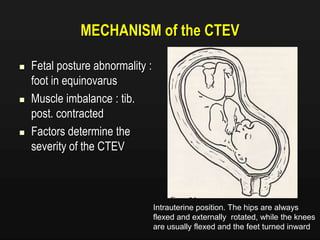
MECHANISM of the CTEV
 Fetal posture abnormality :
foot in equinovarus
 Muscle imbalance : tib.
post. contracted
 Factors determine the
severity of the CTEV
Intrauterine position. The hips are always
flexed and externally rotated, while the knees
are usually flexed and the feet turned inward
EXAMINATION
 History
 Physical examination
 Radiologic examination
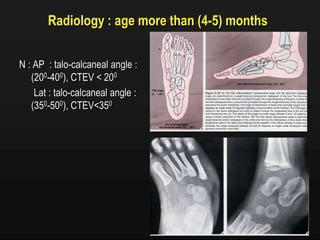
Radiology : age more than (4-5) months
N : AP : talo-calcaneal angle :
(200-400), CTEV < 200
Lat : talo-calcaneal angle :
(350-500), CTEV<350
DIAGNOSIS
1. Non rigid type (packing syndrome)
2. Rigid type :
• Moderate
• Severe
3. Resistance rigid type :
• AMC
• Myelomeningocele
• Constriction band
DIFFERENTIAL DIAGNOSIS
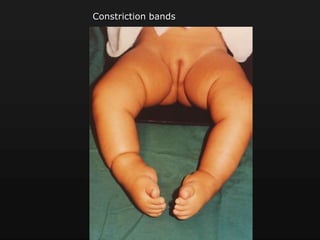
1. Constriction bands (Streeter disease)
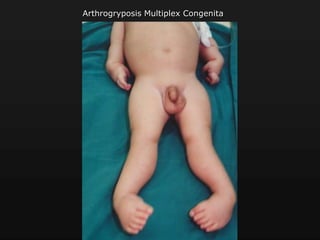
2. A.M.C
3. Myelomeningocel
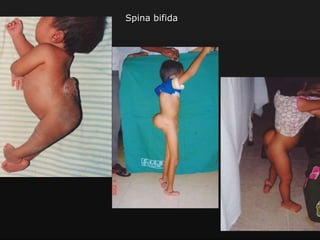
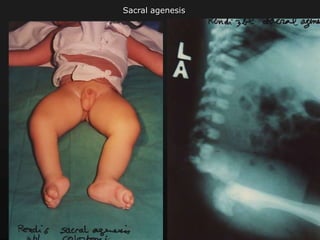
4. Sacral agenesis
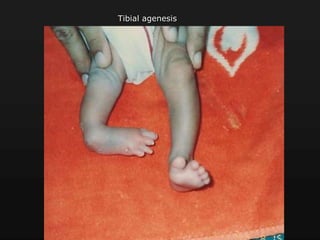
5. Tibial agenesis
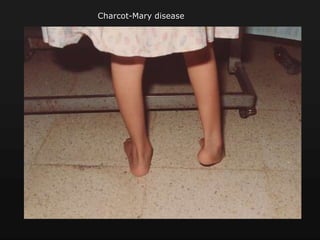
6. Charcot-Marie disease
Constriction bands
Arthrogryposis Multiplex Congenita
Spina bifida
Sacral agenesis
Tibial agenesis
Charcot-Mary disease
TREATMENT
The goal of treatment :
• Realign the os calcis, scaphoid and cuboid
around the astragalus by correcting the varus,
adduction, varus and equinus
• Maintain the correction until stable
 normal function, no pain, plantigrade, good
mobility, no callus formation, wearing normal
shoe
HISTORY
 Egyptian : tomb painting
 India (1.000 BC) : Tx
 Hippocrates (400 BC) : manipulative Tx,
early Tx
 Indian (Aztecs) Pre Columbian American
Tx : splint with cactus leaves
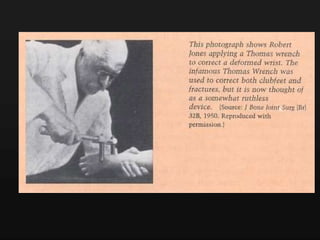
HISTORY : 20th century
Hugh Owen Thomas (1834 -1891)
Wrench
W.H. Trethewan (1882-1934) :
Thomas Wrench is a barbarous weapon
TREATMENT
1. Conservative
2. Operative
Conservative treatment
Golden period:
• 1st week
• laxity :estrogen
1. Serial plastering
2. Stretching  Dennis Brown splint
3. Adhesive strapping
4. Physiotherapy
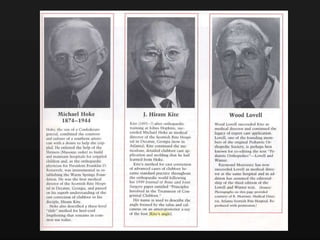
HIRAM KITE :
Brought Hippocrates’ view info focus :
Stressing slow, gentle, manipulative correction of
the adduction, varus and equinus with minimal
surgery
Three magic words for the successful and
enthusiasm carrying out his
treatment : knowledge,patience andenthusiasm
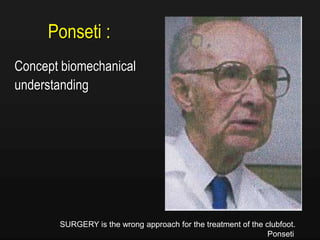
Ponseti :
Concept biomechanical
understanding
SURGERY is the wrong approach for the treatment of the clubfoot.
Ponseti
Ponseti
Based on kinematic of the subtalar joint.
1st concept : the whole foot moves under the talus “calcaneo-
pedis block”
2nd concept : fore foot and hind foot are corrected
simultaneously by abduction
Equinus correction :
• mostly close tenotomy
• tendo achilles non stretchable collagen, thick and
stiff
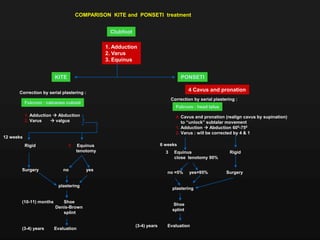
COMPARISON KITE and PONSETI treatment
Clubfoot
1. Adduction
2. Varus
3. Equinus
KITE
Fulcrum : calcaneo cuboid
Correction by serial plastering :
PONSETI
1. Adduction  Abduction
2. Varus  valgus
4 Cavus and pronation
Rigid 3 Equinus
tenotomy
Fulcrum : head talus
Correction by serial plastering :
Surgery no yes
plastering
(10-11) months Shoe
Denis-Brown
splint
(3-4) years Evaluation
3 Equinus Rigid
close tenotomy 90%
12 weeks
no =5% yes=95% Surgery
plastering
Shoe
splint
(3-4) years Evaluation
4. Cavus and pronation (realign cavus by supination)
to “unlock” subtalar movement
1. Adduction  Abduction 600-750
2. Varus : will be corrected by 4 & 1
6 weeks
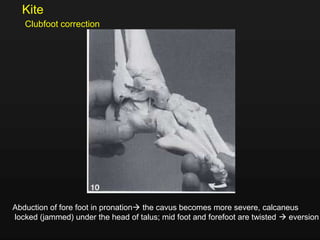
Abduction of fore foot in pronation the cavus becomes more severe, calcaneus
locked (jammed) under the head of talus; mid foot and forefoot are twisted  eversion
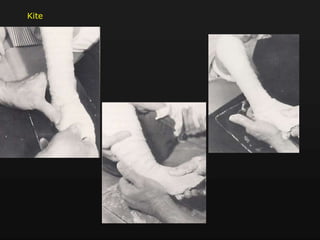
Kite
Clubfoot correction
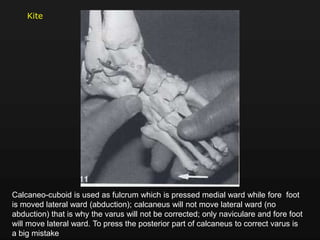
Kite
Calcaneo-cuboid is used as fulcrum which is pressed medial ward while fore foot
is moved lateral ward (abduction); calcaneus will not move lateral ward (no
abduction) that is why the varus will not be corrected; only naviculare and fore foot
will move lateral ward. To press the posterior part of calcaneus to correct varus is
a big mistake
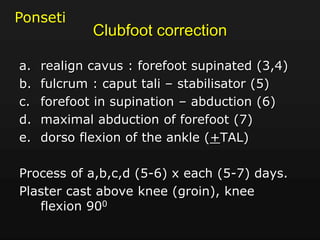
Kite
Clubfoot correction
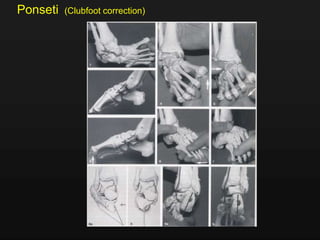
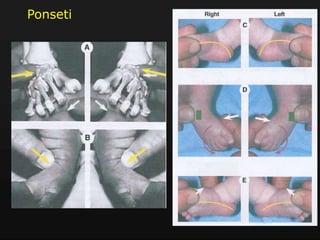
a. realign cavus : forefoot supinated (3,4)
b. fulcrum : caput tali – stabilisator (5)
c. forefoot in supination – abduction (6)
d. maximal abduction of forefoot (7)
e. dorso flexion of the ankle (+TAL)
Process of a,b,c,d (5-6) x each (5-7) days.
Plaster cast above knee (groin), knee
flexion 900
Ponseti
Ponseti (Clubfoot correction)
Ponseti
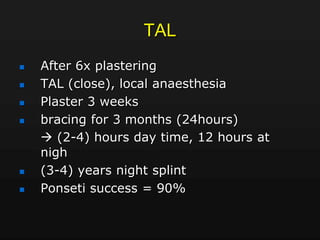
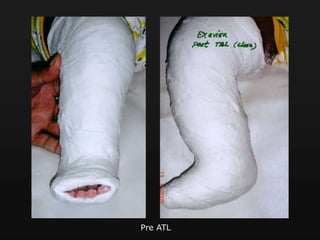
TAL
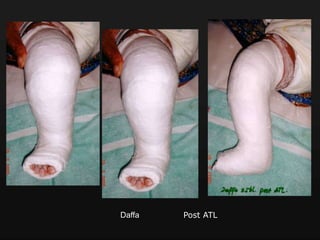
 After 6x plastering
 TAL (close), local anaesthesia
 Plaster 3 weeks
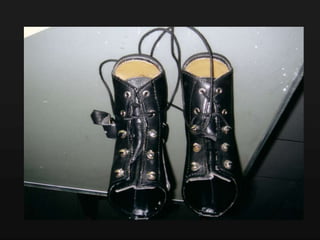
 bracing for 3 months (24hours)
 (2-4) hours day time, 12 hours at
nigh
 (3-4) years night splint
 Ponseti success = 90%
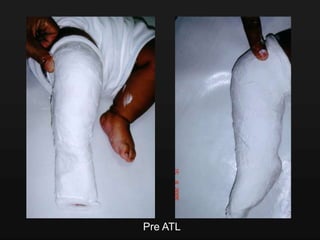
Pre ATL
Pre ATL
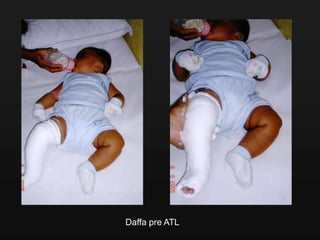
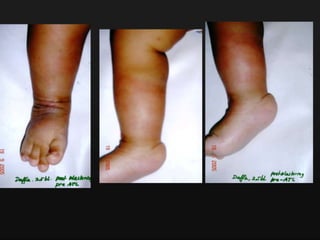
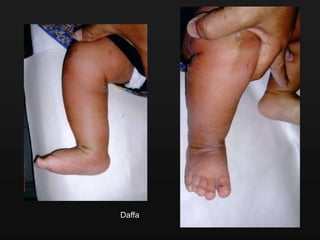
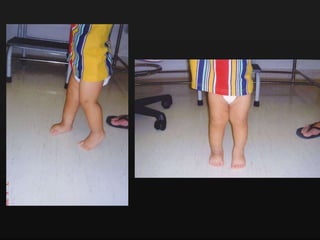
Daffa pre ATL
Daffa Post ATL
Daffa
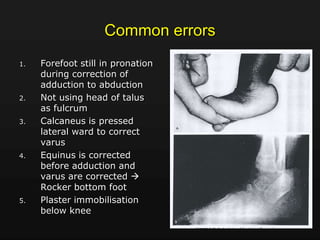
Common errors
1. Forefoot still in pronation
during correction of
adduction to abduction
2. Not using head of talus
as fulcrum
3. Calcaneus is pressed
lateral ward to correct
varus
4. Equinus is corrected
before adduction and
varus are corrected 
Rocker bottom foot
5. Plaster immobilisation
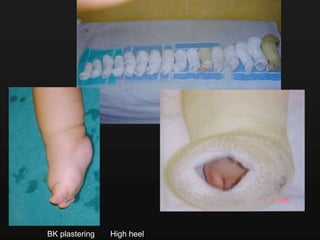
below knee
BK plastering High heel
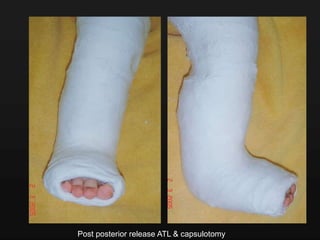
Post posterior release ATL & capsulotomy
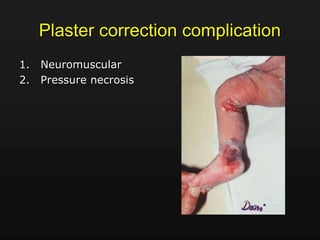
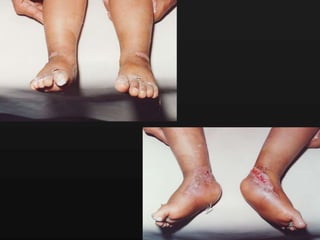
Plaster correction complication
1. Neuromuscular
2. Pressure necrosis
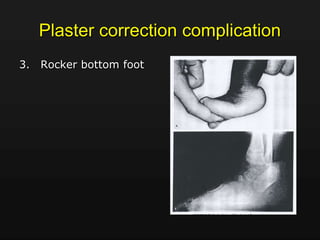
Plaster correction complication
3. Rocker bottom foot
Plaster correction complication
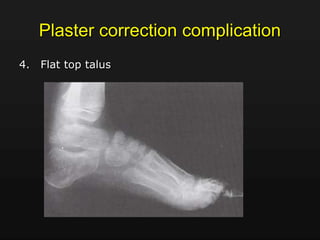
4. Flat top talus
Plaster correction complication
5. Increase cavus deformity
6. Longitudinal breach
7. Stiff joint
Operative treatment
Indication
1. Conservative Tx—fail Ponseti + 10%
2. Neglected
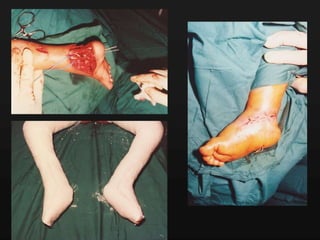
Postero medial release (Turco)
Cincinati
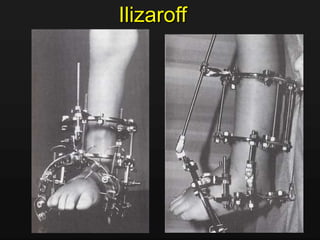
Ilizaroff
Tripple arthrodesis (adult)
Surgical complication
1. Infection
2. Bad scar
3. Stiff joint
4. Over/under correction
5. Navicular dislocation
6. Flattening or beaking talar head
7. Talar necrosis
8. Weakening of the muscles
9. Skew foot (severe valgus of the heel and adduction
of the fore foot)
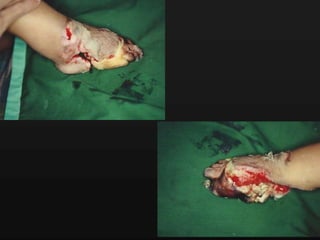
10. Main artery injury  foot necrosis
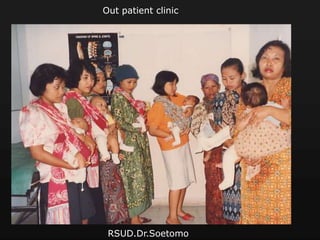
Out patient clinic
RSUD.Dr.Soetomo
Club foot ctev

Club foot ctev

  • 1.
  • 2.
    Definition Twisting of thescaphoid, os calcis and cuboid around the astragalus Congenital Talipes Equino Varus or club foot has 4 basic deformation: 1. fore foot : adduction 2. hind foot : inversion or varus 3. hind foot : equinus 4. mid foot : cavus
  • 3.
    Incidence : -(1-2) per 1000 births - male : female = 7:5 - 50% bilateral Incidence : of CTEV in various races Race Cases per thousand birth Chinese 0.39 Japanese 0.53 Malay 0.68 Filipino 0.76 Caucasian 1.12 Puerto Rican 1.36 Indian 1.51 South African black 3.50 Polynesian 6.81 Tachjian, The child foot
  • 4.
    ETIOLOGY  Chromosomal theory Embryonic theory  Otogenic theory  Fetal theory  Neurological theory  Muscular theory
  • 5.
    ETIOLOGY Chromosomal theory defect :in unfertilized germ cell (defect exists before fertilization)
  • 6.
    ETIOLOGY Embryonic theory defect :within fertilized germ cell Occurs : between conception-12 weeks (Irani, Sherman and Settle)
  • 7.
    ETIOLOGY Otogenic theory (arresttheory) arrest of development related to a change in genetic factor known as “cronon” Cronon : guide the precise time of the progressive modification every structure during development
  • 8.
  • 9.
    ETIOLOGY Fetal theory (packingsyndrome) Intrauterine packing (mechanical factors)
  • 10.
    Schematic illustration ofthe critical periods in human development. During the first two weeks development, of the embryo is usually not susceptible to teratogens. During these pre-embryonic stages, a teratogen either damages all or most of the cells, resulting in its death, or damages only a few cells, allowing the conceptus to recover and the embryo to develop without birth defects. Red denotes highly sensitive periods when major defects may be produced (e.g. amelia, absence of limbs). Yellow indicates stages that are less sensitive to teratogens when minor defects may be induced (e.g. hypoplastic thumbs)
  • 11.
    Etiology - chromosomal theory polygenic(multi factorial) - defect in unfertilized germ cell : - in family - race (palynesia-Maori) Week TERM3012850 - Embryonic theory (0-12) weeks defect occurs during fertilized germ cell Otogenic theory -- arrest theory - Cronon : genetic factor which determine the precise time for progression modification during development - Cronon may be changed by certain element (teratogen)  abnormal development of the limb - growth arrest : permanent, temporair, slowed growth permanent deformity temporary CTEV, slow – steroid - occur during (7-8) week  marked CTEV - occur during (9-12) week  moderate to mild CTEV Specification defect (Hoofnick) limb specification at 5 month (teratogen) - neuromuscular - vascular - bone CTEV : post specification defect primary muscle abnormality? Intra uterine pressure (packing syndrome) 20 Ponseti : genetic, embryonic malformation, collagen over production in ligament, collagen fibres wavy arranged, dense, many cells
  • 12.
    PATHOANATOMY  Major deformity •Inward rotation of the whole foot on the talus  Rotation primarily takes place in : • talocalcaneal joint • talonavicular joint • calcaneocuboid joint
  • 13.
    PATHOANATOMY Talocrural (ankle )joint : • Talus in equinus • Talus in mortise = external rotation (horizontal breach) • Posterior = capsule & ligament contracted
  • 14.
    “Horizontal breach” accordingto the concept of Swann, Lloyd-Roberts, and Catterall
  • 15.
    PATHOANATOMY TALUS  Constriction encasement Head & neck : medial & plantar deviation
  • 16.
    PATHOANATOMY TALOCALCANEAL JOINT: Calcaneus : rotationin 3 dimensions : • Sagittal • Coronal • Horizontal
  • 17.
    Pathomechanics of talipes equinovarus A.Posterolateral view of the calcaneus and talus of normal foot. B. Lateral rotation of the talus, C. The anterior part of the calcaneus is pressed by the head of the talus and forced into plantar flexion, rotation, and varus position. (From Carroll, N., Murphy, R, and Leete, S.F. : The pathoanatomy of congenital clubfoot, Orthop.Clin.N. Amer., 9 : 227, 1978)
  • 18.
    The articular relationshipof the calcaneus to the talus as seen from the front in the left foot.
  • 19.
    Pathoanatomy Talonavicular joint : Navicular : displaced medial & plantarward  Tib.posterior tendon  Tibio-navic. Ligament (deltoid lig.)  Calcaneo-navic.lig. (spring lig.)  Talo-navic. Ligament  Bifurcate ligament  Cubonavic. Oblique ligament  All navicular ligament contracted
  • 22.
    PATHOANATOMY Calcaneo-cuboid joint:  Cuboiddisplaced medially on calcaneus and under navicular & cuneiform  All ligaments : contracted  Forefoot : supination and adduction  Calcaneo-cuboid joint corrected nicely if other 2 subtalar complex are corrected except in resistant CTEV
  • 23.
    PATHOANATOMY Muscles  Imbalance betweenagonist and antagonist  Muscles tonus determined by the amount of muscle fibres type I & II  All muscle below knee in CTEV fibre Type I > II [similar with L.M.N lesion : AMC, sacral agenesis, Charcot- Marie, post poliomyelitis]  Some CTEV tendency to be recurrent
  • 24.
    PATHOANATOMY Vascular By Doppler Technique:  In normal population : a.dorsalis pedis 2.2.% absent  In mild & moderate CTEV : a.dorsalis pedis = normal  In severe CTEV : a.dorsalis pedis = 6.7% absent
  • 25.
    MECHANISM of theCTEV  Fetal posture abnormality : foot in equinovarus  Muscle imbalance : tib. post. contracted  Factors determine the severity of the CTEV Intrauterine position. The hips are always flexed and externally rotated, while the knees are usually flexed and the feet turned inward
  • 26.
    EXAMINATION  History  Physicalexamination  Radiologic examination
  • 33.
    Radiology : agemore than (4-5) months N : AP : talo-calcaneal angle : (200-400), CTEV < 200 Lat : talo-calcaneal angle : (350-500), CTEV<350
  • 34.
    DIAGNOSIS 1. Non rigidtype (packing syndrome) 2. Rigid type : • Moderate • Severe 3. Resistance rigid type : • AMC • Myelomeningocele • Constriction band
  • 35.
    DIFFERENTIAL DIAGNOSIS 1. Constrictionbands (Streeter disease) 2. A.M.C 3. Myelomeningocel 4. Sacral agenesis 5. Tibial agenesis 6. Charcot-Marie disease
  • 36.
  • 37.
  • 38.
  • 39.
  • 40.
  • 41.
  • 42.
    TREATMENT The goal oftreatment : • Realign the os calcis, scaphoid and cuboid around the astragalus by correcting the varus, adduction, varus and equinus • Maintain the correction until stable  normal function, no pain, plantigrade, good mobility, no callus formation, wearing normal shoe
  • 43.
    HISTORY  Egyptian :tomb painting  India (1.000 BC) : Tx  Hippocrates (400 BC) : manipulative Tx, early Tx  Indian (Aztecs) Pre Columbian American Tx : splint with cactus leaves
  • 44.
    HISTORY : 20thcentury Hugh Owen Thomas (1834 -1891) Wrench
  • 46.
    W.H. Trethewan (1882-1934): Thomas Wrench is a barbarous weapon
  • 47.
  • 48.
    Conservative treatment Golden period: •1st week • laxity :estrogen 1. Serial plastering 2. Stretching  Dennis Brown splint 3. Adhesive strapping 4. Physiotherapy
  • 49.
    HIRAM KITE : BroughtHippocrates’ view info focus : Stressing slow, gentle, manipulative correction of the adduction, varus and equinus with minimal surgery Three magic words for the successful and enthusiasm carrying out his treatment : knowledge,patience andenthusiasm
  • 51.
    Ponseti : Concept biomechanical understanding SURGERYis the wrong approach for the treatment of the clubfoot. Ponseti
  • 52.
    Ponseti Based on kinematicof the subtalar joint. 1st concept : the whole foot moves under the talus “calcaneo- pedis block” 2nd concept : fore foot and hind foot are corrected simultaneously by abduction Equinus correction : • mostly close tenotomy • tendo achilles non stretchable collagen, thick and stiff
  • 53.
    COMPARISON KITE andPONSETI treatment Clubfoot 1. Adduction 2. Varus 3. Equinus KITE Fulcrum : calcaneo cuboid Correction by serial plastering : PONSETI 1. Adduction  Abduction 2. Varus  valgus 4 Cavus and pronation Rigid 3 Equinus tenotomy Fulcrum : head talus Correction by serial plastering : Surgery no yes plastering (10-11) months Shoe Denis-Brown splint (3-4) years Evaluation 3 Equinus Rigid close tenotomy 90% 12 weeks no =5% yes=95% Surgery plastering Shoe splint (3-4) years Evaluation 4. Cavus and pronation (realign cavus by supination) to “unlock” subtalar movement 1. Adduction  Abduction 600-750 2. Varus : will be corrected by 4 & 1 6 weeks
  • 54.
    Abduction of forefoot in pronation the cavus becomes more severe, calcaneus locked (jammed) under the head of talus; mid foot and forefoot are twisted  eversion Kite Clubfoot correction
  • 55.
  • 56.
    Calcaneo-cuboid is usedas fulcrum which is pressed medial ward while fore foot is moved lateral ward (abduction); calcaneus will not move lateral ward (no abduction) that is why the varus will not be corrected; only naviculare and fore foot will move lateral ward. To press the posterior part of calcaneus to correct varus is a big mistake Kite
  • 57.
    Clubfoot correction a. realigncavus : forefoot supinated (3,4) b. fulcrum : caput tali – stabilisator (5) c. forefoot in supination – abduction (6) d. maximal abduction of forefoot (7) e. dorso flexion of the ankle (+TAL) Process of a,b,c,d (5-6) x each (5-7) days. Plaster cast above knee (groin), knee flexion 900 Ponseti
  • 58.
  • 59.
  • 60.
    TAL  After 6xplastering  TAL (close), local anaesthesia  Plaster 3 weeks  bracing for 3 months (24hours)  (2-4) hours day time, 12 hours at nigh  (3-4) years night splint  Ponseti success = 90%
  • 62.
  • 63.
  • 64.
  • 66.
  • 67.
  • 69.
    Common errors 1. Forefootstill in pronation during correction of adduction to abduction 2. Not using head of talus as fulcrum 3. Calcaneus is pressed lateral ward to correct varus 4. Equinus is corrected before adduction and varus are corrected  Rocker bottom foot 5. Plaster immobilisation below knee
  • 70.
  • 71.
    Post posterior releaseATL & capsulotomy
  • 73.
    Plaster correction complication 1.Neuromuscular 2. Pressure necrosis
  • 74.
  • 75.
  • 76.
    Plaster correction complication 5.Increase cavus deformity 6. Longitudinal breach 7. Stiff joint
  • 77.
    Operative treatment Indication 1. ConservativeTx—fail Ponseti + 10% 2. Neglected
  • 78.
  • 81.
  • 85.
  • 86.
  • 89.
    Surgical complication 1. Infection 2.Bad scar 3. Stiff joint 4. Over/under correction 5. Navicular dislocation 6. Flattening or beaking talar head 7. Talar necrosis 8. Weakening of the muscles 9. Skew foot (severe valgus of the heel and adduction of the fore foot) 10. Main artery injury  foot necrosis
  • 91.