Histology  of  Cartilage
CARTILAGE
CARTILAGE
CARTILAGE
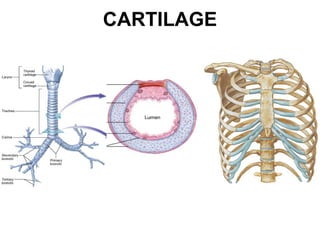
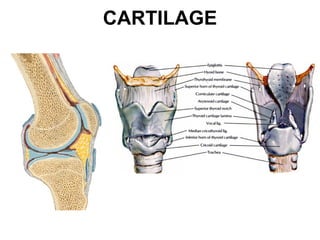
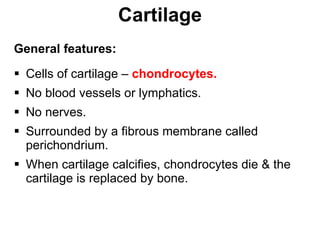
Cartilage General features: Cells of cartilage –  chondrocytes.   No blood vessels or lymphatics. No nerves. Surrounded by a fibrous membrane called perichondrium. When cartilage calcifies, chondrocytes die & the cartilage is replaced by bone.
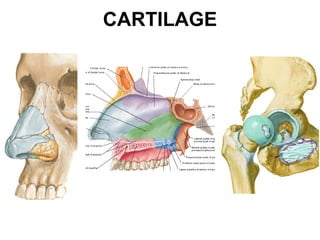
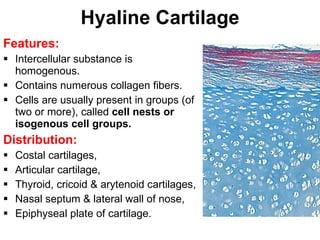
Hyaline Cartilage Features: Intercellular substance is homogenous. Contains numerous collagen fibers. Cells are usually present in groups (of two or more), called  cell nests or isogenous cell groups. Distribution: Costal cartilages, Articular cartilage, Thyroid, cricoid & arytenoid cartilages, Nasal septum & lateral wall of nose, Epiphyseal plate of cartilage.
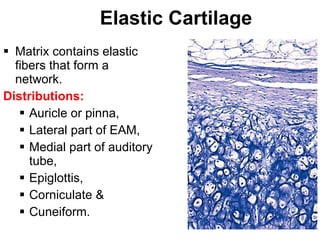
Elastic Cartilage Matrix contains elastic fibers that form a network. Distributions: Auricle or pinna, Lateral part of EAM, Medial part of auditory tube, Epiglottis, Corniculate &  Cuneiform.
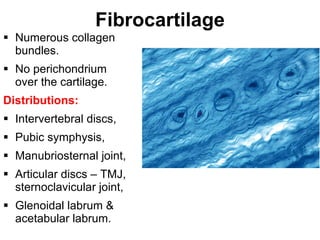
Fibrocartilage Numerous collagen bundles. No perichondrium over the cartilage. Distributions: Intervertebral discs, Pubic symphysis, Manubriosternal joint, Articular discs – TMJ, sternoclavicular joint, Glenoidal labrum & acetabular labrum.
BONE - I
Functions of bone Give shape & support to the body & resist all forms of stress. Provide surface for the attachment of muscles, tendons, ligaments, etc. Serve as levers for muscular actions. Protect visceral organs. Bone marrow manufactures blood cells. Store 97% of the body calcium & phosphorus. Bone marrow contains R-E cells. Paranasal air sinuses affect the timber of the voice
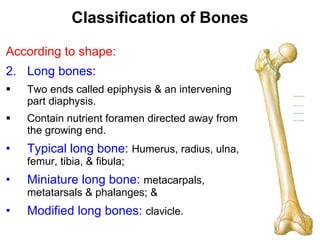
Classification of Bones According to shape: Long bones: Two ends called epiphysis & an intervening part diaphysis. Contain nutrient foramen directed away from the growing end. Typical long bone:   Humerus, radius, ulna, femur, tibia, & fibula;  Miniature long bone:  metacarpals, metatarsals & phalanges; & Modified long bones:  clavicle.
 
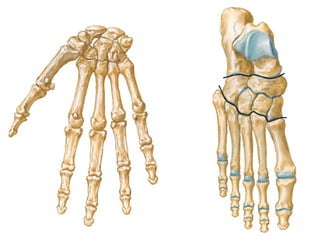
2. Short bones:  Shape is cuboid, cuneiform, trapezoid, or scaphoid. Carpal & tarsal bones.
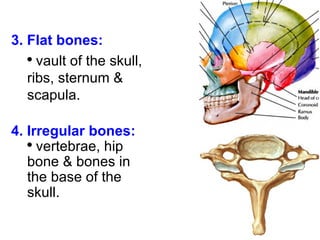
3. Flat bones:  vault of the skull, ribs, sternum & scapula. 4. Irregular bones: vertebrae, hip bone & bones in the base of the skull.
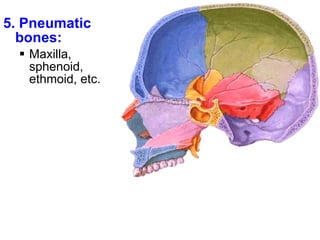
5. Pneumatic bones: Maxilla, sphenoid, ethmoid, etc.
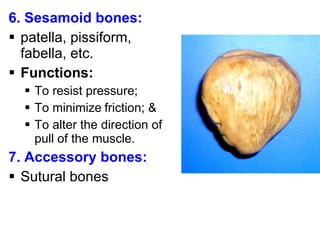
6. Sesamoid bones: patella, pissiform, fabella, etc. Functions: To resist pressure; To minimize friction; & To alter the direction of pull of the muscle. 7. Accessory bones:  Sutural bones
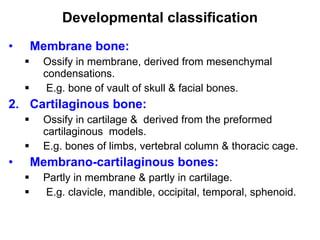
Developmental classification Membrane bone:   Ossify in membrane, derived from mesenchymal condensations. E.g. bone of vault of skull & facial bones. Cartilaginous bone:  Ossify in cartilage &  derived from the preformed cartilaginous  models.  E.g. bones of limbs, vertebral column & thoracic cage. Membrano-cartilaginous bones:   Partly in membrane & partly in cartilage. E.g. clavicle, mandible, occipital, temporal, sphenoid.
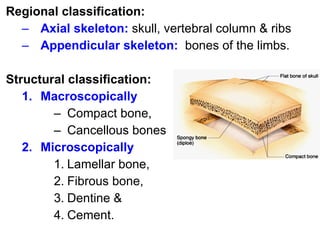
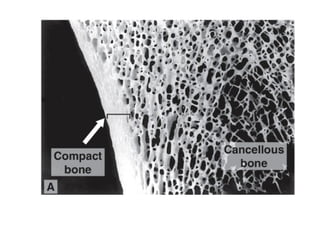
Regional classification: Axial skeleton:   skull, vertebral column & ribs  Appendicular skeleton:   bones of the limbs. Structural classification: Macroscopically Compact bone,  Cancellous bones Microscopically Lamellar bone, Fibrous bone, Dentine &  Cement.
 
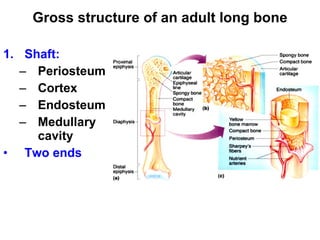
Gross structure of an adult long bone Shaft: Periosteum Cortex Endosteum Medullary cavity  Two ends
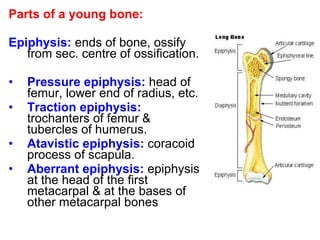
Parts of a young bone: Epiphysis:  ends of bone, ossify from sec. centre of ossification. Pressure epiphysis:  head of femur, lower end of radius, etc. Traction epiphysis:  trochanters of femur & tubercles of humerus. Atavistic epiphysis:  coracoid process of scapula. Aberrant epiphysis:  epiphysis at the head of the first metacarpal & at the bases of other metacarpal bones
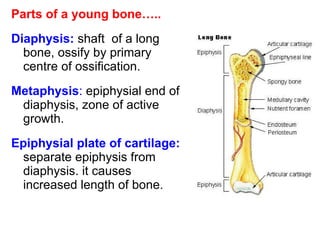
Parts of a young bone….. Diaphysis:  shaft  of a long bone, ossify by primary centre of ossification. Metaphysis :  epiphysial end of diaphysis, zone of active growth. Epiphysial plate of cartilage:  separate epiphysis from diaphysis. it causes increased length of bone.
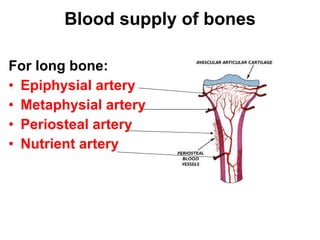
Blood supply of bones For long bone:  Epiphysial artery Metaphysial artery Periosteal artery Nutrient artery
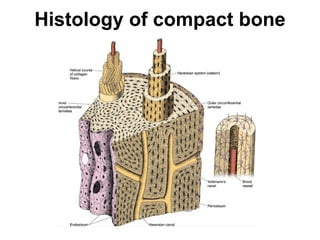
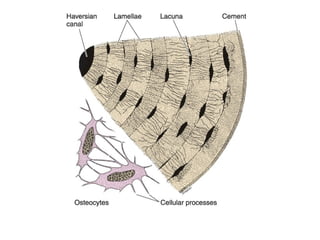
Histology of  compact bone
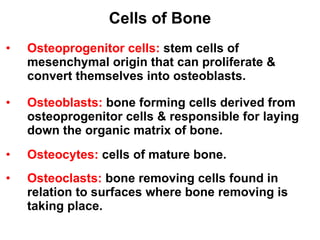
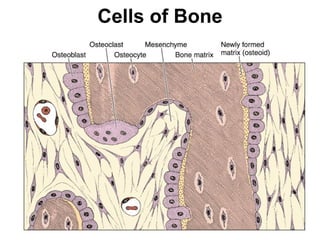
Cells of Bone Osteoprogenitor cells:  stem cells of mesenchymal origin that can proliferate & convert themselves into osteoblasts. Osteoblasts:  bone forming cells derived from osteoprogenitor cells & responsible for laying down the organic matrix of bone. Osteocytes:  cells of mature bone. Osteoclasts:  bone removing cells found in relation to surfaces where bone removing is taking place.
Cells of Bone
Histology of compact bone
 

Cartilage & bone, mbbs 1st year

  • 1.
    Histology of Cartilage
  • 2.
  • 3.
  • 4.
  • 5.
    Cartilage General features:Cells of cartilage – chondrocytes. No blood vessels or lymphatics. No nerves. Surrounded by a fibrous membrane called perichondrium. When cartilage calcifies, chondrocytes die & the cartilage is replaced by bone.
  • 6.
    Hyaline Cartilage Features:Intercellular substance is homogenous. Contains numerous collagen fibers. Cells are usually present in groups (of two or more), called cell nests or isogenous cell groups. Distribution: Costal cartilages, Articular cartilage, Thyroid, cricoid & arytenoid cartilages, Nasal septum & lateral wall of nose, Epiphyseal plate of cartilage.
  • 7.
    Elastic Cartilage Matrixcontains elastic fibers that form a network. Distributions: Auricle or pinna, Lateral part of EAM, Medial part of auditory tube, Epiglottis, Corniculate & Cuneiform.
  • 8.
    Fibrocartilage Numerous collagenbundles. No perichondrium over the cartilage. Distributions: Intervertebral discs, Pubic symphysis, Manubriosternal joint, Articular discs – TMJ, sternoclavicular joint, Glenoidal labrum & acetabular labrum.
  • 9.
  • 10.
    Functions of boneGive shape & support to the body & resist all forms of stress. Provide surface for the attachment of muscles, tendons, ligaments, etc. Serve as levers for muscular actions. Protect visceral organs. Bone marrow manufactures blood cells. Store 97% of the body calcium & phosphorus. Bone marrow contains R-E cells. Paranasal air sinuses affect the timber of the voice
  • 11.
    Classification of BonesAccording to shape: Long bones: Two ends called epiphysis & an intervening part diaphysis. Contain nutrient foramen directed away from the growing end. Typical long bone: Humerus, radius, ulna, femur, tibia, & fibula; Miniature long bone: metacarpals, metatarsals & phalanges; & Modified long bones: clavicle.
  • 12.
  • 13.
    2. Short bones: Shape is cuboid, cuneiform, trapezoid, or scaphoid. Carpal & tarsal bones.
  • 14.
    3. Flat bones: vault of the skull, ribs, sternum & scapula. 4. Irregular bones: vertebrae, hip bone & bones in the base of the skull.
  • 15.
    5. Pneumatic bones:Maxilla, sphenoid, ethmoid, etc.
  • 16.
    6. Sesamoid bones:patella, pissiform, fabella, etc. Functions: To resist pressure; To minimize friction; & To alter the direction of pull of the muscle. 7. Accessory bones: Sutural bones
  • 17.
    Developmental classification Membranebone: Ossify in membrane, derived from mesenchymal condensations. E.g. bone of vault of skull & facial bones. Cartilaginous bone: Ossify in cartilage & derived from the preformed cartilaginous models. E.g. bones of limbs, vertebral column & thoracic cage. Membrano-cartilaginous bones: Partly in membrane & partly in cartilage. E.g. clavicle, mandible, occipital, temporal, sphenoid.
  • 18.
    Regional classification: Axialskeleton: skull, vertebral column & ribs Appendicular skeleton: bones of the limbs. Structural classification: Macroscopically Compact bone, Cancellous bones Microscopically Lamellar bone, Fibrous bone, Dentine & Cement.
  • 19.
  • 20.
    Gross structure ofan adult long bone Shaft: Periosteum Cortex Endosteum Medullary cavity Two ends
  • 21.
    Parts of ayoung bone: Epiphysis: ends of bone, ossify from sec. centre of ossification. Pressure epiphysis: head of femur, lower end of radius, etc. Traction epiphysis: trochanters of femur & tubercles of humerus. Atavistic epiphysis: coracoid process of scapula. Aberrant epiphysis: epiphysis at the head of the first metacarpal & at the bases of other metacarpal bones
  • 22.
    Parts of ayoung bone….. Diaphysis: shaft of a long bone, ossify by primary centre of ossification. Metaphysis : epiphysial end of diaphysis, zone of active growth. Epiphysial plate of cartilage: separate epiphysis from diaphysis. it causes increased length of bone.
  • 23.
    Blood supply ofbones For long bone: Epiphysial artery Metaphysial artery Periosteal artery Nutrient artery
  • 24.
    Histology of compact bone
  • 25.
    Cells of BoneOsteoprogenitor cells: stem cells of mesenchymal origin that can proliferate & convert themselves into osteoblasts. Osteoblasts: bone forming cells derived from osteoprogenitor cells & responsible for laying down the organic matrix of bone. Osteocytes: cells of mature bone. Osteoclasts: bone removing cells found in relation to surfaces where bone removing is taking place.
  • 26.
  • 27.
  • 28.