Skeleton system
Group 9
Human skeleton
 Human skeletal system consist of 206 bones
 Parts of the skeletal system include
-Bones (skeleton)
-Joints
-Cartilages
-Ligaments
 skeletal system can be divided into 2 parts
 Axial skeleton
 Appendicular skeleton
Functions
 Movement
 Support
 Protection
 Blood cell production and storage
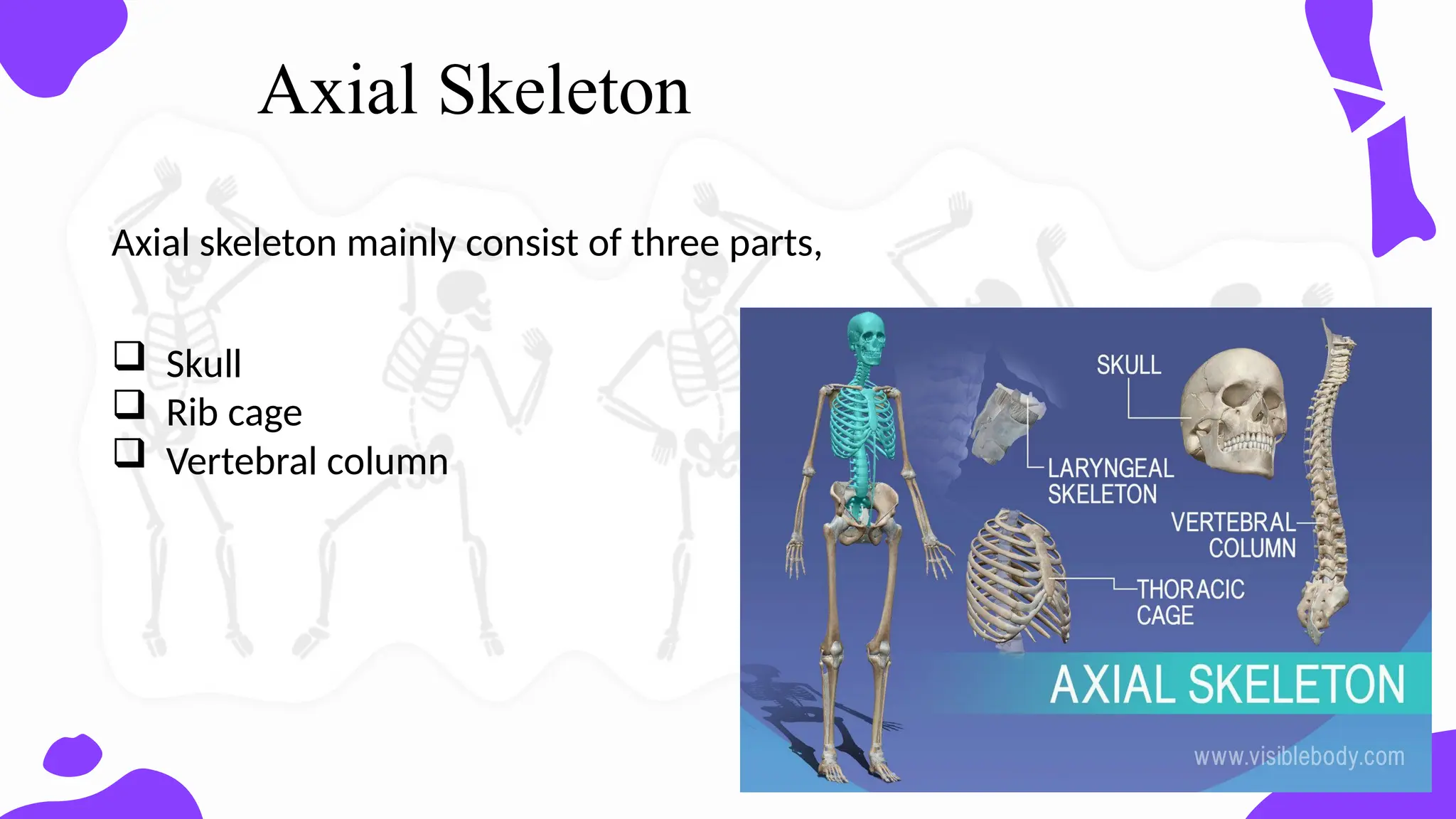
Axial Skeleton
Axial skeleton mainly consist of three parts,
 Skull
 Rib cage
 Vertebral column
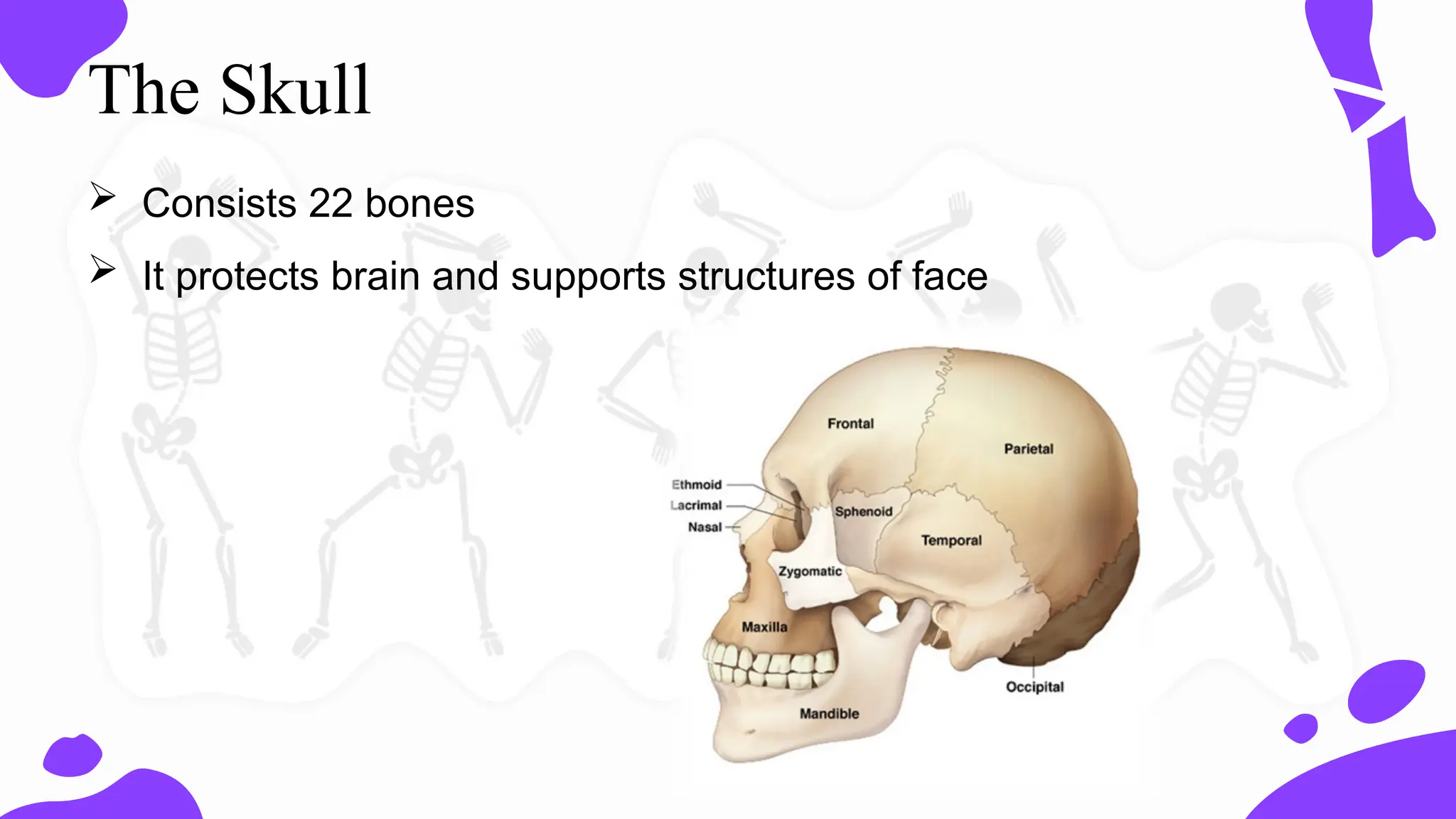
The Skull
 Consists 22 bones
 It protects brain and supports structures of face
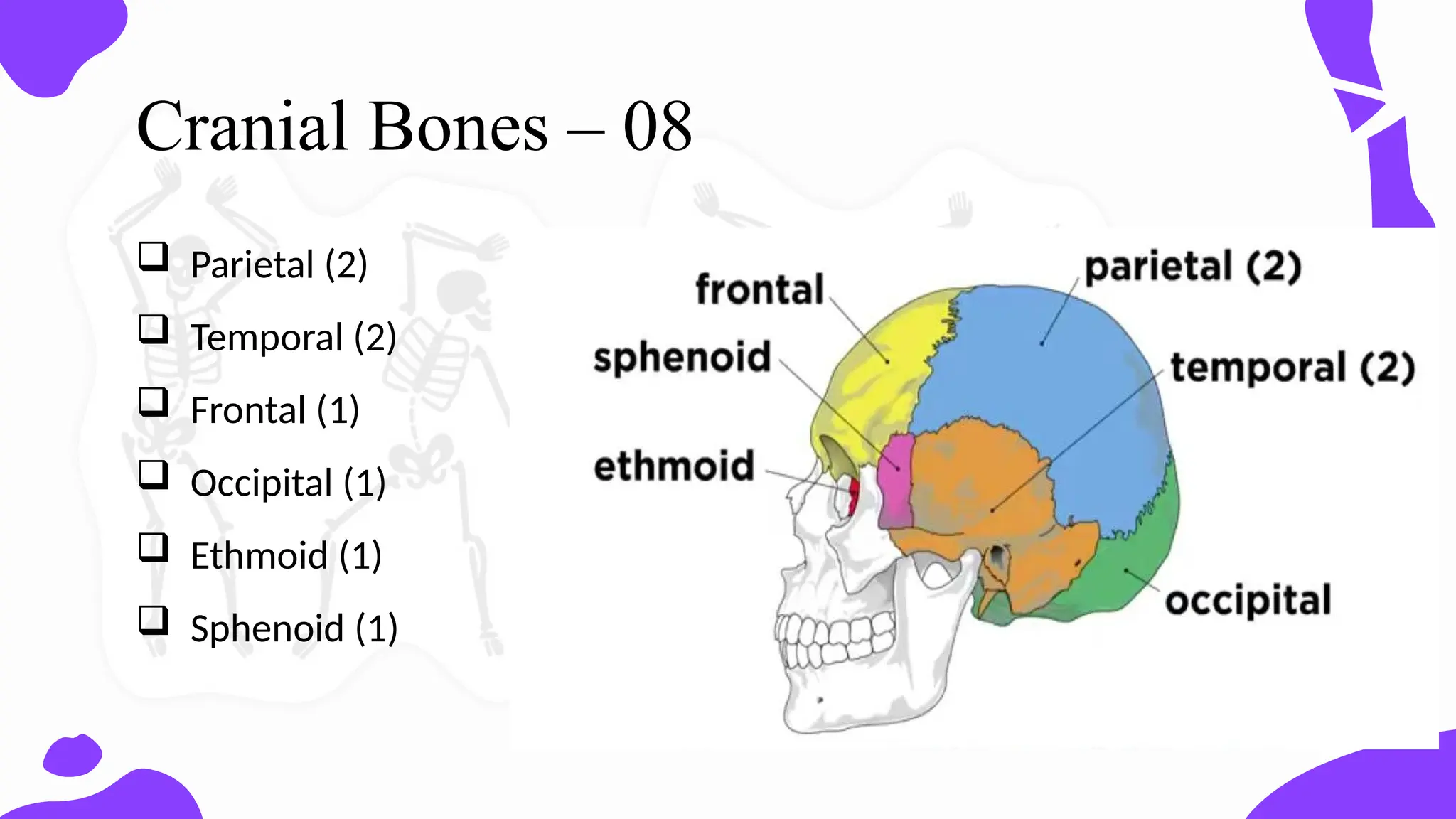
Cranial Bones – 08
 Parietal (2)
 Temporal (2)
 Frontal (1)
 Occipital (1)
 Ethmoid (1)
 Sphenoid (1)
Facial Bones – 14
 Maxilla (2)
 Zygomatic (2)
 Mandible (1)
 Nasal (2)
 Platine (2)
 Inferior nasal concha (2)
 Lacrimal (2)
 Vomer (1)
Thorax
Made-up of three parts,
 Sternum
 Ribs
 Thoracic vertebrae
Vertebral Column
Before Adulthood , 33-34 vertebrae
Cervical - 7 vertebrae(C1-C7)
 Thoracic - 12 vertebrae (T1- T12)
 Lumbar - 5 vertebrae (L1-L5)
 Sacrum - 5 (fused) vertebrae (S1-S5)
 Соссух - 4 (3-5) (fused) vertebrae
 Adult vertebral column - 26 vertebrae
Appendicular skeleton
 Consist of 126 bones
 Includes ,
 Shoulder griddle/pectoral girdle
 Upper limb /upper extremities
 Pelvis/ pectoral girdle
 Lowe limb/ Lower extremities
Shoulder girdle
Composed of two bones,
 Clavicle – collarbone
 Scapula – shoulder blade
Upper limb
 The arm is formed by a single bone
Humerus
 The forearm has two bones
Ulna
Radius
 The hand
Carpals – wrist
Metacarpals – palm
Phalanges – fingers
Pelvic girdle
Hip bones
Composed of three pair of fused bones,
 Ilium
 Ischium
 Pubic bone
Lower limb
 The thigh has one bone
Femur – thigh bone
 The leg has two bones
Tibia
Fibula
 The foot
Tarsus – ankle
Metatarsals – sole
Phalanges – toes
Classification of bones
1.According to the shape,
 Long bone
 Short bone
 Flat bone
 Irregular bone
 Sesamoid bone
Long bone
Typically longer than wide
Have a shaft with heads at both ends
Contain mostly compact bone
Examples:
 Femur, tibia, fibula, humerus, radius
Short bones
 Generally cube-shape
 Contain mostly spongy bone
 Examples: Carpals , tarsals
Flat bones
Thin and flattened
Usually curved
Thin layers of compact bone around a layer of spongy bone
 Examples; Skull, ribs, sternum
Sesamoid bone
Bones embedded in tendons
 Examples: patella (knee cap) ,pisiform (of the wrist) ,Epiphysis
2.According to the bone tissue
 Compact bone
 Spongy bone
Compact bone (Cortical bone)
 Osseous tissue is arranged in osteons/ Haversian systems (structural
unit of compact bone)
 Osteons
 Each osteon is a compact cylinder of concentric bone layers- lamellae
 surrounds a central canal – Harversian canal
 Osteocytes are found on the edges of each lamella
 Cells in - lacunae
 Cyptoplasmic extensions - in canaliculi
 Central canal /Haversian canal contains blood vessels, lymph vessels, and
nerves
 Volkmann’s canals / perforating canals run at right angles connect the
adjacent osteons together (Also contain blood vessels, lymph vessels &
nerves)
 No osteons at the outer edges of compact bone
 Osseous tissue arranged in circumferential lamellae
Spongy bone (Cancellous bone)
 Light, porous bone enclosing numerous large spaces
 Osseous tissue is arranged into trabeculae
 (3dimensional latticework of bony processes)
 Within a single trabecular:
 concentric lamellae , with osteocytes in lacunae connected to one
another via in canaliculi
 The spaces between trabeculae are often filled with bone marrow and
blood vessels
 Found in most areas of bone that are not subject to great mechanical
stress
 ends of long bones (epiphyses)
 near joints
 interior of vertebrae
 Cancellous bone is usually surrounded by a shell of compact bone
 provides greater strength and rigidity
Bone cells
 Osteogenic cells
Stem cells that give rise to other bone cells
 Osteoblasts
 Bone forming cells
 Synthesize soft organic bone matrix
 Hardens later by deposition of minerals
[calcification/ ossification)
 Osteoclasts
Responsible for bone resorption
Large, multi nucleated cells
 Osteocytes
Capable of bone deposition and resorption
Able to sense mechanical stresses to bone
Control the activity of osteoblasts and osteoclasts as necessary
Bone remodeling
levels in blood
Helps in regulating Calcium and phosphate levels in the body
Bone formation & growth
 In embryos, the skeleton is primarily hyaline
cartilage
 During development, much of this cartilage is
replaced by bone.
 Cartilage remains in isolated areas
-Bridge of the nose
-Parts of ribs
-Joints
 Bones form later by 2 mechanisms;
1. Intramembranous ossification
2. Endochondral ossification
1.Bone develops directly from sheets of mesenchymal (undifferentiated) connective tissue
2.Differentiate into capillaries & osteogenic cells
3.Early osteoblasts appear in a cluster (ossification centre)
4.Secrete uncalcified matrix (osteoid )
5. Osteoid
6.Undergo calcification
7.Network of bone trabeculae is formed (Woven bone)
8.Mesenchyme condenses to form the periosteum
9.Trabeculae just deep to the periosteum thicken & converted to compact bone
Intramembranous ossification
Bones formed by Intramembranous ossification (Intramembranous bone)
 Flat bones of the face
 Most of the cranial bones
 Clavicles
Endochondral ossification
 Template of the bone is laid down by hyaline cartilage
 Bone develops by replacing hyaline cartilage Most of the long bones are endochondral bones
 Mesenchymal Form cells differentiate into chondroblasts
 Form the hyaline cartilaginous precursors of the Bones
 Blood vessels in the perichondrium bring osteoblasts to the edges of the structure
 Deposit bone in a ring around the diaphysis (Bone collar)
 Chondrocyte Blood death and disintegration the of cartilage in the centre of the structure
 Blood Vessels penetrate the resulting Spaces
 Spacrs enlarge form medullary cavity
 Invaded by bone forming cells
 Deposit bone in the medullary cavity (Primary ossification centre)
 Cartilage continue to grows at ends of the structure (the future epiphyses)
 Increase the length of the structure
 After birth, same process takes place in the epiphyseal regions (Secondary ossification
centre)
 Thin plate of hyaline cartilage remains between the diaphysis and epiphysis throughout the
childhood and adolescence – epiphyseal plate
Joints
 Functional Classification
-Synarthrosis - immovable
-Amphiarthrosis – slightly movable
-Diarthrosis – freely movable
 Structural Classification
- Fibrous bones - connected by fibrous tissue
- Cartilaginous – bones connected by cartilage
- Synovial – articulating surfaces enclosed within fluid filled joint capsule
Venus has a beautiful name and is the
second planet from the Sun. It’s terribly hot,
even hotter than Mercury, and its
atmosphere is extremely poisonous. It’s the
second-brightest natural object in the night
sky after the Moon
Fibrous joint
 The two bony surfaces involved are separated by
fibrous tissue
 Movement is negligible
Types,
Sutures of the skull
 Distal tibiofibular join- syndesmosis
 Gomphosis
Cartilaginous joints
 Bones are united by fibrocartilage or hyaline cartilage
 Primary cartilaginous
(synchondrosis)
 Bone and hyaline cartilage meet
 Completely immobile
Types,
– Ossifying hyaline cartilage in the epiphysis
– Junctions between the ribs and the costal
Synovial joints
You can enter a subtitle here if you need it
Type of synovial joint Features Examples
Plane joints Two articular
surfaces are flat or
slightly convex or
concave
Joints between the
articular processes of
the vertebrae
Some carpal joints
Some tarsal joints
Hinge joints Permits movements
in one plane
Interphalangeal joints
Elbow joint
Knee joint
Ankle joint
Pivot joints Formed by a central
bony pivot
surrounded by a bony
ligamentous ring
Proximal and distal
radio ulna joint
Atlantoaxial joint
Saddle joints Articular surfaces are
concave-covex
Carpometacapal joint
of thumb
Ellipsoidal joints Ovoid articular
surface or condyle,
articulates with a
elliptical cavity
Wrist joint
Metacarpophalangeal
joint
Metatarsophalangeal
joint
Ball and socket Globular head in toa
cup–like cavity
Hip joint
Shoulder joint
Common Skeletal System Disorders
 A number of disorders affect the skeletal system, including bone
fractures and bone cancers.
 However, the two most common disorders of the skeletal system
are osteoporosis and osteoarthritis
Abnormal Spinal Curvatures
 Abnormal spinal curvatures can result from disease,
weakness or paralysis of the trunk muscles, poor
posture, pregnancy, or congenital defects in vertebral
anatomy
Any questions?
Thank You !
 S.M.B.P.SAMARAKOON - AHS/20/PHY/050
 J.G.N.LITHMA - AHS/20/PHY/046
 D.M.A.S.DISSANAYAKA - AHS/20/PHY/048
 M.S.N.FARWIN - AHS/20/PHY/047
 S.M.W.G.S.M.SAMARAKOON - AHS/20/PHY/057

physiology skeletal system introduction fuction

  • 1.
  • 2.
    Human skeleton  Humanskeletal system consist of 206 bones  Parts of the skeletal system include -Bones (skeleton) -Joints -Cartilages -Ligaments  skeletal system can be divided into 2 parts  Axial skeleton  Appendicular skeleton
  • 3.
    Functions  Movement  Support Protection  Blood cell production and storage
  • 4.
    Axial Skeleton Axial skeletonmainly consist of three parts,  Skull  Rib cage  Vertebral column
  • 5.
    The Skull  Consists22 bones  It protects brain and supports structures of face
  • 6.
    Cranial Bones –08  Parietal (2)  Temporal (2)  Frontal (1)  Occipital (1)  Ethmoid (1)  Sphenoid (1)
  • 7.
    Facial Bones –14  Maxilla (2)  Zygomatic (2)  Mandible (1)  Nasal (2)  Platine (2)  Inferior nasal concha (2)  Lacrimal (2)  Vomer (1)
  • 9.
    Thorax Made-up of threeparts,  Sternum  Ribs  Thoracic vertebrae
  • 10.
    Vertebral Column Before Adulthood, 33-34 vertebrae Cervical - 7 vertebrae(C1-C7)  Thoracic - 12 vertebrae (T1- T12)  Lumbar - 5 vertebrae (L1-L5)  Sacrum - 5 (fused) vertebrae (S1-S5)  Соссух - 4 (3-5) (fused) vertebrae  Adult vertebral column - 26 vertebrae
  • 11.
    Appendicular skeleton  Consistof 126 bones  Includes ,  Shoulder griddle/pectoral girdle  Upper limb /upper extremities  Pelvis/ pectoral girdle  Lowe limb/ Lower extremities
  • 13.
    Shoulder girdle Composed oftwo bones,  Clavicle – collarbone  Scapula – shoulder blade
  • 14.
    Upper limb  Thearm is formed by a single bone Humerus  The forearm has two bones Ulna Radius  The hand Carpals – wrist Metacarpals – palm Phalanges – fingers
  • 15.
    Pelvic girdle Hip bones Composedof three pair of fused bones,  Ilium  Ischium  Pubic bone
  • 16.
    Lower limb  Thethigh has one bone Femur – thigh bone  The leg has two bones Tibia Fibula  The foot Tarsus – ankle Metatarsals – sole Phalanges – toes
  • 17.
    Classification of bones 1.Accordingto the shape,  Long bone  Short bone  Flat bone  Irregular bone  Sesamoid bone
  • 18.
    Long bone Typically longerthan wide Have a shaft with heads at both ends Contain mostly compact bone Examples:  Femur, tibia, fibula, humerus, radius
  • 19.
    Short bones  Generallycube-shape  Contain mostly spongy bone  Examples: Carpals , tarsals
  • 20.
    Flat bones Thin andflattened Usually curved Thin layers of compact bone around a layer of spongy bone  Examples; Skull, ribs, sternum
  • 22.
    Sesamoid bone Bones embeddedin tendons  Examples: patella (knee cap) ,pisiform (of the wrist) ,Epiphysis
  • 23.
    2.According to thebone tissue  Compact bone  Spongy bone
  • 24.
    Compact bone (Corticalbone)  Osseous tissue is arranged in osteons/ Haversian systems (structural unit of compact bone)  Osteons  Each osteon is a compact cylinder of concentric bone layers- lamellae  surrounds a central canal – Harversian canal  Osteocytes are found on the edges of each lamella  Cells in - lacunae
  • 25.
     Cyptoplasmic extensions- in canaliculi  Central canal /Haversian canal contains blood vessels, lymph vessels, and nerves  Volkmann’s canals / perforating canals run at right angles connect the adjacent osteons together (Also contain blood vessels, lymph vessels & nerves)  No osteons at the outer edges of compact bone  Osseous tissue arranged in circumferential lamellae
  • 27.
    Spongy bone (Cancellousbone)  Light, porous bone enclosing numerous large spaces  Osseous tissue is arranged into trabeculae  (3dimensional latticework of bony processes)  Within a single trabecular:  concentric lamellae , with osteocytes in lacunae connected to one another via in canaliculi
  • 28.
     The spacesbetween trabeculae are often filled with bone marrow and blood vessels  Found in most areas of bone that are not subject to great mechanical stress  ends of long bones (epiphyses)  near joints  interior of vertebrae  Cancellous bone is usually surrounded by a shell of compact bone  provides greater strength and rigidity
  • 30.
    Bone cells  Osteogeniccells Stem cells that give rise to other bone cells  Osteoblasts  Bone forming cells  Synthesize soft organic bone matrix  Hardens later by deposition of minerals [calcification/ ossification)
  • 31.
     Osteoclasts Responsible forbone resorption Large, multi nucleated cells  Osteocytes Capable of bone deposition and resorption Able to sense mechanical stresses to bone Control the activity of osteoblasts and osteoclasts as necessary Bone remodeling levels in blood Helps in regulating Calcium and phosphate levels in the body
  • 32.
    Bone formation &growth  In embryos, the skeleton is primarily hyaline cartilage  During development, much of this cartilage is replaced by bone.  Cartilage remains in isolated areas -Bridge of the nose -Parts of ribs -Joints  Bones form later by 2 mechanisms; 1. Intramembranous ossification 2. Endochondral ossification
  • 33.
    1.Bone develops directlyfrom sheets of mesenchymal (undifferentiated) connective tissue 2.Differentiate into capillaries & osteogenic cells 3.Early osteoblasts appear in a cluster (ossification centre) 4.Secrete uncalcified matrix (osteoid ) 5. Osteoid 6.Undergo calcification 7.Network of bone trabeculae is formed (Woven bone) 8.Mesenchyme condenses to form the periosteum 9.Trabeculae just deep to the periosteum thicken & converted to compact bone Intramembranous ossification
  • 35.
    Bones formed byIntramembranous ossification (Intramembranous bone)  Flat bones of the face  Most of the cranial bones  Clavicles
  • 36.
    Endochondral ossification  Templateof the bone is laid down by hyaline cartilage  Bone develops by replacing hyaline cartilage Most of the long bones are endochondral bones  Mesenchymal Form cells differentiate into chondroblasts  Form the hyaline cartilaginous precursors of the Bones  Blood vessels in the perichondrium bring osteoblasts to the edges of the structure  Deposit bone in a ring around the diaphysis (Bone collar)  Chondrocyte Blood death and disintegration the of cartilage in the centre of the structure  Blood Vessels penetrate the resulting Spaces  Spacrs enlarge form medullary cavity  Invaded by bone forming cells
  • 37.
     Deposit bonein the medullary cavity (Primary ossification centre)  Cartilage continue to grows at ends of the structure (the future epiphyses)  Increase the length of the structure  After birth, same process takes place in the epiphyseal regions (Secondary ossification centre)  Thin plate of hyaline cartilage remains between the diaphysis and epiphysis throughout the childhood and adolescence – epiphyseal plate
  • 39.
    Joints  Functional Classification -Synarthrosis- immovable -Amphiarthrosis – slightly movable -Diarthrosis – freely movable  Structural Classification - Fibrous bones - connected by fibrous tissue - Cartilaginous – bones connected by cartilage - Synovial – articulating surfaces enclosed within fluid filled joint capsule
  • 40.
    Venus has abeautiful name and is the second planet from the Sun. It’s terribly hot, even hotter than Mercury, and its atmosphere is extremely poisonous. It’s the second-brightest natural object in the night sky after the Moon Fibrous joint  The two bony surfaces involved are separated by fibrous tissue  Movement is negligible Types, Sutures of the skull  Distal tibiofibular join- syndesmosis  Gomphosis
  • 41.
    Cartilaginous joints  Bonesare united by fibrocartilage or hyaline cartilage  Primary cartilaginous (synchondrosis)  Bone and hyaline cartilage meet  Completely immobile Types, – Ossifying hyaline cartilage in the epiphysis – Junctions between the ribs and the costal
  • 42.
  • 43.
    You can entera subtitle here if you need it Type of synovial joint Features Examples Plane joints Two articular surfaces are flat or slightly convex or concave Joints between the articular processes of the vertebrae Some carpal joints Some tarsal joints Hinge joints Permits movements in one plane Interphalangeal joints Elbow joint Knee joint Ankle joint Pivot joints Formed by a central bony pivot surrounded by a bony ligamentous ring Proximal and distal radio ulna joint Atlantoaxial joint Saddle joints Articular surfaces are concave-covex Carpometacapal joint of thumb Ellipsoidal joints Ovoid articular surface or condyle, articulates with a elliptical cavity Wrist joint Metacarpophalangeal joint Metatarsophalangeal joint Ball and socket Globular head in toa cup–like cavity Hip joint Shoulder joint
  • 44.
    Common Skeletal SystemDisorders  A number of disorders affect the skeletal system, including bone fractures and bone cancers.  However, the two most common disorders of the skeletal system are osteoporosis and osteoarthritis
  • 45.
    Abnormal Spinal Curvatures Abnormal spinal curvatures can result from disease, weakness or paralysis of the trunk muscles, poor posture, pregnancy, or congenital defects in vertebral anatomy
  • 46.
  • 47.
    Thank You ! S.M.B.P.SAMARAKOON - AHS/20/PHY/050  J.G.N.LITHMA - AHS/20/PHY/046  D.M.A.S.DISSANAYAKA - AHS/20/PHY/048  M.S.N.FARWIN - AHS/20/PHY/047  S.M.W.G.S.M.SAMARAKOON - AHS/20/PHY/057