Thermodynamics 2
According to Syllabus of S.G.B.Amravati University
Amravati
Class- B.Sc.Sem I
Mr G.D. Rawate
Department of Chemistry
Shri R.R.Lahoti Science ,College
Morshi
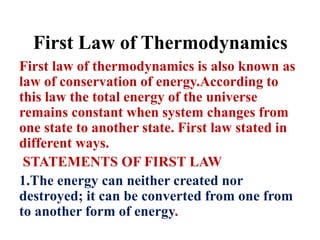
First Law of Thermodynamics
First law of thermodynamics is also known as
law of conservation of energy.According to
this law the total energy of the universe
remains constant when system changes from
one state to another state. First law stated in
different ways.
STATEMENTS OF FIRST LAW
1.The energy can neither created nor
destroyed; it can be converted from one from
to another form of energy.
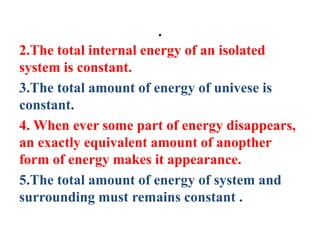
.
2.The total internal energy of an isolated
system is constant.
3.The total amount of energy of univese is
constant.
4. When ever some part of energy disappears,
an exactly equivalent amount of anopther
form of energy makes it appearance.
5.The total amount of energy of system and
surrounding must remains constant .
Mathematical Equation of first law
of thermodynamics.
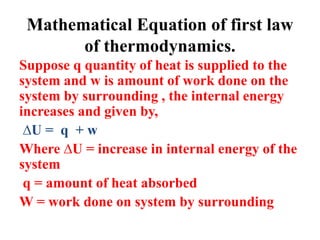
Suppose q quantity of heat is supplied to the
system and w is amount of work done on the
system by surrounding , the internal energy
increases and given by,
∆U = q + w
Where ∆U = increase in internal energy of the
system
q = amount of heat absorbed
W = work done on system by surrounding
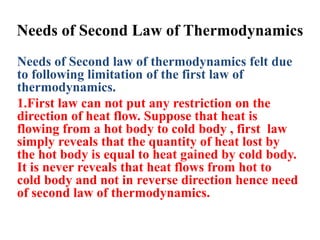
Needs of Second Law of Thermodynamics
Needs of Second law of thermodynamics felt due
to following limitation of the first law of
thermodynamics.
1.First law can not put any restriction on the
direction of heat flow. Suppose that heat is
flowing from a hot body to cold body , first law
simply reveals that the quantity of heat lost by
the hot body is equal to heat gained by cold body.
It is never reveals that heat flows from hot to
cold body and not in reverse direction hence need
of second law of thermodynamics.
.
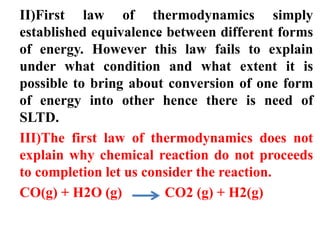
II)First law of thermodynamics simply
established equivalence between different forms
of energy. However this law fails to explain
under what condition and what extent it is
possible to bring about conversion of one form
of energy into other hence there is need of
SLTD.
III)The first law of thermodynamics does not
explain why chemical reaction do not proceeds
to completion let us consider the reaction.
CO(g) + H2O (g) CO2 (g) + H2(g)
.
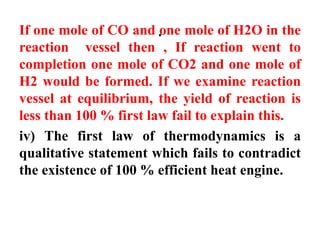
If one mole of CO and one mole of H2O in the
reaction vessel then , If reaction went to
completion one mole of CO2 and one mole of
H2 would be formed. If we examine reaction
vessel at equilibrium, the yield of reaction is
less than 100 % first law fail to explain this.
iv) The first law of thermodynamics is a
qualitative statement which fails to contradict
the existence of 100 % efficient heat engine.
Statements of second law of
thermodynamics
Work can completely converted into heat but heat
can not converted into work ,with out leaving a
permanent change in the system or surrounding.
The SLTD has been stated in no. of ways ,but all
statement are logically equivalent to one another.
1.Kelvin Planck Statement : It is impossible to
construct engine which operating in complete cycle
,will absorb heat from single body and convert it
into work (100 % efficiency),without leaving
permanent changes in the working system.
.
Clausius Statement : Heat flows from hot to
cold body due to difference of temperature.
But in refrigerator heat flows from at lower
temperature and get rejected to body at
higher temperature, here heat is being flow
through some outer agency.This lead to
Clausius to state SLTD which is It is
impossible to transfer for self acting machine
unaided by any external agency to convert
heat continuously, from one body at lower
temperature to body at a higher temperature.
Thomson Statement
In a heat engine, the working substance (system)
takes heat from hot body,a part of heat absorbed
is converted into work while remaining is given
to sink (cold body).No engine has so far been
constructed which continuously takes heat from
single body and changes the whole of its work it
work making any change in the system presence
of cold body is necessary for converting heat into
work. This led Thomson to state that ‶It is
impossible to obtain a continuos supply of work
cooling body to temperature lower than that of
coldest of its surrounding.
.
4.Diffussion of gas always take place from a
region of higher pressure to one at lower
pressure until pressure becomes uniform .
5. All natural Processes take place in one
direction only and can not be reversed.
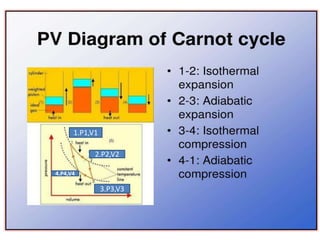
Carnot Heat Engine or Carnot Heat Cycle
French scientist Sodi Carnot in 1824 proposed a
hypothetical and ideal heat engine which converts
heat into work to the maximum extent. The carnot
heat engine operating between two different
temperatures can perform series of operation
between these two temperatures so that at the end
of these operations the system can return to the
initial state this cycle of different processes is
known as carnot cycle. A carnot heat consist of
following main three parts.
.
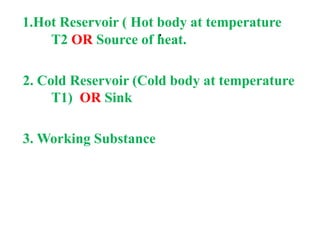
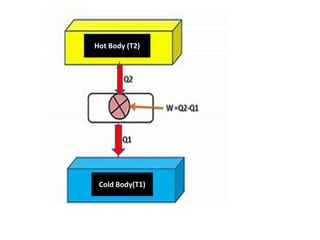
1.Hot Reservoir ( Hot body at temperature
T2 OR Source of heat.
2. Cold Reservoir (Cold body at temperature
T1) OR Sink
3. Working Substance
Cold Body(T1)
Hot Body (T2)
1.P1,V1
2.P2,V2
3.P3,V3
4.P4,V4
Expression For the work done and
efficiency of Carnot heat engine
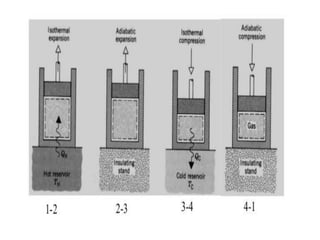
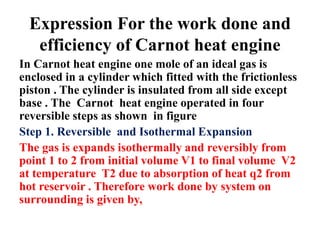
In Carnot heat engine one mole of an ideal gas is
enclosed in a cylinder which fitted with the frictionless
piston . The cylinder is insulated from all side except
base . The Carnot heat engine operated in four
reversible steps as shown in figure
Step 1. Reversible and Isothermal Expansion
The gas is expands isothermally and reversibly from
point 1 to 2 from initial volume V1 to final volume V2
at temperature T2 due to absorption of heat q2 from
hot reservoir . Therefore work done by system on
surrounding is given by,
.
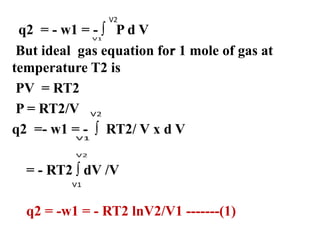
q2 = - w1 = - ∫ P d V
But ideal gas equation for 1 mole of gas at
temperature T2 is
PV = RT2
P = RT2/V
q2 =- w1 = - ∫ RT2/ V x d V
= - RT2 ∫ dV /V
q2 = -w1 = - RT2 lnV2/V1 -------(1)
V2
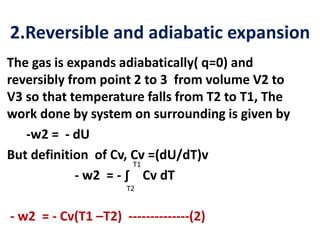
2.Reversible and adiabatic expansion
The gas is expands adiabatically( q=0) and
reversibly from point 2 to 3 from volume V2 to
V3 so that temperature falls from T2 to T1, The
work done by system on surrounding is given by
-w2 = - dU
But definition of Cv, Cv =(dU/dT)v
- w2 = - ∫ Cv dT
- w2 = - Cv(T1 –T2) --------------(2)
T1
T2
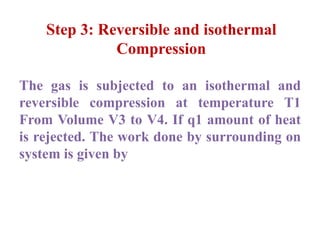
Step 3: Reversible and isothermal
Compression
The gas is subjected to an isothermal and
reversible compression at temperature T1
From Volume V3 to V4. If q1 amount of heat
is rejected. The work done by surrounding on
system is given by
.
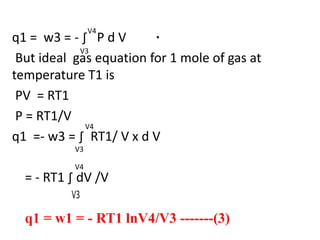
q1 = w3 = - ∫ P d V
But ideal gas equation for 1 mole of gas at
temperature T1 is
PV = RT1
P = RT1/V
q1 =- w3 = ∫ RT1/ V x d V
= - RT1 ∫ dV /V
q1 = w1 = - RT1 lnV4/V3 -------(3)
V3
V4
V3
V4
V4
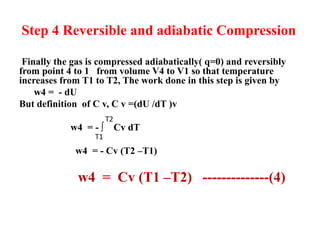
Step 4 Reversible and adiabatic Compression
Finally the gas is compressed adiabatically( q=0) and reversibly
from point 4 to 1 from volume V4 to V1 so that temperature
increases from T1 to T2, The work done in this step is given by
w4 = - dU
But definition of C v, C v =(dU /dT )v
w4 = - ∫ Cv dT
w4 = - Cv (T2 –T1)
w4 = Cv (T1 –T2) --------------(4)
T2
T1
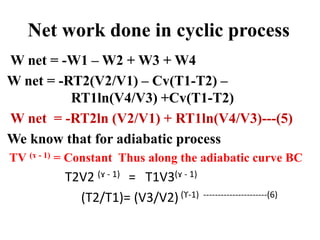
Net work done in cyclic process
W net = -W1 – W2 + W3 + W4
W net = -RT2(V2/V1) – Cv(T1-T2) –
RT1ln(V4/V3) +Cv(T1-T2)
W net = -RT2ln (V2/V1) + RT1ln(V4/V3)---(5)
We know that for adiabatic process
TV (ɤ - 1) = Constant Thus along the adiabatic curve BC
T2V2 (ɤ - 1) = T1V3(ɤ - 1)
(T2/T1)= (V3/V2) (ϒ-1) ----------------------(6)
.
Similarly along the curve AD
T2V1 (ɤ - 1) = T1V4(ɤ - 1)
(T2/T1) = (V4/V1) (ϒ-1) --------------(7)
Thus From Eq 6 and 7
(V3/V2)(ϒ-1) = (V4/V1) (ϒ-1)
(V3/V1) = (V4/V1)
(V2/V1) = (V3/V4)
Equation (5) becomes
- W net = RT2ln(V2/V1)+RT1ln(V1/V2)
- W net = RT2ln(V2/V1) - RT1ln(V2/V1) ------------(8)
- W net = R(T2 - T1)ln(V2/V1)
Net heat absorbed by the system in complete cycle is given by
q = { Heat absorbed in various Step –Heat rejected in various step}
= [ q2 – q1 ] -----------------------------(9)
Q = (q2 –q1)
But net heat absorbed = Net work performed
q = -W net = (q2 – q1) = R(T2-T1)ln(V2/V1)
-Wnet = q = (q2 –q1 = R (T2 –T1) ln (V2/V1) ---------(10)
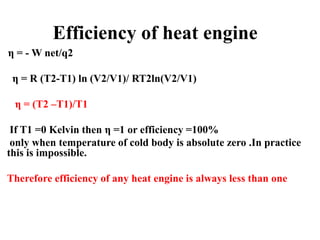
Efficiency of heat engine
η = - W net/q2
η = R (T2-T1) ln (V2/V1)/ RT2ln(V2/V1)
η = (T2 –T1)/T1
If T1 =0 Kelvin then η =1 or efficiency =100%
only when temperature of cold body is absolute zero .In practice
this is impossible.
Therefore efficiency of any heat engine is always less than one
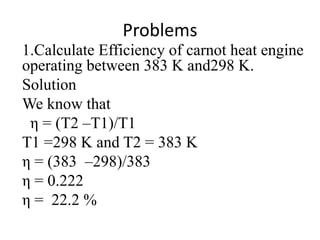
Problems
1.Calculate Efficiency of carnot heat engine
operating between 383 K and298 K.
Solution
We know that
η = (T2 –T1)/T1
T1 =298 K and T2 = 383 K
η = (383 –298)/383
η = 0.222
η = 22.2 %
.
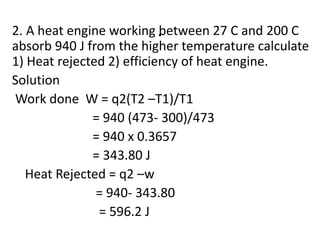
2. A heat engine working between 27 C and 200 C
absorb 940 J from the higher temperature calculate
1) Heat rejected 2) efficiency of heat engine.
Solution
Work done W = q2(T2 –T1)/T1
= 940 (473- 300)/473
= 940 x 0.3657
= 343.80 J
Heat Rejected = q2 –w
= 940- 343.80
= 596.2 J
.
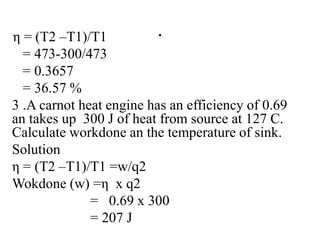
η = (T2 –T1)/T1
= 473-300/473
= 0.3657
= 36.57 %
3 .A carnot heat engine has an efficiency of 0.69
an takes up 300 J of heat from source at 127 C.
Calculate workdone an the temperature of sink.
Solution
η = (T2 –T1)/T1 =w/q2
Wokdone (w) =η x q2
= 0.69 x 300
= 207 J
.
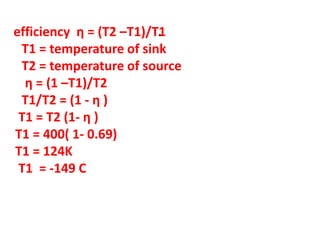
efficiency η = (T2 –T1)/T1
T1 = temperature of sink
T2 = temperature of source
η = (1 –T1)/T2
T1/T2 = (1 - η )
T1 = T2 (1- η )
T1 = 400( 1- 0.69)
T1 = 124K
T1 = -149 C
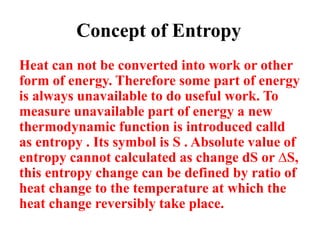
Concept of Entropy
Heat can not be converted into work or other
form of energy. Therefore some part of energy
is always unavailable to do useful work. To
measure unavailable part of energy a new
thermodynamic function is introduced calld
as entropy . Its symbol is S . Absolute value of
entropy cannot calculated as change dS or ∆S,
this entropy change can be defined by ratio of
heat change to the temperature at which the
heat change reversibly take place.
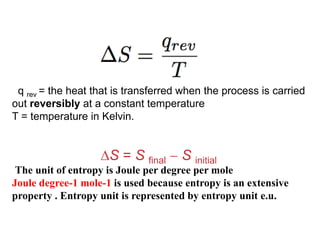
q rev = the heat that is transferred when the process is carried
out reversibly at a constant temperature
T = temperature in Kelvin.
S = S final  S initial
The unit of entropy is Joule per degree per mole
Joule degree-1 mole-1 is used because entropy is an extensive
property . Entropy unit is represented by entropy unit e.u.
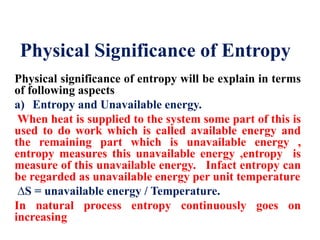
Physical Significance of Entropy
Physical significance of entropy will be explain in terms
of following aspects
a) Entropy and Unavailable energy.
When heat is supplied to the system some part of this is
used to do work which is called available energy and
the remaining part which is unavailable energy ,
entropy measures this unavailable energy ,entropy is
measure of this unavailable energy. Infact entropy can
be regarded as unavailable energy per unit temperature
∆S = unavailable energy / Temperature.
In natural process entropy continuously goes on
increasing
b) Entropy and Disorder
Entropy is a measure of disorder in a system . Whenever we consider
molecular level of chemical system, we find that at lower temperature the
molecule of gas have lower kinetic energy, as the system absorb heat the
kinetic energy of molecule increases and bring about more disorder in the
molecule resulting in increase of entropy of the system when system
changes from more order to less order state there is increase in randomness
and hence entropy of the system increases .Any system which is order state
have less entropy than the disorder state . A substance at absolute zero is
suppose to be in the highest order form i.e crystalline substances. At
absolute zero temperature entropy of the crystalline substance is taken as
zero. In melting of ice ,Vaporization of liquid, dissolution of salt in water
,the entropy increases as randomness increases.
C) Entropy and Probability
During a natural (Spontaneous ) process a system tends to become more
disordered ,hence there is an increase in entropy of the system and the
probability having a disordered system is higher than the probability of
having an ordered system . Thus the entropy and probability are expected to
be link to each other in some way . Therefore entropy may be defined as
function of probability of the thermodynamic state .Also entropy is an
extensive property whereas probability is multiplicative property .if two
system have entropies S1 and S2 the total entropy becomes (S1+S2) whereas
if two system had probabilities W1 and W2 total probability both considered
together becomes (w1+w2). Boltzmann and Planck's suggested following
relationship between S and W.
S ά ln W
S = K ln W
Where S is entropy
W= probability
K= Boltzmann constant
Entropy Change for an ideal gas in
terms of pressure, temperature and
volume
A) Variation of entropy with temperature and
volume
The increase in entropy of the ideal gas for an
infinitesimally small change is given by
dS = dq reversible/T ----------(1)
According to first law of thermodynamics
dq reversible = dU + P dV --------(2)
But Cv = (dU/dT)v and for 1 mole of gas
p = RT/V
Putting value of dU and P in eq 1
.
dS = Cv dT + RT/TV d V
dS = Cv dT/T +R d V /V ------------------------(3)
Integrate equation (3) within temperature T1 to T2 and
assuming C v as constant between entropy S1 and S2 and
Volume between V1 to V2
∫ d S = C v ∫ dT/T +R ∫ dV /V ------(4)
(S2-S1) = Cv lnT2/T1+R lnV2/V1
∆S = Cv ln T2/T1 +R lnV2/V1
∆S = 2.303Cv logT2/T1 +2.303R logV2/V1-------(5)
Above equation for n moles of ideal gas becomes
∆S = 2.303 nCv logT2/T1 +2.303nR logV2/V1-------(6)
B) Variation of Entropy with
temperature and pressure
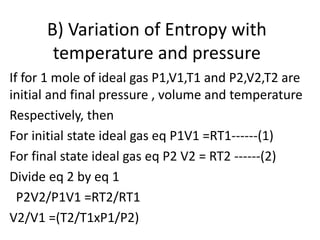
If for 1 mole of ideal gas P1,V1,T1 and P2,V2,T2 are
initial and final pressure , volume and temperature
Respectively, then
For initial state ideal gas eq P1V1 =RT1------(1)
For final state ideal gas eq P2 V2 = RT2 ------(2)
Divide eq 2 by eq 1
P2V2/P1V1 =RT2/RT1
V2/V1 =(T2/T1xP1/P2)
.
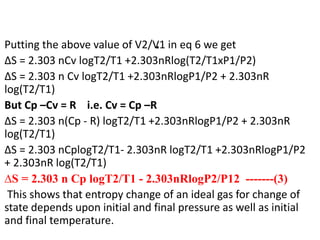
Putting the above value of V2/V1 in eq 6 we get
∆S = 2.303 nCv logT2/T1 +2.303nRlog(T2/T1xP1/P2)
∆S = 2.303 n Cv logT2/T1 +2.303nRlogP1/P2 + 2.303nR
log(T2/T1)
But Cp –Cv = R i.e. Cv = Cp –R
∆S = 2.303 n(Cp - R) logT2/T1 +2.303nRlogP1/P2 + 2.303nR
log(T2/T1)
∆S = 2.303 nCplogT2/T1- 2.303nR logT2/T1 +2.303nRlogP1/P2
+ 2.303nR log(T2/T1)
∆S = 2.303 n Cp logT2/T1 - 2.303nRlogP2/P12 -------(3)
This shows that entropy change of an ideal gas for change of
state depends upon initial and final pressure as well as initial
and final temperature.
Entropy change for ideal gas in
different processes
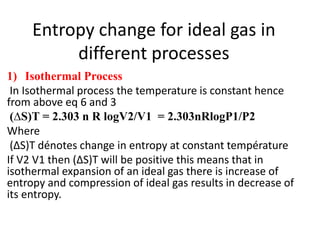
1) Isothermal Process
In Isothermal process the temperature is constant hence
from above eq 6 and 3
(∆S)T = 2.303 n R logV2/V1 = 2.303nRlogP1/P2
Where
(∆S)T dénotes change in entropy at constant température
If V2 V1 then (∆S)T will be positive this means that in
isothermal expansion of an ideal gas there is increase of
entropy and compression of ideal gas results in decrease of
its entropy.
.
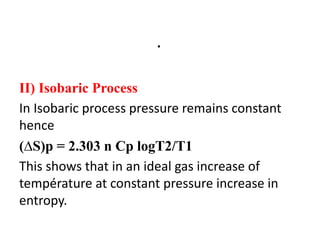
II) Isobaric Process
In Isobaric process pressure remains constant
hence
(∆S)p = 2.303 n Cp logT2/T1
This shows that in an ideal gas increase of
température at constant pressure increase in
entropy.
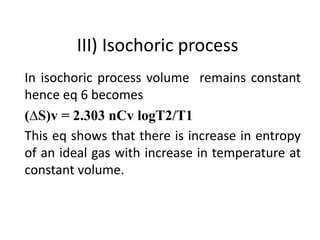
III) Isochoric process
In isochoric process volume remains constant
hence eq 6 becomes
(∆S)v = 2.303 nCv logT2/T1
This eq shows that there is increase in entropy
of an ideal gas with increase in temperature at
constant volume.
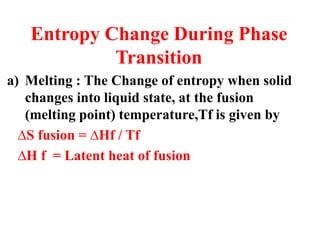
Entropy Change During Phase
Transition
a) Melting : The Change of entropy when solid
changes into liquid state, at the fusion
(melting point) temperature,Tf is given by
∆S fusion = ∆Hf / Tf
∆H f = Latent heat of fusion
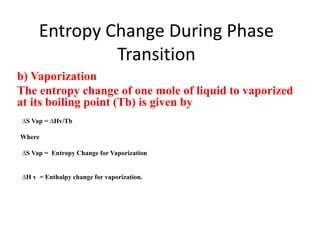
Entropy Change During Phase
Transition
b) Vaporization
The entropy change of one mole of liquid to vaporized
at its boiling point (Tb) is given by
∆S Vap = ∆Hv/Tb
Where
∆S Vap = Entropy Change for Vaporization
∆H v = Enthalpy change for vaporization.
.
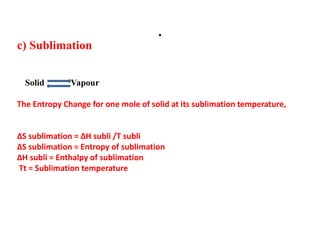
c) Sublimation
Solid Vapour
The Entropy Change for one mole of solid at its sublimation temperature,
∆S sublimation = ∆H subli /T subli
∆S sublimation = Entropy of sublimation
∆H subli = Enthalpy of sublimation
Tt = Sublimation temperature
.
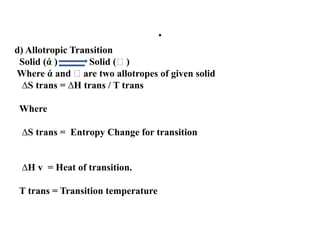
d) Allotropic Transition
Solid (ά ) Solid (ꞵ )
Where ά and ꞵ are two allotropes of given solid
∆S trans = ∆H trans / T trans
Where
∆S trans = Entropy Change for transition
∆H v = Heat of transition.
T trans = Transition temperature
.
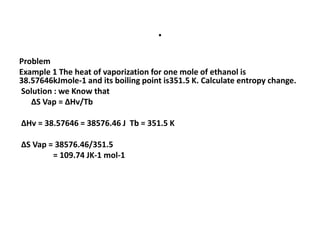
Problem
Example 1 The heat of vaporization for one mole of ethanol is
38.57646kJmole-1 and its boiling point is351.5 K. Calculate entropy change.
Solution : we Know that
∆S Vap = ∆Hv/Tb
∆Hv = 38.57646 = 38576.46 J Tb = 351.5 K
∆S Vap = 38576.46/351.5
= 109.74 JK-1 mol-1
Entropy Change for reversible
and irreversible processes
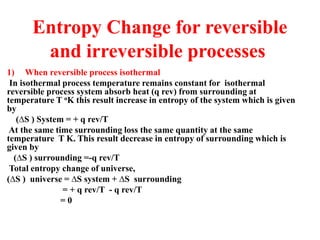
1) When reversible process isothermal
In isothermal process temperature remains constant for isothermal
reversible process system absorb heat (q rev) from surrounding at
temperature T oK this result increase in entropy of the system which is given
by
(∆S ) System = + q rev/T
At the same time surrounding loss the same quantity at the same
temperature T K. This result decrease in entropy of surrounding which is
given by
(∆S ) surrounding =-q rev/T
Total entropy change of universe,
(∆S ) universe = ∆S system + ∆S surrounding
= + q rev/T - q rev/T
= 0
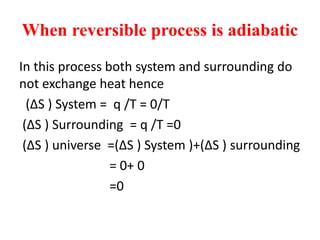
When reversible process is adiabatic
In this process both system and surrounding do
not exchange heat hence
(∆S ) System = q /T = 0/T
(∆S ) Surrounding = q /T =0
(∆S ) universe =(∆S ) System )+(∆S ) surrounding
= 0+ 0
=0
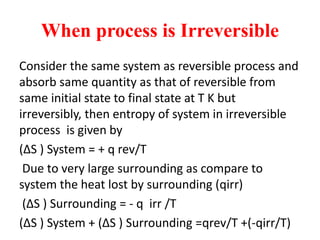
When process is Irreversible
Consider the same system as reversible process and
absorb same quantity as that of reversible from
same initial state to final state at T K but
irreversibly, then entropy of system in irreversible
process is given by
(∆S ) System = + q rev/T
Due to very large surrounding as compare to
system the heat lost by surrounding (qirr)
(∆S ) Surrounding = - q irr /T
(∆S ) System + (∆S ) Surrounding =qrev/T +(-qirr/T)
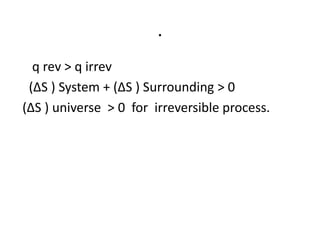
.
q rev ˃ q irrev
(∆S ) System + (∆S ) Surrounding ˃ 0
(∆S ) universe ˃ 0 for irreversible process.
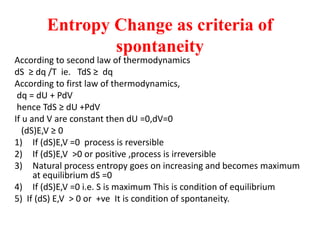
Entropy Change as criteria of
spontaneity
According to second law of thermodynamics
dS ≥ dq /T ie. TdS ≥ dq
According to first law of thermodynamics,
dq = dU + PdV
hence TdS ≥ dU +PdV
If u and V are constant then dU =0,dV=0
(dS)E,V ≥ 0
1) If (dS)E,V =0 process is reversible
2) If (dS)E,V ˃0 or positive ,process is irreversible
3) Natural process entropy goes on increasing and becomes maximum
at equilibrium dS =0
4) If (dS)E,V =0 i.e. S is maximum This is condition of equilibrium
5) If (dS) E,V ˃ 0 or +ve It is condition of spontaneity.

Thermodynamic3

  • 1.
    Thermodynamics 2 According toSyllabus of S.G.B.Amravati University Amravati Class- B.Sc.Sem I Mr G.D. Rawate Department of Chemistry Shri R.R.Lahoti Science ,College Morshi
  • 2.
    First Law ofThermodynamics First law of thermodynamics is also known as law of conservation of energy.According to this law the total energy of the universe remains constant when system changes from one state to another state. First law stated in different ways. STATEMENTS OF FIRST LAW 1.The energy can neither created nor destroyed; it can be converted from one from to another form of energy.
  • 3.
    . 2.The total internalenergy of an isolated system is constant. 3.The total amount of energy of univese is constant. 4. When ever some part of energy disappears, an exactly equivalent amount of anopther form of energy makes it appearance. 5.The total amount of energy of system and surrounding must remains constant .
  • 4.
    Mathematical Equation offirst law of thermodynamics. Suppose q quantity of heat is supplied to the system and w is amount of work done on the system by surrounding , the internal energy increases and given by, ∆U = q + w Where ∆U = increase in internal energy of the system q = amount of heat absorbed W = work done on system by surrounding
  • 5.
    Needs of SecondLaw of Thermodynamics Needs of Second law of thermodynamics felt due to following limitation of the first law of thermodynamics. 1.First law can not put any restriction on the direction of heat flow. Suppose that heat is flowing from a hot body to cold body , first law simply reveals that the quantity of heat lost by the hot body is equal to heat gained by cold body. It is never reveals that heat flows from hot to cold body and not in reverse direction hence need of second law of thermodynamics.
  • 6.
    . II)First law ofthermodynamics simply established equivalence between different forms of energy. However this law fails to explain under what condition and what extent it is possible to bring about conversion of one form of energy into other hence there is need of SLTD. III)The first law of thermodynamics does not explain why chemical reaction do not proceeds to completion let us consider the reaction. CO(g) + H2O (g) CO2 (g) + H2(g)
  • 7.
    . If one moleof CO and one mole of H2O in the reaction vessel then , If reaction went to completion one mole of CO2 and one mole of H2 would be formed. If we examine reaction vessel at equilibrium, the yield of reaction is less than 100 % first law fail to explain this. iv) The first law of thermodynamics is a qualitative statement which fails to contradict the existence of 100 % efficient heat engine.
  • 8.
    Statements of secondlaw of thermodynamics Work can completely converted into heat but heat can not converted into work ,with out leaving a permanent change in the system or surrounding. The SLTD has been stated in no. of ways ,but all statement are logically equivalent to one another. 1.Kelvin Planck Statement : It is impossible to construct engine which operating in complete cycle ,will absorb heat from single body and convert it into work (100 % efficiency),without leaving permanent changes in the working system.
  • 9.
    . Clausius Statement :Heat flows from hot to cold body due to difference of temperature. But in refrigerator heat flows from at lower temperature and get rejected to body at higher temperature, here heat is being flow through some outer agency.This lead to Clausius to state SLTD which is It is impossible to transfer for self acting machine unaided by any external agency to convert heat continuously, from one body at lower temperature to body at a higher temperature.
  • 10.
    Thomson Statement In aheat engine, the working substance (system) takes heat from hot body,a part of heat absorbed is converted into work while remaining is given to sink (cold body).No engine has so far been constructed which continuously takes heat from single body and changes the whole of its work it work making any change in the system presence of cold body is necessary for converting heat into work. This led Thomson to state that ‶It is impossible to obtain a continuos supply of work cooling body to temperature lower than that of coldest of its surrounding.
  • 11.
    . 4.Diffussion of gasalways take place from a region of higher pressure to one at lower pressure until pressure becomes uniform . 5. All natural Processes take place in one direction only and can not be reversed.
  • 12.
    Carnot Heat Engineor Carnot Heat Cycle French scientist Sodi Carnot in 1824 proposed a hypothetical and ideal heat engine which converts heat into work to the maximum extent. The carnot heat engine operating between two different temperatures can perform series of operation between these two temperatures so that at the end of these operations the system can return to the initial state this cycle of different processes is known as carnot cycle. A carnot heat consist of following main three parts.
  • 13.
    . 1.Hot Reservoir (Hot body at temperature T2 OR Source of heat. 2. Cold Reservoir (Cold body at temperature T1) OR Sink 3. Working Substance
  • 14.
  • 16.
  • 17.
    Expression For thework done and efficiency of Carnot heat engine In Carnot heat engine one mole of an ideal gas is enclosed in a cylinder which fitted with the frictionless piston . The cylinder is insulated from all side except base . The Carnot heat engine operated in four reversible steps as shown in figure Step 1. Reversible and Isothermal Expansion The gas is expands isothermally and reversibly from point 1 to 2 from initial volume V1 to final volume V2 at temperature T2 due to absorption of heat q2 from hot reservoir . Therefore work done by system on surrounding is given by,
  • 18.
    . q2 = -w1 = - ∫ P d V But ideal gas equation for 1 mole of gas at temperature T2 is PV = RT2 P = RT2/V q2 =- w1 = - ∫ RT2/ V x d V = - RT2 ∫ dV /V q2 = -w1 = - RT2 lnV2/V1 -------(1) V2
  • 19.
    2.Reversible and adiabaticexpansion The gas is expands adiabatically( q=0) and reversibly from point 2 to 3 from volume V2 to V3 so that temperature falls from T2 to T1, The work done by system on surrounding is given by -w2 = - dU But definition of Cv, Cv =(dU/dT)v - w2 = - ∫ Cv dT - w2 = - Cv(T1 –T2) --------------(2) T1 T2
  • 20.
    Step 3: Reversibleand isothermal Compression The gas is subjected to an isothermal and reversible compression at temperature T1 From Volume V3 to V4. If q1 amount of heat is rejected. The work done by surrounding on system is given by
  • 21.
    . q1 = w3= - ∫ P d V But ideal gas equation for 1 mole of gas at temperature T1 is PV = RT1 P = RT1/V q1 =- w3 = ∫ RT1/ V x d V = - RT1 ∫ dV /V q1 = w1 = - RT1 lnV4/V3 -------(3) V3 V4 V3 V4 V4
  • 22.
    Step 4 Reversibleand adiabatic Compression Finally the gas is compressed adiabatically( q=0) and reversibly from point 4 to 1 from volume V4 to V1 so that temperature increases from T1 to T2, The work done in this step is given by w4 = - dU But definition of C v, C v =(dU /dT )v w4 = - ∫ Cv dT w4 = - Cv (T2 –T1) w4 = Cv (T1 –T2) --------------(4) T2 T1
  • 23.
    Net work donein cyclic process W net = -W1 – W2 + W3 + W4 W net = -RT2(V2/V1) – Cv(T1-T2) – RT1ln(V4/V3) +Cv(T1-T2) W net = -RT2ln (V2/V1) + RT1ln(V4/V3)---(5) We know that for adiabatic process TV (ɤ - 1) = Constant Thus along the adiabatic curve BC T2V2 (ɤ - 1) = T1V3(ɤ - 1) (T2/T1)= (V3/V2) (ϒ-1) ----------------------(6)
  • 24.
    . Similarly along thecurve AD T2V1 (ɤ - 1) = T1V4(ɤ - 1) (T2/T1) = (V4/V1) (ϒ-1) --------------(7) Thus From Eq 6 and 7 (V3/V2)(ϒ-1) = (V4/V1) (ϒ-1) (V3/V1) = (V4/V1) (V2/V1) = (V3/V4) Equation (5) becomes - W net = RT2ln(V2/V1)+RT1ln(V1/V2) - W net = RT2ln(V2/V1) - RT1ln(V2/V1) ------------(8) - W net = R(T2 - T1)ln(V2/V1) Net heat absorbed by the system in complete cycle is given by q = { Heat absorbed in various Step –Heat rejected in various step} = [ q2 – q1 ] -----------------------------(9) Q = (q2 –q1) But net heat absorbed = Net work performed q = -W net = (q2 – q1) = R(T2-T1)ln(V2/V1) -Wnet = q = (q2 –q1 = R (T2 –T1) ln (V2/V1) ---------(10)
  • 25.
    Efficiency of heatengine η = - W net/q2 η = R (T2-T1) ln (V2/V1)/ RT2ln(V2/V1) η = (T2 –T1)/T1 If T1 =0 Kelvin then η =1 or efficiency =100% only when temperature of cold body is absolute zero .In practice this is impossible. Therefore efficiency of any heat engine is always less than one
  • 26.
    Problems 1.Calculate Efficiency ofcarnot heat engine operating between 383 K and298 K. Solution We know that η = (T2 –T1)/T1 T1 =298 K and T2 = 383 K η = (383 –298)/383 η = 0.222 η = 22.2 %
  • 27.
    . 2. A heatengine working between 27 C and 200 C absorb 940 J from the higher temperature calculate 1) Heat rejected 2) efficiency of heat engine. Solution Work done W = q2(T2 –T1)/T1 = 940 (473- 300)/473 = 940 x 0.3657 = 343.80 J Heat Rejected = q2 –w = 940- 343.80 = 596.2 J
  • 28.
    . η = (T2–T1)/T1 = 473-300/473 = 0.3657 = 36.57 % 3 .A carnot heat engine has an efficiency of 0.69 an takes up 300 J of heat from source at 127 C. Calculate workdone an the temperature of sink. Solution η = (T2 –T1)/T1 =w/q2 Wokdone (w) =η x q2 = 0.69 x 300 = 207 J
  • 29.
    . efficiency η =(T2 –T1)/T1 T1 = temperature of sink T2 = temperature of source η = (1 –T1)/T2 T1/T2 = (1 - η ) T1 = T2 (1- η ) T1 = 400( 1- 0.69) T1 = 124K T1 = -149 C
  • 30.
    Concept of Entropy Heatcan not be converted into work or other form of energy. Therefore some part of energy is always unavailable to do useful work. To measure unavailable part of energy a new thermodynamic function is introduced calld as entropy . Its symbol is S . Absolute value of entropy cannot calculated as change dS or ∆S, this entropy change can be defined by ratio of heat change to the temperature at which the heat change reversibly take place.
  • 31.
    q rev =the heat that is transferred when the process is carried out reversibly at a constant temperature T = temperature in Kelvin. S = S final  S initial The unit of entropy is Joule per degree per mole Joule degree-1 mole-1 is used because entropy is an extensive property . Entropy unit is represented by entropy unit e.u.
  • 32.
    Physical Significance ofEntropy Physical significance of entropy will be explain in terms of following aspects a) Entropy and Unavailable energy. When heat is supplied to the system some part of this is used to do work which is called available energy and the remaining part which is unavailable energy , entropy measures this unavailable energy ,entropy is measure of this unavailable energy. Infact entropy can be regarded as unavailable energy per unit temperature ∆S = unavailable energy / Temperature. In natural process entropy continuously goes on increasing
  • 33.
    b) Entropy andDisorder Entropy is a measure of disorder in a system . Whenever we consider molecular level of chemical system, we find that at lower temperature the molecule of gas have lower kinetic energy, as the system absorb heat the kinetic energy of molecule increases and bring about more disorder in the molecule resulting in increase of entropy of the system when system changes from more order to less order state there is increase in randomness and hence entropy of the system increases .Any system which is order state have less entropy than the disorder state . A substance at absolute zero is suppose to be in the highest order form i.e crystalline substances. At absolute zero temperature entropy of the crystalline substance is taken as zero. In melting of ice ,Vaporization of liquid, dissolution of salt in water ,the entropy increases as randomness increases.
  • 34.
    C) Entropy andProbability During a natural (Spontaneous ) process a system tends to become more disordered ,hence there is an increase in entropy of the system and the probability having a disordered system is higher than the probability of having an ordered system . Thus the entropy and probability are expected to be link to each other in some way . Therefore entropy may be defined as function of probability of the thermodynamic state .Also entropy is an extensive property whereas probability is multiplicative property .if two system have entropies S1 and S2 the total entropy becomes (S1+S2) whereas if two system had probabilities W1 and W2 total probability both considered together becomes (w1+w2). Boltzmann and Planck's suggested following relationship between S and W. S ά ln W S = K ln W Where S is entropy W= probability K= Boltzmann constant
  • 35.
    Entropy Change foran ideal gas in terms of pressure, temperature and volume A) Variation of entropy with temperature and volume The increase in entropy of the ideal gas for an infinitesimally small change is given by dS = dq reversible/T ----------(1) According to first law of thermodynamics dq reversible = dU + P dV --------(2) But Cv = (dU/dT)v and for 1 mole of gas p = RT/V Putting value of dU and P in eq 1
  • 36.
    . dS = CvdT + RT/TV d V dS = Cv dT/T +R d V /V ------------------------(3) Integrate equation (3) within temperature T1 to T2 and assuming C v as constant between entropy S1 and S2 and Volume between V1 to V2 ∫ d S = C v ∫ dT/T +R ∫ dV /V ------(4) (S2-S1) = Cv lnT2/T1+R lnV2/V1 ∆S = Cv ln T2/T1 +R lnV2/V1 ∆S = 2.303Cv logT2/T1 +2.303R logV2/V1-------(5) Above equation for n moles of ideal gas becomes ∆S = 2.303 nCv logT2/T1 +2.303nR logV2/V1-------(6)
  • 37.
    B) Variation ofEntropy with temperature and pressure If for 1 mole of ideal gas P1,V1,T1 and P2,V2,T2 are initial and final pressure , volume and temperature Respectively, then For initial state ideal gas eq P1V1 =RT1------(1) For final state ideal gas eq P2 V2 = RT2 ------(2) Divide eq 2 by eq 1 P2V2/P1V1 =RT2/RT1 V2/V1 =(T2/T1xP1/P2)
  • 38.
    . Putting the abovevalue of V2/V1 in eq 6 we get ∆S = 2.303 nCv logT2/T1 +2.303nRlog(T2/T1xP1/P2) ∆S = 2.303 n Cv logT2/T1 +2.303nRlogP1/P2 + 2.303nR log(T2/T1) But Cp –Cv = R i.e. Cv = Cp –R ∆S = 2.303 n(Cp - R) logT2/T1 +2.303nRlogP1/P2 + 2.303nR log(T2/T1) ∆S = 2.303 nCplogT2/T1- 2.303nR logT2/T1 +2.303nRlogP1/P2 + 2.303nR log(T2/T1) ∆S = 2.303 n Cp logT2/T1 - 2.303nRlogP2/P12 -------(3) This shows that entropy change of an ideal gas for change of state depends upon initial and final pressure as well as initial and final temperature.
  • 39.
    Entropy change forideal gas in different processes 1) Isothermal Process In Isothermal process the temperature is constant hence from above eq 6 and 3 (∆S)T = 2.303 n R logV2/V1 = 2.303nRlogP1/P2 Where (∆S)T dénotes change in entropy at constant température If V2 V1 then (∆S)T will be positive this means that in isothermal expansion of an ideal gas there is increase of entropy and compression of ideal gas results in decrease of its entropy.
  • 40.
    . II) Isobaric Process InIsobaric process pressure remains constant hence (∆S)p = 2.303 n Cp logT2/T1 This shows that in an ideal gas increase of température at constant pressure increase in entropy.
  • 41.
    III) Isochoric process Inisochoric process volume remains constant hence eq 6 becomes (∆S)v = 2.303 nCv logT2/T1 This eq shows that there is increase in entropy of an ideal gas with increase in temperature at constant volume.
  • 42.
    Entropy Change DuringPhase Transition a) Melting : The Change of entropy when solid changes into liquid state, at the fusion (melting point) temperature,Tf is given by ∆S fusion = ∆Hf / Tf ∆H f = Latent heat of fusion
  • 43.
    Entropy Change DuringPhase Transition b) Vaporization The entropy change of one mole of liquid to vaporized at its boiling point (Tb) is given by ∆S Vap = ∆Hv/Tb Where ∆S Vap = Entropy Change for Vaporization ∆H v = Enthalpy change for vaporization.
  • 44.
    . c) Sublimation Solid Vapour TheEntropy Change for one mole of solid at its sublimation temperature, ∆S sublimation = ∆H subli /T subli ∆S sublimation = Entropy of sublimation ∆H subli = Enthalpy of sublimation Tt = Sublimation temperature
  • 45.
    . d) Allotropic Transition Solid(ά ) Solid (ꞵ ) Where ά and ꞵ are two allotropes of given solid ∆S trans = ∆H trans / T trans Where ∆S trans = Entropy Change for transition ∆H v = Heat of transition. T trans = Transition temperature
  • 46.
    . Problem Example 1 Theheat of vaporization for one mole of ethanol is 38.57646kJmole-1 and its boiling point is351.5 K. Calculate entropy change. Solution : we Know that ∆S Vap = ∆Hv/Tb ∆Hv = 38.57646 = 38576.46 J Tb = 351.5 K ∆S Vap = 38576.46/351.5 = 109.74 JK-1 mol-1
  • 47.
    Entropy Change forreversible and irreversible processes 1) When reversible process isothermal In isothermal process temperature remains constant for isothermal reversible process system absorb heat (q rev) from surrounding at temperature T oK this result increase in entropy of the system which is given by (∆S ) System = + q rev/T At the same time surrounding loss the same quantity at the same temperature T K. This result decrease in entropy of surrounding which is given by (∆S ) surrounding =-q rev/T Total entropy change of universe, (∆S ) universe = ∆S system + ∆S surrounding = + q rev/T - q rev/T = 0
  • 48.
    When reversible processis adiabatic In this process both system and surrounding do not exchange heat hence (∆S ) System = q /T = 0/T (∆S ) Surrounding = q /T =0 (∆S ) universe =(∆S ) System )+(∆S ) surrounding = 0+ 0 =0
  • 49.
    When process isIrreversible Consider the same system as reversible process and absorb same quantity as that of reversible from same initial state to final state at T K but irreversibly, then entropy of system in irreversible process is given by (∆S ) System = + q rev/T Due to very large surrounding as compare to system the heat lost by surrounding (qirr) (∆S ) Surrounding = - q irr /T (∆S ) System + (∆S ) Surrounding =qrev/T +(-qirr/T)
  • 50.
    . q rev ˃q irrev (∆S ) System + (∆S ) Surrounding ˃ 0 (∆S ) universe ˃ 0 for irreversible process.
  • 51.
    Entropy Change ascriteria of spontaneity According to second law of thermodynamics dS ≥ dq /T ie. TdS ≥ dq According to first law of thermodynamics, dq = dU + PdV hence TdS ≥ dU +PdV If u and V are constant then dU =0,dV=0 (dS)E,V ≥ 0 1) If (dS)E,V =0 process is reversible 2) If (dS)E,V ˃0 or positive ,process is irreversible 3) Natural process entropy goes on increasing and becomes maximum at equilibrium dS =0 4) If (dS)E,V =0 i.e. S is maximum This is condition of equilibrium 5) If (dS) E,V ˃ 0 or +ve It is condition of spontaneity.