LIPOLYSIS 
~ By Ebtisam Al-Thawab
It is the catabolic process leading to the 
breakdown of triglycerides stored in fat cells 
and release of fatty acids and glycerol 
It occurs largely in adipose to release fatty 
acids as a fuel . May also occur in muscle or 
liver- smaller amounts of fatty acids are stored 
.
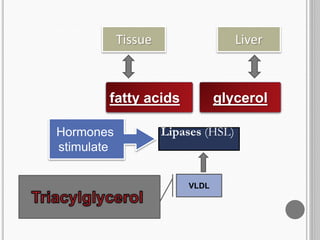
fatty acids glycerol 
Lipases (HSL) 
VLDL 
Hormones 
stimulate 
Tissue Liver
LIPOLYSIS PROCESS 
 Triglycerides are transported through the blood to 
appropriate tissues (adipose, muscle ) by lipoproteins 
such as VLDL (Very-Low-Density-Lipoproteins ) . 
 Hormones include : epinephrine, norepinephrine , 
Growth hormone and thyroid hormone Activate 
Hormone-sensitive lipase (HSL) found in adipose 
tissue . 
 Triglycerides present on the VLDL undergo lipolysis 
by the cellular lipases (HSL) of target tissues, which 
yields glycerol and free fatty acids .
• The glycerol also enters the bloodstream 
and is absorbed by the liver or 
kidney where it is converted to glycerol by 
the enzyme glycerol kinase. 
• Hepatic glycerol 3-phosphate is converted 
mostly into dihydroxy acetone phosphate 
(DHAP) and then glyceraldehyde 3- 
phosphate (GA3P) to rejoin the 
glycolysis and gluconeogenesis
Mitochondrial Beta Oxidation 
Fatty acids bind to albumin, in the blood for transport. 
Enter mitochondria for β-oxidation to produce energy .
• This is simple Animation Explain Lipolysis Mechanism 
• - 
http://www.wiley.com/college/grosvenor/0470197587/animations/Animati 
on_Lipid_Metabolism/Energy/media/content/met/anima/met4a/frameset. 
htm 
• 
• References 
• Vance, DE and Vance, JE (Eds.). 2008. Biochemistry of Lipids, 
Lipoproteins, and Membranes. 5th edition. Oxford, UK: Elsevier. 
• Baldwin, Kenneth David Sutherland; Brooks, George H.; Fahey, Thomas 
D. (2005). Exercise physiology: human bioenergetics and its 
applications. New York: McGraw-Hill 
• Harper‘s Biochemistry, By Robert K. Sppleton and Lange,2000

Lipolysis

  • 1.
    LIPOLYSIS ~ ByEbtisam Al-Thawab
  • 2.
    It is thecatabolic process leading to the breakdown of triglycerides stored in fat cells and release of fatty acids and glycerol It occurs largely in adipose to release fatty acids as a fuel . May also occur in muscle or liver- smaller amounts of fatty acids are stored .
  • 3.
    fatty acids glycerol Lipases (HSL) VLDL Hormones stimulate Tissue Liver
  • 4.
    LIPOLYSIS PROCESS Triglycerides are transported through the blood to appropriate tissues (adipose, muscle ) by lipoproteins such as VLDL (Very-Low-Density-Lipoproteins ) .  Hormones include : epinephrine, norepinephrine , Growth hormone and thyroid hormone Activate Hormone-sensitive lipase (HSL) found in adipose tissue .  Triglycerides present on the VLDL undergo lipolysis by the cellular lipases (HSL) of target tissues, which yields glycerol and free fatty acids .
  • 6.
    • The glycerolalso enters the bloodstream and is absorbed by the liver or kidney where it is converted to glycerol by the enzyme glycerol kinase. • Hepatic glycerol 3-phosphate is converted mostly into dihydroxy acetone phosphate (DHAP) and then glyceraldehyde 3- phosphate (GA3P) to rejoin the glycolysis and gluconeogenesis
  • 7.
    Mitochondrial Beta Oxidation Fatty acids bind to albumin, in the blood for transport. Enter mitochondria for β-oxidation to produce energy .
  • 8.
    • This issimple Animation Explain Lipolysis Mechanism • - http://www.wiley.com/college/grosvenor/0470197587/animations/Animati on_Lipid_Metabolism/Energy/media/content/met/anima/met4a/frameset. htm • • References • Vance, DE and Vance, JE (Eds.). 2008. Biochemistry of Lipids, Lipoproteins, and Membranes. 5th edition. Oxford, UK: Elsevier. • Baldwin, Kenneth David Sutherland; Brooks, George H.; Fahey, Thomas D. (2005). Exercise physiology: human bioenergetics and its applications. New York: McGraw-Hill • Harper‘s Biochemistry, By Robert K. Sppleton and Lange,2000