By
Manali Amin
Lecturer
Institute of Forensic Science
Role and responsibility of Nurse
in forensic department and
Psychological support to victim
Forensic Science
• Forensic science is defined as the
application of science to the just
resolution of legal issues .
-AAFS, 2000
Forensic Nursing
• Forensic nursing is defined as the
application of the nursing process to public
or legal proceedings, and the application of
forensic health care in the scientific
investigation of trauma and/or death related
to abuse, violence, criminal activity,
liability and accidents.
Different role of Forensic Nurse:
• Clinical Forensic Nurse
• Forensic Nurse Investigators
• Sexual Assault Nurse Examiner
• Forensic Psychiatric Nurse
• Legal Nurse Consultants
• Nurse Attorney
• Nurse Coroner
• Evidence is defined as something that gives proof
or leads to a conclusion.
– Which Includes
• Documents
• Testimony
• Objects
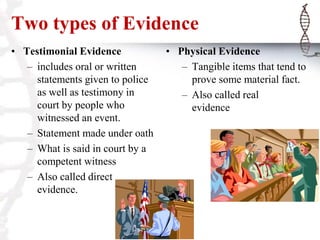
Two types of Evidence
• Testimonial Evidence
– includes oral or written
statements given to police
as well as testimony in
court by people who
witnessed an event.
– Statement made under oath
– What is said in court by a
competent witness
– Also called direct
evidence.
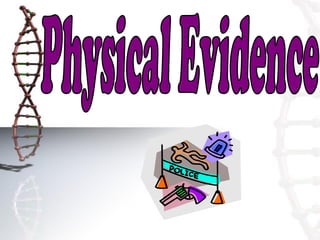
• Physical Evidence
– Tangible items that tend to
prove some material fact.
– Also called real
evidence
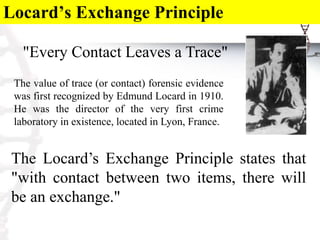
Locard’s Exchange Principle
"Every Contact Leaves a Trace"
The value of trace (or contact) forensic evidence
was first recognized by Edmund Locard in 1910.
He was the director of the very first crime
laboratory in existence, located in Lyon, France.
The Locard’s Exchange Principle states that
"with contact between two items, there will
be an exchange."
Types of Physical Evidence
• Trace Evidence
• Transient evidence
• Conditional Evidence
• Indirect Evidence
• Circumstantial Evidence
• Individual evidence
• Class evidence
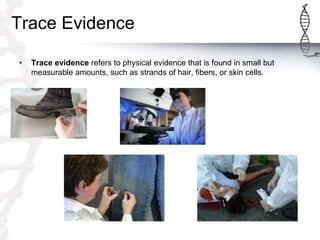
Trace Evidence
• Trace evidence refers to physical evidence that is found in small but
measurable amounts, such as strands of hair, fibers, or skin cells.
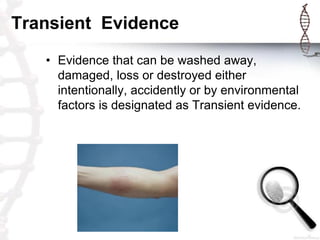
Transient Evidence
• Evidence that can be washed away,
damaged, loss or destroyed either
intentionally, accidently or by environmental
factors is designated as Transient evidence.
Conditional Evidence
• Produced by a specific action or event at the scene
• Must be observed and recorded
• Examples
– Lights
– Garage door
– Doors
– Windows
– Position of body
– Position of furniture
CIRCUMSTANTIAL EVIDENCE
• Circumstantial evidence is not direct evidence
from a witness who saw or heard something.
Circumstantial evidence is a fact that can be
used to infer another fact.
• For instance, a witness saying that she saw
a defendant stab a victim is providing direct
evidence. By contrast, a witness who says that
she saw the defendant enter a house, that she
heard screaming, and that she saw the defendant
leave with a bloody knife gives circumstantial
evidence.
Individual Evidence
• Material that can be related to
a single source
• Individualization always
involves a comparison
• Narrows an identity to a
single person or thing
• Examples
– DNA
– Fingerprints
– Handwriting
Class Evidence
• Material that can be
associated with a group of
items that share properties or
characteristics
• Object is similar to group of
similar objects but not one
single object
• Narrows an identity to group
of persons or things
• Examples
– Blue jeans
Evidence collection techniques
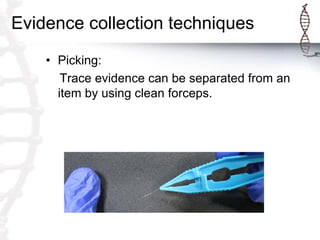
• Picking:
Trace evidence can be separated from an
item by using clean forceps.
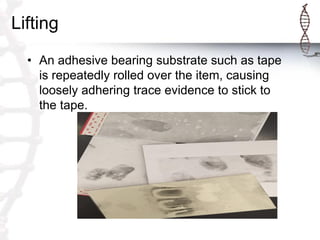
Lifting
• An adhesive bearing substrate such as tape
is repeatedly rolled over the item, causing
loosely adhering trace evidence to stick to
the tape.
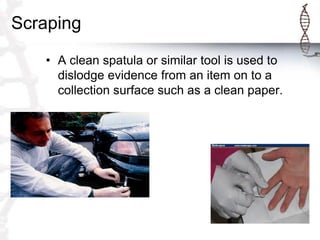
Scraping
• A clean spatula or similar tool is used to
dislodge evidence from an item on to a
collection surface such as a clean paper.
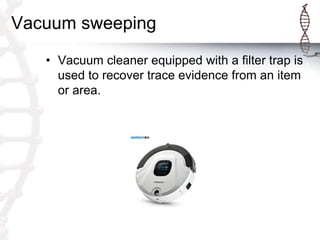
Vacuum sweeping
• Vacuum cleaner equipped with a filter trap is
used to recover trace evidence from an item
or area.
Combing
• A clean comb is used to recover trace
evidences from hair of an individual. The
combing device and debris should be packed
together.
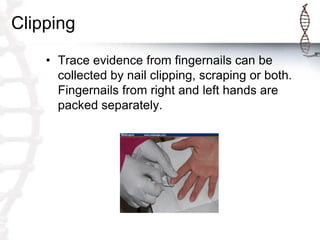
Clipping
• Trace evidence from fingernails can be
collected by nail clipping, scraping or both.
Fingernails from right and left hands are
packed separately.
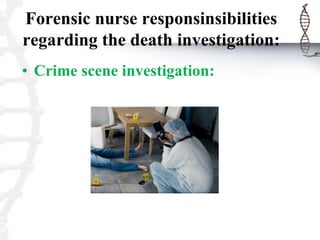
Forensic nurse responsinsibilities
regarding the death investigation:
• Crime scene investigation:
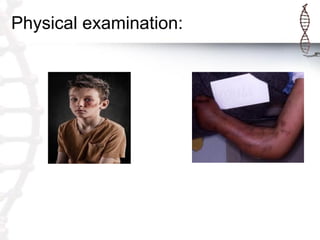
Physical examination:
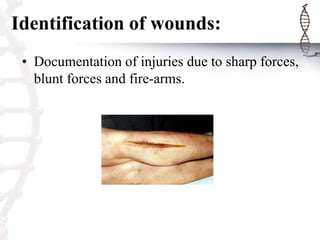
Identification of wounds:
• Documentation of injuries due to sharp forces,
blunt forces and fire-arms.
Injuries due to blunt forces:
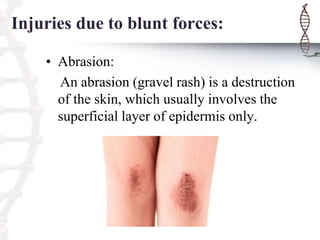
• Abrasion:
An abrasion (gravel rash) is a destruction
of the skin, which usually involves the
superficial layer of epidermis only.
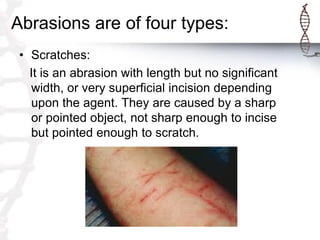
Abrasions are of four types:
• Scratches:
It is an abrasion with length but no significant
width, or very superficial incision depending
upon the agent. They are caused by a sharp
or pointed object, not sharp enough to incise
but pointed enough to scratch.
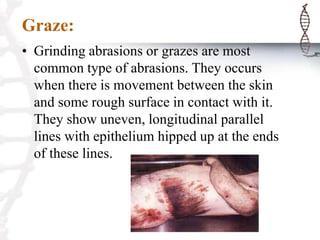
Graze:
• Grinding abrasions or grazes are most
common type of abrasions. They occurs
when there is movement between the skin
and some rough surface in contact with it.
They show uneven, longitudinal parallel
lines with epithelium hipped up at the ends
of these lines.
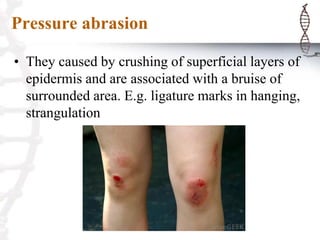
Pressure abrasion
• They caused by crushing of superficial layers of
epidermis and are associated with a bruise of
surrounded area. E.g. ligature marks in hanging,
strangulation
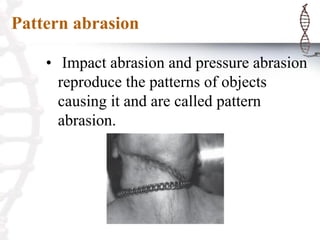
Pattern abrasion
• Impact abrasion and pressure abrasion
reproduce the patterns of objects
causing it and are called pattern
abrasion.
Age of Abrasion
• Fresh: Bright red color
• 12 to 24 hours: Lymph and blood dries up
leaving a bright red scab
• 2 to 3 days: Reddish brown scab
• 4 to 7 days: Dark brown to brownish black
scab as epithelium grows and covers defect
under scab
• After 7 days: Scab dries and falls off, leaving
depigmented area underneath, which gets
gradually pigmented.
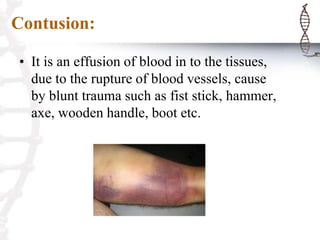
Contusion:
• It is an effusion of blood in to the tissues,
due to the rupture of blood vessels, cause
by blunt trauma such as fist stick, hammer,
axe, wooden handle, boot etc.
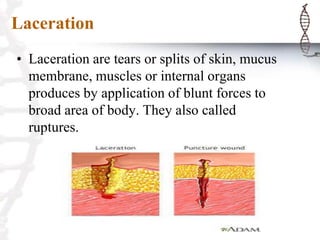
Laceration
• Laceration are tears or splits of skin, mucus
membrane, muscles or internal organs
produces by application of blunt forces to
broad area of body. They also called
ruptures.
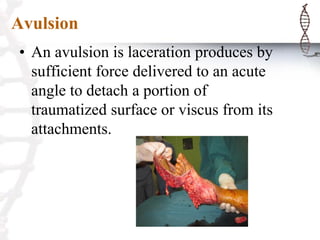
Avulsion
• An avulsion is laceration produces by
sufficient force delivered to an acute
angle to detach a portion of
traumatized surface or viscus from its
attachments.
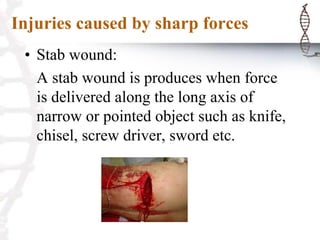
Injuries caused by sharp forces
• Stab wound:
A stab wound is produces when force
is delivered along the long axis of
narrow or pointed object such as knife,
chisel, screw driver, sword etc.
Post mortem changes
• A part of the physical examination, the nurse
must identify any changes associated with
death. These assist with estimating time of
death.
Algor mortis
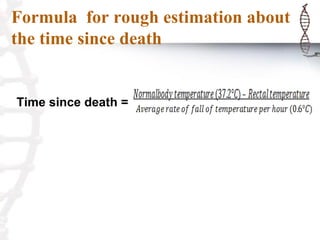
• The progressive fall in the temperature is
one of the most prominent early signs of
death and the amount of cooling indicates
the approximate time elapsed since death.
In tropical countries like India, the average
heat loss is roughly 0.5 – 0.7°C per hour,
and the body attains environmental
temperature in about 16-20 hours after
death.
Formula for rough estimation about
the time since death
Time since death =
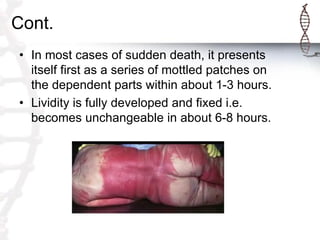
Livor mortis
• This means discoloration of the skin
and organs after death due to
accumulation of fluid blood in the
toneless capillaries and small veins of
the dependent parts of the body due to
gravitational forces, which is of the
same color as that of the blood. This
process starts within an hour after
death.
Cont.
• In most cases of sudden death, it presents
itself first as a series of mottled patches on
the dependent parts within about 1-3 hours.
• Lividity is fully developed and fixed i.e.
becomes unchangeable in about 6-8 hours.
• Certain poisons impart a distinct colour to
lividity, e.g. poisoning with carbon-
monoxide - bright cherry red
• cyanide – pink
• chlorates - chocolate brown,
• Phosphorus - dark brown,
• opiates and some snake venous - almost
black.
• Cherry red staining is also found in death
due to burning, and exposure to cold.
• Grayish brown staining is often found in
death from septic abortion.
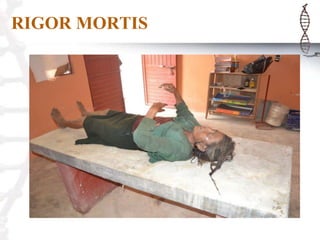
RIGOR MORTIS
RIGOR MORTIS
• Rigor mortis is a state of stiffening of muscles,
sometime with slight shortening of fibers.
Rigor mortis first appears in involuntary and
then in voluntary muscles.
• In Indian climate, rigor mortis commences in
2-3 hours after death, takes about 12 hours to
develop from head to foot, persists for another
12 hours, and takes about 12 hours to pass off.
The rigor mortis generally passes off, in the
same order in which it sets in, due to autolysis
of muscle proteins.
CADAVERIC SPASM
• This is the stiffening of muscles soon after
death without being preceded by the stage
of primary relaxation. This condition
develops when somatic death occurs very
rapidly, the person must be in a state of
great emotional tension, and the muscles
must be in physical activity at that time.
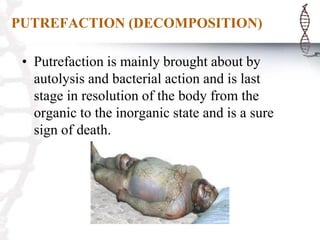
PUTREFACTION (DECOMPOSITION)
• Putrefaction is mainly brought about by
autolysis and bacterial action and is last
stage in resolution of the body from the
organic to the inorganic state and is a sure
sign of death.
Forensic Nurse responsibility in Disaster
victim identification:
The victim can be identified based on the following
identifying factors:
• Tattoos and scars.
• Evidence of prior surgical marks or bone
fractures.
• Unusual deformity.
• Approximate age, built, sex and race.
• Personnel belongings (jewelry, clothing, shoes
etc.).
• Superimposition techniques.
• DNA analysis.
Taking Fingerprints of dead bodies
• In cases of unidentified dead bodies, the
identification through fingerprints is a possible
way.
• When there is rigidity in the fingers, the joint
should be bent many times until it becomes
flexible. The tips of the fingers are then inked
using a roller and printing ink and the prints can
be taken on the card. The finger should not be
rolled against the card rather card may be rolled
around the fingertip for better results.
Collection and packing of exhibits in
case of death from fire:
• The remnants of the cloths should be removed
and packed in air tight containers very carefully.
• Routine viscera samples should be taken and
properly preserved in saturated salt solution.
• Post mortem blood approximately 300 ml. or the
amount available in the body should be taken for
the determination of the carbon monoxide level.
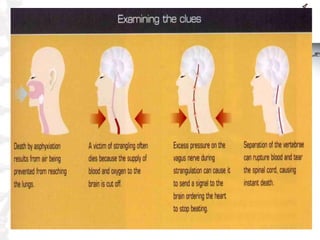
ASPHYXIAL DEATHS
• The asphyxial death occurs from mechanical
interference with the process of respiration.
They are of common occurrence and called
violent deaths, which may be classified as:
hanging, strangulation, throttling, suffocation
and drowning.
Hanging
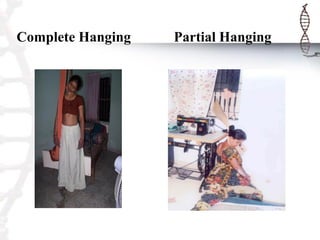
• Hanging may be defined as a form of violent
asphyxial death resulting from suspension of
body by a ligature round the neck. The weight
of the body acts as the constricting force.
• The weight of only the head, and not the whole
body, acts as a constricting force, it is called
partial hanging. The weight of head is sufficient
to produce a fatal result.
Complete Hanging Partial Hanging
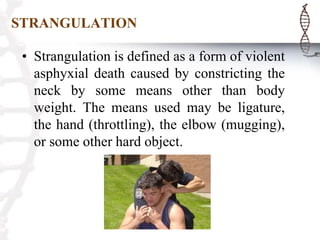
STRANGULATION
• Strangulation is defined as a form of violent
asphyxial death caused by constricting the
neck by some means other than body
weight. The means used may be ligature,
the hand (throttling), the elbow (mugging),
or some other hard object.
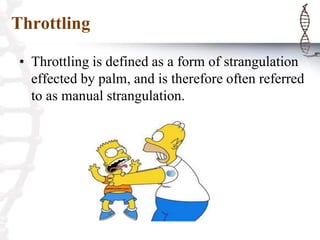
Throttling
• Throttling is defined as a form of strangulation
effected by palm, and is therefore often referred
to as manual strangulation.
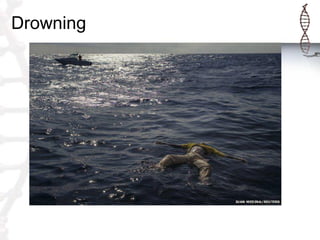
Drowning
Collection and preservation of
forensic evidences
• COLLECTION OF DNA SAMPLES
• Fresh liquid blood
For DNA fingerprinting, 2-5 ml of intravenous
blood should be collected in sterile EDTA bulb
(anticoagulant) or two to three drops of blood on
FTA card by pricking finger.
• Wet blood
• Dry blood stains
• Buccal (oral) swabs
• Saliva & Urine
• Tissue / Teeth / Bone Sample
• Hair
Collection and preservation of rape
evidence
• Semen and seminal stains
Collect the suspected liquid semen onto a clean
cotton cloth or swab by absorption. Leave a
portion of the cloth or swab unstained as a
control. Air-dry the cloth or swab and pack in
clean paper or an envelope.
Submit small suspected dry semen stained
objects to the laboratory. Pack in clean paper.
Vaginal Secretions
• Vaginal fluid may be located on a suspect’s
underpants or taken from pubic area swabs. It is
possible to generate a DNA profile if a
sufficient sample is available for testing.
Reconstruction of sequence of events in
case of firing:
It helps to distinguish between homicide and
suicide by looking and studying the following:
• Victim:
Suicide generally committed by adult males by
firearms. Ladies and children do not use firearms
for committing suicide. It gives suspicion of
homicide.
• Site of injury
• Range of firing:
Determination of range is carried out with the
help of “Ejecta”
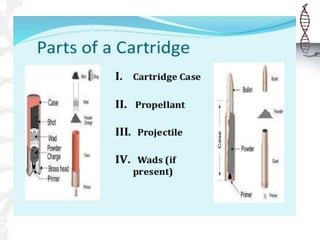
This ejecta is contributed by primer, propellent
bullet(projectile) and cartridge case. The
ejecta is known as Firearm discharge residue.
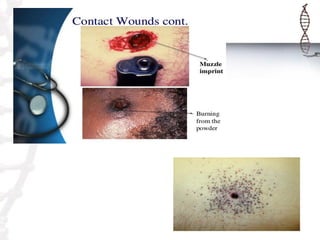
• If the target lies within the range of flame, i.e.
6 inches, burning is produces around the gun shot.
It is known as burning effect or singeing of hair.
• Ejecta also includes carbon particles. These
particles travel up to 12 inches in case of long
barrel firearms and 6-8 inches in case of short
barrel firearms.
• Partially burnt and unburnt propellant which travel
4 feets in case of long barrel firearms and 1-2 feets
in case of short barrel firearms. may produce slight
contusion on skin known as “Tattooing”.
• Direction of firing:
• Number of rounds fired:
• Cadaveric spasm:
• GSR on the hands of firer:
• Gunshot injuries: It has three parts:
1.Wound of entrance
2.Wound of exit
3.Bullet track
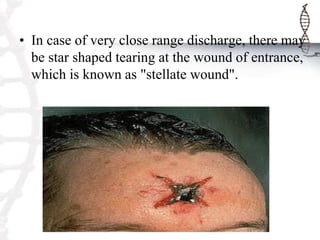
• In case of very close range discharge, there may
be star shaped tearing at the wound of entrance,
which is known as "stellate wound".
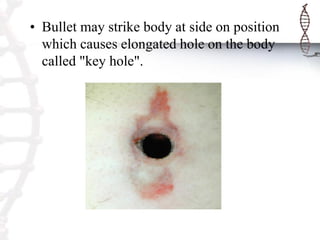
• Bullet may strike body at side on position
which causes elongated hole on the body
called "key hole".
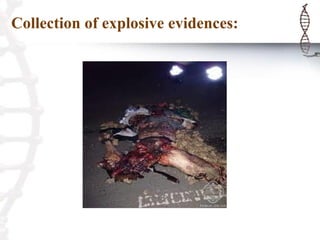
Collection of explosive evidences:
Evidence collection in poisoning case
• Stomach and whole of its contents or stomach wash whichever
is available and one feet of proximal part of small intestine along
with its contents.
• 100 gms of liver in pieces, preferably the portion containing gall
bladder and its contents, half of each kidney.
• Blood about 50ml obtained from the femoral artery or vein by
percutaneous puncture with a wide bore needle. It is not
advisable to collect spilled blood or blood from body cavities.
• Spleen – half in adult and whole in children.
• 100 ml of urine or the amount available in bladder.
Additional materials
• Shaft of long bones (8 – 10 cms of femur), a tuft of
head hair, finger and toe nails and some muscles should
be taken in suspected cases of chronic poisoning by
heavy metals like arsenic, lead, antimony etc.
• Bile should be taken in the case of narcotic drugs,
cocaine and paracetamol poisoning etc.
• Blood from peripheral vein, lung tissue and a
cerebrospinal fluid should be preserved in a suspected
case of poisoning by alcohol.
• In highly putrefied bodies; larvae, maggots,
pupa and other entomological samples should
be preserved.
• In embalmed bodies, the vitreous humour
usually remains uncontaminated by the
process.
• Cerebro-spinal fluid may be taken in a
suspected case of alcohol poisoning.
• Fatty tissues from abdominal wall or
perinephric region in the cases of pesticides.
Technique for collection of
Additional Material
• Blood
• Urine
• Cerebro – Spinal fluid
• Bone and Bone marrow
• Hair
• Nails
• Skin
Preservation, packing and forwarding of
viscera
• The stomach with its contents should be
preserved in wide mouth glass bottle, small
intestine with its contents in another and liver,
spleen and kidney should be preserved
separately.
• In all cases of poisoning including carbolic acid
but excluding other acids, saturated solution of
common salt should be used.
Cont.
• Blood for alcohol estimation in living person
should be preserved with 10 mg sodium fluoride
(enzyme inhibitor) and 30 mg of potassium
oxalate (anticoagulant) for 10 ml of blood.
• The tissues taken for histopathological
examination may be preserved in 10% formalin.
• The stomach and intestine are opened before
they are preserved. The liver and kidney are cut
into small pieces to ensure penetration of the
preservative into tissues.
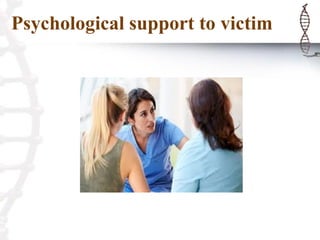
Psychological support to victim
Post Traumatic stress disorder
• The first cluster of symptoms are referred to
re-experiencing symptoms.
• The second cluster of symptoms are referred
to avoidance symptoms.
• The last cluster of symptoms are referred to
Hyper-arousal symptoms.
The following points should be consider
while supporting the victim:
• Establish positive rapport.
• Promote physical comfort.
• Allow the victim to discuss his or her account of
the trauma.
• Listen and document any changes in the tone of
voice.
• Observe and document nonverbal behaviours.
• Encourage the victim to discuss emotions and
feelings related to trauma.
• Avoid inserting your own words or feelings in to
the victim's experience.
• Forensic nurses are also responsible for
educating a patient on his or her rights.
• The forensic nurse should be able to provide the
victim with necessary resources. These resources
may include crisis centres, therapy referrals, and
support group information.
• Physical Care of the victim
• Emotional Support
• Preventive treatments for STD
• Counseling or psychotherapy —
Counseling or psychotherapy can be helpful
in dealing with the events of the assault
itself as well as the anger, fear, depression,
or anxiety that many people feel afterwards.
Psychodynamic therapy
• The goal of therapy is to promote a greater
conscious awareness of the connection between
traumatic memory feelings and behavior.
Cognitive behavior therapy
• Stress reduction training
• Anxiety management training
• Cognitive restructuring is the process of
identifying and correcting cognitive distortions
associated with trauma.
Group therapy
• It provides the group members to provide
mutual support with others who share and
understand the patient’s issues. It reduce the
sense of being alone.
Forensic nursing ppt

Forensic nursing ppt

  • 1.
    By Manali Amin Lecturer Institute ofForensic Science Role and responsibility of Nurse in forensic department and Psychological support to victim
  • 2.
    Forensic Science • Forensicscience is defined as the application of science to the just resolution of legal issues . -AAFS, 2000
  • 3.
    Forensic Nursing • Forensicnursing is defined as the application of the nursing process to public or legal proceedings, and the application of forensic health care in the scientific investigation of trauma and/or death related to abuse, violence, criminal activity, liability and accidents.
  • 4.
    Different role ofForensic Nurse: • Clinical Forensic Nurse • Forensic Nurse Investigators • Sexual Assault Nurse Examiner • Forensic Psychiatric Nurse • Legal Nurse Consultants • Nurse Attorney • Nurse Coroner
  • 5.
    • Evidence isdefined as something that gives proof or leads to a conclusion. – Which Includes • Documents • Testimony • Objects
  • 6.
    Two types ofEvidence • Testimonial Evidence – includes oral or written statements given to police as well as testimony in court by people who witnessed an event. – Statement made under oath – What is said in court by a competent witness – Also called direct evidence. • Physical Evidence – Tangible items that tend to prove some material fact. – Also called real evidence
  • 8.
    Locard’s Exchange Principle "EveryContact Leaves a Trace" The value of trace (or contact) forensic evidence was first recognized by Edmund Locard in 1910. He was the director of the very first crime laboratory in existence, located in Lyon, France. The Locard’s Exchange Principle states that "with contact between two items, there will be an exchange."
  • 9.
    Types of PhysicalEvidence • Trace Evidence • Transient evidence • Conditional Evidence • Indirect Evidence • Circumstantial Evidence • Individual evidence • Class evidence
  • 10.
    Trace Evidence • Traceevidence refers to physical evidence that is found in small but measurable amounts, such as strands of hair, fibers, or skin cells.
  • 11.
    Transient Evidence • Evidencethat can be washed away, damaged, loss or destroyed either intentionally, accidently or by environmental factors is designated as Transient evidence.
  • 12.
    Conditional Evidence • Producedby a specific action or event at the scene • Must be observed and recorded • Examples – Lights – Garage door – Doors – Windows – Position of body – Position of furniture
  • 13.
    CIRCUMSTANTIAL EVIDENCE • Circumstantialevidence is not direct evidence from a witness who saw or heard something. Circumstantial evidence is a fact that can be used to infer another fact. • For instance, a witness saying that she saw a defendant stab a victim is providing direct evidence. By contrast, a witness who says that she saw the defendant enter a house, that she heard screaming, and that she saw the defendant leave with a bloody knife gives circumstantial evidence.
  • 14.
    Individual Evidence • Materialthat can be related to a single source • Individualization always involves a comparison • Narrows an identity to a single person or thing • Examples – DNA – Fingerprints – Handwriting Class Evidence • Material that can be associated with a group of items that share properties or characteristics • Object is similar to group of similar objects but not one single object • Narrows an identity to group of persons or things • Examples – Blue jeans
  • 15.
    Evidence collection techniques •Picking: Trace evidence can be separated from an item by using clean forceps.
  • 16.
    Lifting • An adhesivebearing substrate such as tape is repeatedly rolled over the item, causing loosely adhering trace evidence to stick to the tape.
  • 17.
    Scraping • A cleanspatula or similar tool is used to dislodge evidence from an item on to a collection surface such as a clean paper.
  • 18.
    Vacuum sweeping • Vacuumcleaner equipped with a filter trap is used to recover trace evidence from an item or area.
  • 19.
    Combing • A cleancomb is used to recover trace evidences from hair of an individual. The combing device and debris should be packed together.
  • 20.
    Clipping • Trace evidencefrom fingernails can be collected by nail clipping, scraping or both. Fingernails from right and left hands are packed separately.
  • 21.
    Forensic nurse responsinsibilities regardingthe death investigation: • Crime scene investigation:
  • 22.
  • 23.
    Identification of wounds: •Documentation of injuries due to sharp forces, blunt forces and fire-arms.
  • 24.
    Injuries due toblunt forces: • Abrasion: An abrasion (gravel rash) is a destruction of the skin, which usually involves the superficial layer of epidermis only.
  • 25.
    Abrasions are offour types: • Scratches: It is an abrasion with length but no significant width, or very superficial incision depending upon the agent. They are caused by a sharp or pointed object, not sharp enough to incise but pointed enough to scratch.
  • 26.
    Graze: • Grinding abrasionsor grazes are most common type of abrasions. They occurs when there is movement between the skin and some rough surface in contact with it. They show uneven, longitudinal parallel lines with epithelium hipped up at the ends of these lines.
  • 27.
    Pressure abrasion • Theycaused by crushing of superficial layers of epidermis and are associated with a bruise of surrounded area. E.g. ligature marks in hanging, strangulation
  • 28.
    Pattern abrasion • Impactabrasion and pressure abrasion reproduce the patterns of objects causing it and are called pattern abrasion.
  • 29.
    Age of Abrasion •Fresh: Bright red color • 12 to 24 hours: Lymph and blood dries up leaving a bright red scab • 2 to 3 days: Reddish brown scab • 4 to 7 days: Dark brown to brownish black scab as epithelium grows and covers defect under scab • After 7 days: Scab dries and falls off, leaving depigmented area underneath, which gets gradually pigmented.
  • 30.
    Contusion: • It isan effusion of blood in to the tissues, due to the rupture of blood vessels, cause by blunt trauma such as fist stick, hammer, axe, wooden handle, boot etc.
  • 31.
    Laceration • Laceration aretears or splits of skin, mucus membrane, muscles or internal organs produces by application of blunt forces to broad area of body. They also called ruptures.
  • 32.
    Avulsion • An avulsionis laceration produces by sufficient force delivered to an acute angle to detach a portion of traumatized surface or viscus from its attachments.
  • 33.
    Injuries caused bysharp forces • Stab wound: A stab wound is produces when force is delivered along the long axis of narrow or pointed object such as knife, chisel, screw driver, sword etc.
  • 34.
    Post mortem changes •A part of the physical examination, the nurse must identify any changes associated with death. These assist with estimating time of death.
  • 35.
    Algor mortis • Theprogressive fall in the temperature is one of the most prominent early signs of death and the amount of cooling indicates the approximate time elapsed since death. In tropical countries like India, the average heat loss is roughly 0.5 – 0.7°C per hour, and the body attains environmental temperature in about 16-20 hours after death.
  • 36.
    Formula for roughestimation about the time since death Time since death =
  • 37.
    Livor mortis • Thismeans discoloration of the skin and organs after death due to accumulation of fluid blood in the toneless capillaries and small veins of the dependent parts of the body due to gravitational forces, which is of the same color as that of the blood. This process starts within an hour after death.
  • 38.
    Cont. • In mostcases of sudden death, it presents itself first as a series of mottled patches on the dependent parts within about 1-3 hours. • Lividity is fully developed and fixed i.e. becomes unchangeable in about 6-8 hours.
  • 39.
    • Certain poisonsimpart a distinct colour to lividity, e.g. poisoning with carbon- monoxide - bright cherry red • cyanide – pink • chlorates - chocolate brown, • Phosphorus - dark brown, • opiates and some snake venous - almost black. • Cherry red staining is also found in death due to burning, and exposure to cold. • Grayish brown staining is often found in death from septic abortion.
  • 40.
  • 41.
    RIGOR MORTIS • Rigormortis is a state of stiffening of muscles, sometime with slight shortening of fibers. Rigor mortis first appears in involuntary and then in voluntary muscles. • In Indian climate, rigor mortis commences in 2-3 hours after death, takes about 12 hours to develop from head to foot, persists for another 12 hours, and takes about 12 hours to pass off. The rigor mortis generally passes off, in the same order in which it sets in, due to autolysis of muscle proteins.
  • 42.
    CADAVERIC SPASM • Thisis the stiffening of muscles soon after death without being preceded by the stage of primary relaxation. This condition develops when somatic death occurs very rapidly, the person must be in a state of great emotional tension, and the muscles must be in physical activity at that time.
  • 43.
    PUTREFACTION (DECOMPOSITION) • Putrefactionis mainly brought about by autolysis and bacterial action and is last stage in resolution of the body from the organic to the inorganic state and is a sure sign of death.
  • 44.
    Forensic Nurse responsibilityin Disaster victim identification: The victim can be identified based on the following identifying factors: • Tattoos and scars. • Evidence of prior surgical marks or bone fractures. • Unusual deformity. • Approximate age, built, sex and race. • Personnel belongings (jewelry, clothing, shoes etc.). • Superimposition techniques. • DNA analysis.
  • 45.
    Taking Fingerprints ofdead bodies • In cases of unidentified dead bodies, the identification through fingerprints is a possible way. • When there is rigidity in the fingers, the joint should be bent many times until it becomes flexible. The tips of the fingers are then inked using a roller and printing ink and the prints can be taken on the card. The finger should not be rolled against the card rather card may be rolled around the fingertip for better results.
  • 46.
    Collection and packingof exhibits in case of death from fire: • The remnants of the cloths should be removed and packed in air tight containers very carefully. • Routine viscera samples should be taken and properly preserved in saturated salt solution. • Post mortem blood approximately 300 ml. or the amount available in the body should be taken for the determination of the carbon monoxide level.
  • 47.
    ASPHYXIAL DEATHS • Theasphyxial death occurs from mechanical interference with the process of respiration. They are of common occurrence and called violent deaths, which may be classified as: hanging, strangulation, throttling, suffocation and drowning.
  • 49.
    Hanging • Hanging maybe defined as a form of violent asphyxial death resulting from suspension of body by a ligature round the neck. The weight of the body acts as the constricting force. • The weight of only the head, and not the whole body, acts as a constricting force, it is called partial hanging. The weight of head is sufficient to produce a fatal result.
  • 50.
  • 51.
    STRANGULATION • Strangulation isdefined as a form of violent asphyxial death caused by constricting the neck by some means other than body weight. The means used may be ligature, the hand (throttling), the elbow (mugging), or some other hard object.
  • 52.
    Throttling • Throttling isdefined as a form of strangulation effected by palm, and is therefore often referred to as manual strangulation.
  • 53.
  • 54.
    Collection and preservationof forensic evidences • COLLECTION OF DNA SAMPLES • Fresh liquid blood For DNA fingerprinting, 2-5 ml of intravenous blood should be collected in sterile EDTA bulb (anticoagulant) or two to three drops of blood on FTA card by pricking finger.
  • 55.
    • Wet blood •Dry blood stains • Buccal (oral) swabs • Saliva & Urine • Tissue / Teeth / Bone Sample • Hair
  • 56.
    Collection and preservationof rape evidence • Semen and seminal stains Collect the suspected liquid semen onto a clean cotton cloth or swab by absorption. Leave a portion of the cloth or swab unstained as a control. Air-dry the cloth or swab and pack in clean paper or an envelope. Submit small suspected dry semen stained objects to the laboratory. Pack in clean paper.
  • 57.
    Vaginal Secretions • Vaginalfluid may be located on a suspect’s underpants or taken from pubic area swabs. It is possible to generate a DNA profile if a sufficient sample is available for testing.
  • 58.
    Reconstruction of sequenceof events in case of firing: It helps to distinguish between homicide and suicide by looking and studying the following: • Victim: Suicide generally committed by adult males by firearms. Ladies and children do not use firearms for committing suicide. It gives suspicion of homicide. • Site of injury
  • 59.
    • Range offiring: Determination of range is carried out with the help of “Ejecta” This ejecta is contributed by primer, propellent bullet(projectile) and cartridge case. The ejecta is known as Firearm discharge residue.
  • 61.
    • If thetarget lies within the range of flame, i.e. 6 inches, burning is produces around the gun shot. It is known as burning effect or singeing of hair. • Ejecta also includes carbon particles. These particles travel up to 12 inches in case of long barrel firearms and 6-8 inches in case of short barrel firearms. • Partially burnt and unburnt propellant which travel 4 feets in case of long barrel firearms and 1-2 feets in case of short barrel firearms. may produce slight contusion on skin known as “Tattooing”.
  • 63.
    • Direction offiring: • Number of rounds fired: • Cadaveric spasm: • GSR on the hands of firer: • Gunshot injuries: It has three parts: 1.Wound of entrance 2.Wound of exit 3.Bullet track
  • 64.
    • In caseof very close range discharge, there may be star shaped tearing at the wound of entrance, which is known as "stellate wound".
  • 65.
    • Bullet maystrike body at side on position which causes elongated hole on the body called "key hole".
  • 66.
  • 67.
    Evidence collection inpoisoning case • Stomach and whole of its contents or stomach wash whichever is available and one feet of proximal part of small intestine along with its contents. • 100 gms of liver in pieces, preferably the portion containing gall bladder and its contents, half of each kidney. • Blood about 50ml obtained from the femoral artery or vein by percutaneous puncture with a wide bore needle. It is not advisable to collect spilled blood or blood from body cavities. • Spleen – half in adult and whole in children. • 100 ml of urine or the amount available in bladder.
  • 68.
    Additional materials • Shaftof long bones (8 – 10 cms of femur), a tuft of head hair, finger and toe nails and some muscles should be taken in suspected cases of chronic poisoning by heavy metals like arsenic, lead, antimony etc. • Bile should be taken in the case of narcotic drugs, cocaine and paracetamol poisoning etc. • Blood from peripheral vein, lung tissue and a cerebrospinal fluid should be preserved in a suspected case of poisoning by alcohol.
  • 69.
    • In highlyputrefied bodies; larvae, maggots, pupa and other entomological samples should be preserved. • In embalmed bodies, the vitreous humour usually remains uncontaminated by the process. • Cerebro-spinal fluid may be taken in a suspected case of alcohol poisoning. • Fatty tissues from abdominal wall or perinephric region in the cases of pesticides.
  • 70.
    Technique for collectionof Additional Material • Blood • Urine • Cerebro – Spinal fluid • Bone and Bone marrow • Hair • Nails • Skin
  • 71.
    Preservation, packing andforwarding of viscera • The stomach with its contents should be preserved in wide mouth glass bottle, small intestine with its contents in another and liver, spleen and kidney should be preserved separately. • In all cases of poisoning including carbolic acid but excluding other acids, saturated solution of common salt should be used.
  • 72.
    Cont. • Blood foralcohol estimation in living person should be preserved with 10 mg sodium fluoride (enzyme inhibitor) and 30 mg of potassium oxalate (anticoagulant) for 10 ml of blood. • The tissues taken for histopathological examination may be preserved in 10% formalin. • The stomach and intestine are opened before they are preserved. The liver and kidney are cut into small pieces to ensure penetration of the preservative into tissues.
  • 73.
  • 74.
    Post Traumatic stressdisorder • The first cluster of symptoms are referred to re-experiencing symptoms. • The second cluster of symptoms are referred to avoidance symptoms. • The last cluster of symptoms are referred to Hyper-arousal symptoms.
  • 75.
    The following pointsshould be consider while supporting the victim: • Establish positive rapport. • Promote physical comfort. • Allow the victim to discuss his or her account of the trauma. • Listen and document any changes in the tone of voice. • Observe and document nonverbal behaviours.
  • 76.
    • Encourage thevictim to discuss emotions and feelings related to trauma. • Avoid inserting your own words or feelings in to the victim's experience. • Forensic nurses are also responsible for educating a patient on his or her rights. • The forensic nurse should be able to provide the victim with necessary resources. These resources may include crisis centres, therapy referrals, and support group information.
  • 77.
    • Physical Careof the victim • Emotional Support • Preventive treatments for STD • Counseling or psychotherapy — Counseling or psychotherapy can be helpful in dealing with the events of the assault itself as well as the anger, fear, depression, or anxiety that many people feel afterwards.
  • 78.
    Psychodynamic therapy • Thegoal of therapy is to promote a greater conscious awareness of the connection between traumatic memory feelings and behavior.
  • 79.
    Cognitive behavior therapy •Stress reduction training • Anxiety management training • Cognitive restructuring is the process of identifying and correcting cognitive distortions associated with trauma.
  • 80.
    Group therapy • Itprovides the group members to provide mutual support with others who share and understand the patient’s issues. It reduce the sense of being alone.