Carboxylic acid
Pt L R college of pharmacy
faridabad
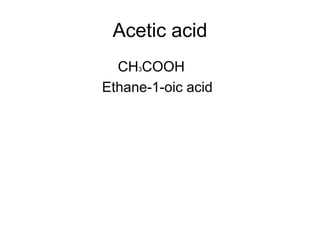
Acetic acid
CH3COOH
Ethane-1-oic acid
uses
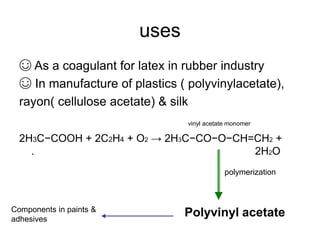
☺ As a coagulant for latex in rubber industry
☺ In manufacture of plastics ( polyvinylacetate),
rayon( cellulose acetate) & silk
vinyl acetate monomer
2H3C−COOH + 2C2H4 + O2 → 2H3C−CO−O−CH=CH2 +
. 2H2O
Polyvinyl acetate
polymerization
Components in paints &
adhesives
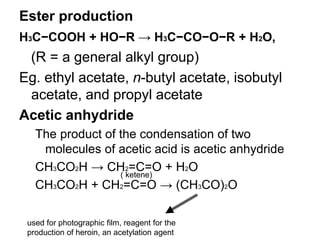
Ester production
H3C−COOH + HO−R → H3C−CO−O−R + H2O,
(R = a general alkyl group)
Eg. ethyl acetate, n-butyl acetate, isobutyl
acetate, and propyl acetate
Acetic anhydride
The product of the condensation of two
molecules of acetic acid is acetic anhydride
CH3CO2H → CH2=C=O + H2O
CH3CO2H + CH2=C=O → (CH3CO)2O
( ketene)
used for photographic film, reagent for the
production of heroin, an acetylation agent
• Vinegar is typically no less than 4% acetic
acid by mass
• Vinegar is used directly as a condiment
i.e. preparation that is added to food,
typically after cooking, to impart a specific
flavor, to enhance the flavor
• Acetic acid injection into a tumor has been
used to treat cancer since the 1800s.
• Acetic acid is used as part of cervical
cancer screening in many areas in
the developing world. It is applied to
the cervix & if an area of white appears
after about a minute the test is positive
• it is an effective antiseptic when used as a 1%
solution, with broad spectrum of activity against
streptococci, staphylococci pseudomonas,
enterococci and others
• It may be used to treat skin infections caused by
pseudomonas strains resistant to typical
antibiotics
• diluted acetic acid is used in iontophoresis i.e. is
a process of transdermal drug delivery by use of
a voltage gradient on the skin
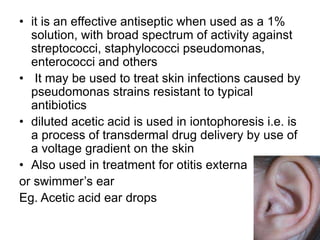
• Also used in treatment for otitis externa
or swimmer’s ear
Eg. Acetic acid ear drops
• Glacial acetic acid is an excellent polar protic
solvent, It is frequently used as a solvent for re-
crystallization to purify organic compounds
• Acetic acid is often used as a solvent for
reactions involving carbocations, such
as Friedel-Crafts alkylation.
• As a solvent in the laboratory for carrying out
reactions
☺ As vinegar for table purposes in 4-8% conc” &
in the manufacture of pickles of vegetables and
other foods
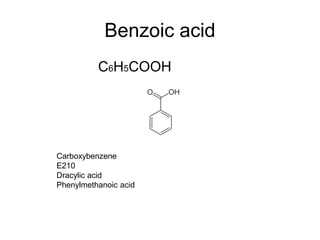
Benzoic acid
C6H5COOH
Carboxybenzene
E210
Dracylic acid
Phenylmethanoic acid
Uses
• In the medicines as urinary antiseptic
• For making aniline blue in dye industries
• As a preservative sodium benzoate being
less toxic is used for preserving food
products such as tomato sauce ( ketchup)
& fruit jams & juices
• Esters of benzoic acid are used in
perfumery
• benzoic acid is a common standard for
calibrating a bomb calorimeter i.e. the
process of measuring the heat of chemical
reactions
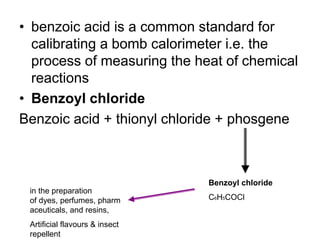
• Benzoyl chloride
Benzoic acid + thionyl chloride + phosgene
Benzoyl chloride
C6H5COCl
in the preparation
of dyes, perfumes, pharm
aceuticals, and resins,
Artificial flavours & insect
repellent
• Benzoic acid is a constituent of Whitfield'sointment which
is used for the treatment of fungal skin diseases such
as tinea, ringworm, and athlete's foot
• Benzoic acid was used as an expectorant, analgesic
& antiseptic in the early 20th century
• Benzoic acid & its salts are used as a food preservative
represented by the E numbers E210, E211, E212,
& E213 because it inhibits the growth of mold, yeast
• The efficacy of benzoic acid & its salts is dependent on
the pH of the food
• Acidic food and beverage like fruit juice (citric acid),
sparkling drinks (carbon dioxide), soft drinks (phosphoric
acid), pickles (vinegar) or other acidified food are
preserved with benzoic acid and benzoates
• use for benzoic acid as a preservative in food are
between 0.05–0.1%
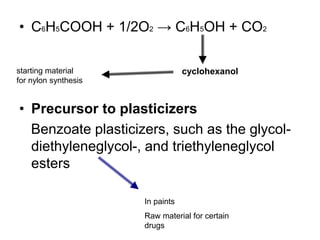
• C6H5COOH + 1/2O2 → C6H5OH + CO2
• Precursor to plasticizers
Benzoate plasticizers, such as the glycol-
diethyleneglycol-, and triethyleneglycol
esters
cyclohexanolstarting material
for nylon synthesis
In paints
Raw material for certain
drugs
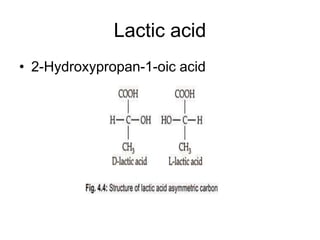
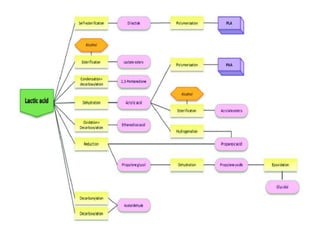
Lactic acid
• 2-Hydroxypropan-1-oic acid
uses
• Lactic acid is used as a food preservative,
curing agent, and flavoring agent.
• It is an ingredient in processed foods and
is used as a decontaminant during meat
processing
• in disease of calcium deficiency it is used
to introduce calcium into the body in the
form of calcium lactate.
• Ammonium lactate are use for dry skin
disorder
• Mineral lactate are use for diseases such
as “ anemia, hypertension ”
• Lactic acid is used as a humectant, or
moisturizer, in some cosmetics
• It also used as a mordant, a chemical that
helps fabrics accept dyes, in textiles
• It is also used in making pickles and sauerkraut,
foods for which a sour taste is desired
• Lactic acid is used in the dairy industry not only
in making yogurt but in making cheese as well
• It is also used in tanning leather
• Lactic acid is important in the pharmaceutical
industry as a starting material for other
substances and is involved in the manufacturing
of lacquers and inks. A related compound that is
made from lactic acid is calcium stearoyl-2-
lactylate, which is used as a food preservative.
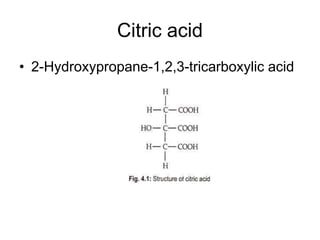
Citric acid
• 2-Hydroxypropane-1,2,3-tricarboxylic acid
uses
• citric acid is as a flavoring and preservative in
food and beverages, especially soft drinks and
candies
• Citric acid can be added to ice cream as an
emulsifying agent to keep fats from separating,
to caramel to prevent sucrose crystallization, or
in recipes in place of fresh lemon juice
• Citric acid + sodium bicarbonate in a wide range
of effervescent formulae
• It has use in culinary applications, as an
alternative to vinegar or lemon juice
• Citric acid can be used in food coloring to
balance the pH level of a normally basic
dye
• Citric acid can be used in shampoo to
wash out wax & coloring from the hair
• it is the active ingredient in some
bathroom & kitchen cleaning solutions with
a 6% conc” of citric acid will remove hard
water stains from glass without scrubbing
• In industry, it is used to dissolve rust from
steel
• Citric acid is an excellent chelating agent,
binding metals by making them soluble
• Citric acid is an alpha hydroxy acid and is
an active ingredient in chemical skin peels
• Citric acid is commonly used as a buffer to
increase the solubility of brown heroin
• Citric acid is used as one of the active
ingredients in the production of facial
tissues with antiviral properties
• Sodium citrate is a component of Benedict‘s
reagent, used for identification both qualitatively
and quantitatively of reducing sugars.
• The buffering properties of citrates are used to
control pH in household cleaners & pharma-
ceuticals so used as buffering solution ingredient
• Citric acid/potassium-sodium citrate can be used
as a blood acid regulator.
• It is an excellent soldering flux
• Citric acid can be used as a lower-odor stop
bath as part of the process for
developing photographic film. Photographic
developers are alkaline, so a mild acid is used
to neutralize and stop their action quickly, but
commonly used acetic acid leaves a strong
vinegar odor in the darkroom
• Citric acid can be used as an alternative to
nitric acid in passivation of stainless steel
• Citric acid is used as an acidulant in
creams, gels, and liquids
These are chemical compounds that
confer a tart, sour, or acidic flavor to foods.
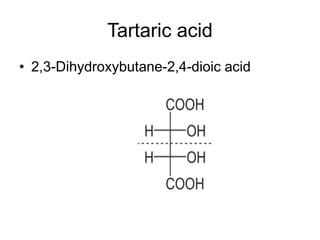
Tartaric acid
• 2,3-Dihydroxybutane-2,4-dioic acid
uses
• Tartaric acid & its derivatives have a plethora of
uses in the field of pharmaceuticals. For
example, it has been used in the production of
effervescent salts, in combination with citric acid,
to improve the taste of oral medications
• The potassium antimonyl derivative of the acid
known as tartar emetic is included, in small
doses, in cough syrup as an expectorant.
• Tartaric acid also has several applications for
industrial use.
• The acid has been observed to chelate metal
ions such as calcium and magnesium.
Therefore, the acid has served in the farming
and metal industries as a chelating agent for
complexing micronutrients in soil fertilizer and
for cleaning metal surfaces consisting of
aluminium, copper, iron, and alloys of these
metals
• Tartaric acid is often used as an acidulant in
grape- and lime-flavored beverages, gelatin
desserts, jams, jellies, and hard sour
confectionery
• It is often added to products like
carbonated beverages, fruit jellies, gelatin
and effervescent tablets
• industrial uses for tartaric acid include
within the gold and silver plating process,
cleaning and polishing metals, tanning
leather and making blue ink for blueprints
• Tartaric acid is also an ingredient in
Rochelle Salt, which reacts with silver
nitrate to create the silvering on mirrors.
Rochelle Salt is also a laxative
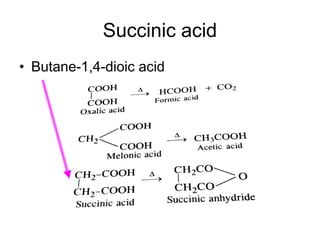
Succinic acid
• Butane-1,4-dioic acid
uses
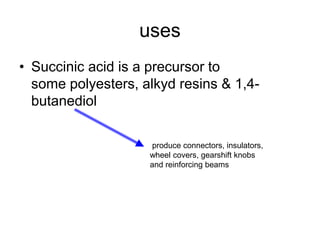
• Succinic acid is a precursor to
some polyesters, alkyd resins & 1,4-
butanediol
produce connectors, insulators,
wheel covers, gearshift knobs
and reinforcing beams
• Succinic acid also serves as the bases of
certain biodegradable polymers, which are
of interest in tissue engineering application
• Acylation with succinic acid is called
succination. Oversuccination occurs
when more than one succinate adds to a
substrate.
• As a food additive and dietary supplement,
succinic acid is generally recognized as
safe by the U.S. FDA.
• it is used primarily as an acidity regulator in the
food and beverage industry
• As an excipient in pharmaceutical products, it is
also used to control acidity or as a counter ion
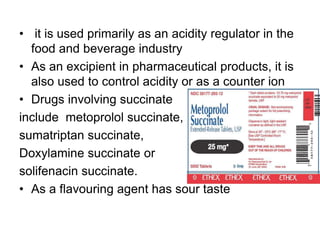
• Drugs involving succinate
include metoprolol succinate,
sumatriptan succinate,
Doxylamine succinate or
solifenacin succinate.
• As a flavouring agent has sour taste
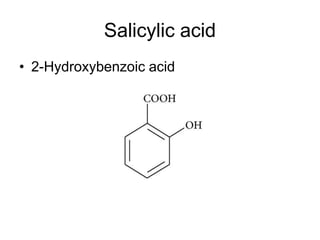
Salicylic acid
• 2-Hydroxybenzoic acid
uses
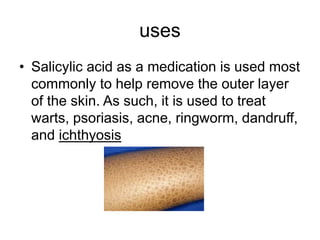
• Salicylic acid as a medication is used most
commonly to help remove the outer layer
of the skin. As such, it is used to treat
warts, psoriasis, acne, ringworm, dandruff,
and ichthyosis
• Salicylic acid is used in the production of
other pharmaceuticals, including 4-
aminosalicylic acid, sandulpiride, and
landetimide
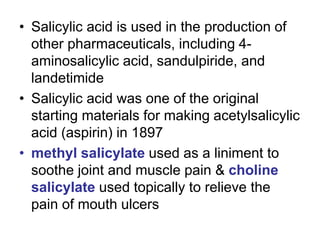
• Salicylic acid was one of the original
starting materials for making acetylsalicylic
acid (aspirin) in 1897
• methyl salicylate used as a liniment to
soothe joint and muscle pain & choline
salicylate used topically to relieve the
pain of mouth ulcers
• it is used as a food preservative, a
bactericidal and an antiseptic
• Sodium salicylate is a useful phosphor in
the vacuum ultraviolet spectral range, with
nearly flat quantum efficiency for wave-
lengths between 10-100 nm. It fluoresces
in the blue at 420 nm.
• Aspirin preparation
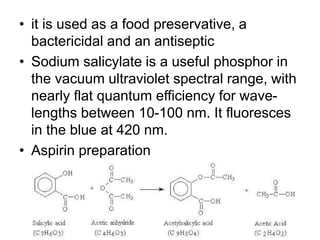
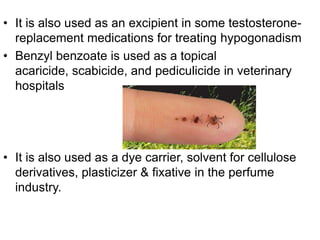
Benzyl benzoate
uses
• It is used repellent for chiggers, ticks, &
mosquitoes
• as a medication it is used to treat scabies
& lice. It is an effective & inexpensive
topical treatment for human scabies
• It has vasodilating & spasmolytic effects
& is present in many asthma & whooping
cough drugs
• It is also used as an excipient in some testosterone-
replacement medications for treating hypogonadism
• Benzyl benzoate is used as a topical
acaricide, scabicide, and pediculicide in veterinary
hospitals
• It is also used as a dye carrier, solvent for cellulose
derivatives, plasticizer & fixative in the perfume
industry.
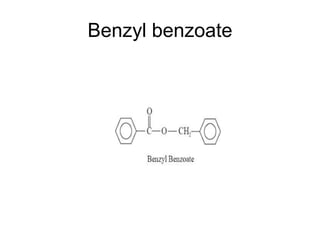
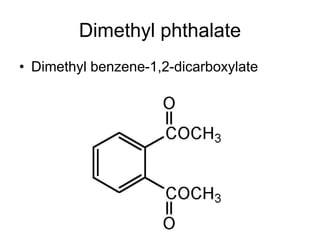
Dimethyl phthalate
• Dimethyl benzene-1,2-dicarboxylate
uses
• Dimethyl phthalate is an insect repellent
for mosquitoes and flies.
• It is also an ecto-parasiticide and has
many other uses
• It is also used as solid rocket propellants,
and plastics.
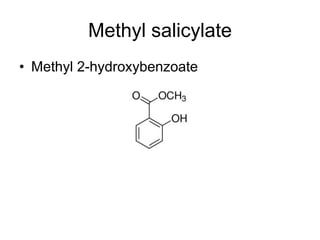
Methyl salicylate
• Methyl 2-hydroxybenzoate
uses
• Methyl salicylate is used in high concentrations
as a rubefacient & analgesic in deep
heating liniments to treat joint and muscular pain
• Methyl salicylate is used in low conc” (0.04%
and under) as a flavoring agent in chewing
gum & mints.
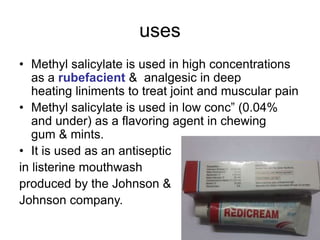
• It is used as an antiseptic
in listerine mouthwash
produced by the Johnson &
Johnson company.
• It provides fragrance to various products
and as an odor-masking agent for some
organophosphate pesticides
• Methyl salicylate is also used as a bait for
attracting male orchid bees for study,
which apparently gather the chemical to
synthesize pheromones
• It is as a penetrating oil to loosen rusted
parts.
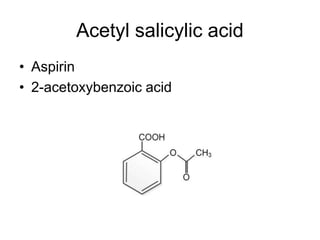
Acetyl salicylic acid
• Aspirin
• 2-acetoxybenzoic acid
uses
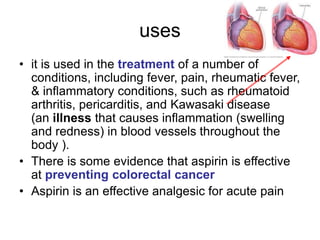
• it is used in the treatment of a number of
conditions, including fever, pain, rheumatic fever,
& inflammatory conditions, such as rheumatoid
arthritis, pericarditis, and Kawasaki disease
(an illness that causes inflammation (swelling
and redness) in blood vessels throughout the
body ).
• There is some evidence that aspirin is effective
at preventing colorectal cancer
• Aspirin is an effective analgesic for acute pain
• combinations of aspirin & caffeine
provide slightly greater pain relief than
aspirin alone
• Effervescent formulations of aspirin
relieve pain faster than aspirin in tablets
which makes them useful for the treatment
of migraines
• Topical aspirin may be effective for treating
some types of neuro-pathic pain
• It also reduces the overall risk of both
getting cancer and dying from cancer,
also slightly reduce the risk of endometrial
cancer,breast cancer, and prostate cancer
• aspirin is combined with an ADP receptor
inhibitor, such as clopidogrel, prasugrel,
or ticagrelor to prevent blood clots called
dual antiplatelet therapy (DAPT)
• it is an important part of the treatment of
those who have had a heart attack &
stroke.
• Aspirin, especially as a component of
an aspirin/paracetamol/caffeine combina
tion, is considered a first-line therapy in
the treatment of migraine, & comparable
to lower doses of sumatriptan. It is most
effective at stopping migraines when they
are first beginning

Carboxylic acid structure & uses

  • 1.
    Carboxylic acid Pt LR college of pharmacy faridabad
  • 2.
  • 3.
    uses ☺ As acoagulant for latex in rubber industry ☺ In manufacture of plastics ( polyvinylacetate), rayon( cellulose acetate) & silk vinyl acetate monomer 2H3C−COOH + 2C2H4 + O2 → 2H3C−CO−O−CH=CH2 + . 2H2O Polyvinyl acetate polymerization Components in paints & adhesives
  • 4.
    Ester production H3C−COOH +HO−R → H3C−CO−O−R + H2O, (R = a general alkyl group) Eg. ethyl acetate, n-butyl acetate, isobutyl acetate, and propyl acetate Acetic anhydride The product of the condensation of two molecules of acetic acid is acetic anhydride CH3CO2H → CH2=C=O + H2O CH3CO2H + CH2=C=O → (CH3CO)2O ( ketene) used for photographic film, reagent for the production of heroin, an acetylation agent
  • 5.
    • Vinegar istypically no less than 4% acetic acid by mass • Vinegar is used directly as a condiment i.e. preparation that is added to food, typically after cooking, to impart a specific flavor, to enhance the flavor • Acetic acid injection into a tumor has been used to treat cancer since the 1800s. • Acetic acid is used as part of cervical cancer screening in many areas in the developing world. It is applied to the cervix & if an area of white appears after about a minute the test is positive
  • 6.
    • it isan effective antiseptic when used as a 1% solution, with broad spectrum of activity against streptococci, staphylococci pseudomonas, enterococci and others • It may be used to treat skin infections caused by pseudomonas strains resistant to typical antibiotics • diluted acetic acid is used in iontophoresis i.e. is a process of transdermal drug delivery by use of a voltage gradient on the skin • Also used in treatment for otitis externa or swimmer’s ear Eg. Acetic acid ear drops
  • 7.
    • Glacial aceticacid is an excellent polar protic solvent, It is frequently used as a solvent for re- crystallization to purify organic compounds • Acetic acid is often used as a solvent for reactions involving carbocations, such as Friedel-Crafts alkylation. • As a solvent in the laboratory for carrying out reactions ☺ As vinegar for table purposes in 4-8% conc” & in the manufacture of pickles of vegetables and other foods
  • 8.
  • 9.
    Uses • In themedicines as urinary antiseptic • For making aniline blue in dye industries • As a preservative sodium benzoate being less toxic is used for preserving food products such as tomato sauce ( ketchup) & fruit jams & juices • Esters of benzoic acid are used in perfumery
  • 10.
    • benzoic acidis a common standard for calibrating a bomb calorimeter i.e. the process of measuring the heat of chemical reactions • Benzoyl chloride Benzoic acid + thionyl chloride + phosgene Benzoyl chloride C6H5COCl in the preparation of dyes, perfumes, pharm aceuticals, and resins, Artificial flavours & insect repellent
  • 11.
    • Benzoic acidis a constituent of Whitfield'sointment which is used for the treatment of fungal skin diseases such as tinea, ringworm, and athlete's foot • Benzoic acid was used as an expectorant, analgesic & antiseptic in the early 20th century • Benzoic acid & its salts are used as a food preservative represented by the E numbers E210, E211, E212, & E213 because it inhibits the growth of mold, yeast • The efficacy of benzoic acid & its salts is dependent on the pH of the food • Acidic food and beverage like fruit juice (citric acid), sparkling drinks (carbon dioxide), soft drinks (phosphoric acid), pickles (vinegar) or other acidified food are preserved with benzoic acid and benzoates • use for benzoic acid as a preservative in food are between 0.05–0.1%
  • 12.
    • C6H5COOH +1/2O2 → C6H5OH + CO2 • Precursor to plasticizers Benzoate plasticizers, such as the glycol- diethyleneglycol-, and triethyleneglycol esters cyclohexanolstarting material for nylon synthesis In paints Raw material for certain drugs
  • 13.
  • 14.
    uses • Lactic acidis used as a food preservative, curing agent, and flavoring agent. • It is an ingredient in processed foods and is used as a decontaminant during meat processing
  • 16.
    • in diseaseof calcium deficiency it is used to introduce calcium into the body in the form of calcium lactate. • Ammonium lactate are use for dry skin disorder • Mineral lactate are use for diseases such as “ anemia, hypertension ” • Lactic acid is used as a humectant, or moisturizer, in some cosmetics • It also used as a mordant, a chemical that helps fabrics accept dyes, in textiles
  • 17.
    • It isalso used in making pickles and sauerkraut, foods for which a sour taste is desired • Lactic acid is used in the dairy industry not only in making yogurt but in making cheese as well • It is also used in tanning leather • Lactic acid is important in the pharmaceutical industry as a starting material for other substances and is involved in the manufacturing of lacquers and inks. A related compound that is made from lactic acid is calcium stearoyl-2- lactylate, which is used as a food preservative.
  • 18.
  • 19.
    uses • citric acidis as a flavoring and preservative in food and beverages, especially soft drinks and candies • Citric acid can be added to ice cream as an emulsifying agent to keep fats from separating, to caramel to prevent sucrose crystallization, or in recipes in place of fresh lemon juice • Citric acid + sodium bicarbonate in a wide range of effervescent formulae
  • 20.
    • It hasuse in culinary applications, as an alternative to vinegar or lemon juice • Citric acid can be used in food coloring to balance the pH level of a normally basic dye • Citric acid can be used in shampoo to wash out wax & coloring from the hair • it is the active ingredient in some bathroom & kitchen cleaning solutions with a 6% conc” of citric acid will remove hard water stains from glass without scrubbing
  • 21.
    • In industry,it is used to dissolve rust from steel • Citric acid is an excellent chelating agent, binding metals by making them soluble • Citric acid is an alpha hydroxy acid and is an active ingredient in chemical skin peels • Citric acid is commonly used as a buffer to increase the solubility of brown heroin • Citric acid is used as one of the active ingredients in the production of facial tissues with antiviral properties
  • 22.
    • Sodium citrateis a component of Benedict‘s reagent, used for identification both qualitatively and quantitatively of reducing sugars. • The buffering properties of citrates are used to control pH in household cleaners & pharma- ceuticals so used as buffering solution ingredient • Citric acid/potassium-sodium citrate can be used as a blood acid regulator. • It is an excellent soldering flux • Citric acid can be used as a lower-odor stop bath as part of the process for developing photographic film. Photographic developers are alkaline, so a mild acid is used to neutralize and stop their action quickly, but commonly used acetic acid leaves a strong vinegar odor in the darkroom
  • 23.
    • Citric acidcan be used as an alternative to nitric acid in passivation of stainless steel • Citric acid is used as an acidulant in creams, gels, and liquids These are chemical compounds that confer a tart, sour, or acidic flavor to foods.
  • 24.
  • 25.
    uses • Tartaric acid& its derivatives have a plethora of uses in the field of pharmaceuticals. For example, it has been used in the production of effervescent salts, in combination with citric acid, to improve the taste of oral medications • The potassium antimonyl derivative of the acid known as tartar emetic is included, in small doses, in cough syrup as an expectorant. • Tartaric acid also has several applications for industrial use.
  • 26.
    • The acidhas been observed to chelate metal ions such as calcium and magnesium. Therefore, the acid has served in the farming and metal industries as a chelating agent for complexing micronutrients in soil fertilizer and for cleaning metal surfaces consisting of aluminium, copper, iron, and alloys of these metals • Tartaric acid is often used as an acidulant in grape- and lime-flavored beverages, gelatin desserts, jams, jellies, and hard sour confectionery
  • 27.
    • It isoften added to products like carbonated beverages, fruit jellies, gelatin and effervescent tablets • industrial uses for tartaric acid include within the gold and silver plating process, cleaning and polishing metals, tanning leather and making blue ink for blueprints • Tartaric acid is also an ingredient in Rochelle Salt, which reacts with silver nitrate to create the silvering on mirrors. Rochelle Salt is also a laxative
  • 28.
  • 29.
    uses • Succinic acidis a precursor to some polyesters, alkyd resins & 1,4- butanediol produce connectors, insulators, wheel covers, gearshift knobs and reinforcing beams
  • 30.
    • Succinic acidalso serves as the bases of certain biodegradable polymers, which are of interest in tissue engineering application • Acylation with succinic acid is called succination. Oversuccination occurs when more than one succinate adds to a substrate. • As a food additive and dietary supplement, succinic acid is generally recognized as safe by the U.S. FDA.
  • 31.
    • it isused primarily as an acidity regulator in the food and beverage industry • As an excipient in pharmaceutical products, it is also used to control acidity or as a counter ion • Drugs involving succinate include metoprolol succinate, sumatriptan succinate, Doxylamine succinate or solifenacin succinate. • As a flavouring agent has sour taste
  • 32.
  • 33.
    uses • Salicylic acidas a medication is used most commonly to help remove the outer layer of the skin. As such, it is used to treat warts, psoriasis, acne, ringworm, dandruff, and ichthyosis
  • 34.
    • Salicylic acidis used in the production of other pharmaceuticals, including 4- aminosalicylic acid, sandulpiride, and landetimide • Salicylic acid was one of the original starting materials for making acetylsalicylic acid (aspirin) in 1897 • methyl salicylate used as a liniment to soothe joint and muscle pain & choline salicylate used topically to relieve the pain of mouth ulcers
  • 35.
    • it isused as a food preservative, a bactericidal and an antiseptic • Sodium salicylate is a useful phosphor in the vacuum ultraviolet spectral range, with nearly flat quantum efficiency for wave- lengths between 10-100 nm. It fluoresces in the blue at 420 nm. • Aspirin preparation
  • 36.
  • 37.
    uses • It isused repellent for chiggers, ticks, & mosquitoes • as a medication it is used to treat scabies & lice. It is an effective & inexpensive topical treatment for human scabies • It has vasodilating & spasmolytic effects & is present in many asthma & whooping cough drugs
  • 38.
    • It isalso used as an excipient in some testosterone- replacement medications for treating hypogonadism • Benzyl benzoate is used as a topical acaricide, scabicide, and pediculicide in veterinary hospitals • It is also used as a dye carrier, solvent for cellulose derivatives, plasticizer & fixative in the perfume industry.
  • 39.
    Dimethyl phthalate • Dimethylbenzene-1,2-dicarboxylate
  • 40.
    uses • Dimethyl phthalateis an insect repellent for mosquitoes and flies. • It is also an ecto-parasiticide and has many other uses • It is also used as solid rocket propellants, and plastics.
  • 41.
  • 42.
    uses • Methyl salicylateis used in high concentrations as a rubefacient & analgesic in deep heating liniments to treat joint and muscular pain • Methyl salicylate is used in low conc” (0.04% and under) as a flavoring agent in chewing gum & mints. • It is used as an antiseptic in listerine mouthwash produced by the Johnson & Johnson company.
  • 43.
    • It providesfragrance to various products and as an odor-masking agent for some organophosphate pesticides • Methyl salicylate is also used as a bait for attracting male orchid bees for study, which apparently gather the chemical to synthesize pheromones • It is as a penetrating oil to loosen rusted parts.
  • 44.
    Acetyl salicylic acid •Aspirin • 2-acetoxybenzoic acid
  • 45.
    uses • it isused in the treatment of a number of conditions, including fever, pain, rheumatic fever, & inflammatory conditions, such as rheumatoid arthritis, pericarditis, and Kawasaki disease (an illness that causes inflammation (swelling and redness) in blood vessels throughout the body ). • There is some evidence that aspirin is effective at preventing colorectal cancer • Aspirin is an effective analgesic for acute pain
  • 46.
    • combinations ofaspirin & caffeine provide slightly greater pain relief than aspirin alone • Effervescent formulations of aspirin relieve pain faster than aspirin in tablets which makes them useful for the treatment of migraines • Topical aspirin may be effective for treating some types of neuro-pathic pain
  • 47.
    • It alsoreduces the overall risk of both getting cancer and dying from cancer, also slightly reduce the risk of endometrial cancer,breast cancer, and prostate cancer • aspirin is combined with an ADP receptor inhibitor, such as clopidogrel, prasugrel, or ticagrelor to prevent blood clots called dual antiplatelet therapy (DAPT) • it is an important part of the treatment of those who have had a heart attack & stroke.
  • 48.
    • Aspirin, especiallyas a component of an aspirin/paracetamol/caffeine combina tion, is considered a first-line therapy in the treatment of migraine, & comparable to lower doses of sumatriptan. It is most effective at stopping migraines when they are first beginning