Unit -3
Alkyl halide
Uses:
1. The major use of Chloroethane was to produce tetraethyllead
(TEL: It is a petro-fuel additive), an anti-knock additive for
gasoline.
2. Gasoline or gas for short (American English), or petrol (British
English), is a transparent, petroleum-derived liquid that is used
primarily as a fuel in internal combustion engines.
3.Chloroethane has been used as a refrigerant, an aerosol spray
propellant, an anesthetic, and a blowing agent for foam
packaging.
4. In dentistry, Chloroethane is used as one of the means of
diagnosing a 'dead tooth', i.e. one in which the pulp has died. A
small amount of the substance is placed on the suspect tooth
using a cotton wad.
5. Chloroethane is not classifiable as to its carcinogenicity to
humans, but toxic over-exposure starts at 9% to 12%
concentrations, the heart rate dr
Structure
Structure
Uses:
1. Chloroform is also used to extract and purify
penicillin.
2. Chloroform used for extraction and
purification of Alkaloids.
3. Chloroform was popular as an anesthetic from
the mid-1800s to around 1900, but it was
found to cause death from Paralysis.
4. chloroform is also used in pesticide
formulations, as a solvent for fats, oils, rubber,
waxes, gutta-percha, and resins, as a cleansing
agent
Structure
Uses
- The main use of trichloroethylene is in the
vapor degreasing of metal parts.
- Trichloroethylene is also used as an
extraction solvent for greases, oils, fats,
waxes, and tars, a chemical
intermediate in the production of other
chemicals, and as a refrigerant.
- Trichloroethylene is used in consumer
products such as typewriter correction fluids,
paint removers/strippers,
adhesives, spot removers, and rug-cleaning
fluids.
- Trichloroethylene was used in the past as a
general anesthetic
Structure
Uses:
-
1. DCM's volatility and ability to dissolve a wide
range of organic compounds makes it a useful solvent
for
many chemical processes.
2. It is widely used as a paint stripper and a
degreaser.
3. In the food industry, it has been used to
decaffeinate coffee and tea as well as to prepare
extracts of hops
and other flavorings. Its volatility has led to its use as
an aerosol spray propellant and as a blowing agent
for polyurethane foams
Uses
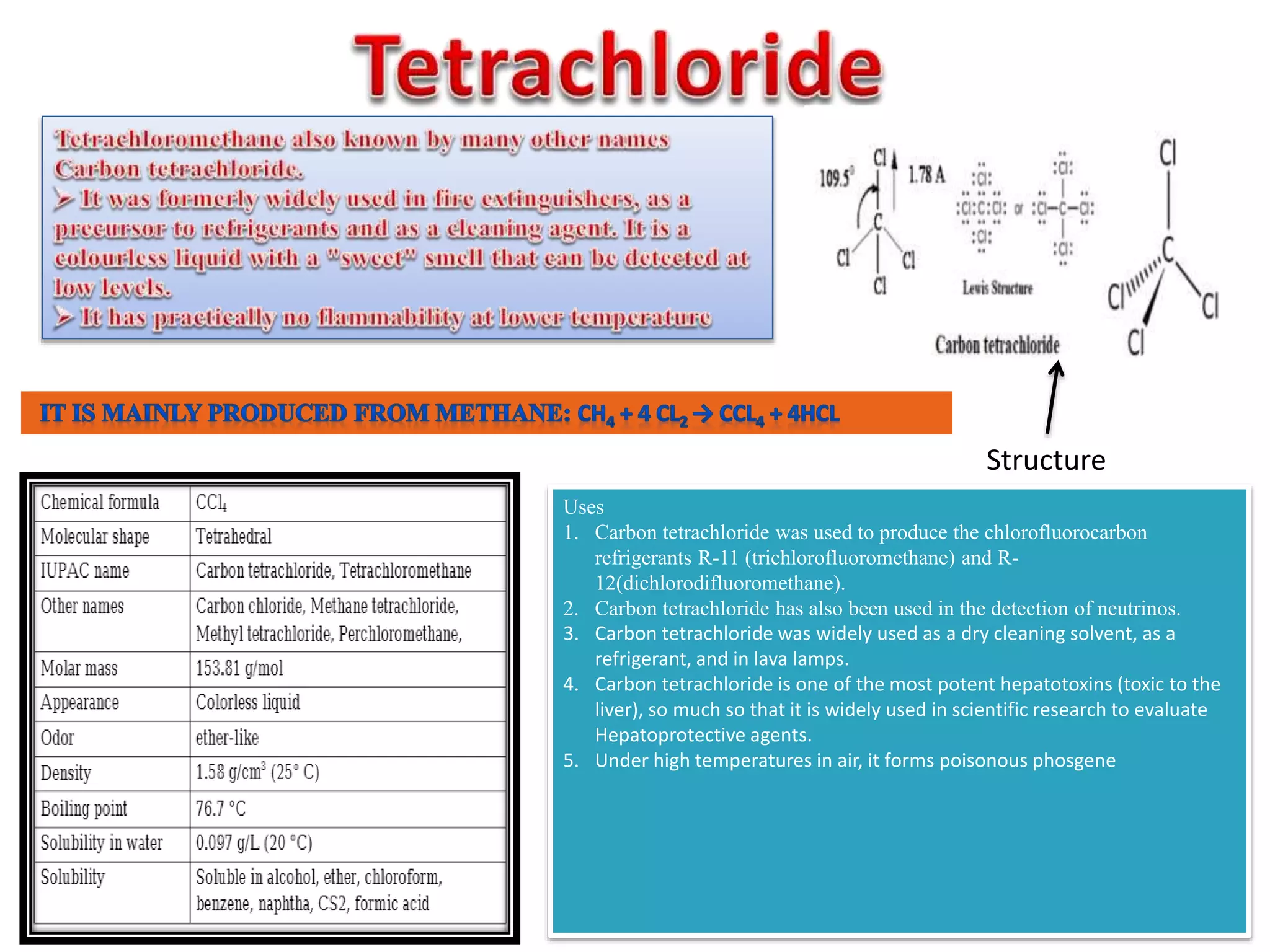
1. Carbon tetrachloride was used to produce the chlorofluorocarbon
refrigerants R-11 (trichlorofluoromethane) and R-
12(dichlorodifluoromethane).
2. Carbon tetrachloride has also been used in the detection of neutrinos.
3. Carbon tetrachloride was widely used as a dry cleaning solvent, as a
refrigerant, and in lava lamps.
4. Carbon tetrachloride is one of the most potent hepatotoxins (toxic to the
liver), so much so that it is widely used in scientific research to evaluate
Hepatoprotective agents.
5. Under high temperatures in air, it forms poisonous phosgene
Structure
Structure
Uses:
1. The compound finds small-scale use as a
disinfectant.
2. It was used in medicine as a healing and
antiseptic dressing for wounds and sores.
3.It is the active ingredient in many ear
powders for dogs and cats, along with zinc
oxide and propanoic acid, which are used to
prevent infection and facilitate removal of ear
hair.
Structure & uses of chemicals

Structure & uses of chemicals

  • 1.
  • 3.
    Uses: 1. The majoruse of Chloroethane was to produce tetraethyllead (TEL: It is a petro-fuel additive), an anti-knock additive for gasoline. 2. Gasoline or gas for short (American English), or petrol (British English), is a transparent, petroleum-derived liquid that is used primarily as a fuel in internal combustion engines. 3.Chloroethane has been used as a refrigerant, an aerosol spray propellant, an anesthetic, and a blowing agent for foam packaging. 4. In dentistry, Chloroethane is used as one of the means of diagnosing a 'dead tooth', i.e. one in which the pulp has died. A small amount of the substance is placed on the suspect tooth using a cotton wad. 5. Chloroethane is not classifiable as to its carcinogenicity to humans, but toxic over-exposure starts at 9% to 12% concentrations, the heart rate dr Structure
  • 4.
    Structure Uses: 1. Chloroform isalso used to extract and purify penicillin. 2. Chloroform used for extraction and purification of Alkaloids. 3. Chloroform was popular as an anesthetic from the mid-1800s to around 1900, but it was found to cause death from Paralysis. 4. chloroform is also used in pesticide formulations, as a solvent for fats, oils, rubber, waxes, gutta-percha, and resins, as a cleansing agent
  • 5.
    Structure Uses - The mainuse of trichloroethylene is in the vapor degreasing of metal parts. - Trichloroethylene is also used as an extraction solvent for greases, oils, fats, waxes, and tars, a chemical intermediate in the production of other chemicals, and as a refrigerant. - Trichloroethylene is used in consumer products such as typewriter correction fluids, paint removers/strippers, adhesives, spot removers, and rug-cleaning fluids. - Trichloroethylene was used in the past as a general anesthetic
  • 6.
    Structure Uses: - 1. DCM's volatilityand ability to dissolve a wide range of organic compounds makes it a useful solvent for many chemical processes. 2. It is widely used as a paint stripper and a degreaser. 3. In the food industry, it has been used to decaffeinate coffee and tea as well as to prepare extracts of hops and other flavorings. Its volatility has led to its use as an aerosol spray propellant and as a blowing agent for polyurethane foams
  • 7.
    Uses 1. Carbon tetrachloridewas used to produce the chlorofluorocarbon refrigerants R-11 (trichlorofluoromethane) and R- 12(dichlorodifluoromethane). 2. Carbon tetrachloride has also been used in the detection of neutrinos. 3. Carbon tetrachloride was widely used as a dry cleaning solvent, as a refrigerant, and in lava lamps. 4. Carbon tetrachloride is one of the most potent hepatotoxins (toxic to the liver), so much so that it is widely used in scientific research to evaluate Hepatoprotective agents. 5. Under high temperatures in air, it forms poisonous phosgene Structure
  • 8.
    Structure Uses: 1. The compoundfinds small-scale use as a disinfectant. 2. It was used in medicine as a healing and antiseptic dressing for wounds and sores. 3.It is the active ingredient in many ear powders for dogs and cats, along with zinc oxide and propanoic acid, which are used to prevent infection and facilitate removal of ear hair.