LIPIDS
ASIYABI.M
ASSISTANT PROFFESSOR
DEPARTMENT OF PHARMACOLOGY
SVCP
DEFINITION
 Lipids or fats are greasy material occurring widely in
nature. They are generally in soluble in water but
soluble in fat solvents. They include substance such
as,
 Naturally occurring fats,for example butter and oils.
 Oils which are liquid at room temprature.
 Substance which are related to fats, because of
certain common properties such as solubility and
biological origin but differ from fat in appearance
and chemical nature for example cholesterol.
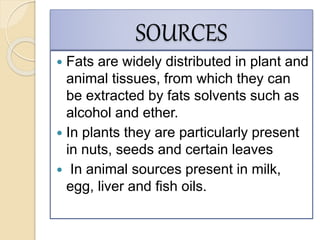
SOURCES
 Fats are widely distributed in plant and
animal tissues, from which they can
be extracted by fats solvents such as
alcohol and ether.
 In plants they are particularly present
in nuts, seeds and certain leaves
 In animal sources present in milk,
egg, liver and fish oils.
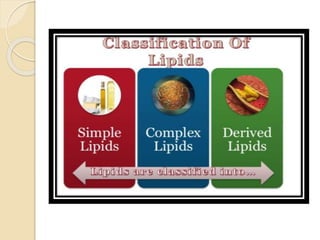
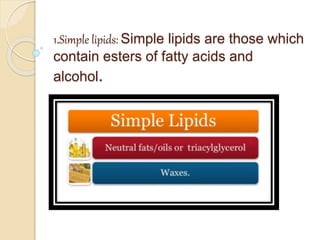
1.Simple lipids: Simple lipids are those which
contain esters of fatty acids and
alcohol.
Compound lipids: Compound lipids contain
some other chemical group in addition to
alcohol and fatty acids. There are four sub
divisions under this group.
1.Phospholipids
2.Glycolipids
3.Sulpholipids
4.LIPOPROTEINS
Lipoproteins:
Lipidsproteins
Bases
Fatty
acids
Glycerides
Alcohols other than
glycerol
SIMPLE LIPIDS
FATS
Physical properties
WAXES
 Waxes are ester of fatty acids with alcohol other
than glycerol. Waxes are insoluble in water but
soluble in fat solvents.They are not easily
hydrolysed like fats or digested by lipase.
 Bees wax: This is secreted by the honey bee to
the form honeycomb.
 Chinese wax: This is the secretion of an insect.
 Carnauba wax: This is found on the leaves of
carnauba palm.
 Lanoline: This is known as “wool wax”. obtained
from wool.
Compound lipids
1) Phospholipids: Phospholipids are
also known as phosphatides. They are
important Compounds present in all
vegetable and animal cells. They are
abudantly present in heart,
brain,kidneys, egg yolk and soya
bean.
 Phospholipids play an important role in
the prevention of fatty liver and in the
process of blood coagulation.
 Tha important 3 phospholipids are:
oLecithin
oCephalin
oSphingomyel
oin
A typical lecithin consist of one glycerol
molecule and two molecules of fatty
acids.
One of these fatty acids may be
unsaturated and the other saturated. It
contains a phosphoric acid molecule
and a nitrogen base.
LECITHIN
 Two forms of lecithin α-lecithin and β-
lecithin.
 Lecithin are hydrolysed enzyme called
Lecithinase to various components. There
are four types of Lecithinase occuring
 Lecithinase A
 Lecithinase B
 Lecithinase C
 Lecithinase D
They are similar structure of that of Lecithin
but differ from that tha base is attached to
phosphoric acid is not choline.
CEPHALIN
2) Glycolipids: The Glycolipids contain a sugar in
addition to fatty acid and sphingosine.
They do not contain phosphoric acid. It may be
further subdivided in to CEREBROSIDES and
GANGLIOSIDES.
3) LIPOPROTEINS: Lipoprotein are formed by
combination of protein with lipids which include
phospholipids,lecithin,and cephalin, fatty acid,
cholesterol, glycerides and fat soluble vitamins.
The lipoprotein molecule has lower density than
the ordinary protein molecule, due to its
combination with lipids.
DERIVED LIPIDS
Saturated fatty acids
 These are fatty acids which do not
contain double bonds.They do not
exhibit addition reaction and their
iodine value are nil. Generally the
presence of saturated fatty acids
makes the fat solid.For example butter
which is a solid fat has a higher iodine
value (35-50) than coconut oil which is
a liquid fat (iodine value 6-10).
UNSATURATED FATTY ACIDS
 Unsaturated fatty acids may further
divided as follows:
1) Monosaturated: it containing only
one double bond.
2) Polysaturated: It containing two or
more double bonds.
The iodine values vary according to
the degree of unsaturation.
Lipids
Lipids

Lipids

  • 1.
  • 2.
    DEFINITION  Lipids orfats are greasy material occurring widely in nature. They are generally in soluble in water but soluble in fat solvents. They include substance such as,  Naturally occurring fats,for example butter and oils.  Oils which are liquid at room temprature.  Substance which are related to fats, because of certain common properties such as solubility and biological origin but differ from fat in appearance and chemical nature for example cholesterol.
  • 3.
    SOURCES  Fats arewidely distributed in plant and animal tissues, from which they can be extracted by fats solvents such as alcohol and ether.  In plants they are particularly present in nuts, seeds and certain leaves  In animal sources present in milk, egg, liver and fish oils.
  • 9.
    1.Simple lipids: Simplelipids are those which contain esters of fatty acids and alcohol.
  • 10.
    Compound lipids: Compoundlipids contain some other chemical group in addition to alcohol and fatty acids. There are four sub divisions under this group. 1.Phospholipids 2.Glycolipids 3.Sulpholipids 4.LIPOPROTEINS
  • 14.
  • 17.
  • 18.
  • 19.
  • 23.
    WAXES  Waxes areester of fatty acids with alcohol other than glycerol. Waxes are insoluble in water but soluble in fat solvents.They are not easily hydrolysed like fats or digested by lipase.  Bees wax: This is secreted by the honey bee to the form honeycomb.  Chinese wax: This is the secretion of an insect.  Carnauba wax: This is found on the leaves of carnauba palm.  Lanoline: This is known as “wool wax”. obtained from wool.
  • 24.
    Compound lipids 1) Phospholipids:Phospholipids are also known as phosphatides. They are important Compounds present in all vegetable and animal cells. They are abudantly present in heart, brain,kidneys, egg yolk and soya bean.  Phospholipids play an important role in the prevention of fatty liver and in the process of blood coagulation.  Tha important 3 phospholipids are:
  • 25.
    oLecithin oCephalin oSphingomyel oin A typical lecithinconsist of one glycerol molecule and two molecules of fatty acids. One of these fatty acids may be unsaturated and the other saturated. It contains a phosphoric acid molecule and a nitrogen base. LECITHIN
  • 26.
     Two formsof lecithin α-lecithin and β- lecithin.  Lecithin are hydrolysed enzyme called Lecithinase to various components. There are four types of Lecithinase occuring  Lecithinase A  Lecithinase B  Lecithinase C  Lecithinase D They are similar structure of that of Lecithin but differ from that tha base is attached to phosphoric acid is not choline. CEPHALIN
  • 27.
    2) Glycolipids: TheGlycolipids contain a sugar in addition to fatty acid and sphingosine. They do not contain phosphoric acid. It may be further subdivided in to CEREBROSIDES and GANGLIOSIDES. 3) LIPOPROTEINS: Lipoprotein are formed by combination of protein with lipids which include phospholipids,lecithin,and cephalin, fatty acid, cholesterol, glycerides and fat soluble vitamins. The lipoprotein molecule has lower density than the ordinary protein molecule, due to its combination with lipids.
  • 28.
  • 30.
    Saturated fatty acids These are fatty acids which do not contain double bonds.They do not exhibit addition reaction and their iodine value are nil. Generally the presence of saturated fatty acids makes the fat solid.For example butter which is a solid fat has a higher iodine value (35-50) than coconut oil which is a liquid fat (iodine value 6-10).
  • 32.
    UNSATURATED FATTY ACIDS Unsaturated fatty acids may further divided as follows: 1) Monosaturated: it containing only one double bond. 2) Polysaturated: It containing two or more double bonds. The iodine values vary according to the degree of unsaturation.