EPILEPSY
By
M.ASIYABI.,M.PHARM (PHARMACOLOGY)
ASSISTANT PROFESSOR
DEPARTMENT OF PHARMACY
Definition
• Epilepsy : The occurrence of transient (short-
term) paroxysms (sudden attack) of excessive
or uncontrolled discharges of neurons in the
cerebral cortex, which may be caused by a
number of different etiologies, leading to
epileptic seizures.
• The term seizure needs to be carefully
distinguished from convulsions and epilepsy.
What is the differences between
Seizure and Epilepsy
• Epilepsy is a disorder characterized by
recurring seizures (also known as “seizure
disorder”)
• A seizure is a brief, temporary disturbance in
the electrical activity of the brain
“A seizure is a symptom of epilepsy”
Historical Background
Epilepsy derived from a Greek term:
Epilambane -to posses, to take hold of, to
grab or to seize.
Vedic period of 4500-1500BC : Ancient Indian
Medicine refined and developed the basic
concept of epilepsy
Charaka Samhita- The Ayurvedic literature
400 BC: Describe epilepsy as ‘Apasmara’
means loss of consciousness.
Cont…
Hippocrates 400 BC: ‘This is not a sacred
disease rather disorder of brain’ . He described
some physical treatment of epilepsy and
stated it is an incurable chronic illness.
Ibn Sina 370 AH: describe epilepsy as a brain
disease
Timeline
• 1909: Formation International league against
epilepsy (ILAE).
• 1912: Use Phenobarbitone as AED.
• 1938: Use Phenytoin as AED.
• 1950-1970: Developed many AED.
• 1981: ILAE classified epilepsy.
• 1997: ILAE, IBE and WHO jointly established
Global campaign against epilepsy.
The Brain Is the Source of Epilepsy
• All brain functions -- including feeling, seeing,
thinking, and moving muscles -- depend on
electrical signals passed between nerve cells
in the brain
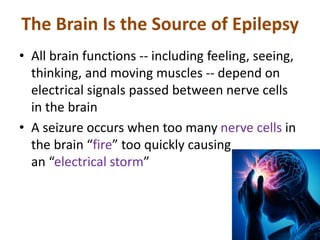
• A seizure occurs when too many nerve cells in
the brain “fire” too quickly causing
an “electrical storm”
Epidemiology
The most common ages of incidence are under the
age of 18 and over the age of 65.
About 1% of the population meets the diagnostic
criteria for epilepsy at any given time.
Prevalence:
Developed countries- 0.5% (0.4% - 1%)
Developing countries- five times higher
Incidence:
After infancy annual incidence- 20-70/100000 in
developed countries.
Developing countries- Incidence is double.
(100/100000)
Causes
• In 28% cases cause can be determined. Rests
(72%) are Idiopathic.
Determined causes:
• Inherited genetic
• Acquired : trauma, Neuro surgery, Inflammatory,
Metabolic, Infections, Tumor, Toxic disorders,
drugs, etc.
• Congenital: inborn error of metabolism.
• Withdrawal of drugs : Alcohol,Benzodiazepine,
Barbiturates, Other Anti-Epileptics
Drugs That Induce Seizures
• Antibiotics: Penicillin, INH, Cycloserin,
Ciprofloxacin, Metronidazole.
• Anti Diabetic: Insulin,Phenformin.
• Hormonal: Prednisolone, OCP, Oxytocin
• Cardiac: Lidocaine,Procaine, Disopiramide
• Anesthetics: Methohexital, Ketamin,
Halothane,Propofol
• Antimalarial: Chroloquine, Mefloquine,
Proguanil.
• Anti Spastic: Baclofen
• Stimulant: Aminophylline, Theophyline.
Cont…
• Radiographic contrast: Meglumine
derivatives, Metrizamide.
• Antidepressant:
TCA- (Amitriptaline, Imipramine,
Clomipramine), Dosulepin, Buproprion,
Venlafaxine, Duloxitine,Reboxetine
• Antipsychotics: Chlorpromazine, Zotepine,
Loxapine,Depot Anti-psychotics,Clozapine
• Mood Stabilizer: Lithium
• Psycho stimulant: Amphetamine
Safe Psychiatric medication in
Epilepsy
• Antidepressant:
Moclobemide,
SSRI (with cautious)
• Antipsychotics:
Haloperidol,
Trifluphenazine,
Sulpiride
Groups at higher risk
The risk is higher in people with certain medical
conditions:
• Mental retardation
• Cerebral palsy (movement disorder)
• Alzheimer’s disease (neuro-degeneration)
• Stroke (poor blood flow to brain
• Autism (troubles with
social interaction)
Triggers
• Missed medication (#1 reason)
• Stress/anxiety
• Hormonal changes
• Dehydration
• Lack of sleep
• Extreme fatigue
• Photosensitivity
• Drug/alcohol use; drug interactions
Symptoms
• Confused memory
• Occasional “fainting spells”
• Episodes of blank staring (looking somewhere
without any reason) in children
• Sudden falls for no apparent reason
• Episodes of blinking or chewing at
inappropriate times
• A convulsion, with or without fever
• Swift jerking movements in babies
First Aids
Stay calm and track time
Do not restrain the person, but help them avoid
hazards
– Protect head, remove glasses, loosen tight neckwear
– Move anything hard or sharp out of the way
– Turn person on one side, position mouth to ground
Check for epilepsy or seizure disorder ID
Understand that verbal instructions may not be obeyed
Stay until person is fully aware and help reorient them
Call ambulance if seizure lasts more than 5 minutes or
if it is unknown whether the person has had prior
seizures
NOT TO DO
Put anything in the person’s mouth
Try to hold down or restrain the person
Attempt to give oral anti-seizure medication
Keep the person on their back face up
throughout convulsion
P
A
T
H
O
P
H
Y
S
I
O
L
O
G
Y
Decreased inhibitory system
Increased excitation
Epilepsy is generated
(Epileptogenesis)
Imbalance occurs
Classification Of Seizures
I. Partial seizures
A. Simple partial
seizures
B. Complex Partial
Seizures
C. Partial Seizures
evolving to
secondary
generalized seizures
II. Generalized seizures
A. Absence seizures
B. Myoclonic seizures
C. Clonic seizures
D. Tonic seizures
E. Tonic-Clonic seizures
F. Atonic seizures
III. Unclassified epileptic
seizures
a. Febrile epilepsy
b. Infantile spasm
Partial seizures
A. Simple seizures (without impairment of
consciousness)
• With motor symptoms
• With special sensory or somatosensory symptoms
• With psychic symptoms
Signs &symptoms:
 Motor – convulsive jerking, chewing motions, lip smacking
 Sensory & somatosensory – paresthesias, auras
 Automatic – sweating, flushing, pupil dilation
 Behavioral – hallucinations, dysphasia, impaired
consciousness (rare)
B.Complex seizures (with impairment of
consciousness)
1.Simple partial onset followed by impairment
of consciousness
2.Impaired consciousness at onset
• Impairment of consciousness
• Purposeless behaviour is common
• Affected person may wander about aimlessly
• Aggressive behaviour (violence)
• Automatism (eg: picking at clothes)
• Visual, auditory, or olfactory hallucinations
Generalised Seizures
Generalized Tonic-clonic (grand mal)
Convulsive seizures
No Aura but have prodormal phase- general
malaise
a.)Tonic phase: These are characterized by rigid
violent muscular contraction with stiff and fixed
extended
b.)Clonic phase: These are characterized by
repetitive muscle jerks.
• Duration: few minutes
• Post ictal period: drowsiness, confusion,
headache, deep sleep
C.) Typical Absence Seizures (Petit mal):
• There is no aura associated with this disorder and
attack appears without warning.
• There is usually no loss of consciousness.
• Absence seizures are characterized by subtle
bilateral motor symptoms such as rapid blinking
of eyelids, chewing movements.
• Attacks last only a few seconds (<10 sec) and
often pass un- recognized.
• About 100-200 attacks may occur/day.
• Attacks precipitate by fatigue, drowsiness,
relaxation , photic stimulation or hyperventilation
D.) Myoclonic seizures: Bilateral epileptic
myoclonus
- sudden and brief skeletal muscle contraction
(entire or part of the body)
- sudden jerking movements appearing during
sleep.
E.) Atonic seizures (Akinetic seizures):
- sudden loss of postural tone.
- The head may sag to one side or the patient
may fall all of a sudden.
- The consciousness may be impaired
Unclassified Seizures
• Febrile seizures : wherein young children
frequently develop seizures with illness
accompanied by hyperpyrexia.
• Infantile spasm : with progressive mental
retardation. These are generalized tonic-clonic
convulsions of short duration . These have not
yet been classified because of insufficient data
or atypical pattern of the seizures
Classification Based On Epilepsy Syndrome
• Idiopathic in which no cause could be identified
except for genetic linkage.
Examples : Juvenile myoclonic epilepsy
syndrome.
• Symptomatic in which the seizures are associated
with some identifiable underlying disorders.
Examples : Lennox-Gastaut epilepsy syndrome
(impaired cognitive functions)
• Cryptogenic in which the epilepsy appears to be
symptomatic but the exact cause is unknown.
Examples : west’s syndrome (infantile spasm).
Diagnosis
Thorough History taking :
 From patients
 From reliable valid informants
 From observer (who observed seizures)
Physical Examination:
 Specially neurological system
 Higher Psychic function
Laboratory Investigation:
 Serum Electrolytes, Serum Prolactin, Blood sugar, Complete
blood count, Function tests (liver, thyroid, renal), CSF study
Imaging:
 EEG, Video EEG telemetry, CT Scan of Brain, MRI of
Brain.
Polysomnography (a type of sleep study)
Anti-Epileptic Drug (AED)
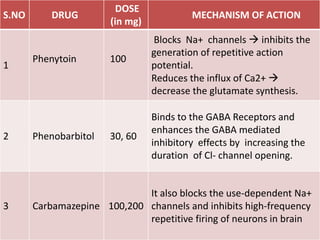
S.NO DRUG
DOSE
(in mg)
MECHANISM OF ACTION
1
Phenytoin 100
Blocks Na+ channels  inhibits the
generation of repetitive action
potential.
Reduces the influx of Ca2+ 
decrease the glutamate synthesis.
2 Phenobarbitol 30, 60
Binds to the GABA Receptors and
enhances the GABA mediated
inhibitory effects by increasing the
duration of Cl- channel opening.
3 Carbamazepine 100,200
It also blocks the use-dependent Na+
channels and inhibits high-frequency
repetitive firing of neurons in brain
S.NO DRUG
DOSE
(in mg)
MECHANISM OF ACTION
4 Ethosuximide
500
inhibits T-type Ca2+ channels
 generates thalamic cortical
pacemaker current.
5 Valproic acid 200 , 300
Blocks Na+ channels  increase
the GABA activity by activating
glutamic acid decarboxylase and
inhibiting GABA transaminase.
6 Benzodiazepines 5 , 10, 20
Enhances the frequency of
GABA-mediated Cl- channels
opening.
Screening methods of Anti-epileptic drugs
In-vitro methods
• Hippocampal slices.
• Electrial recording from isolated brain cells.
• GABA uptake in rat cerebral cortex.
• TBPS binding assay
Withdrawal Of Anti-epileptic Drugs
• After complete control of seizures for 2-4 years,
withdrawal of Anti Epileptic drugs may be
considered. But in case of special professional
group (car driver, machine man etc) withdraw the
AED after keen follow-up.
• AED should be tapered during the stopping of
medications.
• Slow reduction by increments over at least 6
months.
• If the patient is taking two AEDs one drug should
be slowly withdrawn before the second is tapered
AED SIDE EFFECTS
Nausea
Rashes
vomitting
Altered sleep cycles
Behavioural changes
Blurred vision
Diarrhoea
Ataxia
Stevens – johnson
syndrome
Aplastic anaemia
Hepatic failure
Weight gain
Menstrual irregularity
Hair loss
Osteomalacia (long term use)
Neuropathy (long term use)
Dermatitis e.t.c…..
Even causesDeath.
Some famous persons had epilepsy
ARISTOTLE SOCRATES
Julius Caesar
Alfred Nobel
Napoleon Bonaparte
Epilepsy

Epilepsy

  • 1.
  • 2.
    Definition • Epilepsy :The occurrence of transient (short- term) paroxysms (sudden attack) of excessive or uncontrolled discharges of neurons in the cerebral cortex, which may be caused by a number of different etiologies, leading to epileptic seizures. • The term seizure needs to be carefully distinguished from convulsions and epilepsy.
  • 3.
    What is thedifferences between Seizure and Epilepsy • Epilepsy is a disorder characterized by recurring seizures (also known as “seizure disorder”) • A seizure is a brief, temporary disturbance in the electrical activity of the brain “A seizure is a symptom of epilepsy”
  • 4.
    Historical Background Epilepsy derivedfrom a Greek term: Epilambane -to posses, to take hold of, to grab or to seize. Vedic period of 4500-1500BC : Ancient Indian Medicine refined and developed the basic concept of epilepsy Charaka Samhita- The Ayurvedic literature 400 BC: Describe epilepsy as ‘Apasmara’ means loss of consciousness.
  • 5.
    Cont… Hippocrates 400 BC:‘This is not a sacred disease rather disorder of brain’ . He described some physical treatment of epilepsy and stated it is an incurable chronic illness. Ibn Sina 370 AH: describe epilepsy as a brain disease
  • 6.
    Timeline • 1909: FormationInternational league against epilepsy (ILAE). • 1912: Use Phenobarbitone as AED. • 1938: Use Phenytoin as AED. • 1950-1970: Developed many AED. • 1981: ILAE classified epilepsy. • 1997: ILAE, IBE and WHO jointly established Global campaign against epilepsy.
  • 7.
    The Brain Isthe Source of Epilepsy • All brain functions -- including feeling, seeing, thinking, and moving muscles -- depend on electrical signals passed between nerve cells in the brain • A seizure occurs when too many nerve cells in the brain “fire” too quickly causing an “electrical storm”
  • 8.
    Epidemiology The most commonages of incidence are under the age of 18 and over the age of 65. About 1% of the population meets the diagnostic criteria for epilepsy at any given time. Prevalence: Developed countries- 0.5% (0.4% - 1%) Developing countries- five times higher Incidence: After infancy annual incidence- 20-70/100000 in developed countries. Developing countries- Incidence is double. (100/100000)
  • 9.
    Causes • In 28%cases cause can be determined. Rests (72%) are Idiopathic. Determined causes: • Inherited genetic • Acquired : trauma, Neuro surgery, Inflammatory, Metabolic, Infections, Tumor, Toxic disorders, drugs, etc. • Congenital: inborn error of metabolism. • Withdrawal of drugs : Alcohol,Benzodiazepine, Barbiturates, Other Anti-Epileptics
  • 10.
    Drugs That InduceSeizures • Antibiotics: Penicillin, INH, Cycloserin, Ciprofloxacin, Metronidazole. • Anti Diabetic: Insulin,Phenformin. • Hormonal: Prednisolone, OCP, Oxytocin • Cardiac: Lidocaine,Procaine, Disopiramide • Anesthetics: Methohexital, Ketamin, Halothane,Propofol • Antimalarial: Chroloquine, Mefloquine, Proguanil. • Anti Spastic: Baclofen • Stimulant: Aminophylline, Theophyline.
  • 11.
    Cont… • Radiographic contrast:Meglumine derivatives, Metrizamide. • Antidepressant: TCA- (Amitriptaline, Imipramine, Clomipramine), Dosulepin, Buproprion, Venlafaxine, Duloxitine,Reboxetine • Antipsychotics: Chlorpromazine, Zotepine, Loxapine,Depot Anti-psychotics,Clozapine • Mood Stabilizer: Lithium • Psycho stimulant: Amphetamine
  • 12.
    Safe Psychiatric medicationin Epilepsy • Antidepressant: Moclobemide, SSRI (with cautious) • Antipsychotics: Haloperidol, Trifluphenazine, Sulpiride
  • 13.
    Groups at higherrisk The risk is higher in people with certain medical conditions: • Mental retardation • Cerebral palsy (movement disorder) • Alzheimer’s disease (neuro-degeneration) • Stroke (poor blood flow to brain • Autism (troubles with social interaction)
  • 14.
    Triggers • Missed medication(#1 reason) • Stress/anxiety • Hormonal changes • Dehydration • Lack of sleep • Extreme fatigue • Photosensitivity • Drug/alcohol use; drug interactions
  • 15.
    Symptoms • Confused memory •Occasional “fainting spells” • Episodes of blank staring (looking somewhere without any reason) in children • Sudden falls for no apparent reason • Episodes of blinking or chewing at inappropriate times • A convulsion, with or without fever • Swift jerking movements in babies
  • 16.
    First Aids Stay calmand track time Do not restrain the person, but help them avoid hazards – Protect head, remove glasses, loosen tight neckwear – Move anything hard or sharp out of the way – Turn person on one side, position mouth to ground Check for epilepsy or seizure disorder ID Understand that verbal instructions may not be obeyed Stay until person is fully aware and help reorient them Call ambulance if seizure lasts more than 5 minutes or if it is unknown whether the person has had prior seizures
  • 17.
    NOT TO DO Putanything in the person’s mouth Try to hold down or restrain the person Attempt to give oral anti-seizure medication Keep the person on their back face up throughout convulsion
  • 18.
    P A T H O P H Y S I O L O G Y Decreased inhibitory system Increasedexcitation Epilepsy is generated (Epileptogenesis) Imbalance occurs
  • 19.
    Classification Of Seizures I.Partial seizures A. Simple partial seizures B. Complex Partial Seizures C. Partial Seizures evolving to secondary generalized seizures II. Generalized seizures A. Absence seizures B. Myoclonic seizures C. Clonic seizures D. Tonic seizures E. Tonic-Clonic seizures F. Atonic seizures III. Unclassified epileptic seizures a. Febrile epilepsy b. Infantile spasm
  • 20.
    Partial seizures A. Simpleseizures (without impairment of consciousness) • With motor symptoms • With special sensory or somatosensory symptoms • With psychic symptoms Signs &symptoms:  Motor – convulsive jerking, chewing motions, lip smacking  Sensory & somatosensory – paresthesias, auras  Automatic – sweating, flushing, pupil dilation  Behavioral – hallucinations, dysphasia, impaired consciousness (rare)
  • 21.
    B.Complex seizures (withimpairment of consciousness) 1.Simple partial onset followed by impairment of consciousness 2.Impaired consciousness at onset • Impairment of consciousness • Purposeless behaviour is common • Affected person may wander about aimlessly • Aggressive behaviour (violence) • Automatism (eg: picking at clothes) • Visual, auditory, or olfactory hallucinations
  • 22.
    Generalised Seizures Generalized Tonic-clonic(grand mal) Convulsive seizures No Aura but have prodormal phase- general malaise a.)Tonic phase: These are characterized by rigid violent muscular contraction with stiff and fixed extended b.)Clonic phase: These are characterized by repetitive muscle jerks. • Duration: few minutes • Post ictal period: drowsiness, confusion, headache, deep sleep
  • 24.
    C.) Typical AbsenceSeizures (Petit mal): • There is no aura associated with this disorder and attack appears without warning. • There is usually no loss of consciousness. • Absence seizures are characterized by subtle bilateral motor symptoms such as rapid blinking of eyelids, chewing movements. • Attacks last only a few seconds (<10 sec) and often pass un- recognized. • About 100-200 attacks may occur/day. • Attacks precipitate by fatigue, drowsiness, relaxation , photic stimulation or hyperventilation
  • 25.
    D.) Myoclonic seizures:Bilateral epileptic myoclonus - sudden and brief skeletal muscle contraction (entire or part of the body) - sudden jerking movements appearing during sleep. E.) Atonic seizures (Akinetic seizures): - sudden loss of postural tone. - The head may sag to one side or the patient may fall all of a sudden. - The consciousness may be impaired
  • 26.
    Unclassified Seizures • Febrileseizures : wherein young children frequently develop seizures with illness accompanied by hyperpyrexia. • Infantile spasm : with progressive mental retardation. These are generalized tonic-clonic convulsions of short duration . These have not yet been classified because of insufficient data or atypical pattern of the seizures
  • 27.
    Classification Based OnEpilepsy Syndrome • Idiopathic in which no cause could be identified except for genetic linkage. Examples : Juvenile myoclonic epilepsy syndrome. • Symptomatic in which the seizures are associated with some identifiable underlying disorders. Examples : Lennox-Gastaut epilepsy syndrome (impaired cognitive functions) • Cryptogenic in which the epilepsy appears to be symptomatic but the exact cause is unknown. Examples : west’s syndrome (infantile spasm).
  • 28.
    Diagnosis Thorough History taking:  From patients  From reliable valid informants  From observer (who observed seizures) Physical Examination:  Specially neurological system  Higher Psychic function Laboratory Investigation:  Serum Electrolytes, Serum Prolactin, Blood sugar, Complete blood count, Function tests (liver, thyroid, renal), CSF study Imaging:  EEG, Video EEG telemetry, CT Scan of Brain, MRI of Brain. Polysomnography (a type of sleep study)
  • 29.
  • 30.
    S.NO DRUG DOSE (in mg) MECHANISMOF ACTION 1 Phenytoin 100 Blocks Na+ channels  inhibits the generation of repetitive action potential. Reduces the influx of Ca2+  decrease the glutamate synthesis. 2 Phenobarbitol 30, 60 Binds to the GABA Receptors and enhances the GABA mediated inhibitory effects by increasing the duration of Cl- channel opening. 3 Carbamazepine 100,200 It also blocks the use-dependent Na+ channels and inhibits high-frequency repetitive firing of neurons in brain
  • 31.
    S.NO DRUG DOSE (in mg) MECHANISMOF ACTION 4 Ethosuximide 500 inhibits T-type Ca2+ channels  generates thalamic cortical pacemaker current. 5 Valproic acid 200 , 300 Blocks Na+ channels  increase the GABA activity by activating glutamic acid decarboxylase and inhibiting GABA transaminase. 6 Benzodiazepines 5 , 10, 20 Enhances the frequency of GABA-mediated Cl- channels opening.
  • 33.
    Screening methods ofAnti-epileptic drugs
  • 34.
    In-vitro methods • Hippocampalslices. • Electrial recording from isolated brain cells. • GABA uptake in rat cerebral cortex. • TBPS binding assay
  • 35.
    Withdrawal Of Anti-epilepticDrugs • After complete control of seizures for 2-4 years, withdrawal of Anti Epileptic drugs may be considered. But in case of special professional group (car driver, machine man etc) withdraw the AED after keen follow-up. • AED should be tapered during the stopping of medications. • Slow reduction by increments over at least 6 months. • If the patient is taking two AEDs one drug should be slowly withdrawn before the second is tapered
  • 36.
    AED SIDE EFFECTS Nausea Rashes vomitting Alteredsleep cycles Behavioural changes Blurred vision Diarrhoea Ataxia Stevens – johnson syndrome Aplastic anaemia Hepatic failure Weight gain Menstrual irregularity Hair loss Osteomalacia (long term use) Neuropathy (long term use) Dermatitis e.t.c….. Even causesDeath.
  • 37.
    Some famous personshad epilepsy ARISTOTLE SOCRATES
  • 38.