What is Financial Modelling?
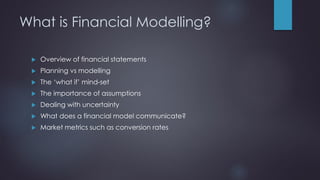
 Overview of financial statements
 Planning vs modelling
 The ‘what if’ mind-set
 The importance of assumptions
 Dealing with uncertainty
 What does a financial model communicate?
 Market metrics such as conversion rates
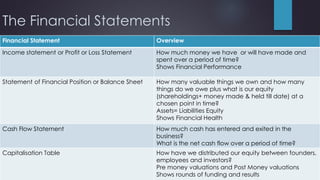
The Financial Statements
Financial Statement Overview
Income statement or Profit or Loss Statement How much money we have or will have made and
spent over a period of time?
Shows Financial Performance
Statement of Financial Position or Balance Sheet How many valuable things we own and how many
things do we owe plus what is our equity
(shareholdings+ money made & held till date) at a
chosen point in time?
Assets= Liabilities Equity
Shows Financial Health
Cash Flow Statement How much cash has entered and exited in the
business?
What is the net cash flow over a period of time?
Capitalisation Table How have we distributed our equity between founders,
employees and investors?
Pre money valuations and Post Money valuations
Shows rounds of funding and results
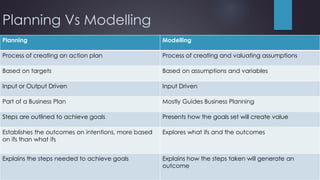
Planning Vs Modelling
Planning Modelling
Process of creating an action plan Process of creating and valuating assumptions
Based on targets Based on assumptions and variables
Input or Output Driven Input Driven
Part of a Business Plan Mostly Guides Business Planning
Steps are outlined to achieve goals Presents how the goals set will create value
Establishes the outcomes on intentions, more based
on ifs than what ifs
Explores what ifs and the outcomes
Explains the steps needed to achieve goals Explains how the steps taken will generate an
outcome
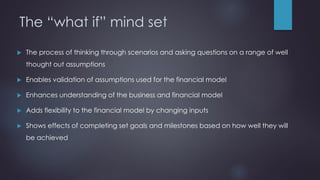
The “what if” mind set
 The process of thinking through scenarios and asking questions on a range of well
thought out assumptions
 Enables validation of assumptions used for the financial model
 Enhances understanding of the business and financial model
 Adds flexibility to the financial model by changing inputs
 Shows effects of completing set goals and milestones based on how well they will
be achieved
The Importance of Assumptions
 Assumptions are the basic map for creating any model
 The assumptions decrease uncertainty
 The financial model is as good as the assumptions used to build the model
 Assumptions are the key to achieving “buy in” from investors, partners and employees
 Assumptions guide not only the financial but also business modelling & planning
 Assumptions have to be well thought out, researched and tested
Dealing with uncertainty
 Uncertainty is the fear of the unknown
 or the risk faced from variables that are not accounted for
 and those variables that cannot be evaluated
 Uncertainty is reduced through assumptions, modelling and research
 Uncertainty is reduced as assumptions add some level of certainty
 A model that responds to range of inputs decreases uncertainty
 Uncertainty is productive as it keeps us sharp and prepared!!!!
What does a Financial Model
Communicate?
 It shows that you understand your business and how it works.
 It shows how your assumptions and plans will generate value
 It allows investors to evaluate some aspects of your business
 It shows how a range of inputs will impact on the outputs i.e profits and costs
 It shows how your business will likely perform over a period of time
 A good financial plan shows that you have had a reality check and are not working on
guesses and blind devotion
Importance of Marketing Metrics
 Your key assumptions will be based on how your marketing will work?
 How do you plan to reach your target market?
 How do you plan to turn your target market into customers?
 How much time and cost will you incur in the process of gaining customers?
 How much value will each customer add to your business?
 What are the expected range of conversion rates for marketing efforts of your business?
Summary
 The financial model is expressed through financial statements.
 Financial models are dynamic, assumption based and input driven.
 Financial models are built with a “what if” mind-set.
 Financial models deal with uncertainty, but do not eliminate it.
 Financial models communicate information to aid decision making and planning.
 For a start up, marketing metrics drive the creation of the financial modelling.
To find out more
Call at +92 333 6401 601
Or
Email: Riz.khan@bistructures.com
Register at www.bistructures.com for subscribing to
more useful information for improving businesses.

Session 1-Financial Modelling

  • 1.
    What is FinancialModelling?  Overview of financial statements  Planning vs modelling  The ‘what if’ mind-set  The importance of assumptions  Dealing with uncertainty  What does a financial model communicate?  Market metrics such as conversion rates
  • 2.
    The Financial Statements FinancialStatement Overview Income statement or Profit or Loss Statement How much money we have or will have made and spent over a period of time? Shows Financial Performance Statement of Financial Position or Balance Sheet How many valuable things we own and how many things do we owe plus what is our equity (shareholdings+ money made & held till date) at a chosen point in time? Assets= Liabilities Equity Shows Financial Health Cash Flow Statement How much cash has entered and exited in the business? What is the net cash flow over a period of time? Capitalisation Table How have we distributed our equity between founders, employees and investors? Pre money valuations and Post Money valuations Shows rounds of funding and results
  • 3.
    Planning Vs Modelling PlanningModelling Process of creating an action plan Process of creating and valuating assumptions Based on targets Based on assumptions and variables Input or Output Driven Input Driven Part of a Business Plan Mostly Guides Business Planning Steps are outlined to achieve goals Presents how the goals set will create value Establishes the outcomes on intentions, more based on ifs than what ifs Explores what ifs and the outcomes Explains the steps needed to achieve goals Explains how the steps taken will generate an outcome
  • 4.
    The “what if”mind set  The process of thinking through scenarios and asking questions on a range of well thought out assumptions  Enables validation of assumptions used for the financial model  Enhances understanding of the business and financial model  Adds flexibility to the financial model by changing inputs  Shows effects of completing set goals and milestones based on how well they will be achieved
  • 5.
    The Importance ofAssumptions  Assumptions are the basic map for creating any model  The assumptions decrease uncertainty  The financial model is as good as the assumptions used to build the model  Assumptions are the key to achieving “buy in” from investors, partners and employees  Assumptions guide not only the financial but also business modelling & planning  Assumptions have to be well thought out, researched and tested
  • 6.
    Dealing with uncertainty Uncertainty is the fear of the unknown  or the risk faced from variables that are not accounted for  and those variables that cannot be evaluated  Uncertainty is reduced through assumptions, modelling and research  Uncertainty is reduced as assumptions add some level of certainty  A model that responds to range of inputs decreases uncertainty  Uncertainty is productive as it keeps us sharp and prepared!!!!
  • 7.
    What does aFinancial Model Communicate?  It shows that you understand your business and how it works.  It shows how your assumptions and plans will generate value  It allows investors to evaluate some aspects of your business  It shows how a range of inputs will impact on the outputs i.e profits and costs  It shows how your business will likely perform over a period of time  A good financial plan shows that you have had a reality check and are not working on guesses and blind devotion
  • 8.
    Importance of MarketingMetrics  Your key assumptions will be based on how your marketing will work?  How do you plan to reach your target market?  How do you plan to turn your target market into customers?  How much time and cost will you incur in the process of gaining customers?  How much value will each customer add to your business?  What are the expected range of conversion rates for marketing efforts of your business?
  • 9.
    Summary  The financialmodel is expressed through financial statements.  Financial models are dynamic, assumption based and input driven.  Financial models are built with a “what if” mind-set.  Financial models deal with uncertainty, but do not eliminate it.  Financial models communicate information to aid decision making and planning.  For a start up, marketing metrics drive the creation of the financial modelling.
  • 10.
    To find outmore Call at +92 333 6401 601 Or Email: Riz.khan@bistructures.com Register at www.bistructures.com for subscribing to more useful information for improving businesses.