CAPITAL BUDGETING
What is capital budgeting?
 Analysis of potential additions to fixed assets.
 Long-term decisions; involve large expenditures.
 Very important to firm’s future.
 Planning on long-term assets
 Investment concept
Examples
New equipment
Plant expansion
Equipment selection
Lease or buy
Timing of replacement
Capital budgeting is the process of evaluating and
selecting long term investments that are consistent with
the goal of shareholders (owners) wealth maximization
Features of capital budgeting
Potentially large anticipated benefits
A relatively high degree of risk
A relatively long period between the initial outlay and
the anticipated returns
Capital expenditure is an outlay of funds that is
expected to produce benefits over a period of time
exceeding one year
Capital expenditure management includes addition,
disposition, modification and replacement of fixed assets
Significance of capital budgeting
Capital Budgeting decisions affect the profitability of the
firm
Risk exposure of funds committed in capital expenditure
projects
Effects on operating expenditures and the patterns of cash
flows for a longer period
Where a company is contemplating to diversify its
operations or expand its activity the management is required
to make a series of investment decisions
Classification of investments
Mutually exclusive investments
Independent investments
Contingent investments
Mutually Exclusive Investments
They serve the same purpose and compete with each
other
If one investment is undertaken others will have to be
excluded
For E.g. A company may either use a labour intensive,
semi automatic machine or highly automatic for production
Independent investments
They serve different purposes and do not compete with
each other
For E.g. a heavy engineering company may be
considering expansion of its plant capacity or manufacture
a new product – light commercial vehicles. Depending on
their profitability and availability of funds, the company
can undertake both investments
Contingent Investments
These are dependent projects
The choice of one investment necessitates undertaking
one or more other investments
For E.g. if a company decides to build a factory in a
remote, backward area, it may have to invest in houses,
roads, hospitals, schools etc.
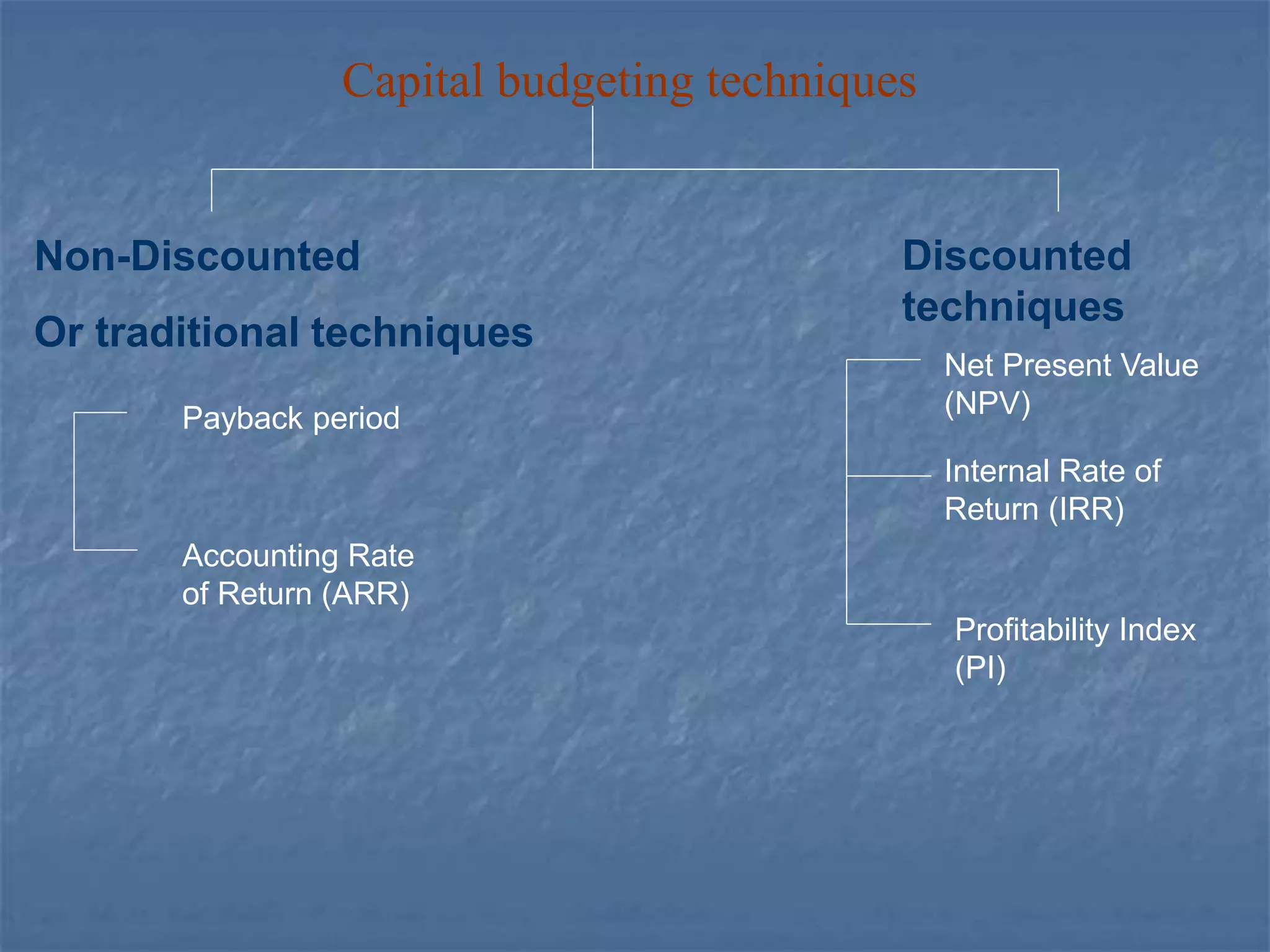
Capital budgeting techniques
Discounted
techniques
Non-Discounted
Or traditional techniques
Payback period
Accounting Rate
of Return (ARR)
Net Present Value
(NPV)
Internal Rate of
Return (IRR)
Profitability Index
(PI)
1. Payback Method
Payback is the no. of years required to recover the
original cash outlay invested in a project. If the project
generates constant annual cash inflows, the payback period
can be computed by dividing cash outlay by the annual
cash inflow.
Payback = Initial Investment = Co
Annual Cash Inflow C
Acceptance Rule
Many firm’s compare the project’s payback with a
predetermined, standard payback. The project would be
accepted if its payback period is less than the maximum or
standard payback set by the management
Advantages of payback
 Simplicity
 Cost Effective
 Short-term effects
 Risk shields
 Liquidity
Limitations
 Cash flows after payback
 Cash flows ignored
Cash flow patterns
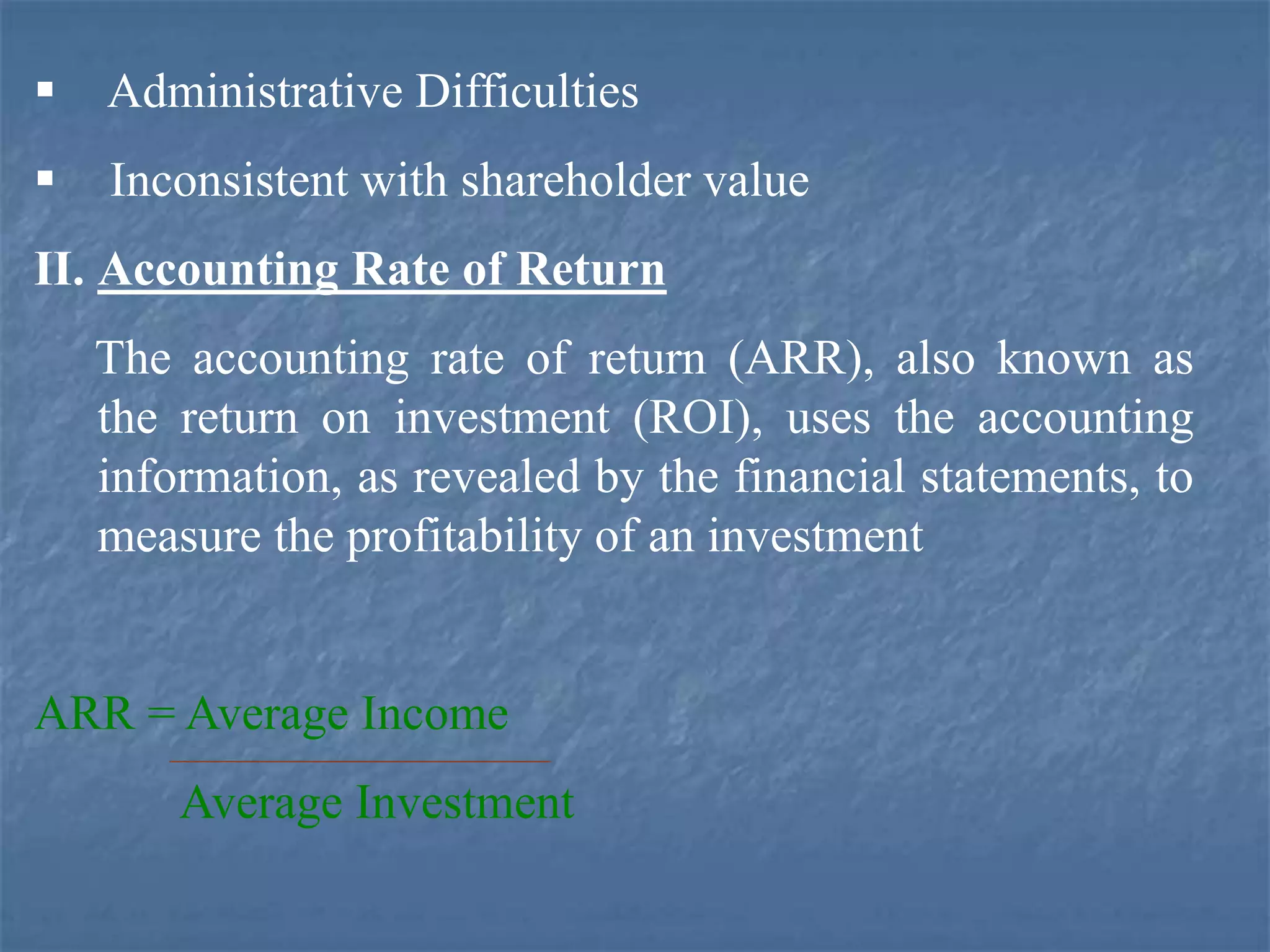
 Administrative Difficulties
 Inconsistent with shareholder value
II. Accounting Rate of Return
The accounting rate of return (ARR), also known as
the return on investment (ROI), uses the accounting
information, as revealed by the financial statements, to
measure the profitability of an investment
ARR = Average Income
Average Investment
Acceptance rule
This method will accept all those projects whose ARR is
higher than the minimum rate established by the
management and reject those projects which have ARR less
than the minimum rate
Merits
Simplicity
Accounting data
Accounting profitability
Limitations
Cash flows ignored
Time value ignored
Arbitrary cut- off
III Net Present Value Method
Discounted cash flow technique that explicitly that
recognizes the time value of money
It correctly postulates that cash flows arising at different
time periods differ in value are comparable only when their
equivalents present values are found out
The following steps are involved in the calculation of NPV:
1. Cash flows of the investment project should be forecasted
based on realistic assumptions.
2. Appropriate discount rate should be identified to discount
the forecasted cash flows. (The appropriate discount rate is
the project’s opportunity cost of capital , which is equal to
the required rate of return expected by investors on
investments of equivalent risk).
3. Present value of cash flows should be calculated using the
opportunity cost of capital as the discount rate
4. NPV should be found out by subtracting present value of
cash inflows
Acceptance rule
The project should be accepted if NPV is positive (i.e.,
NPV>0) and to reject it if the net present value is negative
i.e. (NPV<0)
Positive NPV contributes to the net wealth of the
shareholders, which should result in the increased price of a
firm’s share.
The positive NPV will result only if the project generates
cash inflows at a rate higher than the opportunity cost of
capital
Advantages
Time value
Measure of true profitability
Value – additivity
Shareholder value
Limitations
Cash flow estimation
Discount rate
Mutually exclusive projects
Ranking of projects
IV Internal Rate Of Return Method (IRR)
–is another model using discounted cash flows.
The internal rate of return (IRR) is the rate of return that
a company can expect to earn by investing in a project.
The higher the IRR, the more desirable the investment.
The IRR is the rate of return at which the net present
value equals zero.
Investment = Expected annual net cash inflow × PV
annuity factor
Investment ÷ Expected annual net cash inflow = PV
annuity factor
Assume that A BC is considering investing Rs. 500,000
in a project that will yield net cash inflows of Rs. 152,725
per year over its 5-year life.
What is the IRR of this project?
500,000 ÷ 152,725 = 3.274 (PV annuity factor)
The annuity table shows that 3.274 is in the 16% column
for a 5-period row in this example.
Therefore, 16% is the internal rate of return of this
project.
If the minimum desired rate of return is 16% or less,
A.B. Fast should undertake this project.
 Project Cost = Rs 36000, Cash Inflows = Rs 11200 for 5
years
NPV = Present Value of Sum of Cash inflows – Initial
Investment
NPV = 0
PV of Sum of Cash Inflows = Initial Investment
36000/11200 = 3.214
Discount Factor closest to 3.214 for 5 years are 3.274 is
16% & 3.199 is 17%.
IRR = r + (Discount Factor at lowest interest – Discount Factor at interest rate)
--------------------------------------------------------------------------------------
(Discount Factor at lower interest - Discount Factor at higher interest)
= 16 + (3.274 – 3.214)
----------------------
(3.274 – 3.199)
= 16.8 %
•Decision rule:
Accept the project if the IRR is greater than the
required rate of return.
 If IRR > k, accept project.
 If IRR < k, reject project.
 May accept the project when r=k
Advantages
Time value
Profitability measure
Acceptance rule
Shareholder value
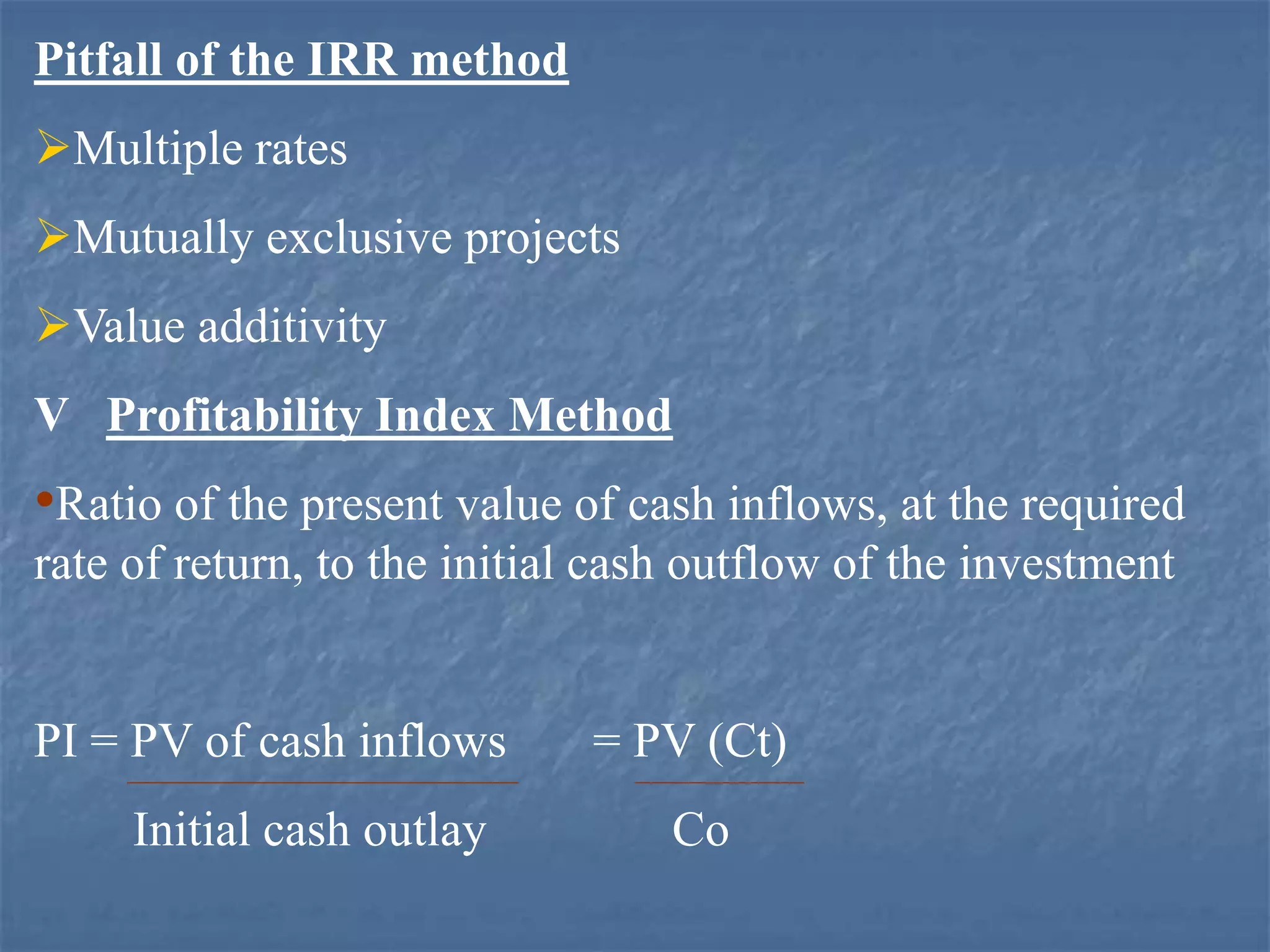
Pitfall of the IRR method
Multiple rates
Mutually exclusive projects
Value additivity
V Profitability Index Method
•Ratio of the present value of cash inflows, at the required
rate of return, to the initial cash outflow of the investment
PI = PV of cash inflows = PV (Ct)
Initial cash outlay Co
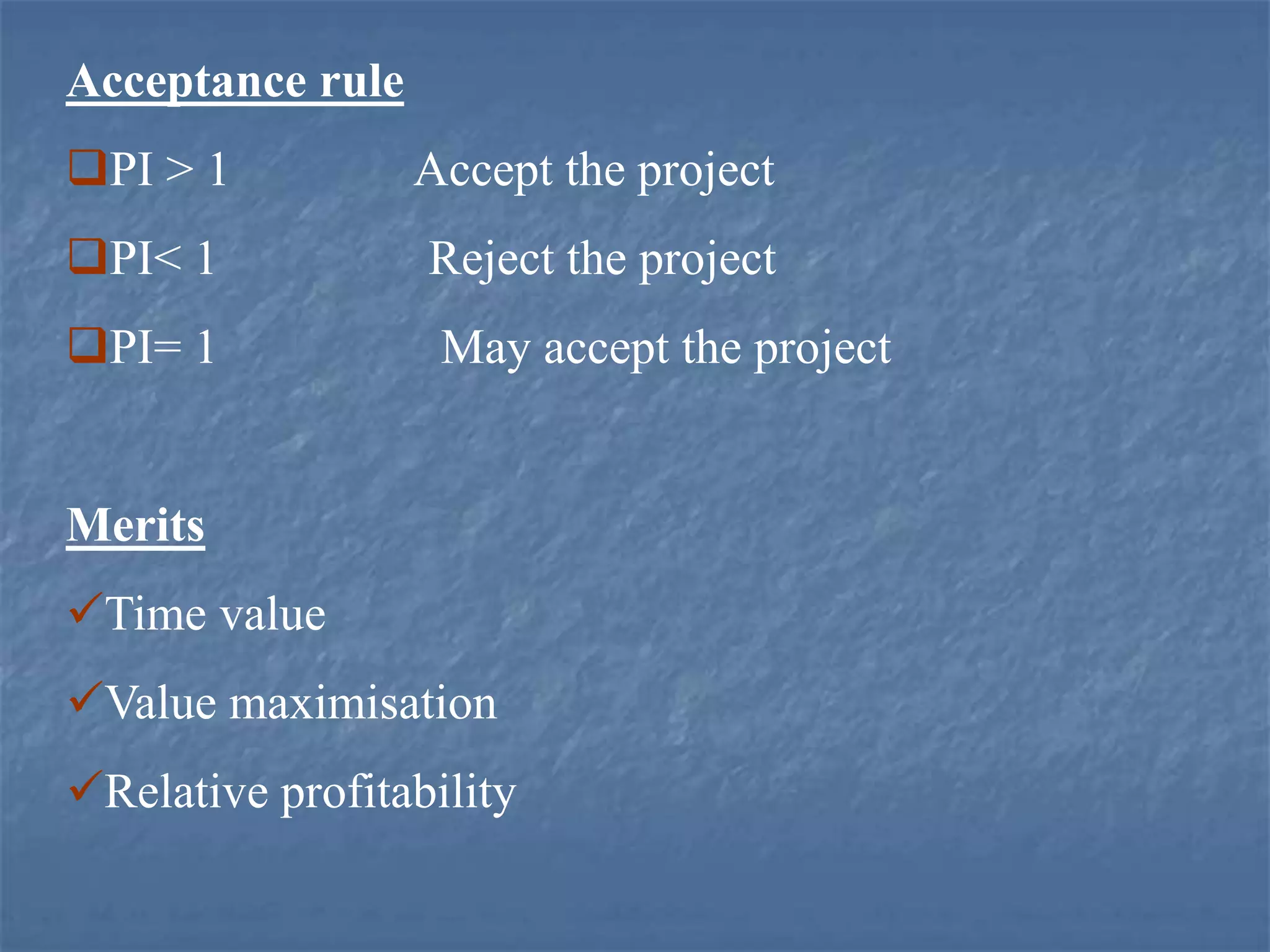
Acceptance rule
PI > 1 Accept the project
PI< 1 Reject the project
PI= 1 May accept the project
Merits
Time value
Value maximisation
Relative profitability
-The most widely accepted criterion of evaluating capital
budgeting or investment decision is estimated net worth of the
capital project
-If the present value of estimated cash inflows of a project
exceeds the present value of cash outlays it has net cash
benefits or net worth
-If the present value of estimated cash outflows of a project
exceeds the present value of cash inflows over its estimated
life, it has net expenditure or net cash losses
-Projects having net cash benefits are candidates for further
consideration, while those involving net cash expenditure are
out of race
Net investment
# is the incremental or marginal investment involved in an
investment project at a point of time or over a period of
time
# it includes not only the expenditure on the new physical
equipment and facilities, installation cast etc. but also the
value of the existing physical facilities that are to be used as
part of the new project
# the loss on the sale of old fixed assets is a book loss &
involves no cash outflows associated with the investment
project under consideration
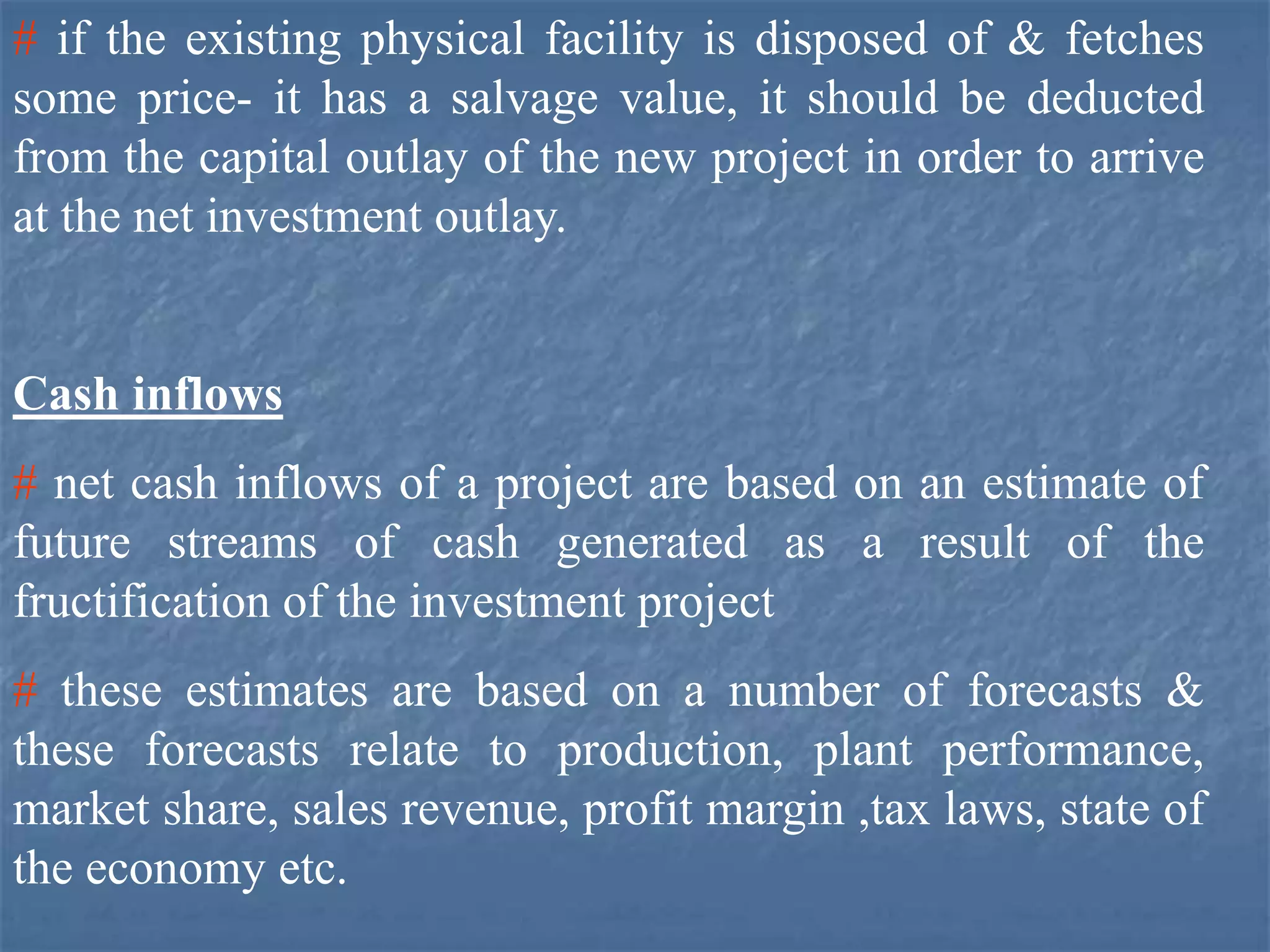
# if the existing physical facility is disposed of & fetches
some price- it has a salvage value, it should be deducted
from the capital outlay of the new project in order to arrive
at the net investment outlay.
Cash inflows
# net cash inflows of a project are based on an estimate of
future streams of cash generated as a result of the
fructification of the investment project
# these estimates are based on a number of forecasts &
these forecasts relate to production, plant performance,
market share, sales revenue, profit margin ,tax laws, state of
the economy etc.
Net cash benefits
# net cash benefits are net cash inflows over a period of
time resulting from the capital project
# net cash inflows are incremental cash inflows and are
estimates of cash revenues minus all cash outflows
including maintenance costs, corporate taxes, etc
# depreciation is excluded but tax benefit resulting from
dep. appropriation is included in cash inflows
Net cash inflows = cash revenues – cash expenses + tax
benefit from dep. appropriation + salvage value + capital
gains tax value of current assets released
Risks in investment decisions
It is the inability to predict with perfect knowledge the
course of future events that introduces risks. As event
become more predictable, risk is reduced
Sources of risk
Size of the investment
Reinvestment of cash flows
Variability of cash flows
Life of the project
Measurement of risk
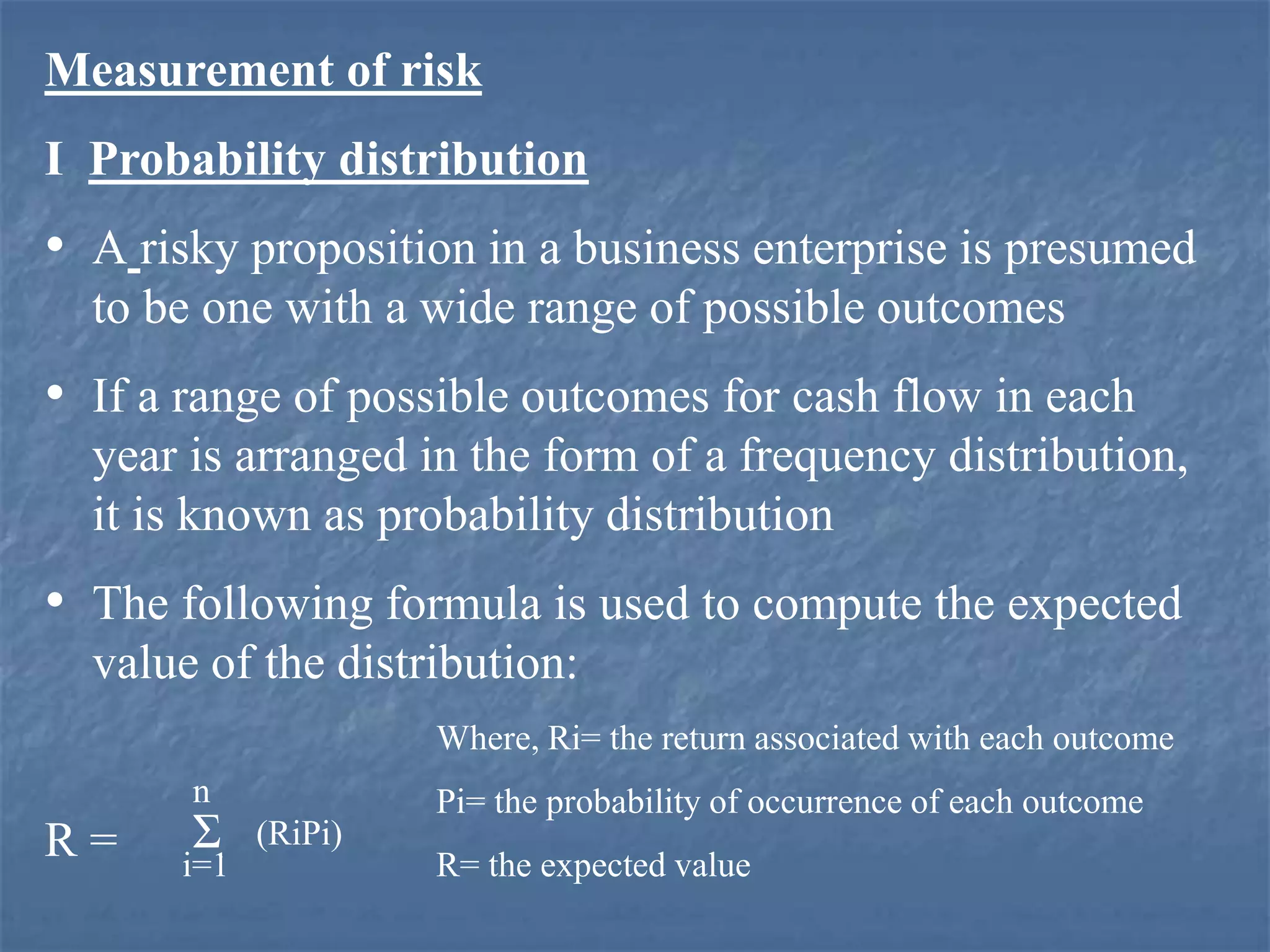
I Probability distribution
• A risky proposition in a business enterprise is presumed
to be one with a wide range of possible outcomes
• If a range of possible outcomes for cash flow in each
year is arranged in the form of a frequency distribution,
it is known as probability distribution
• The following formula is used to compute the expected
value of the distribution:
R = i=1
n
(RiPi)
Where, Ri= the return associated with each outcome
Pi= the probability of occurrence of each outcome
R= the expected value
Σ
II Standard Deviation
To measure the rightness or dispersion of the probability
distribution technique of standard deviation is used. The
following steps are used to calculate standard deviation:
Calculate the mean of expected value of the distribution
Calculate the deviation from each possible outcome
Deviation = Ri – R
Square each deviation
Multiply the squared deviations by the probability of
occurrence for its related outcome
Sum all the products. This is called VARIANCE
Variance = σ =
2
i=1
n
(Ri - R)
2
Pi
The standard deviation is determined by taking the
square root of the variance
Σ
Σ
σ =
n
i=1
(Ri - R)
2
Pi
The smaller the standard deviation, accordingly the lower the
riskiness of the project
III Coefficient of variation as a relative measure of risk
It measures the relative variability of returns
Coefficient of Variation (v) = σ
R
Utility Theory & Risk Analysis in Investment Decision
Utility theory was developed by Milton Friedman to
measure an individual’s attitude toward varying amount of
gains & losses
Based upon the concept of “diminishing marginal utility
for money”
Marginal utility of a unit of money goes on declining
successively in correspondence with increasing money
income
Thus increase in income will mean lower utility from
additional income
The investor with a diminishing marginal utility of money
will get more pain from a rupee lost than pleasure from a
rupee gained
A finance manager considers both risk factor & utility
function together while choosing worth – while capital
investment projects
Risk Analysis Approaches
Simulation Approach Sensitivity Analysis
-- simulation approach combines the variabilities in all the relevant
factors so as to provide a clear picture of the relative risk & the
probable odds of coming out ahead in the light of uncertain
foreknowledge
-- Simulation model considers the following variables which are
subject to certain variation
Market Related Factors
1) Market size
2) Market growth rate
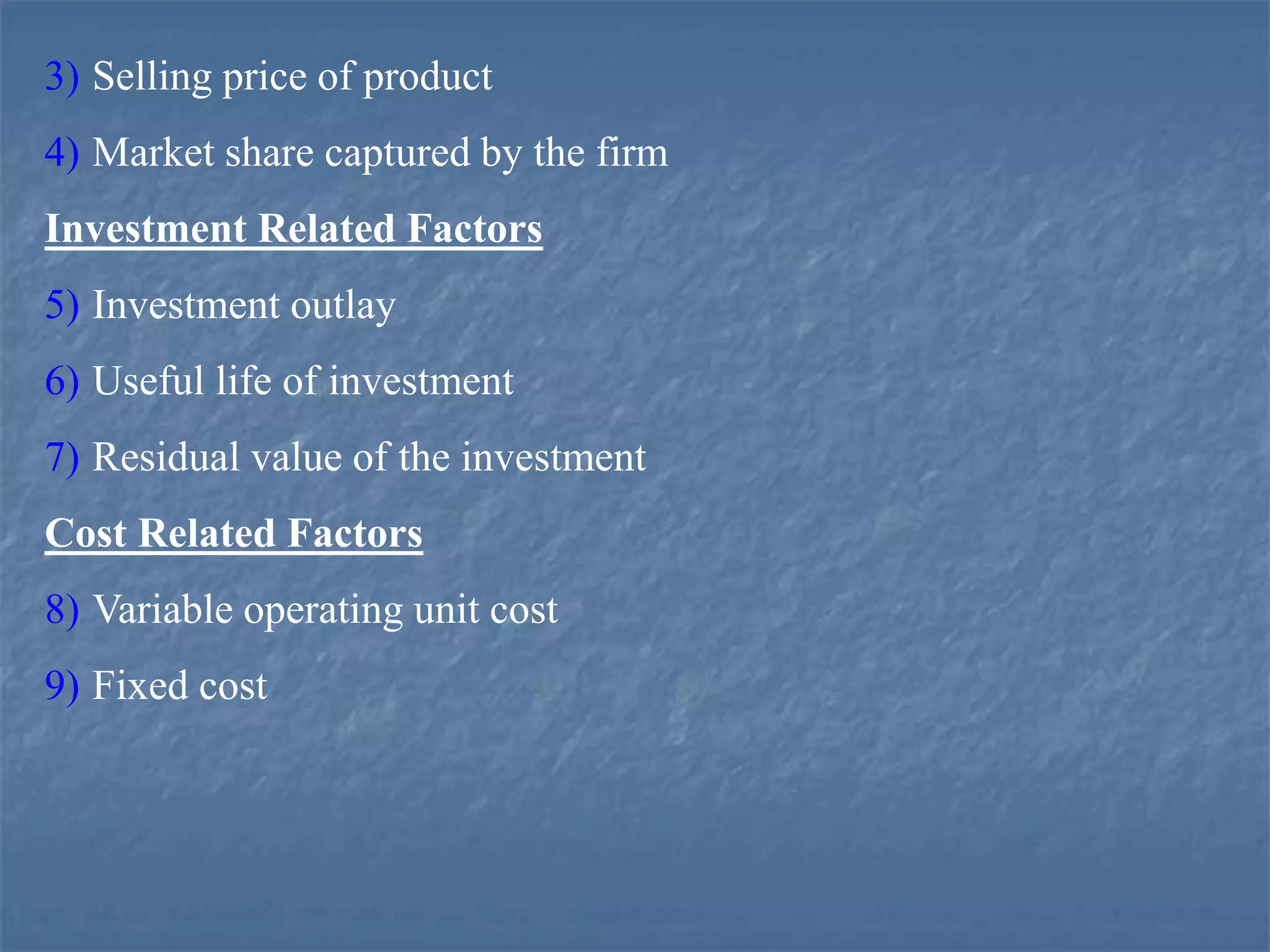
3) Selling price of product
4) Market share captured by the firm
Investment Related Factors
5) Investment outlay
6) Useful life of investment
7) Residual value of the investment
Cost Related Factors
8) Variable operating unit cost
9) Fixed cost
Sensitivity analysis
Meaningful technique used to locate & assess the
potential impact of risk on a project’s profitability
It does not attempt to quantify risk, but rather provides
insight into how the final outcome of an investment
decision is likely to be affected by possible variations in
the underlying factors
For e.g. it attempts to answer what is the NPV if selling
price falls by 10%
Identifies the critical factors which have greatest impact
on a project’s profitability
Encourages consideration of uncertainties & risks by
managers at different levels
It isolates areas on which the management is required to
concentrate during implementation of the project
Methods of adjusting risk
1. Informal Method
2. Formal Method

capital_budgeting.ppt

  • 1.
  • 2.
    What is capitalbudgeting?  Analysis of potential additions to fixed assets.  Long-term decisions; involve large expenditures.  Very important to firm’s future.  Planning on long-term assets  Investment concept Examples New equipment Plant expansion Equipment selection Lease or buy Timing of replacement
  • 3.
    Capital budgeting isthe process of evaluating and selecting long term investments that are consistent with the goal of shareholders (owners) wealth maximization Features of capital budgeting Potentially large anticipated benefits A relatively high degree of risk A relatively long period between the initial outlay and the anticipated returns
  • 4.
    Capital expenditure isan outlay of funds that is expected to produce benefits over a period of time exceeding one year Capital expenditure management includes addition, disposition, modification and replacement of fixed assets Significance of capital budgeting Capital Budgeting decisions affect the profitability of the firm Risk exposure of funds committed in capital expenditure projects
  • 5.
    Effects on operatingexpenditures and the patterns of cash flows for a longer period Where a company is contemplating to diversify its operations or expand its activity the management is required to make a series of investment decisions Classification of investments Mutually exclusive investments Independent investments Contingent investments
  • 6.
    Mutually Exclusive Investments Theyserve the same purpose and compete with each other If one investment is undertaken others will have to be excluded For E.g. A company may either use a labour intensive, semi automatic machine or highly automatic for production Independent investments They serve different purposes and do not compete with each other For E.g. a heavy engineering company may be considering expansion of its plant capacity or manufacture
  • 7.
    a new product– light commercial vehicles. Depending on their profitability and availability of funds, the company can undertake both investments Contingent Investments These are dependent projects The choice of one investment necessitates undertaking one or more other investments For E.g. if a company decides to build a factory in a remote, backward area, it may have to invest in houses, roads, hospitals, schools etc.
  • 8.
    Capital budgeting techniques Discounted techniques Non-Discounted Ortraditional techniques Payback period Accounting Rate of Return (ARR) Net Present Value (NPV) Internal Rate of Return (IRR) Profitability Index (PI)
  • 9.
    1. Payback Method Paybackis the no. of years required to recover the original cash outlay invested in a project. If the project generates constant annual cash inflows, the payback period can be computed by dividing cash outlay by the annual cash inflow. Payback = Initial Investment = Co Annual Cash Inflow C Acceptance Rule Many firm’s compare the project’s payback with a predetermined, standard payback. The project would be accepted if its payback period is less than the maximum or standard payback set by the management
  • 10.
    Advantages of payback Simplicity  Cost Effective  Short-term effects  Risk shields  Liquidity Limitations  Cash flows after payback  Cash flows ignored Cash flow patterns
  • 11.
     Administrative Difficulties Inconsistent with shareholder value II. Accounting Rate of Return The accounting rate of return (ARR), also known as the return on investment (ROI), uses the accounting information, as revealed by the financial statements, to measure the profitability of an investment ARR = Average Income Average Investment
  • 12.
    Acceptance rule This methodwill accept all those projects whose ARR is higher than the minimum rate established by the management and reject those projects which have ARR less than the minimum rate Merits Simplicity Accounting data Accounting profitability
  • 13.
    Limitations Cash flows ignored Timevalue ignored Arbitrary cut- off III Net Present Value Method Discounted cash flow technique that explicitly that recognizes the time value of money It correctly postulates that cash flows arising at different time periods differ in value are comparable only when their equivalents present values are found out
  • 14.
    The following stepsare involved in the calculation of NPV: 1. Cash flows of the investment project should be forecasted based on realistic assumptions. 2. Appropriate discount rate should be identified to discount the forecasted cash flows. (The appropriate discount rate is the project’s opportunity cost of capital , which is equal to the required rate of return expected by investors on investments of equivalent risk). 3. Present value of cash flows should be calculated using the opportunity cost of capital as the discount rate 4. NPV should be found out by subtracting present value of cash inflows
  • 15.
    Acceptance rule The projectshould be accepted if NPV is positive (i.e., NPV>0) and to reject it if the net present value is negative i.e. (NPV<0) Positive NPV contributes to the net wealth of the shareholders, which should result in the increased price of a firm’s share. The positive NPV will result only if the project generates cash inflows at a rate higher than the opportunity cost of capital
  • 16.
    Advantages Time value Measure oftrue profitability Value – additivity Shareholder value Limitations Cash flow estimation Discount rate Mutually exclusive projects Ranking of projects
  • 17.
    IV Internal RateOf Return Method (IRR) –is another model using discounted cash flows. The internal rate of return (IRR) is the rate of return that a company can expect to earn by investing in a project. The higher the IRR, the more desirable the investment. The IRR is the rate of return at which the net present value equals zero. Investment = Expected annual net cash inflow × PV annuity factor Investment ÷ Expected annual net cash inflow = PV annuity factor
  • 18.
    Assume that ABC is considering investing Rs. 500,000 in a project that will yield net cash inflows of Rs. 152,725 per year over its 5-year life. What is the IRR of this project? 500,000 ÷ 152,725 = 3.274 (PV annuity factor) The annuity table shows that 3.274 is in the 16% column for a 5-period row in this example. Therefore, 16% is the internal rate of return of this project. If the minimum desired rate of return is 16% or less, A.B. Fast should undertake this project.
  • 19.
     Project Cost= Rs 36000, Cash Inflows = Rs 11200 for 5 years NPV = Present Value of Sum of Cash inflows – Initial Investment NPV = 0 PV of Sum of Cash Inflows = Initial Investment 36000/11200 = 3.214 Discount Factor closest to 3.214 for 5 years are 3.274 is 16% & 3.199 is 17%. IRR = r + (Discount Factor at lowest interest – Discount Factor at interest rate) -------------------------------------------------------------------------------------- (Discount Factor at lower interest - Discount Factor at higher interest) = 16 + (3.274 – 3.214) ---------------------- (3.274 – 3.199) = 16.8 %
  • 20.
    •Decision rule: Accept theproject if the IRR is greater than the required rate of return.  If IRR > k, accept project.  If IRR < k, reject project.  May accept the project when r=k Advantages Time value Profitability measure Acceptance rule Shareholder value
  • 21.
    Pitfall of theIRR method Multiple rates Mutually exclusive projects Value additivity V Profitability Index Method •Ratio of the present value of cash inflows, at the required rate of return, to the initial cash outflow of the investment PI = PV of cash inflows = PV (Ct) Initial cash outlay Co
  • 22.
    Acceptance rule PI >1 Accept the project PI< 1 Reject the project PI= 1 May accept the project Merits Time value Value maximisation Relative profitability
  • 23.
    -The most widelyaccepted criterion of evaluating capital budgeting or investment decision is estimated net worth of the capital project -If the present value of estimated cash inflows of a project exceeds the present value of cash outlays it has net cash benefits or net worth -If the present value of estimated cash outflows of a project exceeds the present value of cash inflows over its estimated life, it has net expenditure or net cash losses -Projects having net cash benefits are candidates for further consideration, while those involving net cash expenditure are out of race
  • 24.
    Net investment # isthe incremental or marginal investment involved in an investment project at a point of time or over a period of time # it includes not only the expenditure on the new physical equipment and facilities, installation cast etc. but also the value of the existing physical facilities that are to be used as part of the new project # the loss on the sale of old fixed assets is a book loss & involves no cash outflows associated with the investment project under consideration
  • 25.
    # if theexisting physical facility is disposed of & fetches some price- it has a salvage value, it should be deducted from the capital outlay of the new project in order to arrive at the net investment outlay. Cash inflows # net cash inflows of a project are based on an estimate of future streams of cash generated as a result of the fructification of the investment project # these estimates are based on a number of forecasts & these forecasts relate to production, plant performance, market share, sales revenue, profit margin ,tax laws, state of the economy etc.
  • 26.
    Net cash benefits #net cash benefits are net cash inflows over a period of time resulting from the capital project # net cash inflows are incremental cash inflows and are estimates of cash revenues minus all cash outflows including maintenance costs, corporate taxes, etc # depreciation is excluded but tax benefit resulting from dep. appropriation is included in cash inflows Net cash inflows = cash revenues – cash expenses + tax benefit from dep. appropriation + salvage value + capital gains tax value of current assets released
  • 27.
    Risks in investmentdecisions It is the inability to predict with perfect knowledge the course of future events that introduces risks. As event become more predictable, risk is reduced Sources of risk Size of the investment Reinvestment of cash flows Variability of cash flows Life of the project
  • 28.
    Measurement of risk IProbability distribution • A risky proposition in a business enterprise is presumed to be one with a wide range of possible outcomes • If a range of possible outcomes for cash flow in each year is arranged in the form of a frequency distribution, it is known as probability distribution • The following formula is used to compute the expected value of the distribution: R = i=1 n (RiPi) Where, Ri= the return associated with each outcome Pi= the probability of occurrence of each outcome R= the expected value Σ
  • 29.
    II Standard Deviation Tomeasure the rightness or dispersion of the probability distribution technique of standard deviation is used. The following steps are used to calculate standard deviation: Calculate the mean of expected value of the distribution Calculate the deviation from each possible outcome Deviation = Ri – R Square each deviation Multiply the squared deviations by the probability of occurrence for its related outcome Sum all the products. This is called VARIANCE
  • 30.
    Variance = σ= 2 i=1 n (Ri - R) 2 Pi The standard deviation is determined by taking the square root of the variance Σ Σ σ = n i=1 (Ri - R) 2 Pi The smaller the standard deviation, accordingly the lower the riskiness of the project
  • 31.
    III Coefficient ofvariation as a relative measure of risk It measures the relative variability of returns Coefficient of Variation (v) = σ R Utility Theory & Risk Analysis in Investment Decision Utility theory was developed by Milton Friedman to measure an individual’s attitude toward varying amount of gains & losses Based upon the concept of “diminishing marginal utility for money”
  • 32.
    Marginal utility ofa unit of money goes on declining successively in correspondence with increasing money income Thus increase in income will mean lower utility from additional income The investor with a diminishing marginal utility of money will get more pain from a rupee lost than pleasure from a rupee gained
  • 33.
    A finance managerconsiders both risk factor & utility function together while choosing worth – while capital investment projects
  • 34.
    Risk Analysis Approaches SimulationApproach Sensitivity Analysis -- simulation approach combines the variabilities in all the relevant factors so as to provide a clear picture of the relative risk & the probable odds of coming out ahead in the light of uncertain foreknowledge -- Simulation model considers the following variables which are subject to certain variation Market Related Factors 1) Market size 2) Market growth rate
  • 35.
    3) Selling priceof product 4) Market share captured by the firm Investment Related Factors 5) Investment outlay 6) Useful life of investment 7) Residual value of the investment Cost Related Factors 8) Variable operating unit cost 9) Fixed cost
  • 36.
    Sensitivity analysis Meaningful techniqueused to locate & assess the potential impact of risk on a project’s profitability It does not attempt to quantify risk, but rather provides insight into how the final outcome of an investment decision is likely to be affected by possible variations in the underlying factors For e.g. it attempts to answer what is the NPV if selling price falls by 10% Identifies the critical factors which have greatest impact on a project’s profitability
  • 37.
    Encourages consideration ofuncertainties & risks by managers at different levels It isolates areas on which the management is required to concentrate during implementation of the project Methods of adjusting risk 1. Informal Method 2. Formal Method