Capacitors and dielectrics
Dimpal Boro
Tezpur University
November 4, 2022
Capacitors
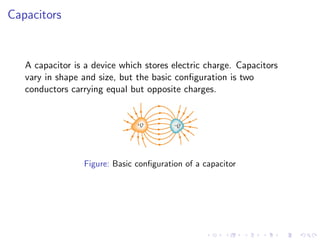
A capacitor is a device which stores electric charge. Capacitors
vary in shape and size, but the basic configuration is two
conductors carrying equal but opposite charges.
Figure: Basic configuration of a capacitor
Potential difference between the two conductors
There is a potential difference between the two conductors of the
capacitor, with the positively charged conductor at a higher
potential than the negatively charged conductor.
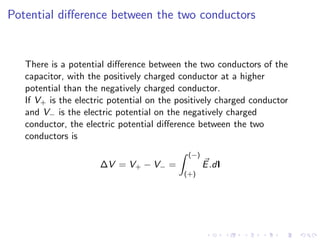
If V+ is the electric potential on the positively charged conductor
and V− is the electric potential on the negatively charged
conductor, the electric potential difference between the two
conductors is
∆V = V+ − V− =
Z (−)
(+)
⃗
E.dl
Capacitance of a capacitor
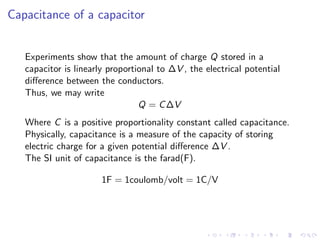
Experiments show that the amount of charge Q stored in a
capacitor is linearly proportional to ∆V , the electrical potential
difference between the conductors.
Thus, we may write
Q = C∆V
Where C is a positive proportionality constant called capacitance.
Physically, capacitance is a measure of the capacity of storing
electric charge for a given potential difference ∆V .
The SI unit of capacitance is the farad(F).
1F = 1coulomb/volt = 1C/V
Parallel-plate capacitors
The simplest example of a capacitor consists of two conducting
plates of area A, which are parallel to each other, and seperated by
a distance d. Such capacitors are called parallel-plate capacitors.
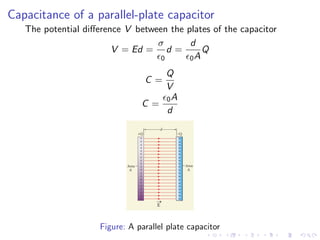
Figure: A parallel-plate capacitor
Figure: The electric field between the plates of a parallel-plate capacitor
Capacitance of a parallel-plate capacitor
The potential difference V between the plates of the capacitor
V = Ed =
σ
ϵ0
d =
d
ϵ0A
Q
C =
Q
V
C =
ϵ0A
d
Figure: A parallel plate capacitor
Capacitance of a real parallel-plate capacitor
The formula
C =
ϵ0A
d
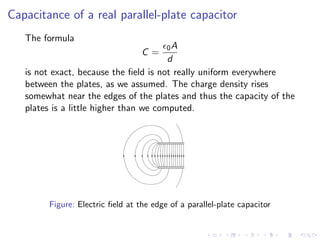
is not exact, because the field is not really uniform everywhere
between the plates, as we assumed. The charge density rises
somewhat near the edges of the plates and thus the capacity of the
plates is a little higher than we computed.
Figure: Electric field at the edge of a parallel-plate capacitor
Work done to charge a capacitor
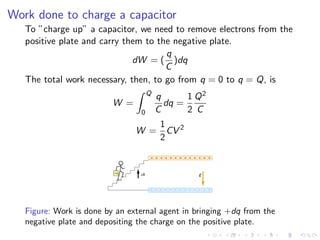
To ”charge up” a capacitor, we need to remove electrons from the
positive plate and carry them to the negative plate.
dW = (
q
C
)dq
The total work necessary, then, to go from q = 0 to q = Q, is
W =
Z Q
0
q
C
dq =
1
2
Q2
C
W =
1
2
CV 2
Figure: Work is done by an external agent in bringing +dq from the
negative plate and depositing the charge on the positive plate.
High-voltage breakdown
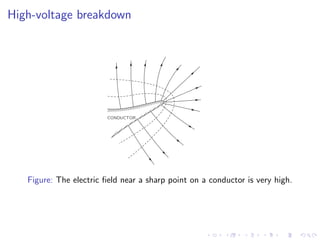
Figure: The electric field near a sharp point on a conductor is very high.
High-voltage breakdown
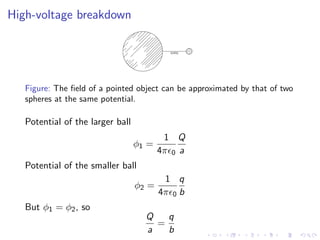
Figure: The field of a pointed object can be approximated by that of two
spheres at the same potential.
Potential of the larger ball
ϕ1 =
1
4πϵ0
Q
a
Potential of the smaller ball
ϕ2 =
1
4πϵ0
q
b
But ϕ1 = ϕ2, so
Q
a
=
q
b
High-voltage breakdown
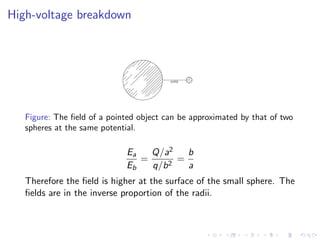
Figure: The field of a pointed object can be approximated by that of two
spheres at the same potential.
Ea
Eb
=
Q/a2
q/b2
=
b
a
Therefore the field is higher at the surface of the small sphere. The
fields are in the inverse proportion of the radii.
Dielectrics
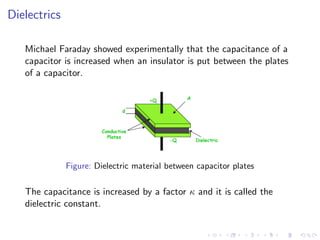
Michael Faraday showed experimentally that the capacitance of a
capacitor is increased when an insulator is put between the plates
of a capacitor.
Figure: Dielectric material between capacitor plates
The capacitance is increased by a factor κ and it is called the
dielectric constant.
Inside dielectrics
Capacitance of a capacitor is
C =
Q
V
When we put a piece of insulating material between the plates, we
find that capacitance is larger. That means, of course, that the
voltage is lower for the same charge.
Voltage difference is the integral of the electric field across the
capacitor; so we must conclude that inside the capacitor, the
electric field is reduced even though the charges on the plates
remain unchanged.
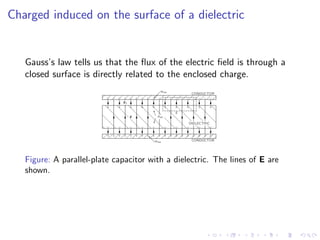
Charged induced on the surface of a dielectric
Gauss’s law tells us that the flux of the electric field is through a
closed surface is directly related to the enclosed charge.
Figure: A parallel-plate capacitor with a dielectric. The lines of E are
shown.
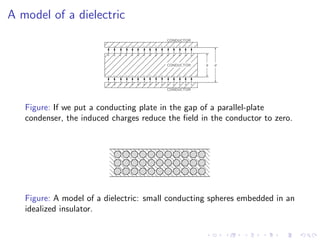
A model of a dielectric
Figure: If we put a conducting plate in the gap of a parallel-plate
condenser, the induced charges reduce the field in the conductor to zero.
Figure: A model of a dielectric: small conducting spheres embedded in an
idealized insulator.
Polarization
The idea of regions of perfect conductivity and insulation is not
essential.
Each of the small spheres acts like a dipole, the moment of which
is induced by the external field.
The only thing that is essential to the understanding of dielectrics
is that there are many little dipoles induced in the material.
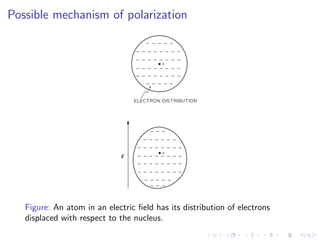
Possible mechanism of polarization
Figure: An atom in an electric field has its distribution of electrons
displaced with respect to the nucleus.
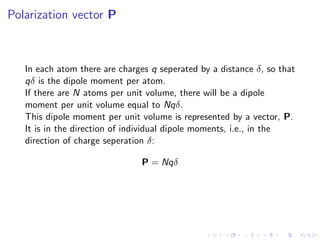
Polarization vector P
In each atom there are charges q seperated by a distance δ, so that
qδ is the dipole moment per atom.
If there are N atoms per unit volume, there will be a dipole
moment per unit volume equal to Nqδ.
This dipole moment per unit volume is represented by a vector, P.
It is in the direction of individual dipole moments, i.e., in the
direction of charge seperation δ:
P = Nqδ
Calculation of the charged induced on the surface of a
dielectric
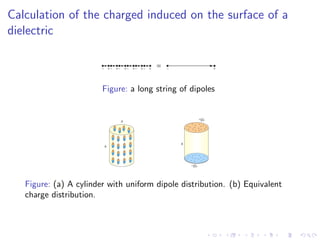
Figure: a long string of dipoles
Figure: (a) A cylinder with uniform dipole distribution. (b) Equivalent
charge distribution.
Calculation of the charged induced on the surface of a
dielectric
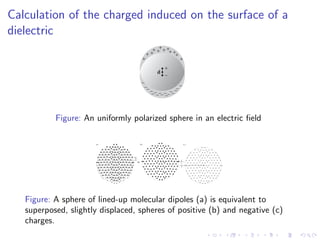
Figure: An uniformly polarized sphere in an electric field
Figure: A sphere of lined-up molecular dipoles (a) is equivalent to
superposed, slightly displaced, spheres of positive (b) and negative (c)
charges.
Calculation of the charged induced on the surface of a
dielectric
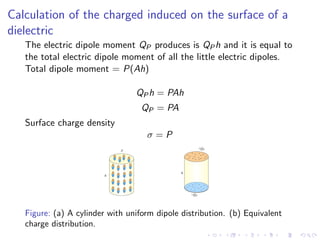
The electric dipole moment QP produces is QPh and it is equal to
the total electric dipole moment of all the little electric dipoles.
Total dipole moment = P(Ah)
QPh = PAh
QP = PA
Surface charge density
σ = P
Figure: (a) A cylinder with uniform dipole distribution. (b) Equivalent
charge distribution.
Calculation of the charge induced on the surface of a
dielectric
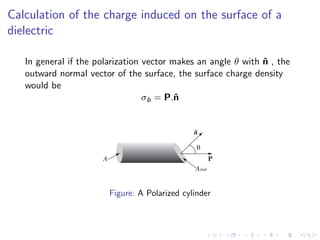
In general if the polarization vector makes an angle θ with n̂ , the
outward normal vector of the surface, the surface charge density
would be
σb = P.n̂
Figure: A Polarized cylinder
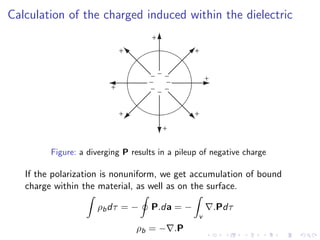
Calculation of the charged induced within the dielectric
Figure: a diverging P results in a pileup of negative charge
If the polarization is nonuniform, we get accumulation of bound
charge within the material, as well as on the surface.
Z
ρbdτ = −
I
P.da = −
Z
v
∇.Pdτ
ρb = −∇.P
The electric displacement
The effect of polarization is to produce accumulations of (bound)
charge, ρb = −∇.P within the dielectric and σb = P.n̂ on the
surface.
Within the dielectric, the total electric charge density can be
written:
ρ = ρb + ρf
and the Gauss’s law reads
ϵ0∇.E = ρ = ρb + ρf = −∇.P + ρf
∇.(ϵ0E + P) = ρf
Where,
D = ϵ0E + P
D is called the electric displacement. In terms of D, Gauss’s law
reads
∇.D = ρf
Linear dielectrics
In linear dielectrics, the polarization is proportional to the electric
field, provided the electric field is not too strong:
P = ϵ0χeE
Where χe is called the electric susceptibility of the medium.
D = ϵ0E + P = ϵ0(1 + χe)E
D = ϵE
ϵ = ϵ0(1 + χe)
The constant ϵ is called the permittivity of the material.
The constant
ϵr =
ϵ
ϵ0
= 1 + χe
is called the dielectric constant of the material.
THE END.

Capacitor.pdf

  • 1.
    Capacitors and dielectrics DimpalBoro Tezpur University November 4, 2022
  • 2.
    Capacitors A capacitor isa device which stores electric charge. Capacitors vary in shape and size, but the basic configuration is two conductors carrying equal but opposite charges. Figure: Basic configuration of a capacitor
  • 3.
    Potential difference betweenthe two conductors There is a potential difference between the two conductors of the capacitor, with the positively charged conductor at a higher potential than the negatively charged conductor. If V+ is the electric potential on the positively charged conductor and V− is the electric potential on the negatively charged conductor, the electric potential difference between the two conductors is ∆V = V+ − V− = Z (−) (+) ⃗ E.dl
  • 4.
    Capacitance of acapacitor Experiments show that the amount of charge Q stored in a capacitor is linearly proportional to ∆V , the electrical potential difference between the conductors. Thus, we may write Q = C∆V Where C is a positive proportionality constant called capacitance. Physically, capacitance is a measure of the capacity of storing electric charge for a given potential difference ∆V . The SI unit of capacitance is the farad(F). 1F = 1coulomb/volt = 1C/V
  • 5.
    Parallel-plate capacitors The simplestexample of a capacitor consists of two conducting plates of area A, which are parallel to each other, and seperated by a distance d. Such capacitors are called parallel-plate capacitors. Figure: A parallel-plate capacitor Figure: The electric field between the plates of a parallel-plate capacitor
  • 6.
    Capacitance of aparallel-plate capacitor The potential difference V between the plates of the capacitor V = Ed = σ ϵ0 d = d ϵ0A Q C = Q V C = ϵ0A d Figure: A parallel plate capacitor
  • 7.
    Capacitance of areal parallel-plate capacitor The formula C = ϵ0A d is not exact, because the field is not really uniform everywhere between the plates, as we assumed. The charge density rises somewhat near the edges of the plates and thus the capacity of the plates is a little higher than we computed. Figure: Electric field at the edge of a parallel-plate capacitor
  • 8.
    Work done tocharge a capacitor To ”charge up” a capacitor, we need to remove electrons from the positive plate and carry them to the negative plate. dW = ( q C )dq The total work necessary, then, to go from q = 0 to q = Q, is W = Z Q 0 q C dq = 1 2 Q2 C W = 1 2 CV 2 Figure: Work is done by an external agent in bringing +dq from the negative plate and depositing the charge on the positive plate.
  • 9.
    High-voltage breakdown Figure: Theelectric field near a sharp point on a conductor is very high.
  • 10.
    High-voltage breakdown Figure: Thefield of a pointed object can be approximated by that of two spheres at the same potential. Potential of the larger ball ϕ1 = 1 4πϵ0 Q a Potential of the smaller ball ϕ2 = 1 4πϵ0 q b But ϕ1 = ϕ2, so Q a = q b
  • 11.
    High-voltage breakdown Figure: Thefield of a pointed object can be approximated by that of two spheres at the same potential. Ea Eb = Q/a2 q/b2 = b a Therefore the field is higher at the surface of the small sphere. The fields are in the inverse proportion of the radii.
  • 12.
    Dielectrics Michael Faraday showedexperimentally that the capacitance of a capacitor is increased when an insulator is put between the plates of a capacitor. Figure: Dielectric material between capacitor plates The capacitance is increased by a factor κ and it is called the dielectric constant.
  • 13.
    Inside dielectrics Capacitance ofa capacitor is C = Q V When we put a piece of insulating material between the plates, we find that capacitance is larger. That means, of course, that the voltage is lower for the same charge. Voltage difference is the integral of the electric field across the capacitor; so we must conclude that inside the capacitor, the electric field is reduced even though the charges on the plates remain unchanged.
  • 14.
    Charged induced onthe surface of a dielectric Gauss’s law tells us that the flux of the electric field is through a closed surface is directly related to the enclosed charge. Figure: A parallel-plate capacitor with a dielectric. The lines of E are shown.
  • 15.
    A model ofa dielectric Figure: If we put a conducting plate in the gap of a parallel-plate condenser, the induced charges reduce the field in the conductor to zero. Figure: A model of a dielectric: small conducting spheres embedded in an idealized insulator.
  • 16.
    Polarization The idea ofregions of perfect conductivity and insulation is not essential. Each of the small spheres acts like a dipole, the moment of which is induced by the external field. The only thing that is essential to the understanding of dielectrics is that there are many little dipoles induced in the material.
  • 17.
    Possible mechanism ofpolarization Figure: An atom in an electric field has its distribution of electrons displaced with respect to the nucleus.
  • 18.
    Polarization vector P Ineach atom there are charges q seperated by a distance δ, so that qδ is the dipole moment per atom. If there are N atoms per unit volume, there will be a dipole moment per unit volume equal to Nqδ. This dipole moment per unit volume is represented by a vector, P. It is in the direction of individual dipole moments, i.e., in the direction of charge seperation δ: P = Nqδ
  • 19.
    Calculation of thecharged induced on the surface of a dielectric Figure: a long string of dipoles Figure: (a) A cylinder with uniform dipole distribution. (b) Equivalent charge distribution.
  • 20.
    Calculation of thecharged induced on the surface of a dielectric Figure: An uniformly polarized sphere in an electric field Figure: A sphere of lined-up molecular dipoles (a) is equivalent to superposed, slightly displaced, spheres of positive (b) and negative (c) charges.
  • 21.
    Calculation of thecharged induced on the surface of a dielectric The electric dipole moment QP produces is QPh and it is equal to the total electric dipole moment of all the little electric dipoles. Total dipole moment = P(Ah) QPh = PAh QP = PA Surface charge density σ = P Figure: (a) A cylinder with uniform dipole distribution. (b) Equivalent charge distribution.
  • 22.
    Calculation of thecharge induced on the surface of a dielectric In general if the polarization vector makes an angle θ with n̂ , the outward normal vector of the surface, the surface charge density would be σb = P.n̂ Figure: A Polarized cylinder
  • 23.
    Calculation of thecharged induced within the dielectric Figure: a diverging P results in a pileup of negative charge If the polarization is nonuniform, we get accumulation of bound charge within the material, as well as on the surface. Z ρbdτ = − I P.da = − Z v ∇.Pdτ ρb = −∇.P
  • 24.
    The electric displacement Theeffect of polarization is to produce accumulations of (bound) charge, ρb = −∇.P within the dielectric and σb = P.n̂ on the surface. Within the dielectric, the total electric charge density can be written: ρ = ρb + ρf and the Gauss’s law reads ϵ0∇.E = ρ = ρb + ρf = −∇.P + ρf ∇.(ϵ0E + P) = ρf Where, D = ϵ0E + P D is called the electric displacement. In terms of D, Gauss’s law reads ∇.D = ρf
  • 25.
    Linear dielectrics In lineardielectrics, the polarization is proportional to the electric field, provided the electric field is not too strong: P = ϵ0χeE Where χe is called the electric susceptibility of the medium. D = ϵ0E + P = ϵ0(1 + χe)E D = ϵE ϵ = ϵ0(1 + χe) The constant ϵ is called the permittivity of the material. The constant ϵr = ϵ ϵ0 = 1 + χe is called the dielectric constant of the material.
  • 26.