22ECR224 VARUN.S
DIELECTRIC
CONSTANT
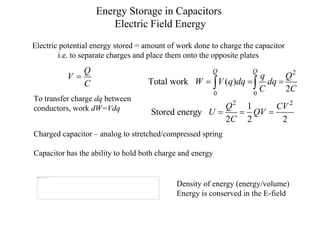
Energy Storage in Capacitors
Electric Field Energy
Electric potential energy stored = amount of work done to charge the capacitor
i.e. to separate charges and place them onto the opposite plates
Q
V
C

2
0 0
2 2
Total work ( )
2
1
Stored energy
2 2 2
Q Q
q Q
W V q dq dq
C C
Q CV
U QV
C
  
  
 
Charged capacitor – analog to stretched/compressed spring
Capacitor has the ability to hold both charge and energy
To transfer charge dq between
conductors, work dW=Vdq
Density of energy (energy/volume)
Energy is conserved in the E-field
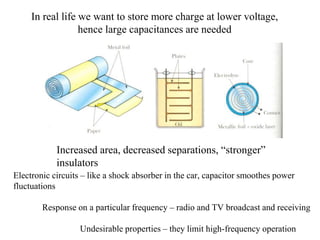
In real life we want to store more charge at lower voltage,
hence large capacitances are needed
Increased area, decreased separations, “stronger”
insulators
Electronic circuits – like a shock absorber in the car, capacitor smoothes power
fluctuations
Response on a particular frequency – radio and TV broadcast and receiving
Undesirable properties – they limit high-frequency operation
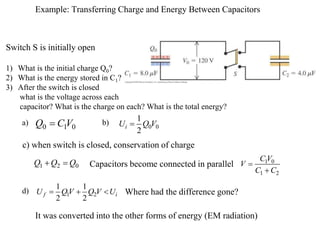
Example: Transferring Charge and Energy Between Capacitors
Switch S is initially open
1) What is the initial charge Q0?
2) What is the energy stored in C1?
3) After the switch is closed
what is the voltage across each
capacitor? What is the charge on each? What is the total energy?
a) 0 1 0
Q C V
 0 0
1
2
i
U Q V

b)
c) when switch is closed, conservation of charge
1 2 0
Q Q Q
  Capacitors become connected in parallel 1 0
1 2
C V
V
C C


d) 1 2
1 1
2 2
f i
U QV Q V U
   Where had the difference gone?
It was converted into the other forms of energy (EM radiation)
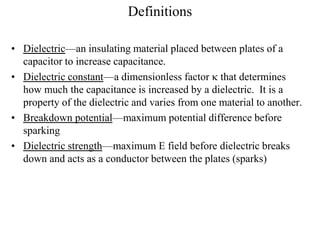
Definitions
• Dielectric—an insulating material placed between plates of a
capacitor to increase capacitance.
• Dielectric constant—a dimensionless factor  that determines
how much the capacitance is increased by a dielectric. It is a
property of the dielectric and varies from one material to another.
• Breakdown potential—maximum potential difference before
sparking
• Dielectric strength—maximum E field before dielectric breaks
down and acts as a conductor between the plates (sparks)
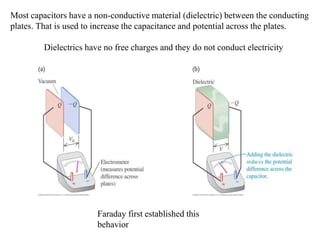
Most capacitors have a non-conductive material (dielectric) between the conducting
plates. That is used to increase the capacitance and potential across the plates.
Dielectrics have no free charges and they do not conduct electricity
Faraday first established this
behavior
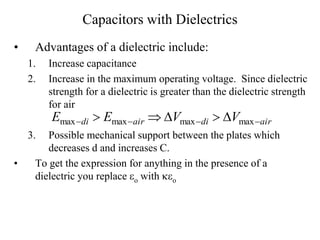
Capacitors with Dielectrics
• Advantages of a dielectric include:
1. Increase capacitance
2. Increase in the maximum operating voltage. Since dielectric
strength for a dielectric is greater than the dielectric strength
for air
3. Possible mechanical support between the plates which
decreases d and increases C.
• To get the expression for anything in the presence of a
dielectric you replace o with o
air
di
air
di V
V
E
E 


 



 max
max
max
max
Field inside the capacitor became smaller – why?
There are polarization (induced)
charges
– Dielectrics get polarized
We know what happens to the conductor in the electric field
Field inside the conductor E=0
outside field did not change
Potential difference (which is the
integral of field) is, however, smaller.
( )
o
V d b


  0
[1 / ]
A
C
d b d



Properties of Dielectrics
0
E
E
K

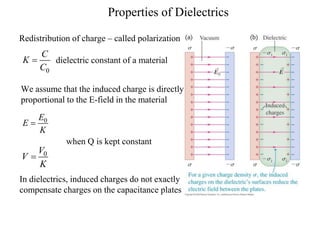
Redistribution of charge – called polarization
We assume that the induced charge is directly
proportional to the E-field in the material
0
C
K
C
 dielectric constant of a material
0
V
V
K

when Q is kept constant
In dielectrics, induced charges do not exactly
compensate charges on the capacitance plates
0
0 0
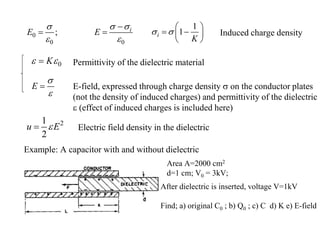
; i
E E
 

 

 
1
1
i
K
 
 
 
 
 
Induced charge density
0
K
 
 Permittivity of the dielectric material
E


 E-field, expressed through charge density  on the conductor plates
(not the density of induced charges) and permittivity of the dielectric
 (effect of induced charges is included here)
2
1
2
u E

 Electric field density in the dielectric
Example: A capacitor with and without dielectric
Area A=2000 cm2
d=1 cm; V0 = 3kV;
After dielectric is inserted, voltage V=1kV
Find; a) original C0 ; b) Q0 ; c) C d) K e) E-field
Dielectric Breakdown
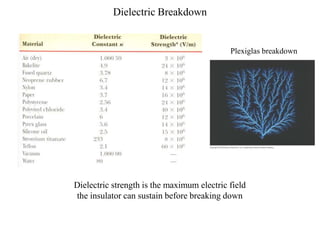
Dielectric strength is the maximum electric field
the insulator can sustain before breaking down
Plexiglas breakdown
Molecular Model of Induced Charge
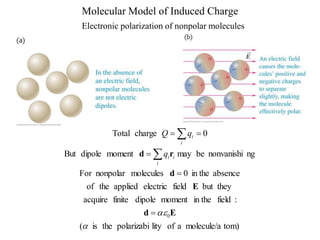
Electronic polarization of nonpolar molecules
tom)
molecule/a
a
of
lity
polarizabi
the
is
(
:
field
in the
moment
dipole
finite
acquire
but they
field
electric
applied
the
of
absence
in the
0
molecules
nonpolar
For
ng
nonvanishi
be
may
moment
dipole
But
0
charge
Total
0

 E
d
E
d
r
d







i
i
i
i
i
q
q
Q
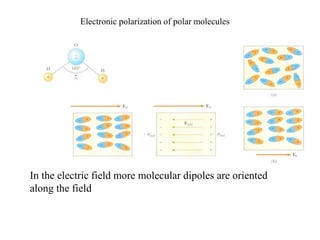
In the electric field more molecular dipoles are oriented
along the field
Electronic polarization of polar molecules
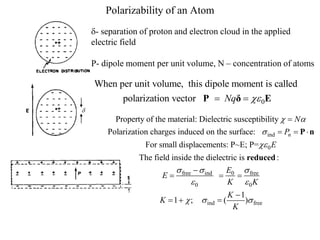
Polarizability of an Atom

- separation of proton and electron cloud in the applied
electric field
P- dipole moment per unit volume, N – concentration of atoms
0
When per unit volume, this dipole moment is called
polarization vector Nq 
 
P δ E
ind
0
fre
Property of the material: Dielectric susceptibility
Polarization charges induced on the surface:
For small displacements: P~E; P=
The field inside the dielectric is :
n
N
P
E
E
 




  

P n
reduced
e ind 0 free
0 0
ind free
1
1 ; ( )
E
K K
K
K
K
 
 
  

 

  
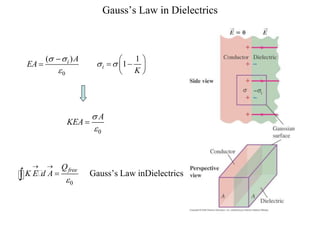
Gauss’s Law in Dielectrics
0
( )
i A
EA
 



1
1
i
K
 
 
 
 
 
0
A
KEA



0
free
Q
K E d A

 

 Gauss’s Law inDielectrics
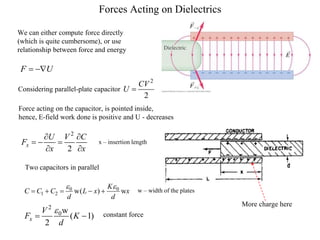
Forces Acting on Dielectrics
More charge here
We can either compute force directly
(which is quite cumbersome), or use
relationship between force and energy
F U
 
Considering parallel-plate capacitor
2
2
CV
U 
Force acting on the capacitor, is pointed inside,
hence, E-field work done is positive and U - decreases
2
2
x
U V C
F
x x
 
  
 
x – insertion length
Two capacitors in parallel
0 0
1 2 w( ) w
K
C C C L x x
d d
 
     w – width of the plates
2
0w
( 1)
2
x
V
F K
d

  constant force
Thank you

Dielectric constant by varun.s(22ECR224).pptx

  • 1.
  • 2.
    Energy Storage inCapacitors Electric Field Energy Electric potential energy stored = amount of work done to charge the capacitor i.e. to separate charges and place them onto the opposite plates Q V C  2 0 0 2 2 Total work ( ) 2 1 Stored energy 2 2 2 Q Q q Q W V q dq dq C C Q CV U QV C         Charged capacitor – analog to stretched/compressed spring Capacitor has the ability to hold both charge and energy To transfer charge dq between conductors, work dW=Vdq Density of energy (energy/volume) Energy is conserved in the E-field
  • 3.
    In real lifewe want to store more charge at lower voltage, hence large capacitances are needed Increased area, decreased separations, “stronger” insulators Electronic circuits – like a shock absorber in the car, capacitor smoothes power fluctuations Response on a particular frequency – radio and TV broadcast and receiving Undesirable properties – they limit high-frequency operation
  • 4.
    Example: Transferring Chargeand Energy Between Capacitors Switch S is initially open 1) What is the initial charge Q0? 2) What is the energy stored in C1? 3) After the switch is closed what is the voltage across each capacitor? What is the charge on each? What is the total energy? a) 0 1 0 Q C V  0 0 1 2 i U Q V  b) c) when switch is closed, conservation of charge 1 2 0 Q Q Q   Capacitors become connected in parallel 1 0 1 2 C V V C C   d) 1 2 1 1 2 2 f i U QV Q V U    Where had the difference gone? It was converted into the other forms of energy (EM radiation)
  • 5.
    Definitions • Dielectric—an insulatingmaterial placed between plates of a capacitor to increase capacitance. • Dielectric constant—a dimensionless factor  that determines how much the capacitance is increased by a dielectric. It is a property of the dielectric and varies from one material to another. • Breakdown potential—maximum potential difference before sparking • Dielectric strength—maximum E field before dielectric breaks down and acts as a conductor between the plates (sparks)
  • 6.
    Most capacitors havea non-conductive material (dielectric) between the conducting plates. That is used to increase the capacitance and potential across the plates. Dielectrics have no free charges and they do not conduct electricity Faraday first established this behavior
  • 7.
    Capacitors with Dielectrics •Advantages of a dielectric include: 1. Increase capacitance 2. Increase in the maximum operating voltage. Since dielectric strength for a dielectric is greater than the dielectric strength for air 3. Possible mechanical support between the plates which decreases d and increases C. • To get the expression for anything in the presence of a dielectric you replace o with o air di air di V V E E          max max max max
  • 8.
    Field inside thecapacitor became smaller – why? There are polarization (induced) charges – Dielectrics get polarized We know what happens to the conductor in the electric field Field inside the conductor E=0 outside field did not change Potential difference (which is the integral of field) is, however, smaller. ( ) o V d b     0 [1 / ] A C d b d   
  • 9.
    Properties of Dielectrics 0 E E K  Redistributionof charge – called polarization We assume that the induced charge is directly proportional to the E-field in the material 0 C K C  dielectric constant of a material 0 V V K  when Q is kept constant In dielectrics, induced charges do not exactly compensate charges on the capacitance plates
  • 10.
    0 0 0 ; i EE         1 1 i K           Induced charge density 0 K    Permittivity of the dielectric material E    E-field, expressed through charge density  on the conductor plates (not the density of induced charges) and permittivity of the dielectric  (effect of induced charges is included here) 2 1 2 u E   Electric field density in the dielectric Example: A capacitor with and without dielectric Area A=2000 cm2 d=1 cm; V0 = 3kV; After dielectric is inserted, voltage V=1kV Find; a) original C0 ; b) Q0 ; c) C d) K e) E-field
  • 11.
    Dielectric Breakdown Dielectric strengthis the maximum electric field the insulator can sustain before breaking down Plexiglas breakdown
  • 12.
    Molecular Model ofInduced Charge Electronic polarization of nonpolar molecules tom) molecule/a a of lity polarizabi the is ( : field in the moment dipole finite acquire but they field electric applied the of absence in the 0 molecules nonpolar For ng nonvanishi be may moment dipole But 0 charge Total 0   E d E d r d        i i i i i q q Q
  • 13.
    In the electricfield more molecular dipoles are oriented along the field Electronic polarization of polar molecules
  • 14.
    Polarizability of anAtom  - separation of proton and electron cloud in the applied electric field P- dipole moment per unit volume, N – concentration of atoms 0 When per unit volume, this dipole moment is called polarization vector Nq    P δ E ind 0 fre Property of the material: Dielectric susceptibility Polarization charges induced on the surface: For small displacements: P~E; P= The field inside the dielectric is : n N P E E           P n reduced e ind 0 free 0 0 ind free 1 1 ; ( ) E K K K K K              
  • 15.
    Gauss’s Law inDielectrics 0 ( ) i A EA      1 1 i K           0 A KEA    0 free Q K E d A      Gauss’s Law inDielectrics
  • 16.
    Forces Acting onDielectrics More charge here We can either compute force directly (which is quite cumbersome), or use relationship between force and energy F U   Considering parallel-plate capacitor 2 2 CV U  Force acting on the capacitor, is pointed inside, hence, E-field work done is positive and U - decreases 2 2 x U V C F x x        x – insertion length Two capacitors in parallel 0 0 1 2 w( ) w K C C C L x x d d        w – width of the plates 2 0w ( 1) 2 x V F K d    constant force
  • 17.