Prepared by Connie Dello Buono 8/10/2011


Corrective and Preventive Action Plan/Report (CAPA) is used to improve the organization even when your
supplier defines your failure rate or customer complaints. CAPA helps in finding the core issues and
specifics of actions that lead to improvement programs.


You can assist your supplier in defining the problem, performing the investigations and finding comparisons
and clues and likely causes of the problem and testing the solution to the problem. Training is an important
quality element in the effort of collaborating with suppliers in CAPA documentation.


Use root cause analysis to point to the right direction, the specific target by which action plans can be
implemented to solve the problem or product failure.
Root Cause Analysis , RCA, is finding clues that suits your organization:
        2 clues: Process and Method
        4M: material, manpower, machinery, method
        Ms: mother nature, management, measurement
        Service: surroundings, supplier, system, skills
        6P: People, process, policy, plant, program, product


The end result of RCA is identifying the unnecessary constraints, unrecognized hazards, broken or missing
barriers and inadequate controls. What are examples of inadequate controls in process and methods:


    1.   Incomplete inspection criteria and specifications
    2.   Incomplete test specifications
    3.   Inadequate training
    4.   Inadequate testing in incoming, in-process and final test
    5.   Inadequate process of sub-contractor selection and qualifying
    6.   Incomplete method of assembly
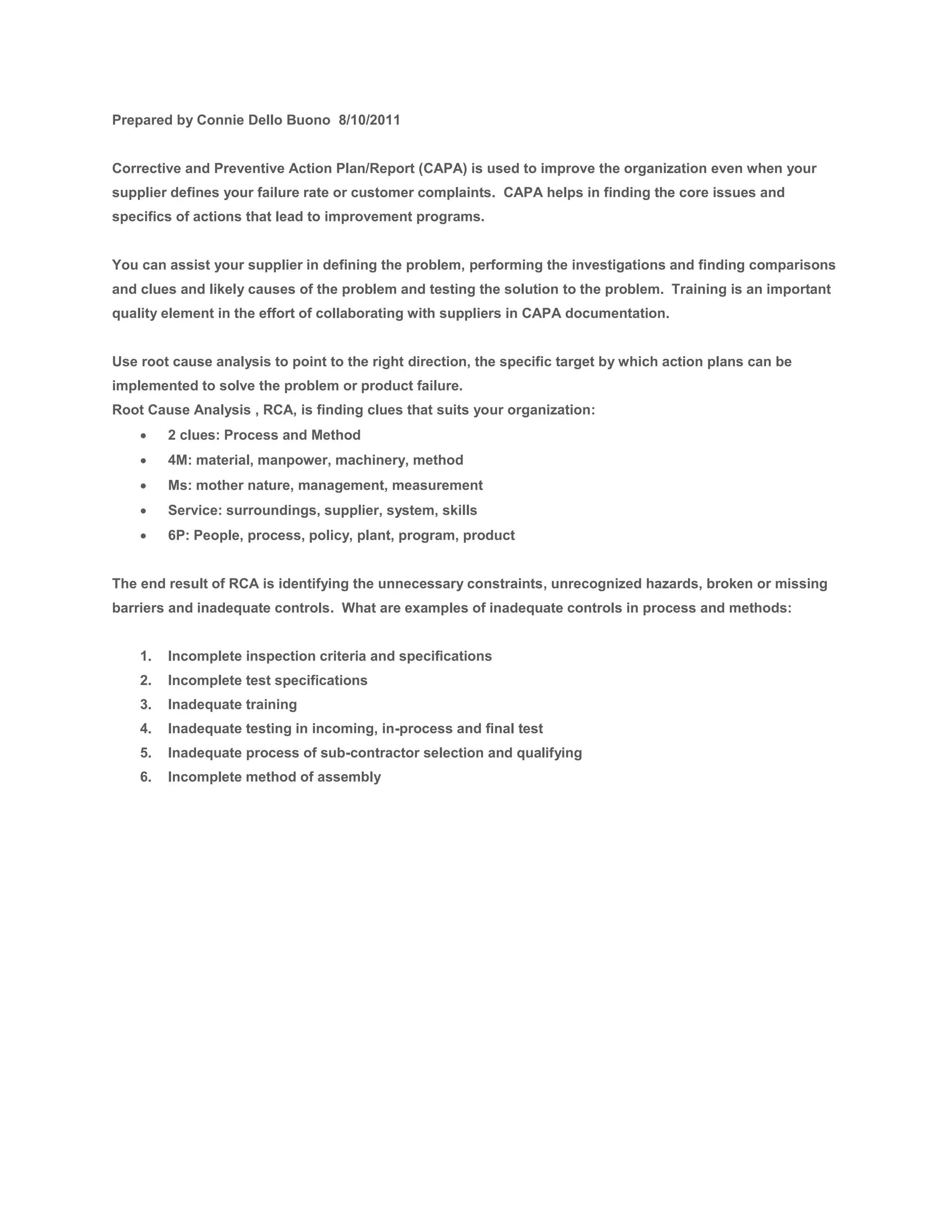
At the end, we identify the causal factors such as equipment problem or human error but we did not take into
account management system weakness such as lack of systems/controls: Procedures, Policies, Training,
Communication, Supervision, Equipment Design Process, Manufacturing Process and Practices


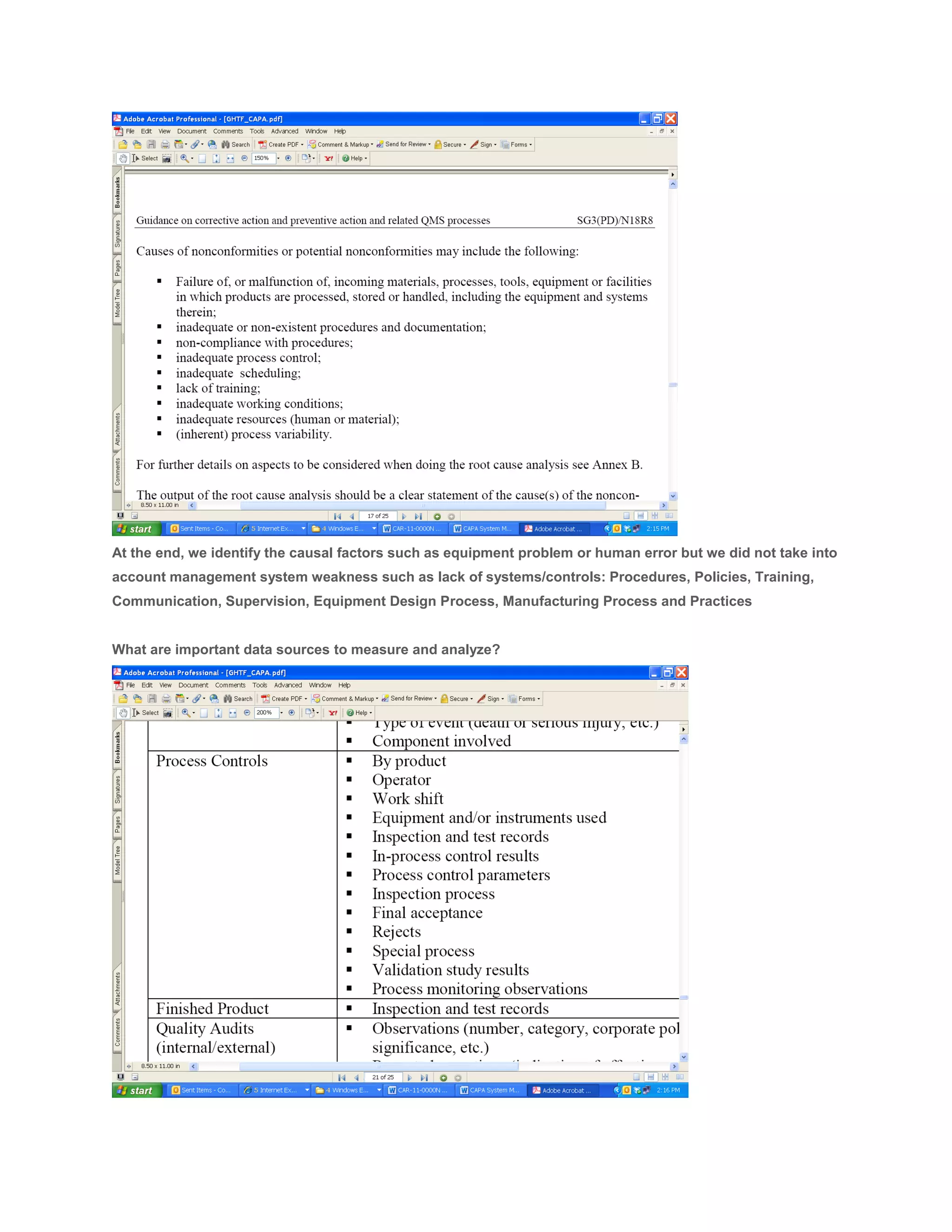
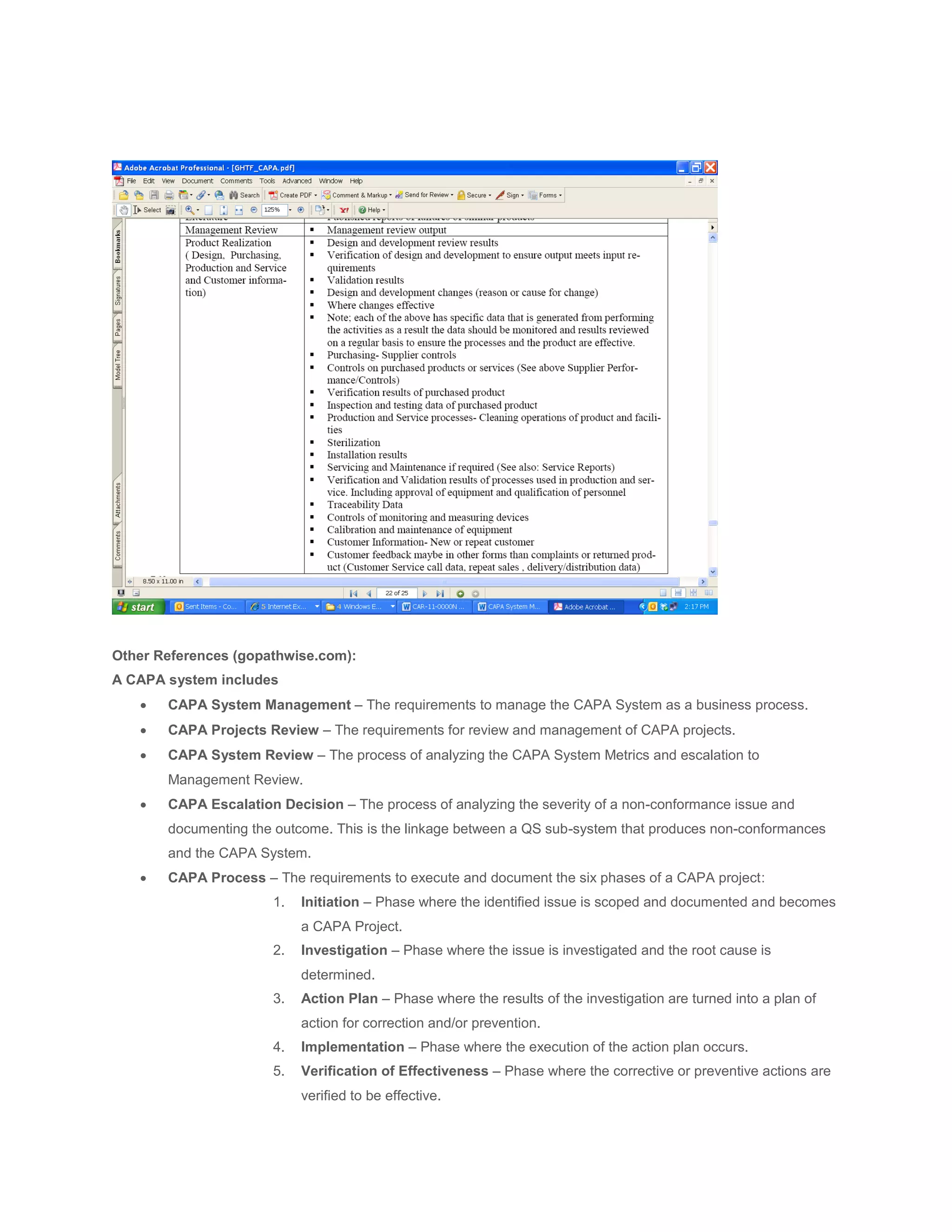
What are important data sources to measure and analyze?
Other References (gopathwise.com):
A CAPA system includes
      CAPA System Management – The requirements to manage the CAPA System as a business process.
      CAPA Projects Review – The requirements for review and management of CAPA projects.
      CAPA System Review – The process of analyzing the CAPA System Metrics and escalation to
       Management Review.
      CAPA Escalation Decision – The process of analyzing the severity of a non-conformance issue and
       documenting the outcome. This is the linkage between a QS sub-system that produces non-conformances
       and the CAPA System.
      CAPA Process – The requirements to execute and document the six phases of a CAPA project:
                      1.   Initiation – Phase where the identified issue is scoped and documented and becomes
                           a CAPA Project.
                      2.   Investigation – Phase where the issue is investigated and the root cause is
                           determined.
                      3.   Action Plan – Phase where the results of the investigation are turned into a plan of
                           action for correction and/or prevention.
                      4.   Implementation – Phase where the execution of the action plan occurs.
                      5.   Verification of Effectiveness – Phase where the corrective or preventive actions are
                           verified to be effective.
6.   Closure – Phase where the documented activity necessary to gain closure of the
                                  CAPA occurs.
        NC and CAPA Trending – The requirements to analyze and trend nonconformance quality data and CAPA
         project effectiveness.
The instructions for executing CAPA project work and the various additional elements of a CAPA System are unique
and separate. The separate system components should be individually defined within a system of documents that
work together to accomplish the effective execution of all CAPA activity within the organization. In their entirety, these
documents then comprise the organization’s CAPA System.


Efficient CAPA System
A properly constructed CAPA System should consist of streamlined work processes that provide an organization with
some significant benefits:
        In using appropriate escalation rules, the organization is less likely to become overwhelmed with the trivial
         many and can properly address the significant few non-conformance issues that arise from the QS sub-
         systems.
        By enabling a separate focus on the execution of the distinct phases of a CAPA project, the work output is
         capable of being efficiently completed within each individual phase resulting in a more successful CAPA
         project in aggregate.
        By enabling a distinct phases of a CAPA project work, with different required skill sets required for
         execution, CAPA project work is capable of being assigned by phase and in accordance with individual
         skills.
        Appropriate trending process will identify the “common cause” variation for non-conformance reduction
         improvement initiatives that can provide significant return in the investment of a CAPA project.

CAPA Documentation

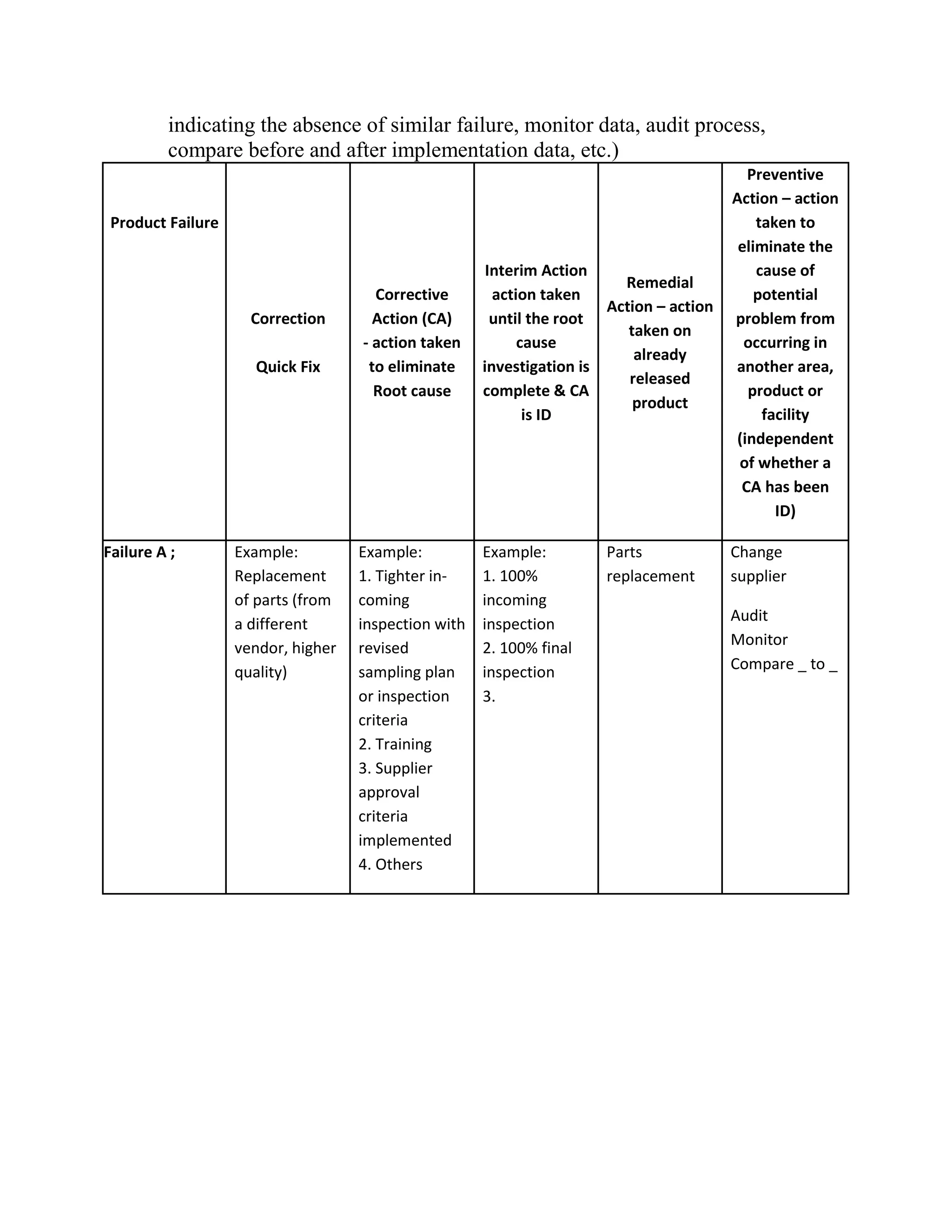
For each failure or defective components:

Details of Corrections and CAPA Plans (Please complete)

The following are major areas that need to be addressed in your detailed
investigation for each failure:

    1. An in-depth Root Cause Analysis (RCA); Analyze failure for root cause
       (RC)
    2. Identification of appropriate actions (Lists of tasks, who, when, what data or
       analysis results will make the defect go away) ; Correction CO or Corrective
       Action CA or Preventive Action PA
    3. Verification of identified actions ; Check CK (Proof)
    4. Implementation of actions ; Do IA (Plan, results, mgt review)
    5. Effectiveness Check of Implemented actions ; Determine effectiveness of
       actions/validate DE (example: Field data gathered after 3-6months
indicating the absence of similar failure, monitor data, audit process,
         compare before and after implementation data, etc.)
                                                                                              Preventive
                                                                                           Action – action
 Product Failure                                                                               taken to
                                                                                            eliminate the
                                                       Interim Action                          cause of
                                                                           Remedial
                                      Corrective        action taken                           potential
                                                                         Action – action
                     Correction       Action (CA)       until the root                     problem from
                                                                            taken on
                                    - action taken          cause                            occurring in
                                                                             already
                     Quick Fix       to eliminate     investigation is                     another area,
                                                                            released
                                      Root cause      complete & CA                           product or
                                                                             product
                                                             is ID                              facility
                                                                                            (independent
                                                                                            of whether a
                                                                                             CA has been
                                                                                                  ID)

Failure A ;        Example:         Example:          Example:           Parts             Change
                   Replacement      1. Tighter in-    1. 100%            replacement       supplier
                   of parts (from   coming            incoming
                                                                                           Audit
                   a different      inspection with   inspection
                   vendor, higher   revised           2. 100% final                        Monitor
                   quality)         sampling plan     inspection                           Compare _ to _
                                    or inspection     3.
                                    criteria
                                    2. Training
                                    3. Supplier
                                    approval
                                    criteria
                                    implemented
                                    4. Others

Capa system management

  • 1.
    Prepared by ConnieDello Buono 8/10/2011 Corrective and Preventive Action Plan/Report (CAPA) is used to improve the organization even when your supplier defines your failure rate or customer complaints. CAPA helps in finding the core issues and specifics of actions that lead to improvement programs. You can assist your supplier in defining the problem, performing the investigations and finding comparisons and clues and likely causes of the problem and testing the solution to the problem. Training is an important quality element in the effort of collaborating with suppliers in CAPA documentation. Use root cause analysis to point to the right direction, the specific target by which action plans can be implemented to solve the problem or product failure. Root Cause Analysis , RCA, is finding clues that suits your organization:  2 clues: Process and Method  4M: material, manpower, machinery, method  Ms: mother nature, management, measurement  Service: surroundings, supplier, system, skills  6P: People, process, policy, plant, program, product The end result of RCA is identifying the unnecessary constraints, unrecognized hazards, broken or missing barriers and inadequate controls. What are examples of inadequate controls in process and methods: 1. Incomplete inspection criteria and specifications 2. Incomplete test specifications 3. Inadequate training 4. Inadequate testing in incoming, in-process and final test 5. Inadequate process of sub-contractor selection and qualifying 6. Incomplete method of assembly
  • 2.
    At the end,we identify the causal factors such as equipment problem or human error but we did not take into account management system weakness such as lack of systems/controls: Procedures, Policies, Training, Communication, Supervision, Equipment Design Process, Manufacturing Process and Practices What are important data sources to measure and analyze?
  • 3.
    Other References (gopathwise.com): ACAPA system includes  CAPA System Management – The requirements to manage the CAPA System as a business process.  CAPA Projects Review – The requirements for review and management of CAPA projects.  CAPA System Review – The process of analyzing the CAPA System Metrics and escalation to Management Review.  CAPA Escalation Decision – The process of analyzing the severity of a non-conformance issue and documenting the outcome. This is the linkage between a QS sub-system that produces non-conformances and the CAPA System.  CAPA Process – The requirements to execute and document the six phases of a CAPA project: 1. Initiation – Phase where the identified issue is scoped and documented and becomes a CAPA Project. 2. Investigation – Phase where the issue is investigated and the root cause is determined. 3. Action Plan – Phase where the results of the investigation are turned into a plan of action for correction and/or prevention. 4. Implementation – Phase where the execution of the action plan occurs. 5. Verification of Effectiveness – Phase where the corrective or preventive actions are verified to be effective.
  • 4.
    6. Closure – Phase where the documented activity necessary to gain closure of the CAPA occurs.  NC and CAPA Trending – The requirements to analyze and trend nonconformance quality data and CAPA project effectiveness. The instructions for executing CAPA project work and the various additional elements of a CAPA System are unique and separate. The separate system components should be individually defined within a system of documents that work together to accomplish the effective execution of all CAPA activity within the organization. In their entirety, these documents then comprise the organization’s CAPA System. Efficient CAPA System A properly constructed CAPA System should consist of streamlined work processes that provide an organization with some significant benefits:  In using appropriate escalation rules, the organization is less likely to become overwhelmed with the trivial many and can properly address the significant few non-conformance issues that arise from the QS sub- systems.  By enabling a separate focus on the execution of the distinct phases of a CAPA project, the work output is capable of being efficiently completed within each individual phase resulting in a more successful CAPA project in aggregate.  By enabling a distinct phases of a CAPA project work, with different required skill sets required for execution, CAPA project work is capable of being assigned by phase and in accordance with individual skills.  Appropriate trending process will identify the “common cause” variation for non-conformance reduction improvement initiatives that can provide significant return in the investment of a CAPA project. CAPA Documentation For each failure or defective components: Details of Corrections and CAPA Plans (Please complete) The following are major areas that need to be addressed in your detailed investigation for each failure: 1. An in-depth Root Cause Analysis (RCA); Analyze failure for root cause (RC) 2. Identification of appropriate actions (Lists of tasks, who, when, what data or analysis results will make the defect go away) ; Correction CO or Corrective Action CA or Preventive Action PA 3. Verification of identified actions ; Check CK (Proof) 4. Implementation of actions ; Do IA (Plan, results, mgt review) 5. Effectiveness Check of Implemented actions ; Determine effectiveness of actions/validate DE (example: Field data gathered after 3-6months
  • 5.
    indicating the absenceof similar failure, monitor data, audit process, compare before and after implementation data, etc.) Preventive Action – action Product Failure taken to eliminate the Interim Action cause of Remedial Corrective action taken potential Action – action Correction Action (CA) until the root problem from taken on - action taken cause occurring in already Quick Fix to eliminate investigation is another area, released Root cause complete & CA product or product is ID facility (independent of whether a CA has been ID) Failure A ; Example: Example: Example: Parts Change Replacement 1. Tighter in- 1. 100% replacement supplier of parts (from coming incoming Audit a different inspection with inspection vendor, higher revised 2. 100% final Monitor quality) sampling plan inspection Compare _ to _ or inspection 3. criteria 2. Training 3. Supplier approval criteria implemented 4. Others