Description of the Implementation Strategy for Process Certification (Six Sigma) at Hamilton Sundstrand, United Technologies Corporation Mark Milward & Pete Teti,  IIE Annual Conference & Expo 2009 Hamilton Sundstrand, UTC May 30 – June 3 rd Windsor Locks, Connecticut Doral Golf Resort & Spa Miami Florida
Speaker Bio Mark D. Milward, CSSMBB Six Sigma Master Black Belt Fmr. Manager, Process Certification Hamilton Sundstrand, Windsor Locks, Connecticut United Technologies Corporation EMAIL:mdmilward@aol.com Mark Milward has nineteen (19) years experience in Manufacturing and Quality Engineering.  He was a pioneer in the introduction, development and application of Surface Mount Technology principles and practices. His experience covers work within the Aerospace, Electronics, and Medical Devices industries. Mark received his Principal Black Belt in Lean manufacturing in 2001. He is a ASQ certified Six Sigma Black Belt (2003) and an IIE certified Six Sigma Master Black Belt (2009). Mark joined Pratt & Whitney, UTC in 2004 where he led cross-functional teams implementing Process Certification in the Supply Base at domestic and international locations. At Hamilton, Mark was responsible for implementing Process Certification at the Windsor Locks manufacturing facility for internal operations. His responsibilities included training, coaching, mentoring Black Belts/Green Belts, project and standard work development, infrastructure design, and implementation of the Statistical Process Control (SPC) system for data collection, SPC Proficy 5.5 ; GE Fanuc. Mark has a B.S. in Manufacturing Engineering Technology from Barry University, Miami Fl, and an MBA from Nova Southeastern University, where he is on leave from Doctoral studies in Business Administration.
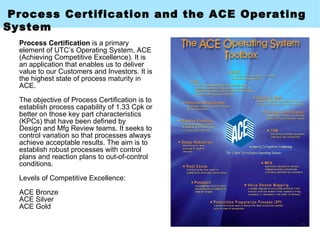
Process Certification  is a primary  element of UTC’s Operating System, ACE (Achieving Competitive Excellence). It is an application that enables us to deliver value to our Customers and Investors. It is the highest state of process maturity in ACE. The objective of Process Certification is to establish process capability of 1.33 Cpk or better on those key part characteristics (KPCs) that have been defined by  Design and Mfg Review teams. It seeks to control variation so that processes always achieve acceptable results. The aim is to establish robust processes with control plans and reaction plans to out-of-control conditions.  Levels of Competitive Excellence: ACE Bronze ACE Silver ACE Gold Process Certification and the ACE Operating System
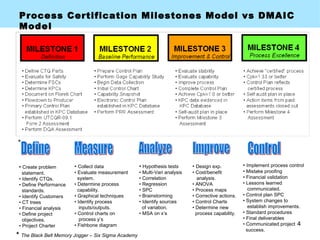
Process Certification Milestones Model vs DMAIC Model Define Measure Analyze Improve Control •  Create problem  statement. •  Identify CTQs. •  Define Performance standards. •  Identify Customers •  CT trees •  Financial analysis •  Define project objectives. •  Project Charter •  Collect data •  Evaluate measurement system. •  Determine process capability. •  Graphical techniques •  Identify process inputs/outputs. •  Control charts on process y’s •  Fishbone diagram •  Hypothesis tests •  Multi-Vari analysis •  Correlation •  Regression •  SPC •  Brainstorming •  Identify sources of variation. •  MSA on x’s  •  Design exp. •  Cost/benefit analysis. •  ANOVA •  Process maps •  Corrective actions. •  Control Charts •  Determine new process capability. •  Implement process control •  Mistake proofing •  Financial validation •  Lessons learned  communicated. •  Control plan SPC •  System changes to  establish improvements. •  Standard procedures •  Final deliverables •  Communicated project success. * *  The Black Belt Memory Jogger – Six Sigma Academy
October 2006 – Process Certification Kaizen Event
Process Certification Council AMS Dean Halter ES  Dana Ragaller PS  Matt Keogh Flight Paul Carvalho Kidde Terry Simpson Electronic Op’s Roland Hade Mechanical Ops (RKFD) Dave Moser Tech. Consultant  Pete Teti ASE Walt Scott JSF Luke Wissman Mechanical Ops (WLOX) Mark Milward Supplier Dev John Gaughan Engineering Carl Houk ProcCert Standard Work  Dave Sladewski Quality Technologies  Mark Voislow P&WA Fellow Eric Taylor Process Certification Steering Committees Process Certification Executive Sponsors and Steering Teams Executive Sponsors Joe Adams - VP Engineering Don McDonald - VP Quality Dave  Galuska - VP Operations Steering Committee Dir Engineering Roger Stamm Dir Electronic Op’s Rocky Laporte Dir Mechanical Eng. Gregg Abbott Dir Supply Base Ron Sepe Tech. Fellow  Pete Teti HS Working Together Team (WTT) Chairman: Bob Leduc, President, Flight Systems Co-Chairman: Joe Triompo, President, Engine Systems Co-Chairman: Tim Morris, President, Aerospace Systems Co-Chairman: Mike Dumais, VP & GM Customer Service WTT Meeting Weekly to Drive Quality Strategy Standard Work Process Certification High Impact ACE Teams Mfg Process Reviews Corrective Action Boards Certified Quality Clinics
Outlining the Challenge – Multiple Plant sites York, NE Plant site HSunpac  Bedok Plant site Rockford MFG Plant site HSunpac  Changi Plant site Rockford Assembly Plant site WLOX MFG Plant site Process Certification Technolgy Transfer Mechanical Operations
3P Formula (Production, Planning, Preparation) Standard Work and Procedures Team Engineering Classification of Characteristics Team Process Certification Systems Team UTCQR-09.1 (Process Certification Requirements) Pratt & Whitney Hamilton Sundstrand Sikorsky Aircraft Otis Elevator Carrier UTC Power UTC Research Center Outlining the Challenge – Team Approach
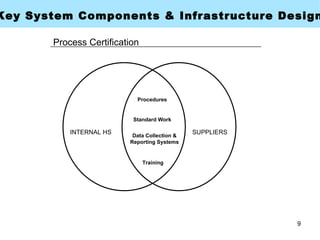
Key System Components & Infrastructure Design Procedures Standard Work Data Collection & Reporting Systems Training INTERNAL HS SUPPLIERS Process Certification
Process Certification Training Status
Standard Work and Procedures  – HT0985/HT0990/PR9103 How to do a Gage R&R Study in SPC Proficy 5.5  How to do a Gage R&R Study in Minitab How to perform a Gage Repeatability  Study on a Test Rig Six Sigma Green Belt Project Template How to Create an Xbar-R  Control Chart in Minitab How to Read SPC Control Charts How to Perform a Normality Test in Minitab How to Create a Capability  Sixpack in Minitab How to Call Up a Data Report List Part no. in SPC  Proficy 5.5 QC0911 Form RRCA Cause & Effect Diagram 5 Why Analysis Green Belt Project Template Fault Tree Analysis* How to Perform a Box Cox Transformation in Minitab How to Fill Out the KPI/KPO Form
“ How do we select what’s important” HSC16199 Engineering Classification of Characteristics Overlap between HSC16199, HS15000 & QC13.01-03. Confusion exists regarding proper selection and classification of characteristics.  Confusion with regards to minor characteristics. No standardized identification of FSC/KPC among the various engineering groups. Lack of standard work and robust design guidelines creates confusion. Perceived vagueness concerning KPC2 designation. Current definition too broad and all encompassing. No process for manufacturing characteristics.
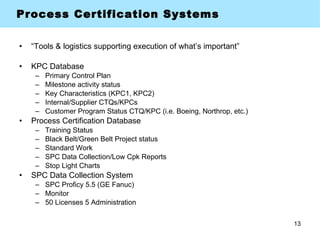
“ Tools & logistics supporting execution of what’s important” KPC Database Primary Control Plan Milestone activity status Key Characteristics (KPC1, KPC2) Internal/Supplier CTQs/KPCs Customer Program Status CTQ/KPC (i.e. Boeing, Northrop, etc.)  Process Certification Database Training Status Black Belt/Green Belt Project status Standard Work SPC Data Collection/Low Cpk Reports Stop Light Charts SPC Data Collection System SPC Proficy 5.5 (GE Fanuc) Monitor 50 Licenses 5 Administration Process Certification Systems
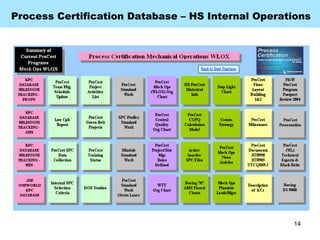
Process Certification Database – HS Internal Operations
Supplier Quality & Development
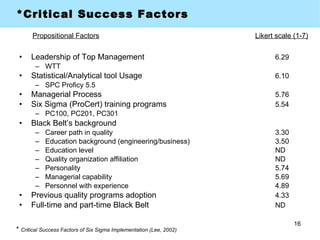
Leadership of Top Management 6.29 WTT Statistical/Analytical tool Usage 6.10 SPC Proficy 5.5 Managerial Process 5.76 Six Sigma (ProCert) training programs 5.54 PC100, PC201, PC301 Black Belt’s background Career path in quality 3.30 Education background (engineering/business) 3.50 Education level ND Quality organization affiliation ND Personality 5.74 Managerial capability 5.69 Personnel with experience 4.89 Previous quality programs adoption 4.33 Full-time and part-time Black Belt ND  *Critical Success Factors *  Critical Success Factors of Six Sigma Implementation (Lee, 2002) Propositional Factors   Likert scale (1-7)
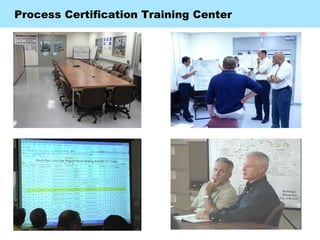
Process Certification Training Center
Implementation Results Pro Cert Black Belts Pro Cert Green Belts COPQ/SRR  Reduction Variation  Reduction ProCert  Standard  Work Customer  Satisfaction Boeing AS9103 GOLD Variation Management ACE SILVER Black  Belt  Projects Green  Belt  Projects Supplier Quality & Development Program
Phase II - Manufacturing to ProCert Business Applications

Process Certification Implementation Presentation

  • 1.
    Description of theImplementation Strategy for Process Certification (Six Sigma) at Hamilton Sundstrand, United Technologies Corporation Mark Milward & Pete Teti, IIE Annual Conference & Expo 2009 Hamilton Sundstrand, UTC May 30 – June 3 rd Windsor Locks, Connecticut Doral Golf Resort & Spa Miami Florida
  • 2.
    Speaker Bio MarkD. Milward, CSSMBB Six Sigma Master Black Belt Fmr. Manager, Process Certification Hamilton Sundstrand, Windsor Locks, Connecticut United Technologies Corporation EMAIL:mdmilward@aol.com Mark Milward has nineteen (19) years experience in Manufacturing and Quality Engineering. He was a pioneer in the introduction, development and application of Surface Mount Technology principles and practices. His experience covers work within the Aerospace, Electronics, and Medical Devices industries. Mark received his Principal Black Belt in Lean manufacturing in 2001. He is a ASQ certified Six Sigma Black Belt (2003) and an IIE certified Six Sigma Master Black Belt (2009). Mark joined Pratt & Whitney, UTC in 2004 where he led cross-functional teams implementing Process Certification in the Supply Base at domestic and international locations. At Hamilton, Mark was responsible for implementing Process Certification at the Windsor Locks manufacturing facility for internal operations. His responsibilities included training, coaching, mentoring Black Belts/Green Belts, project and standard work development, infrastructure design, and implementation of the Statistical Process Control (SPC) system for data collection, SPC Proficy 5.5 ; GE Fanuc. Mark has a B.S. in Manufacturing Engineering Technology from Barry University, Miami Fl, and an MBA from Nova Southeastern University, where he is on leave from Doctoral studies in Business Administration.
  • 3.
    Process Certification is a primary element of UTC’s Operating System, ACE (Achieving Competitive Excellence). It is an application that enables us to deliver value to our Customers and Investors. It is the highest state of process maturity in ACE. The objective of Process Certification is to establish process capability of 1.33 Cpk or better on those key part characteristics (KPCs) that have been defined by Design and Mfg Review teams. It seeks to control variation so that processes always achieve acceptable results. The aim is to establish robust processes with control plans and reaction plans to out-of-control conditions. Levels of Competitive Excellence: ACE Bronze ACE Silver ACE Gold Process Certification and the ACE Operating System
  • 4.
    Process Certification MilestonesModel vs DMAIC Model Define Measure Analyze Improve Control • Create problem statement. • Identify CTQs. • Define Performance standards. • Identify Customers • CT trees • Financial analysis • Define project objectives. • Project Charter • Collect data • Evaluate measurement system. • Determine process capability. • Graphical techniques • Identify process inputs/outputs. • Control charts on process y’s • Fishbone diagram • Hypothesis tests • Multi-Vari analysis • Correlation • Regression • SPC • Brainstorming • Identify sources of variation. • MSA on x’s • Design exp. • Cost/benefit analysis. • ANOVA • Process maps • Corrective actions. • Control Charts • Determine new process capability. • Implement process control • Mistake proofing • Financial validation • Lessons learned communicated. • Control plan SPC • System changes to establish improvements. • Standard procedures • Final deliverables • Communicated project success. * * The Black Belt Memory Jogger – Six Sigma Academy
  • 5.
    October 2006 –Process Certification Kaizen Event
  • 6.
    Process Certification CouncilAMS Dean Halter ES Dana Ragaller PS Matt Keogh Flight Paul Carvalho Kidde Terry Simpson Electronic Op’s Roland Hade Mechanical Ops (RKFD) Dave Moser Tech. Consultant Pete Teti ASE Walt Scott JSF Luke Wissman Mechanical Ops (WLOX) Mark Milward Supplier Dev John Gaughan Engineering Carl Houk ProcCert Standard Work Dave Sladewski Quality Technologies Mark Voislow P&WA Fellow Eric Taylor Process Certification Steering Committees Process Certification Executive Sponsors and Steering Teams Executive Sponsors Joe Adams - VP Engineering Don McDonald - VP Quality Dave Galuska - VP Operations Steering Committee Dir Engineering Roger Stamm Dir Electronic Op’s Rocky Laporte Dir Mechanical Eng. Gregg Abbott Dir Supply Base Ron Sepe Tech. Fellow Pete Teti HS Working Together Team (WTT) Chairman: Bob Leduc, President, Flight Systems Co-Chairman: Joe Triompo, President, Engine Systems Co-Chairman: Tim Morris, President, Aerospace Systems Co-Chairman: Mike Dumais, VP & GM Customer Service WTT Meeting Weekly to Drive Quality Strategy Standard Work Process Certification High Impact ACE Teams Mfg Process Reviews Corrective Action Boards Certified Quality Clinics
  • 7.
    Outlining the Challenge– Multiple Plant sites York, NE Plant site HSunpac Bedok Plant site Rockford MFG Plant site HSunpac Changi Plant site Rockford Assembly Plant site WLOX MFG Plant site Process Certification Technolgy Transfer Mechanical Operations
  • 8.
    3P Formula (Production,Planning, Preparation) Standard Work and Procedures Team Engineering Classification of Characteristics Team Process Certification Systems Team UTCQR-09.1 (Process Certification Requirements) Pratt & Whitney Hamilton Sundstrand Sikorsky Aircraft Otis Elevator Carrier UTC Power UTC Research Center Outlining the Challenge – Team Approach
  • 9.
    Key System Components& Infrastructure Design Procedures Standard Work Data Collection & Reporting Systems Training INTERNAL HS SUPPLIERS Process Certification
  • 10.
  • 11.
    Standard Work andProcedures – HT0985/HT0990/PR9103 How to do a Gage R&R Study in SPC Proficy 5.5 How to do a Gage R&R Study in Minitab How to perform a Gage Repeatability Study on a Test Rig Six Sigma Green Belt Project Template How to Create an Xbar-R Control Chart in Minitab How to Read SPC Control Charts How to Perform a Normality Test in Minitab How to Create a Capability Sixpack in Minitab How to Call Up a Data Report List Part no. in SPC Proficy 5.5 QC0911 Form RRCA Cause & Effect Diagram 5 Why Analysis Green Belt Project Template Fault Tree Analysis* How to Perform a Box Cox Transformation in Minitab How to Fill Out the KPI/KPO Form
  • 12.
    “ How dowe select what’s important” HSC16199 Engineering Classification of Characteristics Overlap between HSC16199, HS15000 & QC13.01-03. Confusion exists regarding proper selection and classification of characteristics. Confusion with regards to minor characteristics. No standardized identification of FSC/KPC among the various engineering groups. Lack of standard work and robust design guidelines creates confusion. Perceived vagueness concerning KPC2 designation. Current definition too broad and all encompassing. No process for manufacturing characteristics.
  • 13.
    “ Tools &logistics supporting execution of what’s important” KPC Database Primary Control Plan Milestone activity status Key Characteristics (KPC1, KPC2) Internal/Supplier CTQs/KPCs Customer Program Status CTQ/KPC (i.e. Boeing, Northrop, etc.) Process Certification Database Training Status Black Belt/Green Belt Project status Standard Work SPC Data Collection/Low Cpk Reports Stop Light Charts SPC Data Collection System SPC Proficy 5.5 (GE Fanuc) Monitor 50 Licenses 5 Administration Process Certification Systems
  • 14.
    Process Certification Database– HS Internal Operations
  • 15.
    Supplier Quality &Development
  • 16.
    Leadership of TopManagement 6.29 WTT Statistical/Analytical tool Usage 6.10 SPC Proficy 5.5 Managerial Process 5.76 Six Sigma (ProCert) training programs 5.54 PC100, PC201, PC301 Black Belt’s background Career path in quality 3.30 Education background (engineering/business) 3.50 Education level ND Quality organization affiliation ND Personality 5.74 Managerial capability 5.69 Personnel with experience 4.89 Previous quality programs adoption 4.33 Full-time and part-time Black Belt ND *Critical Success Factors * Critical Success Factors of Six Sigma Implementation (Lee, 2002) Propositional Factors Likert scale (1-7)
  • 17.
  • 18.
    Implementation Results ProCert Black Belts Pro Cert Green Belts COPQ/SRR Reduction Variation Reduction ProCert Standard Work Customer Satisfaction Boeing AS9103 GOLD Variation Management ACE SILVER Black Belt Projects Green Belt Projects Supplier Quality & Development Program
  • 19.
    Phase II -Manufacturing to ProCert Business Applications

Editor's Notes

  • #3 This chart summarizes each of the 4 Key Milestones. Section 4.0 of HT0985 does this nicely as well (you may want to bring that up on your computer; it is always good to align the training to the written procedure for we want to constantly re-enforce our standard work!).
  • #5 This chart summarizes each of the 4 Key Milestones. Section 4.0 of HT0985 does this nicely as well (you may want to bring that up on your computer; it is always good to align the training to the written procedure for we want to constantly re-enforce our standard work!).
  • #6 This chart summarizes each of the 4 Key Milestones. Section 4.0 of HT0985 does this nicely as well (you may want to bring that up on your computer; it is always good to align the training to the written procedure for we want to constantly re-enforce our standard work!).
  • #10 This chart summarizes each of the 4 Key Milestones. Section 4.0 of HT0985 does this nicely as well (you may want to bring that up on your computer; it is always good to align the training to the written procedure for we want to constantly re-enforce our standard work!).
  • #18 This chart summarizes each of the 4 Key Milestones. Section 4.0 of HT0985 does this nicely as well (you may want to bring that up on your computer; it is always good to align the training to the written procedure for we want to constantly re-enforce our standard work!).
  • #19 This chart summarizes each of the 4 Key Milestones. Section 4.0 of HT0985 does this nicely as well (you may want to bring that up on your computer; it is always good to align the training to the written procedure for we want to constantly re-enforce our standard work!).
  • #20 This chart summarizes each of the 4 Key Milestones. Section 4.0 of HT0985 does this nicely as well (you may want to bring that up on your computer; it is always good to align the training to the written procedure for we want to constantly re-enforce our standard work!).