Fresh salted    Old salted

  Eye      Slight turbid    Turbid
                           Yellowish
Eye lens     Yellow          brown
                            Shrinked
            Bright &
  skin                      &loss its
            smooth         brightness
Fresh salted Old salted
                                  Turbid
             Grey ,glassy or
Muscle         bight red
                                 yellow or
                                  brown
             Soft ,removed       Slimy and
Consistency
            easily from spine       sticky
                                Yellowish or
   Fat           Normal          yellowish
                                  brown
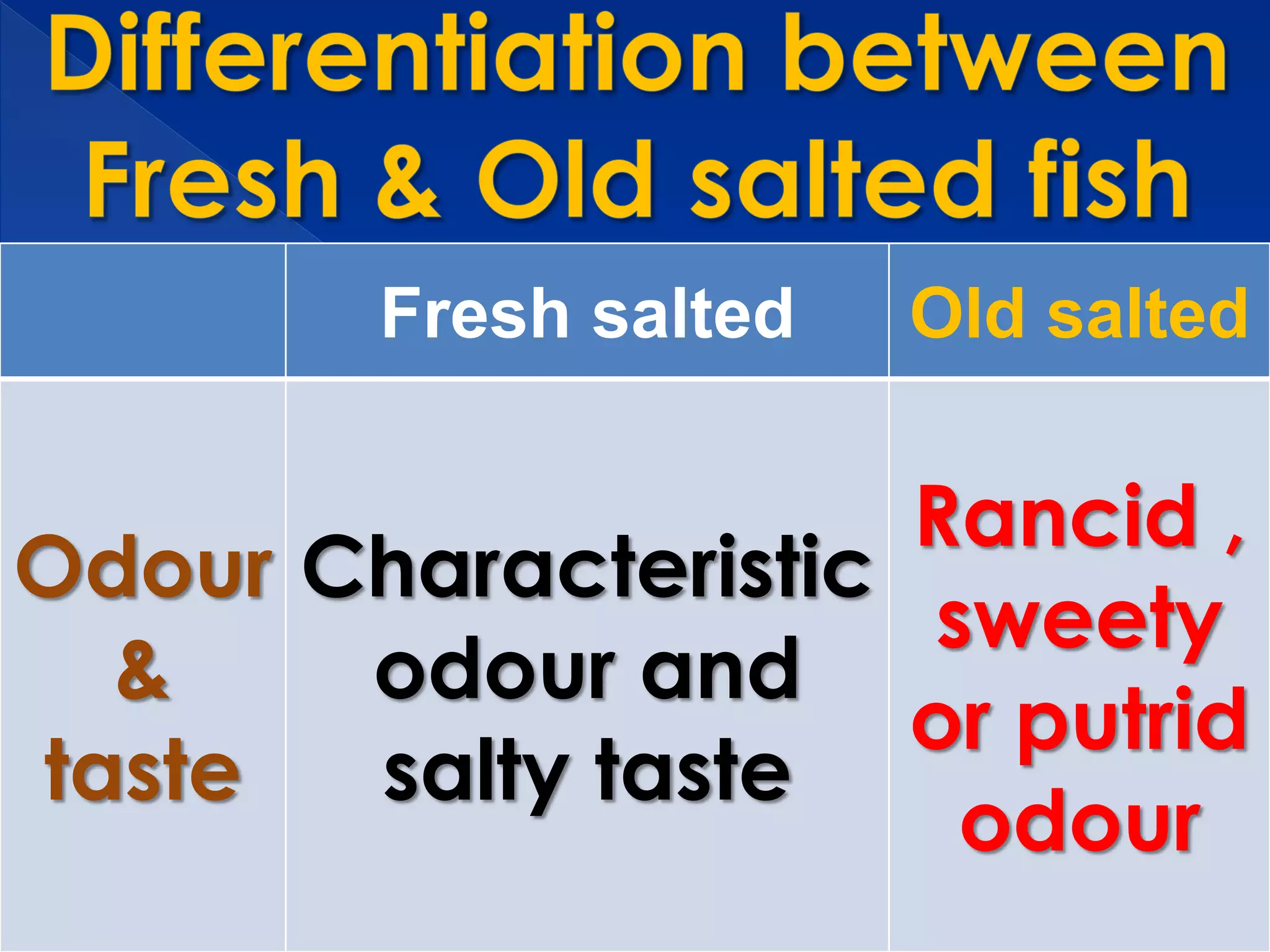
Fresh salted   Old salted

                     Rancid ,
Odour Characteristic
                     sweety
  &    odour and
                     or putrid
taste  salty taste
                      odour
E.S.S of Salted Fish
             Fessikh    Sardine Molouha

Histamine 20 mg/100 g 20 mg/100 g 20 mg/100 g

Anaerobes
               102 /g     102 /g     102 /g
 reducing
  sulfite

S. aureus      102 /g     102 /g     102 /g
E.S.S of Salted Fish
          Fessikh Sardine Molouha
  PH      6 - 6.5     6 - 6.5 6 - 6.5
    Salmonella,
  Shigella, E.coli,
L.monocytogenes,          Free
   C.botulinum,
V.parahemolyticus
Smoked Fish
Method of smoking
    1.Salting

    2.Washing

    3.Drying

    4.Smoking (hot – cold)

    5.Cooling & packing
Decomposition of smoked fish
   1- Dry decomposition:-
   • Due to Micrococci spp
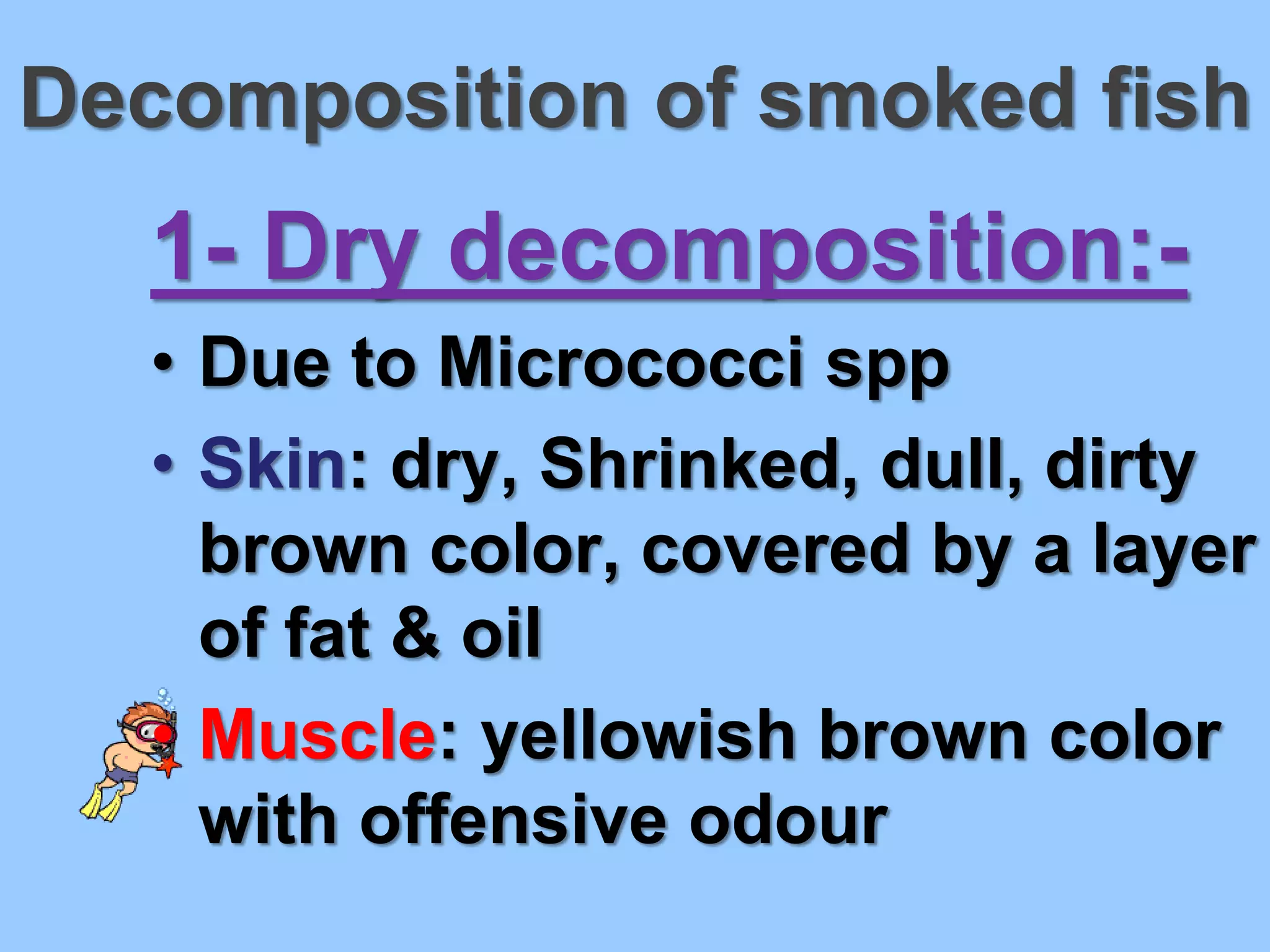
   • Skin: dry, Shrinked, dull, dirty
     brown color, covered by a layer
     of fat & oil
   • Muscle: yellowish brown color
     with offensive odour
Decomposition of smoked fish
  2- Moist decomposition:-
  • Due to E.coli, Pseudomonas,
    Proteus & B.fluorescence
  • Viscera: Sticky, bad odour
  • Muscle: Moist, slimy & bad
    odour
Decomposition of smoked fish
  3- Mouldy decomposition:-
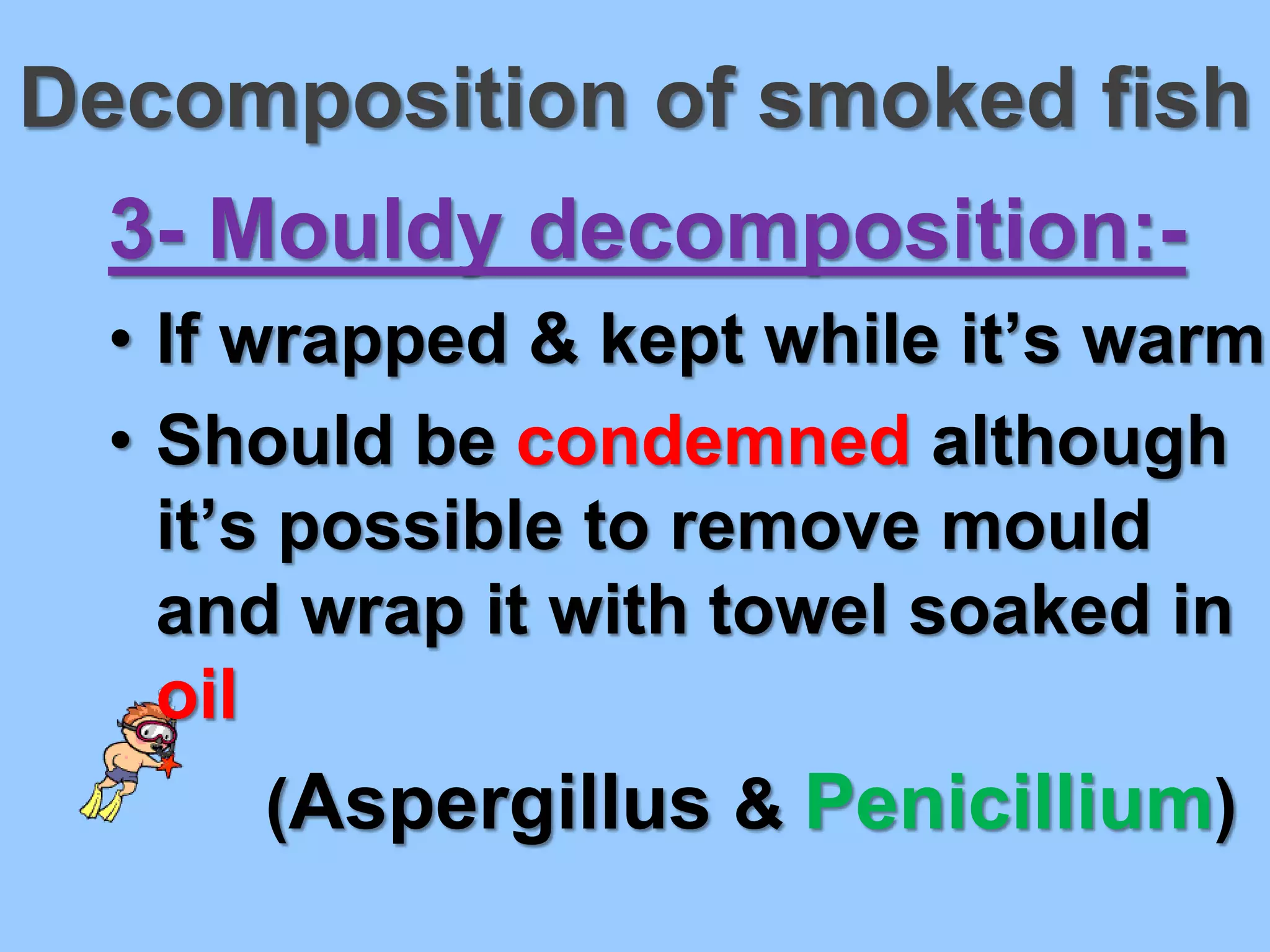
  • If wrapped & kept while it’s warm
  • Should be condemned although
    it’s possible to remove mould
    and wrap it with towel soaked in
    oil
      (Aspergillus & Penicillium)
Detection of artificial
    yellow color
 • Few drops of sulfuric
   acid (1:3) to surface of
   the fish.
 • Blue color is formed in
   case of artificial color.
E.S.S of Smoked Fish
         TMA                      10mg/100gm

          TBA                      4.5 mg/Kg

       Histamine                  10 mg/100mg

          APC                        105 /g
       Coliforms                   10 cell / g
  Salmonella, Shigella, E.coli,
      L.monocytogenes,                Free
C.botulinum,V.parahemolyticus
E.S.S of Smoked Fish
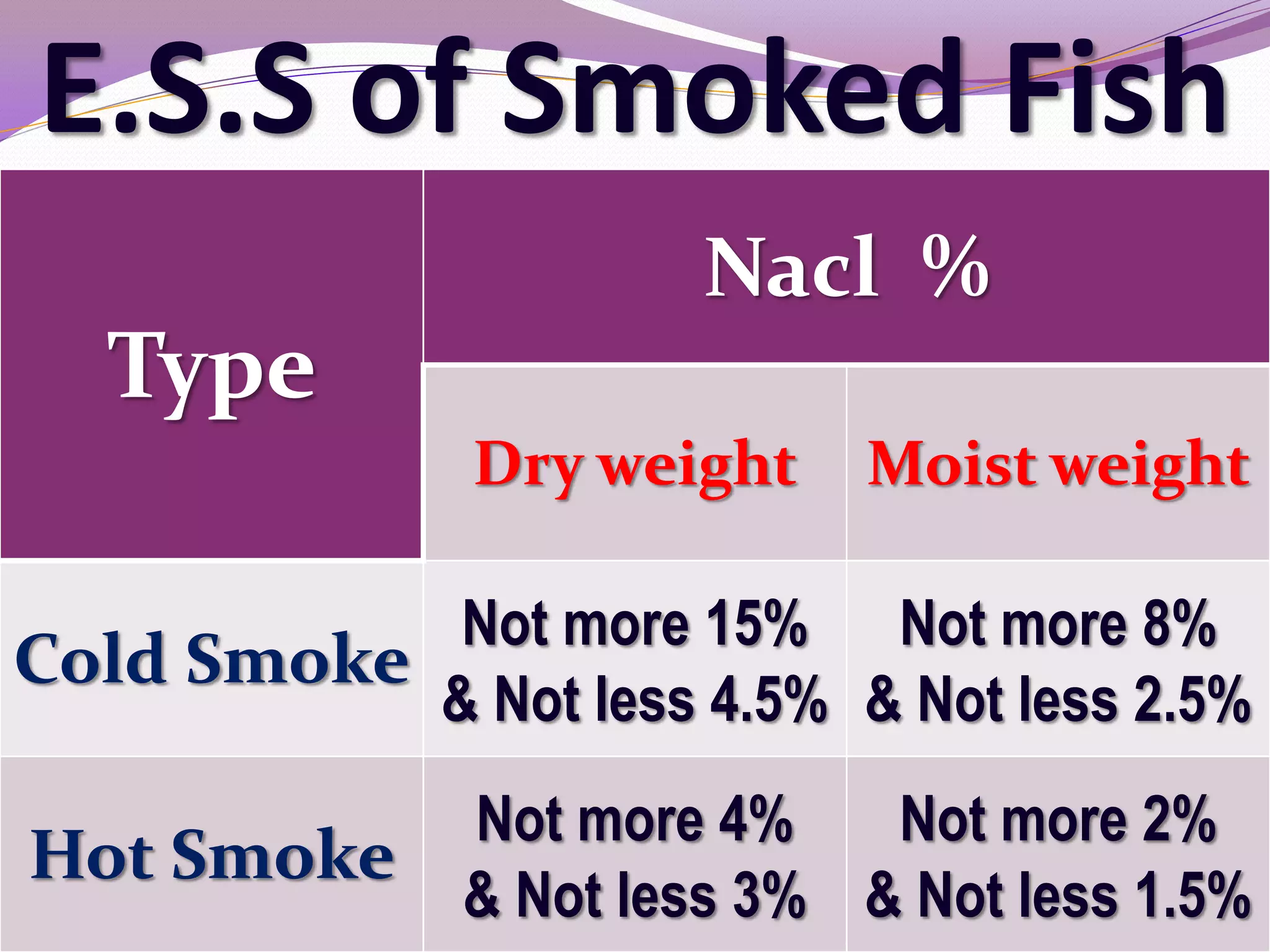
                       Nacl %
   Type
               Dry weight    Moist weight

            Not more 15% Not more 8%
Cold Smoke
           & Not less 4.5% & Not less 2.5%
               Not more 4%    Not more 2%
Hot Smoke
               & Not less 3% & Not less 1.5%
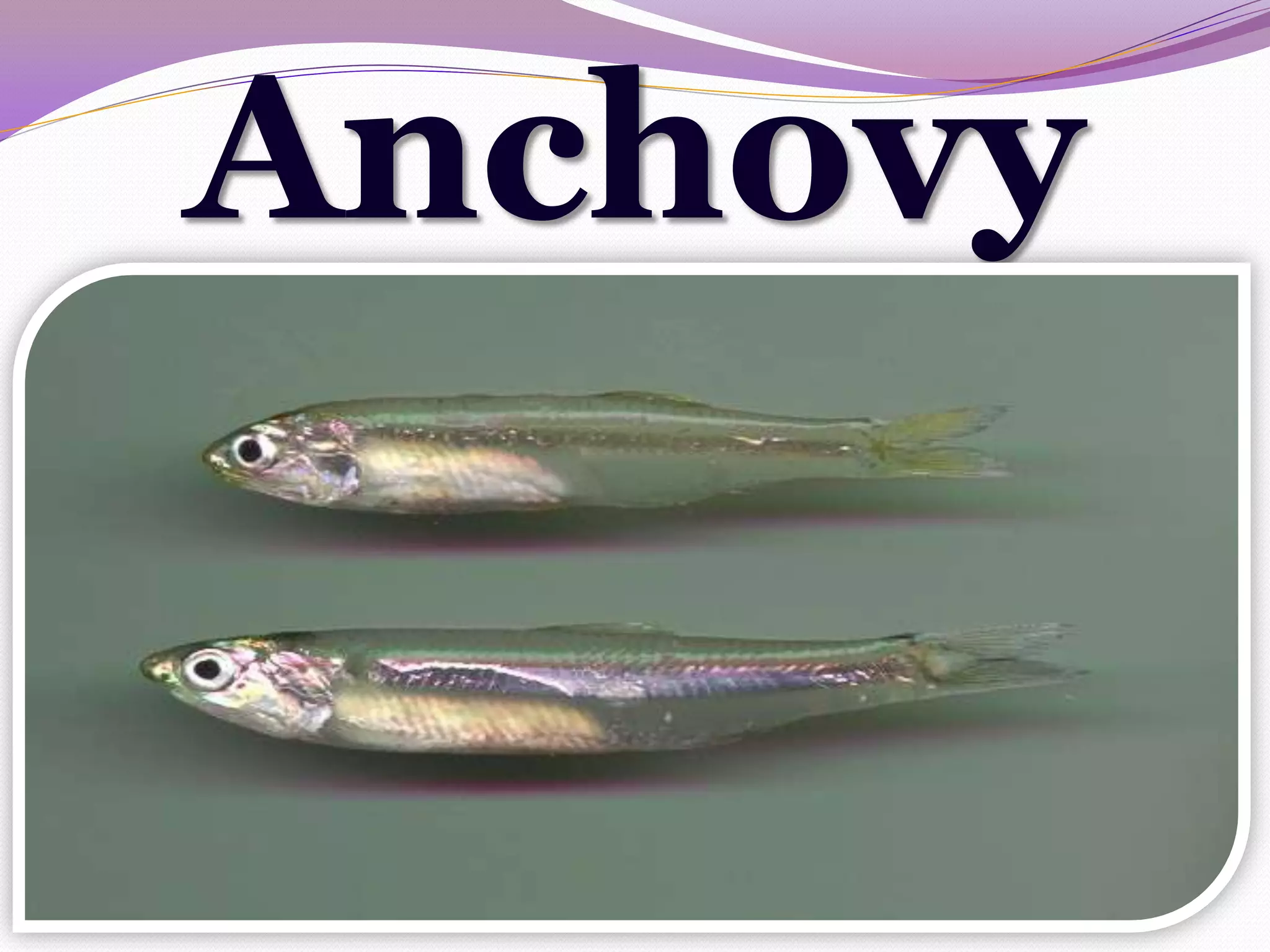
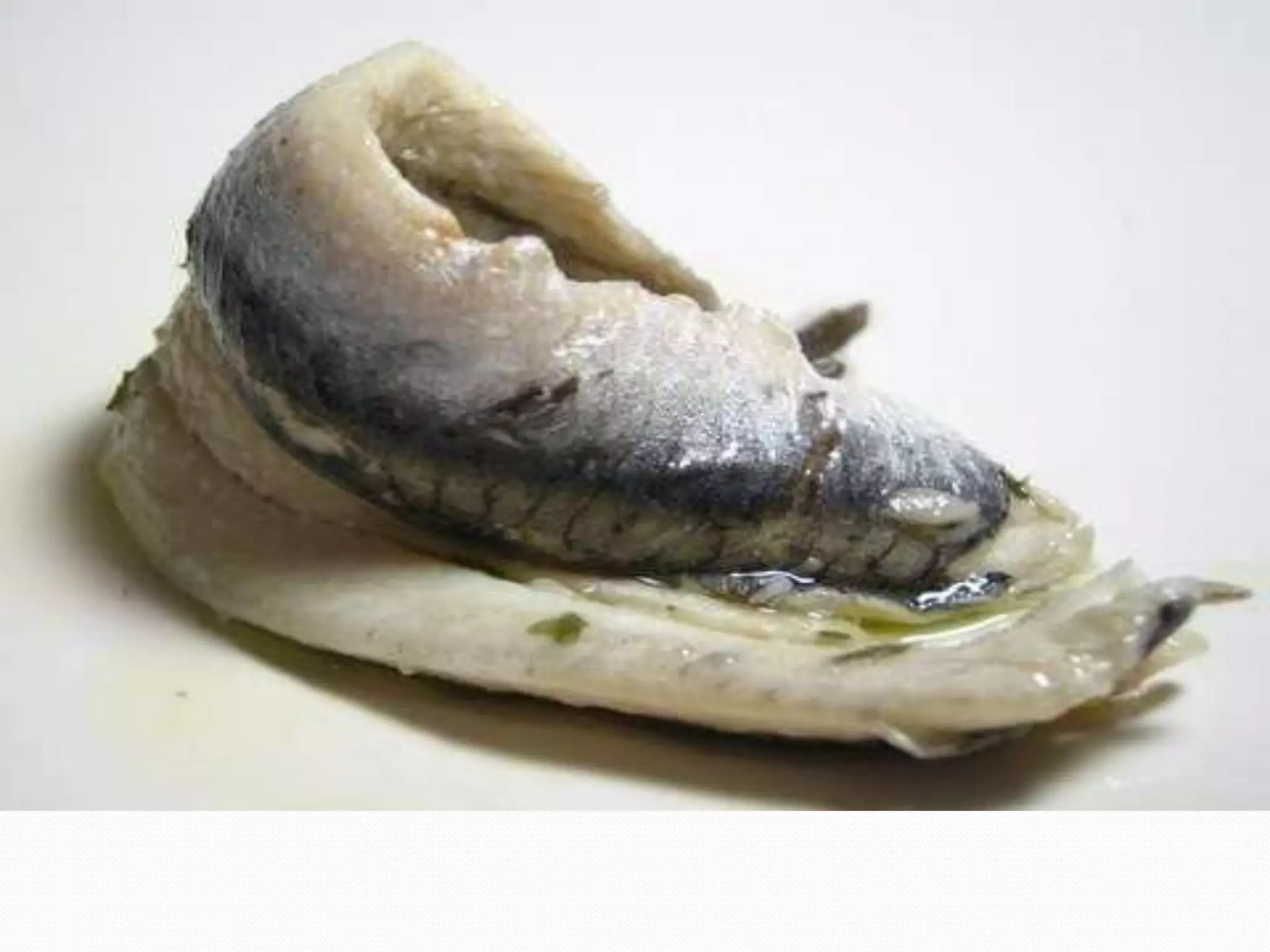
Anchovy
Engraulis spp
Anchovy
Fresh, canned or jarred
Fillet in olive oil, vegetable
 oil, sunflower oil, vinegar &
 salted
Anchovy paste: with olive
 oil, spices & garlic flavor
Manufacturing:-
Cut off the head, remove the scales
 and open the fish up and remove
 the spine & the viscera.
Salting for 1 month in 25% brine
 solution in room temperature.
Canning in tin can containing
 edible oil OR prepared in form of
 paste.
Legal requirements of
        Anchovy
• Packed in edible oil
• Equal in length
• Moisture not more than 60%
• Fat not more than 15%
• Salt range between 10 – 16%
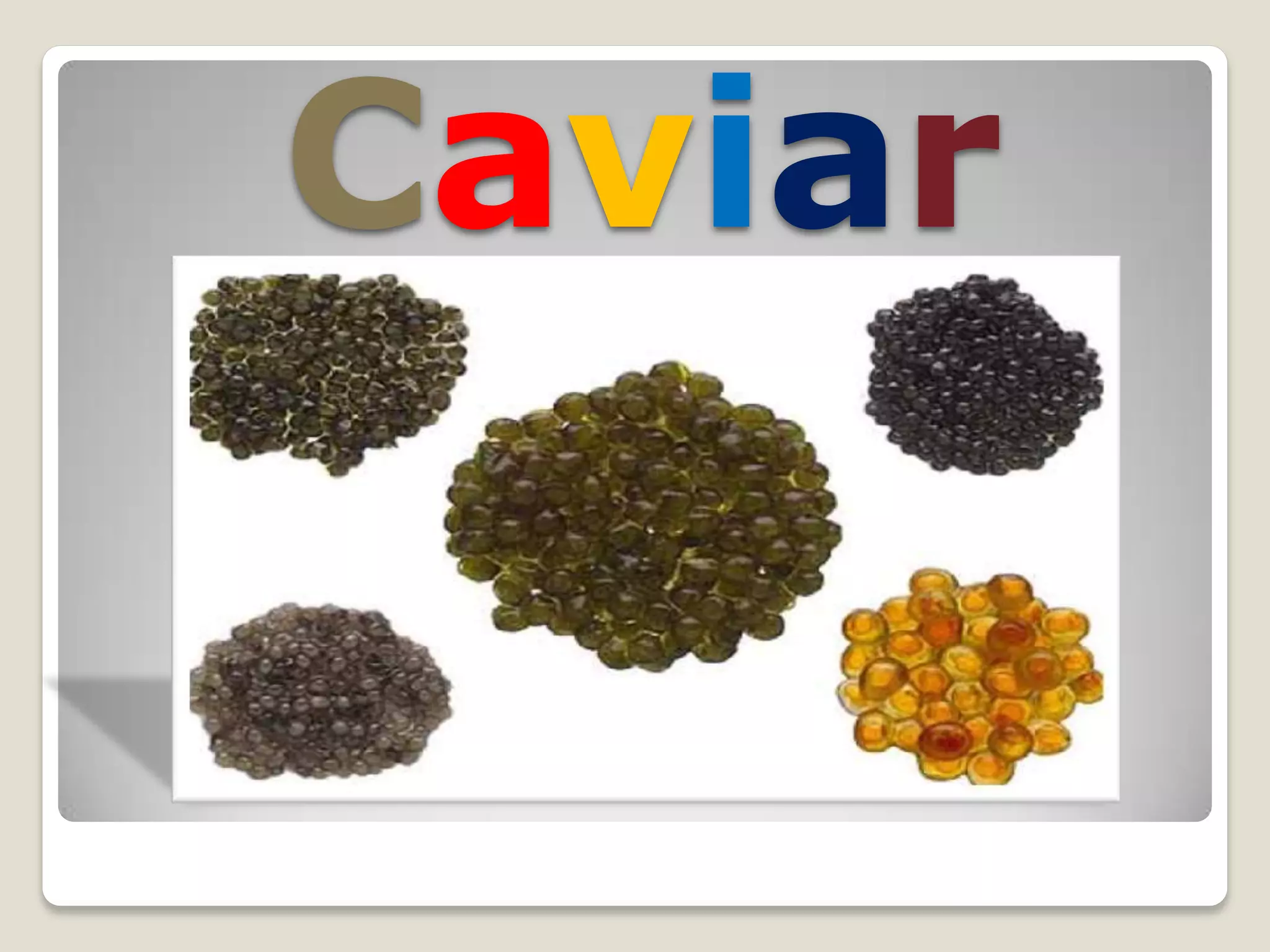
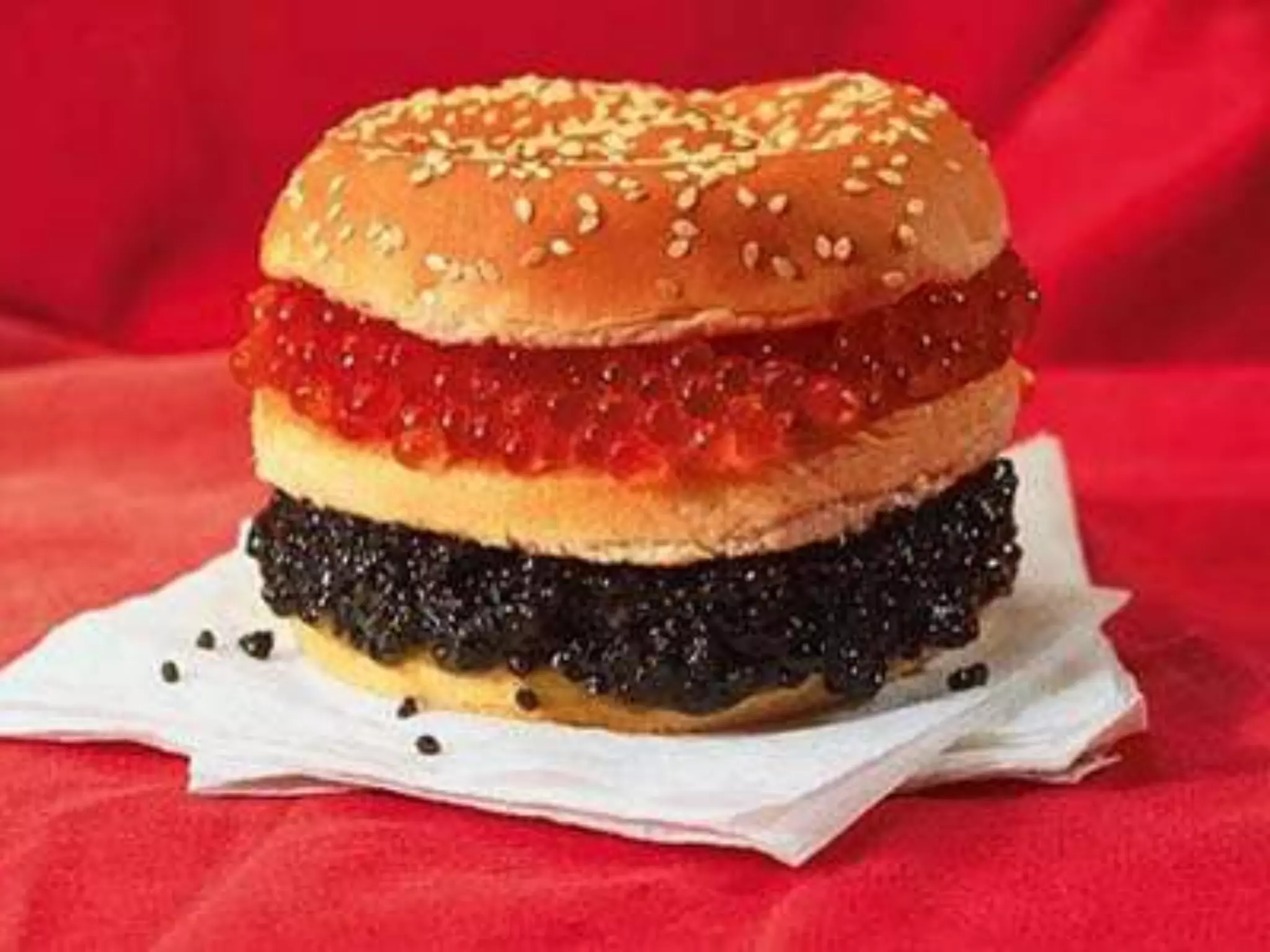
Caviar
Caviar
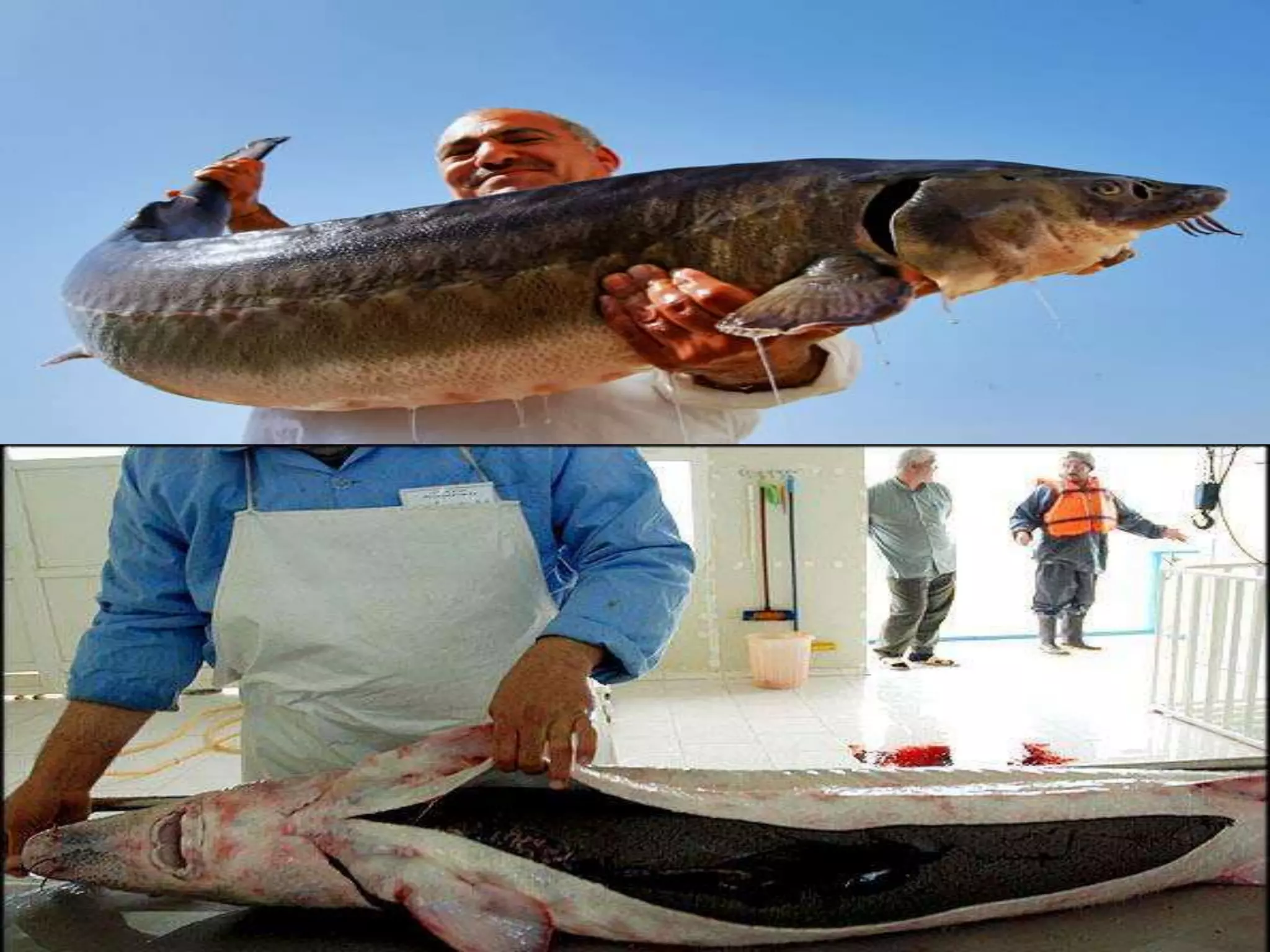
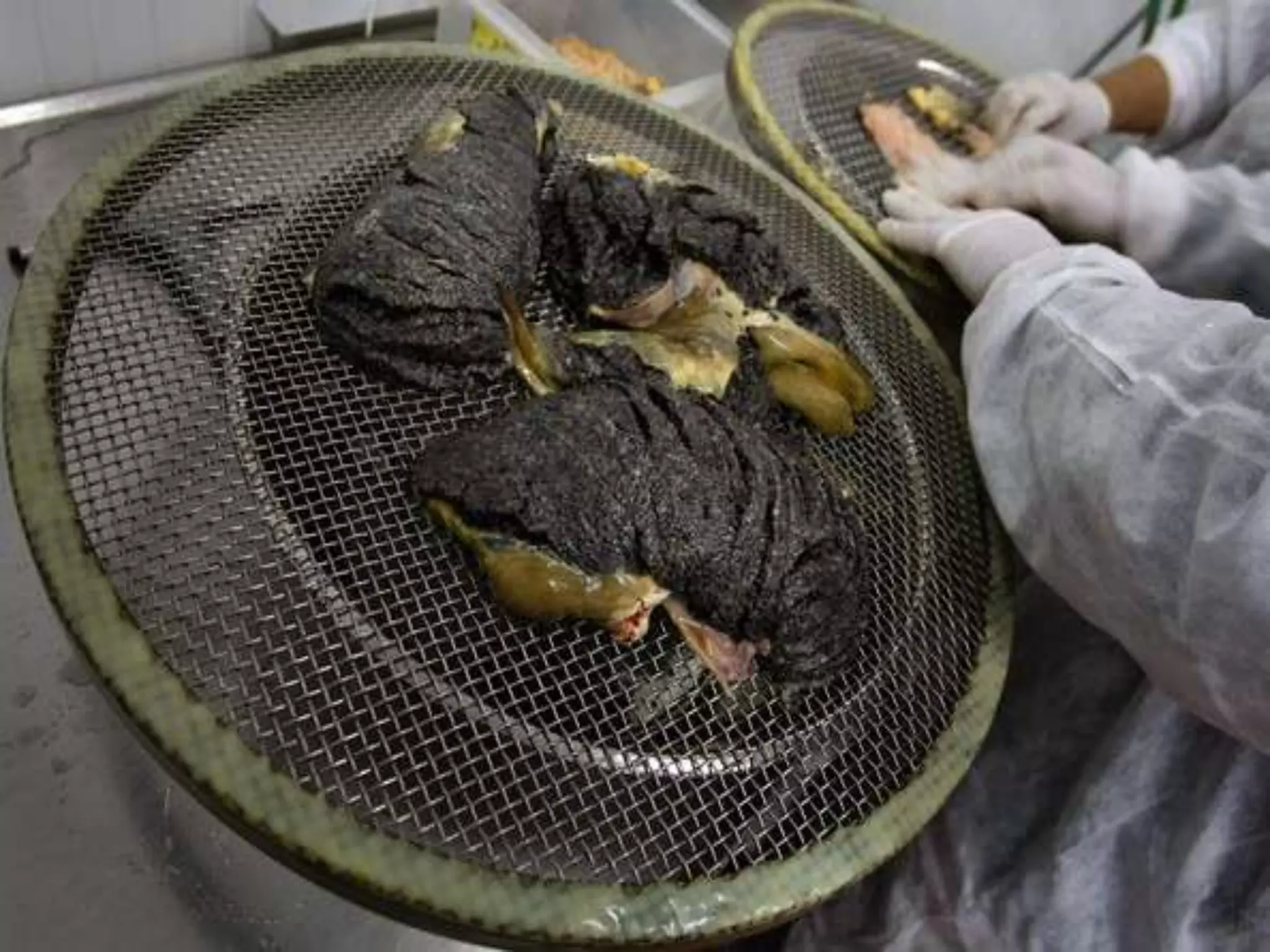
 Consisting    of     processed,
  salted, non-fertilized sturgeon
  roe.
 The roe can be "fresh" (non-
  pasteurized) or pasteurized
 Wild sturgeon species from
  the Caspian Sea, in most cases
  from Russia or Iran.
Caviar
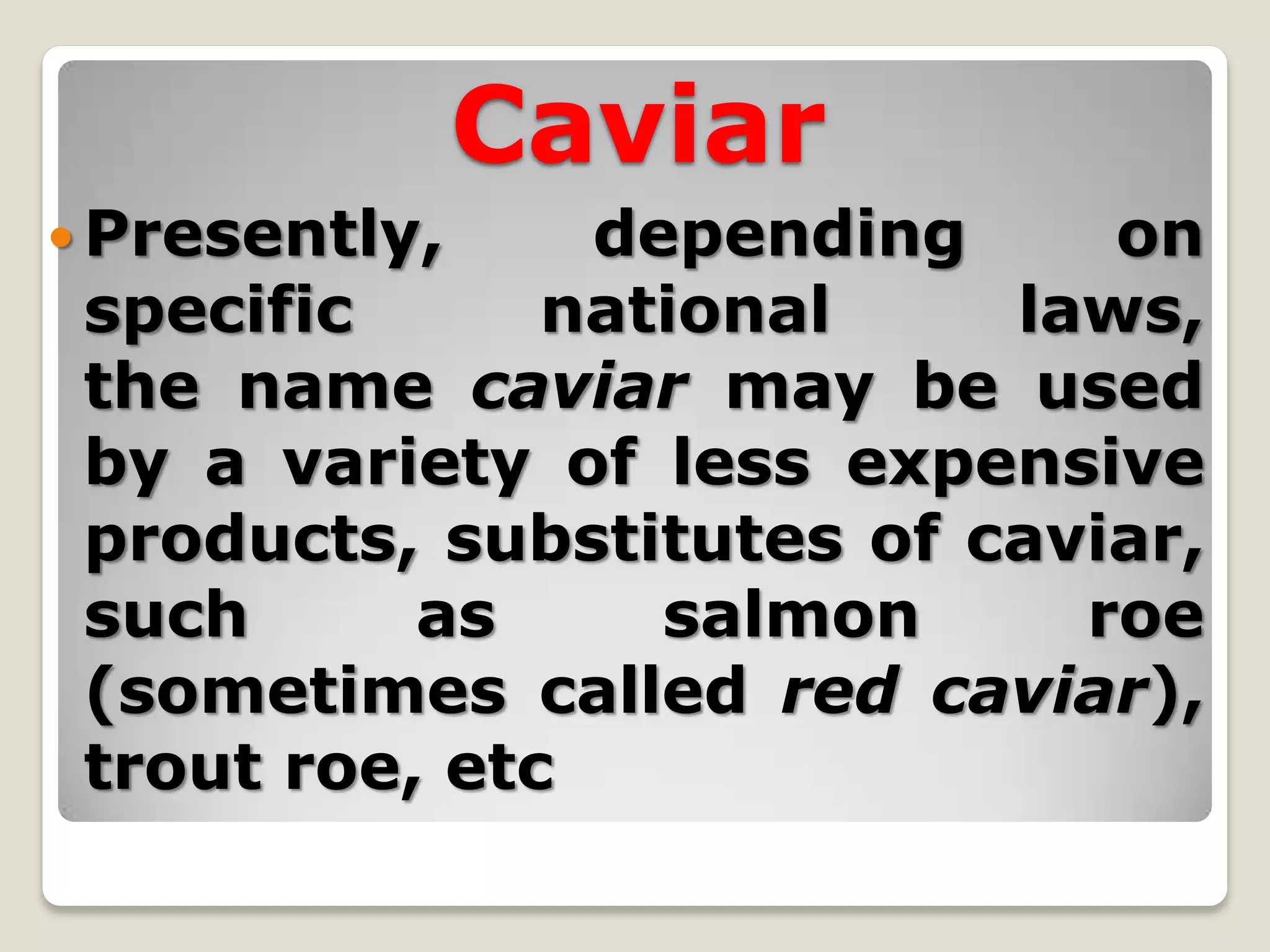
 Presently,    depending     on
 specific      national    laws,
 the name caviar may be used
 by a variety of less expensive
 products, substitutes of caviar,
 such      as     salmon     roe
 (sometimes called red caviar),
 trout roe, etc
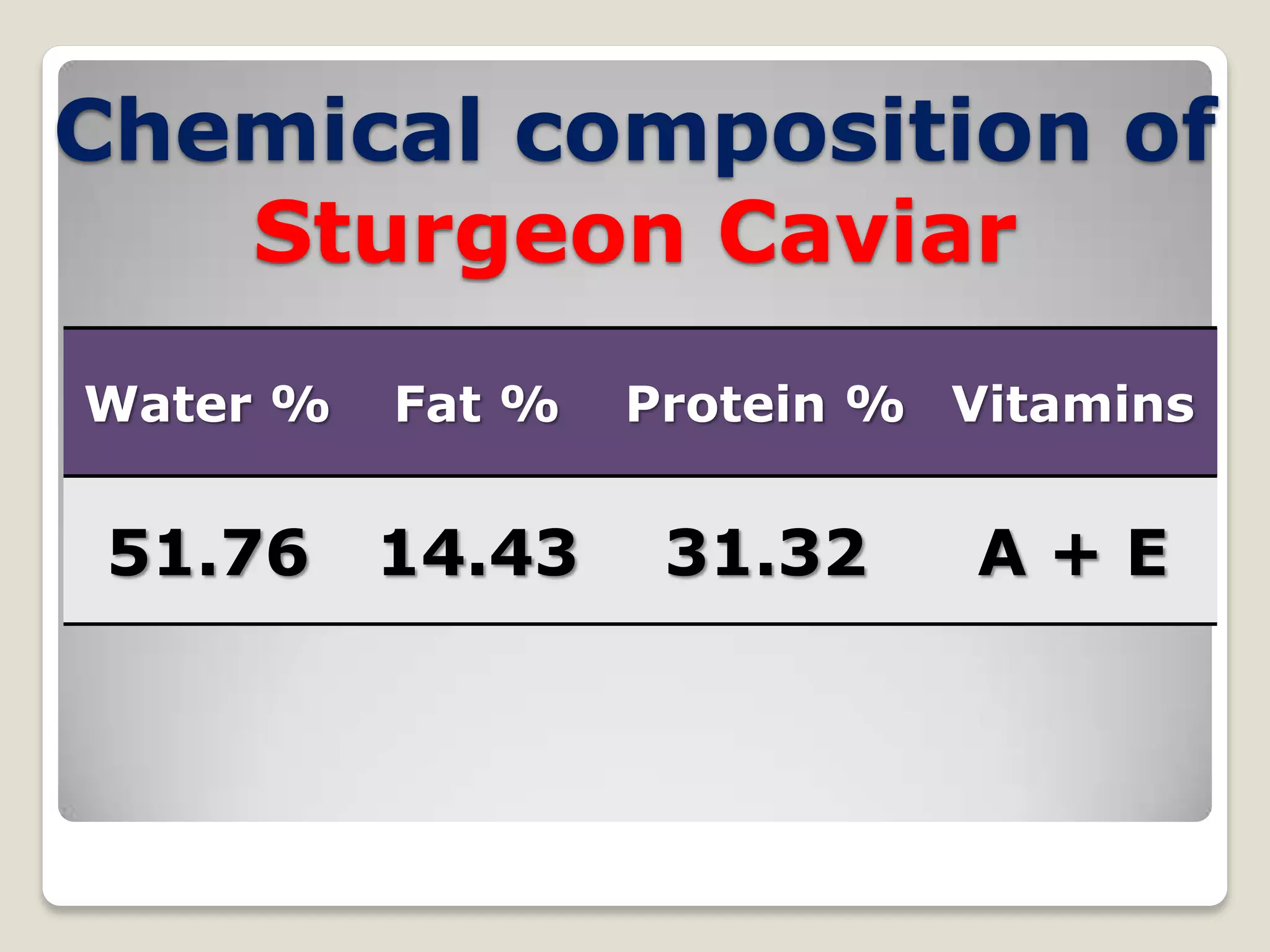
Chemical composition of
   Sturgeon Caviar
Water %   Fat %   Protein % Vitamins


 51.76    14.43    31.32     A+E
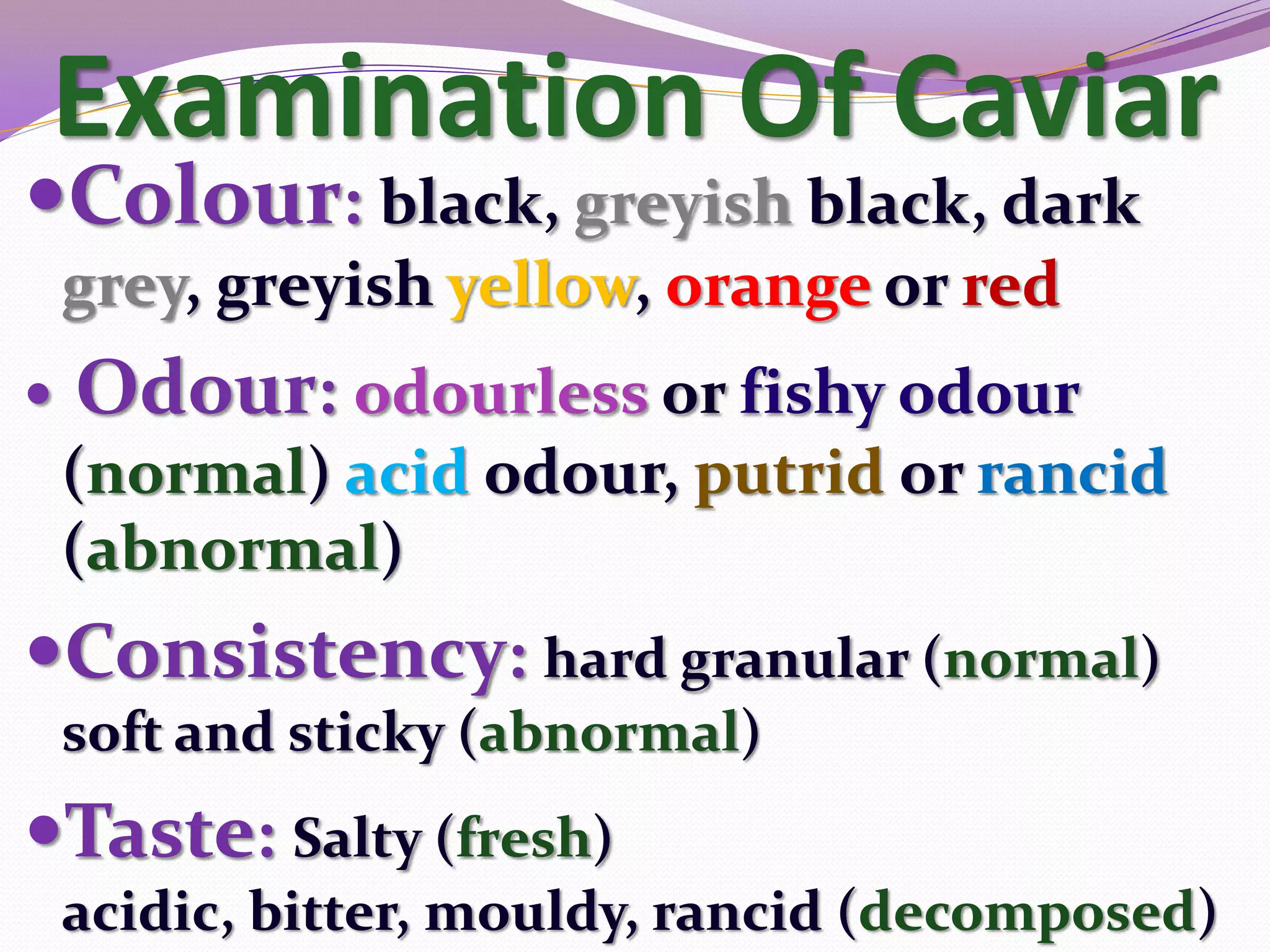
Examination Of Caviar
Colour: black, greyish black, dark
    grey, greyish yellow, orange or red
   Odour: odourless or fishy odour
    (normal) acid odour, putrid or rancid
    (abnormal)
Consistency: hard granular (normal)
    soft and sticky (abnormal)
Taste: Salty (fresh)
    acidic, bitter, mouldy, rancid (decomposed)
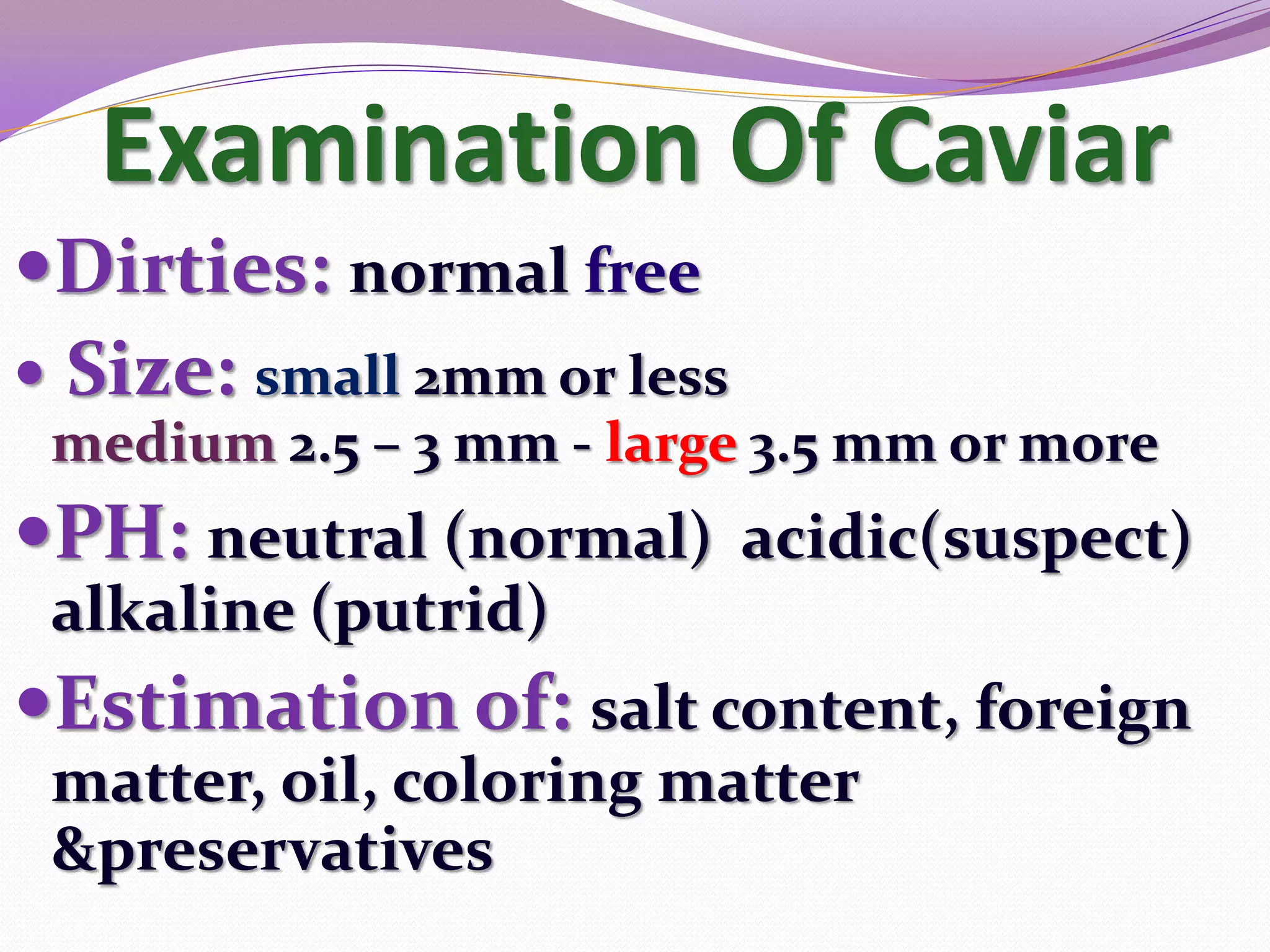
Examination Of Caviar
Dirties: normal free
   Size: small 2mm or less
    medium 2.5 – 3 mm - large 3.5 mm or more
PH: neutral (normal) acidic(suspect)
    alkaline (putrid)
Estimation of: salt content, foreign
    matter, oil, coloring matter
    &preservatives
Examination Of Caviar
Bacteriological examination:
 anaerobic reducing sulfide free
Chemical examination : PH,
 Hydrogen sulfide, ammonia, free fatty
 acids
Fish products
Fish products

Fish products

  • 3.
    Fresh salted Old salted Eye Slight turbid Turbid Yellowish Eye lens Yellow brown Shrinked Bright & skin &loss its smooth brightness
  • 4.
    Fresh salted Oldsalted Turbid Grey ,glassy or Muscle bight red yellow or brown Soft ,removed Slimy and Consistency easily from spine sticky Yellowish or Fat Normal yellowish brown
  • 5.
    Fresh salted Old salted Rancid , Odour Characteristic sweety & odour and or putrid taste salty taste odour
  • 8.
    E.S.S of SaltedFish Fessikh Sardine Molouha Histamine 20 mg/100 g 20 mg/100 g 20 mg/100 g Anaerobes 102 /g 102 /g 102 /g reducing sulfite S. aureus 102 /g 102 /g 102 /g
  • 9.
    E.S.S of SaltedFish Fessikh Sardine Molouha PH 6 - 6.5 6 - 6.5 6 - 6.5 Salmonella, Shigella, E.coli, L.monocytogenes, Free C.botulinum, V.parahemolyticus
  • 10.
  • 13.
    Method of smoking 1.Salting 2.Washing 3.Drying 4.Smoking (hot – cold) 5.Cooling & packing
  • 14.
    Decomposition of smokedfish 1- Dry decomposition:- • Due to Micrococci spp • Skin: dry, Shrinked, dull, dirty brown color, covered by a layer of fat & oil • Muscle: yellowish brown color with offensive odour
  • 15.
    Decomposition of smokedfish 2- Moist decomposition:- • Due to E.coli, Pseudomonas, Proteus & B.fluorescence • Viscera: Sticky, bad odour • Muscle: Moist, slimy & bad odour
  • 16.
    Decomposition of smokedfish 3- Mouldy decomposition:- • If wrapped & kept while it’s warm • Should be condemned although it’s possible to remove mould and wrap it with towel soaked in oil (Aspergillus & Penicillium)
  • 17.
    Detection of artificial yellow color • Few drops of sulfuric acid (1:3) to surface of the fish. • Blue color is formed in case of artificial color.
  • 19.
    E.S.S of SmokedFish TMA 10mg/100gm TBA 4.5 mg/Kg Histamine 10 mg/100mg APC 105 /g Coliforms 10 cell / g Salmonella, Shigella, E.coli, L.monocytogenes, Free C.botulinum,V.parahemolyticus
  • 20.
    E.S.S of SmokedFish Nacl % Type Dry weight Moist weight Not more 15% Not more 8% Cold Smoke & Not less 4.5% & Not less 2.5% Not more 4% Not more 2% Hot Smoke & Not less 3% & Not less 1.5%
  • 21.
  • 22.
  • 23.
    Anchovy Fresh, canned orjarred Fillet in olive oil, vegetable oil, sunflower oil, vinegar & salted Anchovy paste: with olive oil, spices & garlic flavor
  • 25.
    Manufacturing:- Cut off thehead, remove the scales and open the fish up and remove the spine & the viscera. Salting for 1 month in 25% brine solution in room temperature. Canning in tin can containing edible oil OR prepared in form of paste.
  • 27.
    Legal requirements of Anchovy • Packed in edible oil • Equal in length • Moisture not more than 60% • Fat not more than 15% • Salt range between 10 – 16%
  • 28.
  • 29.
    Caviar  Consisting of processed, salted, non-fertilized sturgeon roe.  The roe can be "fresh" (non- pasteurized) or pasteurized  Wild sturgeon species from the Caspian Sea, in most cases from Russia or Iran.
  • 33.
    Caviar  Presently, depending on specific national laws, the name caviar may be used by a variety of less expensive products, substitutes of caviar, such as salmon roe (sometimes called red caviar), trout roe, etc
  • 35.
    Chemical composition of Sturgeon Caviar Water % Fat % Protein % Vitamins 51.76 14.43 31.32 A+E
  • 36.
    Examination Of Caviar Colour:black, greyish black, dark grey, greyish yellow, orange or red  Odour: odourless or fishy odour (normal) acid odour, putrid or rancid (abnormal) Consistency: hard granular (normal) soft and sticky (abnormal) Taste: Salty (fresh) acidic, bitter, mouldy, rancid (decomposed)
  • 37.
    Examination Of Caviar Dirties:normal free  Size: small 2mm or less medium 2.5 – 3 mm - large 3.5 mm or more PH: neutral (normal) acidic(suspect) alkaline (putrid) Estimation of: salt content, foreign matter, oil, coloring matter &preservatives
  • 38.
    Examination Of Caviar Bacteriologicalexamination: anaerobic reducing sulfide free Chemical examination : PH, Hydrogen sulfide, ammonia, free fatty acids