Fish Canning
Fish Canning
Canning is relatively modern process, which enable
food to be preserved in an edible condition under a
wide range of storage condition for long period
(from a few months to several years).
There are three different stages to the process:
• Hermetically sealing the food in a container
• Heat ‘sterilizing’ the sealed unit and
• Cooling it to ambient temperature for subsequent
storage.
• Although the fish canning industry is more
developed in the industrialized countries of the
northern hemisphere, a number of tropical
countries produce a variety of canned fish
product.
• Mexico and Brazil, for example, produce large
quantities of canned fish, a large proportion of
which is sold on the local market.
• Morocco is reported as the largest producer of
canned sardines in the world and Thailand is now
a producer of large quantities of canned tuna.
• Tuna is also canned in countries such as the
Solomon Island and Fiji.
Canning industry should be considered
only if the following are available-
• A regular supply of large quantities of suitable
fish (and other materials e.g. salt, oil, etc. ) at a
reasonable price.
• An adequate supply of cans at an economic price.
• Adequate manpower.
• Suitable infrastructure (energy, water, transport
etc.)
• A market for the finished product.
Definition of Canning
• Canning may be defined as packaging of food in a
hermetically sealed container and obtaining
commercial sterility through the use of heat
processing.
• Commercial sterility may be defined as the
degree of sterility necessary to destroy all
harmful bacteria without changes in food quality.
• Canning is long-term preservation method
storage range from 2-10 years with maintaining
more or less same quality
Principles of canning:
• To obtain commercial sterility
• To preserve the fish in a hermetically
sealed container by subjecting to require
heat processing.
• Maintenance of bacteriological principles.
• Maintenance of anaerobic condition within
the can.
Steps of fish canning:
1. Selection of raw materials
2. Treatment before canning.
1. Nobbing
2. Washing and de-scaling
3. Brining
3. Packing/ filling the can
4. Exhausting.
5. Closing the can
6. Washing.
7. Heat processing/ retorting.
8. Cooling.
9. Labeling and boxing.
1. Selection of raw
materials:
• Mature, pre-spawning fish and medium fatty fish
are better for canning. Eventually fish with the
following characteristics are used for canning-
– Excess bone
– Taste less
– High fishy odour
– Fish with hard and farm muscle.
– Available Eg: Sardine, Hilsa, Salmon, Herring etc
2. Treatment before canning:
• Nobbing: In the case of larger fish, such as herring and
pilchard, the head and gut are removed, but not the roe or
milt. This process of removing head and gut in one
operation is called nobbing.
• Washing and de-scaling: The next operation is de-
scaling; remove fins, viscera from the raw materials and
washing. Nobbing releases blood that must be removed
because it causes brown staining in the processed fish.
Washing also removes surface slime and dirty materials
from fish.
• Brining: The fish are immersed in a concentrated solution
of common salt for a predetermined length of time. Salt is
absorbed by the flesh and imparts a desired flavour to the
finished products in which a salt content of about 2 % is
acceptable.
Nobbing process Washing machine
Washing
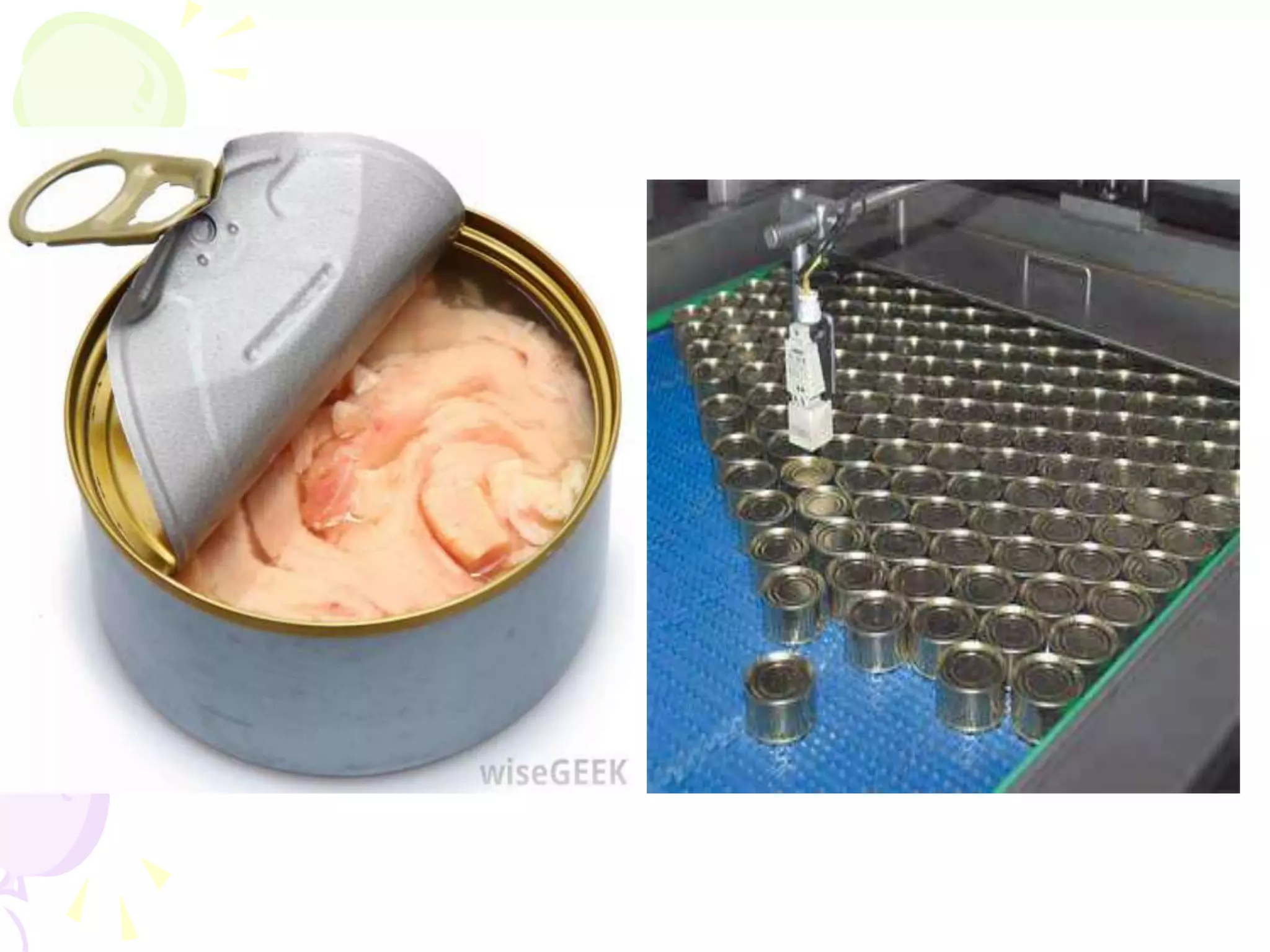
3. Packing/ filling the can
• The above treated fishes are filled in the can
either by manually or mechanically usually a
small top space is left which is also called head
space and generally filled with inert gas.
• The fishes are arranged inside the can as
compact as possible.
• Necessary additives (Salt, Tomato sauce, Starch,
Sugar etc) may be used to develop
characteristics flavour and improve keeping
quality.
Packing/
filling the can
4. Exhausting
Exhausting is done by the application of heat. By
this the gas inside the headspace and between
two fish pieces will be removed and a partial
vacuum will be formed.
Exhausting is done to prevent-
• Bulging of can
• Oxidation of the food
• Inside erosion of the tin plate.
5. Closing the can:
All fish cans prepared in this country are closed by
the double-seaming method and the operation is
usually called seaming.
A seal must be achieved that will prevent passage
of contaminating material, carried either in air or
water, into the can after it has been sterilized.
Proper care and maintenance of seaming is vital
and its performance should be checked at
frequent intervals throughout the working day.
6. Washing:
• Washing of can is done by the hot
water spray to remove adhering
materials.
7. Heat processing:
• It is the most important step during the whole
canning procedure.
• It is done for predetermined time at the
respective temperature.
• To fulfill the canning objectives 32 minutes are
required at 1100 C or 2.5 min is required at 1210
C.
• The temperature of the can is determined a
recorder which is called thermo couple.
• Heat processing is done in a special instrument
called retort and so the process is called
retorting.
8. Cooling:
• Cooling is done as quickly as possible
after retorting. Otherwise off flavour
may produce because considerable
changes may take place during heat
processing
9. Labeling and boxing:
• After cooling, cans of large fish such as herring and
pilchards are stored for a period of weeks before labeling.
• Cans of small fish are usually labeled directly, since thest
are not so susceptible to damage.
• Ingenious machines are available for labeling dingley cans,
and are capable of fixing the lid label, placing a key on this,
and wrapping the whole in a greaseproof wrapper.
• Larger cans may have the top label pasted on by hand, and
the side label by machine.
• Many canners label by hand, making use of female labour
during off-season period.
• In recent years, the introduction of decorated lids has cut
down the use of paper labels.
Fish canning
Fish canning

Fish canning

  • 1.
  • 2.
    Fish Canning Canning isrelatively modern process, which enable food to be preserved in an edible condition under a wide range of storage condition for long period (from a few months to several years). There are three different stages to the process: • Hermetically sealing the food in a container • Heat ‘sterilizing’ the sealed unit and • Cooling it to ambient temperature for subsequent storage.
  • 3.
    • Although thefish canning industry is more developed in the industrialized countries of the northern hemisphere, a number of tropical countries produce a variety of canned fish product. • Mexico and Brazil, for example, produce large quantities of canned fish, a large proportion of which is sold on the local market. • Morocco is reported as the largest producer of canned sardines in the world and Thailand is now a producer of large quantities of canned tuna. • Tuna is also canned in countries such as the Solomon Island and Fiji.
  • 4.
    Canning industry shouldbe considered only if the following are available- • A regular supply of large quantities of suitable fish (and other materials e.g. salt, oil, etc. ) at a reasonable price. • An adequate supply of cans at an economic price. • Adequate manpower. • Suitable infrastructure (energy, water, transport etc.) • A market for the finished product.
  • 5.
    Definition of Canning •Canning may be defined as packaging of food in a hermetically sealed container and obtaining commercial sterility through the use of heat processing. • Commercial sterility may be defined as the degree of sterility necessary to destroy all harmful bacteria without changes in food quality. • Canning is long-term preservation method storage range from 2-10 years with maintaining more or less same quality
  • 6.
    Principles of canning: •To obtain commercial sterility • To preserve the fish in a hermetically sealed container by subjecting to require heat processing. • Maintenance of bacteriological principles. • Maintenance of anaerobic condition within the can.
  • 7.
    Steps of fishcanning: 1. Selection of raw materials 2. Treatment before canning. 1. Nobbing 2. Washing and de-scaling 3. Brining 3. Packing/ filling the can 4. Exhausting. 5. Closing the can 6. Washing. 7. Heat processing/ retorting. 8. Cooling. 9. Labeling and boxing.
  • 8.
    1. Selection ofraw materials: • Mature, pre-spawning fish and medium fatty fish are better for canning. Eventually fish with the following characteristics are used for canning- – Excess bone – Taste less – High fishy odour – Fish with hard and farm muscle. – Available Eg: Sardine, Hilsa, Salmon, Herring etc
  • 10.
    2. Treatment beforecanning: • Nobbing: In the case of larger fish, such as herring and pilchard, the head and gut are removed, but not the roe or milt. This process of removing head and gut in one operation is called nobbing. • Washing and de-scaling: The next operation is de- scaling; remove fins, viscera from the raw materials and washing. Nobbing releases blood that must be removed because it causes brown staining in the processed fish. Washing also removes surface slime and dirty materials from fish. • Brining: The fish are immersed in a concentrated solution of common salt for a predetermined length of time. Salt is absorbed by the flesh and imparts a desired flavour to the finished products in which a salt content of about 2 % is acceptable.
  • 11.
    Nobbing process Washingmachine Washing
  • 12.
    3. Packing/ fillingthe can • The above treated fishes are filled in the can either by manually or mechanically usually a small top space is left which is also called head space and generally filled with inert gas. • The fishes are arranged inside the can as compact as possible. • Necessary additives (Salt, Tomato sauce, Starch, Sugar etc) may be used to develop characteristics flavour and improve keeping quality.
  • 13.
  • 14.
    4. Exhausting Exhausting isdone by the application of heat. By this the gas inside the headspace and between two fish pieces will be removed and a partial vacuum will be formed. Exhausting is done to prevent- • Bulging of can • Oxidation of the food • Inside erosion of the tin plate.
  • 16.
    5. Closing thecan: All fish cans prepared in this country are closed by the double-seaming method and the operation is usually called seaming. A seal must be achieved that will prevent passage of contaminating material, carried either in air or water, into the can after it has been sterilized. Proper care and maintenance of seaming is vital and its performance should be checked at frequent intervals throughout the working day.
  • 18.
    6. Washing: • Washingof can is done by the hot water spray to remove adhering materials.
  • 19.
    7. Heat processing: •It is the most important step during the whole canning procedure. • It is done for predetermined time at the respective temperature. • To fulfill the canning objectives 32 minutes are required at 1100 C or 2.5 min is required at 1210 C. • The temperature of the can is determined a recorder which is called thermo couple. • Heat processing is done in a special instrument called retort and so the process is called retorting.
  • 20.
    8. Cooling: • Coolingis done as quickly as possible after retorting. Otherwise off flavour may produce because considerable changes may take place during heat processing
  • 21.
    9. Labeling andboxing: • After cooling, cans of large fish such as herring and pilchards are stored for a period of weeks before labeling. • Cans of small fish are usually labeled directly, since thest are not so susceptible to damage. • Ingenious machines are available for labeling dingley cans, and are capable of fixing the lid label, placing a key on this, and wrapping the whole in a greaseproof wrapper. • Larger cans may have the top label pasted on by hand, and the side label by machine. • Many canners label by hand, making use of female labour during off-season period. • In recent years, the introduction of decorated lids has cut down the use of paper labels.