FOOD PRESERVATION:
CANNING BASICS
Preserving Food
Main home food preservation methods
• Canning
• Freezing
• Drying
Choice of method depends upon
• Safe guidelines
• Product characteristics
To maintain safety and quality
• Microorganisms
• Enzymes
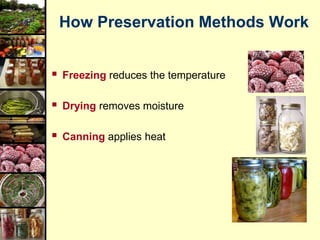
How Preservation Methods Work
 Freezing reduces the temperature
 Drying removes moisture
 Canning applies heat
4
Principles of Canning
 Heat processing at specified temperature for a
specified time
• Destroy organisms
• Inactivate enzymes
• Oxygen driven out
 A Vacuum is formed upon cooling
• Prevent recontamination
5
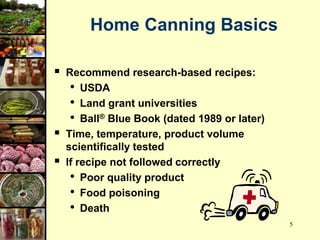
Home Canning Basics
 Recommend research-based recipes:
• USDA
• Land grant universities
• Ball® Blue Book (dated 1989 or later)
 Time, temperature, product volume
scientifically tested
 If recipe not followed correctly
• Poor quality product
• Food poisoning
• Death
6
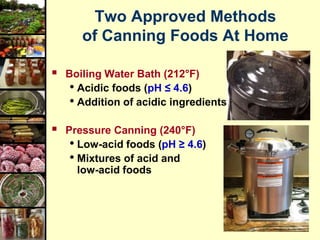
Two Approved Methods
of Canning Foods At Home
 Boiling Water Bath (212°F)
• Acidic foods (pH ≤ 4.6)
• Addition of acidic ingredients
 Pressure Canning (240°F)
• Low-acid foods (pH ≥ 4.6)
• Mixtures of acid and
low-acid foods
7
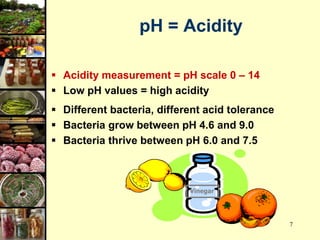
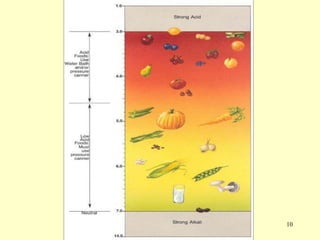
pH = Acidity
 Acidity measurement = pH scale 0 – 14
 Low pH values = high acidity
 Different bacteria, different acid tolerance
 Bacteria grow between pH 4.6 and 9.0
 Bacteria thrive between pH 6.0 and 7.5
Vinegar
8
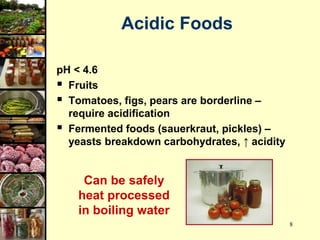
Acidic Foods
pH < 4.6
 Fruits
 Tomatoes, figs, pears are borderline –
require acidification
 Fermented foods (sauerkraut, pickles) –
yeasts breakdown carbohydrates, ↑ acidity
Can be safely
heat processed
in boiling water
9
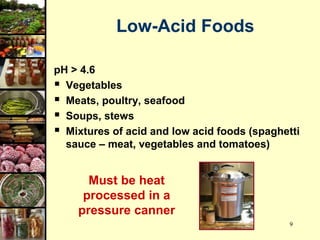
Low-Acid Foods
pH > 4.6
 Vegetables
 Meats, poultry, seafood
 Soups, stews
 Mixtures of acid and low acid foods (spaghetti
sauce – meat, vegetables and tomatoes)
Must be heat
processed in a
pressure canner
10
11
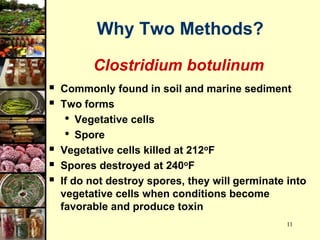
Why Two Methods?
Clostridium botulinum
 Commonly found in soil and marine sediment
 Two forms
• Vegetative cells
• Spore
 Vegetative cells killed at 212oF
 Spores destroyed at 240oF
 If do not destroy spores, they will germinate into
vegetative cells when conditions become
favorable and produce toxin
12
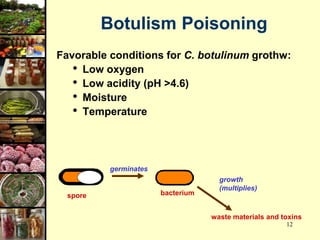
Botulism Poisoning
Favorable conditions for C. botulinum grothw:
• Low oxygen
• Low acidity (pH >4.6)
• Moisture
• Temperature
spore bacterium
waste materials and toxins
growth
(multiplies)
germinates
13
Botulism Foodborne Illness
 Symptoms appear within 12 to 72 hours:
• Nausea, vomiting, weakness,
dizziness
• Blurred, double vision
• Difficulty swallowing, speaking and
breathing
• Possible death from suffocation
14
Botulism Foodborne Illness
 Potentially fatal
 Permanent nerve damage
 Food can contain toxin without showing signs
of contamination
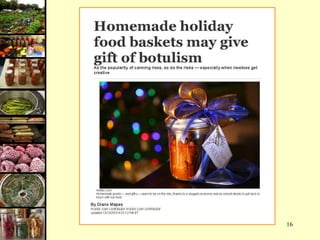
 Improperly home canned vegetables remain the
leading cause
15
Foodborne Botulism
Outbreaks in US
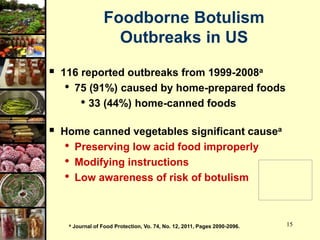
 116 reported outbreaks from 1999-2008a
• 75 (91%) caused by home-prepared foods
• 33 (44%) home-canned foods
 Home canned vegetables significant causea
• Preserving low acid food improperly
• Modifying instructions
• Low awareness of risk of botulism
a Journal of Food Protection, Vo. 74, No. 12, 2011, Pages 2090-2096.
16
17
Follow the recipe- NO MODIFICATIONS!
Several factors affect heat penetration
• Jar
• Food
Cold-spot
• Slowest heating area of the jar
• Determines process time
Use recommended canners
• Heat-up and cool-down times in pressure
canner are counted toward “sterilization”
• DO NOT RUSH!!!
Preventing Botulism
18
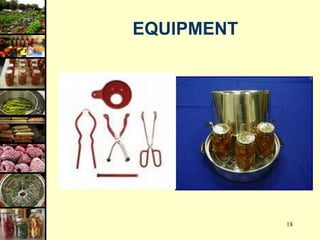
EQUIPMENT
19
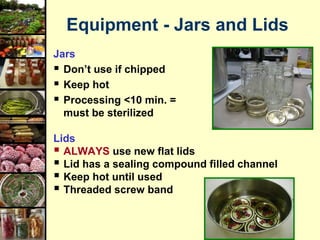
Equipment - Jars and Lids
Jars
 Don’t use if chipped
 Keep hot
 Processing <10 min. =
must be sterilized
Lids
 ALWAYS use new flat lids
 Lid has a sealing compound filled channel
 Keep hot until used
 Threaded screw band
20
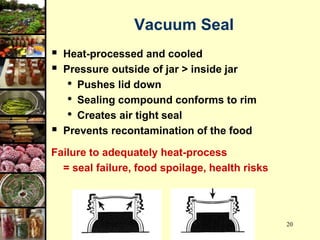
Vacuum Seal
 Heat-processed and cooled
 Pressure outside of jar > inside jar
• Pushes lid down
• Sealing compound conforms to rim
• Creates air tight seal
 Prevents recontamination of the food
Failure to adequately heat-process
= seal failure, food spoilage, health risks
21
Packing Methods –
Raw/Cold Pack
 Raw, unheated food
 Boiling liquid poured over the food
 Tightly pack fruits and most vegetables
because that will shrink during processing
 Loosely pack starchy vegetables that will
expand during processing
22
 Put hot food and boiling liquid into jars
 Pack fairly loosely because shrinking already
occurred
 Make sure enough cooking liquid covers the
food
 Preferred method for most foods
Note: If directions say only hot
pack then hot pack!
Packing Methods –
Hot Pack
23
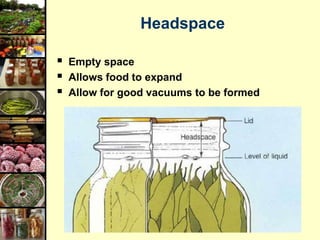
Headspace
 Empty space
 Allows food to expand
 Allow for good vacuums to be formed
24
Headspace
TOO LITTLE
= PREVENT SEALING
TOO MUCH
= AIR IN JAR
= PREVENT SEALING
= FOOD DISCOLOR
25
Air Bubbles
 Rise during processing
= Too much headspace
= Prevent sealing
 To prevent air bubbles
• Run a plastic or rubber knife-like
utensil around the edges of the jar
• Gently shift the food
 More liquid may need to be added to ensure
proper headspace
26
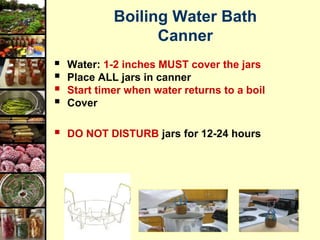
 Water: 1-2 inches MUST cover the jars
 Place ALL jars in canner
 Start timer when water returns to a boil
 Cover
 DO NOT DISTURB jars for 12-24 hours
Boiling Water Bath
Canner
27
Pressure Canning
 Water: 2-3 inches
 Place jars in canner
 Heat the pressure canner until steam comes out of the
vent tube
 Allow steam to vent for 10 min.
 Process times are for a pure steam environment
 USDA instructs to vent ALL pressure canners
 DO NOT DISTURB jars for 12-24 hours
If pressure drops anytime during the process, bring the
canner back up to required pressure and start timing the
process over, from the beginning
28
Pressure Canners vs. Cookers
NOT INTERCHANGEABLE!
 Canners MUST hold at least 4 quart-size jars
 Cookers have less metal, smaller diameter, and
use less water
= shorter processing time
= reduced heat
= under processed product
= risk of botulism!
National Center for Home Food Preservation
Preserving Food: Using Pressure Canners
http://nchfp.uga.edu/publications/uga/using_press_canners.html
30
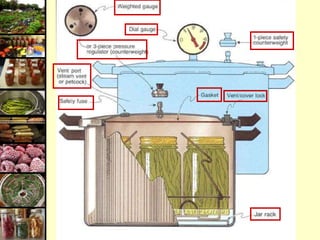
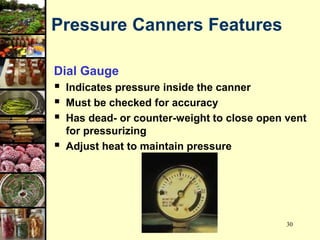
Pressure Canners Features
Dial Gauge
 Indicates pressure inside the canner
 Must be checked for accuracy
 Has dead- or counter-weight to close open vent
for pressurizing
 Adjust heat to maintain pressure
31
Pressure Canners Features
Weighted Gauge
 Weights regulate pressure inside the
canner – 5, 10, 15 lb.
 Open vent is where the weights fit
 Steam, exhausted during processing,
causes the weights to rock or jiggle
 Does not require testing for accuracy, but
replace the weights if they become
damaged
32
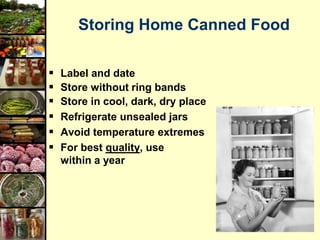
Storing Home Canned Food
 Label and date
 Store without ring bands
 Store in cool, dark, dry place
 Refrigerate unsealed jars
 Avoid temperature extremes
 For best quality, use
within a year
33
Disclaimer:
 Trade and brand names are used only for information. The University of Rhode Island
does not guarantee nor warrant published standards on any product mentioned; neither
does the use of a trade or brand name imply approval of any product to the exclusion of
others which may also be suitable.
Document Use:
 Adapted with permission of the University of Georgia. Harrison, J.A. 2008. Canning
Foods at Home – The Basics (slides). Athens, GA: The University of Georgia, Cooperative
Extension.
 So Easy to Preserve, 5th Edition, 2006, University of Georgia Cooperative Extension
Service
 Adapted with permission of the University of Georgia. Andress, E.L. 2003. Freezing fruits
and vegetables at home (slides). Athens, GA: The University of Georgia, Cooperative
Extension Service.
 Adapted with permission of the University of Illinois. Finck, J. 2011. Drying Foods (slides).
Springfield, IL: The University of Illinois, Extension.
 Ball® Complete Book of Home Preserving, Ed. J. Kingry and L. Devine, 2006. Robert
Rose Inc.
Photography Credits
 Elizabeth Andress and Elaine D’Sa, National Center for Home Food Preservation,
University of Georgia.
 Information Staff, Agricultural Research Service, USDA.
 North Caroline State University

Canning-Basics .ppt

  • 1.
  • 2.
    Preserving Food Main homefood preservation methods • Canning • Freezing • Drying Choice of method depends upon • Safe guidelines • Product characteristics To maintain safety and quality • Microorganisms • Enzymes
  • 3.
    How Preservation MethodsWork  Freezing reduces the temperature  Drying removes moisture  Canning applies heat
  • 4.
    4 Principles of Canning Heat processing at specified temperature for a specified time • Destroy organisms • Inactivate enzymes • Oxygen driven out  A Vacuum is formed upon cooling • Prevent recontamination
  • 5.
    5 Home Canning Basics Recommend research-based recipes: • USDA • Land grant universities • Ball® Blue Book (dated 1989 or later)  Time, temperature, product volume scientifically tested  If recipe not followed correctly • Poor quality product • Food poisoning • Death
  • 6.
    6 Two Approved Methods ofCanning Foods At Home  Boiling Water Bath (212°F) • Acidic foods (pH ≤ 4.6) • Addition of acidic ingredients  Pressure Canning (240°F) • Low-acid foods (pH ≥ 4.6) • Mixtures of acid and low-acid foods
  • 7.
    7 pH = Acidity Acidity measurement = pH scale 0 – 14  Low pH values = high acidity  Different bacteria, different acid tolerance  Bacteria grow between pH 4.6 and 9.0  Bacteria thrive between pH 6.0 and 7.5 Vinegar
  • 8.
    8 Acidic Foods pH <4.6  Fruits  Tomatoes, figs, pears are borderline – require acidification  Fermented foods (sauerkraut, pickles) – yeasts breakdown carbohydrates, ↑ acidity Can be safely heat processed in boiling water
  • 9.
    9 Low-Acid Foods pH >4.6  Vegetables  Meats, poultry, seafood  Soups, stews  Mixtures of acid and low acid foods (spaghetti sauce – meat, vegetables and tomatoes) Must be heat processed in a pressure canner
  • 10.
  • 11.
    11 Why Two Methods? Clostridiumbotulinum  Commonly found in soil and marine sediment  Two forms • Vegetative cells • Spore  Vegetative cells killed at 212oF  Spores destroyed at 240oF  If do not destroy spores, they will germinate into vegetative cells when conditions become favorable and produce toxin
  • 12.
    12 Botulism Poisoning Favorable conditionsfor C. botulinum grothw: • Low oxygen • Low acidity (pH >4.6) • Moisture • Temperature spore bacterium waste materials and toxins growth (multiplies) germinates
  • 13.
    13 Botulism Foodborne Illness Symptoms appear within 12 to 72 hours: • Nausea, vomiting, weakness, dizziness • Blurred, double vision • Difficulty swallowing, speaking and breathing • Possible death from suffocation
  • 14.
    14 Botulism Foodborne Illness Potentially fatal  Permanent nerve damage  Food can contain toxin without showing signs of contamination  Improperly home canned vegetables remain the leading cause
  • 15.
    15 Foodborne Botulism Outbreaks inUS  116 reported outbreaks from 1999-2008a • 75 (91%) caused by home-prepared foods • 33 (44%) home-canned foods  Home canned vegetables significant causea • Preserving low acid food improperly • Modifying instructions • Low awareness of risk of botulism a Journal of Food Protection, Vo. 74, No. 12, 2011, Pages 2090-2096.
  • 16.
  • 17.
    17 Follow the recipe-NO MODIFICATIONS! Several factors affect heat penetration • Jar • Food Cold-spot • Slowest heating area of the jar • Determines process time Use recommended canners • Heat-up and cool-down times in pressure canner are counted toward “sterilization” • DO NOT RUSH!!! Preventing Botulism
  • 18.
  • 19.
    19 Equipment - Jarsand Lids Jars  Don’t use if chipped  Keep hot  Processing <10 min. = must be sterilized Lids  ALWAYS use new flat lids  Lid has a sealing compound filled channel  Keep hot until used  Threaded screw band
  • 20.
    20 Vacuum Seal  Heat-processedand cooled  Pressure outside of jar > inside jar • Pushes lid down • Sealing compound conforms to rim • Creates air tight seal  Prevents recontamination of the food Failure to adequately heat-process = seal failure, food spoilage, health risks
  • 21.
    21 Packing Methods – Raw/ColdPack  Raw, unheated food  Boiling liquid poured over the food  Tightly pack fruits and most vegetables because that will shrink during processing  Loosely pack starchy vegetables that will expand during processing
  • 22.
    22  Put hotfood and boiling liquid into jars  Pack fairly loosely because shrinking already occurred  Make sure enough cooking liquid covers the food  Preferred method for most foods Note: If directions say only hot pack then hot pack! Packing Methods – Hot Pack
  • 23.
    23 Headspace  Empty space Allows food to expand  Allow for good vacuums to be formed
  • 24.
    24 Headspace TOO LITTLE = PREVENTSEALING TOO MUCH = AIR IN JAR = PREVENT SEALING = FOOD DISCOLOR
  • 25.
    25 Air Bubbles  Riseduring processing = Too much headspace = Prevent sealing  To prevent air bubbles • Run a plastic or rubber knife-like utensil around the edges of the jar • Gently shift the food  More liquid may need to be added to ensure proper headspace
  • 26.
    26  Water: 1-2inches MUST cover the jars  Place ALL jars in canner  Start timer when water returns to a boil  Cover  DO NOT DISTURB jars for 12-24 hours Boiling Water Bath Canner
  • 27.
    27 Pressure Canning  Water:2-3 inches  Place jars in canner  Heat the pressure canner until steam comes out of the vent tube  Allow steam to vent for 10 min.  Process times are for a pure steam environment  USDA instructs to vent ALL pressure canners  DO NOT DISTURB jars for 12-24 hours If pressure drops anytime during the process, bring the canner back up to required pressure and start timing the process over, from the beginning
  • 28.
    28 Pressure Canners vs.Cookers NOT INTERCHANGEABLE!  Canners MUST hold at least 4 quart-size jars  Cookers have less metal, smaller diameter, and use less water = shorter processing time = reduced heat = under processed product = risk of botulism! National Center for Home Food Preservation Preserving Food: Using Pressure Canners http://nchfp.uga.edu/publications/uga/using_press_canners.html
  • 30.
    30 Pressure Canners Features DialGauge  Indicates pressure inside the canner  Must be checked for accuracy  Has dead- or counter-weight to close open vent for pressurizing  Adjust heat to maintain pressure
  • 31.
    31 Pressure Canners Features WeightedGauge  Weights regulate pressure inside the canner – 5, 10, 15 lb.  Open vent is where the weights fit  Steam, exhausted during processing, causes the weights to rock or jiggle  Does not require testing for accuracy, but replace the weights if they become damaged
  • 32.
    32 Storing Home CannedFood  Label and date  Store without ring bands  Store in cool, dark, dry place  Refrigerate unsealed jars  Avoid temperature extremes  For best quality, use within a year
  • 33.
    33 Disclaimer:  Trade andbrand names are used only for information. The University of Rhode Island does not guarantee nor warrant published standards on any product mentioned; neither does the use of a trade or brand name imply approval of any product to the exclusion of others which may also be suitable. Document Use:  Adapted with permission of the University of Georgia. Harrison, J.A. 2008. Canning Foods at Home – The Basics (slides). Athens, GA: The University of Georgia, Cooperative Extension.  So Easy to Preserve, 5th Edition, 2006, University of Georgia Cooperative Extension Service  Adapted with permission of the University of Georgia. Andress, E.L. 2003. Freezing fruits and vegetables at home (slides). Athens, GA: The University of Georgia, Cooperative Extension Service.  Adapted with permission of the University of Illinois. Finck, J. 2011. Drying Foods (slides). Springfield, IL: The University of Illinois, Extension.  Ball® Complete Book of Home Preserving, Ed. J. Kingry and L. Devine, 2006. Robert Rose Inc. Photography Credits  Elizabeth Andress and Elaine D’Sa, National Center for Home Food Preservation, University of Georgia.  Information Staff, Agricultural Research Service, USDA.  North Caroline State University