CANDY
DEFINITION
Candy is defined as a sweet food made with sugar
or chocolate. It is also defined as crystallized
sugar formed by boiling down sugar syrup, and
also as a confection made with sugar and often
flavouring and filling.
HISTORY
• Egyptian hieroglyphics dating back at least 3,000 years indicate that the art of
sugar confectionery was already established. The confectioner was regarded as
a skilled craftsman by the Romans, and a confectioner’s kitchen excavated at
Herculaneum was equipped with pots, pans, and other implements similar to
those in use today.
• During the Middle Ages the Persians spread sugarcane cultivation, developed
refining methods, and began to make a sugar-based candy.
• The Venetians brought about a major change in candy manufacture during the
14th century, when they began to import sugar from Arabia.
• By the 16th century confectioners were manufacturing sweets by molding boiled
sugar with fruits and nuts into fanciful forms by simple hand methods.
• The development of candy-manufacturing machinery began in the late 18th
century.
INGREDIENTS
• Sugar, mainly sucrose from sugar beets or sugarcane, is the major constituent of
most candies. Other sweeteners employed in candy manufacture include corn
syrup, corn sugar, honey, molasses, maple sugar, and non-caloric sweeteners.
Sweeteners may be used in dry or liquid form.
• Invert sugar, a mixture of glucose (dextrose) and fructose produced from sugar
(sucrose) by application of heat and an acid “sugar doctor,” such as cream of
tartar or citric acid, affects the sweetness, solubility, and amount of
crystallization in candy making. Invert sugar is also prepared as a syrup of about
75 percent concentration by the action of acid or enzymes on sugar in solution.
• Milk based ingredients often used in making some types of candies include:
evaporated milk, butter and condensed milk.
• Butter and fats determine the brittleness, hardness, flavour and texture of candy.
• Nuts are associated with their rich texture and flavour properties. Ex: almonds,
pista, pecan .etc
• Chocolate, flavourful, yet delicate, along with its nutrients make this an essential
ingredients for candy making.
• Acids, such as cream of tartar, lemon juice .. Etc are used in candy making.
• Candy oils are the preferred flavourings used mostly in candy making.
• Gelatin, powdered or leaf, starch, pectin or gum will gel the sugar and make
products like jell bean, its .added to the boiling mixture.
• Food colouring is best to use for sugar based candy.
• Fruits add flavours, fragrance and colour to simple sweeteners.
CLASSIFICATION
• Candy classification are dependent on the thickness of the syrup or the extent to
which sugar is caramelized.
• The density of syrup determines the general types of candies.
• Candies are divided in roughly 2 categories:
1. Creamy or Crystalline
2. Amorphous or Non-Crystalline
• Class one contains- Fondant, Fudge, Candies, Penuche, Sea-foam and Divinity.
• The second class contains- Caramels, Butterscotch, Lollipops, Gumdrops and
Marshmallows.
• The candies type is determined by: the ingredients used, degree of cooking or
concentration, and manipulation after cooking.
FONDANT
FUDGE
PENUCHE
SEA FOAM
DIVINITY
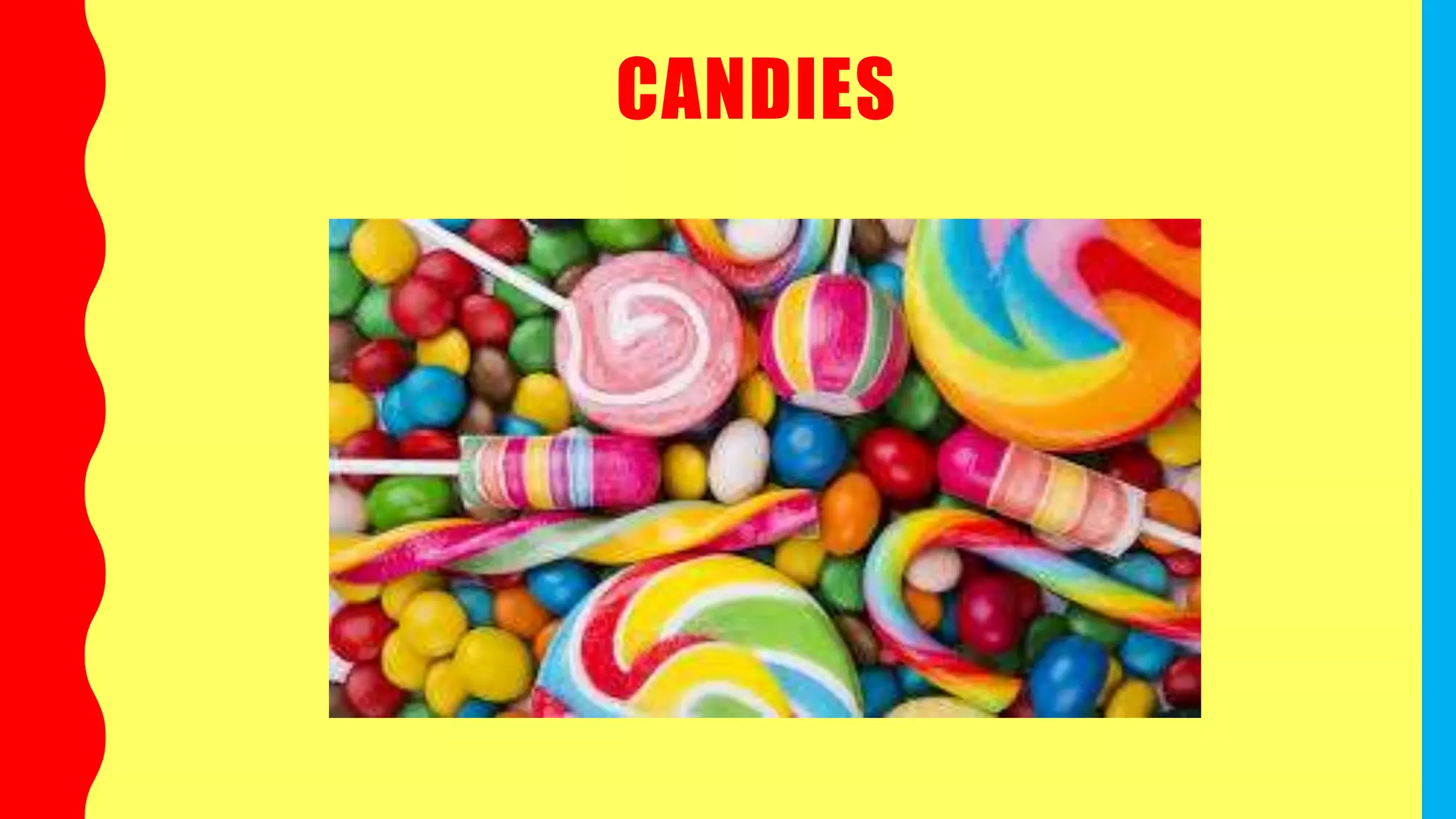
CANDIES
PROPERTIES
• Sugar has the property of forming a type of non-crystalline ‘glass’ that forms the
basis of hard candy products. Sugar and water are boiled until the concentration
of solution reaches a high level and super saturation persists upon cooling.
• This solution takes a plastic form and on further cooling becomes a hard,
transparent, glassy mass containing less than 2% water.
• High-boiled sugar solutions are, however, unstable and will readily crystallize
unless preventive steps are taken by either adding manufactured invert syrup or
corn syrup.
• The latter is now favoured because it contains complex saccharides and dextrin
that increase the viscosity and solubility, considerably retarding crystallization.
SUGAR STAGES
• Final texture of candy depends on the sugar concentration.
• A given temperature corresponds to a particular sugar concentration, so temperature is
used as a maker for the necessary concentration.
• In general, higher temperatures and greater sugar concentration results in hard, brittle
candies and lower temperatures result in softer candies.
HARD CANDY
PROCESSING OF
NOUGAT
RAW MATERIALS
• The peeled almonds are selected and calibrated and then
subjected to analyses by a metal detector.
• This extracts any impurities or foreign bodies (shells, skins)
and a uniform quality of almond is obtained, guaranteeing a
homogeneous toasting.
• The refined sugar and also that of sugar cane, are filtered in
silos and pulverized with a mill until it becomes “icing sugar”.
• The honey arrives intact and uncontaminated at the
processing unit, is filtered into barrels and then combined with
the mixture, to create a particular and inimitable compound.
• The vanilla beans are cleaned, chopped and mixed with the
powdered sugar.
• The glucose, heat-extracted from sugar beets, is mixed with
the honey.
• The egg whites are whipped and added very slowly to the
mixture in order to facilitate the formation of air bubbles.
TOASTING
• The second phase of production involves the toasting:
toasting is the cooking process of the almonds.
• it is an operation of high heating to the surface of the
almonds. The effect of toasting is dehydration of the
exterior of the almonds, the consequent formation of a
crust and of a browning that is localized and fairly intense,
and contemporarily, the development of a particular
flavour.
• For this procedure is utilized an oven used also for the
toasting of coffee beans, ingeniously modified: the curved
internal blades rotate continually and allow a homogenous
toasting of the almonds.
• Unlike industrial products in which the almonds are dried,
toasting at over 170°C causes the secretion of the almond
oil from the seed, which is absorbed into the almond paste
and gives it a particular taste.
• During the toasting process some of the almond’s sugars
are subjected to a transformation and become
caramelized, developing a multitude of complex aromas
• The variables in toasting are complex: they are the type of almond, the calibre, the
humidity and the external humidity.
• During the toasting two principal mechanisms can be identified: the so-called “Maillard
reaction” and the caramelizing.
• During the Maillard reaction, under intermediate humidity conditions, even at relative
modest temperatures (over 60°C), brown coloured substances called melanoidine are
formed with a noted bitter taste and complex aromas (“malted”, “baked bread”,
“caramel” “roasted”, and also “burnt”).
• These aromatic substances are what produce the typical taste.
• Along with the Maillard reaction, at higher temperatures a process of dehydration and
condensation of sugars begins, which generates substances like caramel, of an orange
or brown colour and a characteristic taste and aroma: it is the phase that gives the
almonds a characteristic colour.
• After cooking, the almonds are left to cool in jute sacks. Jute, a natural fibre, permits
transpiration of the almonds and conserves their aroma and humidity.
COOKING OF THE HONEY AND SUGAR
• The third phase of work is that of the cooking of the honey and
sugar.
• The honey and the sugar are poured into copper pots with a
mechanical arm. The mechanical arm mixes the product
tirelessly for over 8 hours, while it cooks bain-marie, in a
double boiler.
• The double boiler is a method of cooking adapted to food that
suffer under a too intense heat (which can alter its properties),
since the temperature can be easily controlled by increasing or
decreasing the vapours that feed the pot, and the cooking is
slow and delicate.
• The double boiler is a very old and useful method in cooking.
Bain-marie cooking consists of heating a pot full of water, then
placing a smaller pot containing the food which heats under
the conductive effect of that under it.
• . Between the copper pot and its bottom there is, in fact, a
cavity in which circulates vapour-heated water at 80 °C. The
heat, unlike toasting, is lower, humid and continuous.
• The cooking causes honey and sugar to lose the major part of
their water.
WHIPPING OF ALBUMEN
• It is at this point that egg whites are added, which, in
contact with the hot mixture, swells up with air, rendering
the honey and sugar light and soft.
• The phase of the whipping of albumen is very delicate.
• The albumen is formed mainly of water and protein,
which can be imagined as tiny separate balls of wool.
• As the egg whites are mechanically whipped, some of
the tiny balls begin to unravel: the protein is being
“denatured”, that is, we are unravelling the ball. As the
albumen continues to be whipped, more and more
molecules of protein are denatured and are engulfed by
air. The unrolled filaments of protein begin to twist
around each other: the beginning of the “coagulation”.
the proteins form an irregular net that imprisons the
water, which in turn imprisons the air bubbles.
• With continued whipping, there is more binding between
the proteins and the net thickens.
• There is need for much attention at this stage, because if the egg whites are whipped
for too long there is too much binding, the water is literally “squeezed” out of the net,
and there is no way to restore it.
• The albumen has to be discarded.
• Essentially, the beating or the mounting of egg whites causes the engulfing of air
bubbles into liquid ingredients, with the formation of soft foam. As the whipping action
continues, the structure of the foam changes. the trapped air bubbles diminish in
dimension and increase in number, making the foam lighter and stiffer.
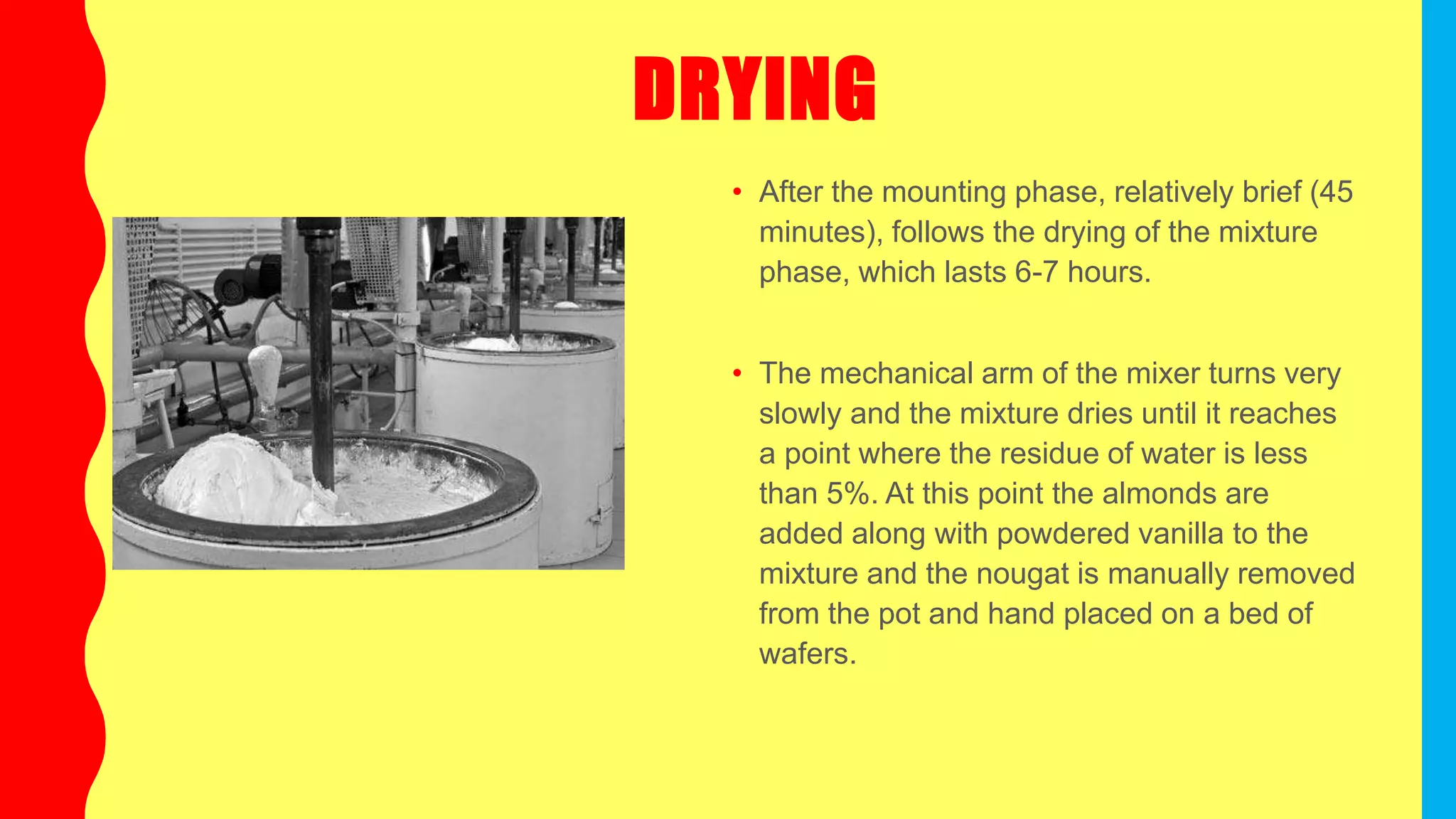
DRYING
• After the mounting phase, relatively brief (45
minutes), follows the drying of the mixture
phase, which lasts 6-7 hours.
• The mechanical arm of the mixer turns very
slowly and the mixture dries until it reaches
a point where the residue of water is less
than 5%. At this point the almonds are
added along with powdered vanilla to the
mixture and the nougat is manually removed
from the pot and hand placed on a bed of
wafers.
PLACEMENT
• The placement of the product is the final phase.
• It is composed into its characteristic flakes either by
hand or by mechanical action.
• This permits the product to maintain a major friability,
because the air enclosed in the cooked albumen does
not escape by rolling or other mechanical procedures
(levelling, centrifuge) and is ready to be eaten in
friable bite sizes.
SOFT CANDY
PROCESSING OF
COTTON CANDY
• Cotton candy is a light and fluffy sugar confectionery which resembles cotton wool. It is
made by melting a sugar composition and spinning it into fine strands.
• The strands are then collected on a cardboard tube or bundled in a continuous mass. It
was first developed over 100 years ago.
• With the development of more efficient, automated machines it is expected that the
market for cotton candy will substantially increase in the coming years.
• It has a fibrous texture that makes it unique among sugar confectioneries. This texture
is a direct result of the sugar used to make the candy and the method in which it is
processed. At the start of manufacture, the sugar is a solid material supplied as
individual granules.
• When it is melted the individual granules become intermixed and form a thick, sticky
syrup. This syrup is then spun out to create thin strands that harden. These hardened
strands have many of the same characteristics as cotton fibres, which is how cotton
candy got its name.
• When the strands are collected on a cone, they are not packed close together and a
certain amount of air gets trapped between them.
• This increases the volume of the candy, giving it a light and fluffy texture.
RAW MATERIALS
• Sugar is the most important ingredient used in the manufacture of cotton candy.
• In cotton candy, sugar is responsible for the candy's physical structure as well as its
sweet taste and mouth feel. The sugar used for cotton candy production, called floss
sugar, is specially treated to promote the formation of fibres.
• To produce the well-known characteristics of cotton candy, other ingredients such as
dyes and flavourings must be added. Since sugar is naturally white, dyes must be
added to produce the different colours typical of cotton candy.
• Usual dyes include Red dye #40, Yellow dye #5, Yellow dye #6, and Blue dye #1. By
using only these federally regulated dyes, cotton candy can be made to be almost any
colour desired.
• The most popular colours are pink and blue, however purple, yellow, red, and brown
cotton candy are also sold.
• To produce these flavours, both artificial and natural flavourings may be used.
• Natural flavours are obtained from fruits, berries, honey, molasses, and maple sugar.
• Artificial flavours are mixtures of aromatic chemicals produced synthetically via organic
reactions. Some important artificial flavouring compounds include materials such as
methyl anthranilate and ethyl caproate.
• In addition to the cotton candy ingredients, different packaging raw materials are
required.
• Since moisture can make cotton candy rubbery and sticky, the packaging is designed
to inhibit interaction with air. Typically, a plastic bag made out of a high molecular
weight polymer is used.
SUGAR PROCESSING
• The first step in making cotton candy is converting the granular sugar into fine
filaments. To do this, solid sugar is placed in a large, stainless steel hopper. This
hopper has a tapered bottom, which funnels the sugar into the extruder.
• The extruder is a rotating metal cylinder, which has holes along its sides and is
equipped with a heating element.
• Inside the extruder, the sugar is heated such that it melts and becomes a molten liquid.
The spinning extruder then throws the strands of liquid sugar out in all directions
through the holes in its sides.
• As it exits the extruder, the liquid sugar cools and forms solid strands.
• These strands, which are the fibres used to make cotton candy, are collected in a large
circular pan surrounding the extruder.
• To prevent coagulation of the strands, moisture is minimized during this phase of
manufacture.
CANDY COLLECTION
• In machines that produce a small amount of cotton candy, such as those found at
carnivals, the strands of cotton candy are then collected by the machine operator.
• He takes a cardboard cone and passes it around the sides of the collection pan. As the
cardboard is passed around, the sticky sugar strands adhere to it.
• When enough is collected on the cone, the cotton candy is sold to the consumer
immediately. The situation is slightly different for automated cotton candy machines.
• In these machines, the strands of cotton candy are pulled onto a conveyor belt and
transferred into a sizing container. Here the candy strands are combined into a
continuous bundle.
• In the sizing container, the bundle of cotton candy is moulded into a consistent shape.
• This is done by rollers that are spaced on the top and sides of the conveyor belt.
• To prevent the cotton candy from sticking to the rollers, they are typically coated with a
non-stick substance such as Teflon.
• As the candy exits the sizing container, it has the shape of a continuous block with a
fixed height and width.
• This forming process is done with a minimum of force so the candy is not compressed
so much that it changes its character or texture.
CUTTING
• After the shaping process, the cotton candy is conveyed to a knife blade where it is cut
into segments of a set length.
• The knife is mounted vertically above the conveyor, and as the candy passes by, it
slides down to make the cut. The knife is then retracted and the segmented candy is
conveyed away.
• To help the candy maintain its shape and prevent it from sticking to the knife, it is then
passed under another roller immediately after it is cut.
PACKAGING
• The cut mass of cotton candy is next transferred to the packaging machine. Here, it is
automatically put into a plastic bag or other type of packaging, and sealed shut.
• It is important that the package is sealed so moisture is prevented from spoiling the
candy.
• The bags are passed by a coding device where they are marked with information
related to the date of production, batch number, and other information.
• The bags are then carefully put into boxes. The boxes are stacked on wooden pallets,
transferred to trucks via forklifts, and shipped to the local supermarket.
• The entire process from loading the sugar to putting the candy in boxes takes only a
few minutes.
MACHINERY

Candy

  • 1.
  • 2.
    DEFINITION Candy is definedas a sweet food made with sugar or chocolate. It is also defined as crystallized sugar formed by boiling down sugar syrup, and also as a confection made with sugar and often flavouring and filling.
  • 3.
    HISTORY • Egyptian hieroglyphicsdating back at least 3,000 years indicate that the art of sugar confectionery was already established. The confectioner was regarded as a skilled craftsman by the Romans, and a confectioner’s kitchen excavated at Herculaneum was equipped with pots, pans, and other implements similar to those in use today. • During the Middle Ages the Persians spread sugarcane cultivation, developed refining methods, and began to make a sugar-based candy. • The Venetians brought about a major change in candy manufacture during the 14th century, when they began to import sugar from Arabia. • By the 16th century confectioners were manufacturing sweets by molding boiled sugar with fruits and nuts into fanciful forms by simple hand methods. • The development of candy-manufacturing machinery began in the late 18th century.
  • 4.
  • 5.
    • Sugar, mainlysucrose from sugar beets or sugarcane, is the major constituent of most candies. Other sweeteners employed in candy manufacture include corn syrup, corn sugar, honey, molasses, maple sugar, and non-caloric sweeteners. Sweeteners may be used in dry or liquid form. • Invert sugar, a mixture of glucose (dextrose) and fructose produced from sugar (sucrose) by application of heat and an acid “sugar doctor,” such as cream of tartar or citric acid, affects the sweetness, solubility, and amount of crystallization in candy making. Invert sugar is also prepared as a syrup of about 75 percent concentration by the action of acid or enzymes on sugar in solution. • Milk based ingredients often used in making some types of candies include: evaporated milk, butter and condensed milk. • Butter and fats determine the brittleness, hardness, flavour and texture of candy. • Nuts are associated with their rich texture and flavour properties. Ex: almonds, pista, pecan .etc • Chocolate, flavourful, yet delicate, along with its nutrients make this an essential ingredients for candy making.
  • 6.
    • Acids, suchas cream of tartar, lemon juice .. Etc are used in candy making. • Candy oils are the preferred flavourings used mostly in candy making. • Gelatin, powdered or leaf, starch, pectin or gum will gel the sugar and make products like jell bean, its .added to the boiling mixture. • Food colouring is best to use for sugar based candy. • Fruits add flavours, fragrance and colour to simple sweeteners.
  • 7.
  • 8.
    • Candy classificationare dependent on the thickness of the syrup or the extent to which sugar is caramelized. • The density of syrup determines the general types of candies. • Candies are divided in roughly 2 categories: 1. Creamy or Crystalline 2. Amorphous or Non-Crystalline • Class one contains- Fondant, Fudge, Candies, Penuche, Sea-foam and Divinity. • The second class contains- Caramels, Butterscotch, Lollipops, Gumdrops and Marshmallows. • The candies type is determined by: the ingredients used, degree of cooking or concentration, and manipulation after cooking.
  • 9.
  • 10.
  • 11.
  • 12.
  • 13.
  • 14.
  • 15.
  • 16.
    • Sugar hasthe property of forming a type of non-crystalline ‘glass’ that forms the basis of hard candy products. Sugar and water are boiled until the concentration of solution reaches a high level and super saturation persists upon cooling. • This solution takes a plastic form and on further cooling becomes a hard, transparent, glassy mass containing less than 2% water. • High-boiled sugar solutions are, however, unstable and will readily crystallize unless preventive steps are taken by either adding manufactured invert syrup or corn syrup. • The latter is now favoured because it contains complex saccharides and dextrin that increase the viscosity and solubility, considerably retarding crystallization.
  • 17.
    SUGAR STAGES • Finaltexture of candy depends on the sugar concentration. • A given temperature corresponds to a particular sugar concentration, so temperature is used as a maker for the necessary concentration. • In general, higher temperatures and greater sugar concentration results in hard, brittle candies and lower temperatures result in softer candies.
  • 19.
  • 20.
  • 21.
    RAW MATERIALS • Thepeeled almonds are selected and calibrated and then subjected to analyses by a metal detector. • This extracts any impurities or foreign bodies (shells, skins) and a uniform quality of almond is obtained, guaranteeing a homogeneous toasting. • The refined sugar and also that of sugar cane, are filtered in silos and pulverized with a mill until it becomes “icing sugar”. • The honey arrives intact and uncontaminated at the processing unit, is filtered into barrels and then combined with the mixture, to create a particular and inimitable compound. • The vanilla beans are cleaned, chopped and mixed with the powdered sugar. • The glucose, heat-extracted from sugar beets, is mixed with the honey. • The egg whites are whipped and added very slowly to the mixture in order to facilitate the formation of air bubbles.
  • 22.
    TOASTING • The secondphase of production involves the toasting: toasting is the cooking process of the almonds. • it is an operation of high heating to the surface of the almonds. The effect of toasting is dehydration of the exterior of the almonds, the consequent formation of a crust and of a browning that is localized and fairly intense, and contemporarily, the development of a particular flavour. • For this procedure is utilized an oven used also for the toasting of coffee beans, ingeniously modified: the curved internal blades rotate continually and allow a homogenous toasting of the almonds. • Unlike industrial products in which the almonds are dried, toasting at over 170°C causes the secretion of the almond oil from the seed, which is absorbed into the almond paste and gives it a particular taste. • During the toasting process some of the almond’s sugars are subjected to a transformation and become caramelized, developing a multitude of complex aromas
  • 23.
    • The variablesin toasting are complex: they are the type of almond, the calibre, the humidity and the external humidity. • During the toasting two principal mechanisms can be identified: the so-called “Maillard reaction” and the caramelizing. • During the Maillard reaction, under intermediate humidity conditions, even at relative modest temperatures (over 60°C), brown coloured substances called melanoidine are formed with a noted bitter taste and complex aromas (“malted”, “baked bread”, “caramel” “roasted”, and also “burnt”). • These aromatic substances are what produce the typical taste. • Along with the Maillard reaction, at higher temperatures a process of dehydration and condensation of sugars begins, which generates substances like caramel, of an orange or brown colour and a characteristic taste and aroma: it is the phase that gives the almonds a characteristic colour. • After cooking, the almonds are left to cool in jute sacks. Jute, a natural fibre, permits transpiration of the almonds and conserves their aroma and humidity.
  • 24.
    COOKING OF THEHONEY AND SUGAR • The third phase of work is that of the cooking of the honey and sugar. • The honey and the sugar are poured into copper pots with a mechanical arm. The mechanical arm mixes the product tirelessly for over 8 hours, while it cooks bain-marie, in a double boiler. • The double boiler is a method of cooking adapted to food that suffer under a too intense heat (which can alter its properties), since the temperature can be easily controlled by increasing or decreasing the vapours that feed the pot, and the cooking is slow and delicate. • The double boiler is a very old and useful method in cooking. Bain-marie cooking consists of heating a pot full of water, then placing a smaller pot containing the food which heats under the conductive effect of that under it. • . Between the copper pot and its bottom there is, in fact, a cavity in which circulates vapour-heated water at 80 °C. The heat, unlike toasting, is lower, humid and continuous. • The cooking causes honey and sugar to lose the major part of their water.
  • 25.
    WHIPPING OF ALBUMEN •It is at this point that egg whites are added, which, in contact with the hot mixture, swells up with air, rendering the honey and sugar light and soft. • The phase of the whipping of albumen is very delicate. • The albumen is formed mainly of water and protein, which can be imagined as tiny separate balls of wool. • As the egg whites are mechanically whipped, some of the tiny balls begin to unravel: the protein is being “denatured”, that is, we are unravelling the ball. As the albumen continues to be whipped, more and more molecules of protein are denatured and are engulfed by air. The unrolled filaments of protein begin to twist around each other: the beginning of the “coagulation”. the proteins form an irregular net that imprisons the water, which in turn imprisons the air bubbles. • With continued whipping, there is more binding between the proteins and the net thickens.
  • 26.
    • There isneed for much attention at this stage, because if the egg whites are whipped for too long there is too much binding, the water is literally “squeezed” out of the net, and there is no way to restore it. • The albumen has to be discarded. • Essentially, the beating or the mounting of egg whites causes the engulfing of air bubbles into liquid ingredients, with the formation of soft foam. As the whipping action continues, the structure of the foam changes. the trapped air bubbles diminish in dimension and increase in number, making the foam lighter and stiffer.
  • 27.
    DRYING • After themounting phase, relatively brief (45 minutes), follows the drying of the mixture phase, which lasts 6-7 hours. • The mechanical arm of the mixer turns very slowly and the mixture dries until it reaches a point where the residue of water is less than 5%. At this point the almonds are added along with powdered vanilla to the mixture and the nougat is manually removed from the pot and hand placed on a bed of wafers.
  • 28.
    PLACEMENT • The placementof the product is the final phase. • It is composed into its characteristic flakes either by hand or by mechanical action. • This permits the product to maintain a major friability, because the air enclosed in the cooked albumen does not escape by rolling or other mechanical procedures (levelling, centrifuge) and is ready to be eaten in friable bite sizes.
  • 29.
  • 30.
  • 31.
    • Cotton candyis a light and fluffy sugar confectionery which resembles cotton wool. It is made by melting a sugar composition and spinning it into fine strands. • The strands are then collected on a cardboard tube or bundled in a continuous mass. It was first developed over 100 years ago. • With the development of more efficient, automated machines it is expected that the market for cotton candy will substantially increase in the coming years. • It has a fibrous texture that makes it unique among sugar confectioneries. This texture is a direct result of the sugar used to make the candy and the method in which it is processed. At the start of manufacture, the sugar is a solid material supplied as individual granules. • When it is melted the individual granules become intermixed and form a thick, sticky syrup. This syrup is then spun out to create thin strands that harden. These hardened strands have many of the same characteristics as cotton fibres, which is how cotton candy got its name. • When the strands are collected on a cone, they are not packed close together and a certain amount of air gets trapped between them. • This increases the volume of the candy, giving it a light and fluffy texture.
  • 32.
    RAW MATERIALS • Sugaris the most important ingredient used in the manufacture of cotton candy. • In cotton candy, sugar is responsible for the candy's physical structure as well as its sweet taste and mouth feel. The sugar used for cotton candy production, called floss sugar, is specially treated to promote the formation of fibres. • To produce the well-known characteristics of cotton candy, other ingredients such as dyes and flavourings must be added. Since sugar is naturally white, dyes must be added to produce the different colours typical of cotton candy. • Usual dyes include Red dye #40, Yellow dye #5, Yellow dye #6, and Blue dye #1. By using only these federally regulated dyes, cotton candy can be made to be almost any colour desired. • The most popular colours are pink and blue, however purple, yellow, red, and brown cotton candy are also sold.
  • 33.
    • To producethese flavours, both artificial and natural flavourings may be used. • Natural flavours are obtained from fruits, berries, honey, molasses, and maple sugar. • Artificial flavours are mixtures of aromatic chemicals produced synthetically via organic reactions. Some important artificial flavouring compounds include materials such as methyl anthranilate and ethyl caproate. • In addition to the cotton candy ingredients, different packaging raw materials are required. • Since moisture can make cotton candy rubbery and sticky, the packaging is designed to inhibit interaction with air. Typically, a plastic bag made out of a high molecular weight polymer is used.
  • 34.
    SUGAR PROCESSING • Thefirst step in making cotton candy is converting the granular sugar into fine filaments. To do this, solid sugar is placed in a large, stainless steel hopper. This hopper has a tapered bottom, which funnels the sugar into the extruder. • The extruder is a rotating metal cylinder, which has holes along its sides and is equipped with a heating element. • Inside the extruder, the sugar is heated such that it melts and becomes a molten liquid. The spinning extruder then throws the strands of liquid sugar out in all directions through the holes in its sides. • As it exits the extruder, the liquid sugar cools and forms solid strands. • These strands, which are the fibres used to make cotton candy, are collected in a large circular pan surrounding the extruder. • To prevent coagulation of the strands, moisture is minimized during this phase of manufacture.
  • 35.
    CANDY COLLECTION • Inmachines that produce a small amount of cotton candy, such as those found at carnivals, the strands of cotton candy are then collected by the machine operator. • He takes a cardboard cone and passes it around the sides of the collection pan. As the cardboard is passed around, the sticky sugar strands adhere to it. • When enough is collected on the cone, the cotton candy is sold to the consumer immediately. The situation is slightly different for automated cotton candy machines. • In these machines, the strands of cotton candy are pulled onto a conveyor belt and transferred into a sizing container. Here the candy strands are combined into a continuous bundle. • In the sizing container, the bundle of cotton candy is moulded into a consistent shape.
  • 36.
    • This isdone by rollers that are spaced on the top and sides of the conveyor belt. • To prevent the cotton candy from sticking to the rollers, they are typically coated with a non-stick substance such as Teflon. • As the candy exits the sizing container, it has the shape of a continuous block with a fixed height and width. • This forming process is done with a minimum of force so the candy is not compressed so much that it changes its character or texture.
  • 37.
    CUTTING • After theshaping process, the cotton candy is conveyed to a knife blade where it is cut into segments of a set length. • The knife is mounted vertically above the conveyor, and as the candy passes by, it slides down to make the cut. The knife is then retracted and the segmented candy is conveyed away. • To help the candy maintain its shape and prevent it from sticking to the knife, it is then passed under another roller immediately after it is cut.
  • 38.
    PACKAGING • The cutmass of cotton candy is next transferred to the packaging machine. Here, it is automatically put into a plastic bag or other type of packaging, and sealed shut. • It is important that the package is sealed so moisture is prevented from spoiling the candy. • The bags are passed by a coding device where they are marked with information related to the date of production, batch number, and other information. • The bags are then carefully put into boxes. The boxes are stacked on wooden pallets, transferred to trucks via forklifts, and shipped to the local supermarket. • The entire process from loading the sugar to putting the candy in boxes takes only a few minutes.
  • 39.