


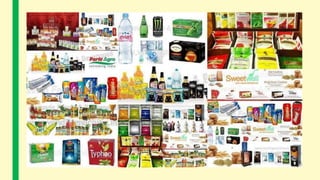

BEVERAGE
INDUSTRY
SCOPE AND IMPORTANCE
DEFINITION
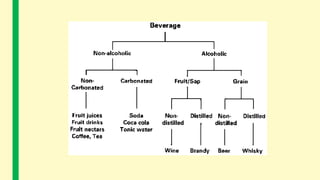
■ Beverage is referredto any drink, usually other than water. It is
derivedfromthe old French“bevrage”, basedon Latin word
“bibere” which means “to drink.”
List of Top Companies in India
■ Ace Continental Exports
■ Vinbros & Co.
■ Apple Valley Group
■ KarnatakaPlantationCoffee
■ LochanTea
■ Tata Tea
■ SABMiller
■ Coca Cola
■ PepsiCo.
■ McDowell & Company
■ Nestle
■ ShawWallace
■ South Seas Distilleries & Breweries
■ UB Groups
BEVERAGE INDUSTRY OVERVIEW
■ The food processing industry in India has a total turnover of around 65 million USD, which
includes value added products of around 20.6 billion USD.
■ Coca Cola, Nestle and Pepsi are the leading beverage brands that have been ruling the Indian
beveragemarket since a past few decades.
■ Amongst all the beverages, Tea and Coffee are manufacturedas well as exportedheavilyin the
international markets succumbing to the individual demands around the world.
■ Beverage industry in India constitutes aroundUSD230 million among the 65 millionfood
processing industry.
■ The major sectors in beverageindustry in Indiaare Tea and Coffee whichare not only sold in
domestic markets but re also exported to a range of leading overseas markets.
■ Half of the Tea and Coffee products are available in unpacked or loose form.
■ Among the hot beverages manufacturedin India, Tea is themost dominant beveragethat is
ruling boththe Domestic and the international markets even today.
■ The supplyof Tea and Coffee is insurmountable in the Indian beverage industry.
ABOUT BEVERAGE COMPANIES IN
INDIA
■ Fruit juices, pulp and concentrates and sauces or ketchups are doing well in the beverage
market in India for the pastfew years.
■ Various milk products, healthbeverages, beer and country liquors have also been contributing
largelyin the rising demandof beverages in India. The leading beverages companies in India
are also exporting various products especially Tea and Coffeeto the international markets
every year
■ Tea and Coffee have registeredan excellent growth in the Indian beverage market as the most
preferreddrinks purchasedexcessivelyaround the world. Among all the leading beverage
companies in India, Coca cola has accountedfor a thriving growth sinceits inception.
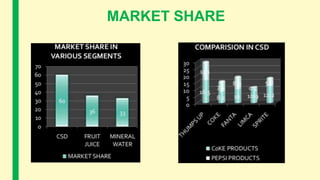
■ It occupies around60% of the carbonated drinks sector in the Indian beverage industry.
■ Another predominant brand is NestleIndia Limitedwhichoccupies 61.85%of the total Nestle
SA, Switzerland.
■ The Nestle products are hugely exported to Russia apart fromselling in domestic markets.
SCOPE: PRESENT
STATUS & FUTURE
PROSPECTS
BEER ANDALCOHOLICBEVERAGES
■ Whendiscussedon alcoholicbeverages, India is considered to be the3rd largest market for
alcoholicbeverages in the world. The domesticbeer and alcoholic beverages marketis largely
dominatedby United Breweries, MohanMeakins and Radio Khaitan.
■ The demandfor beer and spirits s estimatedaround 373 millioncasesper year. There are 12
jointventure companies having a licensedcapacity of 33,919kilolitres per annumfor
production of grain based alcoholic beverages.
■ Around 56 units are manufacturing beer under licensefromthe government of India.
■ Country liquor and Indianmade Foreign liquor are the two segments in liquor, bothcater to
different sections of society. The former is verymuch consumedin rural areas and by low
income groups, while the middle classand high-income groups consume the latter.
■ When discussedon alcoholicbeverages, India is considered to be the 3rd largest market for
alcoholicbeverages in the world. The domesticbeer and alcoholic beverages marketis largely
dominatedby United Breweries, MohanMeakins and Radio Khaitan.
■ The demandfor beer and spirits s estimatedaround 373 millioncases per year. There are 12
jointventure companies having a licensedcapacity of 33,919kilolitres per annumfor
productionof grainbased alcoholic beverages.
■ Around 56 units are manufacturing beer under licensefromthe government of India.
■ Country liquor and Indianmade Foreign liquor are the two segments in liquor, bothcater to
different sections of society. The former is verymuch consumedin rural areas and by low
income groups, while themiddle classand high-income groups consume the latter.
CONSUMER FOODS:
■ This segment comprises of packaged foods, aerated soft drinks, packaged drinking waterand
alcoholicbeverages.
SOFT DRINKS:
■ After Tea and Biscuits(packed), the soft drinksegmentis consideredto be the 3rd largest in the
packagedfoodsindustry. Over 100 plants are engaged in the aeratedsoft drinks industryand
provide hugeemployment. It has obviouslyattractedone of the highest FDI in the country.
■ Strong forwardand backwardlinkages withglass, plastic, refrigeration, sugar and
transportation industryfurther strengthens the portion of the industry. Soft drinksegment
has a huge potential in the Indianmarket, as a vast portionof the marketit still to cover.
IMPORTANCE OF
BEVERAGE
INDUSTRY
EVOLUTION OF BEVERAGE INDUSTRY
■ Althoughmany of these beverages, including beer, wineand havebeen around for thousands
of years, the industry has developed only overthe pastfew centuries.
■ The beverageproducts industry, viewedas an aggregate group, is highly fragmented. This is
evident by the number of manufacturer methods of packaging, production processes and final
products. The soft drinkindustry is the exception to the rule, as its quite concentrated.
Althoughthe beverage industryis fragmented, ongoing consolidationsince the1070’s is
changing that.
■ Since the early 1900’s beverage companies have evolved fromregional firms that mainly
producedgoods for local markets, to today’s corporate giants that makeproducts for
international market
■ This shift beganwhencompanies in this manufacturing sector adopted mass production
techniques that let thenexpand.
■ Also during this time period, there were advances in product packaging and processes that
greatly increasedproduct shelf life.
■ Air-tight containers for tea preventedabsorptionof moisture or off-flavours whichis the
principle case of loss of flavour.
■ In addition, the advent of refrigeration equipment enabledlarge beers to be brewed during the
summer months
ECONOMIC IMPORTANCE
■ The beverageindustry has a unique role in expanding economy .
■ It employs several millions of peopleworld wideand eah type of beveragegrosses of billions of
dollars in revenue each year.
■ Indeed, in several small, developing countries, the production of coffee is a major supportof the
entire economy.
ABOUT PARLE AGRO
■ They are the largest Indian food and beverage company. Withbrands that have won the hearts
of consumers everywhere, theyare in almost every home across the length and breadthof
India.
■ Be it Frooti, India's first mangodrinkin a tetra pak, or Appy, India's first ever apple drink,
or AppyFizz, the country's first sparkling apple drink, their beverages have, over the decades,
acquirediconicstaturein one of the most competitive markets in the world.
■ Their latest beveragebrand, Café Cuba, the carbonatedcoffee soft drink, and Frio, a range of
deliciously flavouredaerated drinks, have alreadymade a grandentrywithin the few months
of their launch.
ABOUT PARLE AGRO
■ Their forayinto the Foodscategory beganwith Hippo Baked Munchies being launched in
2009. Today, Hippo offers a range of snacks in different formats.
■ Bailley, their packageddrinking water brand renownedfor its purity, is one of the largest
waterbrands in the country and one of the most widelyavailable.
■ Backwardintegrationsaw themopen their own PET division, whichmakes themthe only
beveragecompany in India to manufacture its own PET pre-forms.
■ Witha strong presence in over 50 countries already, theyare all set to become the first Indian
global Food & Beverage company.
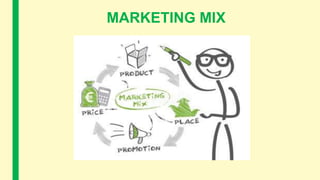
MARKETING MIX
PRODUCT
■ MangoFrooti
■ AppyFizz
■ Bailly
■ AppyClassic
■ ButterCup
■ Mintrox
■ V3 Fitness
■ LMN
■ GrappoFizz
■ SaintJuice
■ FrewtÉclair
■ Hippo
PRICE
■ Servingto mass market
■ No aggressive pricingstrategies
■ Popularityandpositive Image of the
brandhelpsin selling
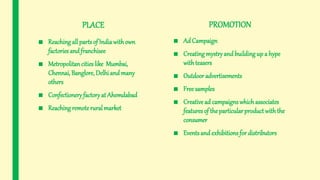
PLACE
■ Reaching all parts of Indiawithown
factories and franchisee
■ Metropolitan cities like Mumbai,
Chennai, Banglore, Delhi and many
others
■ Confectioneryfactoryat Ahemdabad
■ Reaching remoterural market
PROMOTION
■ Ad Campaign
■ Creating mystryand buildingup a hype
withteasers
■ Outdoor advertisements
■ Freesamples
■ Creative ad campaignswhichassociates
features of the particular product withthe
consumer
■ Eventsand exhibitionsfor distributors
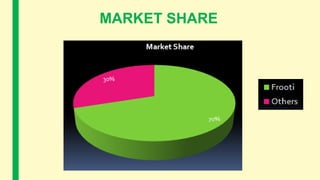
MARKET SHARE
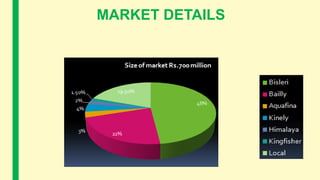
MARKET DETAILS
MARKET DETAILS
■ Basedon historical data
■ Its done quarterly
■ Studying the customer behaviour
■ Analyzing sales data of past 3 to 6 months and considering distributor’s demand
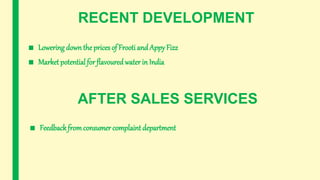
RECENT DEVELOPMENT
■ Lowering down the prices of Frooti and Appy Fizz
■ Market potential for flavoured water in India
AFTER SALES SERVICES
■ Feedbackfromconsumer complaint department
HISTORY
■ Started by JohnPermberton
■ It was initially sold as a patented medicine to cure headache, dyspepsia, morphineaddiction
etc.
■ The first bottling was done in Missippi at Biedenharn Candy Company in 1891.
■ Since the time is started, new productsranging fromthe New Coketo Coke Classic to Diet
Coke, they introducedmany new products.
■ Coca Cola is now drunkin every stateand in everycountry.
BRANDING INPUT
■ The Coca Cola logo was createdby JohnPemberton’s bookkeeper, FrankMason Robinson, in
1885.
■ The equally famous CocaCola bottle, called the ‘ contour bottle ‘ withinthe company, but
known to some as the ‘ hobble skirt, ‘ was createdin 1915 by bottle designer Earl R. Dean
IN INDIA
■ Coca Cola was leading soft drinkbrandin India in 1997, whenit left rather than reveal its
formula to the Government and reduceits equitystakeas required under the Foreign
RegulationAct(FERA) whichgoverned the operations of foreign companies in India.
■ In the new liberalized and de-regulated environment in 1993, Coca Cola made its re-entryinto
Indiathrough its 100% owned subsidiary, HCCBPL.
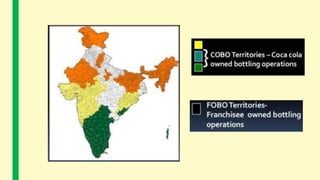
■ At present there are 3 COBOregions and 27 COBO( Company OperatedBottler) units under
HCCBPL( Hindustan Coca Cola Beverages Private Limited) and 1 FOBO( Franchisee Operated
Bottler) regionand 12 FOBOunits under CCIL( Coca ColaAmatil ).
MARKET SHARE
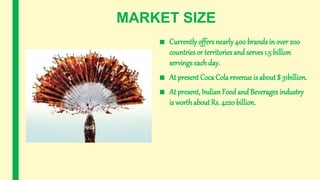
MARKET SIZE
■ Currently offers nearly400 brands in over 200
countries or territories and serves 1.5 billion
servings each day.
■ At present Coca Cola revenue is about $ 31billion.
■ At present, Indian Food and Beverages industry
is worthabout Rs. 4220billion.
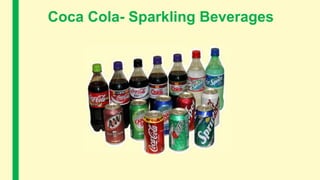
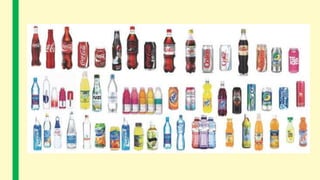
Coca Cola- Sparkling Beverages
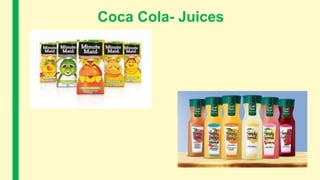
Coca Cola- Juices
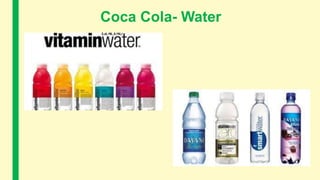
Coca Cola- Water
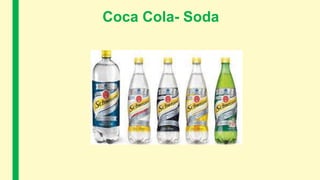
Coca Cola- Soda
PRICE STRATEGY
■ TRADE PROMOTION: Theydo Agreements with store. They offerfree samples and Free empty
bottles and that’s how they pushtheir products front. They also givecashincentives.
■ DIFFERENTPRCEEVERY SEASON: they change their productprice according to the season.
PROMOTION STRATEGY
■ They purchasethe big shelves in the stores and displaytheir products in such a way that their
product is more clear and more attractive.
■ They place the freezers in sucha place and position that its eye catching. Normallynear the
cashcounter or near the entrance.
■ They also do sponsorships at various colleges and school canteens and sponor port events and
other activities for market share.
■ They offer handyprizes under a scheme they have. They handout bicycles, TV sets, cashprizes
etc.
ADVERTISEMENTS
■ Print Media
■ TV commercial
■ Posters
■ Using the Actors and Actresses to promotetheir brand.
THE END
THANK YOU
^_^

Beverage Industry- Scope and Importance

  • 1.
  • 2.
    DEFINITION ■ Beverage isreferredto any drink, usually other than water. It is derivedfromthe old French“bevrage”, basedon Latin word “bibere” which means “to drink.”
  • 3.
    List of TopCompanies in India ■ Ace Continental Exports ■ Vinbros & Co. ■ Apple Valley Group ■ KarnatakaPlantationCoffee ■ LochanTea ■ Tata Tea ■ SABMiller ■ Coca Cola ■ PepsiCo. ■ McDowell & Company ■ Nestle ■ ShawWallace ■ South Seas Distilleries & Breweries ■ UB Groups
  • 4.
    BEVERAGE INDUSTRY OVERVIEW ■The food processing industry in India has a total turnover of around 65 million USD, which includes value added products of around 20.6 billion USD. ■ Coca Cola, Nestle and Pepsi are the leading beverage brands that have been ruling the Indian beveragemarket since a past few decades. ■ Amongst all the beverages, Tea and Coffee are manufacturedas well as exportedheavilyin the international markets succumbing to the individual demands around the world. ■ Beverage industry in India constitutes aroundUSD230 million among the 65 millionfood processing industry. ■ The major sectors in beverageindustry in Indiaare Tea and Coffee whichare not only sold in domestic markets but re also exported to a range of leading overseas markets.
  • 5.
    ■ Half ofthe Tea and Coffee products are available in unpacked or loose form. ■ Among the hot beverages manufacturedin India, Tea is themost dominant beveragethat is ruling boththe Domestic and the international markets even today. ■ The supplyof Tea and Coffee is insurmountable in the Indian beverage industry.
  • 6.
    ABOUT BEVERAGE COMPANIESIN INDIA ■ Fruit juices, pulp and concentrates and sauces or ketchups are doing well in the beverage market in India for the pastfew years. ■ Various milk products, healthbeverages, beer and country liquors have also been contributing largelyin the rising demandof beverages in India. The leading beverages companies in India are also exporting various products especially Tea and Coffeeto the international markets every year ■ Tea and Coffee have registeredan excellent growth in the Indian beverage market as the most preferreddrinks purchasedexcessivelyaround the world. Among all the leading beverage companies in India, Coca cola has accountedfor a thriving growth sinceits inception. ■ It occupies around60% of the carbonated drinks sector in the Indian beverage industry.
  • 7.
    ■ Another predominantbrand is NestleIndia Limitedwhichoccupies 61.85%of the total Nestle SA, Switzerland. ■ The Nestle products are hugely exported to Russia apart fromselling in domestic markets.
  • 8.
    SCOPE: PRESENT STATUS &FUTURE PROSPECTS
  • 9.
    BEER ANDALCOHOLICBEVERAGES ■ Whendiscussedonalcoholicbeverages, India is considered to be the3rd largest market for alcoholicbeverages in the world. The domesticbeer and alcoholic beverages marketis largely dominatedby United Breweries, MohanMeakins and Radio Khaitan. ■ The demandfor beer and spirits s estimatedaround 373 millioncasesper year. There are 12 jointventure companies having a licensedcapacity of 33,919kilolitres per annumfor production of grain based alcoholic beverages. ■ Around 56 units are manufacturing beer under licensefromthe government of India. ■ Country liquor and Indianmade Foreign liquor are the two segments in liquor, bothcater to different sections of society. The former is verymuch consumedin rural areas and by low income groups, while the middle classand high-income groups consume the latter.
  • 10.
    ■ When discussedonalcoholicbeverages, India is considered to be the 3rd largest market for alcoholicbeverages in the world. The domesticbeer and alcoholic beverages marketis largely dominatedby United Breweries, MohanMeakins and Radio Khaitan. ■ The demandfor beer and spirits s estimatedaround 373 millioncases per year. There are 12 jointventure companies having a licensedcapacity of 33,919kilolitres per annumfor productionof grainbased alcoholic beverages. ■ Around 56 units are manufacturing beer under licensefromthe government of India. ■ Country liquor and Indianmade Foreign liquor are the two segments in liquor, bothcater to different sections of society. The former is verymuch consumedin rural areas and by low income groups, while themiddle classand high-income groups consume the latter. CONSUMER FOODS: ■ This segment comprises of packaged foods, aerated soft drinks, packaged drinking waterand alcoholicbeverages.
  • 11.
    SOFT DRINKS: ■ AfterTea and Biscuits(packed), the soft drinksegmentis consideredto be the 3rd largest in the packagedfoodsindustry. Over 100 plants are engaged in the aeratedsoft drinks industryand provide hugeemployment. It has obviouslyattractedone of the highest FDI in the country. ■ Strong forwardand backwardlinkages withglass, plastic, refrigeration, sugar and transportation industryfurther strengthens the portion of the industry. Soft drinksegment has a huge potential in the Indianmarket, as a vast portionof the marketit still to cover.
  • 13.
  • 14.
    EVOLUTION OF BEVERAGEINDUSTRY ■ Althoughmany of these beverages, including beer, wineand havebeen around for thousands of years, the industry has developed only overthe pastfew centuries. ■ The beverageproducts industry, viewedas an aggregate group, is highly fragmented. This is evident by the number of manufacturer methods of packaging, production processes and final products. The soft drinkindustry is the exception to the rule, as its quite concentrated. Althoughthe beverage industryis fragmented, ongoing consolidationsince the1070’s is changing that. ■ Since the early 1900’s beverage companies have evolved fromregional firms that mainly producedgoods for local markets, to today’s corporate giants that makeproducts for international market
  • 15.
    ■ This shiftbeganwhencompanies in this manufacturing sector adopted mass production techniques that let thenexpand. ■ Also during this time period, there were advances in product packaging and processes that greatly increasedproduct shelf life. ■ Air-tight containers for tea preventedabsorptionof moisture or off-flavours whichis the principle case of loss of flavour. ■ In addition, the advent of refrigeration equipment enabledlarge beers to be brewed during the summer months
  • 16.
    ECONOMIC IMPORTANCE ■ Thebeverageindustry has a unique role in expanding economy . ■ It employs several millions of peopleworld wideand eah type of beveragegrosses of billions of dollars in revenue each year. ■ Indeed, in several small, developing countries, the production of coffee is a major supportof the entire economy.
  • 18.
    ABOUT PARLE AGRO ■They are the largest Indian food and beverage company. Withbrands that have won the hearts of consumers everywhere, theyare in almost every home across the length and breadthof India. ■ Be it Frooti, India's first mangodrinkin a tetra pak, or Appy, India's first ever apple drink, or AppyFizz, the country's first sparkling apple drink, their beverages have, over the decades, acquirediconicstaturein one of the most competitive markets in the world. ■ Their latest beveragebrand, Café Cuba, the carbonatedcoffee soft drink, and Frio, a range of deliciously flavouredaerated drinks, have alreadymade a grandentrywithin the few months of their launch.
  • 19.
    ABOUT PARLE AGRO ■Their forayinto the Foodscategory beganwith Hippo Baked Munchies being launched in 2009. Today, Hippo offers a range of snacks in different formats. ■ Bailley, their packageddrinking water brand renownedfor its purity, is one of the largest waterbrands in the country and one of the most widelyavailable. ■ Backwardintegrationsaw themopen their own PET division, whichmakes themthe only beveragecompany in India to manufacture its own PET pre-forms. ■ Witha strong presence in over 50 countries already, theyare all set to become the first Indian global Food & Beverage company.
  • 20.
  • 21.
    PRODUCT ■ MangoFrooti ■ AppyFizz ■Bailly ■ AppyClassic ■ ButterCup ■ Mintrox ■ V3 Fitness ■ LMN ■ GrappoFizz ■ SaintJuice ■ FrewtÉclair ■ Hippo PRICE ■ Servingto mass market ■ No aggressive pricingstrategies ■ Popularityandpositive Image of the brandhelpsin selling
  • 22.
    PLACE ■ Reaching allparts of Indiawithown factories and franchisee ■ Metropolitan cities like Mumbai, Chennai, Banglore, Delhi and many others ■ Confectioneryfactoryat Ahemdabad ■ Reaching remoterural market PROMOTION ■ Ad Campaign ■ Creating mystryand buildingup a hype withteasers ■ Outdoor advertisements ■ Freesamples ■ Creative ad campaignswhichassociates features of the particular product withthe consumer ■ Eventsand exhibitionsfor distributors
  • 23.
  • 24.
  • 25.
    MARKET DETAILS ■ Basedonhistorical data ■ Its done quarterly ■ Studying the customer behaviour ■ Analyzing sales data of past 3 to 6 months and considering distributor’s demand
  • 26.
    RECENT DEVELOPMENT ■ Loweringdown the prices of Frooti and Appy Fizz ■ Market potential for flavoured water in India AFTER SALES SERVICES ■ Feedbackfromconsumer complaint department
  • 29.
    HISTORY ■ Started byJohnPermberton ■ It was initially sold as a patented medicine to cure headache, dyspepsia, morphineaddiction etc. ■ The first bottling was done in Missippi at Biedenharn Candy Company in 1891. ■ Since the time is started, new productsranging fromthe New Coketo Coke Classic to Diet Coke, they introducedmany new products. ■ Coca Cola is now drunkin every stateand in everycountry.
  • 30.
    BRANDING INPUT ■ TheCoca Cola logo was createdby JohnPemberton’s bookkeeper, FrankMason Robinson, in 1885. ■ The equally famous CocaCola bottle, called the ‘ contour bottle ‘ withinthe company, but known to some as the ‘ hobble skirt, ‘ was createdin 1915 by bottle designer Earl R. Dean
  • 31.
    IN INDIA ■ CocaCola was leading soft drinkbrandin India in 1997, whenit left rather than reveal its formula to the Government and reduceits equitystakeas required under the Foreign RegulationAct(FERA) whichgoverned the operations of foreign companies in India. ■ In the new liberalized and de-regulated environment in 1993, Coca Cola made its re-entryinto Indiathrough its 100% owned subsidiary, HCCBPL. ■ At present there are 3 COBOregions and 27 COBO( Company OperatedBottler) units under HCCBPL( Hindustan Coca Cola Beverages Private Limited) and 1 FOBO( Franchisee Operated Bottler) regionand 12 FOBOunits under CCIL( Coca ColaAmatil ).
  • 33.
  • 34.
    MARKET SIZE ■ Currentlyoffers nearly400 brands in over 200 countries or territories and serves 1.5 billion servings each day. ■ At present Coca Cola revenue is about $ 31billion. ■ At present, Indian Food and Beverages industry is worthabout Rs. 4220billion.
  • 35.
  • 36.
  • 37.
  • 38.
  • 39.
    PRICE STRATEGY ■ TRADEPROMOTION: Theydo Agreements with store. They offerfree samples and Free empty bottles and that’s how they pushtheir products front. They also givecashincentives. ■ DIFFERENTPRCEEVERY SEASON: they change their productprice according to the season.
  • 40.
    PROMOTION STRATEGY ■ Theypurchasethe big shelves in the stores and displaytheir products in such a way that their product is more clear and more attractive. ■ They place the freezers in sucha place and position that its eye catching. Normallynear the cashcounter or near the entrance. ■ They also do sponsorships at various colleges and school canteens and sponor port events and other activities for market share. ■ They offer handyprizes under a scheme they have. They handout bicycles, TV sets, cashprizes etc.
  • 41.
    ADVERTISEMENTS ■ Print Media ■TV commercial ■ Posters ■ Using the Actors and Actresses to promotetheir brand.
  • 43.